Sonatas for violin and b. c.
Črtomir Šiškovič violin, Luca Ferrini harpsichord & organ
50:29
Dynamic CDS 7744
[dropcap]A[/dropcap]lthough everyone thinks of Tartini as Italian, he was born in what is now geographically Slovenia, and this recording of four named sonatas is a collaboration between one musician from each of the two countries. They start with “Didone abbandonata” which, like the others, is in three movements (two are slow-fast-fast, the other two slow-fast-alternating). Then comes arguably the composer’s most famous piece, “Il Trillo del Diavolo”, followed by two less well-known pieces; a sonata in A entitled “Pastorale” (unique in the composer’s output in requiring the bottom two strings to be tuned a tone higher than usual, and accompanied on organ where Ferrari plays harpsichord in the others) and “Staggion bella” in B flat. My enjoyment of the recital was hampered by the sound quality – the acoustic lacked warmth, the violin was not really projecting into the space and the harpsichord lacks any resonance; the performances are fine, if they too slightly lack vitality – clean readings, but no real oomph.
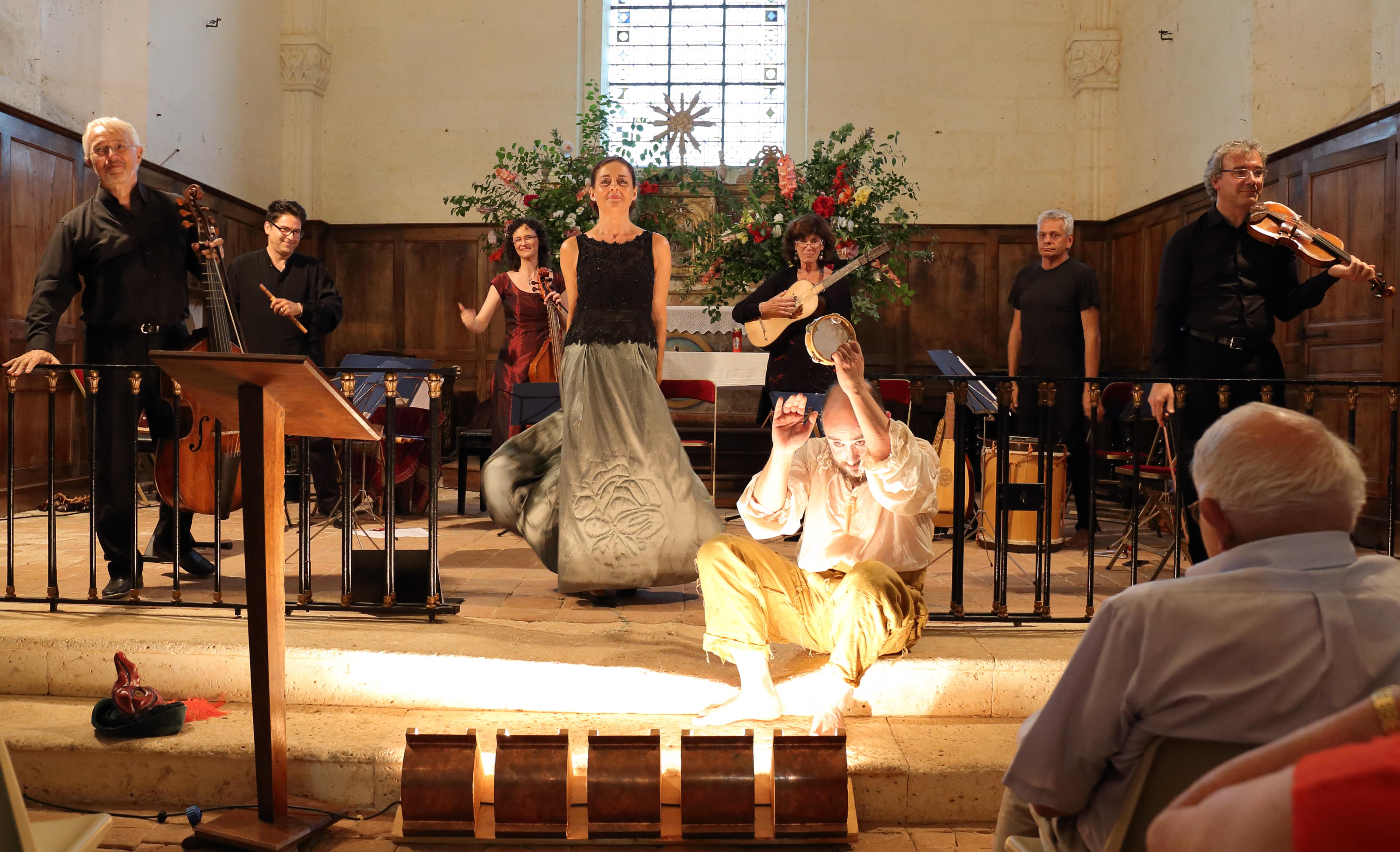
Comedian Lorenzo Bassotto, soprano Elena Bertuzzi and Accademia Strumentale Italiana
Picture a landscape of rolling hills, fields of sunflowers and maize. Intersperse with deeply shaded woodland, sleepy small towns and villages in which the most notable feature is almost inevitably a 12th or 13th century Romanesque church and you have the Périgord Vert, a largely unspoilt area situated in the north of the Dordogne region of France. It sounds an unlikely venue for a festival of Baroque music inspired by one of the great names in early music. Yet in 2016 Itinéraire Baroque reached its 15th edition, still enjoying the benign leadership of its co-founders Ton Koopman and festival director Robert Nicolas-Huet, the festival owing its genesis to the Dutch musician’s ownership of a house in the area.
Itinéraire Baroque may occupy a short space of time, but over four days it packs in a large amount of music. This year it was possible to attend no fewer than eleven events – I missed the final concert – covering a spectrum stretching chronologically from Josquin des Prez to Haydn’s late ‘Nelson’ Mass, stylistically from simple Dutch Calvinist contrafactas of Dowland songs to the splendour of Mozart’s ‘Coronation’ Mass.
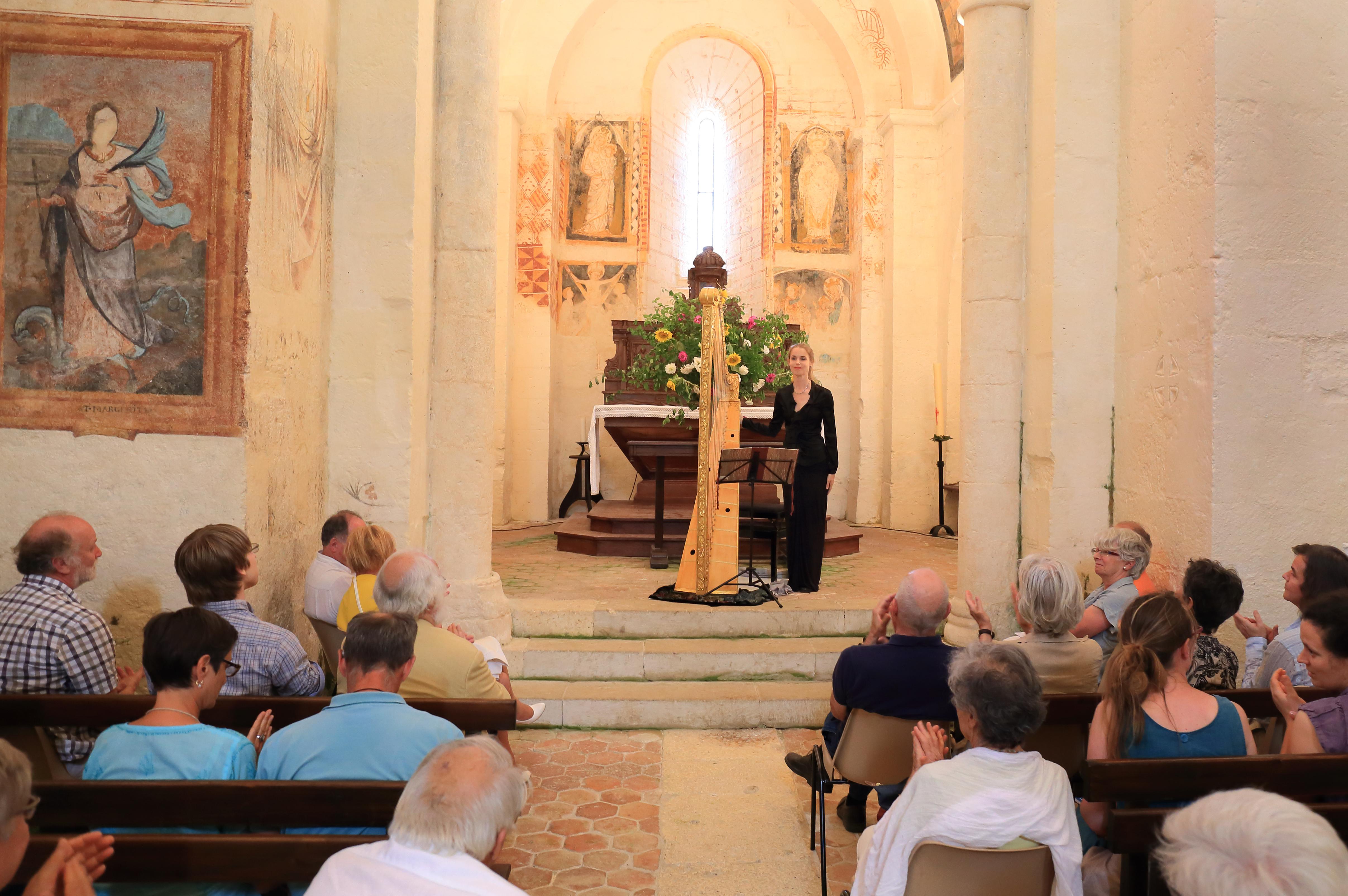
Harpist Emma Huijsser at the church of Bourg des Maisons
At the heart of Itinéraire Baroque is the day that not only gives the festival its name, but also adds an innovative dimension. Each year the Saturday (in this case 30 July) is devoted to a magical musical tour that focuses on short concerts given in five of the historic churches of the region, buildings that in some cases otherwise rarely see the light of day. This year’s audience met early at the church St Cybard at Cercles, a mostly 14th century building, now beautifully restored and of somewhat grandiose pretensions for a community of some 200 souls. There we were regaled with a short Bach organ recital by Koopman (including a lovely performance of the Pastorale, BWV 590; so appropriate to these surroundings) before being split into five groups, each to follow a different itinéraire to the venues, where a short concert is preceded by an introduction to the architecture and history of the building. Of the churches this year that at our first stop, the tiny but beautifully proportioned 12th century St Saturnin at Coutures, turned out to be a perfect gem. It was host to a largely satisfying concert, too, a recital of a group of charming Kraus songs and Haydn’s cantata Arianna a Naxos by the Swedish mezzo Anna Zander and fortepianist Mayumi Kamata, whose strongly characterized performance of the Haydn was marred only by the sluggish tempos at which both arias were taken. We found awaiting us for the second concert an almost equally appealing church in the shape of that at Bourg des Maisons, where a recital of arrangements of lute music on Baroque harp was given by the accomplished young Dutch player Emma Huijsser, standing in for the indisposed Hana Blažíková. The church is especially notable for a ravishing and only recently revealed set of frescos, the earliest of which date from the 12th century, while Huijsser impressed particularly in a highly musical and finely articulated performance of Bach’s Lute Suite in D minor, BWV995. Following a generous break for lunch (well, we are in France, after all!), the next venue on the itinerary was the only non-ecclesiastical one. The lawns of the 15th century Château de Beauregard played host to a recital by Camerata Trajectina, one of Holland’s long-established early music ensembles. I fear a good lunch, the hot afternoon and routine performances conspired to make a programme entitled ‘Dowland in Holland’ less than enticing. For the following concert it was back to church, in this case the rather austere looking St Martin at Cherval, where the La Cetra Barockconsort played a potpourri from Die Zauberflöte arranged in 1793 for flute and string trio by one Franz Heinrich Ehrenfried. Initially the skill with which he coped with the contrapuntal complexities of the Overture intrigued, but interest later lapsed and I fell to musing on the incongruity of a 21st century audience sitting solemnly in a church listening to an arrangement designed to fulfil no more profound a function than provide social entertainment. The final course of this richly diversified 6-course musical feast necessitated only a short hop to St Martial Viveyrol, where the Dordogne-based Le Vertigo gave a pleasant if unremarkable concert based on French music (and Purcell) that might have been heard at the court of Charles II. Unsurprisingly soprano Caroline Dangin-Bardot sounded more comfortable in French repertoire by Michel Lambert (the lovely air ‘Vos mépris), Sébastien Camus and Charpentier than in Purcell’s ‘The Plaint’ and ‘Fairest Isle’.
The festival had opened two days before with a Bach programme given by Koopman and his Amsterdam Baroque Orchestra. The venue was the church of St Martin in Champagne, a building that has its roots in the Romanesque period, as evidenced by the magnificently decorated multi-arched doorway, but that was much rebuilt and enlarged in the 16th century. Sadly, it turned out to have treacherous acoustics and although I tried three different places it proved impossible to hear sufficiently clearly to come to definitive conclusions about the performances. This applied especially to the singing of soprano Yetzabel Arias Fernandez, replacing Hana Blažíková, whose full-blooded approach to Jauchzet Gott, BWV51 and the Wedding Cantata, BWV202 seemed only to exacerbate the inherent problems created by the building, the voice spreading alarmingly in its upper range. Elsewhere Koopman’s long-established and exceptional empathy with Bach’s music could be intermittently appreciated in vital performances of the Orchestral Suite no.1 and the magnificent Sinfonia from the cantata Am Abend aber desselbigen Sabbats, BWV42, but the poor acoustic made this overall a disappointing concert.
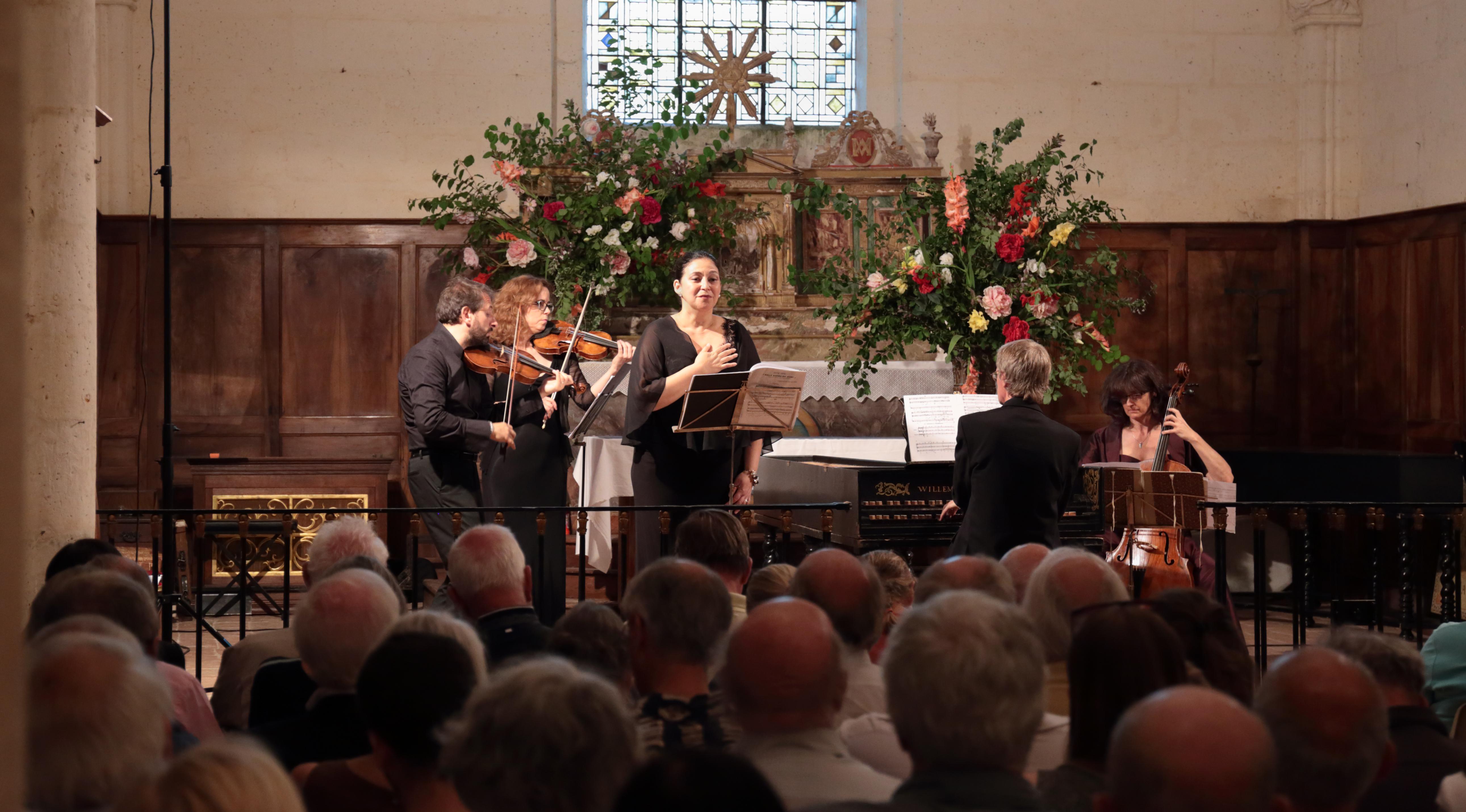
Soprano Yetzabel Arias Fernandez with La Risonanza directed by Fabio Bonizzoni
The following evening Arias Fernandez appeared to rather better effect in the event at which she was originally scheduled to appear. It took place at Cercles, which played host to all three concerts on 29 July. Performed by La Risonanza under their founder and director Fabio Bonizzoni, the programme was notable for a superb performance of Vivaldi’s trio sonata ‘La Folia’, RV63, a work that can outstay its welcome but one that on this occasion was given with such intensity and sense of fantasy that it gripped the attention from start to finish. Arias Fernandez sang chamber cantatas by Alessandro Scarlatti (the splendid Bella madre), Bononcini and Handel’s well-known Armida abbandonata. While the acoustic suited her lustrous voice better than that at Champagne, I still found her apparent inability to curb its power in the upper range disconcerting. Her ornamentation, too, left much to be desired and like so many singers of Baroque music today she has no trill. Given her approach, it was the big Handel cantata that worked best, Arias Fernandez rising well to its dramatic challenge.
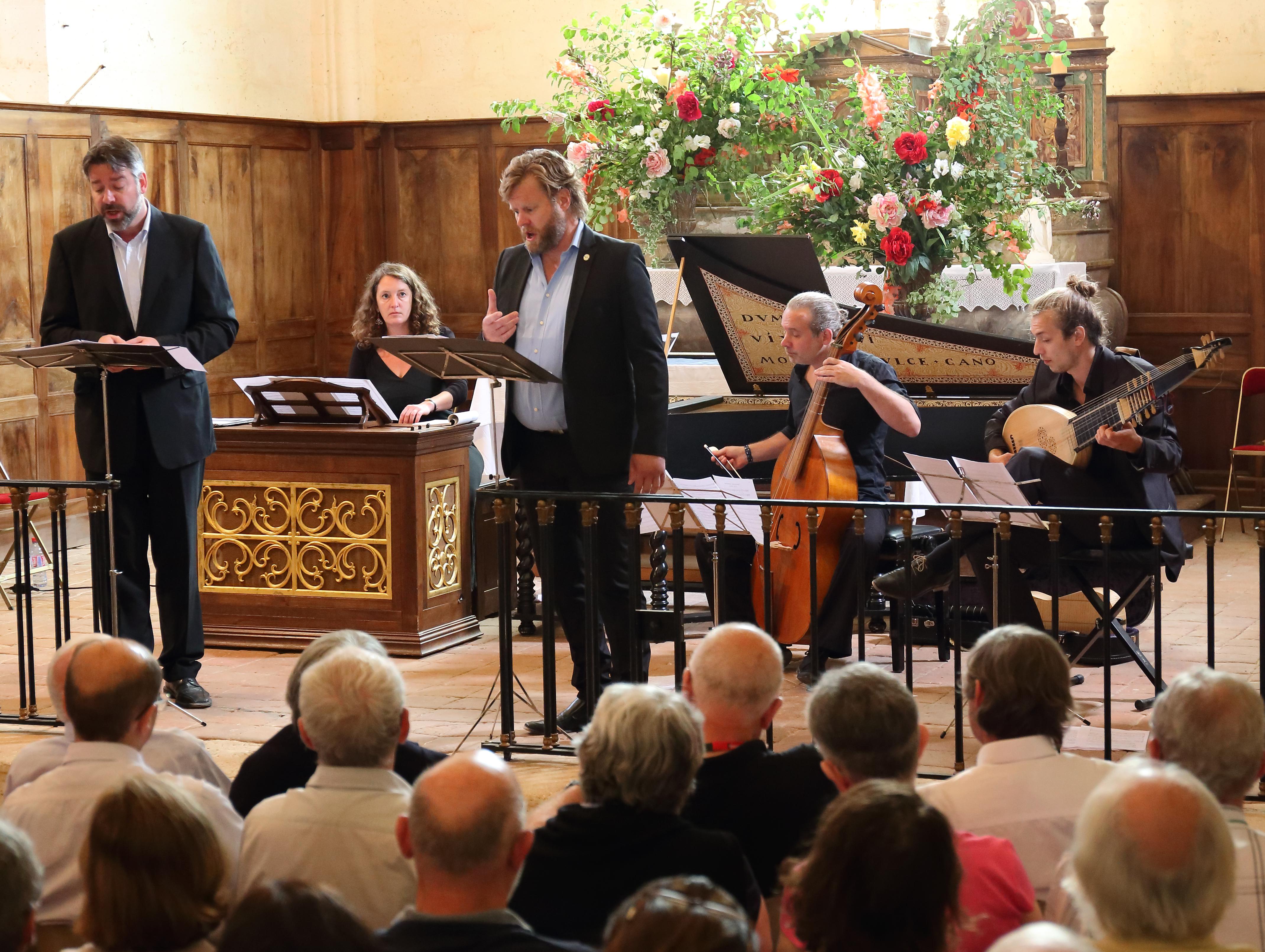
Earlier in the day the Austrian ensemble Vivante had presented a compelling programme of Monteverdi tenor duets and solos culled from the 7th and 8th Books of Madrigals and the Scherzi Musicale of 1632. If the singing of neither Tore Tom Denys nor Erik Leidal displayed truly
Tenors Tore Denys & Erik Leidal and Vivante Ensemble
Italianate qualities, both proved themselves to be well versed stylistically, with Leidal showing an edge in this respect, being more confident with ornamentation, while it was Denys who won the plaudits for vocal beauty, Leidal’s lower range tending to be a little grainy. I’ve left until last the concert that quite unexpectedly gave me the most pleasure. This was given by the Accademia Strumentale Italiana and consisted of an exploration in words and music of the world of the commedia dell arte. Music by a wide range of composers stretching alphabetically from the ubiquitous Anonymous to Adrian Willaert was linked by a brilliant performance (in French) by the comedian Lorenzzo Bassotto, exploring the humour, pathos and vulgarity of commedia dell arte with immense panache. The instrumental playing was of high quality, with some wonderfully subtle percussion work by Sbibu. And I’ll nominate the vivacious soprano Elena Bertuzzi as my discovery of the festival. She boasts outstanding technique, a lovely vocal quality and moreover is a real personality who knows instinctively how to communicate to an audience. If she can reach the point where she can sing this programme without the aid of music books, she’ll be even more irresistible.
[dropcap]W[/dropcap]e have had another batch of “previously loved” recordings from the extensive Glossa catalogue. The first, Concerti, Sinfonie [and] Ouverture by Giuseppe Antonio Brescianello (GCD C82506, 64:33) features La Cetra Barockorchester Basel in two sinfonias for four-part strings, concertos for violin & oboe, violin solo and violin & bassoon, as well as a G minor ouverture with oboes and a gorgeous chaconne in A for five-part strings. I was thrilled by the recording when it first came out and have absolutely no hesitation in recommending this reincarnation.
Pièces de viole avec la basse continuë by Forqueray père & fils (GCD C80412, 146:36, two CDs in a cardboard wallet) features the fabulous playing of Paolo Pandolfo with an impressive continuo line-up (a second gamba, two pluckers and harpsichord). The recordings from 1994/5 sound fresh and lively. I had never explored much of the solo viol repertoire, and I thoroughly enjoyed listening to these discs.
The featured musician in Chamber music with flute by Telemann is Wilbert Hazelzet; he is partnered in an interesting array of the composer’s smaller-scaled music by Jaap ter Linden, Konrad Junghänel and Jacques Ogg (GCD C80803, 63:45). The works range from two of the solo Fantasias to two “concertos” for all four members of the ensemble. Again, this was a pleasant hour’s listening.
Two Mozart releases follow. The first, Music for basset horn trio (GCD C80603, 58:23) by Wolfgang and his contemporaries (Druschetzky, Martín y Soler, the little-known – to me, at least – Vojtech Nudera, the much-maligned Salieri, and Stadler) explores something of a niche market from the turn of the 19th century, and I must confess it did not overstay its welcome, as I had feared (with the best of intentions!) it might.
Frans Brüggen directs the Orchestra of the Eighteenth Century and the Netherlands Chamber Choir (with soloists Mona Julsrud, Wilke te Brummelstroete, Zeger Vandersteene and Jelle Draijer) in Mozart’s Requiem, paired with the Mauerische Trauermusik KV 477 and an adagio for single reeds KV 411 (GCD C81111, 65:01). This is a live recording from 1998, and always has something interesting to say.
The final CD in the set Duets for violin & viola by Alessandro Rolla (GCD C80011, 64:42) was another unexpected treat. His is a name to string players around the world, but – like me? – most will never have played a note of his music. Famed in his own lifetime as a viola player, the five duets (from four different sets – anyone interested should check out the extensive lists on imslp!) on the disc reflect that; while many duets for this line-up tend to favour the more agile violin, Rolla makes no concessions to those who dare to play his instrument… That said, technical difficulty is not what this music is all about; if it had been, I would never have been able to listen to the whole disc once, let alone several times!
Corelli’s Heritage and the Roman School
I Musici
54:51
Dynamic CDS7752
Castrucci op 3/10, Corelli op 6/4, Geminiani op 5/7 (after Corelli), Locatelli op 1/11, Valentini op 7/11
[dropcap]T[/dropcap]his group was among the pioneers of the re-discovery of baroque music, if not quite what we now call HIP. Their recordings of complete sets of Vivaldi’s publications brought him back into the mainstream. Given that attitudes to performance practice have moved on a great deal since those days, I was a little wary of even listening to this CD, even though the performances are from as recently as last year. In actual fact, however, although there are some hints of yesteryear (the trills, for example), these are lively and enjoyable accounts of some lovely music. I don’t mean to sound condescending or disparaging, but this would make an ideal gift for someone who likes less frequently recorded baroque music but does not have any special interest in how it is performed – this is bound to make them smile. Lots.
Cantata for Whit Sunday, TVWV 1:634
Edited by Maik Richter
Bärenreiter BA 5898 (Full score) v+30pp, £15
BA 5898-90 vocal score vi+22pp, £9
Winds £12, Organ £9, Strings £3.50 each
[dropcap]T[/dropcap]his cantata was once attributed to Bach (though there is no mention of that anywhere in the present volume), and consists of a chorus (setting a Biblical text), arias for soprano and alto separated by a recitative in which all four voices participate and rounded off with a chorale setting. The edition seems to be an extract from a volume in the on-going Telemann edition, which explains why much of the introductory material is about the cantata cycle from which this work comes, though the chronology of its history and the various authors involved and performing centres is way too complicated and might have been better expressed as a table; I’m also not sure, given that there are footnote references to two excellent monographs on such issues, why it was felt necessary to give such a wealth of detail. Conversely the discussion of this particular piece is minimal and there is no editorial commentary. I don’t live within a couple of hundred miles of a library that has even the old volumes of the Telemann edition, so goodness knows where I could see the volume this piece comes from; but that is the only way I would be able to work out how the solo Tenor is supposed to start – does he sing with the Tutti and then go his own way (halfway through a word!) in Bar 18? Or is he silent up to that point? Should some marking indicate the answer? There are a couple of slips in the English introduction (“generell” for general in a footnote and “successfull”…) As you would expect, the edition is clear and attractive. I’m not sure why quavers at the opening of no. 4 are beamed in pairs at the opening but subsequently in sixes (as per modern notation); again, this is something that a paragraph on editorial methods could have shone some light on, perhaps. The music is lovely and it is always nice to have a cantata with a pair of horns that is not too taxing for the choir; the alto will need an agile throat, though. I’m fairly certain there should be some mention of a bassoon in the score…
Marcel Ponseele, Il Gardellino
133:29 (2 CDs in a darboard wallet)
Accent ACC 24314
TWV 41:g2, g6, a3; 42:c4, d4, Es3, g5; 43:D7; 51:e1, f2, A12; 53:E1
[dropcap]T[/dropcap]his is a compilation of recordings dating from 1995–2005 and covering the whole gamut of Telemann’s works for solo oboe; sonatas with continuo from various of his published sets, trio sonatas with violin or flute or even obbligato harpsichord, and concertos (including oboe d’more, too). This, of course, is not just any old oboist playing – Ponseele has been recognized as one of the performers on the instrument for many years and these recordings are like a compendium of masterclasses in each of the works involved. Nor are his companions unkown; one the “concerto” disc he is joined by Il Gardellino, while the second disc has Richte van der Meer on cello and Pierre Hantaï on harpsichord, with contributions from Fred Jacobs (in the sonata with obbligato harpsichord and continuo), and Taka Kitazako (oboe) and Per-Olov Lindeke (trumpet) in the rarely heard TWV 43:D7. This is a thoroughly enjoyable set which I have no hesitation in recommending.
Maria Espada, Rachel Redmond, Marta Fumagalli SSA, Ghislieri Choir & Consort, Giulio Prandi
69:59
deutsche harmonia mundi 88985348422 Ah che troppo ineguali, Donna che in ciel, Dixit Dominus
A cracking compilation of three of Handel’s youthful masterpieces, culled from recent live performances in Göttingen, Pavia and Ambronay.
[dropcap]T[/dropcap]he little-known cantata ‘Donna, che in ciel’ opens the disc; its unusual structure (formal French overture, three contrasting arias, with one of the intervening recitatives ‘accompagnato’ and a final aria with contrapuntal chorus) is convincingly suggested by Juliana Riepe as a ‘calling card’ marking Handel’s arrival in Rome in early 1707. Handelians will recognise several old friends- the first movement of the overture was recycled in Agrippina, whilst the striking semiquaver “vacillation” motif which opens the first aria reappears in the sinfonia to the final scene of Giulio Cesare. The final chorus has some echoes in the Birthday Ode for Queen Anne, and the block chords and bass runs of a certain well-known Coronation anthem also make an early appearance. It is a splendid piece, and must have created a considerable stir in Roman musical circles.
Maria Espada is fully in control in the demanding vocal writing, and can throw off semiquaver runs seemingly effortlessly; she also has the beauty of tone and phrasing to make the lovely second continuo-accompanied aria glow.
She is similarly splendid in the next work, a recitative and aria possible performed by the castrato Pascalino at a ‘spiritual concert’ organised by Cardinal Ottoboni for the feast of the Annunciation later the same year.
The disc concludes with the well-known and dazzlingly-virtuosic ‘Dixit Dominus’, where the excellent Ghisleri choir get a chance to really show off. Giulio Prandi sets uncompromisingly lively speeds, to spine-tingling effect. Try the superb final chorus- the Gloria Patri begins with two contrasting thematic tags, which thrillingly combine with the proper psalm tone in long notes (appropriately ‘as it was in the beginning’). The final ‘Amen’ is an exhilarating repeated-note fugue, which takes the sopranos to high B flats, and has everyone singing their shirts off; the repeated stretti and the seemingly-endless pedal point at the end bring the work (and disc) to a gloriously contrapuntally-satisfying conclusion. The lovely tone and precise passagework of the Glaswegian soprano Rachel Redmond, in her aria ‘Tecum principium’, is also worth watching out for.
The sleeve note is interesting factually, though perhaps a little wayward in translation from time to time.
New Appreciations in the Twentieth Century
viii+292, 2016.
ISBN 978-1-58046-512-0
University of Rochester Press
[dropcap]T[/dropcap]his is not, by any means, a full survey of Haydn Reception History in the 20th century. To all intents and purposes the author stops with the 1959 anniversary on the reasonable grounds that the activity since then would require at least one more book. He begins with a scene-setting survey of 19th century attitudes, which could be summed up as ‘audiences like Haydn, but composers/conductors don’t’ (with the possible exception of Brahms, who couldn’t quite bring himself to admit it). This may still be true, at least with regard to conductors (see below).
The first half of the book is then a number of recycled journal articles highlighting the stances of d’Indy, Schoenberg and Schenker towards Haydn – this topic has been a prime interest of the author for 15 years. Now, there’s nothing wrong with this in principle, but such articles do need a bit of a re-think and some less indulgent (or more observant) copy-editing if they are to avoid duplication of material and development of something of the narrative flow that a book needs. On p. 57, for instance, we are introduced to ‘Eusebius Mandyczewski, one of Brahms’s protégés’ and then on p. 115 we meet him again, but as if for the first time – ‘Eusebius Mandyczewski, a Romanian musicologist working in Vienna and a part of Brahms’s circle’. Similarly, p. 186 tells us that ‘Samuel Barber wrote his Fantasie for Two Pianos in the Style of Josef Haydn (1924)’ while on p. 227 ‘Samuel Barber wrote the Fantasie for Two Pianos in the Style of Josef Haydn in 1924’. In addition, references to previous or imminent chapters feel blatantly added, and could do with being page specific, where appropriate.
These might seem small points, but cumulatively this kind of thing does create a lumpy feel to the writing as a whole, interesting though much of it is. I found fascinating – perhaps in its seeming unlikeliness – the surge of Haydn performances in mid-1920s New York. The attempts of various nations (Hungary, Croatia, Germany, Austria) to claim Haydn as their own also make for lively and sometimes sobering reading and, being British, I also enjoyed the investigation of Tovey’s various writings and the observations on Vaughan Williams’s changing attitude towards Haydn and folksong.
But, in conclusion, I would say that the Haydn revival post-1959 (even post-2009) is still ‘work in progress’ in terms of regular performances. Although all the symphonies are now available on CD played on period instruments they still make a minimal impact on concert programming and not one ranks in the ‘top 20 symphonies of all time’ in a recent BBC Music Magazine survey (of conductors’ views). However, in the South Bank 2016/17 season they outnumber Mozart by five to one (though nine to one for Wolfie when it comes to concertos) which is verging on the encouraging. I still think that Haydn is the most under-rated of the canonically ‘Great Composers’.
Bertali, Schmelzer, Biber: Church sonatas
Cappella Murensis, Les Cornets Noirs
71:36
audite 97.539
[dropcap]T[/dropcap]his is the third recording of Muffat’s only surviving liturigcal work that I know of; Cantus Cölln (the first) filled their disc with Biber’s setting of the Litany for St Joseph and sonatas by Biber and Bertali, then Gunar Letzbor used boys for the upper parts and saw no need to pad out the recording. The present version has women sopranos but is a disc of two halves – the added sonatas (by Biber, Bertali and Schmelzer) are performed in an arch-like sequence after the mass. Audite’s recordings are always of exceptional quality and the principle interest of this recording will be for audio geeks who will be thrilled by the positioning of the five “choirs” in different parts of the abbey in Muri where the sessions were held.
[Video in German, subtitled in English]
Surround sound is available as an HD download. For me, though, the whole thing is slightly phoney since Muffat’s contemporaries can never have heard it in such perfection; quite apart from the fact that the resonance must have been affected by the presence of a congregation and the assembled clergy and royalty (although I don’t think the author quite wants to believe what he is writing, the booklet notes give convincing reasons why the piece was more likely written for Passau than Salzburg; though someone should have checked the date Haydn’s death…), the mass was never intended to be an unbroken sequence, and there would have been other music in the service. That said, these are outstanding performances with the trumpets, cornetti and sackbutts, string band and two vocal choirs resounding splendidly in the space. The sonatas – which, incidentally, illustrate perfectly that Biber’s music did not just happen in a vacuum; he learned a thing or two from both the other composers! – show Les Cornets Noirs at their glorious best.
Weser-Renaissance, Manfred Cordes
68:26
cpo 555 010-2
Förtsch: Ich vergesse was dahinten ist, Unser Leben währet siebenzig Jahr
Michael Österreich: Ich habe einen guten Kampf gekämpfet
Georg Österreich: Plötzlich müssen die Leute sterben, Unser keiner lebet ihn selber
[dropcap]T[/dropcap]his is the fourth CD that Manfred Cordes and his excellent team has devoted to music in Gottorf. Alongside music by two of the composers already featured there is a very fine work by the more famous Georg Österreich’s older brother, Michael. The opening piece is Förtsch’s lavish “Unser Leben währet siebenzig Jahr” with seven voice parts, four violins, two violas, four gambas, bassoon and continuo! The fact that it survives only in a copy might explain the rather odd passages in some verses of the central aria where the duetting alto and bass occasionally sing in octaves (a fact that the otherwise informative booklet notes fail to mention).
It is followed by the older Österreich’s setting for more modest forces of one of “the standard” funeral texts, “I have fought a good fight”, which reveals the former Thomaner’s considerable skill. The final work – the longest on the disc at over 19 minutes! – adds a pair of oboes to the ensemble. It ends with a “tremolo”-accompanied setting of a verse from “Herzlich tut mich Verlangen” (known to English speakers as “the Passion chorale”). Throughout the singing and playing as excellent, the balance between individual voices and vocal and instrumental groups is well managed, and the sound quality is very high. All in all, another success for this typically enterprising cpo series.