‘für Kenner und Liebhaber’ Sonatas from Collections 1 & 2
Miklós Spányi clavichord
73:23
BIS-2131
Wq 55/1-3, 5, 56/2,4,6 [=H 244, 130, 245, 243, 246, 269, 270]
[dropcap]T[/dropcap]he Hungarian performer Miklós Spányi continues his complete edition of C.P.E. Bach’s solo keyboard music with four of the sonatas from the first set ‘für Kenner und Lieber’ (the remaining two appear on another disc in the series played on tangent piano) and three from the second set. Published in 1778 and 1779 these are mature sonatas which, despite what the sleeve notes refer to as their ‘tonal restlessness’, are tightly constructed and very satisfying to listen to. Spányi plays on a Hubert copy made by Thomas Friedemann Steiner, a persuasive instrument for these sonatas. He is alive to all the rhetorical implications of the music as well as showcasing its technical virtuosity. The recording quality is excellent.
[dropcap]I[/dropcap] reviewed this outstanding young quartet’s CD of the first three of Haydn’s innovative op 20 String Quartets some 14 months ago (https://earlymusicreview.com/haydn-sun-quartet-op-20-nos-1-3/), at the time expressing the hope that the set would be completed in the not too distant future. Well, here is the completion and unsurprisingly it maintains the high level of performance I noted with the earlier CD.
Reviewing the earlier disc, I drew attention to the sense one gets in the op 20 quartets of Haydn’s ever growing confidence in his handling of the medium he did so much to create; it is the string quartet that Haydn is the true father of, not the symphony. Yes, there are things here that would develop further, the most obvious being greater democracy between the four instruments. Here the first violin still has the lion’s share of the goodies that Haydn hands out, and one of the joys of the Chiaroscuro’s performances is the exquisite finesse of Alina Ibragimova’s playing, which throughout is not only technically outstanding in meeting the athletic demands of Haydn’s at times virtuoso writing, but in more lyrical writing displays a purity of line and tonal sensuality that takes on an almost feline allure. Take for example the Adagio of the A-major Quartet (No.6), this is one of those movements where Haydn takes us into the opera house, the first violin singing a nocturnal aria of love, complete with added ornamental passages and cadential fermatas, and here transformed by Ibragimova into moments of rare, unforgettable pleasure.
It would, however, be wrong and unfair to her excellent colleagues to place too great a stress on Ibragimova’s playing. The balance achieved by the quartet is excellent and nowhere more so than in the two fugal finales, those of No.5 in F minor and the A-major Quartet. Here the counterpoint is laid out with luminescent clarity, each part essayed to telling effect. And again these fugal movements demonstrate the wonderful fertility of the young Haydn’s mind, since they are tellingly contrasted. That of No. 5 is an old-fashioned, austere fugue thoroughly demonstrating how well Haydn had assimilated his lessons in counterpoint, while No. 6’s is a three-part fugue with a much more modern feel, the light textures and fleet progress reminding us that the Classical era would find new purpose to such displays of contrapuntal wizardry. Elsewhere one notes Haydn trying out new ideas as to texture, as for example the Minuetto of No. 4, an extraordinary ‘alla zingarese’ in which the earthy gypsy writing takes on almost orchestral textures. In the slow movement of the same quartet the sad little theme is treated in the first of a set of variations to disconcerting fragmentation and sparseness.
There are many other joys to experience (or discover) in this truly inventive set of quartets, just as there are in the near-flawless performances of the Chiaroscuro Quartet. Some may find the dynamic contrasts or freedom taken with such effects as rubato worrying, but, as noted with the first disc, I feel invariably that these stem from the players’ engagement with the music, not affectation. Taken together as a traversal of op. 20, this is as revelatory a pair of Haydn string quartet CDs as I know of.
Brian Robins
[ED: The video is about the first of the pair of recordings, but insightful nonetheless…]
[dropcap]W[/dropcap]ith all the fabulous recordings in the harmonia mundi archives, it is hardly surprising that – while continuing to release even more delights – they fairly regularly re-visit some gems from the past. The last round of re-releases belong to two series: there are four HIP issues branded as Musique d’abord (with the CDs taking on the appearance of mini LPs) and six from the hmGold set (which come in sturdy cardboard cases).
The earliest of the first batch is Alfred Deller: “O Ravishing Delight” (HMA 190216, 66:10), featuring airs by Dowland to Blow, Croft and Humfrey, but not Henry Purcell. As well as lute and harpsichord, some tracks feature recorders (one played by David Munrow). Dating from 1969, this is an important historical recording. René Jacobs directed the RIAS Kammerchor in Bach’s motets (HMA 1901589, 72:35) in 1997. Since then, performance practice may have shifted in favour of smaller groups (even one-to-a-part), but these are excellent chamber choir performances with a distinguished line-up of soloists, strings and winds. Handel: Ombra cara (HMA1902077, 71:46) is the youngest of the batch. Countertenor Bejun Mehta sings arias from Agrippina, Amadigi, Orlando, Radamiso, Riccardo primo, Rodrigo, Sosarme and Tolomeo, accompanied by the Freiburger Barockorchester, directed by René Jacobs. He is joined on three tracks by Rosemary Joshua. The last of the quartet features Georg Kallweit and Midori Seiler in a programme of concertos by Vivaldi (HMA 1901975, 56:23). Recorded in 2006, there are three double concertos (RV522, 531 & 535), as well as two concerti grossi (RV156 and 574) plus the E major concerto, op. 3 no. 12.
The earliest of the hmGold releases is a broad survey of Sweelinck’s choral output (Psaumes français & Canciones Sacrae, HMG 502033, 61:39) by Capella Amsterdam under Daniel Reuss. It ends with a monumental setting (over 15 minutes!) of the Te Deum. A 2-CD set of selections from two volumes of Jacob Van Eyck’s Der Fluyten Lust-Hof by Marion Verbruggen (HMG 507350.351, 138:19) shows a different side to this repertoire that I saw at last year’s festival in Utrecht – how things have changed since these recordings were made in 1993 & 1996. Philippe Herreweghe directs Collegium Vocale Gent and Concerto Palatino in Schütz’s Opus ultimum (HMG 501895.896, 88:49); the nine chunks of Psalm 119 in this 2007 recording are followed by Psalm 100 and Schütz’s German Magnificat. Davitt Moroney’s 1985 recording of Bach’s Die Kunst der Fuge (HMG501169.70, 98:41) divides this amazing work before the mirror fugues and includes with Moroney’s own completion of the last piece in the collection. Handel’s Concerti Grossi op. 6 are considered by most experts to be his outstanding instrumental music and here the twelve concertos for strings are given electrifying performances under the leadership of Andrew Manze (HMG 507228.229, 156:27). They are re-ordered for the recording, but no. 12 in B minor still concludes the set. The final recital sees Andreas Staier and Christine Schornsheim playing music by Mozart on the vis-à-vis, an instrument combining harpsichord at one end and fortepiano at the other (HMG 501941, 63:20); if the sounds of the instrument are themselves worth the cost of the disk, the performances are outstanding!
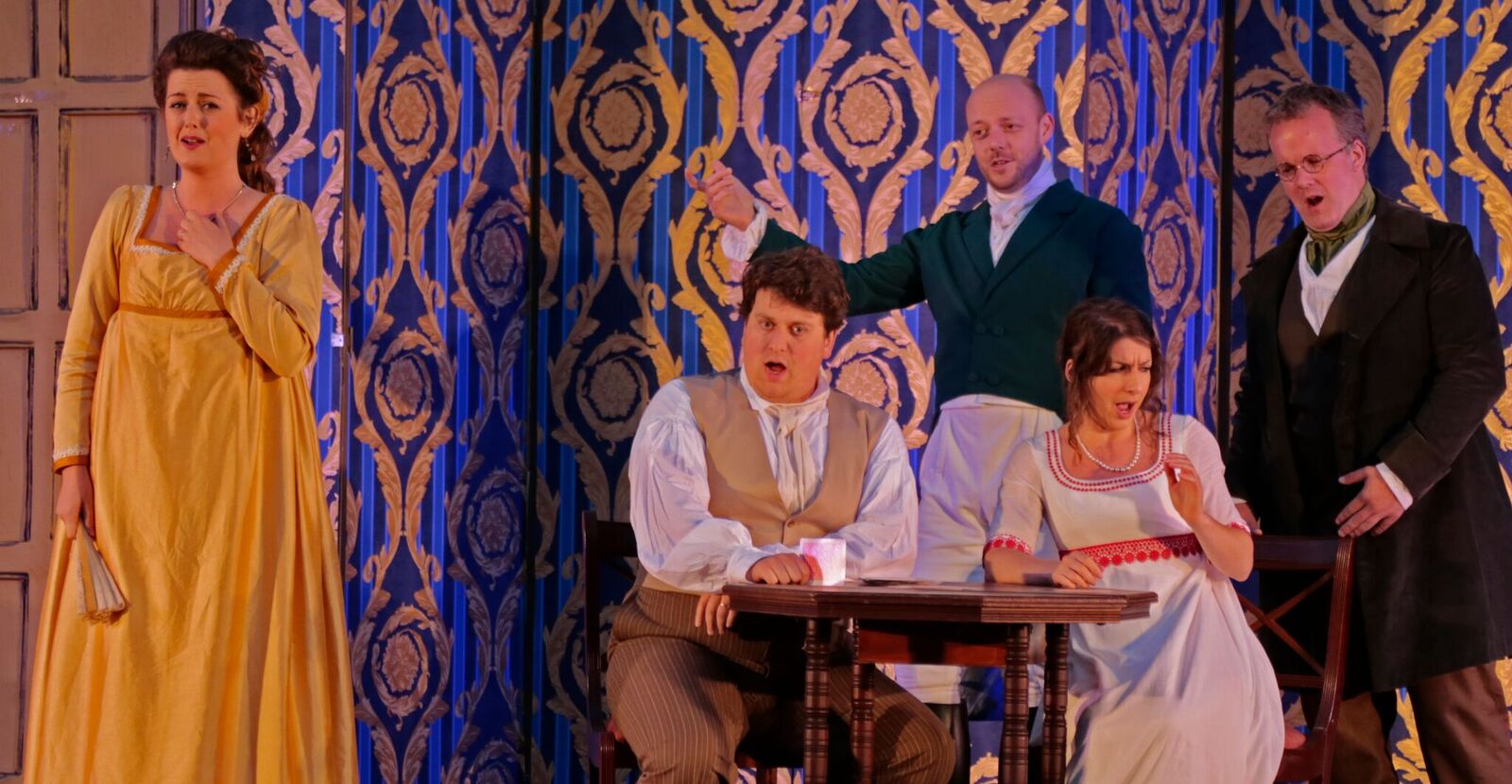
Bampton Classical Opera Salieri The School of Jealousy Act 2 Quintet, l to r Rhiannon Llewellyn (Countess), Alessandro Fisher (Count), Thomas Herford (Lieutenant), Nathalie Chalkley (Ernestina), Matthew Sprange (Blasio)
Bampton Classical Opera, Westonbirt School (Gloucs), 28 August
[dropcap]O[/dropcap]ver the past quarter of a century Bampton Classical Opera (BCO) has established an unrivalled record for the revival of later 18th century operas, including a number of UK first performances. Among these is Salieri’s Falstaff, today recognised as one the composer’s finest operas. For its 2017 production, given at Bampton, Westonbirt School and St John’s Smith Square, BCO turned to an earlier Salieri opera, La scuola de’ gelosi, first performed at the Teatro San Moise in Venice in 1778 and revived with some new music five years later at the Burgtheater in Vienna to inaugurate the new Italian opera company. Thereafter it became one of Salieri’s most popular operas, with performances not only throughout Italy, but also in Germany, London and St Petersburg.
A dramma giocoso in two acts, La scuola has a libretto by Caterino Mazzolà (later to achieve lasting fame as the adaptor of Metastasio’s La clemenza di Tito for Mozart’s final opera) owing much to the comedies of Goldoni. Like many of them, it introduces three distinct social classes: a Count and Countess – the latter a mezzo carattere role that includes a superb seria accompaganato and aria ‘Or ei con Ernestina’ … ‘Ah sia già de miei sospiri’ – a merchant and his wife, and a male and female servant. The cast is completed by the Lieutenant, the Don Alfonso-like manipulator of the goings-on that form a storyline revolving around the efforts of the Count, a small-time predator like Figaro’s Almaviva rather than a Don Giovanni, to seduce the merchant Blasio’s wife, Ernestina, thus invoking the jealousy of the Countess and Blasio. The Lieutenant advises them to turn the tables and make their spouses jealous. After a series of farcical events the ploy works, the lessons learned in the ‘school of jealousy’ bring reunion and happiness to all. The richly varied score is remarkable perhaps above all for its ensembles, in particular the act 1 trio for the Countess, Count and Lieutenant, and the act 2 quintet that broke new ground in 1778 by being the largest ensemble piece to be introduced into the middle of an act.
As is customary with BCO, the opera was given in an English translation that amused the Westonbirt audience with its introduction of such topical terms as ‘fake news’. The set design, costumes and production (by Jeremy Gray) itself were unexceptionably traditional, with folding panels that could with ease change the rooms from the rich blue of the Count’s salon to the more bourgeois surroundings of Blasio’s house. The costumes were slightly post-dated to Biedermeier (Blasio resembled an older Schubert).
The performance in the Orangery Terrace at Westonbirt School on 28 August was my first experience of BCO. For a company that specialises in later 18th opera there were several surprising elements. The first was the use of modern instruments rather than period instruments, which I understand are used because BCO’s main performances at their home in Bampton are open air, always a problem for period strings. It did not work at Westonbirt, being not only too loud for the space but played with a lack of finesse only enhanced by the rigid four-square rhythms of Anthony Kraus’ direction. Matthew Sprange’s Blasio dominated the cast, his richly rounded and well-focussed baritone a source of pleasure throughout the evening. None of the rest of the cast came up to this level, although Nathalie Chalkley brought a lively personality if at times shrill voice to the role of Ernestina. I derived little pleasure from Rhiannon Llewellyn’s singing of the Countess, finding her tone too insecure in the upper range, though I suspect the acoustic was not very kind to her voice. The tenor parts of the Count (Alessandro Fisher) and Lieutenant (Thomas Herford) were decently sung, though the weak lower range of the latter resulted in him being frequently overpowered by the orchestra. The other major surprise, again bearing in mind this is a company specialising in this repertoire, was the lack of appoggiaturas and absence of cadential flourishes and ornamentation. It all served to give the performance a curiously old-fashioned feel. But I don’t want to end on a negative note. Although greater attention to style would make its achievements even more significant, Bampton Classical Opera is doing a sterling job in a still undervalued repertoire
Sieglinde Größinger, Ensemble Klingekunst
62:30
cpo 555 076-2
Music by Bonno, Gaßmann, Monn & Wagenseil
[dropcap]T[/dropcap]opped and tailed by concertos by Wagenseil, this survey of the mid-18th-century flute concerto in Vienna also features works by Monn, Gaßmann and Bonno. Four of them are scored for flute with (here single) strings and continuo. Broadly speaking, they are rococo in style, not really managing to escape Baroque ritornello form, with solo episodes accompanied by upper strings or continuo. The odd man out in the recital is the Monn piece which is for concertato harpsichord, flute, violin and bass; it really is an original sounding composition, with the keyboard sometimes duetting with the flute, sometimes the true soloist while the flute and violin provide a duetting background. The presence of lute as a continuo instrument prevents any direct comparison with C. P. E. Bach’s quartets. It is a pleasant piece, though. In fact, the whole disc is enjoyable, and Größinger provides some neat cadenzas in the flute concertos. I suspect this is a line-up from whom we shall hear more.
Petra Matějová fortepiano
71:14
Supraphon SU 4223-2
Sonatas opp. 13, 14 & 26/48
[dropcap]P[/dropcap]art of an ambitious Supraphon series entitled ‘Music from eighteenth-century Prague’, these fortepiano sonatas by Tomášek only just slip in, being composed during the period from 1799 to 1805. It is clear from the elements of romanticism already apparent, in the composer’s idiom, that Prague was very much in the mainstream of European musical thought at this time – we would recall Mozart’s operas which premiered in Prague rather than Vienna – and while Tomášek was only four years younger than Beethoven, he survived into the middle of the nineteenth century, living long enough to teach Hanslick, the critical musical scourge of end-of-the-century Vienna. There are similarities in these works with Beethoven’s piano sonatas, but there is already also a romantic lyricism and elegance which both looks back to Mozart and Haydn and on to Schubert. Petra Matejová plays a copy of an 1815 Bertsche fortepiano, and her full-toned sound and formidable technique bring Tomášek’s imaginative and inventive music vividly to life. Mention is made in her very informative programme note of a series of Eclogues which Tomášek also composed which sound as if they would make interesting listening, while the composer also wrote symphonies, piano concertos and chamber music. Looking at the extensive list of recordings already made in this excellent Supraphon series, if the many unknown composers are as good as Tomášek, it has been a very worthwhile exercise. And full marks for finding the cover painting – Portrait of a Lady at a Pianoforte by Adèle Romany.
Duo Belder Kimura
132:23 (2 CDs in a gem case)
resonus RES10192
[dropcap]T[/dropcap]his is pretty much how to do it. Outstanding music, tracing a composer’s stylistic development in one genre over six decades; excellent essay; and fine recorded sound, all of which serve or deserve playing of the highest order. My only small gripes are that the booklet is in English only and that the essay deals with the works (eight sonatas, a fantasia and a set of variations) in chronological order but this is not how they appear on the discs. Track references are helpful in this situation. But to stress – the playing and the music are simply splendid, with the use of piano for the latest music a sonic reminder of CPE’s lengthy journey. If you like anything at all about 18th-century music – or even if you don’t – this is for you.
Zürcher Kammerorchester, Sebastian Knauer
69:50
Berlin Classics 0300764BC
BWV1044, 1055, 1056, J. C. Bach: Concerto in f; C. P. E. Bach: Concerto in G
[dropcap]T[/dropcap]his is a second CD produced by the pianist, Sebastian Knauer, of keyboard concertos by Johann Sebastian coupled with two by his sons to link the ‘old’ Bach to the coming age.
You may think it curious, but it isn’t the modern Steinway grand that I have any problems with: this is beautifully and lightly played by Knauer, who quotes Roger Norrington’s dictum ‘Period performance is in the mind, and not in the hardware’, and provides a powerful advocacy of that in these performances. It is more with the overall style including the tuning of the string band, and in particular the way they shape and play through their lines especially in the violins. I did not imagine that the effect in one of my favourite Klavier concertos, the A major BWV1055, would be so striking. It is partly that 21st-century approaches to phrasing, to long lines, to sustaining or even growing phrases that are in themselves less significant is such a contrast to the shorter bow strokes and floating lines we are used to in period instrument ensembles.
Their approach seems to me to pay off splendidly, especially in the Johann Christian F minor concerto with its pre-Sturm und Drang drive, and in the C. P. E. Bach G major concerto with its lyrical, classical lines, but to be essentially at odds with the different sort of partnership between strings and keyboard (and the flute and violin in BWV 1044) demanded in the concertos by J. S. B., where a more interlocked partnership is surely required.
So while I enjoyed Knauer’s musicianship, it was Bach’s sons whose music fares best in this collection.
[dropcap]T[/dropcap]he HIP world owes a lot to I Musici. I am fairly certain I had at least one boxed set of LPs of them playing complete Vivaldi concerto editions and it was partly through them that I discovered Baroque music. Unfortunately, around that time I also bought an LP of the new kids on the block, The Academy of Ancient Music under Christopher Hogwood, and my ears were forever opened to the possibilities of period instrument performance (squawky oboes and all!). Yet, if the arrival of this new disk raised an eyebrow, that is more a reflection on my pre-conceptions that anything else. Sammartini’s concertos (four in three movements, two with only three) contain such a rich variety of material that the attention never wavers and while their bowing arms remain steadfastly in the 21st century, at least I Musici have engaged with earlier left-hand techniques – open strings resound brightly, trills start on the upper note and are shaped rather than automated, ornaments are added with imagination and relentless vibrato is banished. And all for the good, I would say. Even on modern instruments, it is perfectly possible to produce fine performances of this unexpectedly gripping music.
[Anke Herrmann Maddalena, Debora Beronesi Giovanni, Jeffrey Francis Pietro, Maurizio Picconi Giuseppe d’Arimatea SmSTB, Ensemble Vocale Sigismondo d’India, Ensemble Vocale Eufonia,] Berliner Barock Akademie, Alessandro De Marchi
125:00 (2 CDs in a wallet)
Pan Classics PC 10376 (1996)
[dropcap]T[/dropcap]his recording of Jommelli’s 1749 Passion is not new, having originally been issued on K617 in 1996. It was composed during the period the composer was nominally based in Rome, but the oratorio may have been written for Vienna, where Jommelli spent much of 1749. The work is divided into two parts, in the first of which the events of the Crucifixion are retrospectively recounted to Peter (who had of course fled the scene) by Mary Magdalene (sop), John (mez) and Joseph of Arimathea, the last named poetic licence, the man responsible for Jesus’ burial not named in the Gospels as having been present at the Crucifixion. In the briefer second part, the mood turns to looking forward both to the vengeance that will be wreaked on Jerusalem, but also the conflict between doubt and hope that followed in the aftermath of Christ’s death. Metastasio’s libretto is colourful and graphic, employing many of the devices – so-called ‘simile’ arias are an example – familiar from his opera librettos.
Anyone approaching this Passion setting from the standpoint of those of the Baroque in general and Bach in particular may initially be disappointed in La Passione di Gesù Cristo. This is a fully-fledged early Classical work and the Classical era was not very comfortable with tragedy, especially religious tragedy. Arias are long and often demanding, while many will feel a number miss the deeper thoughts expressed by the character. Thus when Mary Magdalene sings ‘Vorrei dirti il mio dolore’ (I wish to express my sorrow), she does so in triple time and Lombardy rhythms that appear to belie any such wish. For this reason I think Part 2 is arguably the stronger musically. There are at least two outstanding arias in this section of the work, one being ‘All’idea de tuoi perigli’, Joseph’s horrified reaction to John’s prediction that Jesus will come again to Jerusalem to avenge the profanation of the temple. Set to a descending fugal figure and exhibiting strong vocal rhetoric, it illustrates Jommelli’s writing at its dramatic best. Conversely, John’s ‘Dovunque il guardo’ is a piece of deeply affecting lyricism set to an especially lovely text. Throughout the work Jommelli’s orchestral writing looks forward to the richness of texture that became such a hallmark of his Stuttgart years (from 1753).
The orchestral playing on the present recording is highly accomplished, a major component of a performance that is in most respects excellent and rather less mannered than some of Alessandro De Marchi’s more recent work. He is proved generally fortunate in his choice of soloists, too. The most demanding role is that of Peter, here sung with great dramatic conviction by the American tenor Jeffrey Francis, who is especially outstanding in Jommelli’s splendid accompanied recitatives. Only in the more challenging tessitura of an aria like ‘Giacché mi tremi does he occasionally sound a little strained. Soprano Anke Herrmann is a touching Mary Magdalene who is an almost unqualified success. She has a decent trill, too, though she might have been encouraged to use it a little more often. Debora Beronesi (John) and Maurizio Picconi (Joseph) do nothing seriously wrong, but neither has a very distinctive vocal personality. There are only three choruses, De Marchi’s decision – for which he seeks justification in his booklet on interpretation – to go for a large body not at all convincing for music whose character clearly suggests to me that they were intended to be sung by the solo quartet.