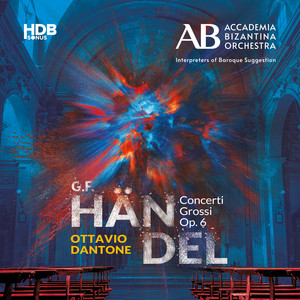
Accademia Bizantina, directed by Ottavio Dantone harpsichord 217:12 (4 CDs) HDB-AB-ST-001/2 (Available from https://hdbsonus.it/en)
This handsome set is currently available only as a 4-CD limited edition box set entitled ‘The Exciting Sound of Baroque Music’ from the website listed above. The title is a project being undertaken by Accademia Bizantina with the objective of, in the words of its founder and director Ottavio Dantone, ‘disseminating musical culture outside conventional listening spaces’. It hardly needs saying that anything furthering encouragement of the discovery of music such as the Handel concerti grossi is obviously to be encouraged, particularly when played by an ensemble as distinctive as Accademia Bizantina. In its hands the sound of Baroque music is indeed exciting and often in ways that differ considerably from that of north European period instrument ensembles. It is instantly more febrile, with an attack that can at times sound more spiky and aggressive, more muscular than the sound aimed at by, say, UK groups. Yet Italianate warmth also prevails where needed and one of the principal characteristics of the playing is always a strong sense of dramatic contrast stemming, I suspect, from the ensemble’s increasing activity in the opera pit. The sound of the full orchestra is at once fuller, richer and more rounded than that customarily sought in this music by most north European groups, the bass fortified by the strong contribution made by the inclusion of the theorbo in the continuo. More on that subject later.
Handel’s two sets of concerti grossi of course form part of the standard repertoire of Baroque orchestral music. Yet they are very different. Op 3 is a set of six concertos assembled mostly from works composed many years before and almost certainly without Handel’s authorisation by his publisher John Walsh, who issued them in 1734. They represent a vivid illustration of the anarchical world of publishing in the 18th century, one of which Walsh as a successful entrepreneur took full advantage. Lacking the scheme of the popular Corellian concerto grosso, the assemblage also contains errors that Bernardo Ticci has sought to correct in his new critical edition employed here. To move from one set to the other is to be aware immediately that opus 6 occupies a different sphere to opus 3, one that attains an elevated grandeur, breadth and nobility in general foreign to the earlier group, for all its charm. Composed in 1739, the 12 concertos were designed to be performed between the acts of Handel’s oratorios. Unlike op 3, they are true concerti grossi, with clearly delineated concertino (solo) parts contrasted with the full body of strings (unlike opus 3, which has oboe parts, opus 6 is scored only for strings.)
Unsurprisingly the performances of the two sets accords closely with the typical characteristics of Accademia Bizantina identified above. The playing is on the highest level, with outstanding concertino playing from the three solo players. Above all marked by the thrillingly committed verve and flair of the quicker movements, these players are also capable of finding a poise, delicacy and lightness of touch that brings to movements such as the final Allegro of op 6/6 an engaging enchantment or the profound intensity of expression that marks such as the Adagio (iv) of op.6/8.
There are few caveats. Some may find the string chording at times a little too abrupt and lacking sustained tone, though it is not something that here concerns me. Neither to any significant degree is the current predilection for tempos that tend to extremes, Dantone’s fondness for fast allegros being particularly prevalent. Just occasionally eyebrows might be raised, as in op 3/5 where in the succession of movements ii and iii, marked respectively Allegro and Presto, the beat for the latter sounds to my ears the slower of the two despite a marking that would suggest greater momentum. More serious to my mind is Dantone’s penchant for an assertive continuo theorbo contribution, a modern and unwelcome development in HIP in recent years. Early period instrument versions of these works, like the classic English Concert versions (1982 & 1984), found no necessity to include any kind of archlute and to my knowledge there is no evidence that Handel would have expected them. Here Dantone includes a theorbo – and worse still in places a guitar – in op.3 and both an archlute and theorbo in op.6. It is possible to argue that to help achieve the richness of Academia Bizantina’s bass sonorities such powerful instruments might be used to add chords. What is, in my view, completely unacceptable are the fiddly byzantine arabesques that here so often distract from the cantabile concertino or even ripieno lines. Writer after writer in the 16th to 18th century complained of plucked instrument players with ideas above their station. It is high time their present-day descendants were put back in theirs.
The set is handsomely produced, being in a sturdy box with individual cases for the two publications and a lavishly illustrated 128 pp book. My only reservation about it is that more space might with benefit have been devoted to notes on individual concertos at the expense of rather less on hyperbole. Notwithstanding, the last thing I would wish to do is conclude on a sour note. The performances are too thrilling, too life enhancing and too elevating to allow it. They deserve the widest possible circulation and I much hope they will become more generally available.
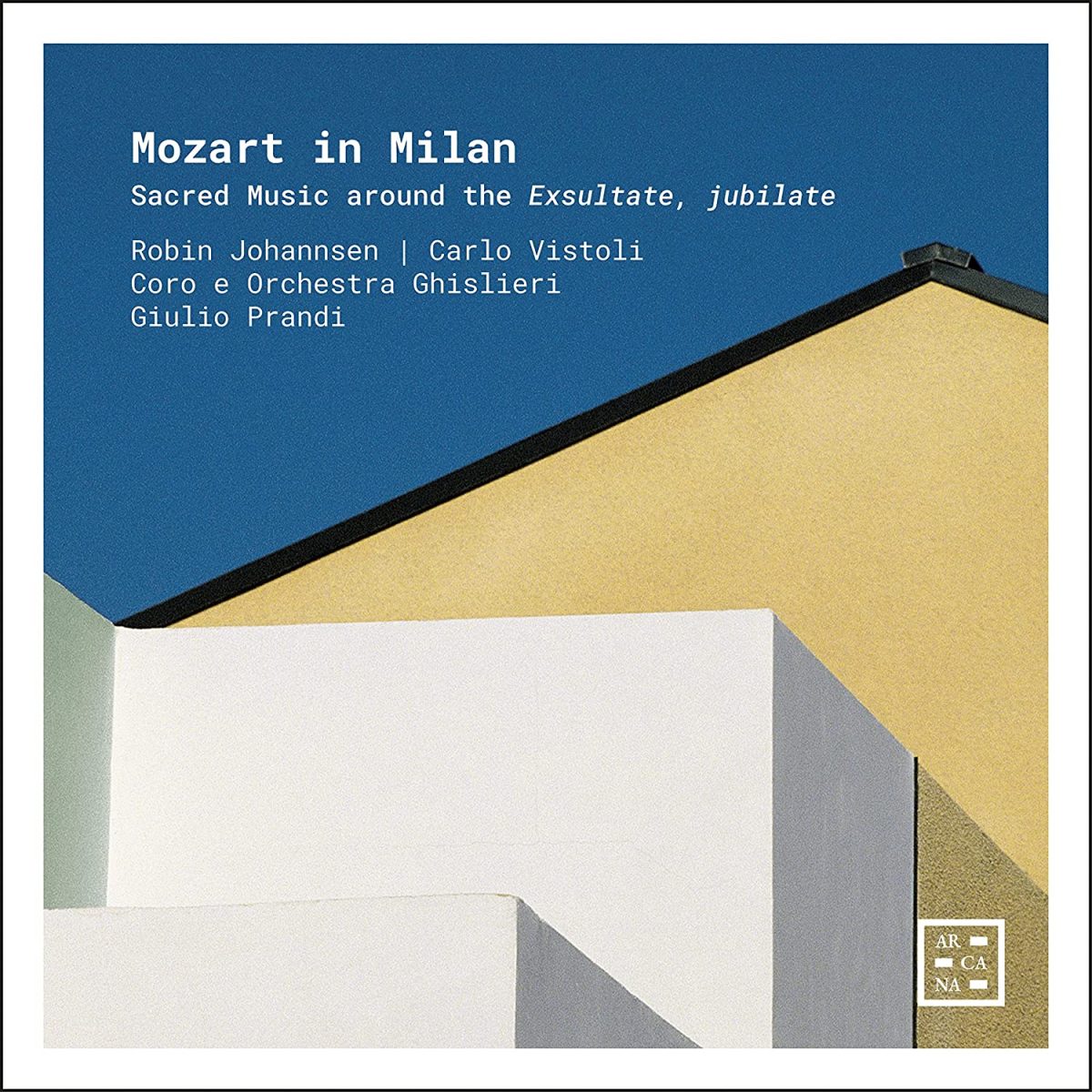
Robin Johannsen soprano, Carlo Vistoli countertenor, Coro e Orchestra Ghislieri, conducted by Giulio Prandi 76:58 Arcana A 538
‘Mozart in Milan’ the cover modestly announces. Modestly because it’s not just Mozart. This excellent and well-filled disc also contains works by Johann Christian Bach, who as a young man spent some years in Italy, where he became a Roman Catholic. Of specific interest is the period he spent in Milan (1757-62) under the patronage of Count Agostino Litta and remote tutelage by the famous authority on counterpoint, Padre Martini of Bologna. Then there is the scarcely known Giovanni Andrea Fioroni, a native of Pavia appointed maestro di cappella of Milan Cathedral in 1747, and the even more obscure Melchiorre Chiesa, maestro al cembalo at the Regio Ducale theatre and later La Scala in addition to holding a number of posts as an organist.
We know from an admiring letter of Leopold Mozart that Chiesa took over as second harpsichordist after Mozart ceased to direct his new opera Mitridate (of which in keeping with the custom of the day he directed only the first three performances) at the Reggio Ducale in December 1770. Mitridate was the first product of a commission received by the teenage Mozart from Count Firmian, Governor-General of Lombardy – Milan then being in territory ruled by the Habsburgs – for three operas, the last of which was Lucio Silla, first performed in December 1772. It was for the leading man of Lucio Silla, the famous castrato Venanzio Rauzzini, that a couple of weeks later Mozart wrote the motet Exsultate, jubilate, K165. The motet is here sung by the US soprano, Robin Johannsen. Charles Burney’s description of Rauzzini as having a ‘sweet and extensive voice, a rapid brilliance of execution great expression and an exquisite and judicious taste’ might easily have been tailored to Johannsen’s performance, which is, quite simply, one of the very best of this frequently performed showpiece I have heard. The ability to cope with the bravura writing of the opening aria and concluding ‘Alleluja’ are not so uncommon, but what is rare is the care and insight Johannsen brings to colouring the text. One example must suffice; the final line of the second, lyrical aria concludes with a perfectly executed trill on the final word ‘cor’, which the singer allows to swell slightly, thus bringing added fervour to the final plea – ‘console our feelings from which our hearts sigh’.
It would be interesting to know the date of composition of Chiesa’s solo motet for alto, Caelo tonati, for it follows precisely the same form as Exsultate, jubilate, which is to say a bravura aria followed by a recitative and concluded by a cantabile largo and Alleluja. The text takes the familiar operatic metaphor of stormy seas to express the torments of the sinful soul, the second aria a plea for peace and light. If lacking the musical quality of the Mozart, it makes for a fine virtuoso showpiece, here receiving its first recording. It is sung with great accuracy and intensity by countertenor Carlo Vistoli, whose performance would be a match for Johannsen’s if he had a less approximate, more sustained trill. As it is, there is much left to admire in the astonishing bravura singing, especially the ornamentation and passaggi of the recap of the opening aria.
The J C Bach works are Vespers pieces, the composition of which was overseen by Padre Martini and first performed in Milan, a Dixit Dominus of 1758, and a Magnificat in C from 1760, one of three settings Bach made of the text during this period. The former is also a first recording. They combine contrapuntal passages with homophony and have a typical layout, being divided into a succession of movements, in the case of Dixit clearly demarcated into choral and solo aria movements, while the Magnificat employs a concertante solo SATB group that emerges from the chorus. Both are highly attractive pieces, displaying Bach’s familiar Rococo melodic elegance grace in abundance.
Finally, we have a pair of brief choral works. Mozart’s Misericordias Domini, KV 222/205a is an Offertory work composed in Munich for the first Sunday of Lent in 1775. Consisting of only two lines of text, it alternates between the strict chromatic counterpoint of the first and the more lyrical homophony of the second. Fioroni’s even briefer O sacrum convivium is a largely homophonic setting of the sacramental antiphon with piquant harmonies, its reverential restraint fully justifying the esteem accorded the composer and suggesting his large sacred output would benefit from further exploration.
All these choral works are given thoroughly accomplished and committed performances by Coro Ghislieri under its experienced founder and director, Giulio Prandi. In the Bach Dixit Dominus, the tenor and bass soloists are respectively Raffaele Giordani and Alessandro Ravasio, the latter particularly impressing in the aria ‘De torrente’, sung with secure tone, excellently articulated fioritura and concluding with an almost unheard of rarity – a finely executed trill by a bass. An exceptionally rewarding CD that will fully engage the attention of anyone interested in mid-18th-century sacred music.
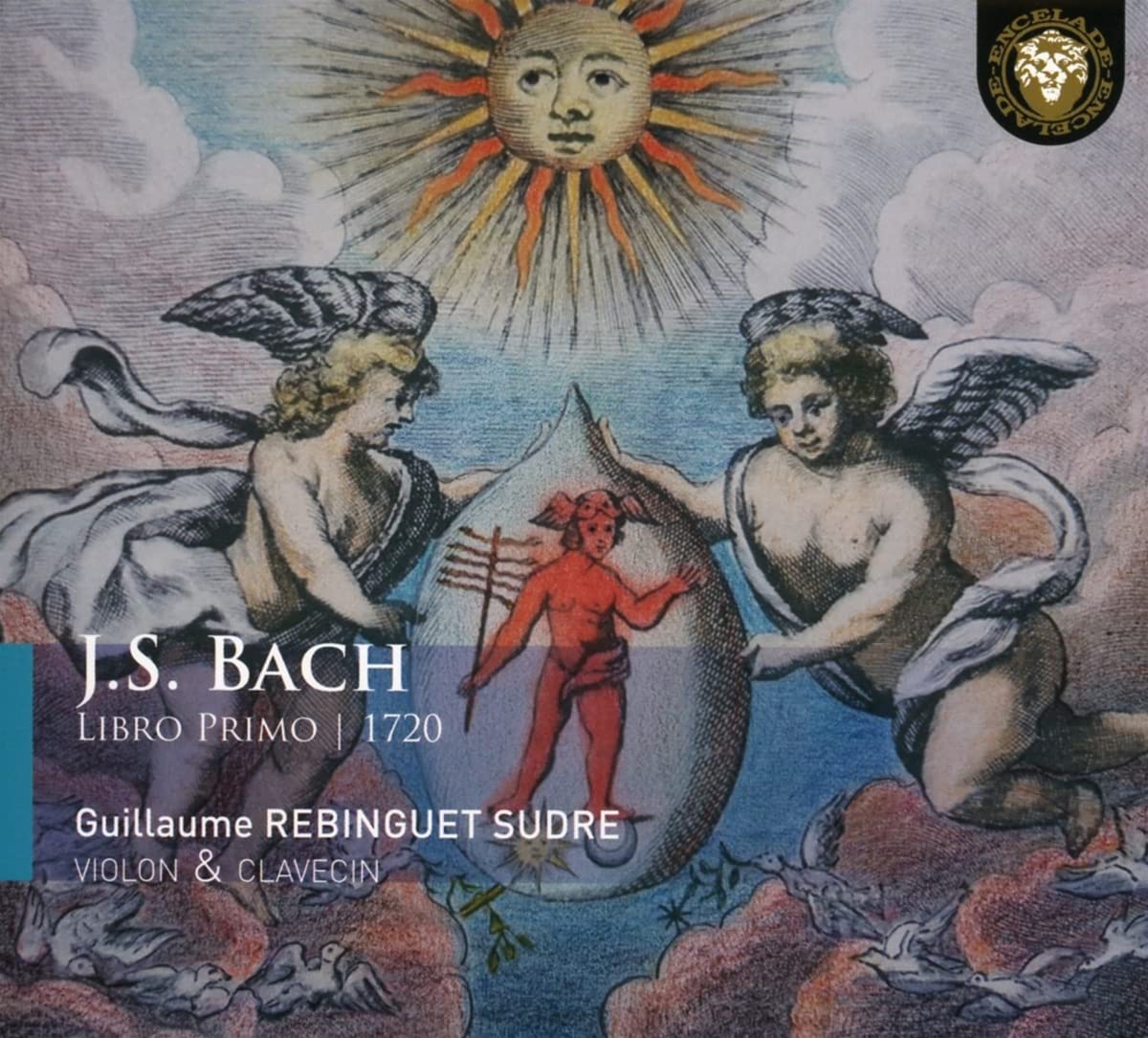
Guillaume Rebinguet Sudre violin / harpsichord / organ 150:00 (2 CDs in a card triptych) Encelade ECL 2001
These two CDs of the Sei Soli are a novel addition to our experience of Bach and multi-tasking. Like Bach, Guillaume Rebinguet Sudre plays both violin and keyboard instruments: the violin is a copy by Christian Rault in 2015 of a Jacob Stainer of 1699, the harpsichord he made himself in 2015 and is modelled on three Mietke instruments (Bach is known to have travelled to Berlin in 1719 to take delivery of one that had been ordered by the Prince of Anhalt-Köthen) and the organ is by Andreas Silbermann of 1718 and was restored by Blumenrode in 2015 for Sainte-Aurélie, Strasbourg. The performances were all recorded in lock-down, and like others of that period offer an insight into how players passed that time in a series of rather introspective, self-critical solo performances.
Exploring the resonances and implied if not entirely realised harmonies is a good mental exercise and bears out C. P. E. Bach’s comment that his father composed in his head but afterwards would try it out on a keyboard. Bach was already experimenting from the two-part inventions onwards how to develop a melodic phrase in such a way as to make it capable of being the germ of a complex polyphonic structure. Such a phrase might immediately suggest a countersubject, or be capable of inversion, augmentation or diminution. Such compositional skills had been an expected stock in trade of those early Renaissance composers like Obrecht, Ockeghem and Josquin, but reappear as key techniques in Bach’s ever-resourceful inventiveness. It was this ability to hear the implied harmonic structure of a particular melodic line that is revealed by his pupil J. F. Agricola’s comment that Johann Sebastian would sometimes play one of the suites or partitas he had written for a solo instrument on a keyboard, filling out the implied harmonies:
their author often played them on the clavichord himself and added as much harmony to them as he deemed necessary. In doing so he recognized the necessity of resonant harmony which in this kind of composition he could not otherwise attain.
This is what these CDs offer: CD 1 opens with the cembalo version of the opening Adagio of BWV 1005, which we hear in its violin version on CD 2.7.
CD 2 opens with the Prelude BWV 539 which has been added to the keyboard version of the Fugue from the violin sonata BWV 1001.ii which we hear on CD 1.3. We do not know whether the transcription of the fugue for keyboard is from Bach’s own hand, and the authenticity of the Prelude is doubted, as no version before c. 1800 is known. On CD 1 the third Sonata is the cembalo version of BWV 1003, BWV 964. So we hear Rebinguet Sudre play the organ (manualiter) and harpsichord as well as the violin. He plays with a considered gravitas, emphasised when he moves to a more resonant acoustic for the violin recordings on CD 2, and offers us a take that might not have seen the light were it not for the lockdown.
While I am grateful for his passion and dedication – not least in the very fine harpsichord he has built – I am not entirely convinced by his mystical account of Bach’s supposed state of mind as he wrote these pieces.
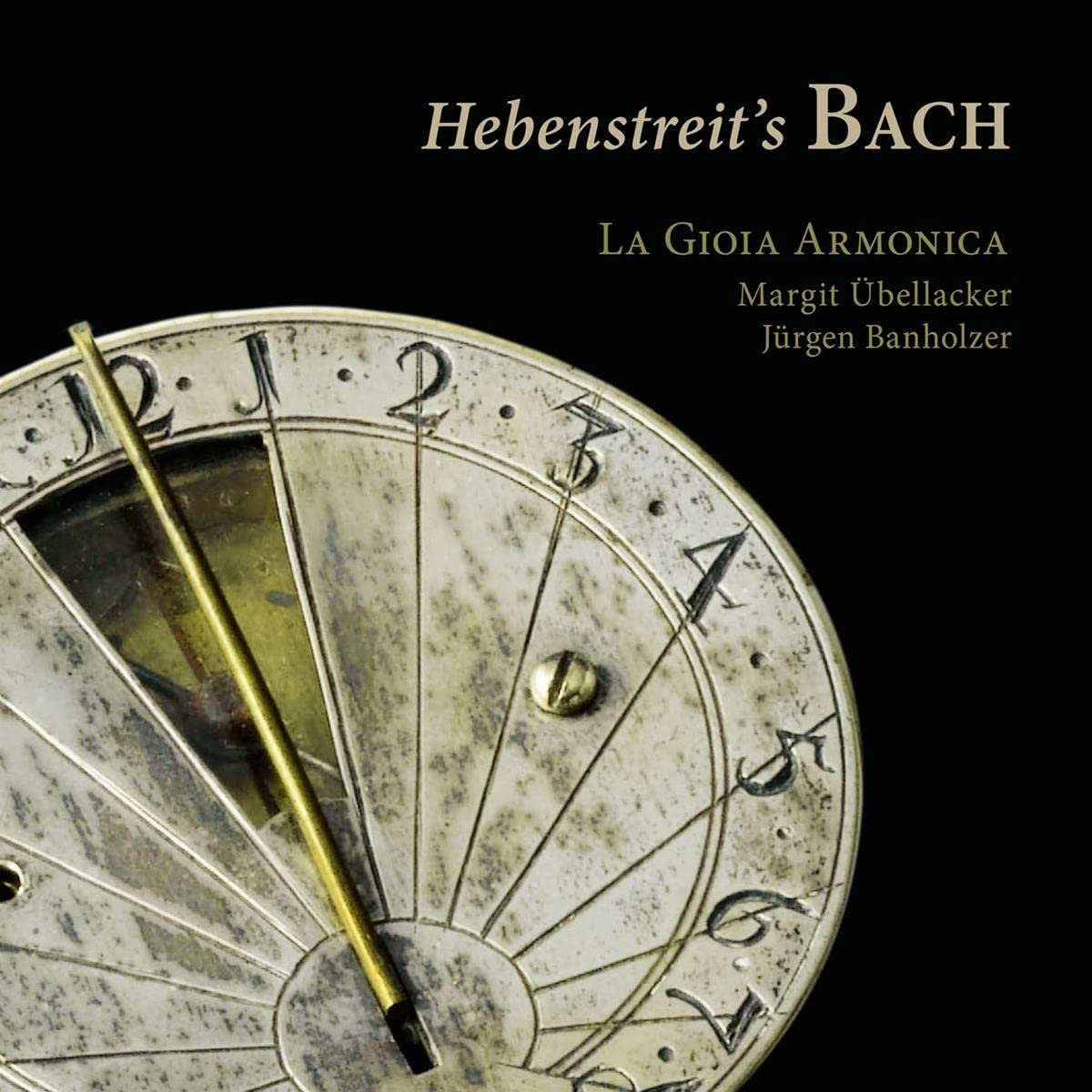
La Gioia Armonica (Margit Übellacker dulcimer, Jürgen Banholzer organ) 66:10 Ramée RAM 2101
This recording is a delightful re-imagining of a number of Bach sonatas and movements for solo violin or violoncello played on a dulcimer and organ. It is inspired by Margit Übellacker’s conviction that the hammered dulcimer – developed by Bach’s near contemporary Pantaleon Hebenstreit – was the instrument that Bach came across when a ‘foreign musician’, possibly Hebenstreit himself, came and displayed his instrument at the court of Köthen in July 1719. Hebenstreit’s instruments were made by Gottfried Silbermann and were one of the inspirations behind the development of the fortepiano, being admired by Bach’s predecessor in Leipzig, Johann Kuhnau, who was intrigued by the possibility of shading rapidly from forte to piano that the dulcimer offered.
Übellacker’s instrument is a tenor dulcimer made by Alfred Pichlmaier of Fraunberg in 1997 and the organ is the 1990 instrument built to hang over the gallery in the Erlöserkirche in Bad Homberg by Gerald Woehl, after a specification by J. S. Bach for Bad Berka in 1743.
The works presented are the sonatas in G (BWV 1019) and A (BWV 1015) for violin and obbligato harpsichord, the sonatas in E minor (BWV 1023) and G (BWV 1021) for violin and basso continuo, two movements from the cello suites (BWV 1009.iv and 1007.i) and one from Partita III (BWV 1006.i). Like other adaptations (and here I am thinking especially of the versions of the Trio Sonatas for organ arranged by Richard Stone for Tempesta del Mare, Chandos: CHAN 0803), I rather enjoy these performances: they make you listen with new ears, and the surging arpeggios seem to suit the instrument well, so for my money the Preludio in C BWV 1006.i, a version of Partita III in E or the Prelude in D BWV 1007.i from the G major cello suite sound the most plausible.
This may be an acquired taste, but it certainly has more claims to authenticity than performances on a fortepiano. You should listen to it, and read the campaigning essay by Margit Übellacker.
With the onset of the Covid pandemic, the streaming of live opera became an increasingly viable and popular way not only to bring opera to an established audience unable to attend public venues, but also to open up the genre to a new audience. Opera Streaming is the name given to a seasonal programme of opera transmissions that are freely available on YouTube. Based in the Emilia-Romagna region of northern Italy, the project draws on the productions presented in an area rich in historic theatres. Within this comparatively small region, there are no fewer than eight theatres, those of Bologna, Piacenza, Parma, Reggio Emilia, Modena, Ferrara, Ravenna and Rimini. Opera Streaming has no input into the theatre production, streaming solely without interference as an ‘onlooker’. Among the works scheduled for the 2022-23 season were new productions of Verdi’s Rigoletto (from Piacenza), Die Fledermaus, given in Italian (!), and the one to which I was invited, Vivaldi’s Il Tamerlano given in the beautiful mid-19th century theatre in Ravenna on January 14 and 15, on the latter of which the opera was streamed live.
I wrote above ‘Vivaldi’s Il Tamerlano’ but knowledgeable Vivaldians will be aware that is only partially true, since the opera is a pasticcio, one of three operas commissioned by the Accademia Filarmonica of Verona for the Carnaval season of 1735. Vivaldi had been hired as impresario for the season, so his occupation in that capacity probably accounts for the reason he put on a pasticcio, one based on a manuscript of his own, Il Bajazet. From that he took the majority of arias, but added others by Giacomelli (3 arias), Hasse (3) and Riccardo Broschi, the brother of Farinelli, who is represented by two. Vivaldi was therefore left with only recitatives to compose, including several stretches of accompagnato, most notably Bajazet’s spine-chilling denunciation of his daughter Asteria near the end of act 2. Also worth noting as being of exceptional quality is Tamerlano’s ‘Cruda sorte’, taken from Hasse’s Siroe, re di Persia of 1733, although that almost certainly had much to do with the magnificent performance it received at Ravenna. But more on that anon. Tamerlano has a libretto by Agostino Piovane that had already been set by several composers, in particular Handel (1724). It is relatively unusual among Baroque operas in having a straightforward story without subplots. It concerns the relationship between the famous Mongol emperor Timur (Tamerlano), who historically defeated the Turks and captured their Sultan, Bayezid (Bajazet). Although Tamerlano is engaged to Princess Irene, he has fallen in love with Asteria the daughter of Bajazet, who has been promised in marriage to the Greek prince Andronico. The opera revolves largely around the battle of minds between victor and loser, but encompasses the moving and powerful love of a proud father who would rather take his own life, than see his daughter become the wife of his hated enemy Tamerlano.
Ravenna’s production started with two considerable advantages: the first the presence in the orchestra pit of the local home team, the Accademia Bizantina under their director Ottavio Dantone, indisputably for some years Italy’s number one Baroque orchestra, who also made a superlative recording of Il Tamerlano some two years ago with a cast that featured the same principals. This told especially in the Tamerlano of the outstanding Filippo Mineccia, who sang throughout with thrilling power and intensity, and the equally impressive Asteria of Delphine Galou, at once a vulnerable and strong character. As Bajazet the baritone Bruno Taddia was a commanding presence, even if vocally the voice itself sounded more worn than it had done on the recording and was less impressive than that of Gianluca Margheri, who took over for the live streaming. Honours in the roles of Irene and Andronico remain in the hands of the recording artists, Sophie Rennert, whose Irene equalled that of Marie Lys for command of coloratura demanded by the role but excelled it for tonal beauty, while Marina de Liso’s outstanding fluid and gracious Andronico was also preferable to that of sopranist Federico Fiorio, though the latter deserves credit for the trill of the performance (the only one throughout apart from a brief attempt by Galou). Both Giuseppina Bridelli in the theatre and Ariana Vendittelli (on CD) were excellent as Idaspe. However, without undermining some fine singing, the point has to be made that the true stars of the performance were Accademia Bizantina, whose playing under Dantone was simply magnificent.
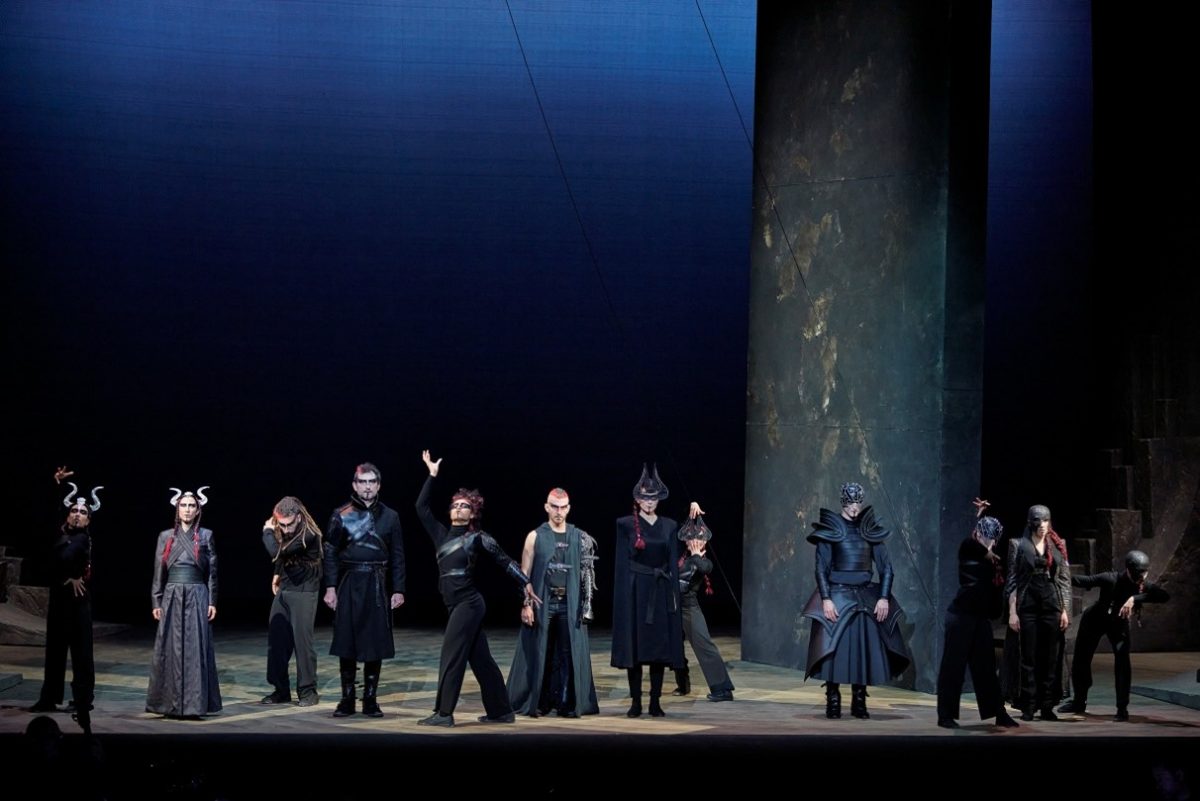
Rather less than magnificent was the production of Stefano Monti, who also designed the sets and costumes. The basic stage set, which incorporated a fair amount of meaningless or puzzling (take your choice) back projection, was clean and uncluttered, featuring only monumental stone columns and steps on each side of the stage. I claim no expertise on the subject of the garb of Mongol warriors, but quick research courtesy of Google suggests Monti’s are pretty authentic looking. Less authentic for an era where operas were staged with bravura magnificence and brilliance was the drab impression made by the staging, predominated as it was by greys and blacks, with the odd splash of red from time to time. Nevertheless, such caveats pale into insignificance compared with Monti’s greatest blunder. This was the decision to have each character shadowed by what was termed a dancer, but in reality was a twitching, demented marionette whose activity barely ceased. The movement not only conflicted for the majority of the time with the music, but, worse, committed the cardinal Baroque opera crime of detracting attention from a singer’s aria time after time, sufficient indeed to earn several lifetime sentences. If you wish to see for yourself, Opera Streaming’s relay will be available on YouTube for six months at the time of writing (June 2023). You can catch it HERE .
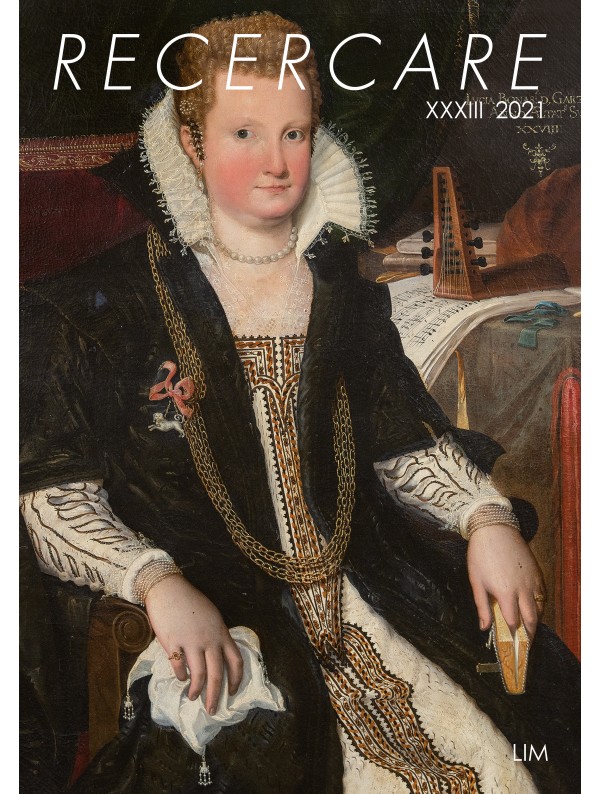
The 2021 RECERCAREcontains four studies (two in Italian, one in French, and one in English), followed by, before the Summaries in Italian and English, a 21-page double Communication in Italian with 11 glossy colour plates concerning the 1590 portrait on the cover of this issue. In ‘La “gentildama” e liutista bolognese Lucia Garzoni in un ritratto di Lavinia Fontana’ Marco Tanzi correctly identifies the noblewoman of the portrait and gives convincing reasons for attributing it to Fontana. Dinko Fabris discusses the ‘Elementi musicali …’ it contains.
Lucia Bonasoni Garzoni (b. 1561-?) was an aristocratic Bolognese lute player praised in a sonnet and two madrigals for her beauty, talent and character. Four other portraits of aristocratic women known to be by Fontana (including another one of Lucia) and two paintings with groups of women are also shown and discussed, including a concert on Parnasso with Apollo playing the lira da braccio while Pegasus romps in the background, Lucia playing the recorder, and the other eight ‘muses’ on various instruments (including a lute like Lucia’s). Their instruments and the fashionable hairdo they share are slightly hard to make out on a small page, but a magnifying glass helps. Details in the five single portraits, on the other hand, are impressive. Fabris describes Lucia’s not quite contemporary 6-choir lute and the music underneath it: a thick, open manuscript book shows a third of a page with about 5 bars of a solo voice part in contemporary notation (four crotchets or two minims per bar) on pentagrams, aligned over the lute accompaniment in tablature on 6 lines. This combination, and the horizontal format, are said by Fabris to be rare, but it isn’t clear how else lute players could have accompanied, especially if they were also singing. There is no conjecture about an actual piece. Only four syllables are clear, which is unfortunate, and perhaps why guessing the two words involves fortuity or lack thereof: [pr-]ovida, [impr-]ovida, [a-]vida or [ar?-]ida + for[-tuna] or sor[-te]. A singer might recognize the fragment!
In ‘Polso e musica negli scritti di teoria musicale tra la fine del Quattrocento e la metà del Seicento’ Martino Zaltron presents some cross-disciplinary theories of the past about pulse and music theory, showing how ancient science and mathematics (in this case medicine and music) filtered down into Renaissance theory and on into the mid-17th century. He cites Tintoris, Gaffurio, Lanfranco, Aaron, Zarlino, Zacconi, Pisa, and Mersenne. Whatever familiarity readers may have with tactus and mensural proportions, and a personal sense of the relation between one’s pulse (and breath) to a piece of music, what is unexpected is the inversion of emphasis to the medical side of the relationship. Doctors Joseph Strus (1510-1569), Franz Joël (1508-1579), Samuel Hafenreffer (1587-1660) and polymath Athanasius Kircher ‘notated’ patterns of heartbeats, sometimes associated with age or voice registers (suggesting pitch and dynamics), by note-values, using mixed values to record them for diagnoses. Hafenreffer even used a 4-line staff to place the values (from crotchets to longs) in ascending, descending or undulating rows. They curiously resemble cardiograms, and hospital oscilloscope monitors showing the frequencies and intensities of heart and lung activity.
At a deeper level, this article will stimulate readers to think of music’s capacity to reflect transient physiological humours, feelings and states of mind and how what began as a rather primitive musical physical-medical relationship was refined by musical theorists and professors of medicine. Zaltron has centered his research on musical-historical-medical writings in the Middle Ages and Renaissance at the Conservatory of Vicenza, and the University of Padua, historically, after Bologna, the second in Italy at which medicine was taught, from the 13th century.
Adriano Giardina, in ‘Un catalogue pour improviser: les Ricercari d’intavolatura d’organo de Claudio Merulo’, concludes that the eight simple but long sectional ricercars of 1567 by Merulo (1533-1604), his first publication for organ, printed by Merulo in Italian keyboard tablature, were not primarily composed for performance, but rather for teaching aspiring organists how to extemporise contrapuntal ricercars, i.e. how to do so a mente and di fantasia – a skill required in church functions. Showing examples of the contrapuntal procedures used, accompanied by simple or parallel contrapuntal voices, he reasons that their purpose was didactic. Giardina also claims support for his thesis from Merulo’s younger contemporary Girolamo Diruta (1546-1624/25), who became his student (and A. Gabrieli’s) in 1574 at the age of at least 28, and transmitted their teachings and his own in a comprehensive treatise, Il Transilvano (1593 and Seconda Parte 1609), planned and completed over several decades, thanks to a long collaboration with Merulo, who endorsed the first part in 1592. Absent a preface to the 1567 Ricercari the thesis is possible but not provable, and implicit confirmation from Il Transilvano lacking.
So I have some reservations about what Giardina reads into Diruta. Ricercars and keyboard tablature do occupy significant portions of Il Transilvano, especially in the Seconda Parte, where Diruta covers modes and strict versus free counterpoint, in some ground-breaking detail, and advocates strongly for the use of Italian keyboard tablature (closed score notation) to facilitate the approximately correct and playable reduced arrangements of vocal and instrumental polyphonic music on keyboards. Tablature ensures the beginnings if not always the durations of essential notes, omits or transposes unreachable ones, notates very few rests because each hand usually has something to do, and respects the imitative counterpoint heard even where not clearly apparent on the page. It is far from ideal for illustrating how a ricercar is composed.
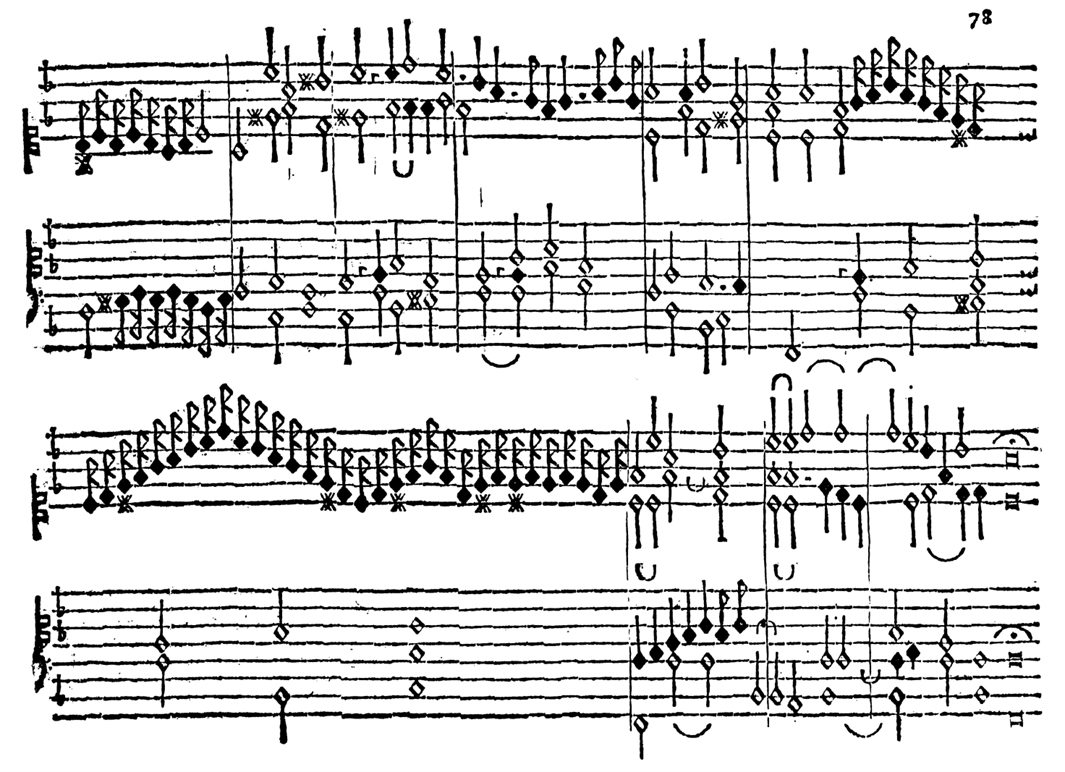
In fact, the 12 ricercars included in Book 2 of the Seconda Parte (pairs by Luzzaschi, Picchi, Banchieri, Fattorini and four by Diruta himself) are all in open score. They are there to be played and are thereby didactic for players who are learning to compose. Whereas with mosaic type in tablature Merulo can stack but not stagger three simultaneous notes on a staff, with only two possible stem directions. Space dictates which way very short or missing stems on inner voice notes point – perhaps why Merulo avoids voice crossings in these ricercars. The voices can be discerned in this tablature, after some scrutiny if not quite at first sight:
Being his own publisher, Merulo must have aimed to sell his music for organ both to professionals seeking handy modal material in excerptible sections, and to learners not yet up to composing ricercars, let alone improvising them. By playing them eventually by heart, their hands and ears might also acquire familiarity with the contrapuntal techniques. To that extent every composition played is somewhat propaedeutic to extemporization. Tablature slightly confounds this from occurring as less experienced players would have had to do the analysis that Giardina did in order to catalogue the techniques Merulo used.
While Diruta gives clear rules for strict and common counterpoint, and on how to compose and transpose within the modes, he never tells his Transylvanian pupil to improvise. Learning to play a mente or di fantasia does not exclude doing so next to pen and paper or an erasable slate, and those ambiguous terms are found only a couple of times in Il Transilvano. Their primary meanings are to play a mente, by heart; and to play or compose di fantasia, inventing rather than adopting a known composition as the basis for a new one. Memorization and invention are prerequisite skills for successful improvisation, but first of all for learning to compose, which comes first.
In fact, Giardina also mentions Diruta’s inclusion of 46 of Gabriele Fattorini’s 320 examples of elaborate ‘cadences’ in 4-part open score. He tells the Transylvanian to memorize them and to play them in transposition – and they are not mere chord progressions, but contrapuntal phrases up to 14 semibreves in length, with mixed note-values from semibreves down to quavers. A repertory of these ‘cadences’ in the hands and mind might well pass for improvisations. Tablature was still controversial and rejected by musicians in 1593 and 1609. If Merulo’s purpose was didactic, why didn’t he publish them in open score so that players in 1567 would have understood them? Why didn’t Diruta even allude to improvisation in his treatise, compared to how strenuously he advocated for making keyboard notation easier to play from in tablature?
Yet, at the end of the first part of Diruta’s Dialogo with the young Transylvanian, there is his personal account of arriving in Venice on Easter of 1574 and hearing a public ‘duello’ between Merulo and A. Gabrieli on the two organs of St Mark’s: they ‘dueled throughout the 18 years they were St Mark’s 1st and 2nd organists, though we don’t know exactly how. Were they improvising imitative rebuttals to each other’s improvised subjects, or did these eminent composers practice for their duels together? Diruta, already a keyboard player in 1566 when 20 years old and at 28 needing to perfect his technique in order to compete for posts, was swept away by their virtuosity – whether technical, creative, or improvisatory – and immediately arranged to study with both of them.
Extemporisation was indeed required of organists. To learn from Merulo’s ricercars, one would have had to sort out the voices in each, as Giardina has done, to note its devices. Applying the same techniques di fantasia, i.e. to an original subject, might then be within reach, especially when done al tavolino (at a table, i.e. in writing) rather than ex tempore. There is, in fact, a specific contemporary term for improvising counterpoint – contrappunto alla mente – and at least one organist, singer, composer and theorist, who dearly wanted to acquire that skill, gave personal testimony:
In the same year that Parte Seconda del Transilvano (1609) was reprinted (1622), Diruta’s contemporary, Ludovico Zacconi (1555-1627), in his Prattica di musica – Seconda Parte p. 84, writes: ‘… for however much, over time, I’ve frequented and conversed with masterful, mature and good musicians and seen how they teach their students counterpoint, I’ve never seen that [any] had a praise-worthy and easy way to teach their students contrappunto alla mente.’Zacconi came to Venice to study counterpoint under A. Gabrieli, remaining active there from 1577 to 1585. He composed four books of canons and also some ricercars for organ. If as late as 1622 he claims that ‘no one’ can teach contrapuntal improvisation, which he sought to learn to no avail, hadn’t Gabrieli, Diruta, or Merulo himself recommended that he study the 1567 Ricercari, which he probably already knew? If so, sadly, they didn’t really help.
In ‘Dafne in alloro di Benedetto Ferrari: drammaturgia ‘alla veneziana’ per Ferdinando III (Vienna, 1652)’ Nicola Usula does three things: he compares the Modena and Viennese manuscript versions of Dafne, Ferrari’s first dramatic work (a vocal introduction in seven scenes to a pastoral ballet); he includes his complete critical edition of its text in the Appendix; and in the framework of Ferrari’s biography he shows how Ferrari used its Viennese production as clever marketing to secure his return to Italy. It might surprise us to think of Ferrari (1603/4 – 1681) not exclusively as a composer and lutenist, and perhaps also as a singer, but equally creatively as a poet.
He frames his study in a biographical account of Ferrari’s career, starting with his libretto for Manelli’s 1637 Andromeda, his collaboration with Monteverdi’s 1640 Ritorno d’Ulisse in patria and the music from his 1640 Pastor regio that became the end of Monteverdi’s 1643 Incoronazione di Poppea with Busenello’s text as ‘Pur ti miro’. As early as 1641 he dedicated his 3rd book of Musiche varie a voce sola to the Holy Royal Emperor Ferdinand III, and while active in Modena at the court of Francesco I d’Este (1644-51), and at the peak of his popularity, was hired as a theorboist to work in Vienna from November 1651. His Dafne was performed February 12, 1652 and he probably played in other Venetian-style musical dramas until March 1653.
Besides the Viennese manuscript (in the National Library), a manuscript copy is held in Modena in the Biblioteca Estense together with four other librettos. It is this later poetic version which Usula draws some interesting conclusions about. His critical edition inserts in boxes the previous readings where amended, and the quality of Ferrari’s revisions and how they affect the ballet are much to his artistic credit.
‘A newly discovered recorder sonata attributed to Vivaldi: considerations on authorship’ of Sonata per flauto, I-Vc Correr 127.46 in the Biblioteca del Museo Correr in Venice will interest recorder players, players of other instruments, and listeners, and not only for the discovery of this particular work. A Summary is not given for this meticulous study by Inês de Avena Braga and Claudio Ribeiro – perhaps because its first paragraph is in effect an introductory abstract, or because its thorough presentation of comparative musical details and the arguments against alternative uncertain attributions cannot be summarized. The gist is contained in its title, and the attribution is by the two authors. They point out the salient traits of Vivaldi’s compositional style over time, selecting from hundreds of direct self-quotes found between this sonata and specific Vivaldi works (39 sonatas, concertos, sacred works, operas from RV 1 to RV 820 being listed), with 25 musical examples filling 13 pages. They conscientiously consider how often other composers knowingly or probably not, also did so.
Therefore sifting through many sonatas by other composers showing similar traits might in the end be futile, with no end of passages ‘by’ Vivaldi and ‘also by’ others. They concluded their positive attribution after exercising profound insight into the creative logic typical only of Vivaldi but not of his copiers, in matters of style and structure, and after applying every other musicological and historical tool as well. Everyone will be enriched by their discussion because the musical traits are not only shown but explained in functional terms: how sequences, phrases, a harmonic juxtaposition, particular melodic moves or chords were used. The authors’ ‘contextualization’ strikes right to the matter of the authenticity of a work by Vivaldi.
The study goes on, in a sort of postscript, to name a few specific composers who warranted consideration as composers of I-Vc Correr 127.46 , as their music was so clearly influenced by Vivaldi’s: Diogenio Bigaglia, Gaetano Meneghetti, Ignazio Sieber, Giovanni Porta. This, too, provides the readers with a fresh discussion of their musical styles with respect to Vivaldi’s, despite superficial borrowings. It is rare that musical analysis is so rewarding to read.
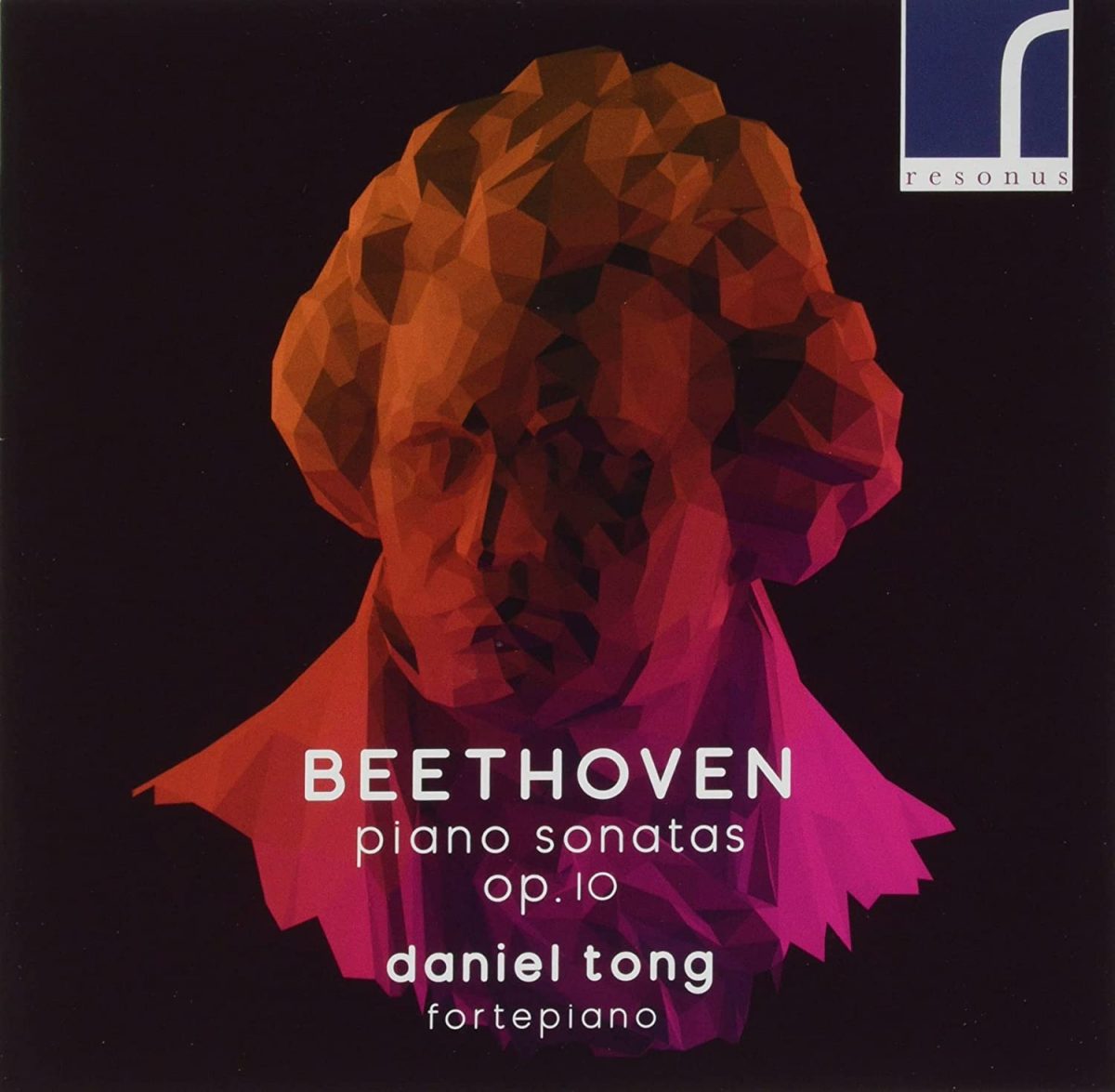
Daniel Tong here plays a copy of an Anton Walter fortepiano of 1805 built by the prolific Paul McNulty. In his informative note, Tong makes a number of points regarding the advantages of playing Beethoven on a fortepiano, correctly observing that it brings both the ‘player and the listener closer to Beethoven’s sound world’. Strangely, among other well-made points, he doesn’t mention what to me is always one of the principal advantages of playing the music of this period on a fine fortepiano, which this example unarguably is. That is the deliberate contrasts of tonal colour in the various registers of the instrument, one of the key differences to the modern grand piano, which aims for homogeneity across the spectrum. This seems to me particularly on display in the opus 10 sonatas, where one senses time and again that Beethoven is deliberately exploiting the contrasting sonorities of the instrument. This exploitation is especially potent in such imitative passages between treble and bass (much exploited in these sonatas) as the coda in the Presto of the D-major Sonata.
The three sonatas that constitute opus 10 were published in 1798 with a dedication to Countess von Browne-Camus, the wife of one of Beethoven’s wealthy patrons, one of several dedications of his publications to both count and countess. As Tong notes, the sonatas follow a pattern that applies to almost all of Beethoven’s publications in threes, aiming at works of considerable diversity and one work in a minor key (No 1 in C minor). The one thing all three have in common is their evident intent to provide above all music for Beethoven the virtuoso pianist who wowed the aristocratic salons of Vienna during the 1790s. This is particularly the case with the D-major Sonata, the only one of the three with four rather than three movements and at once the most ambitious and the most technically demanding for the pianist. Tong meets these demands admirably, articulating the virtuoso passagework of the Rondo finale with nimble fingers and great clarity. He is also capable of extracting poetry from the music where required, as for example in the final bars of the Largo e mesto of the same sonata, where the dynamics are exquisitely controlled to bring the movement to a close of perfectly attained peace. Neither is wit absent from Tong’s playing of a movement like the mostly playful Allegro of the F-major Sonata, where Beethoven uniquely in this set asks for the repeat of the development and recapitulation.
Overall these are admirable performances, enhanced by a recording that presents the instrument itself in the best light, its lovely bell-like treble admirably set off by a characterful middle register and richly resonant bass notes.
To my mind, one of the great pleasures of early Beethoven is encountering the future giant as he flexes his muscles, makes his first confident flights of fancy and exercises his ever-increasing power and strength. While admitting there is of course more than a fair share of wisdom after the event about making such an observation, it is nonetheless substantially true. It certainly is, I think, regarding the three Piano Trios of op 1. First given in 1793 at the Viennese home of Beethoven’s patron Prince Lichnowsky, to whom the trios were dedicated, they were revised before publication two years later. Advised by Haydn to make changes, Beethoven not only admitted to his youthful profligacy, observing he had introduced into one work ‘enough music for twenty’, but thanked Haydn for his advice. When the trios were published in 1795, very likely courtesy of a secret subvention by Lichnowsky, they were a great success among the Viennese. It is said they earned him nearly two years’ worth of the salary he had been paid in the post he occupied in Bonn before coming to Vienna.
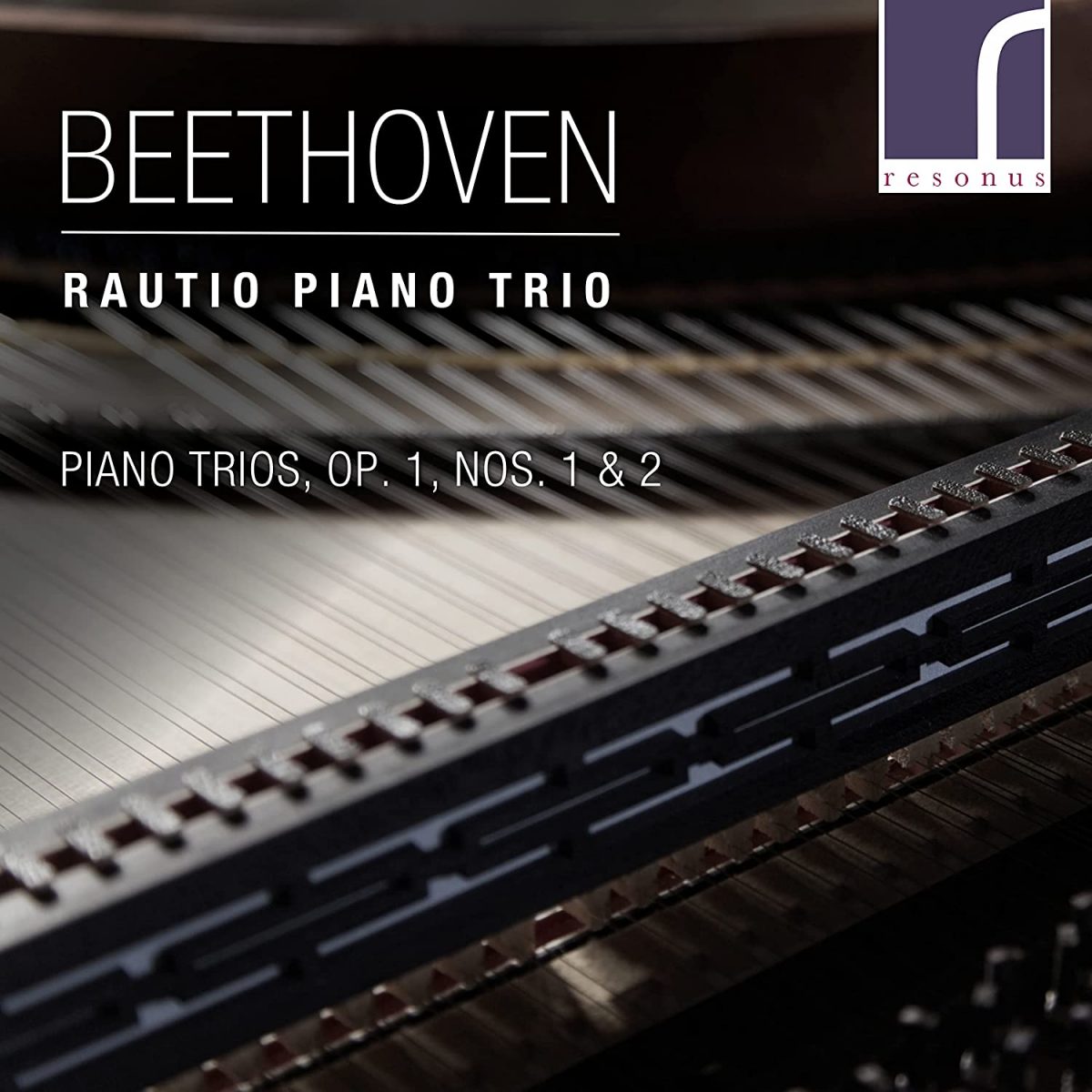
One of the first things to be noted about the op 1 trios is their ambitious scale. Unlike the three-movement trios of Haydn and Mozart, they are cast in four movements and planned as expansive works, which, if no longer containing enough ideas for twenty, are arresting pieces overflowing with the young composer’s sheer joie de vivre and the unadulterated pleasure of composing. It is these qualities that are so convincingly and compellingly communicated by the period-instrument Rautio Piano Trio (Jane Gordon, violin; Victoria Simonson, cello and Jan Rautio, fortepiano). Both string players play original 17th-century instruments, by G B Rogeri and G Granico respectively, while Rautio’s is based by Paul McNulty on an 1805 Viennese fortepiano built by the Walters. It’s an exceptionally fine-sounding instrument, with an appealingly silvery top and a richly endowed bass capable of powerful chords when necessary. To hear how well and beguilingly the instruments can interact, try the lovely Adagio cantabile (ii) of the Trio in E flat (No 1), where the violin’s song-like melody is joined in dialogue by the cello and then delightful filigree work by the piano, all beautifully balanced. Throughout tempi are well judged, with the players not misled in the ‘slow’ movement of the G-major Trio by the Largo con expressione marking, achieving just the right flow for the movement. And for sheer exuberance go the Finale of the same Trio, with its headlong chasse-like impetus disrupted only by what sounds like a bucolic dance. Technically the playing is of a high order, with Rautio himself, as one might expect in these works, stealing the thunder, his splendid articulation and clean finger-work being a constant pleasure. Just occasionally I thought the violinist’s tone a little thin, though this may be the recording, which in all other aspects is fine. Overall this is an outstanding addition to the catalogue and it is much to be hoped that the Rautios will complete the set with the C-minor Trio.
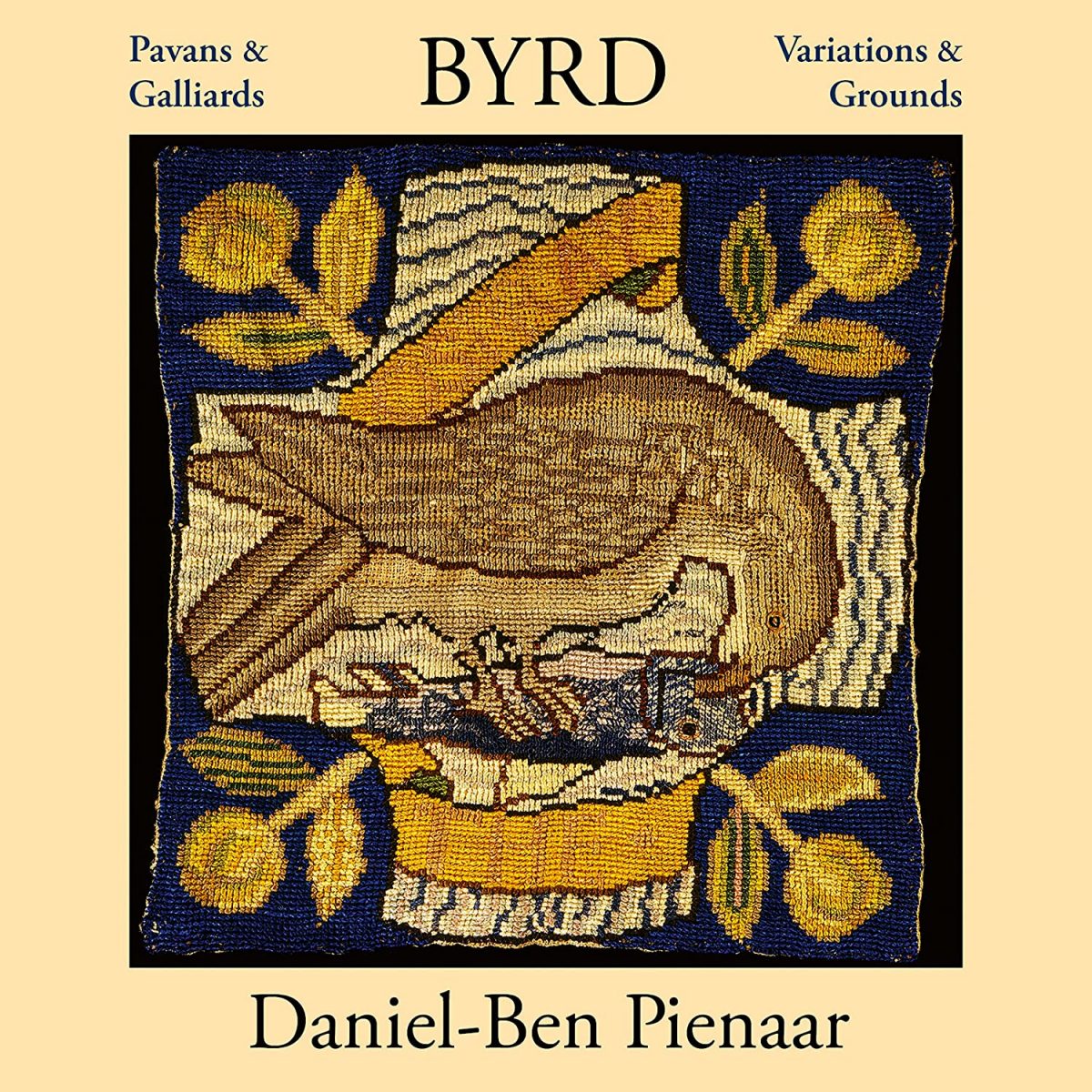
This is an intriguing double album: 39 of Byrd’s 101 surviving works for keyboard, composed for the contemporary harpsichord, but played here on the modern piano. The contents include all ten of the great Nevell pavans and galliards alongside the Quadran and Salisbury pavans and associated galliards, the three titled Grounds, his eight most famous settings of popular songs of the day, and three works which also qualify as grounds: The bells, Qui passe and, perhaps the only singular inclusion, the Hornpipe. Several of these pieces have been recorded by other pianists, the greatest overlaps occurring on the albums by Glenn Gould and Kit Armstrong (Sony B8725413722 and DG 486 0583 respectively; my review of the latter was published on 25 August 2021), but not forgetting Joanna MacGregor’s take on Hugh Ashton’s ground (Sound Circus SC007) and more recently Karim Said’s Qui passe (Rubicon RCD1014). Pienaar eschews the fantasias and voluntaries, plus (understandably) the works based around plainsongs which, with their many sustained notes, Byrd obviously intended (or at least preferred) to be played on the organ. So, where do these versions sit among the other substantial recordings of Byrd’s keyboard music played on the piano? What is there to be said about Pienaar’s interpretations of the pieces? And what do Pienaar’s interpretations contribute to the debate about performing these works on the modern piano, the emergence of which was still at least a century away in the future?
Playing this repertory on the piano raises a host of issues. Given the stratospheric status and quality of Byrd’s keyboard music, it is essential that it is accessible to as many people as possible. Nowadays there is a plethora of instruments based on keyboards, both traditional and electronic. To date, commercial recordings, broadcasts and public performances have been given either on the harpsichord and related instruments (hereinafter simply “harpsichord”), or the organ, or the piano. The last thing any sensitive reviewer would want to do would be to discourage performances on the piano, or to patronize pianists over their choice of instrument. While not quite an elephant in a room, the fact remains however that the music was composed for the harpsichord and/or organ, and it is at least arguable that had the piano been available to Byrd, he would have composed his pieces idiomatically to that instrument. And that matter of idiom – that a work composed for the harpsichord might not sit so well upon a different albeit similar keyboard instrument – can be a stumbling block, whether this is because the piano has a different mechanism from the harpsichord, or because a different technique is required for playing either instrument, or because it simply does not sound right to the listener. Pienaar’s recording throws up all these issues (and more – how long have you got?), which is unsurprising given the quantity and quality of the chosen music.
That chosen music is all, within the context of Byrd’s oeuvre for keyboard, familiar apart from the impressive Hornpipe of which there is only one other commercial recording – on the harpsichord – currently available (Friederike Chylek, Oehms OC1702). So, to look at that aspect from a critical perspective, we are being invited to listen to nearly forty of Byrd’s best-known pieces being played on the anachronistic piano when they are all easily accessible on recordings where they are played on the authentic harpsichord (noting that such recordings sometimes use harpsichords the designs of which postdate Byrd’s compositions). Or … we are being invited to listen to a large swathe of Byrd’s keyboard repertory played on an anachronistic but similar instrument which requires no alteration to a single note that Byrd has written, and which might, in the right hands, offer new insights into the structure and meaning of this incomparable corpus of works.
Pienaar’s performances are unapologetically those of a pianist, not of someone trying to make his instrument sound like a harpsichord. This is good in that it links Byrd with later composers for the piano such as Chopin for whom counterpoint is an important structural element, besides the rhetorical use of chordal passages (another penchant of Byrd’s, also noticeable in his vocal works, e.g. famously the A flat chord near the end of Infelix ego). This means that Pienaar can sound a bit precious in some of the pavans, but his essay in the accompanying booklet is an assertive justification for using the piano against those who show “moral outrage” at such a decision. Indeed, his rendition of Walsingham which is timed at an extraordinarily fast 6’39” (all other current versions whether on harpsichord or piano are over eight minutes, in one case nine) seems almost to be an aggressive demonstration of the capabilities of the modern piano and an exhibition of the technical capabilities of the pianist. And while this is one of Byrd’s most intense works (see for instance Bradley Brookshire’s article “’Bare ruin’d quires, where late the sweet birds sang’: covert speech in William Byrd’s ‘Walsingham’ variations”, in Walsingham in literature and culture from the Middle Ages to modernity, edited by Dominic Janes and Gary Waller, Farnham, 2010, pp. 199-216), Pienaar seems to be invoking the tune’s modest status as a popular song and, through his performance, provoking thoughts of Byrd’s passionate reaction to this place of mediaeval pilgrimage and to its destruction as a Catholic shrine by Protestants in 1538. Yet elsewhere his interpretation of O mistress mine, I must brings out all the light and sheer beauty in Byrd’s setting, making it sing in such a way as to persuade listeners that this music might actually have been composed for the piano.
So we have a choice. We can purchase the recording for what it is. We can purchase it as an experiment or a novel experience and enjoy finding out which performances work and which do not. Or we can decide that Tudor keyboard music on the piano is not for us. For this reviewer (and I did indeed buy a copy before I was invited to review it!), among some tracks that are dances that don’t (not all the Nevell pavans and galliards “take off”), or where Byrd’s momentum and polyphony are clogged by too many spread chords (ditto), or where something other than Byrd’s self-explanatory genius is being exhibited (virtuosity in John come kiss me now, another fastest version on disc), there are many performances that are decorous, thought-provoking or challenging (for instance Qui passe, The bells, and those three titled Grounds, plus the mighty Quadran pavan and galliard) and have made that purchase worthwhile. When I first encountered this repertory I had no access to a harpsichord and played through Byrd’s entire keyboard output on the family’s piano, so please, any pianists reading this review, please do play and perform Byrd’s keyboard music on your pianos, especially in this quatercentenary year.
Published by Taverner 504 pp ISBN 978-1-915229-53-3 Hardback – £65 ISBN 978-1-915229-54-0 Paperback – £35 ISBN 978-1-915229-86-1 ebook – No detail of availability
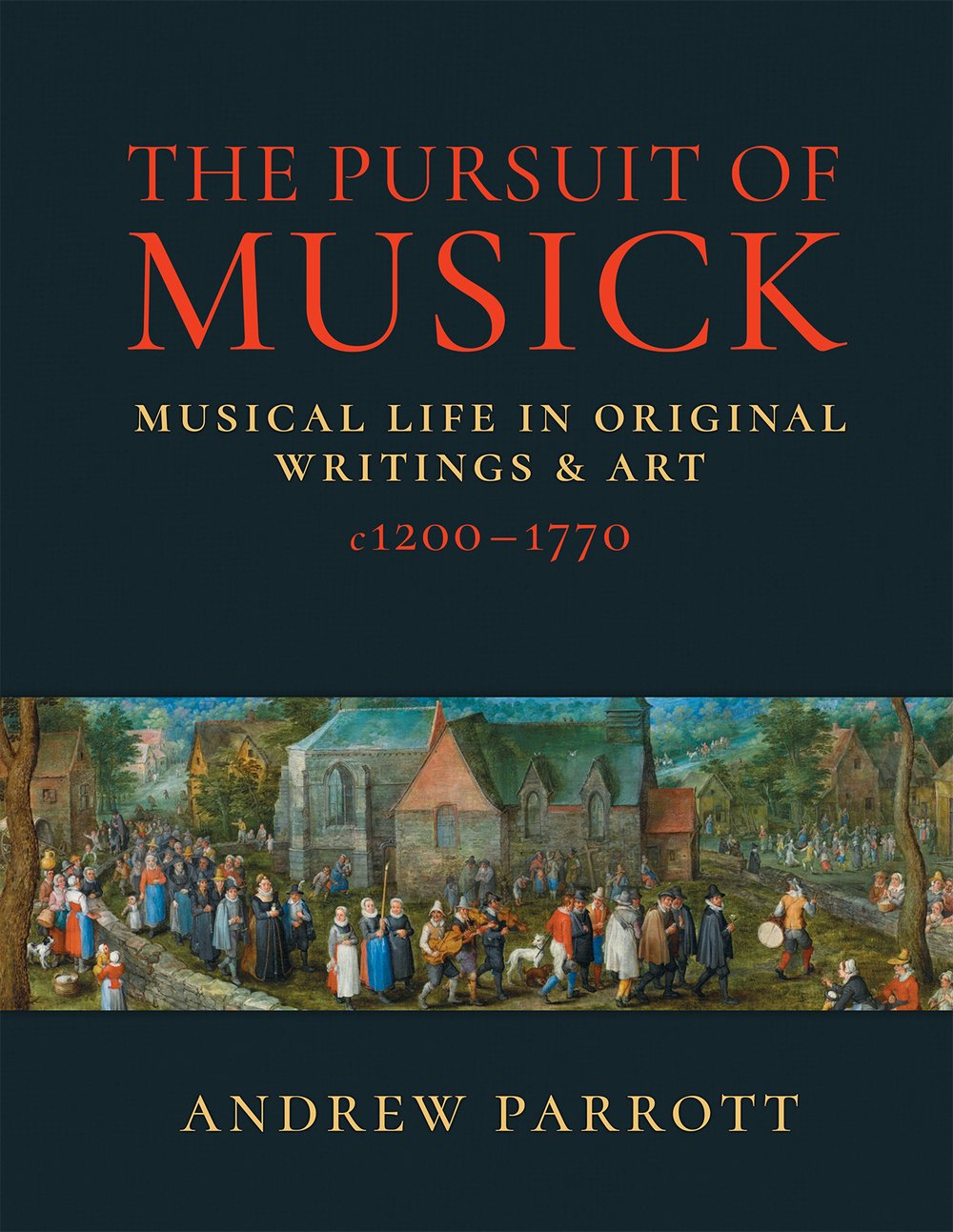
I can find no better way of introducing this review than by quoting the opening sentence of the online blurb: ‘The Pursuit of Musick is an encyclopedic and generously illustrated anthology of original written sources, exploring some 600 years of musical activity in Europe, from the first troubadours to the emergence of the pianoforte’. For once lacking hyperbole, this is a succinct and factual description of what is a remarkable and beautifully produced book. Printed on heavy gloss paper -the paperback I have to hand weighs in at 2.3kg – that enables the lavish and profuse artwork to be reproduced to the highest quality, it will be concluded that this is no bedside table book!
Those that have kept in touch with Andrew Parrott’s activities, which sadly have involved little in the concert hall or opera house more recently, will know that he has been thinking about this book for some years. Parrott’s eventual objective, which he only arrived at after several transitional ideas, was to allow the musicians (and the artists that involved themselves in their works) to speak for themselves with only brief introductions heading sections. The Book is divided into three parts: ‘Music & Society’, Music & Ideas’ and ‘Music & Performance’, which themselves are sub-divided into numerous sub-headings. Part 1, for example, includes sections devoted to music in everyday life, the church, music at court and so forth. Not the least of the book’s attractions is its meticulous indexing of the source material, in the book itself for paintings, online at taverner.org for literary material.
There are two groups of people to whom this book is surely going to be an obligatory part of any music library: musicians involved with early music and writers and critics who also have any depth of involvement with the subject. Doubtless there are also many others that will take not only didactic interest but also an aesthetic one; it would be possible to pass many a rewarding and pleasurable hour just browsing the hundreds of illustrations. It will be obvious from the foregoing that this is indeed not a book for reading but one to use for research or simply the sheer enjoyment of dipping into it at random. I would imagine that on first acquaintance most readers will make for topics in which they have a particular interest. That was certainly my course in the limited amount of time I’ve had to so far examine the book. Thus my first ports of call included the sections on performance practice, vocal music and opera. In the case of the first named I was delighted to find solid support for one of the most frequent moans in my reviews – the over-fervent activities of theorbo players, particularly when they interfere with the vocal line. Here’s St Lambert in 1707: ‘the [continuo] accompaniment is made to support the voice, not to stifle or disfigure it with an unpleasant jangle…’ Or Bacilly in 1688: ‘If the theorbo is not played with restraint and there is too much complexity […] then it is theorbo accompanied by voice, not voice by theorbo’. It is fascinating too to find most of the ire directed at Italian players, for in my experience they are the worst culprits. But all theorbists should read, mark and learn.
When we turn to singing there are as many extracts concerning technique as might have been expected. One constant motif is the need for singers to maintain an ease of production, the sentiments behind these words of the German composer Hermann Finck (1527-1588) serving to illustrate universally acknowledged views that held good until the end of the period covered by the book: ‘Singing is not made more beautiful by bellowing and shouting: rather you should embrace all notes with spirit and understanding. The more a voice moves upwards, the quieter and sweeter the sound should be; the lower it goes the fuller it should be […]. Amen indeed to that. In an ideal world they are words that would be emblazoned on the portals of every singing conservatoire.
The section on Music Drama leads from the earliest sacred representations through court intermedi to opera itself. The extracts devoted to opera are notable for illustrating how much more writing there is on the topic by French writers than Italian, probably an accurate reflection, though it would have been possible to have struck more of a balance. These extracts are dominated by the unending war between proponents of Italian opera and those favouring the French rival, summed up in an anonymous publication in Florence in 1756 (possibly by Gluck’s reformist librettist Calzabigi) forecasting the desirability of the combination of the best elements of both: ‘The opera in Paris offers [the audience] only painted scenery, ballets, machines, a sparkling assembly & a deep hush. In Naples it presents them only with ravishing music, beauties that are unseen & an appalling hubbub. Everyone understands that out of these two kinds one good one could be made, but no one has as yet thought to suggest it’. Prescient words.
It would be easy to continue citing such jewels, but it is time to leave the interested reader to obtain the book. But before doing so it is perhaps worth noting that the illustrations themselves provide a fount of information; staying with opera one might cite the marvellous illustration on p. 223 by P D Oliviero showing the re-opening of the Teatro Regio in Turin in 1740. Here one notes the wonderful set with its colonnaded perspective (not dissimilar to what can be seen in Turin today), stage filled with far more figures (12) than we normally experience in Baroque opera production today and the disposition and number of the orchestral musicians. No fewer than 29 musicians are involved, seated in two rows with harpsichords and continuo at either end of the pit. Two people are serving refreshments, while several in the front row are turning round to look at the audience rather than pay attention to what is happening on stage, a clear reminder that 18th-century audiences rarely paid undivided attention to the performance.
This magnificent publication can be obtained only online from: https://www.taverner.org/store. At the time of writing (mid-December 2022) it was available in both formats at a reduced price.