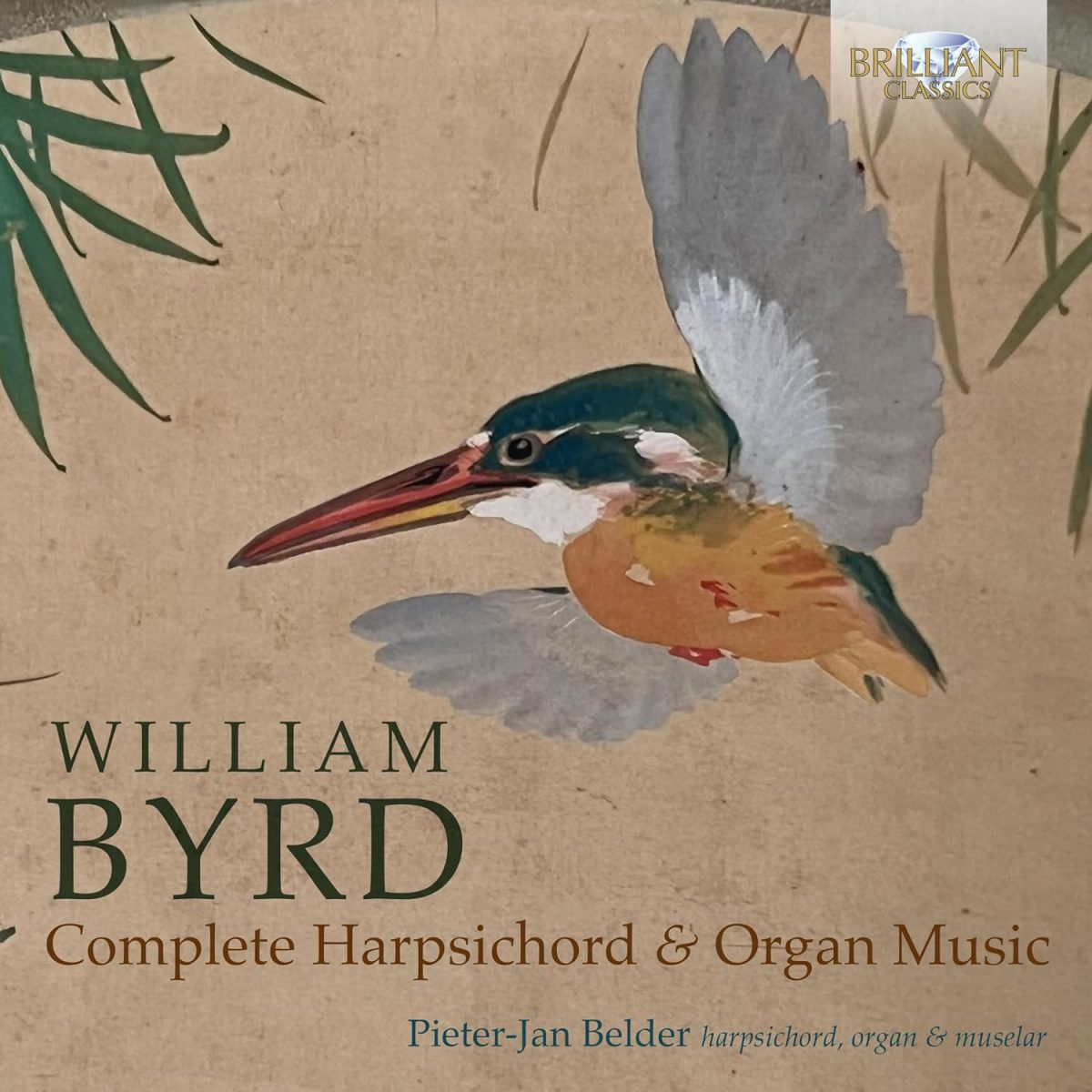
Pieter-Jan Belder harpsichord, muselar, virginals and organ 9 CDs Brilliant Classics 97074
This album of Byrd’s complete music for keyboard is in every way a worthy successor to Davitt Moroney’s pioneering boxed set released in 1999 (Hyperion 66551-7, reissued 2010 as CDS444617). Musically the fact of the music being by Byrd is self-recommending. He was the first great composer for the keyboard, writing music that is not only attractive on its own account, transcending the liturgical parameters of preceding repertory, but also idiomatic to the harpsichord, comfortable under the fingers as well as to the ears! As for performance, Belder’s strength is in allowing Byrd to speak through the music rather than inflicting an interpretative regime upon the music. The sheer variety among the pieces, well over a hundred in total, is mind-boggling, and thanks to the clarity of Belder’s readings, lesser-known jewels such as the Pavan and Galliard BK 16 glow in their own light, while the neglected Pavan and Galliard BK 76-77 (probably intended as a pair but not presented as such in their unique source) positively bask in the glow of Belder’s performance. More familiar masterpieces and classics such as The barley break, Walsingham, Ut re mi fa sol la (BK 64) plus the great sequence of Nevell pavans and galliards, the grounds and the fantasias (especially BK 13 in A minor, the first true masterpiece for the keyboard) flourish in this environment.
An interesting talking point, possibly controversial to some, is Belder’s choice of “fringe” repertory. Most of the accompanying booklet is written by Jon Baxendale, experienced co-editor (with Francis Knights) of such important sources as My Lady Nevells’ Book, Will Forster’s Virginal Book and the Fitzwilliam Virginal Book, though parts of his text must be read with caution: Byrd is now known to have been born in 1540 or late 1539, not 1542/3 as stated; he was appointed to the Chapel Royal in 1572, not 1573; he moved to Stondon Massey in 1595, not 1594; and pace Mr Baxendale, the anonymous variations on Robin Hood are not attributed to Byrd by Will Forster anywhere at all in his Virginal Book (WFVB), the work’s unique source. In a brief but informative personal note in the booklet about the recording project, Belder is “up front” about some inclusions, and one of these is Robin Hood (previously performed by Bernhard Klapprott on his complete recording of Thomas Tomkins Keyboard Music MDG 607 0704-2 with circumstantial evidence for Tomkins’ authorship on p. 12 of the booklet; and subsequently recorded by Bertrand Cuiller on Mr Tomkins his Lessons of Worth, Mirare MIR137, as by “Thomas Tomkins?”) but Belder cites the less assertive comments of Baxendale and Knights in their edition of WFVB (p. 372) merely suggesting tentatively that it offers traces of Byrd’s style. Half a dozen of Byrd’s songs survive in contemporary arrangements for keyboard. Two had already been recorded: Lullaby and Susanna fair. None are thought to be by Byrd himself, but rather than record all or none of them, Belder has decided to include a couple that “work” for him as works for keyboard. One such is the album’s single premiere recording! This is the arrangement for keyboard of Care for thy soul from the Psalmes, sonets and songs published in 1588; the original song has already been recorded twice. The other is Susanna fair. He also includes two settings of Dowland’s If my complaints. BK 103 is attributed to Byrd in its source but rejected as being by him, while BK 118 is anonymous but accepted as likely to be by Byrd. Belder explains this in his note so listeners can agree or disagree with scholarly opinion, or simply just enjoy both settings! In the same generous spirit, those pieces attributed uniquely to Byrd in contemporary sources, but considered improbable or impossible to be by him, are also included. A few works receive two “versions” performed on different instruments, such as the arrangement of Robert Parsons’ In nomine on harpsichord and on organ.
It remains wholeheartedly to welcome and recommend this fine discographical achievement. Pieter-Jan has recorded the pieces from Nevell and Fitzwilliam before but, given the many extra works here which include some gems which are outstanding even by Byrd’s elevated standards, and at its reasonable price, this boxed set is worth the attention – and outlay – of everyone who is already aware of this music, or who is moved to discover it.
+ Laudem dicite; Jesu salvator saeculi, redemptis; Martyr Dei qui unicum; Gaude, gaude, gaude Maria; Beata nobis gaudia; Gaude virgo Christiphera
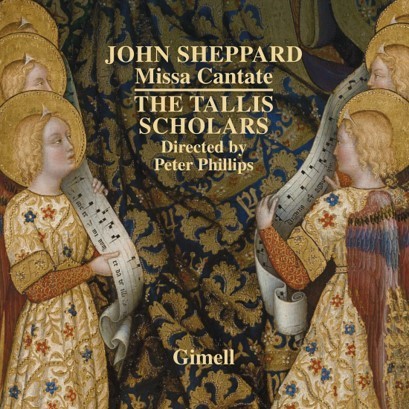
The Tallis Scholars conducted by Peter Phillips 76:22 Gimell CDGIM 053
Peter Phillips has done remarkable work with The Tallis Scholars (TTS), the choir he founded in 1973, recording, performing, broadcasting, editing, writing about and generally evangelizing for British (sic – Tomkins, though no Carver) and European music of the Renaissance. The standard of performance has always been high, sometimes transcendent – Josquin’s Missa Pange lingua, Sheppard’s Media vita and from left field the Agnus of Missa Da pacem by Bauldeweyn misattributed to Josquin, to name only a few at random. The choir’s personnel never stagnate, and nor therefore do their performances. This is illustrated by a concert which I recall attending in December 2014 at St John’s Smith Square, during which TTS sang the exhilarating but unfamiliar Magnificat by Edmund Turges, and the familiar Lullaby by Byrd which nonetheless received a revelatory rendition.
With their pinpoint tuning and use of high pitch, TTS have an ideal composer in Sheppard, with his thrilling melodies, enthralling counterpoint, spicy harmonies and startling dissonances. The works selected for this recording each contain all of the above. Every piece was intended for the Roman Catholic liturgy that passed into obsolescence in England almost simultaneously with the death of Sheppard himself. The mass, which is for six voices, runs for nearly half an hour on this recording, and two of the motets, Gaude, gaude, gaude Maria and Gaude virgo Christiphera, take over ten minutes, while all the others except Martyr Dei qui unicum take over five, all giving Sheppard ample scope for exhibiting his unique and remarkable style.
There are five other current recordings of this Mass, and while two of these are by other adult chamber choirs, the other three are by cathedral or collegiate choirs of men plus boys (and, in one case, boys and girls): The Choir of Westminster Cathedral; St Mary’s Scottish Episcopal Cathedral, Edinburgh; and the trebles of Salisbury Cathedral joined by the lower voices of the Gabrieli Consort, most of whom will have had ecclesiastical backgrounds. This version by The Tallis Scholars (many of whom also have ecclesiastical backgrounds) sounds the most secular of all these. It seems in places to come over as quite assertively accented, either on the beat in the Mass, or corresponding with changes of notes in the plainsong in works which are built around the chant in one of the voices. The versions sung by the ecclesiastical choirs seem to have more of an ethereal flow, appropriate to the acoustics of the buildings in which Sheppard’s works would be sung liturgically, while The Tallis Scholars’ interpretation is ideal for the sort of drier acoustic usually encountered in secular concert halls. This is the reality of the modern world: fabulous early liturgical music being rediscovered, cherished, and performed democratically, for mental and spiritual refreshment and delectation, as well as for sheer listening pleasure, outwith the sacred environment for which it was originally intended. Ironically in view of what I have just written, The Tallis Scholars made this recording in Brinkburn Priory, but it still comes across to this listener as an interpretation suited for the likes of Cadogan Hall. This in no way is any sort of denigration of a fine recording, expertly sung, which contains consistently wonderful music, sometimes achieving sublimity as in the case of the increasingly famous Amen to Jesu salvator saeculi, redemptis.
Three of Sheppard’s other four surviving masses (all a4) – Plainsong Mass for a Mean, Western Wind and Be not afraid – are available on commercial recordings, so it would be good to have the French Mass on CD etc. to complete the set, and to enable the listening public to hear more of this great composer’s music.
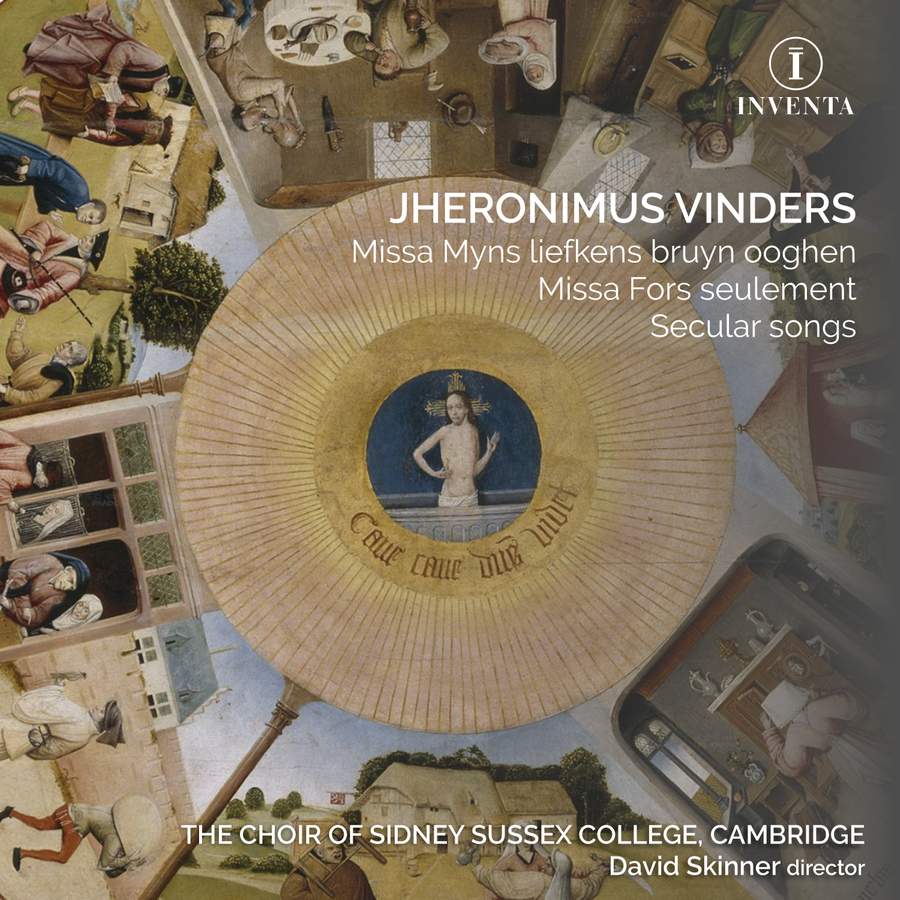
Missa Myns liefkens bruyn ooghen; Missa Fors seulement; Salve regina; secular songs Choir of Sidney Sussex College, Cambridge, conducted by David Skinner; Andrew Lawrence-King, psaltery and harp 101:17 (2 CDs in a single jewel case) Inventa INV1012
Jheronimus Vinders: another fine Franco-Flemish composer who has been waiting in the wings for discovery, and now, thanks to Eric Jas who has edited his complete surviving works, and David Skinner and the Choir of Sidney Sussex College, Cambridge, who have recorded these three wonderful works, Vinders can begin to receive the recognition that is his due. All that is known about him biographically is that he was in Ghent during 1525-26. Stylistically his music sits between Josquin, for whom he composed the lament O more inevitabilis which is the only work by which he is currently known, and Jacob Clement. Qualitatively it is on a par with the best composers of that era.
This recording consists of two masses based on folksongs, plus illustrative settings of those songs, performed vocally and instrumentally, including the versions on which Vinders based his masses. These musical strands are all unpicked fascinatingly and lucidly by Eric Jas in the accompanying booklet. In particular, he explains the process by which it has been possible to affirm the attribution to Vinders of the Missa Myns liefkens bruyn ooghen despite its being anonymous in its source. The other mass is also attributed to Gombert but, despite some echoes of that master in its music – such as the almost obsessively thrummed repetitions – it is also most likely that a chronologically earlier ascription to Vinders is correct.
The music of both masses is intense, in minor mode, and tightly rather than thickly scored. Vinders sustains interest throughout all the movements with varied textures, striking melodies and vivid harmonies. Particularly notable are the beautiful sonority at “Tu solus Dominus” in the Gloria of Missa Myns liefkens and a breathtaking cadence on “Sabaoth” in the Sanctus, which is beautifully executed by the singers. In the Missa Fors seulement there is a sweeping opening to the Kyrie, the music of which is taken over wholesale for the Agnus. The album also contains an absolute peach of a Salve regina a5, one of three surviving settings by Vinders.
The singing by the Sidney Sussex choir in a reverberant acoustic is excellent, with attention to detail and clarity of individual parts. David Skinner’s tempi are judicious, and of considerable interest is his decision to take the Gloria slowly from “Qui tollis” almost right to the end of the movement. The instrumental pieces are played by Andrew Lawrence-King on the harp and the psaltery, an inspired choice for music of this period which suits the relevant pieces admirably. Vinders’ music is a wonderful discovery, and the greatest compliment one can pay this recording is to express a wish to hear much more of it.
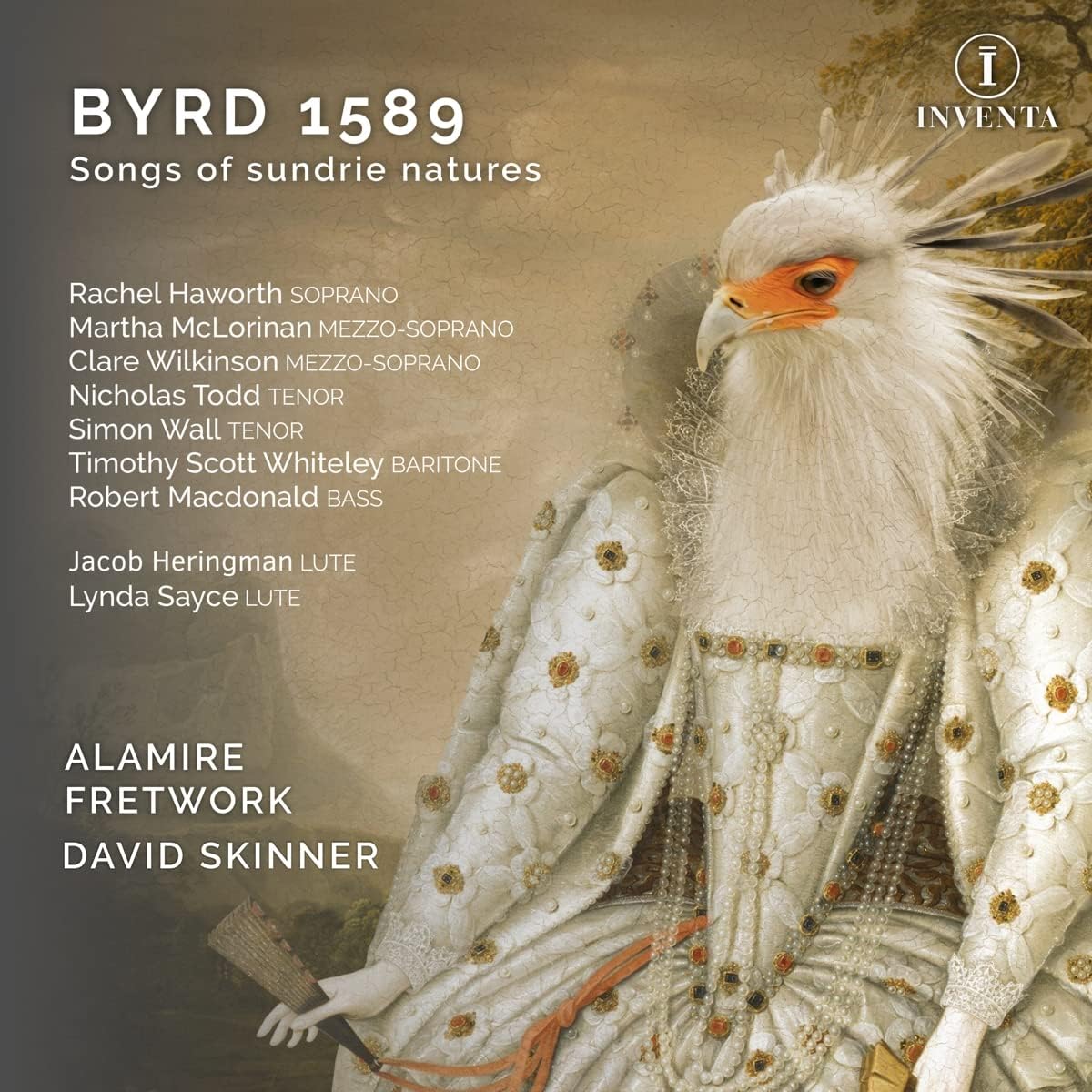
Alamire, Fretwork, David Skinner 122:37 (2 CDs in a single case) Inventa INV1011
Alamire and Fretwork continue their great work on behalf of Byrd, under the direction of David Skinner, by following up their complete recording of his Psalmes, sonets and songs of 1588 with this double album consisting of the Songs of sundrie natures 1589. In an important respect this new release is even more significant because it includes so many premiere recordings from this more neglected collection. For instance, of the Seven Penitential Psalms that begin the disc, only three have ever received commercial recordings. Just a few of the pieces have received repeated attention – such as the majestic consort anthem Christ rising again and the bucolic duet Who made thee Hob forsake the plough – but now we can revel in the likes of the first complete recording of the exquisite Wounded I am, the first commercial recording of what David in his note calls “this epic tale” From Citheron the warlike boy is fled and only the second recording of the sublime sacred song O Lord my God. The two carols for Christmas Day – From virgin’s womb and An earthly tree – have of late begun at last to receive appropriate attention on disc, performed with both their two sections intact and accompanied by viols. This is definitively the case here, and they also demonstrate the high quality of Alamire’s soloist Martha McLorinan; she is joined by the equally admirable Clare Wilkinson in Christ rising and Who made thee Hob mentioned above, and both mezzos also sing separate solo songs; Unlike the 1588 songs, many of which survive in pre-publication sources as consort songs which Byrd subsequently adapted as partsongs for publication, those in 1589 are almost all original partsongs; just three survive as consort songs in sources predating the print. Of these, I thought that love and When first by force are performed as in the print, but See those sweet eyes is sung enchantingly by Clare Wilkinson in its original solo format. The violists of Fretwork provide excellent accompaniments whenever required, as do star lutenists, Jacob Heringman and Lynda Sayce, for the five stunning secular songs that are in three parts.
As in 1588, there is a wide variety of mood, illustrated well by the almost curt and flirtatious I thought that love had been a boy sitting next to the impassioned and emotional O dear life to words by Sir Philip Sidney; indeed, the teeming creativity that gushes from the ten works in the section of songs in five parts could stand as an epitome of the entire collection. Alamire and David respond sensitively to all of Byrd’s different musical perspectives. Indeed, this is a collection simply crammed full of delights, both spiritual and emotional, all the better for the listener with such a high proportion of the songs being in the main unfamiliar. The initial sequence of seven psalms in three parts might seem forbidding, but do as Byrd himself suggests, listen a few times, and even here in these ostensibly austere works many beauties emerge; earlier this Byrd Quatercentenary year I had the pleasure of attending a concert in Norwich given by the outstanding Marian Consort, during which they sang the dourly-texted Lord in thy wrath correct me not and its concluding bars radiated beauty, which beauty is conveyed equally well on this recording. The more luxuriant Unto the hills mine eyes I lift in six parts, with its own plodding text, possesses a Flemish quality reminding us of Byrd’s familiarity with the glorious works of Jacob Clement, “Clemens non Papa”. One could go on throughout the entire set – there is not a work among them all which is less than excellent, and which does not repay repeated listening.
The Sixteen have beaten Alamire to recording Byrd’s third and final collection of songs, the Psalmes, songs, and sonnets of 1611, but Alamire have provisional plans for a possible celebration of another Byrd anniversary in 2024 which, if it comes to fruition, would be just as exciting as all the foregoing. Meanwhile, it remains yet again to recommend without reservation the album under review, to compliment Alamire on making some hitherto hidden masterpieces by Byrd accessible to the worldwide public, and to congratulate Alamire, Fretwork, David and the soloists on a job superbly done. And let’s have a minute’s applause for William, who made it all possible.
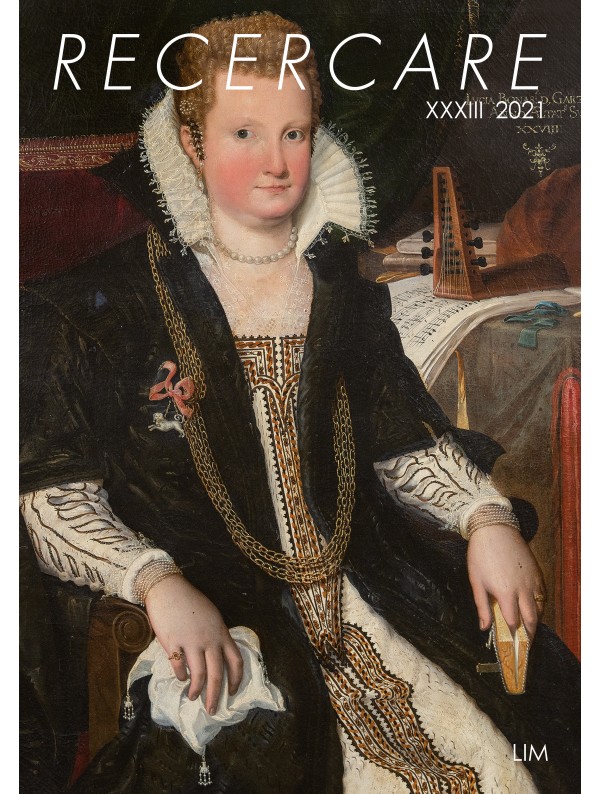
The 2021 RECERCAREcontains four studies (two in Italian, one in French, and one in English), followed by, before the Summaries in Italian and English, a 21-page double Communication in Italian with 11 glossy colour plates concerning the 1590 portrait on the cover of this issue. In ‘La “gentildama” e liutista bolognese Lucia Garzoni in un ritratto di Lavinia Fontana’ Marco Tanzi correctly identifies the noblewoman of the portrait and gives convincing reasons for attributing it to Fontana. Dinko Fabris discusses the ‘Elementi musicali …’ it contains.
Lucia Bonasoni Garzoni (b. 1561-?) was an aristocratic Bolognese lute player praised in a sonnet and two madrigals for her beauty, talent and character. Four other portraits of aristocratic women known to be by Fontana (including another one of Lucia) and two paintings with groups of women are also shown and discussed, including a concert on Parnasso with Apollo playing the lira da braccio while Pegasus romps in the background, Lucia playing the recorder, and the other eight ‘muses’ on various instruments (including a lute like Lucia’s). Their instruments and the fashionable hairdo they share are slightly hard to make out on a small page, but a magnifying glass helps. Details in the five single portraits, on the other hand, are impressive. Fabris describes Lucia’s not quite contemporary 6-choir lute and the music underneath it: a thick, open manuscript book shows a third of a page with about 5 bars of a solo voice part in contemporary notation (four crotchets or two minims per bar) on pentagrams, aligned over the lute accompaniment in tablature on 6 lines. This combination, and the horizontal format, are said by Fabris to be rare, but it isn’t clear how else lute players could have accompanied, especially if they were also singing. There is no conjecture about an actual piece. Only four syllables are clear, which is unfortunate, and perhaps why guessing the two words involves fortuity or lack thereof: [pr-]ovida, [impr-]ovida, [a-]vida or [ar?-]ida + for[-tuna] or sor[-te]. A singer might recognize the fragment!
In ‘Polso e musica negli scritti di teoria musicale tra la fine del Quattrocento e la metà del Seicento’ Martino Zaltron presents some cross-disciplinary theories of the past about pulse and music theory, showing how ancient science and mathematics (in this case medicine and music) filtered down into Renaissance theory and on into the mid-17th century. He cites Tintoris, Gaffurio, Lanfranco, Aaron, Zarlino, Zacconi, Pisa, and Mersenne. Whatever familiarity readers may have with tactus and mensural proportions, and a personal sense of the relation between one’s pulse (and breath) to a piece of music, what is unexpected is the inversion of emphasis to the medical side of the relationship. Doctors Joseph Strus (1510-1569), Franz Joël (1508-1579), Samuel Hafenreffer (1587-1660) and polymath Athanasius Kircher ‘notated’ patterns of heartbeats, sometimes associated with age or voice registers (suggesting pitch and dynamics), by note-values, using mixed values to record them for diagnoses. Hafenreffer even used a 4-line staff to place the values (from crotchets to longs) in ascending, descending or undulating rows. They curiously resemble cardiograms, and hospital oscilloscope monitors showing the frequencies and intensities of heart and lung activity.
At a deeper level, this article will stimulate readers to think of music’s capacity to reflect transient physiological humours, feelings and states of mind and how what began as a rather primitive musical physical-medical relationship was refined by musical theorists and professors of medicine. Zaltron has centered his research on musical-historical-medical writings in the Middle Ages and Renaissance at the Conservatory of Vicenza, and the University of Padua, historically, after Bologna, the second in Italy at which medicine was taught, from the 13th century.
Adriano Giardina, in ‘Un catalogue pour improviser: les Ricercari d’intavolatura d’organo de Claudio Merulo’, concludes that the eight simple but long sectional ricercars of 1567 by Merulo (1533-1604), his first publication for organ, printed by Merulo in Italian keyboard tablature, were not primarily composed for performance, but rather for teaching aspiring organists how to extemporise contrapuntal ricercars, i.e. how to do so a mente and di fantasia – a skill required in church functions. Showing examples of the contrapuntal procedures used, accompanied by simple or parallel contrapuntal voices, he reasons that their purpose was didactic. Giardina also claims support for his thesis from Merulo’s younger contemporary Girolamo Diruta (1546-1624/25), who became his student (and A. Gabrieli’s) in 1574 at the age of at least 28, and transmitted their teachings and his own in a comprehensive treatise, Il Transilvano (1593 and Seconda Parte 1609), planned and completed over several decades, thanks to a long collaboration with Merulo, who endorsed the first part in 1592. Absent a preface to the 1567 Ricercari the thesis is possible but not provable, and implicit confirmation from Il Transilvano lacking.
So I have some reservations about what Giardina reads into Diruta. Ricercars and keyboard tablature do occupy significant portions of Il Transilvano, especially in the Seconda Parte, where Diruta covers modes and strict versus free counterpoint, in some ground-breaking detail, and advocates strongly for the use of Italian keyboard tablature (closed score notation) to facilitate the approximately correct and playable reduced arrangements of vocal and instrumental polyphonic music on keyboards. Tablature ensures the beginnings if not always the durations of essential notes, omits or transposes unreachable ones, notates very few rests because each hand usually has something to do, and respects the imitative counterpoint heard even where not clearly apparent on the page. It is far from ideal for illustrating how a ricercar is composed.
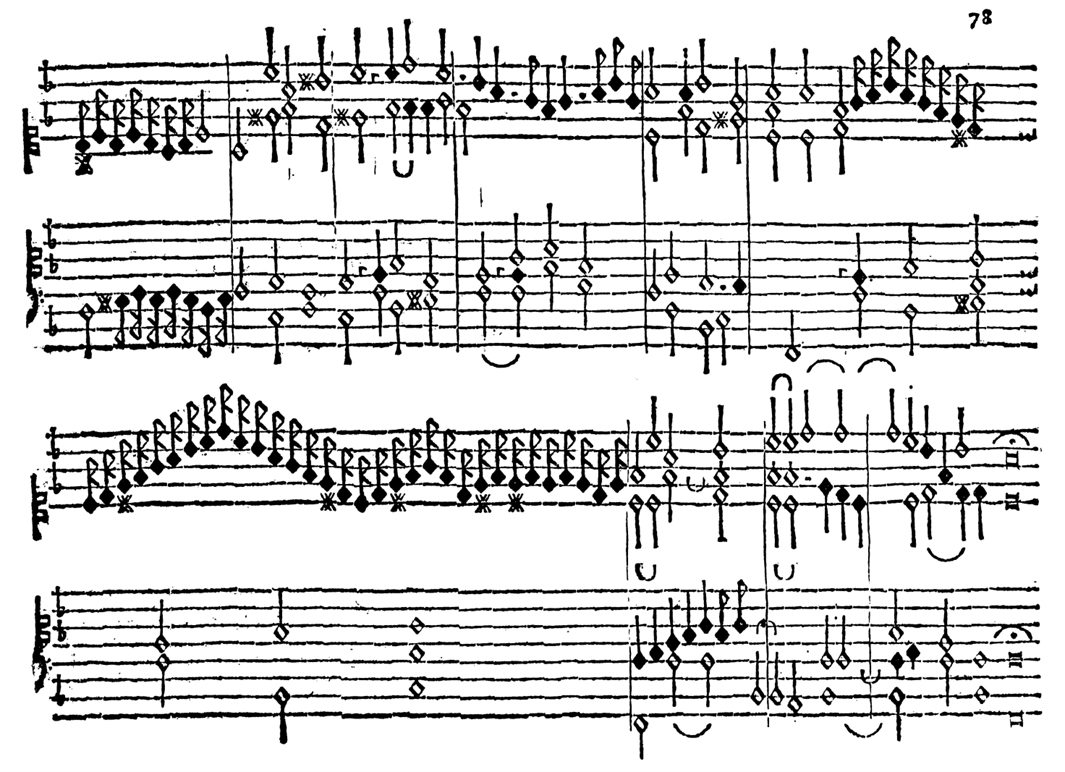
In fact, the 12 ricercars included in Book 2 of the Seconda Parte (pairs by Luzzaschi, Picchi, Banchieri, Fattorini and four by Diruta himself) are all in open score. They are there to be played and are thereby didactic for players who are learning to compose. Whereas with mosaic type in tablature Merulo can stack but not stagger three simultaneous notes on a staff, with only two possible stem directions. Space dictates which way very short or missing stems on inner voice notes point – perhaps why Merulo avoids voice crossings in these ricercars. The voices can be discerned in this tablature, after some scrutiny if not quite at first sight:
Being his own publisher, Merulo must have aimed to sell his music for organ both to professionals seeking handy modal material in excerptible sections, and to learners not yet up to composing ricercars, let alone improvising them. By playing them eventually by heart, their hands and ears might also acquire familiarity with the contrapuntal techniques. To that extent every composition played is somewhat propaedeutic to extemporization. Tablature slightly confounds this from occurring as less experienced players would have had to do the analysis that Giardina did in order to catalogue the techniques Merulo used.
While Diruta gives clear rules for strict and common counterpoint, and on how to compose and transpose within the modes, he never tells his Transylvanian pupil to improvise. Learning to play a mente or di fantasia does not exclude doing so next to pen and paper or an erasable slate, and those ambiguous terms are found only a couple of times in Il Transilvano. Their primary meanings are to play a mente, by heart; and to play or compose di fantasia, inventing rather than adopting a known composition as the basis for a new one. Memorization and invention are prerequisite skills for successful improvisation, but first of all for learning to compose, which comes first.
In fact, Giardina also mentions Diruta’s inclusion of 46 of Gabriele Fattorini’s 320 examples of elaborate ‘cadences’ in 4-part open score. He tells the Transylvanian to memorize them and to play them in transposition – and they are not mere chord progressions, but contrapuntal phrases up to 14 semibreves in length, with mixed note-values from semibreves down to quavers. A repertory of these ‘cadences’ in the hands and mind might well pass for improvisations. Tablature was still controversial and rejected by musicians in 1593 and 1609. If Merulo’s purpose was didactic, why didn’t he publish them in open score so that players in 1567 would have understood them? Why didn’t Diruta even allude to improvisation in his treatise, compared to how strenuously he advocated for making keyboard notation easier to play from in tablature?
Yet, at the end of the first part of Diruta’s Dialogo with the young Transylvanian, there is his personal account of arriving in Venice on Easter of 1574 and hearing a public ‘duello’ between Merulo and A. Gabrieli on the two organs of St Mark’s: they ‘dueled throughout the 18 years they were St Mark’s 1st and 2nd organists, though we don’t know exactly how. Were they improvising imitative rebuttals to each other’s improvised subjects, or did these eminent composers practice for their duels together? Diruta, already a keyboard player in 1566 when 20 years old and at 28 needing to perfect his technique in order to compete for posts, was swept away by their virtuosity – whether technical, creative, or improvisatory – and immediately arranged to study with both of them.
Extemporisation was indeed required of organists. To learn from Merulo’s ricercars, one would have had to sort out the voices in each, as Giardina has done, to note its devices. Applying the same techniques di fantasia, i.e. to an original subject, might then be within reach, especially when done al tavolino (at a table, i.e. in writing) rather than ex tempore. There is, in fact, a specific contemporary term for improvising counterpoint – contrappunto alla mente – and at least one organist, singer, composer and theorist, who dearly wanted to acquire that skill, gave personal testimony:
In the same year that Parte Seconda del Transilvano (1609) was reprinted (1622), Diruta’s contemporary, Ludovico Zacconi (1555-1627), in his Prattica di musica – Seconda Parte p. 84, writes: ‘… for however much, over time, I’ve frequented and conversed with masterful, mature and good musicians and seen how they teach their students counterpoint, I’ve never seen that [any] had a praise-worthy and easy way to teach their students contrappunto alla mente.’Zacconi came to Venice to study counterpoint under A. Gabrieli, remaining active there from 1577 to 1585. He composed four books of canons and also some ricercars for organ. If as late as 1622 he claims that ‘no one’ can teach contrapuntal improvisation, which he sought to learn to no avail, hadn’t Gabrieli, Diruta, or Merulo himself recommended that he study the 1567 Ricercari, which he probably already knew? If so, sadly, they didn’t really help.
In ‘Dafne in alloro di Benedetto Ferrari: drammaturgia ‘alla veneziana’ per Ferdinando III (Vienna, 1652)’ Nicola Usula does three things: he compares the Modena and Viennese manuscript versions of Dafne, Ferrari’s first dramatic work (a vocal introduction in seven scenes to a pastoral ballet); he includes his complete critical edition of its text in the Appendix; and in the framework of Ferrari’s biography he shows how Ferrari used its Viennese production as clever marketing to secure his return to Italy. It might surprise us to think of Ferrari (1603/4 – 1681) not exclusively as a composer and lutenist, and perhaps also as a singer, but equally creatively as a poet.
He frames his study in a biographical account of Ferrari’s career, starting with his libretto for Manelli’s 1637 Andromeda, his collaboration with Monteverdi’s 1640 Ritorno d’Ulisse in patria and the music from his 1640 Pastor regio that became the end of Monteverdi’s 1643 Incoronazione di Poppea with Busenello’s text as ‘Pur ti miro’. As early as 1641 he dedicated his 3rd book of Musiche varie a voce sola to the Holy Royal Emperor Ferdinand III, and while active in Modena at the court of Francesco I d’Este (1644-51), and at the peak of his popularity, was hired as a theorboist to work in Vienna from November 1651. His Dafne was performed February 12, 1652 and he probably played in other Venetian-style musical dramas until March 1653.
Besides the Viennese manuscript (in the National Library), a manuscript copy is held in Modena in the Biblioteca Estense together with four other librettos. It is this later poetic version which Usula draws some interesting conclusions about. His critical edition inserts in boxes the previous readings where amended, and the quality of Ferrari’s revisions and how they affect the ballet are much to his artistic credit.
‘A newly discovered recorder sonata attributed to Vivaldi: considerations on authorship’ of Sonata per flauto, I-Vc Correr 127.46 in the Biblioteca del Museo Correr in Venice will interest recorder players, players of other instruments, and listeners, and not only for the discovery of this particular work. A Summary is not given for this meticulous study by Inês de Avena Braga and Claudio Ribeiro – perhaps because its first paragraph is in effect an introductory abstract, or because its thorough presentation of comparative musical details and the arguments against alternative uncertain attributions cannot be summarized. The gist is contained in its title, and the attribution is by the two authors. They point out the salient traits of Vivaldi’s compositional style over time, selecting from hundreds of direct self-quotes found between this sonata and specific Vivaldi works (39 sonatas, concertos, sacred works, operas from RV 1 to RV 820 being listed), with 25 musical examples filling 13 pages. They conscientiously consider how often other composers knowingly or probably not, also did so.
Therefore sifting through many sonatas by other composers showing similar traits might in the end be futile, with no end of passages ‘by’ Vivaldi and ‘also by’ others. They concluded their positive attribution after exercising profound insight into the creative logic typical only of Vivaldi but not of his copiers, in matters of style and structure, and after applying every other musicological and historical tool as well. Everyone will be enriched by their discussion because the musical traits are not only shown but explained in functional terms: how sequences, phrases, a harmonic juxtaposition, particular melodic moves or chords were used. The authors’ ‘contextualization’ strikes right to the matter of the authenticity of a work by Vivaldi.
The study goes on, in a sort of postscript, to name a few specific composers who warranted consideration as composers of I-Vc Correr 127.46 , as their music was so clearly influenced by Vivaldi’s: Diogenio Bigaglia, Gaetano Meneghetti, Ignazio Sieber, Giovanni Porta. This, too, provides the readers with a fresh discussion of their musical styles with respect to Vivaldi’s, despite superficial borrowings. It is rare that musical analysis is so rewarding to read.
This is an intriguing double album: 39 of Byrd’s 101 surviving works for keyboard, composed for the contemporary harpsichord, but played here on the modern piano. The contents include all ten of the great Nevell pavans and galliards alongside the Quadran and Salisbury pavans and associated galliards, the three titled Grounds, his eight most famous settings of popular songs of the day, and three works which also qualify as grounds: The bells, Qui passe and, perhaps the only singular inclusion, the Hornpipe. Several of these pieces have been recorded by other pianists, the greatest overlaps occurring on the albums by Glenn Gould and Kit Armstrong (Sony B8725413722 and DG 486 0583 respectively; my review of the latter was published on 25 August 2021), but not forgetting Joanna MacGregor’s take on Hugh Ashton’s ground (Sound Circus SC007) and more recently Karim Said’s Qui passe (Rubicon RCD1014). Pienaar eschews the fantasias and voluntaries, plus (understandably) the works based around plainsongs which, with their many sustained notes, Byrd obviously intended (or at least preferred) to be played on the organ. So, where do these versions sit among the other substantial recordings of Byrd’s keyboard music played on the piano? What is there to be said about Pienaar’s interpretations of the pieces? And what do Pienaar’s interpretations contribute to the debate about performing these works on the modern piano, the emergence of which was still at least a century away in the future?
Playing this repertory on the piano raises a host of issues. Given the stratospheric status and quality of Byrd’s keyboard music, it is essential that it is accessible to as many people as possible. Nowadays there is a plethora of instruments based on keyboards, both traditional and electronic. To date, commercial recordings, broadcasts and public performances have been given either on the harpsichord and related instruments (hereinafter simply “harpsichord”), or the organ, or the piano. The last thing any sensitive reviewer would want to do would be to discourage performances on the piano, or to patronize pianists over their choice of instrument. While not quite an elephant in a room, the fact remains however that the music was composed for the harpsichord and/or organ, and it is at least arguable that had the piano been available to Byrd, he would have composed his pieces idiomatically to that instrument. And that matter of idiom – that a work composed for the harpsichord might not sit so well upon a different albeit similar keyboard instrument – can be a stumbling block, whether this is because the piano has a different mechanism from the harpsichord, or because a different technique is required for playing either instrument, or because it simply does not sound right to the listener. Pienaar’s recording throws up all these issues (and more – how long have you got?), which is unsurprising given the quantity and quality of the chosen music.
That chosen music is all, within the context of Byrd’s oeuvre for keyboard, familiar apart from the impressive Hornpipe of which there is only one other commercial recording – on the harpsichord – currently available (Friederike Chylek, Oehms OC1702). So, to look at that aspect from a critical perspective, we are being invited to listen to nearly forty of Byrd’s best-known pieces being played on the anachronistic piano when they are all easily accessible on recordings where they are played on the authentic harpsichord (noting that such recordings sometimes use harpsichords the designs of which postdate Byrd’s compositions). Or … we are being invited to listen to a large swathe of Byrd’s keyboard repertory played on an anachronistic but similar instrument which requires no alteration to a single note that Byrd has written, and which might, in the right hands, offer new insights into the structure and meaning of this incomparable corpus of works.
Pienaar’s performances are unapologetically those of a pianist, not of someone trying to make his instrument sound like a harpsichord. This is good in that it links Byrd with later composers for the piano such as Chopin for whom counterpoint is an important structural element, besides the rhetorical use of chordal passages (another penchant of Byrd’s, also noticeable in his vocal works, e.g. famously the A flat chord near the end of Infelix ego). This means that Pienaar can sound a bit precious in some of the pavans, but his essay in the accompanying booklet is an assertive justification for using the piano against those who show “moral outrage” at such a decision. Indeed, his rendition of Walsingham which is timed at an extraordinarily fast 6’39” (all other current versions whether on harpsichord or piano are over eight minutes, in one case nine) seems almost to be an aggressive demonstration of the capabilities of the modern piano and an exhibition of the technical capabilities of the pianist. And while this is one of Byrd’s most intense works (see for instance Bradley Brookshire’s article “’Bare ruin’d quires, where late the sweet birds sang’: covert speech in William Byrd’s ‘Walsingham’ variations”, in Walsingham in literature and culture from the Middle Ages to modernity, edited by Dominic Janes and Gary Waller, Farnham, 2010, pp. 199-216), Pienaar seems to be invoking the tune’s modest status as a popular song and, through his performance, provoking thoughts of Byrd’s passionate reaction to this place of mediaeval pilgrimage and to its destruction as a Catholic shrine by Protestants in 1538. Yet elsewhere his interpretation of O mistress mine, I must brings out all the light and sheer beauty in Byrd’s setting, making it sing in such a way as to persuade listeners that this music might actually have been composed for the piano.
So we have a choice. We can purchase the recording for what it is. We can purchase it as an experiment or a novel experience and enjoy finding out which performances work and which do not. Or we can decide that Tudor keyboard music on the piano is not for us. For this reviewer (and I did indeed buy a copy before I was invited to review it!), among some tracks that are dances that don’t (not all the Nevell pavans and galliards “take off”), or where Byrd’s momentum and polyphony are clogged by too many spread chords (ditto), or where something other than Byrd’s self-explanatory genius is being exhibited (virtuosity in John come kiss me now, another fastest version on disc), there are many performances that are decorous, thought-provoking or challenging (for instance Qui passe, The bells, and those three titled Grounds, plus the mighty Quadran pavan and galliard) and have made that purchase worthwhile. When I first encountered this repertory I had no access to a harpsichord and played through Byrd’s entire keyboard output on the family’s piano, so please, any pianists reading this review, please do play and perform Byrd’s keyboard music on your pianos, especially in this quatercentenary year.
Music from the Old Hall Manuscript Gothic Voices 76:03 Linn CKD 644
There is always room on my shelves for a new selection of music from the Old Hall Manuscript, particularly when the music is as well sung as it is here. Gothic Voices, always leaders in the field of mediaeval and early Renaissance polyphony, bring a wealth of joint experience to this CD, and relatively obscure names such as Cooke, Mayshuet, Damett, Forest and Lymburgia are once again allowed to rub shoulders with their more celebrated contemporaries, Power, Byttering, Dunstaple, Pycard, and even the ubiquitous Binchois and Dufay. How exciting to find a five-part Gloria by John Cooke which is similar in style to and the qualitative equal of the remarkable and more familiar five-part Gloria by Power, which concludes the first part of the programme. The true masterpiece of the programme must be another five-part Gloria by Pycard which concludes the programme, and which is extremely impressive in its ruggedly conservative style. This is not just a random and generous selection of music from Old Hall though – it is extremely carefully structured, using the extraordinary ‘singers’ manifesto’ represented by the opening piece, Arae post libamini by Mayshuet de Joan, as a template. The second half of the programme, headed ‘reverberances’ is recorded partly at a distance, a radical departure for a group that in earlier times usually insisted on a very close recording ambience. This is an enthralling CD, imaginatively programmed with an excellent note by Julian Podger and compellingly performed. It will undoubtedly win many new admirers to the remarkable Old Hall Manuscript and its hugely important contents.
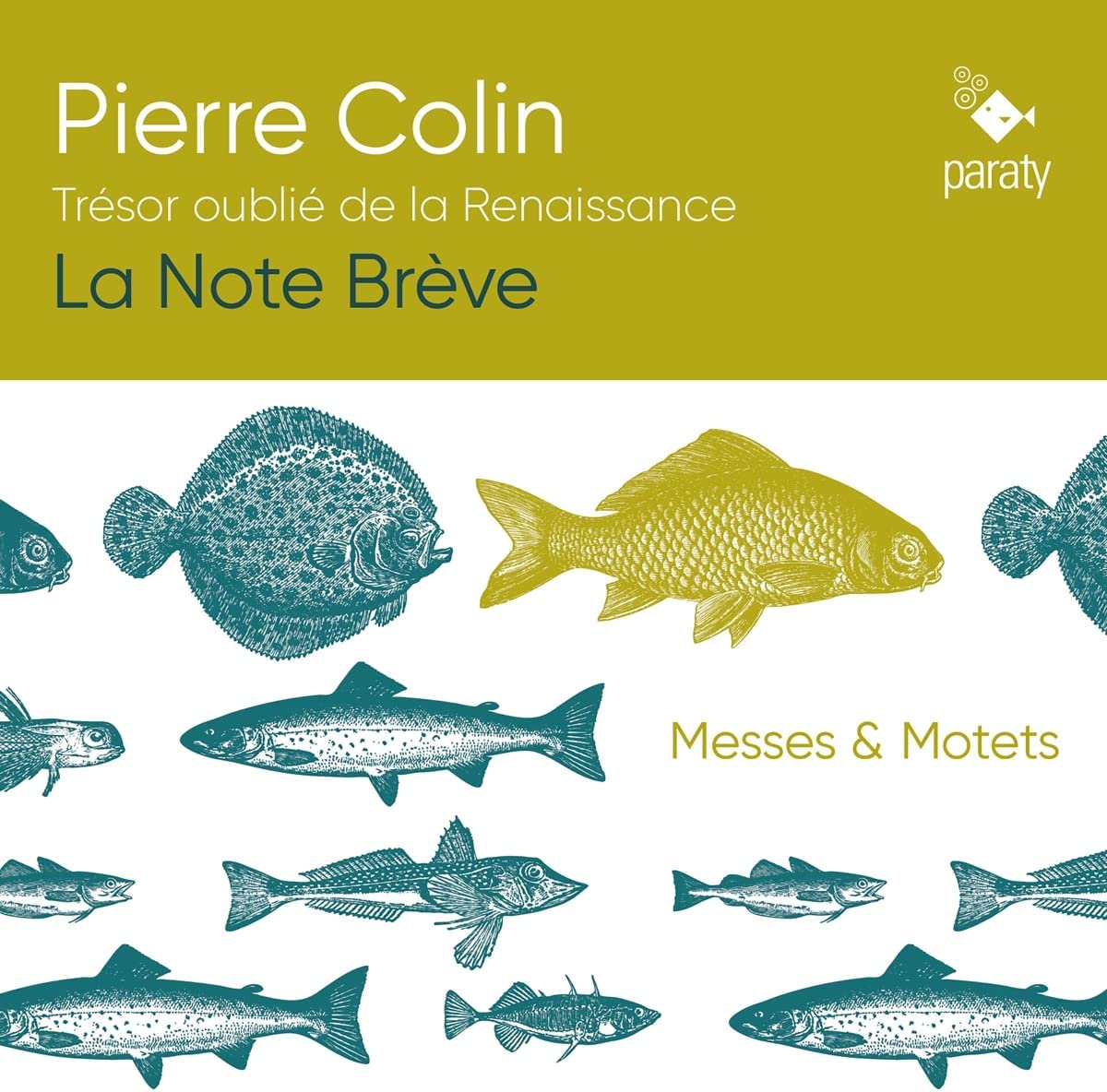
Messes & Motets La Note Brève 57:37 Paraty 7221120
Simon Gallot and his ensemble have done us a favour in introducing the neglected work of this mid-16th-century Burgundian composer. Although he seems to have spent his life in the relative musical backwater of Autun, Colin was scrupulous in seeing that much of his music made it to print. Still, while copies found their way into many of the great establishments of Europe, the music was often anonymous, and despite his best efforts Colin’s name lapsed into obscurity. His settings of the Mass and his motets, as well as his chansons, represented here by a performance on organ of L’oeil dict assez, are firmly in the mid-century style of the likes of Claudin. In tutti sections, the voices are accompanied by organ, an approach which suits the generally simple counterpoint rather well – the programme note suggests that Colin’s style is slightly more adventurous than the standard Parisian style of the period, with a greater tolerance of dissonance, but I can’t say that I was aware of this. However, Colin has a distinctive idiom and a thorough grasp of harmonic progressions and imitation, which means that this music is rarely dull. La Note Brève is a happy blend of male and female voices, producing a mellow sound and singing expressively. In their pursuit of authenticity, including convincing period pronunciation, this group belongs in the worthy tradition of French exploration of early choral music.
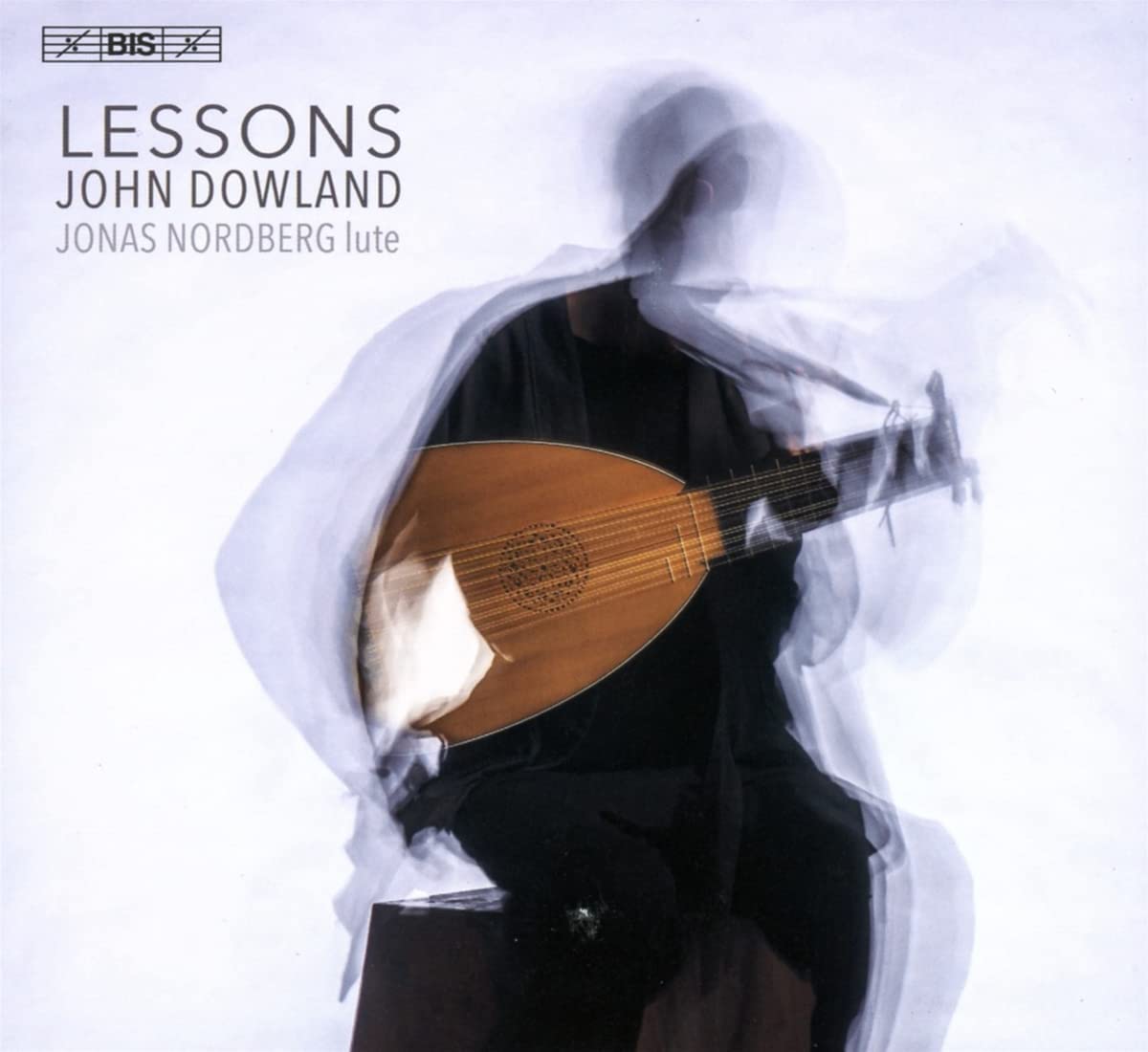
From the first few notes of this CD it is clear that Jonas Nordberg sets out to put his own gloss on well-known music by John Dowland (1563-1626). He begins with Dowland’s Prelude, playing at quite a slow speed, taking liberties with the rhythm, adding a few more ornaments than were in the unique source (Margaret Board’s lute book), and exaggerating the briskness of repeated high notes towards the end. There follows A Fancy (Poulton 73) which opens with a theme similar to “All in a Garden Green”, and develops many contrasting musical ideas – little four-note rising scales overlapping each other, the introduction of a new theme which shares the first four notes of the opening theme, more rising scales but with a quaver followed by six semiquavers, a lengthy tremolo passage, and rounding off with Dowland’s characteristic alternation of tonic and dominant chords before the final grand 6-note chord. Nordberg wisely does not add a chord at the end of bar 19 as suggested by Diana Poulton, since this would interfere with the theme reiterated in the bass.
For The Frog Galliard Nordberg creates a gentle mood, perhaps thinking of the words “Now oh now I needs must part”. However, those words, supposedly for the Duc d’Alençon leaving Queen Elizabeth after a failed courtship, were probably loaded with sarcasm, and a happier mood might have been more appropriate. Who is to say? One thing I do like about Nordberg’s performance of this piece is his ornaments of which there are many. Some match Poulton’s edition, no. 23a, others are his own, but they are all most convincing. It is Nordberg’s use of ornaments and imaginative little touches of his own, which bring Dowland’s music to life.
A good example of Nordberg’s little touches comes at the end of Lady Hunsdon’s Puffe. There is a rising scale in parallel tenths, where each note of the treble is followed by a note a third higher before moving on to the next tenth; this means that the treble has a succession of rising thirds in quavers. On the repeat Nordberg introduces a fast passing note between each of these thirds – such a simple idea, but a pleasant surprise which put a smile across my face.
The title of the CD is Lessons, meaning pieces to be learned. Nordberg gives a good account of five pieces from Robert Dowland’s Varietie of Lute-lessons (1610): Galliards for Queen Elizabeth, the King of Denmark, and the Earl of Derby, John Smith’s Almain, and Fantasie (Poulton 1a).
An important aspect of English music at this time, whether for lute, virginals or other instruments, was the writing of variations on simple folk melodies. Dowland’s variations on “Loth to depart” are a fine example of this, with a wealth of musical ideas displaying the expressive capabilities of the lute. In contrast is Dowland’s simple setting of Orlando Sleepeth, which is a short piece with no ornaments or decorated repeats. Nordberg plays it through with some decoration of his own, and then again with more embellishment.
For Solus cum Sola Diana Poulton used the setting in the Ewing lute book, but Nordberg instead turns to the setting in Cambridge University Library, Dd.2.11. The last strain appears only once in the manuscript, so Nordberg repeats it with his own tasteful additions. In another pavan, Semper Dowland Semper Dolens, Nordberg creates a suitable melancholic mood, but I am puzzled by the penultimate chord of the second strain. The Ewing lute book has d’ and b, and the Weld lute book has f’ and d’. Either is fine, but Nordberg plays f’ and b creating a diminished fifth, which cannot be right.
Nordberg plays a nine-course lute strung in gut, with a string-length of 65 cm tuned to g’ at A=392. It was built by Lars Jönssen. In modern times it has been common to tune lutes to g’ at modern pitch (A=440), which requires a smallish lute with a string-length of 60 cm, and which can sound a bit tinkly. Nordberg’s larger lute is effectively tuned a tone lower, giving a richer, warmer sound, which is ideal for Dowland’s lute solos.
The number seven and multiples of seven seem to have been important for Dowland. There are 21 songs in three of his four printed collections of songs (The Second Booke has 22), 21 instrumental pieces in Lachrimae [1604] of which the first seven pavans are seven different Lachrimaes, and 42 lute solos in Varietie of which there are seven of each of the six genres represented. His setting of “Loth to depart” consists of seven variations. Significantly Robert Nordberg’s CD has 21 tracks.
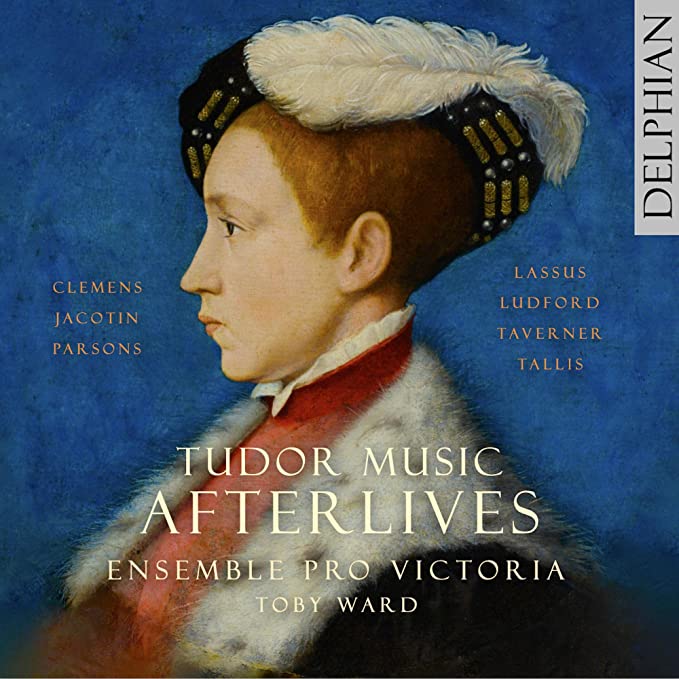
Ensemble Pro Victoria, conducted by Toby Ward, Magnus Williamson, organ. Toby Carr, lute 69:27 Delphian DCD34295
This is Ensemble Pro Victoria’s successor to their rewarding recording of music celebrating the quincentenary of Fayrfax, which I reviewed. And a very successful successor this album is too. The premise on which it is based might seem a tad academic, but it produces a fascinatingly varied yet coherent programme of music, containing some staggeringly fine pieces, excellently performed.
All these pieces are caught in their afterlife, and are presumed or known to have had a prior existence. There are several strands to this programme: “extreme” reconstructions of some of Sheppard’s many fragmentary psalm settings; reconstructions of sections of longer motets that survive only as solo songs with lute accompaniments; a reconstruction of a partsong by Robert Parsons – the stunningly beautiful When I look back – from isolated partbooks and a lute intabulation; Continental motets and chansons that have made their way over to England; excerpts from Ludford’s Lady Masses; two motets with only Elizabethan attributions to Taverner, who died over a dozen years before she ascended the English throne; and a famous work by Tallis – successively a fantasia, O sacrum convivium and finally (among other contrafacta) I call and cry – that seemingly began life as an instrumental work for a consort of viols, with an afterlife serving both the Roman and English Churches.
Musically the most interesting works are the two attributed to Taverner and the motet by Clement. It is unlikely that anyone listening to a “blind tasting” of Quemadmodum would guess that it is by Taverner; indeed, of its five surviving sources, two are anonymous, one ascribes it to Tye, and the other two to Taverner. All these sources are Elizabethan, and none provide any text beyond the initial word. The text of Psalm XLI can be fitted to the notes, so it is reasonable to conclude that it was composed as a motet but was performed instrumentally during its Elizabethan afterlife. What is beyond dispute is that it is one of the most strikingly beautiful works from the Tudor period. In the same class is O splendor gloriae which has Elizabethan ascriptions both to Taverner alone and jointly – respectively the first and second sections – to him and Tye (that man again!). It seems credible that the latter is accurate: either a work on which the two composers agreed to collaborate, or one that Taverner left unfinished and Tye completed; it is even possible that two independent compositions were at some point yoked together, as for instance seems to be the case with the two parts of Byrd’s anthem Arise O Lord/Help us O God albeit they are by the same composer. Clement’s Job tonso capite simply illustrates why he is among the finest composers of his own and of all time.
Musicologically the most interesting works are the five settings by Sheppard of Sternhold and Hopkins’ metrical psalms. These will be published in the forthcoming volume of Sheppard’s complete vernacular music in Early English Church Music, edited by Stefan Scot. Except in one case, only the upper voice of the original four survives for each of these 48 pieces, but the “extreme reconstruction” by Magnus Williamson mentioned above has produced five credible pieces of music for this disc. Given the constraints of a CD booklet it is good that Magnus has been able to summarise the process of reconstruction for each individual psalm. Meanwhile in the Mulliner Book there is an arrangement for keyboard of Sheppard’s setting of Psalm I, The Man is Blest, which, in the words of Stefan Scot, “permits a reconstruction and indicates something of the style of the remaining choral psalms.” Academia Musica Choir, conducted by Aryan O. Arji, recorded all of Sheppard’s Collected Vernacular Works on two discs (Priory PRCD 1081 and 1108, 2013 and 2015) and The Man is Blest is the first track on volume II. Mulliner’s arrangement is played on the organ by Michael Blake (who is scandalously uncredited!) on volume I, track 8.
The two Kyrie movements from different Lady Masses for three voices by Ludford perhaps fall within the category of worthy, albeit pleasantly so, and are enhanced by verses played on the organ by Magnus Williamson employing authentic methods of improvisation on given melodies called “squares”, but the third such movement, Alleluia. Veni electa mea, is, in modern colloquial parlance, an absolute belter, for all its brevity. Like the motet by Clement mentioned above, it illustrates why Ludford takes his seat at the same table as Clement himself, beside Sheppard, Lassus, Taverner, Tye and Tallis, to name only composers present on this disc.
Ensemble Pro Victoria sing all this varied music consistently well, be it plainsong or the augmented forces assembled for O splendor gloriae. I was concerned that the full-throated sound exhibited in some tracks on their disc of Fayrfax might be reproduced here and overwhelm the more understated material. This proves not to be the case. The performances and interpretations, whether assertive, neutral or restrained, are appropriate to each item. Toby Carr’s occasional contributions on the lute with the singers provide both variety of texture and authenticity. The organ played by Magnus Williamson, mentioned above, was built by Goetze and Gwynn in 2002 for the Early English Organ Project, and embodies evidence from fragments of pre-Reformation organs discovered in Suffolk. This combination of cutting-edge scholarship and outstanding performance gives us a recording of the highest quality, apt for edification and pleasure.