Categories
Recording

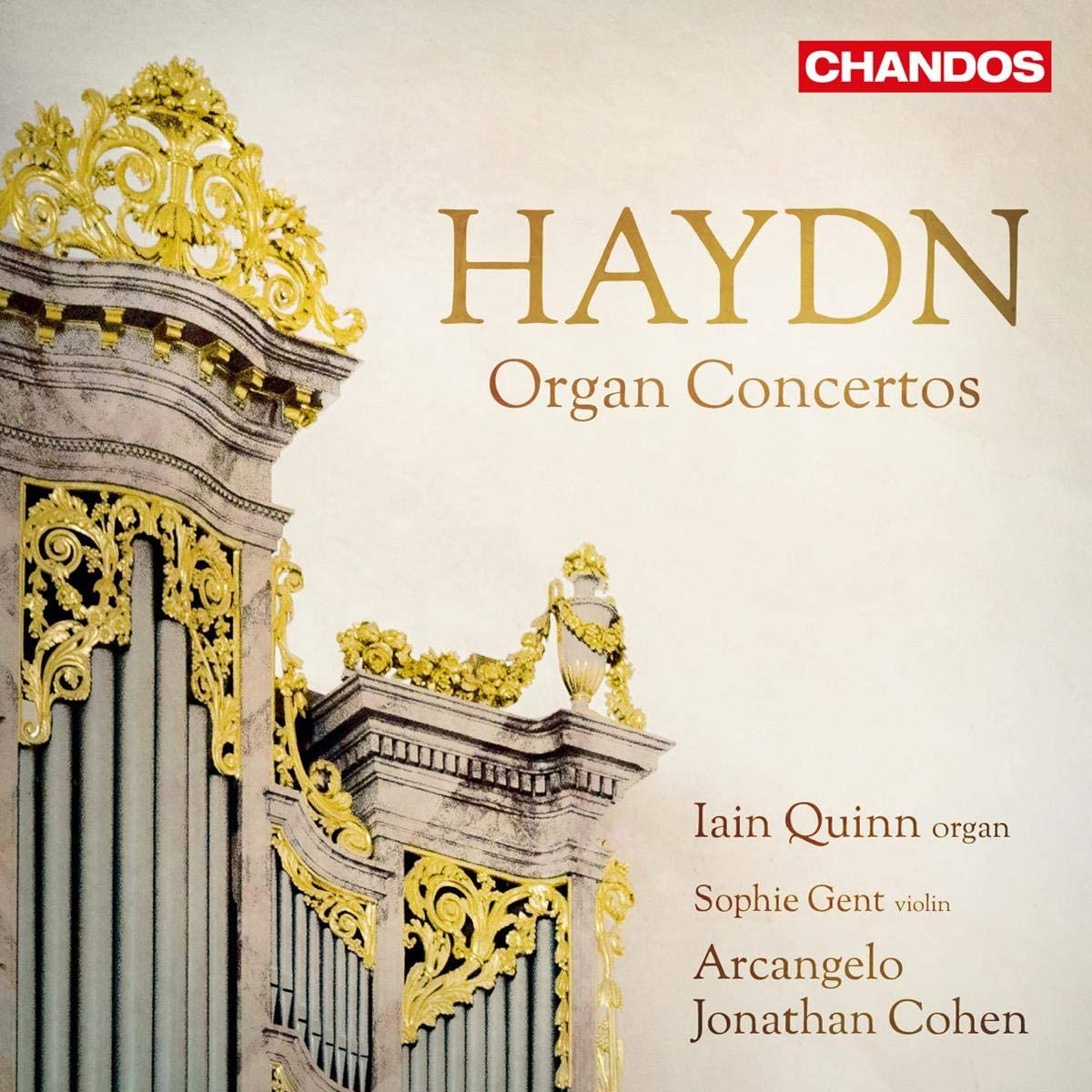
Haydn: Organ Concertos

Iain Quinn organ, Sophie Gent violin, Arcangelo, Jonathan Cohen
69:41
Chandos CHAN 20118

Click HERE to buy this CD on amazon.co.uk

These works date mainly from early in Haydn’s career and were probably written for performance at Esterházy. The modest demands on the organ, just manuals not pedals, mean that the works are all eminently playable on the harpsichord or fortepiano, although the pieces recorded here sound nicely at home on the organ. Particularly charming is a concerto Hob. XVIII:6 for violin, organ and strings in which the two soloists share the spotlight very equally. As the programme note suggests the plausible total of six concertos for organ by Haydn, it is odd that while we have three recorded here, a fourth is available for download – surely we were looking at a potential double album with all the concerti? Arcangelo play modern instruments, although the strings are gut-strung and the bowing and phrasing are of the period. Although this music is very affable, as with much early Haydn I’m afraid I find it rather bland and notwithstanding fine playing from the soloists and the ensemble I found myself drifting off. Lovers of Haydn’s music will warm to this more than I did, and it does fill a useful gap for me in my appreciation of the composer’s early output.

D. James Ross

Categories
Recording

Mendelssohn: String Symphonies Vol. 3

Margot Oitzinger, L’Orfeo Barockorchester, Michi Gaigg
68:58
cpo 555 202-2

Click HERE to buy this CD on amazon.co.uk

For many years Mendelssohn’s ‘string symphonies’ were dismissed as juvenilia, but in the case of a prodigious genius like Mendelssohn one should be wary of dismissing anything on the grounds of youth. Once they were more frequently performed and recorded, it became apparent that these are as remarkable as much of the composer’s other youthful projects. In these sizzling period instrument recordings the Orfeo Baroque Orchestra take this process of rehabilitation a stage further, bringing out the subtleties of works which turn out to be much richer and more dynamic than hitherto suspected. Bearing in mind the domestic context of their original performance, they use reduced forces (particularly at the lower end) allowing the light to fall on the highly innovative textures the young composer conjures up – take for example the opening section of the slow movement of the 8th symphony where a solo ensemble of violas and cello gives the music the texture of a lugubrious Romantic concerto grosso. Relying on accounts of the initial performances as well as common sense, these versions include a fortepiano playing a sort of continuo. This is highly plausible and in practice utterly convincing. This third volume in what looks like a projected complete account of the string symphonies presents the 8th and 9th symphonies, and as a delightful bonus the substantial Scene for alto and string orchestra ‘Ce vuoi mio cor’ MNV H1, sung expressively and dramatically by Margot Oitzinger. As fascinating as the demanding vocal part are the textures of the string accompaniment. It is exciting to see this music, composed for family matinee concerts chez Mendelssohn around 1825, being taken a little more seriously, and being given thoughtful and technically polished period instrument performances. As they branch out so successfully into the music of the 19th century, is this a group trapped slightly in its over-specific name?

D. James Ross


Categories
Recording

Veracini: Overtures & Concerti Vol. 2

L’Arte dell’Arco, Federico Guglielmo
56:22
cpo 555 220-2

Click HERE to buy this on amazon.co.uk

A slightly younger contemporary of Bach and Handel and younger still than Telemann, Veracini has always seemed to me to invite comparison with the last. Always imaginative and influenced by a range of musical styles, he appears however to lack the final spark of genius which Telemann displays. In fact, Veracini belongs to a whole separate tradition of the travelling violinist virtuoso composer, and both the flamboyance of the composer and the instability of the career are underlined by an anecdote relating how Veracini broke his leg by throwing himself out of a window while on tour. The composer’s more extravagant nature is most in evidence in the two sonatas for violin and continuo recorded here. The D major violin concerto is also a sparkling affair in the post-Vivaldi mode, with lots of virtuosic demands placed upon the soloist. Federico Guglielmo is an able and expressive soloist as well as directing the ensemble extremely effectively. So the present CD offers an interesting cross-section of Veracini’s output, with one major reservation. It is recorded in the Gabinetto di Lettura in Este, and sadly it sounds as if it was recorded in an actual cabinet – the ambience is startlingly immediate, brittle and dead. This an enormous shame as the performances sound really persuasive and technically impressive, but with such a dead acoustic this is not a relaxing listen.

D. James Ross 

Categories
Recording

Handel: Concerti grossi Op. 6 (7-12)

Akademie für Alte Musik Berlin, Bernhard Forck
80:29
Pentatone PIC 5186 738

Click HERE to buy this on amazon.co.uk as an mp3

When I was a child the first vinyl boxed set I bought was the famous Decca recording of Handel’s opp. 3 and 6 by the Academy of St Martin in the Fields – I recently ‘rebought’ it on CD and found to my delight that it stood up very well to the passage of time, with some extremely elegant and unfussy string playing and some deeply funky continuo playing from non other than Thurston Dart. As it happens, my absolute favourite concerto in the set is number 7 with its ‘fugue on one note’, and this new recording of the second half of the set opens of course with this concerto. Although it is the composer’s opus 6, he was already 54 when it went to print – he chose the low opus number with his publisher Walsh to encourage obvious comparisons with Corelli’s op 6 Concerti grosso. Dating as they do from his late middle age, they contain a wealth of material recycled from other pieces as well as music he would go on to ‘repurpose’, and as such they make a superb introduction to the musical world of the composer. So I love the music, but did I love this recording? I liked its crispness in the faster movements and its lyricism in the slower ones, and the playing is never less than polished and elegant. Compared to the ASMF accounts, the slow movements fairly race along, but this is in line with current thinking and the music never sounds perfunctory. If I appear to be almost damning with faint praise, that is probably unfair, but if you record Handel’s op 6 concerti these days you need to have something special to say about the music, and I’m not sure that the present performers have. At the moment, my favourite modern period instrument performance is the 2008 account on BIS by Martin Gester’s Arte dei Suonatori, a beautifully poised and thought-through account of the complete op 6. Would I replace this with the present recording? – I’m afraid not.

D. James Ross


Categories
Recording

Quantz: Flute Concertos

Greg Dikmans flute, Lucinda Moon violin, Elysium Ensemble
70:37
resonus RES10252

Click HERE to buy this CD on amazon.co.uk 

It is important to note that the great theoretician of the Baroque flute, Quantz, author of the seminal Versuch einer Anweisung die Flöte transversiere zu spielen (1752), much consulted by modern period instrument flautists, was also a very fine player himself as well as a talented composer. Quantz lives and breathes the galant (or empfindsam) style, and this sensibility in conjunction with his expertise on the flute produced works, which seem utterly redolent of the mid-eighteenth century. The Elysium Ensemble are entirely in tune with this sensibility, and they give wonderfully eloquent accounts of three of Quantz’s concerti with, as the programme note states it, ‘a bonus slow movement’, the beguiling Cantabile e frezzante QV 5:116. Played on muted strings and with ‘fizzing’ ornamentation, this charming ‘bonus’ in many ways sums up the group’s approach to Quantz’s music generally. A strong sense of melodic line is enhanced by deliciously appropriate ornamentation, while the wonderful sense of ensemble evokes perfectly the original performances of this music by Quantz himself and his colleagues at the Potsdam court. If ever an argument for one-to-a-part performances of concerti were needed, it is here in spades. In addition to providing some exemplary Baroque flute playing, intelligent and deeply moving, Greg Dikmans also supplies a very erudite programme note, which concentrates on applying Quantz’s theories of playing to his own music, while astutely leaving the biographical details to the group’s website.

D. James Ross

Categories
Recording

Baroque

Amsterdam Bach Soloists, Capella Tibernia, Collegium Pro Musica, Concerto Köln, Ensemble Arte Musica, Ensemble Cordevento, Ensemble Violini Capricciosi, Gewandhausorchester Leipzig, Insieme Strumentale di Roma, L’Arte dell’Arco, Musica ad Rhenum, Musica Amphion, Rundfunk-Sinfonie-Orchester Berlin, St Christopher Chamber Orchestra, Stuttgarter Kammerorchester, Virtuosi Saxoniae
25 CDs
Brilliant Classics 95886

Click HERE to buy this set on amazon.co.uk

Doubtless there will have been some raised eyebrows while reading the “cast list” of this collection of music that includes discs dedicated to (in numerical order!) Albinoni (1), Bach (2-5), Corelli (6-7), Couperin (8-9), Handel (10-12), Locatelli (13-14), Marcello (15), Purcell (16), the Sammartinis (17), Alessandro Scarlatti (18), Telemann (20-22) and Vivaldi (23-25). My random selections (literally picked blind) were some truly lively and engaging accounts of Corelli’s op. 6 concerti from 2004 by Musica Amphion under Pieter-Jan Belder (7), an equally enjoyable disc of Marcello (proving that the ubiquitous oboe concerto is far from the only nice piece he wrote) by the Insieme Strumentale di Roma (10), a rather confusing disc of Bach violin concertos in which the stylish (earlier) recordings by the Amsterdam Bach Soloists were followed by a (later) rather stodgy account of BWV1043 with the Leipzig Gewandhaus (4) and, finally, Concerto Köln’s version of Handel’s Water Music in which the brass players seemed to be competing for the title of “Most Audicious Ornamenter”. I can see how a set like this might be useful for libraries or for school teachers who want to introduce children to baroque music, but it is something of a curate’s egg; the word “instrumental” might usefully have been deployed on the exterior of the box, too, since there is no vocal music in the set at all.

Brian Clark

Categories
Recording

Haydn 2032 No. 8 – La Roxolana

Il Giardino Armonico, Giovanni Antonini
Symphonies 28, 43, 63 + Anonymous (Sonata jucunda), Bartók (Romanian folk dances)

Click HERE to buy this on amazon.co.uk

Not the least of the pleasures of this exhilarating series has been the works supplementing the Haydn symphonies, invariably to some (at times tenuous) thematic purpose. This time we are given perhaps the most surprising to date, the set of Bartók’s seven tiny Romanian folk dances originally for piano, but orchestrated by the composer in 1917. So if you’ve ever wondered what Bartók sounds like on period instruments, now’s your chance. The results are nothing less than electrifying, given the virtuosity and verve of Antonini’s superlative players, whether in the scrunchy chords of no. 1, the rubato brought to no. 2, the wistful no. 4, with its plangent violin solo, or the extraordinary sound of Giovanni Antonini’s Renaissance flute in no. 3. All is explained in his notes, devoted to what Antonini describes as ‘the birth of crossover’, or music from traditions other than so-called ‘classical music’.

Also falling into this category is the anonymous Sonata Jucunda (‘cheerful sonata’), a manuscript from the important collection housed in Kromĕříž Castle in Moravia, which also includes the manuscripts of a number of Haydn’s works. Composed in the style of Biber, it includes eleven brief connected movements that evolve from a solemn opening adagio to incorporate traditional music from the Haná region of Moravia, some sections given a delightfully quirky character.

The earliest of the three Haydn symphonies is No. 28 in A, a modestly scored work that dates from 1765. H. C. Robbins Landon conjectured that it originated as incidental music for a play presented at Eisenstadt in that year, an idea expanded by the notes for the present CD, which suggests the comedy Die Insel der gesunden Vernunft (The Isle of Common Sense) as the source. The opening Allegro certainly has a feel of barely suppressed excitement before eventually breaking out in the full orchestra, while the Poco Adagio suggests a nocturnal walk. Robbins Landon believes it could have served as an entr’acte. Symphony No. 43 in E-flat, nicknamed ‘The Mercury’ in the 19th century for no discernable reason, dates from 1770. It opens with a strongly announced chord, answered by sotto voce strings before proceeding to an animated Allegro bristling with tremolandi. The Adagio is wonderfully atmospheric, a lyrical musing that in its second half moves to a world of introspection. If No. 28 can conjecturally be linked to a stage work, no such doubts arise with Symphony No. 63 in C, the work that gives this volume its name. Composed around 1779/80, it is one of several composite symphonies from that period. The affable opening Allegro is taken from the overture to the comic opera Il mondo della luna, composed in 1777, while the nocturnal theme of the succeeding set of variations, ‘La Roxelana’ comes from incidental music for a play given at Ezsterháza in which the French lady of the title wins the favour of the Turkish emperor Suliman in the face of competition from two other ladies. The bustling Presto finale again has the feel of theatre.

All this music is played with dynamic panache, along with the sensitivity and delicacy all noted as characteristics of earlier issues. With well-judged tempos and acute balance enabling part-writing to be revealed in translucent textures, these are performance that convey a spirit of fresh spontaneity, while at the same time giving full value to every single bar.

Brian Robins

Categories
Recording

Vivaldi Con amore

Tafelmusik Baroque Orchestra, Elisa Citterio, dir
75:25
Tafelmusik TMK1039CD

For nearly forty years Tafelmusik, Canada’s leading period instrument orchestra, was directed by violinist Jeanne Lamon, but in 2017 she was succeeded by another woman violinist, the Italian Elisa Citterio. The present collection of Vivaldi concertos marks Citterio’s recording debut with the orchestra, and it is interesting to find that on the basis of it she has already put a strong individual mark. Citterio’s background includes work with all the major Italian period instrument orchestras and there are times here when we might almost be listening to Accademia Bizantina or Il Giardino Armonico. There is the same nervous, at times spiky, intensity brought to Vivaldi’s allegros, the same grand sweep to ritornellos, the same relishing of long cantabile lines, and the same careful dynamic gradations. Yet even in writing that I’m conscious of being slightly unfair to Citterio, since one of the principal positives of this outstanding set of performances is that they reveal she has a strong musical personality. There is hardly a routine moment here, no mean achievement when it comes to a batch of Vivaldi concertos. Take for example the popular Lute Concerto in D, RV 93, hardly a masterpiece and a work that can easily outstay its welcome. Superbly played throughout by Lucas Harris, the opening movement is here given an understated delicacy that introduces an unexpected aura of mystery. The following Largo is taken very slowly, but enriched by decoration from the soloist that gives the movement an improvisatory freshness, while the final movement is again unassertively presented, but distinguished by the precision of Harris’ fingerwork.

This freshness of approach is a feature of the whole programme, which has been well planned to include a diverse set of concertos that allows some of Tafelmusik’s outstanding players an chance to shine. Thus in addition to the lute concerto we are given violin concertos in C minor (RV 761), known as ‘Amato bene’, and E major, the well-known ‘L’amoroso’ (RV 271), the 4-violin Concerto in B flat, RV 553, a double oboe Concerto in C, RV 534, a bassoon Concerto in D minor, RV 481 and the Concerto in D for 2 violins and 2 oboes, RV 564a. The programme is completed by the overture to the opera Ottone in villa (Venice, 1713).

Among these works, the two minor key concertos are exceptional. The nervous intensity and restless spirit of the opening Allegro of the C minor Concerto are splendidly captured by Elisa Citterio, while the filigree of the marvellous central Largo, taken rather too slowly, is spun with affectionate elegance and the final Allegro played with a bright edginess that does not exclude moments of fantasy and bizzarrie also apparent elsewhere in Citterio’s playing. The bassoon concerto is another outstanding work, played quite superlatively by Dominic Teresi. In the opening Allegro the soloist alternates the slighty mournful tones unique to his instrument with gurgling passage work, while the chromatic dissonance of the succeeding Larghetto, a quasi accompanied recitative and love-sick aria, reaches depths of profound desolation.

My only reservations concern the tempo of largos; it is odd to find Citterio taking the Adagio non molto central movement of RV 564a at a faster tempo than most of them, while the familiar Italian fondness for over-intrusive plucked continuo is here particularly annoying in the central Largo of RV 553. Tafelmusik’s CD production people might also care to consider rather better notes than the scanty generalised effort included here. None of that detracts from the fact that this is the most stimulating and thought provoking CD of Vivaldi concertos I’ve heard in some while.

Brian Robins

Click here to buy the CD on amazon.co.uk.

Categories
Recording

Bach: Violin Concertos

Kati Debretzeni, English Baroque Soloists, John Eliot Gardiner
70:15
Soli Deo Gloria SDG732

On this accomplished CD, Kati Debretzeni, the leader of the English Baroque soloists among other things, plays the violin concertos in A minor (BWV 1041) and E major (BWV 1042) as you would expect and then adds two reconstructions drawn from the harpsichord concertos – a new version of BWV 1053 transposed down a tone into D major with its singing siciliano middle movement and a version of BWV 1052 in D minor, which has long been posited as a violin concerto in origin.

Debretzeni recalls the moment in the Bach Cantata Pilgrimage of 2000 when the beautiful Trost organ in the Schlosskapelle in Altenburg that Bach had played and commented on developed a fault and they had to fit in a recording of BWV 146 the next morning before flying home. The first two movements of Cantata 146 with obbligato organ form part of what Bach used again in BWV 1052. A version of the final movement is in Cantata 188. She also reflects upon the large number of violin obbligati in the church cantatas with pleasure and clearly the interplay between these various sources has informed her judgment of how to reach back behind the decisively keyboard-style passagework with its built-in bass line to a plausible violin original which needs a reconstructed basso continuo.

I enjoyed her playing as much as her editorial additions and decisions. Spirited and rhythmically infectious, she is well served by her 3.3.2.2.1 colleagues from the EBS and the beautifully judged continuo playing of James Johnstone. The slow movements never loose momentum – how easy it is to degenerate into a maudlin self-indulgence – while the outer movements never collapse into a scramble. They are helped by the wonderfully warm acoustic of St Jude’s, Hampstead Garden Suburb where they recorded.

Like Debretzeni, I hope that her versions find their way into the repertoire of many violinists. Bach did not only quarry his ‘instrumental’ work for concerto movements but used material from the cantatas, whether sacred or secular, to provide the sounds of heaven, and from the number of recordings of ‘arrangements’ appearing now, I can see that the process of re-inventing Bach’s multiple versions is set to continue. When they are in the hands of players so immersed in the whole oeuvre as this, we have a good deal to look forward to.

David Stancliffe

Click HERE to buy this CD on amazon.

Categories
Recording

J B Bach: Orchestral suites

Thüringer Bach Collegium
82:22
audite 97.770

These four suites by Johann Sebastian’s second cousin and near contemporary display his skill and invention. Cast in the form of suites with a series of dances, some movements feel more like concerti so close are they to the Italian and French models current in the cultured courts of the principalities of central Europe, where French cuisine and dress and Italian music were known.

From 1703, Johann Bernhard held the post of organist in Eisenach till his death in 1749, overlapping between 1708 and 1712 with Telemann. He was also harpsichordist to the admired court orchestra of Duke Johann Wilhelm of Sachsen-Eisenach.

J. S. Bach had copied out at least three of these suites for the Collegium in Leipzig, and it is because of this set of parts that Johann Bernhard’s music survives. The two Bachs were cross godparents to each other’s children, and Johann Bernhard’s ease with the French as well as the Italian style gives us an interesting glimpse of the cosmopolitan nature of this small Saxon court.

The competent players of the Thüringer Bach Collegium use single strings plus the director, Gernot Süßmuth’s solo violin and muster two oboes, a taille and fagotto, and one is heard playing recorder and traverso.

The performances are snappy, and sometimes a little rustic – some slapping of the instruments from time to time; but the major and in the end irritating fault is that the kontrabass is either miked far too closely or else just plays insensitively. With single strings, I would have been quite content with a violone or bass violin at 8’ pitch, but a substantial double bass thumping away – frequently joined by the harpsichordist’s lute stop – is an error of judgment and doesn’t blend with the rest of the band as it should.

The music was recorded in the Georgenkirche in Eisenach and from the photo in the booklet the players were standing just east of the font in which JSB was baptised. The essay (in German and then in English) on where this music fits into the high Baroque in Saxony is admirably informative. But there is no information on instruments or temperament, which would have been a plus. The ensemble has already recorded concerti by Prinz Johann Ernst von Sachsen-Weimar on the same label, and is clearly performing a notable service in making this kind of court music available to a modern audience.

The music is novel, fills a gap in our understanding of court life in the early 18th century and is tuneful as well as original. If you can bear the kontrabass, you will enjoy this music.

David Stancliffe

Click HERE to buy this CD on amazon.