Categories
Recording

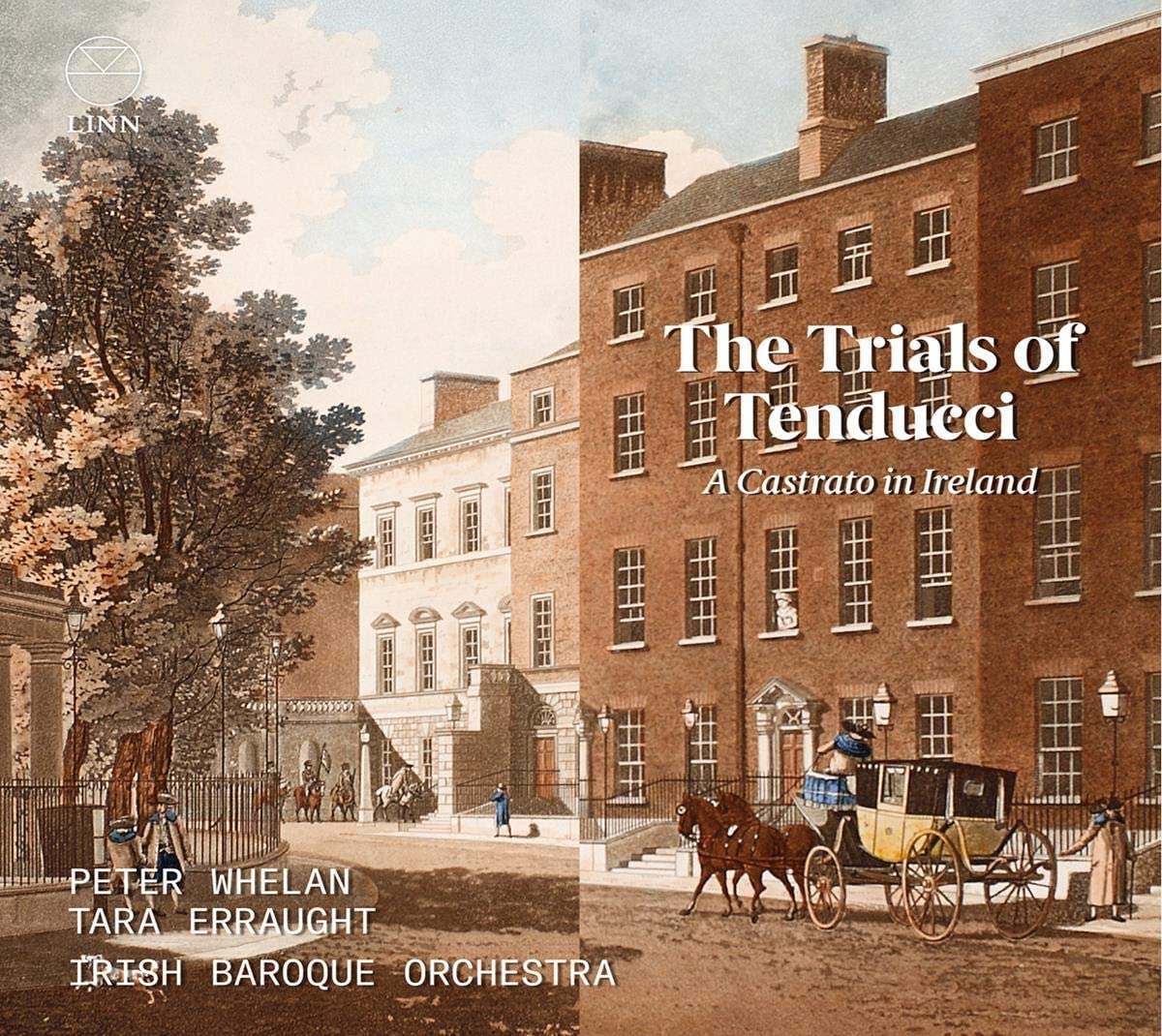
The Trials of Tenducci

The Trials of Tenducci
A Castrato in Ireland
Tara Erraught mezzo-soprano, Irish Baroque Orchestra, Peter Whelan
65:57
Linn Records CKD 639
Music by Arne, J. C. Bach, Fischer, Giordani, van Maldere & Mozart

Click HERE to buy this on amazon.co.uk
[These sponsored links help keep the site alive and FREE – go buy it!]

The soprano castrato Giusto Ferdinando Tenducci, born in Siena around 1735, led a life that was colourful even by the standards of his profession. Jailed for debt on more than one occasion, he held a magnetic appeal to women, an attraction that led to a notorious scandal when he married a young pupil in Dublin. After spending the earlier part of his career singing minor roles in such European centres as Milan, Naples, Venice and Dresden, Tenducci arrived in London in 1758. There, following his first spell in a debtors’ prison, he created the role of Arbaces in Thomas Arne’s English opera seria Artaxerses in 1762, a success he later repeated in both Dublin and Edinburgh. Particularly well regarded in lyrical music, Tenducci spent his later years in London, Dublin and Italy, where he died in Genoa in 1790.

As the title suggests, this pleasing CD sets out to give a musical snapshot of Tenducci’s connections with Dublin, even if somewhat tenuously at times  – Mozart’s Exultate, jubilate seems to have gained admission solely by dint of the fact that he wrote a now-lost scena for Tenducci when in 1778 the latter met Mozart in Paris in the company of their mutual friend, J. C. Bach. It is given a very capable performance by mezzo Tara Erraught, whose attractive tone and warmth are heard to particular advantage in the second aria (‘Tu virginum’), where we even get a cadential trill, though the continuous vibrato may be more to the taste of general listeners than early music enthusiasts. But she copes well with the coloratura of the first aria and ‘Alleluia’ and as throughout the programme is accompanied neatly, if in quicker music rather clipped fashion, by the IBO.

A more direct connection with Dublin can be found in the brief and agreeable if not especially distinctive three-movement Symphony in G by the Belgian Pierre van Maldere, a leading figure in the Fishamble Street concert series between 1751 and 1753. The inclusion of extracts from Artaxerses, which ran for a record 33 performances in Dublin, was obviously a given, as were the two arias of Arbaces chosen, the bravura ‘Amid a thousand racking woes’, which Erraught doesn’t always have fully under control in the upper register, and the show’s hit number, ‘Water parted from the sea’, sensitively done, if not entirely without diction problems.   

Tommaso Giordani was another Italian to spend considerable time in Dublin, having been part of a touring opera family that first visited in 1764 and then again in the 1780s, when he founded an opera company that went bankrupt. Two of Giordani’s songs that were particularly associated with Tenducci are included, along with his three-movement overture to the pantomime The Island of Saints (1785). The final movement is a rumbustious medley of traditional Irish jigs and reels, here despatched with great aplomb by the IBO. Another popular Irish melody, ‘Gramachree Molly’ forms the theme for the set of variations that concludes J. C. Fischer’s Oboe Concerto No 7 in F, here very well played by Andreas Helm. Another opera premiered by Tenducci, Mortellari’s Arsace (Padua, 1775) includes a scena consisting of a strongly declamatory accompagnato and aria later adapted for and dedicated to Tenducci by his friend J. C. Bach. It is capably sung by Erraught, though director Peter Whelan’s flowery fortepiano continuo arpeggiations in the recitative are to my mind not in the best taste.

All in all, the CD is an interesting, well-performed showcase of music in and around Tenducci’s Dublin, albeit perhaps in the final analysis not one likely to set the Liffey on fire. 

Brian Robins
 

Categories
Recording

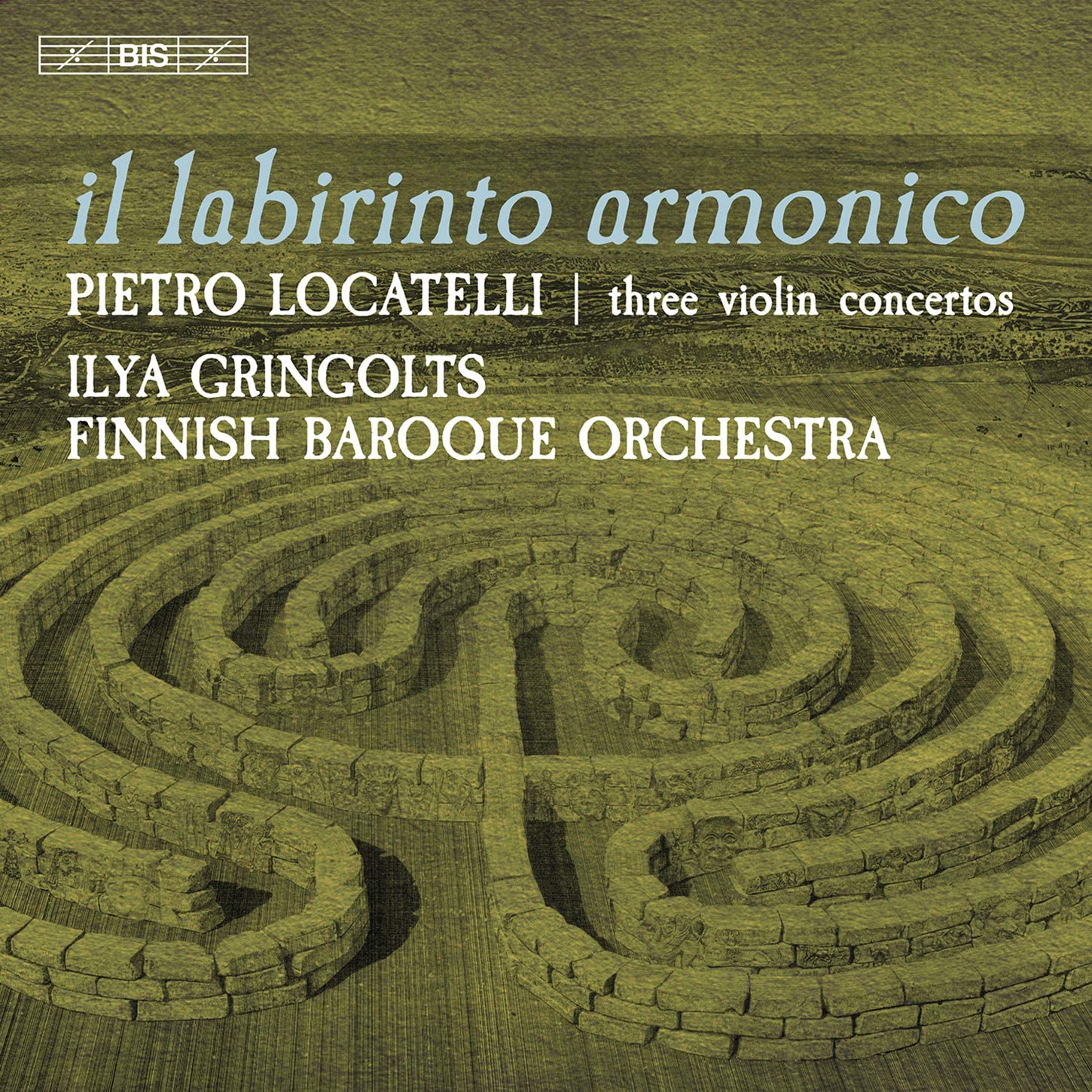
Locatelli: Three Violin Concertos from L’Arte del violino

Ilya Gringolts, Finnish Baroque Orchestra
61:49
BIS-2445 SACD

Click HERE to buy this on amazon.co.uk
[Buying things we review helps keep the site alive and FREE!]

Locatelli’s op 3 violin concertos were composed in Venice, under the influence of Vivaldi and in the shadow of Corelli, under whom Locatelli may even have studied previously in Rome. What is much more interesting than tracing Locatelli’s antecedents, though, is to hear in his remarkable music suggestions of the coming generations, including Paganini and even the Mannheim school. A striking feature of the twelve concerti of the op 3 are the 24 Capricci for solo violin, which the composer integrates into the outer movements of each as showpieces for his own virtuosity. The excellent programme note by Marianne Rônez, however, points out that perhaps our obsession with these startling Capricci unfairly overshadows the beauty of Locatelli’s Largo movements, as well as his adventurous and ground-breaking use of harmonic progressions – it is a very fair point. Soloist and director, Ilya Gringolts, produces exciting and profound readings of Locatelli’s music, and he is very ably supported by the Finnish Baroque Orchestra in the 9th, 11th and 12th concertos of the set.

D. James Ross

Categories
Sheet music

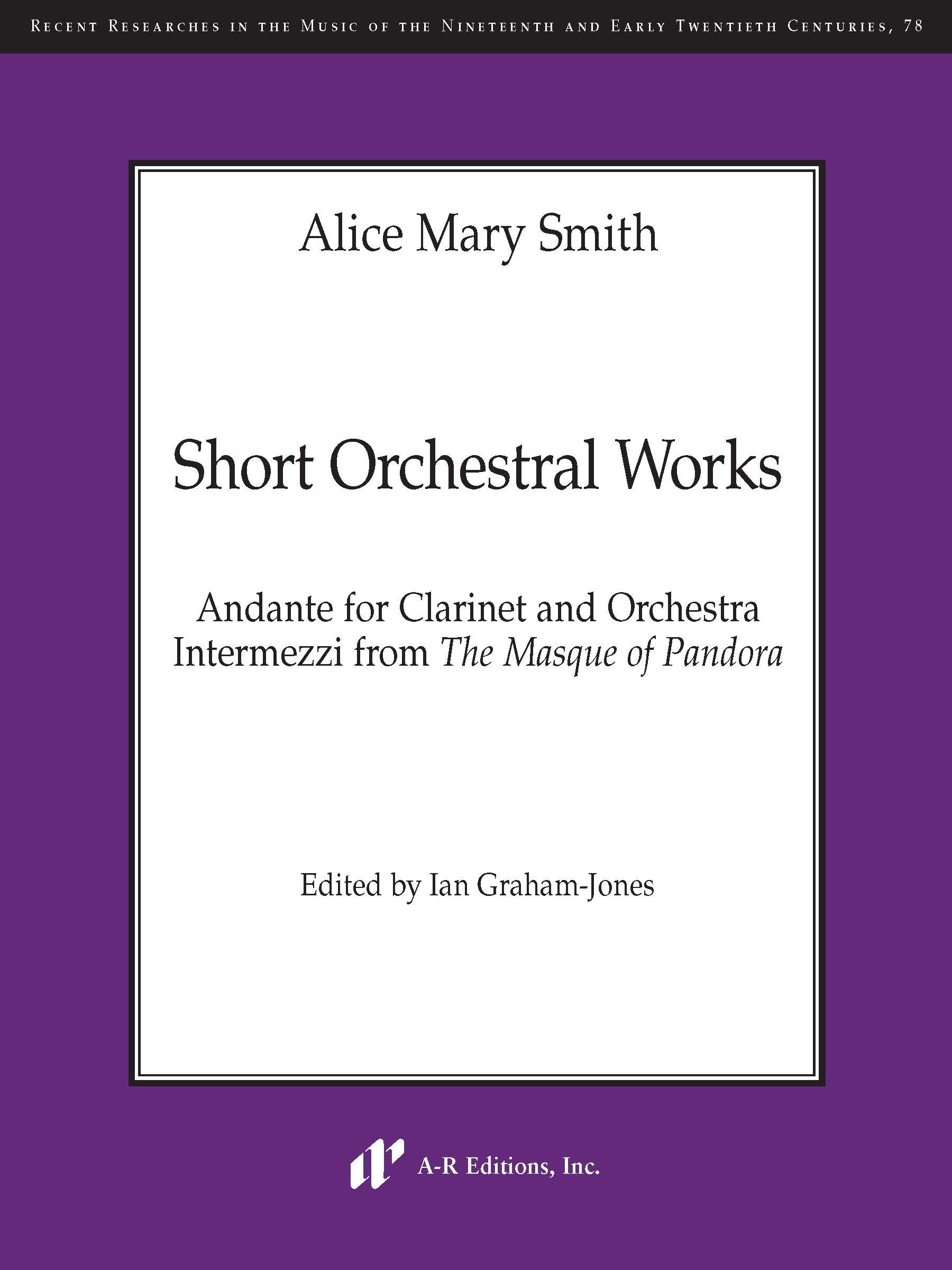
Alice Mary Smith: Short Orchestral Works

Andante for Clarinet and Orchestra, [2] Intermezzi from The Masque of Pandora
Recent Researches in Music of the Nineteenth and Early Twentieth Centuries, 78
Edited by Ian Graham-Jones
ix, 2, 65pp. ISBN 978-1-9872-0452-0. $144

This is the latest of several volumes Ian Graham-Smith has devoted to Alice Mary Smith. An acknowledged expert on the lady and her output, his introduction to these three works is positively bulging with background information.

The clarinet solo began its life as the middle movement of a sonata with piano. The dedicatee and original performer, Henry Lazarus, commissioned the orchestration and played it with universal approbation. Whether or not the composer (who had also been the “accompanist” at its premiere) ever produced a full concerto (as it is described in at least some of the press coverage of performances) is unclear.*

The two intermezzi also originated in a larger work, this time a “grand choral cantata” setting words by Longfellow. “After the storm”, an Andante movement moving from common time into 9/8 then back again, was transposed from its original B flat minor down a semitone to facilitate a more gentle segue into “In the garden”, which is in A major and 9/8.

These are, indeed, brief pieces – at 148 bars, the clarinet solo is longer than both of the others put together. Yet, there is a charm to all three (and not a little virtuosity about the Andante for clarinet!) which makes them ideal introductions to the composer and her music.

Brian Clark

* The publisher also lists two parts for clarinet and piano of just this work for $10.

Categories
Recording

Mozart: Serenades


Capella Savaria, Nicholas McGegan
69:30
Hungaroton HCD 32850

Click HERE to buy this on amazon.co.uk

These performances of the Haffner Serenade K250/248b and the Serenata Notturna K. 234 are part of the complete recording of music by Mozart for solo violin and orchestra played by Zsolt Kalló and the Capella Savaria. As the relatively low Köchel numbers suggest, these are works from Mozart’s Salzburg period, but already the young Mozart seems dissatisfied to write conventional Unterhaltungsmusik, incorporating unexpected movements featuring solo violin, which he may well have played himself. One of these is the perky trio to a darkly foreboding minuet, which would not be out of place in one of the late great symphonies. It is not difficult to picture the young genius already chafing at the bit of his conventional role in Salzburg and longing for the challenges of Vienna. The Bartók Concert Hall in Szombathely provides a nicely resonant acoustic for some delightfully idiomatic playing from the Capella and their soloist. Celebrating its 40th anniversary this year, the Capella Savaria was the first period instrument group in Hungary, and has traditionally harnessed the innate talents of this very musical nation in the service of period performance.

D. James Ross

Categories
Recording

Edinburgh 1742: Barsanti & Handel, Parte Seconda

Ensemble Marsyas, Peter Whelan
51:51
Linn Records CKD 626

Click HERE to buy this on amazon.co.uk

This is the second of a pair of CDs evoking the lively world of the 18th-century Musical Society of Edinburgh and bringing us the balance of Barsanti’s op 3 Concerti Grossi, those featuring solo trumpet and two oboes, as well as another four of his Old Scots Tunes and music by Handel. Barsanti’s treatment of the wind instruments in these Concerti Grossi, published in Edinburgh in 1742 just before the Jacobite Uprising, sounds very classical in style, alternating them as a section augmented by timpani with the strings. Perhaps more innovative still and unexpected are the more structurally free slow movements. The four Old Scots Tunes are charmingly played by Colin Scobie – a member of the Maxwell and Fitzwilliam Quartets, in encore slots Colin frequently demonstrates his considerable traditional fiddle skills, and these are very much to the fore here as he is joined by Elizabeth Kenny on the Baroque Guitar for stirring accounts of ‘Dumbarton’s drums’, ‘Ettrick banks’, ‘The bush aboon Traquair’ and ‘Cornriggs are bonnie’. Handel’s Overture to ‘Atalanta’ serves to illustrate a very different treatment of the trumpet and indeed a very different style of composition, notwithstanding that Handel and Barsanti were contemporaries and acquaintances. These works by Barsanti, in an edition from Prima la Musica, provide a valuable counterbalance to our sometimes Handel-dominated and London-centric view of the mid 18th century, and it would be interesting to hear accounts of his later publications, which include a set of six motets for five or six voices and continuo (1750) and his Trio Sonatas op 6 (1769). On first listening, I found the recorded sound a little cramped, but then the Musical Society concerts were presented in the ‘upper room of St Mary’s Chapel, Niddry Wynd’ until 1763 when they moved into the superb surroundings of St Cecilia’s Hall. At any rate, I soon adapted my ear, and the amount of detail captured in the recordings is indeed impressive.

D. James Ross

Categories
Recording

Telemann: 3 Overture Suites

L’Orfeo Barockorchester, Carin van Heerden
66:11
cpo 555 389-2
TWV 55: G1, G5 & B13

Click HERE to buy this on amazon.co.uk

Every once and a while, along comes a recording that fires on all cylinders with a special synergy and bubbling musical alchemy, matching the finest ideals of music-making, and presents the dazzling facets of a composer’s subtle, creative nuances and whims.

Here the players of L’Orfeo Barockorchester under Carin van Heerden deploy their boundless energy and polished musicality to great effect, creating some truly wonderful moments of euphonic transport. The well-honed Orchester navigate through Telemann’s many subtleties and scenic changes with seemingly effortless fluency.

The three fairly lengthy suites date from just before or during his time in Frankfurt, offering tremendous scope for the composer’s imaginative musical, operatic esprit. The Frankfurt connection may well be present in TWV55:G5’s “Les Augures” (oracles, portents? – note those shuddering winces! – possibly (bad?) financial omens at the Stockmarket, which stood next to Telemann’s home).  The delightful Rondeau(x) is an addictive Ohrwurm! Normally, a Gigue might close a suite, not here, carrying on until a delightful sweep of no fewer than *three* Menuets. The ravishing kaleidoscopic tour moves on with some arresting slower movements too: Plaintes (B13, G5).

The recorded sound here is just about perfect, every timbral shade is found and heard. Despite the claims, the TWV55:B13 (c1725?) is the only real premiere – G5 came on a slightly earlier Atma CD, and there is a recording of G1 possibly from late 80s?

A highlight of the premiered work, the tender and sprightly interplay of solo violin (Julia Huber-Warzecha), two oboes and tutti, is rather special and gives a very different opening. Placing the gigue in second place is unusuale! Special mention must go to the penultimate movement, given as “affectuoso e molto adagio” or as the oboe part has it: “Cantabile et Affectuoso” a truly captivating duet!

The opening suite (G1 of 1716-25?) opens with an attention-grabbing, curtains-up Overture, after which comes the exquisite quasi-Handelian Air: Document, which made me think, did he hear this and use it elsewhere? (Where’ere ye walk seems a likely candidate…) The other airs all feel like hidden arias or scenic mood music for the Leipzig stage.

All in all, this is a real tour de force, with added Italianate passages for a perfect musical assemblage. L’Orfeo Barockorchester is in excellent form. This is a must for all baroquophiles! Moments of wonder, wistfulness and elegiac tenderness wrapped in entrancing music. Probably my CD of 2020, heart on the sleeve, hand on the heart.

David Bellinger

Categories
Recording

Vivaldi: Concerti per flauto

Giovanni Antonini, Il Giardino Armonico
59:45
Alpha Classics Alpha 384

Click HERE to buy this on amazon.co.uk

These are tempestuous and stunningly virtuosic performances of Vivaldi’s RVs 433, 441, 442, 443, 444 and 445 by one of the finest Baroque ensembles of the moment and one of the most impressive recorder virtuosi. Giovanni Antonini employs a sopranino recorder for the  ‘flautino’ concertos and a treble recorder for the ‘flauto’ ones, both of which he plays with eye-watering skill and musicality, ably supported by Il Giardino Armonico, which he also directs. The playing is so deft and expressive from soloist and ensemble that the listener’s attention is seized at the very opening of the CD and never allowed to wander. The famous concerto ‘La Tempesta di Mare’ has never sounded more exciting, but neither have any of the others! Antonini’s photo on the cover is consciously or unconsciously reminiscent of the younger Franz Brüggen, and none is more entitled to associate himself with this earlier recorder virtuoso. Almost as an afterthought, Antonini takes to the chalumeau for a contrasting account of the rather lugubrious ‘Cum dederit’ from the ‘Nisi Dominus’ RV 608, and annoyingly he’s a pretty good chalumist too! This is an impressive CD in every respect and a useful antidote either to the type of lackadaisical approach you hear sometimes to Vivaldi, or worse still the recent vogue in ‘mucking about’ with his music. These are thoroughly honest accounts and yet breathtakingly effective.

D. James Ross

Categories
Recording

The Mystery of the Natural Trumpet

Krisztián Kováts, L’arpa festante
66:57
cpo 555 144-2
Concertos by Lang, Otto, Riepel, Sperger & Stamitz

Click HERE to buy this on amazon.co.uk

The mystery alluded to by the title of this CD is perhaps why nobody now performs any of the many trumpet concertos to survive from the late 18th and early 19th centuries, with the exception of the ubiquitous concerti by Haydn and Hummel. In many ways, these two concerti are aberrations, composed as they were for the keyed trumpet, and it is fascinating to hear the other concertos here by Johann Stamitz, Johann Sperger, Johann Lang and Johann Otto as well as the Sinfonia by Joseph Riepel written for and performed on the valveless (and keyless) trumpet – it should be said that the instrument used is in the Baroque style but with four finger-holes, which puts it some way along the route to the now ubiquitous keyed trumpet. The solo trumpet playing of Kristián Kováts is simply superb, ranging with flawless tuning and tone over a vertiginous range and he is ably supported throughout by L’arpa festante. It has to be said that the quality of composition here is not of the top level of inspiration – even as a fan of the music of the Stamitz family I would have to admit that they are prone to cliché, and this is also the case with much of the rest of the music here. Coupled with the fact that this period saw the beginning of a process which would lead to the trumpet being emasculated from Baroque magnificence to Classical conformity, I found myself increasingly reliant on the soloist’s virtuosity and musicality to hold my interest. Having said that, it is important to be able to put the Haydn and Hummel concerti in some sort of context, and this repertoire and these performances are never less than enjoyable.   

D. James Ross

Categories
Recording

Sturm und Drang 2

Ida Ränslöv mezzo, The Mozartists, Ian Page
71:39
Signum SIGCG 636
Works by Haydn, Gluck, Vanhal, Mysliveček, J. C. Bach

This is the second in a projected series of seven CDs devoted to the so-called ‘Sturm und Drang’ (storm and stress) movement, in fact not a movement at all but an outpouring of passionate, often turbulent emotional outbursts across literature, music and painting primarily between the 1760s and early 1780s. Although the name stems from literature, being particularly associated with Goethe’s Sorrows of Young Werther of 1774, the music associated with it was mostly composed a decade or more earlier. There appear to be no philological links between the literature and the music, Ian Page’s characteristically informative notes suggesting that Sturm und Drang may simply be a reaction against the charm and gentility of the mid-18th century rococo style.

G minor was a key that particularly lent itself to the turbulence of such fierce emotions. The present disc includes particularly fine examples in symphonies by Haydn and J. C. Bach and vocal works by Haydn and Mysliveček.

Haydn’s Symphony No 39 is not only archetypal of the genre, but also the earliest of a group of minor-key Sturm und Drang works (including string quartets and solo keyboard works in addition to symphonies) that form a highly important component of the middle years of his output. It is unusual in its scoring including four horns, a distinction that leads to suggestions that it exerted an influence not only on the minor key symphonies of Vanhal, at least four of which, including d1, are scored for four horns, but also the earlier of Mozart’s G minor symphonies, No 25, K 183, composed in 1773. Incidentally, in my view it is wrong to include Mozart’s great Symphony No 40 in G minor among Sturm und Drang works; its overall sentiment is one of profound universal sadness, tragedy even that goes beyond the stormy, hurtling drama of works of this kind. Equally, Johann Christian Bach’s Symphony in G minor, op 6/6 seems to belong to a less intense side of the genre, placing as its centre of gravity a deeply-felt C minor central movement that opens in the style of an operatic accompagnato before proceeding to a beautifully shaped melody built on ornamental arabesques. The whole symphony is an object lesson for those who think of Bach’s second son as a purveyor of little more than galant pleasantries.

Ian Page’s performances of all three symphonies are exemplary. Outer movements have a tremendous driving force, with fierce chords, highlighted dynamic contrasts – listen to the splendidly judged opening paragraphs of the opening Allegro assai of the Haydn – and fierce tremolandos. Also notable as a feature of the performances is the clarity with which the conductor reveals the contrapuntal detail of passages such as the development of the same movement, the importance given to such writing being one of the characteristic features of Sturm und Drang works. In the slow movements of the Haydn and Vanhal Page finds a lighter touch to reveal necessary respite from the fiery thrust of the outer movements, the pastoral serenity of the splendid Vanhal Andante arioso (with flutes replacing oboes) calling to mind Gluck’s Blessed Spirits. As is his custom, Page includes all marked repeats, especially valuable in the Vanhal, which becomes a far more substantial work than in the performance by Concerto Köln, where the total work clocks in at 14:22 against Page’s 21:49.

As with vol. 1 appropriate vocal works are interspersed with the symphonies. They include two extracts from Gluck’s Paride ed Elena (Vienna, 1770), the affecting aria ‘Fac me vere tecum flere’ from Haydn’s Stabat Mater (1768) and an aria di furia from Mysliveček’s setting of a standard Metastasio warhorse, Semiramide (Bergamo, 1776). They are sung by the young Swedish mezzo Ida Ränslöv, who the biography tells us has already sung a wide range of roles in her capacity as a member of Staatsoper Stuttgart and elsewhere. The voice itself has a lovely quality, displaying a tonal richness and variety of colour that bodes well for her future, though I suspect that might be concentrated on later music. Her interpretations here are satisfactory without showing any truly distinctive features. Ornamentation is extremely sparse and her Italian diction and enunciation suggest little detailed exploration of what lies below the surface of the music. Page gives her excellent support, while it would be wrong to conclude without giving generous recognition of the outstanding orchestral playing throughout.

Sturm und Drang is shaping up to be not only an eminently enjoyable series in its own right but an insightful collection of considerable value. Volume 3 can’t come soon enough!

Brian Robins

Categories
Recording

Telemann: Concertos and Ouverture

Vincent Lauzer recorder, Mathieu Lussier bassoon, Arion Orchestre Baroque
60:03
Atma ACD2 2789.

Click HERE to buy this on amazon.co.uk

With “just” over an hour’s worth of music to savour here, we are treated to a vibrant and salient reminder of the fluent and mellifluent composing skills of this versatile master of mixed music tastes and guises. The extensive Ouverture-suite closing this disc provides ample proof of both qualities cited above with its refined subtleties and idiomatic twists… it really is akin to Lully with a twist or tweak or three!

It was J. A. Scheibe in his Critischer Musicus (1745) that pointed out Telemann’s prowess and impetus to popularise the ouverture-suite form in Germany and this area was cultivated from quite early on in his career. This fine G-major Suite belongs to a select group that takes us through ten well-crafted, beautifully contoured movements. The amazing flow of musical ideas, clever with subtle touches, displays an ability that Lully and others would have been very proud of. The suite most likely hails from the composer’s Frankfurt period.

After a perfectly observed Ouverture, we set off through the various movements, beginning with “Les Augures” (Omens/Signs) which poses the question, “good or bad?” And there is a brief hint of wincing to be heard! Possibly an allusion to scenes in the stock market on the first floor of his Frankfurt mansion? Splendid examples of the French dance forms feature too, not only a neat, formal Rondeau, but later a Gavotte en rondeau, all attesting to Telemann’s familiarity and playfulness with these dances. The transition is a real delight; going from 4. Entree into 5. La Joye, one feels the processional, joyful flow. Equally, when the emotional “brakes” are applied this overflowing buoyancy, the Sarabande and Plainte find a melancholic mood like tragic operatic nadirs. In many Suites the Gigue is a final fling, but not her;, the closing triple Menuets I-III  add curtain-falling elegance to the musical trajectory. The playing by Arion Orchestre Baroque under Alexander Weimann is first-class, crisp, vibrant, and alert to the subtle dance mannerisms with “twists”. The two concerti expose the brilliant combined talents of Vincent Lauzer on recorder (who, with that blistering ease “à la Steger”, is yet another dazzling virtuoso on his chosen instrument!) and the equally gifted Mathieu Lussier on bassoon in the F-major work, which opens in quasi-pastoral mode, their superbly interwoven dialogue is captured with great relish and responsiveness;, especially in the final Allegro. The overall playing standard is as expected, exceptionally high, and the recorded sound many could merely envy! Viva Arion! 

David Bellinger

Bravo to Dr Ian Payne (Severinus Press) for conflating the various copied versions for the first edition of the Suite used by Arion for the present recording