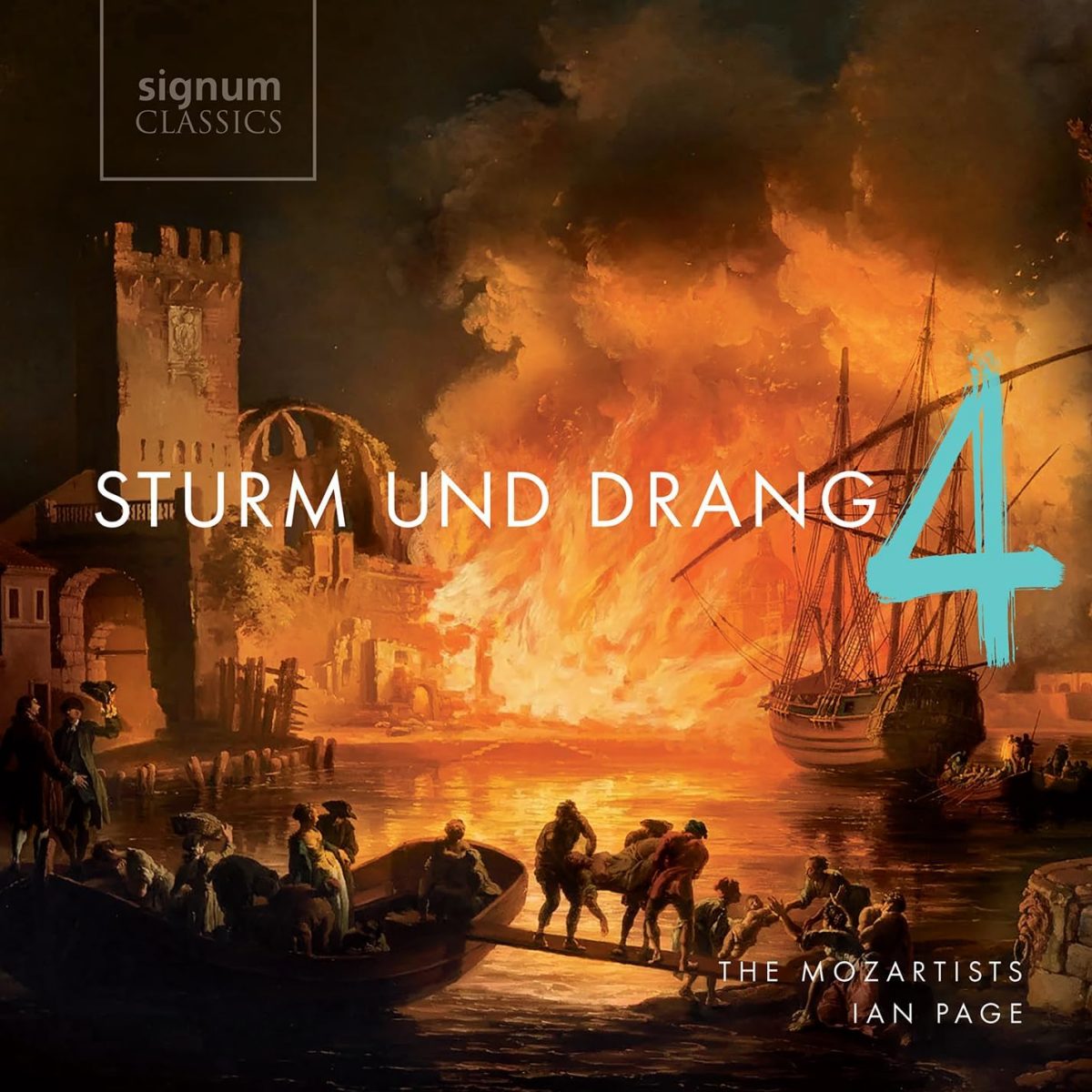
Alexandra Lowe soprano, The Mozartists, conducted by Ian Page
73:44
Signum SIGCD1012
This invaluable series – reviews of vols 2 and 3 can be read on this site – continues with a group of works that have a loose association with the literary movement founded on Goethe’s The Sorrows of Young Werther (1774). It is however not too reiterative to stress again that there are no identifiable links between the music associated with ‘Sturm und Drang’ (‘storm and stress’) and the literary movement most famously associated with Goethe’s famous proto-Romantic novel. Neither are there cohesive connections between the music identified with the term.
Notwithstanding there are general characteristics that allow the term to be applied to certain works, among them the use of minor keys, dramatic, fiery outbursts and the undisguised expression of deeply-felt emotion. This unrestrained intensity of emotional outpouring can be heard from the outset of one of the earliest works on the present disc, Haydn’s Symphony No 45 in F sharp minor, ‘Farewell’ (1772). Here that fieriness is announced at a finely-judged tempo enhanced by the Mozartists, whose technically assured and idiomatic playing is indeed one of the distinguishing features not just of the present disc but of the series as a whole. ‘The Farewell’ is of course one of the better-known of the middle-period Haydn symphonies, owing its fame largely to the story of the composer’s none-too-subtle hint to his employer Prince Esterházy that his musicians did not want the long summer holiday at Esterháza to be further extended and wished to go back to Eisenstadt to their wives and families.
Tommaso Traetta’s Antigona dates from the same year and is the dramma per musica that marked the start of the revival of interest in his music, having been recorded complete by Christophe Rousset as long ago as 2000 following a concert performance at the Beaune Festival. First given at the court of Catherine the Great in St Petersburg, it has a libretto by Marco Coltelini based on Sophocles’s great tragedy and shows the influence of the ongoing operatic reforms and French tragédie lyrique. The recitative and aria sung by Antigona near the start of Act 2 is one of the most exceptional passages. Antigona has come with her serving women to cremate her murdered brother Polinices. The superb accompagnato and aria ‘Ombra cara’/’Io resto sempre’ are darkly passionate and here projected with good diction and dramatic intensity by soprano Alexandra Lowe, though some may find her vibrato troublesome at times. But she manages a splendid trill at the cadence of the repeat, for me as regular readers will know, a saving grace for any singer!
With the exception of a lack of control in the upper register at odd moments, Lowe also does very well by the aria di furia ‘Vorrei punirti’, hurled at her fiancé Count Belfiore by the aristocratic Arminda in Mozart’s La finta giardiniera (Munich, 1775), a so-called dramma giocoso featuring comic, semi-serious and serious characters. But Lowe’s finest moment on the CD arguably comes not in singing but the spoken word. This is an extract from the Bohemian Georg Anton Benda’s melodrama Medea, written for a famous actress Sophie Seyler and first given in Leipzig in 1775. Melodrama, a dramatic work or part of one in which the spoken word is set within a musical context, fascinated Mozart when he heard Medea in Mannheim, but although he was obviously aware of the dramatic possibilities, he never himself used it apart from in parts of the abandoned Zaide of 1779-80. The passage here involves the terrifying climax of the adaptation of Euripides drama in which the thwarted sorceress Medea expresses her last thoughts and actions set against Benda’s highly dramatic score. Alexandra Lowe’s finely-nuanced performance is electrifyingly powerful, sweeping all before her.
Finally, the splendid three-movement Symphony in C minor by Frankfurt-born Joseph Martin Kraus, composed in Vienna in 1783, apparently dedicated to Haydn and the latest music in the programme. The work is archetypal Sturm und Drang, perhaps nowhere more remarkably so than in the slow Larghetto that precedes the main opening Allegro. Here the dissonant opening on high strings seems to be a prelude to some as yet unknown tragedy, the threat of which hangs over the superbly sustained brooding mood achieved by the playing of the Mozartists under Ian Page. Page’s total empathy with the music is indeed the single most distinguished feature of the performances both here and in earlier discs of a series further graced by his scholarly notes. And there are still three more projected CDs to come. They cannot do so soon enough!
Brian Robins