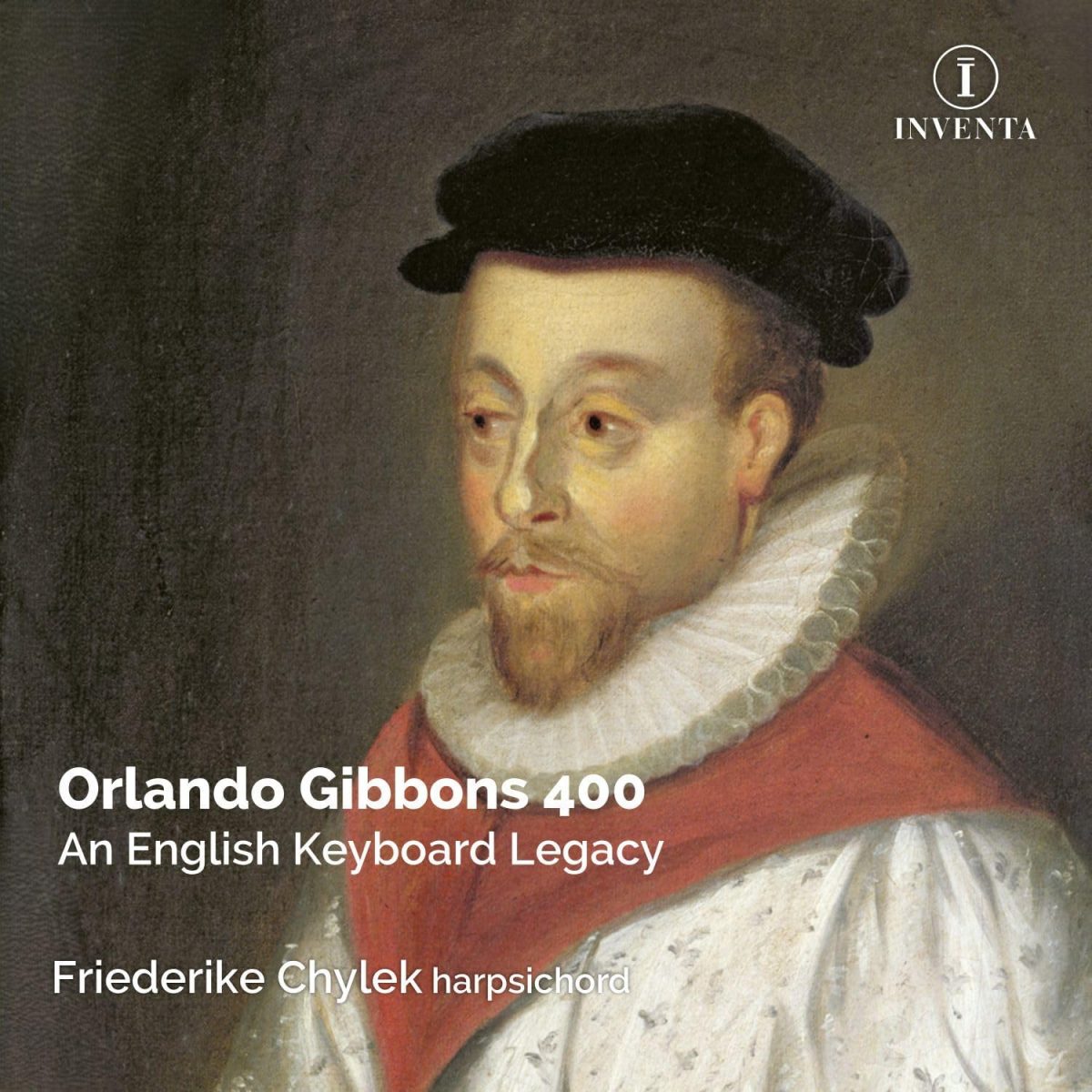
An English Keyboard Legacy
Friederike Chylek harpsichord
48:27
Resonus Inventa INV1022
Arguably the outstanding interpreter of Byrd’s keyboard music from her generation, Friederike Chylek turns her attention to Byrd’s younger Chapel Royal colleague (and possible though undocumented pupil) Orlando Gibbons, the quatercentenary of whose death occurred last year. To present Gibbons’ music in contemporary perspective, she includes a few works by Byrd himself, and by Byrd’s documented pupil John Bull, the date of whose birth fell between the other two.
Ms Chylek’s strengths are a wonderful grasp of melodic line, an impeccable sense of momentum, and superb clarity of contrapuntal discourse. It will come as no surprise to those aware of her other recordings that many of her interpretations on this disc are the best, or equal the best, of the works under consideration. Critics and musicologists (apart from the late John Harley) seem inhibited about celebrating and revelling in exotic or well-constructed chords in Tudor music. Gibbons’ Fantasia in A minor “in four parts” is adorned by the composer with several, and Ms Chylek plays these perfectly, with every note audible and immaculately balanced. I cannot think of a better version on disc, nor of the famous Pavan and Galliard for Lord Salisbury. The other works by Gibbons included on this disc are The Italian Ground, Galliard in C major (MB20/25), Fantasia in D minor (MB20/8), Ground in A minor (MB29/26), and The Queen’s Command.
I was particularly interested to hear Ms Chylek’s take on Byrd’s Pavan and Galliard for Philippa Tregian. Besides being one of the greatest pairings of this sort in the entire repertory, the second strain, in its understated way, paradoxically reaches a profundity achieved by only the most gifted composers and, particularly in the varied repeat, delves where nobody had been before in keyboard music. Playing this passage requires the utmost clarity of line and steadiness of tempo. Of previous recordings, only Colin Booth on his all-Byrd The Melodious Birde matches Ms Chylek’s sensitivity to Byrd’s intense introspection.
She also plays two sets of folksong variations by Byrd. Callino casturame is again the equal of any other recording and has a good claim to be the best available, bringing out all that is delightful in Byrd’s fresh textures and affectionately creative ruminations on the original theme. John come kiss me now is a rite of passage for Byrd recitalists: a longer work that requires a sense of ebb and flow while controlling the overall shape, plus a dazzling technique to cope with Byrd’s teeming enjambment across sections later in the work. Suffice to say Ms Chylek copes with all this capably.
Bull is represented by just two pieces. Predictably but appropriately, Bull’s Goodnight closes the album. The other piece is his Country Dance and this leads me to my one reservation about this disc. This seems to be the only available recording of the work, and is therefore an excellent choice. (On all the available evidence we can securely ignore Thurston Dart’s typically whimsical protestation over the attribution of this piece to Bull.) However, the running time for the entire record is only 48’27. I fully understand that constraints of time and/or money might well be in play here, but another half hour of music could have been accommodated. It would have been wonderful to hear Ms Chylek playing Gibbons’ heartfelt Pavan in d minor (MB20/16) and – even on a disc celebrating Gibbons – a couple of Byrd’s pavan and galliard pairings from left field, such as BK 16 (Dowland would have given his right arm for the theme opening the Galliard!) or the majestic and sonorous BK 76-77, glory which only survives in a playable form by the skin of its teeth and so should be cherished all the more. That said, such is the concentration of excellence on this disc – in Ms Chylek’s playing and in the music itself – that any reservations remain just that and are not complaints. Indeed, I warmly recommend it.
Richard Turbet