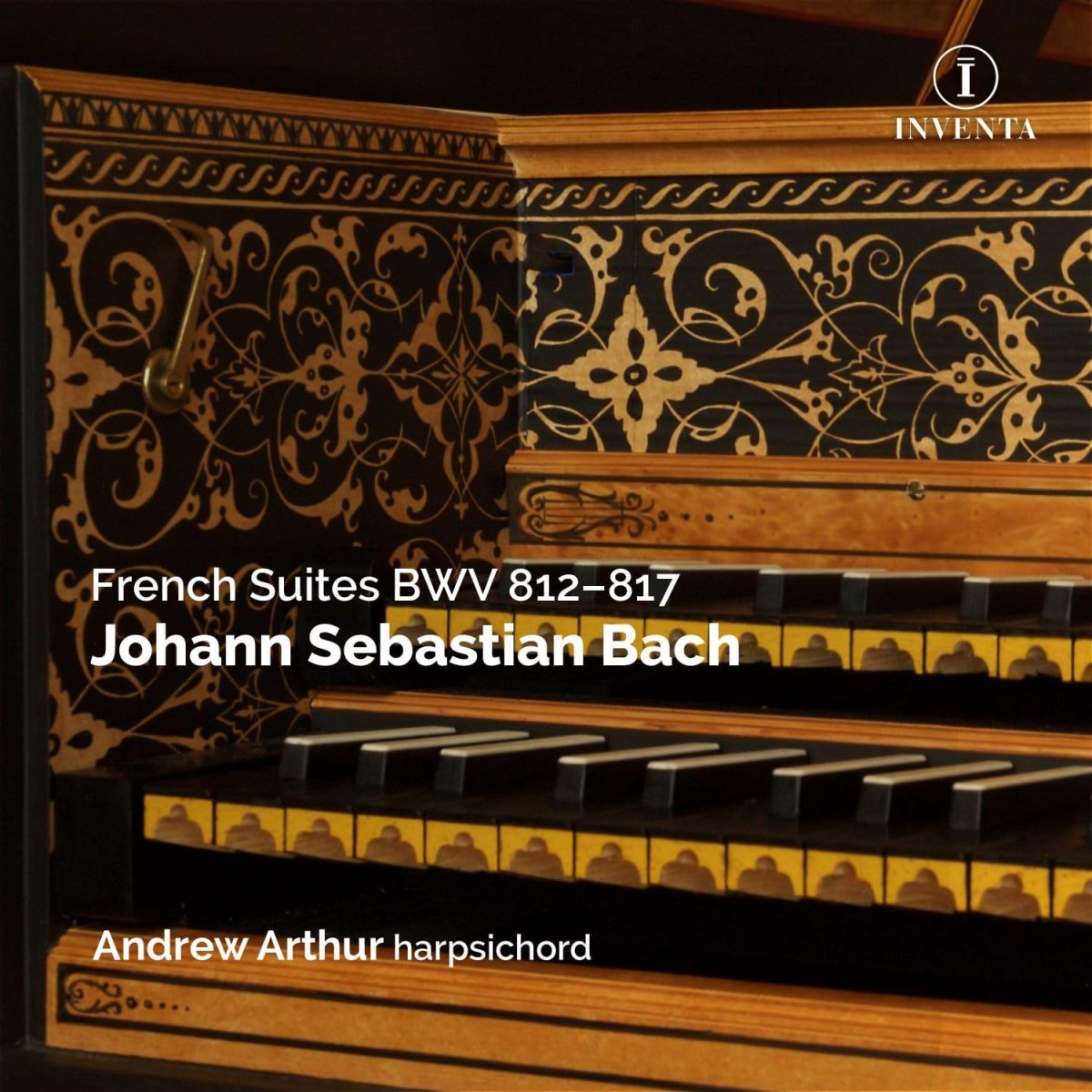
Andrew Arthur harpsichord
108:51 (2 CDs in a single case)
Resonus Inventa INV1021
The French Suites on this pair of CDs follow the release of the Clavier concertos Andrew Arthur made with a small string band led by Theresa Caudle under the aegis of the Hanover Band that I much enjoyed and reviewed for the EMR in 2022 and 23.
Here he plays BWV 812, 814 and 817 on a double manual by Andrew Garlick of 2009 after a Goujon in the Paris Conservatoire of 1749 and is the instrument in Trinity Hall, Cambridge, where Andrew Arthur is a fellow; while BWV 815, 813 and 816 are played on an instrument by Keith Hill after a Taskin of 1769 in the Russell Collection at Edinburgh University. Both instruments are tuned in Neidhardt “fur ein grosse Stadt” of 1724 at A=415 Hz. They are a nicely balanced pair, and Arthur’s neat and lyrical playing makes them sing. The one by Keith Hill has an especially nutty character, reminding me of the tone of an oboe da caccia. These are not performances that are full of clanging post-Wanda Landowska neo-Baroquery effects, but something much more subtle, like the use of the lute stop in Menuet of 814 with a gentler 8’ for the Trio.
But almost more significant than the eloquent performances are Arthur’s fascinating notes on pages 8 – 11 of the booklet on sources and performance decisions. He traces the material from its first version in the 1722 Clavier-Büchlein for Anna Magdalena through to its sole surviving autograph made by Johann Christoph Altnickol which contains the later composed sixth suite, finished no later than 1725. Then there are the multiple versions made by pupils and other copyists, all of which Arthur has studied.
All this gives the performer today a challenge about which version to use and in which order to play the movements in each suite. Arthur lists the many manuscript sources, and invites to listener to appreciate his own choices in the performances he gives us. The context of his choices, underlined by the venue for this recording – Trinity Hall’s small-scale chapel – is one of comparative domesticity rather than the grand bravura performances of some more ‘soloistic’ versions of the French Suites available, and I very much warmed to this studied and studious version.
You will learn much, and will not tire of listening to them repeatedly.
David Stancliffe
One reply on “Bach: French Suites BWV812–817”
My experience playing the lower register of that piece varied significantly across different instruments. The acoustic quality of the recording itself felt quite muted.