Weser-Renaissance, directed by Manfred Cordes 70:26 cpo 555 078-2
He may have been Holy Roman Emperor but, when listening to this music, we hear a heart-broken man outpouring the unimaginable grief of losing not one but two wives; the former perhaps even his true love, the tragedy made even worse by the fact that she was carrying his unborn son. The Requiem for the Empress Margareta of 1673 is a stunning work in the typical 17th-century patchwork style; each verse of the text is treated differently, and the composer gave himself lots of options by employing muted trumpets and cornetti as well as trombones and strings. The musical architecture of the three Lectiones he wrote three years later for his second wife, Claudia Felicia, was largely dictated by the texts, but even here he creates a clever design whereby the first and third are similar and the second one different from both. This excellent CD is completed by his motet for the Feast of the Seven Sorrows of the Blessed Virgin Mary, which was a major event in the Hapsburg liturgical calendar. The recording was made in 2016 after a festival celebrating the Emperor’s music and it is evident that the performers have been immersed in it – the six singers and 15 instrumentalists (including Jörg Jacobi, author of the booklet note and editor of the music, on organ) give fabulous accounts of this emotionally charged music.
That booklet note should have been copy edited; it presumably started life as a concert programme when the music was performed in a different order… I would also respectfully suggest to Jörg Jacobi that the reason that the separate sections are listed of larger works in the Distinta specificatione is exactly because of the document’s function: it describes the forces required to perform works in the Imperial library.
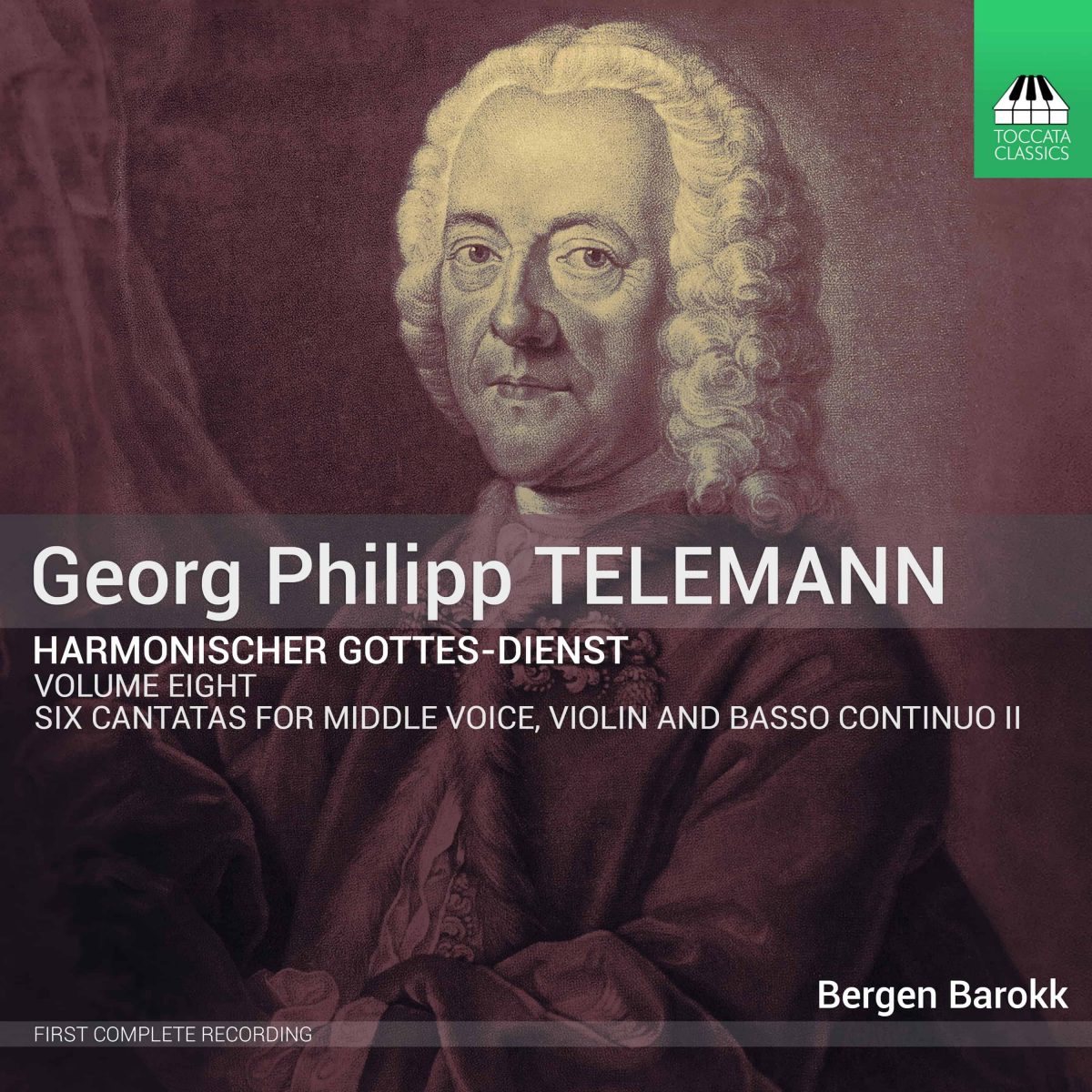
Marianne Beate Kielland, Bergen Barokk 65:51 Toccata Classics TOCC 0266
This is the eighth instalment of this noteworthy project to record the complete cycle of the Harmonischer Gottesdienst, a wonderfully crafted and mellifluous cycle of 72 chamber cantatas from 1725/6, which are firmly couched in the Scriptures, and have the multi-function trait of being ideal for moralistic, musical accompaniment to a sermon, or suitable for domestic worship, and even musical home practice. Although the CD indicates there is one premiered piece, you would have to buy about four or five CDs to cover all these works in one go (Dux, Enchiriadis, Canterino=Brilliant classics) so several of these will be new to many listeners. What better endorsement would one need, than Handel’s? |You can hear why he chose to examine and indeed use some of the melodic content found here. The responsive mezzo-soprano tackles these pieces with just the right attack in her declamation, delivering some wonderful moments, with clever modulations and increased intensity when required. The violin (the back-up instrument if recorder and oboe players weren’t available) makes a perfect partner to this well-honed, mid-ranged voice, and the rest of the ensemble offer admirable supporting roles.
While the texts of the first and third cantatas may even be from Telemann’s own quill, the vast majority were written by the jurist and literatus Mathaeus Arnold Wilckens (1704-59), an obviously gifted 21-year-old. This would not be the last time Telemann approached young Hamburg poets of high quality. There are a few textual nuances to observe in Andrus Madsen’s translation: for example, in German, “Lust” as a singular noun tends to be a positive (joy or pleasure), while in the plural it equates more to vice and debauchery. There are several others but focussing on them might detract from the thoroughly satisfying performances on the disc, so let me just say: caveat lector!
The CD booklet contains a rather splendid essay on Telemann and Neumeister by Sjur Haga Bringeland, an important working relationship which yielded some four or five cycles. One has to question what it is doing here, though – while it is useful page-filler, it has nothing to do with the music on the disc.
As one progresses through these fine sparkling gems of spiritual music, one feels the dramatic effects and cogency, perfectly set to some engaging music, so well suited for their intended purpose. The opera composer is not very far away either. This is a really worthy addition to Toccata Classics’ on-going survey of Telemann’s music.
D James Ross at the St Magnus International Festival 2024
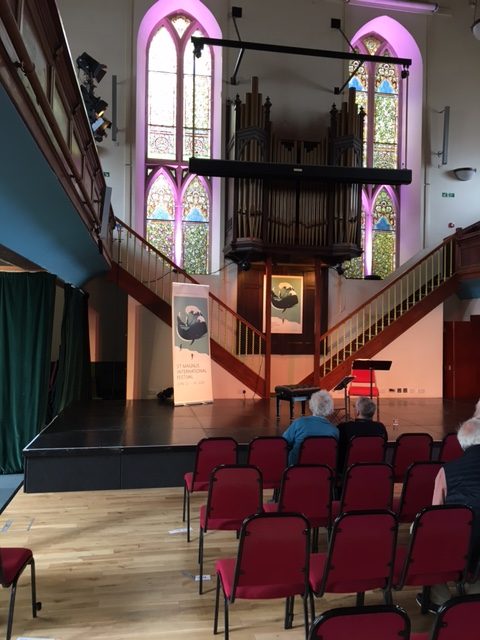
This year the relevant concerts for an EMR reviewer at the St Magnus International Festival were grouped together in the middle of the festival week, although it turned out that this was a mixed blessing as the venues in which they took place were scattered across the islands, and making it to all of them involved some brisk driving! My festival opened with an event in the Stromness Town House, a venue which had formerly been a church and which now serves as an excellent music venue. The concert, entitled Bowed Bach, featured cellist Robin Michael, an eminent figure in the world of period instrument ensembles. He is principal cello with the Orchestre Revolutionaire et Romantique as well as appearing with a number of other leading period instrument ensembles. He also plays modern cello, transferring his skills from the HIP world, and it was in this guise that he presented two of the Bach Solo Cello Suites and the Sonata by Huw Watkins.
The recital opened with the second Bach Cello Suite in D-minor, and it soon became clear that Michael’s reading, full of nuance and energy, sprang from a thorough understanding of the music and also of its Baroque context. His bowing and articulation spoke to his years of period instrument experience, while his choice of tempi was judicious. If one or two of the more rapid dances occasionally sounded something of a scramble, they were never less than exciting, while the slower movements displayed considerable intensity and dignity. Huw Watkins is a pianist and composer who frequently works with Robin Michael, for whom this Sonata for Solo Cello was composed in 2022. He cleverly incorporates elements of Scottish traditional music as well as more generally the spacious ambience of the Scottish landscape in an impressive work which both fully exploits the potential of the solo cello as well as thoroughly exploring a number of felicitous musical ideas. I was enthralled with Michael’s lyrical performance of this valuable addition to the solo cello repertoire. The recital concluded with probably the most best loved of Bach’s Suites in C-major. Michael seemed to have relaxed a little and with his cello also hitting its stride, we were given a compelling account of this masterpiece. In response to warm applause he gave us a further Sarabande from the fifth Cello Suite to send us on our way.
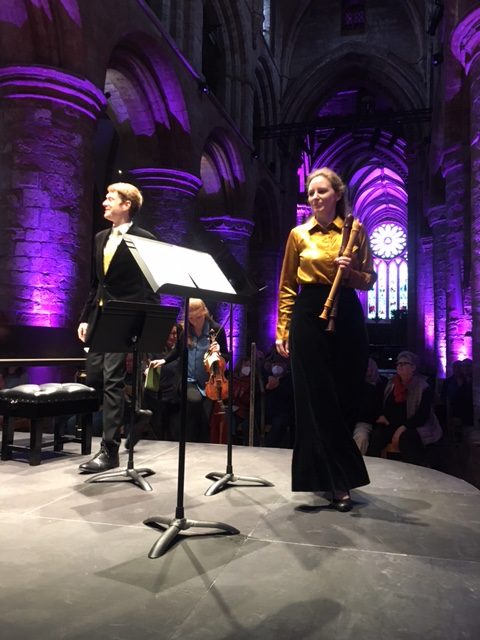
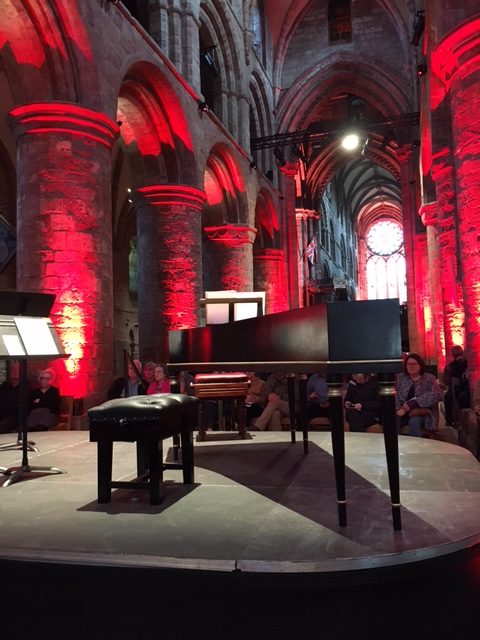
In my case, my way was a hasty drive to St Magnus Cathedral in Kirkwall for a performance by Ensemble Hesperi of the first of two concerts for the Festival entitled Full of Highland Humours. A quartet consisting of recorders, Baroque violin, Baroque cello and harpsichord, these young players presented a delightful programme of music with Scottish overtones. In 18th-century London, there was a considerable vogue for Scots tunes, a demand in part satisfied by Scottish composers such as James Oswald but also enthusiastically embraced by English composers such as John Playford and even visiting Italian musicians such as Francesco Barsanti, Giuseppe Sammartini and Francesco Geminiani. It was with the music of Oswald, one of his popular Airs for the Seasons, The Honeysuckle, that the concert began – Oswald originally published these pieces as music for a solo melody instrument and BC, later issuing a set of second parts, and it was in this later manifestation, with the recorder taking the melody and the violin on the second, that Hesperi presented this piece. Their performance was delightfully detailed and sympathetic, with a charming interaction between the players.
In the ensuing pieces by Barsanti, they confirmed their affinity with the Highland Humour, while a Sammartini Trio Sonata also served to demonstrate their easy technical virtuosity. One of the earliest collections of such material, A Collection of Original Scotch Tunes Full of the Highland Humour, published by Playford in 1700, demonstrated the same energy as his more familiar Dancing Master collections and worked extremely well on the recorder, while Robert Bremner, whom I knew only from a handful of violin pieces, was the composer of a very fine set of variations for harpsichord on Maggie Lauder. These were flamboyantly rendered by Thomas Allery, whose unobtrusive but highly creative contribution to the ensemble pieces was consistently impressive. Thomas Erskine, Earl of Kellie is perhaps one of the better-known Scottish composers of the 18th century, composing symphonies, chamber music and even an opera. He trained under the Stamitzes in Mannheim and brought their imaginatively galante style of composition back to Scotland. His set of six Trio Sonatas, of which Hesperi gave us the fourth, are works of polished accomplishment, incorporating many of the tricks the Earl learned in Germany but also demonstrating an engaging individuality.
It was the turn of the group’s cellist Florence Petit to step into the spotlight for an account for cello and harpsichord of Oswald’s setting of another fine Scots tune, Alloway House. Approaching the original tune with an appropriate degree of improvisation, she gave a wonderfully musical and utterly convincing account of this lovely melody. Geminiani’s Trio Sonata, based again on a traditional Scots tune The Bush aboon Traquair, allowed recorder player Mary Jannet-Leith and violinist Magdalena Loth-Hill once again to sparkle, while this delightful concert concluded with an attractive Sonata on Scots Tunes by James Oswald. Playing with consummate technical virtuosity and charming musicality, the Ensemble Hesperi won the hearts of their St Magnus Cathedral audience, introducing many for the first time to the rich treasury of 18th-century Scottish music.
My second Festival day opened with another morning recital in Stromness Town House, this time given by the Morris-Begg Duo and entitled Time Stands Still. Soprano Ines Mayhew-Begg was joined by guitarist Ross Morris for a programme of Baroque and more modern music. Taking the role of a lute in music by Dowland, Robert Johnson and Purcell, Morris’s deft touch on his guitar successfully invoked the appropriate ambience for the early repertoire, while Begg’s bright tones with a slight vibrato proved a charming vehicle for the melodies. She was animated in her portrayal of her songs, bringing the scenarios of each vividly to life, while interacting closely with her accompanist. A short Dowland set was introduced by an instrumental Preludium followed by the very familiar songs Come Again and Time Stands Still. Next came the much less familiar song Have you seen but a bright lily grow by Robert Johnson, a beautiful piece expressively performed by the duo. The Baroque section ended with two iconic Purcell songs, Music for a While and Sweeter than Roses, during which we were all aware of the beautifully twining roses in the stained glass behind the performers. Unfortunately, notwithstanding the wonderfully characterised renditions of these fine Purcell songs, I grew aware of Ines Mayhew-Begg occasionally slightly undercutting the pitch, spoiling the otherwise perfect match with her accompanist.
The rest of the programme consisted of more modern music – an adaptation of Moon by contemporary guitarist and composer Marco Romelli from 2017, and a set of five songs from Under Milk Wood by another contemporary guitarist/composer Stephen Goss (the only music in the programme originally composed for soprano and guitar), an arrangement of two songs by James MacMillan, and finally arrangements of four Tonadillas by Enrique Granados. The Romelli proved to be atmospheric and engaging, while the Goss alternated acerbic wit and wistful lyricism to bring Dylan Thomas’s brilliantly vivid texts to life. The skill of the arrangements for guitar of the MacMillan and the Granados (by Ross Morris and Julian Byzantine respectively) was such that it was hard to believe they had originally been written for piano, and the Granados brought this recital to a beguiling conclusion. Enthusiastic applause persuaded the performers to add an idiomatic account of the Scots tune The Wild Mountain Thyme, which had the audience joining in!
Time stands still – no such luxury for your reviewer, who had to repeat his rat-run of yesterday to get to St Magnus Cathedral for the second performance by Ensemble Hesperi. This time their programme was entitled A Gift for your Garden and tapped into the 18th-century vogue for exotic plants to which Handel, Telemann and of course James Oswald all subscribed. Oswald contributed two Airs for the Seasons to the programme, The Anemone, which opened the concert, and The Hyacinth, which Magdalena Loth-Hill presented in its original form for melody instrument and BC. The first of Telemann’s Paris Quartets TWV 43, demonstrated the versatility and originality of this sometimes underrated composer as, in contrast to the trio sonata, he places all four instruments equally in the spotlight. A beautiful account of the B-minor Trio Sonata by Handel reminded us of the virtues of this staple Baroque form in the hands of a great master, while Florence Petit’s eloquent account of Telemann’s only Solo Cello Sonata made us wonder with her why he had never returned to the form.
A charming two-movement Trio Sonata by Johann Gottlieb Graun reminded us that some capable Baroque composers are unjustly overshadowed by the big names, while Telemann’s folk-influenced G-minor Trio Sonata TWV 42 brought the concert to a dynamic, toe-tapping conclusion. I was hugely impressed by the virtuosity and musicality of these accomplished young musicians, and their boundless energy, their well-researched programmes and their relaxed rapport with their audiences make me sure that they will become an established and admired ensemble in the very near future – another great ‘find’ by the St Magnus Festival!
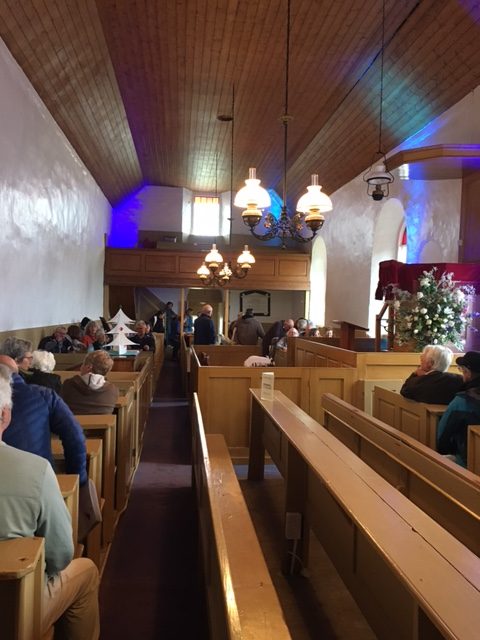
The bustling finale of the Telemann set the tone for my final festival dash, this time passing through five islands and crossing four barriers to St Peter’s Kirk, Eastside in South Ronaldsay. On paper, this programme, called Plucked Bach, looked one of the more bizarre concerts I would be attending – accounts on the mandolin of some of the great solo instrumental music by Bach. The Israeli musician Alon Sariel set himself the project over lockdown of exploring Bach’s music on mandolin, and today’s programme, along with several others and a number of CDs, was the result.
Sariel’s opening observation, reminding us that Bach himself had been a keen transcriber of his own and other people’s music for a variety of instruments including the lute, lent the project added credibility, while we would recall that Vivaldi, the subject of so many Bach transcriptions, wrote concertos for mandolins. Ultimately however it was Sariel’s own persuasive virtuosity and musicality that suspended our disbelief. He opened with the Prelude from the third Partita for solo violin, and immediately I found that I could hear the original in my head, running in parallel with the performance. He continued with the Prelude and Fugue from the fifth Suite, an astonishing display of virtuosity, followed by a beautiful Fantasia by Telemann. Next came the iconic D-minor Toccata and Fugue, by which time fortunately we were entirely mesmerised – anticipating this piece and indeed looking back on it, it is very hard to imagine this titanic organ music working on the mandolin, and it is a testimony to the arrangement and Sariel’s bravura performance that it did.
Next came a Mandolin Partita by Sariel himself, drawing on his intimate knowledge of Bach but also engaging with other Baroque masters and earlier composers. This was a beautiful piece, and again utterly convincing. What was left to tackle but the great Chaconne from the second Solo Violin Partita, the subject of myriad arrangements over the years? Sariel’s reworking proved impressively effective, and his intense performance brought this extraordinary recital to a triumphant conclusion. Insistent applause elicited an account of the Londonderry Air, an eccentric encore to round off an eccentric concert, which had been much more convincing than I could ever have hoped – a testimony to the adage that it doesn’t matter how strange a thing is if it is superlatively executed. We had been warned in advance that the Kirk pews in this historic building offered only ‘presbyterian comfort’, but such was the spell we were held under that the audience barely moved! I knew the church and its lack of comfort already, having attended it as a child more than fifty years ago during many summer holidays. It was strange to be back there after all these years, and to pass the graves of my Orkney ancestors on my way back to my car. No desperate rush this time, just some time for nostalgia and vivid memories of five excellent concerts at the 2024 St Magnus International Festival.
Accademia Bizantina, conducted by Ottavio Dantone 59:08 HDB-AB-ST-004
An old cliché has it that Schumann’s symphonies suffer from thick, indifferently orchestrated textures. Not if they are played like this performance of the ‘Rhenish’ they don’t. Throughout both symphonies the listener is constantly struck not only by Dantone’s superb ear for balance but how helpful period instruments are when it comes to clarifying textures and providing colour. Thanks to conductors such as Mackerras and Norrington we are by now used to hearing this repertoire in this guise, but I do not recall previously being so aware of the rich inner detail of the contrapuntal writing in these works as there is here. It is relevant that in a perceptive note Dantone draws attention to the relationship both composers have with Bach, one of his great heroes. Thus, for example, in the development of the opening Allegro Vivace of the Mendelssohn, the counterpoint stands superbly revealed thanks to a lightness of touch comparable with the scintillating writing of the “Midsummer Night’s Dream” Overture.
‘Lightness of touch’ and ‘clarity of texture’ are two phrases that referring back to my notes I see recur time and again. They are benefits aided and complemented by the superb playing Dantoni inspires from an augmented Accademia Bizantina. String articulation is outstanding, the benchmark set by the cellos and double basses at the start of the Italian Symphony taken up and equalled by that of the upper strings in the secondary idea. The harmonie band is exceptional, too, never more telling than in the Andante con moto (the ‘moto’ well observed), where the delicate luminosity of the period flutes gives the music a magical ambiance. The beautifully paced Nicht schnell third movement of the Schumann finds lower strings and wind band exuding an affectionate, glowing warmth.
The succeeding Feierlich (‘solemn or grave’) is the most telling example of Dantone’s ability to span the architectural sweep of an entire movement, building the majestic edifice, said to have been inspired by a visit to Cologne Cathedral, to a quite overwhelming climax before gradually subsiding to a tranquil conclusion. In the final movement Lebhaft (lively, vivacious) Dantone avoids the temptation to take the heading to imply a fast tempo, keeping the movement moving at a brisk, but not rushed tempo which once again allows for admirable clarity of texture and building to an exuberant climax.
In his ‘Conductor’s Notes’ Dantone also discusses the importance of rhetoric in interpreting the music of the period, a topic that plays a major role in the recent Narratio Quartet recording of Beeethoven’s op. 18 String Quartets reviewed in EMR. It is fascinating to observe what seems to be an increasing preoccupation among some of today’s musicians with a topic whose importance, once a vital part of education, went out of fashion to the point where few today understand its linguistic let alone musical importance. Here there are fewer obvious cases of its application than in the Beethoven quartets; the use of portamento, for example, is subtly understated, often more hinted at then observed, but rubato is sparingly if tellingly applied at times, the second idea of the opening movement of the Schumann being an example.
In sum, I’ve found these performances revealing, challenging and endlessly fascinating. If, like me, you now infrequently visit works such as these, the music most of us grew up on, then do listen to these performances and prepare to have the senses refreshed.
Published less than five years apart, what a world of difference exists between the six opus 18 String Quartets of Beethoven and the similarly constituted opus 76 set of Haydn! While the latter are the supreme work of a man at the height of his powers, the man indeed responsible above all others for the creation of the form, opus 18 represent the entry into the field by a young man who had probably just reached 30 by the time he completed the set. And it had proved to be a far from an easy entry. We know because Beethoven himself admitted it – ‘Only now’, he wrote to a friend in 1801, the year of publication, ‘do I know how to write string quartets’.
This feeling of exploration and questing with a form accepted as arguably the most difficult to master is also very much a part of these performances by the Amsterdam-based Narratio Quartet. Playing on period instruments they have spent some fifteen years re-examining and working on the quartets in the context of the expressive performing traditions of Beethoven’s own time. These include a more flexible approach to tempo and rhythm than the strict, metronomic time-keeping we generally encounter today. The use of rubato was once a valuable expressive tool and is often used in harness with dynamic and other expressive markings. You can hear an example at the point of arrival of the secondary subject of the opening Allegro con brio of the F-major Quartet (no. 1), where the brisk opening subsides not only into a decrescendo and piano marking but also here an unmarked slowing of tempo, all combining to tell us we’ve moved into fresh territory. Less innovative is the restriction of vibrato to expressive use, a technique now employed by many instrumentalists and singers. Most radical of all is the use of portamento or glissando, the sliding of one note into another in imitation of the human voice. It is used for expressive purposes, but needs to be employed sparingly. Especially in slower music, it carries a risk of sentimentality if used excessively. Beethoven is reported to have liked it, particularly in his chamber music. The Narratios seem to me to have got it just right, with the technique used sparingly and always sensitively, with little impression of simply making a spectacular effect. You can hear a startling example right at the start of the first CD, in the opening of the D-major Quartet (no. 3), where Beethoven’s unexpectedly poetic opening seems to expect this kind of expression. Incidentally, the quartets are arranged in the order it was once thought they were composed: 3; 1; 2; 5; 4; 6. It is now disputed.
All this attention to such detail would be to little effect were the performances less perceptive than they are. Other more usual expressive devices such as dynamics and hairpin markings are keenly observed and I could find no tempo with which to take exception. But more importantly, the Narratios have for me captured the youthful essence and spirit of the six quartets to as near ideal an extent as can be humanly expected. Perhaps above all, it is the manner in which the wit and humour are embraced, a characteristic so frequently missing by those that would have Beethoven elevated to some kind of spiritual status. There are countless examples dotted through these performances, but I’ll highlight one. One of the most striking movements of opus 18 is the finale of the B-flat Quartet (no. 6), the structure of which has led some commentators to think in terms of an anticipation of the designs of the late quartets. It opens with an adagio marked La Malinchonia, an intensely inward passage almost entirely marked pp, it is played here with a rapt, intense inwardness brought to a halt by a fortissimo chord that quickly segues into a bright, witty triple-time movement marked Allegretto quasi Allegro. It is Beethoven laughing at us: ‘Ah, fooled you there, didn’t I?’ Wit, good humour and the dance now pervade the movement until a climax, led to in the present performance by an ever-quicker tempo subsiding to a dozen bars of the Adagio interspersed with four bars of triple-time. The coda brings a final example of these two extremes. You will find nothing comparable in the quartets on Haydn and Mozart; it is music that announces a musical revolutionary to whom the Narratio Quartet respond with compelling insight.
The quartet’s name refers to the art of rhetoric, the projection of which is tellingly apparent in these marvellously communicative performances. The continuation of the Narratio’s cycle can be awaited with the keenest anticipation.
Benjamin Lyko, Alex Potter, e.g.baroque 61:19 audite aud 97.803
While Pohle’s instrumental music is gaining popularity (partly through my own efforts to publish his surviving output, as well as his complete church music, in collaboration with Gottfried Gille and Anna-Juliane Peetz-Ullman), his other output is relatively unknown. The present CD presents a set of 12 love songs for altos with a pair of violins and continuo, originally dedicated to the composer’s new employer, Wilhelm VI of Hesse-Kassel. These are not duets in the sense of lovers singing to one another. Rather, the two voices present the same texts in alternation, imitation, and intertwining counterpoint. Sometimes, they are strophic with violin ritornelli; in others, Pohle uses the same bassline but varies the melodic line (much as Buxtehude would later do in “Membra Jesu nostri”), while the violins join with the voices in yet others. And the violin parts are not mere fillers – the 11th song, “Will sie nicht”, demands some very virtuosic scales! Paul Fleming’s texts tell of his unhappy love life; the first sister that he fell in love with (in Tallinn, as Reval is known to English speakers) married someone else in his absence, then on his way to marry her sister, he died, aged only 30. They are printed in the booklet without translations, which unfortunately – I suspect – will put some people off buying what is a fine CD. Lyko and Potter’s voices are a good match, the former possibly a little edgy at the top of his range. Both declaim the texts well and produce a lovely warm sound. The sequence of songs is broken by the first of a set of 12 trio sonatas by Pohle’s successor as Kapellmeister in Halle, Johann Philipp Krieger. There was space on the disc for more of the set (which has been recorded complete).
Apologies to the musicians and the recording company for the delay in reviewing this wonderful recording; I have just found it in a box that was put in my attic (and “lost”!) when I moved house.
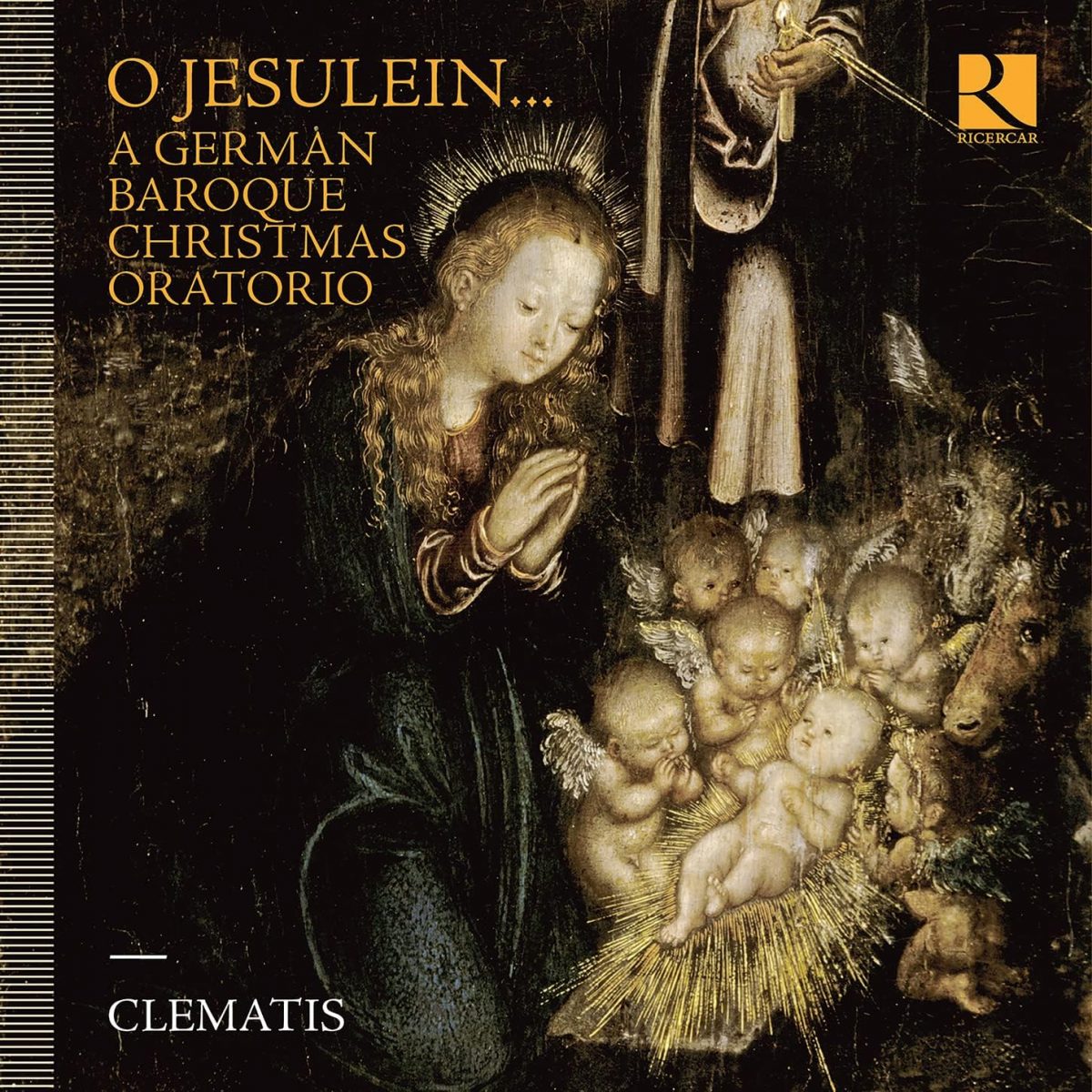
A German Baroque Christmas oratorio Clematis 71:23 Ricercar RIC444
Rather than an oratorio in the strict sense, this gorgeous disc offers up a selection of beautiful settings of texts that tell the Christmas story by some of the next composers of the 17th and early 18th centuries. Beginning with the Coronation of the Virgin, we have the Annunciation, music for the angels, the shepherds and the adoration, the angels appear to Joseph, then the Magi arrive, followed by the Presentation in the Temple, then “fast forward” to Jesus preaching there, and finally some general rejoicing. Much of the repertoire will be unfamiliar to most readers – though as popular in their day as their now better-known contemporaries, Michael Praetorius, Buxtehude and Schütz, the likes of Schelle, Hammerschmidt and Briegel are shockingly neglected nowadays, let alone Christoph Bernhard, Christian Flor and David Pohle. Six singers (SScTTB) and 10 instrumentalists (on strings, recorders, bassoons and crumhorns – as well as schalmey, bombard and rackett!) mix and match as the programme proceeds, and there is not a weak link among them. The voices combine beautifully – try the Gesualdo-like passage in Andreas Hammerschmidt’s “Ach mein herzliches Jesulein” for proof – then relax into the warmth of the string consort at the opening of Tunder’s “Ein kleines Kindelein”. Then get set for the crumhorns in Praetorius’ “Puer natus in Bethlehem”, which weren’t quite as rollicking as I’d expected, but the reedy sound was perfect. Some works are performed purely instrumentally. The informative booklet note is given in English, French and German. For the sung texts and their translations, you’ll have to go to the record company’s website to download a PDF (no great hardship!) If you need a musical background when wrapping Christmas presents or while stirring the Christmas cake for the 20th time, let me recommend the many forgotten gems on this beautiful CD.
Apologies to the musicians and the recording company for the delay in reviewing this wonderful recording; I have just found it in a box that was put in my attic (and “lost”!) when I moved house.
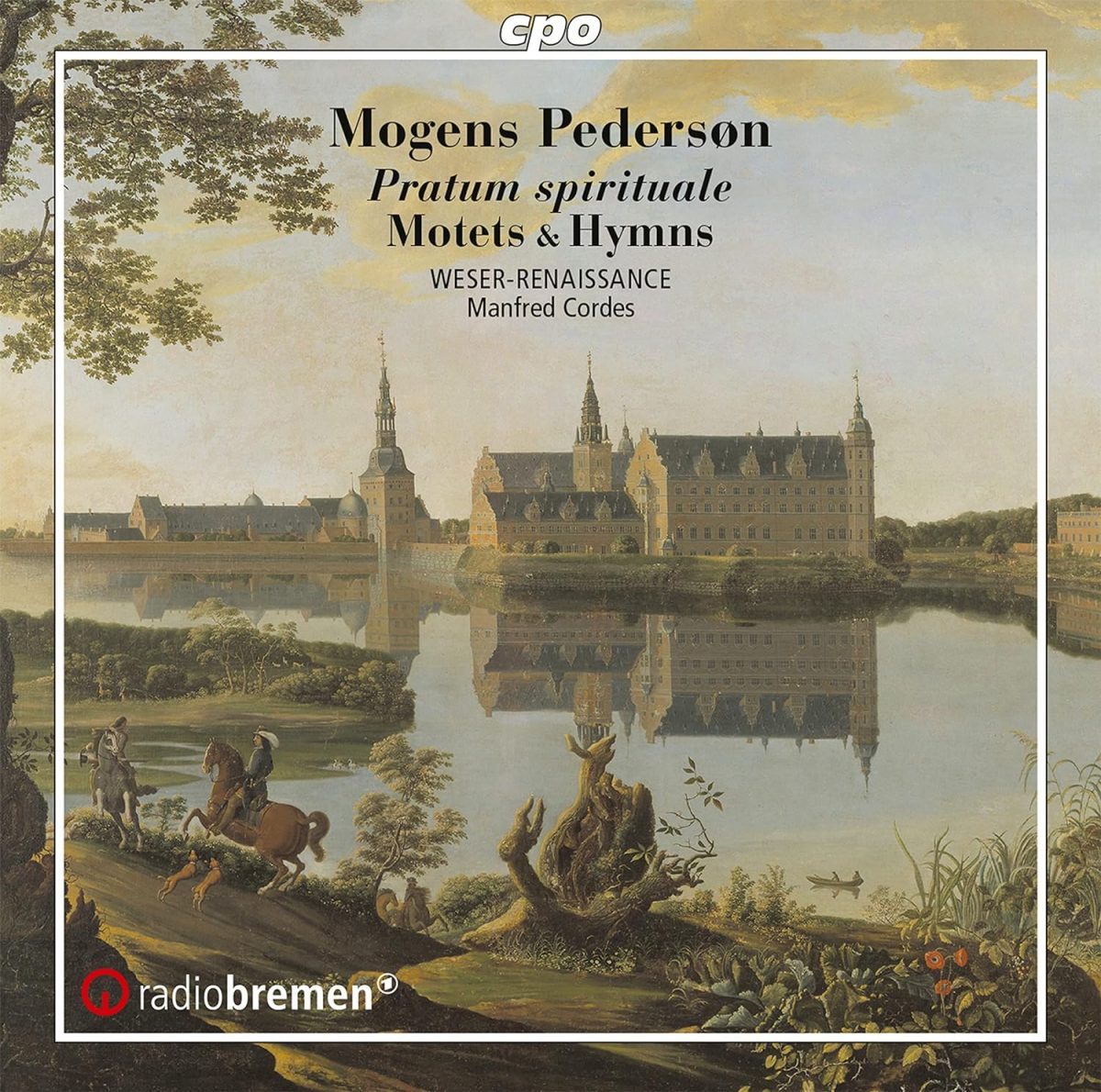
If you have heard of this Danish composer at all, it will almost certainly be through his madrigals. Like many a northern European disciple of the Gabrielis in Venice, his “right of passage” publication was a book of secular music to demonstrate his complete immersion in the Italian style of day. Less well known – but equally impressed for combining that with the needs of the Lutheran church (again, like many of his contemporaries) was his 1620 “Pratum spirituale”, a collection of “masses, psalms and motets… for use in Denmark and Norway”. This engaging recording (you should never expect any less from these forces!) presents a selection of pieces, including a mass for five voices, Latin motets and hymns in Danish. Some are performed tutti, some with solo voice(s) and groups of strings (violin with gambas) or winds (cornetto with sackbutts and dulcian) and continuo, sometimes varying the scoring of the various verses of the hymns. (The booklet listing is wrong for “Ad te levavi”, as only one singer is credited, where I can hear two.) The booklet notes mention Venetian two-choir writing several times, but do not expect to hear any here; “Pratum spirituale” is for five voices. This is a valuable project for illustrating the performance of Latin-texted music (including that mass with its curtailed Credo and Benedictus-less Sanctus!) within Lutheran liturgies, and also for confirming the quality of Pederson’s output.
Apologies to the musicians and the recording company for the delay in reviewing this wonderful recording; I have just found it in a box that was put in my attic (and “lost”!) when I moved house.
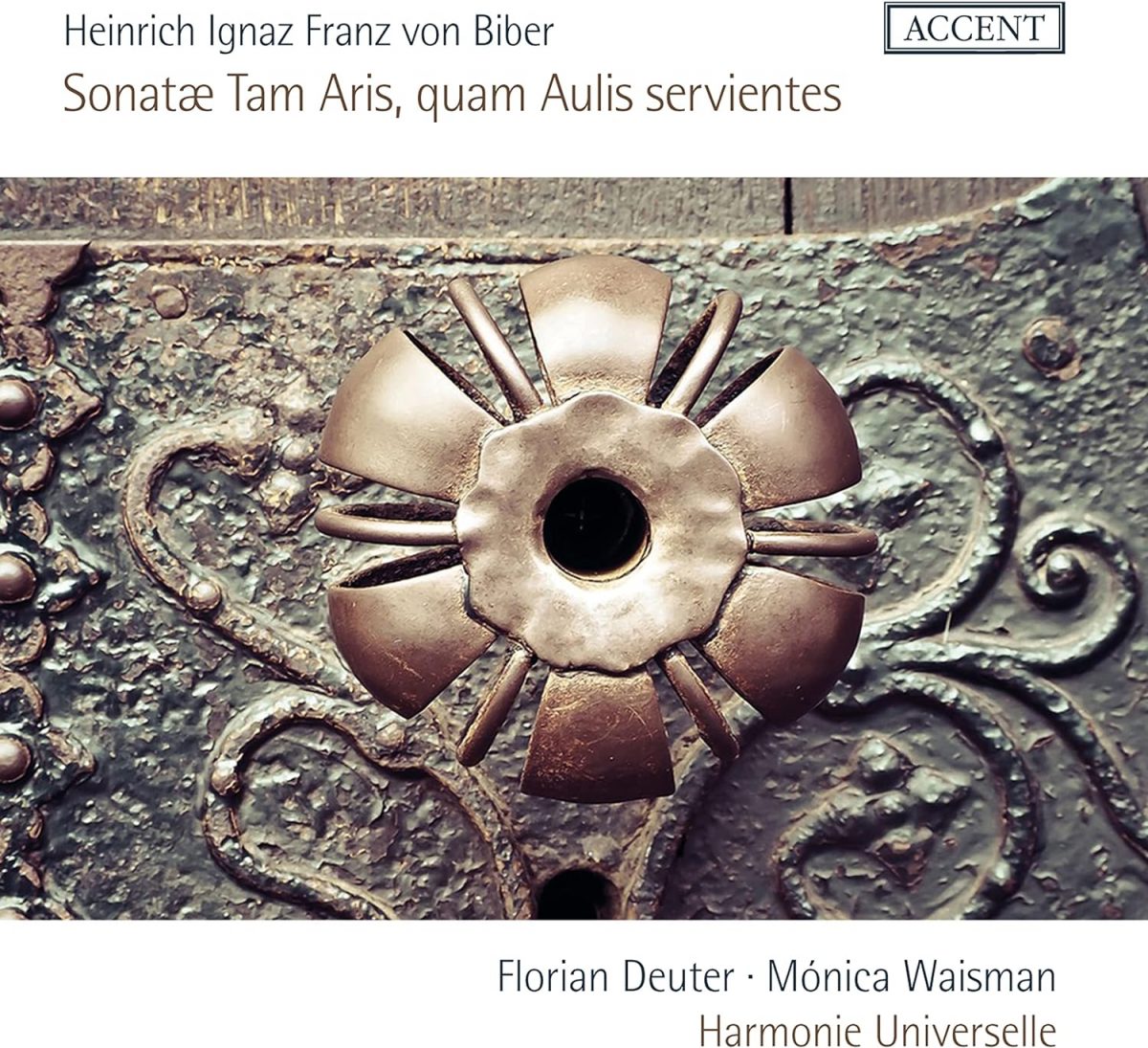
It has been some years since a new recording of this set came to the market. It is the first that I have which also includes the trumpet duets, and (I think!) the first that uses a proper church organ in the continuo group. The 12 duos are interspersed (and not in their original order) between groups of the ensemble sonatas, which are played in the printed order. The trumpet playing (by Hans-Martin Rux-Brachtendorf and Astrid Brachtendorf) is excellent throughout. So, too, is the string playing, though I would have liked a little more information about the instruments used; in this repertoire, I don’t think the “violas” should all be the standard instrument we know today, as indicated by the differing clefs, and – rather than a “cello” – I believe that the lowest stringed instrument should be what we’ve come to call a “bass violin”. Without an instrumentarium in the booklet, it is impossible to be sure. The only relevant comment on the scoring concerns which keyboards are appropriate, and doesn’t mention lutes at all… Christoph Sommer – whose name is omitted on the case, but appears in the booklet – does an excellent job of placing chords, but sometimes lets a flourish get the better of him here or there; with only one continuo part-book, how would a theorbist and full church organist managed to share? On that point, I’m sorry that we don’t get to hear more of the organ – the soundscape definitely favours the strings. Of course, that is where the detail of Biber’s endlessly inventive music is. Even so, I would have liked to hear a little more – could some of the pieces not have been played just with organ, and others just with theorbo. Or even, dare I say it, harpsichord? I don’t want to end on a negative, though; this is superb music, superbly played. Don’t miss this recording, even if you already have a rival version!
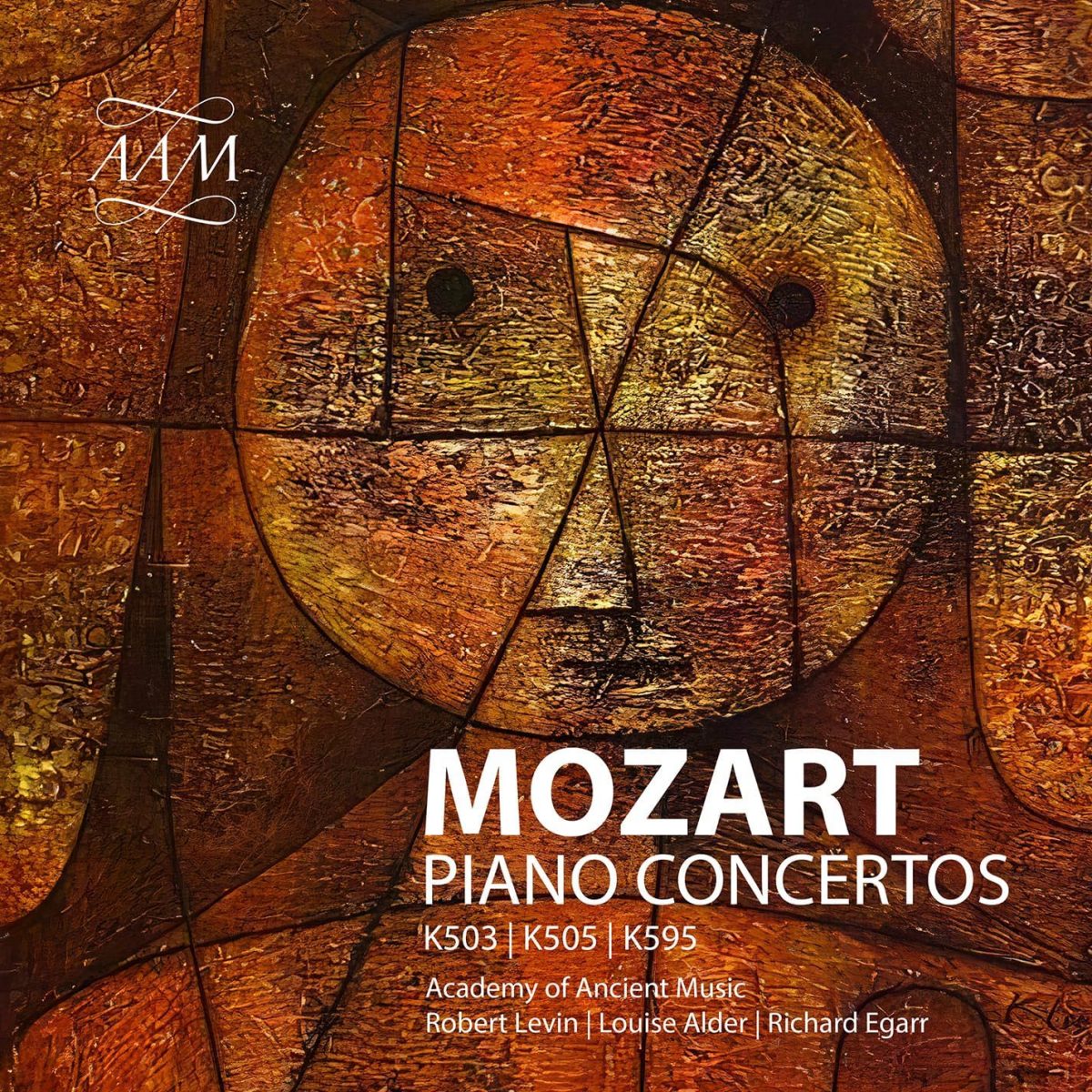
Robert Levin fortepiano, Louise Alder soprano, Academy of Ancient Music, conducted by Richard Egarr 66:39 AAM AAM045
This is a significant issue which finally brings to a close a series that was started thirty years ago but was brought to a halt after the AAM’s contract with Universal (Decca) ended. In 2023 the series was resumed on the AAM’s own label, the five CDs needed to complete the series now issued and reviewed by EMR. It is perhaps a piece of serendipity that this final CD is to my mind the most satisfying of the series since its resumption. I think there are three definable reasons: firstly, the restricted sound quality of several of the previous discs has concerned me. Here the venue is for the first time St John’s Smith Square and for whatever reason the quality is more open and spacious than other recent discs; also the fortepiano Robert Levin uses here is a beautifully-toned copy of a Viennese Anton Walter instrument of 1795 by Chris Maene of Ruiselede, Belgium. Warmly and roundly characterful across its range, it responds to Robert Levin’s fluent passage work to often mesmerizing effect. Finally, former AAM director Richard Egarr’s lively, positive direction seems to me a step up from that on other recent recordings in the series.
A further reason to celebrate this issue is of course that the CD includes not only two of Mozart’s greatest piano concertos but also one of his finest concert arias. The scena consists of an accompanied recitative and aria, Ch’io mi scordi di te? … Non temer amato ben, K505, the reason it is included here being that it includes an elaborate concertante part for keyboard. It was written for Nancy Storace, his first Susanna in Le nozze diFigaro, on the occasion of her final concert in Vienna in 1786. Mozart’s catalogue of works records that it was written for ‘Mlle Storace and me’, underlining suspicions that the relationship may have been more than simply a professional one. More importantly, it is sung with affectionate warmth by Louise Alder, who displays some fine chest notes and whose ornamentation is excellent with the exception of the absence of cadential (or any other) trills.
It has long been known that the oft-referred to ‘valedictory’ qualities of Concerto No. 27 in B-flat, K595 belong to the imagination, since it is now known to have been composed earlier, probably between 1787 and 1789, than was once believed. However, Cliff Eisen’s notes advance an argument for the same thing applying to Concerto No. 25 in C, K503 an idea new to me. Eisen argues that at least in part it may date from between 1784 and 1786, thus making it one of the works Mozart is known to have started and then put aside for completion when he wanted a new work. More importantly, as noted above, both works are among the greatest Mozart composed in a genre that he transformed over the course of his lifetime. For sheer grandeur he never excelled the opening Allegro maestoso of K503, the contrast with the reflective opening movement of K595 here underlined by the gentle, almost understated treatment of the latter.
Detailed comment on the individual concertos can be restricted to a few points. The opening of K503 might have benefitted from a little more ceremonial pomp, though that impression does not apply to its return after the development. The secondary idea in the same movement might be considered a bit brisk and inflexible. The ornamented entry by the piano in the central Andante of the same concerto is magical and the final Allegretto has a nice sense of operatic bustle. In K595 the unexpected restlessness that develops in the central Larghetto is well brought out, while the solo oboe’s beautifully played lead-back to the main theme can serve as a special example of the high quality of the AAMs playing.
Overall, the merits of Robert Levin’s playing by now need little further rehearsing. His ability to shape Mozart’s lines with equal idiomatic insight in both passaggi and cantabile is a joy, while his imaginative ornamentation never exceeds the bounds of stylish decoration. As already made clear this is a truly fitting conclusion to a series that for long looked as if it would remain a torso. Congratulations to all that oversaw its completion are very much in order.