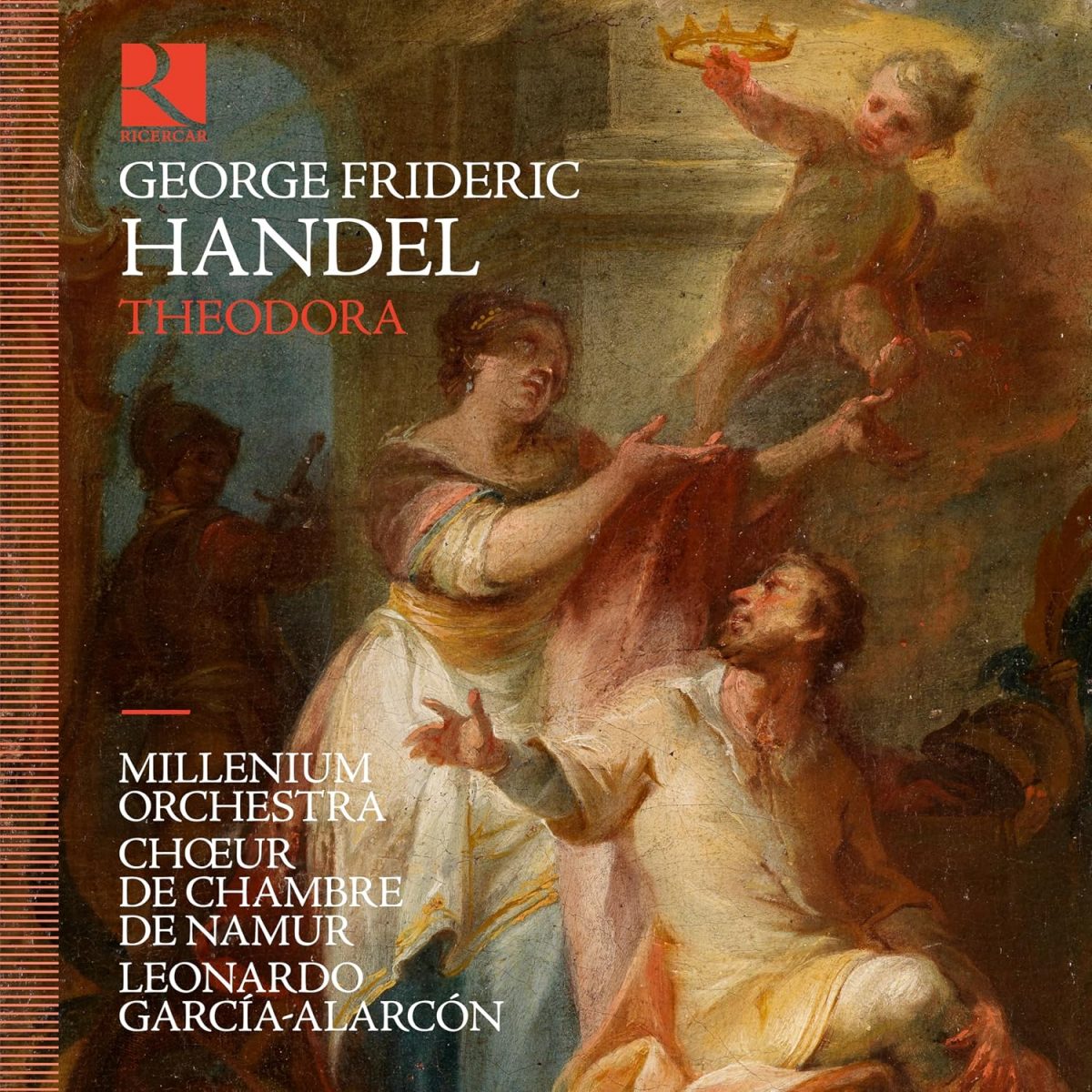
Soloists, Chœur de Chambre de Namur, Millenium Orchestra, conducted by Leonardo Garcia Alarcón
166:16 (3 CDs)
Ricercar RIC 485
It has hardly been a well-kept musical secret that my enthusiasm for the work of Leonardo Garcia Alarcón has over a long period of time been distinctly lacking, particularly in the instance of his over-bloated performances of 17th-century music. It therefore came as a considerable surprise when he started on a series of Handel’s oratorios that has turned out to be outstanding and which to date includes Solomon (review HERE), Samson, and Semele. Now he has turned with equal success to what for many is the greatest of all Handel’s oratorios, Theodora.
If that is a verdict that today would be endorsed by many, it was by no means always the case. First performed in the spring of 1750 at Covent Garden, Theodora was distinctly unsuccessful. In the no-nonsense words of Handel enthusiast the Earl of Shaftsbury, ‘The Town don’t like it at all’. Several explanations can be advanced, one non-musical. Days before the premiere, London had been rocked by unusually strong earth tremors and a number of its citizens had deserted the capital in fear. More directly, there is the nature of the oratorio itself. Its libretto by Thomas Morrell, the author of some half a dozen of Handel’s librettos, is unique in that its text is the only one set by Handel that is not drawn from the Bible. Rather, it was based on early Christian history as related in a 17th-century romance by Robert Boyle, The Martyrdom of Theodora and Didymus (1687). Handel is known to have entertained a particularly soft spot for the oratorio, the disappointing reception of which caused him considerable pain. His enthusiasm is not difficult to understand. To a greater degree than usual in oratorio librettos the dramatic possibilities in the story of Roman force opposed to Christian faith are self-apparent. We therefore have at one extreme the uninhibited exuberance of the Roman revellers as they celebrate their pagan festival, at the other the quiet, prayerful confidence of the Christians. That it is the latter that inexorably come to dominate the work can be illustrated in a comparison that shows of 24 arias only five have a marking of allegro or quicker, an exceptional statistic for an 18th-century dramatic work. That, too, may provide further explanation for the disappointment of early audiences; they were simply not used to the idea of an elegiac Handel and missed the overwhelming choruses.
It is that disparity of mood that forms one of the reasons for Alarcón’s success with the work. In this he is fortunate to have at his disposal the superb Namur Chamber Choir, which portraying either the verve of the Roman mob or devotional Christians does so with total commitment and impeccable sense of style. This ability to capture the dramatic essence of the work applies to Alarcón’s direction of the splendid Millenium Orchestra, which plays with an impressive depth of sonority, particularly in the lower register, which belies the slim number of performers (two cellos, one double-bass). Alarcón’s overall direction captures the oratorio’s individual character to outstanding effect, producing a performance exuding colour and far removed from the staid monochrome English oratorio tradition. This being Alarcón there are of course controversial or eccentric elements. The contrast of tempo is further exaggerated by a tendency to take slower ones too slowly and vice versa, although there is nothing here that jars too much. What does jar from time to time is the conductor’s propensity for a continuo section that is ripely constituted and ripely active in its production of arpeggiations, broken chords etc etc. It is quite extraordinary how conductors and theorbists (in particular) seem unable to understand that florid continuo realisation is not only egotistical but unmusical and ill-mannered toward singers, from whom it diverts attention. The changes from harpsichord to organ keyboard continuo within a single number are at times disconcerting.
The soloists – Sophie Junker (Theodora), Dara Savinova (Irene), Christopher Lowrey (Didymus), Matthew Newlin (Septimus), Frederico Projecto (Messenger) and Andreas Wolf (Valens) – will be largely familiar names from the earlier Alarcón oratorio recordings. They form a fine team, led by Junker’s bright, innocent-sounding Theodora, some less convincing ornamentation notwithstanding. But the major kudos go to the coal black bass of Andreas Wolf, in his element as the strutting, bullying governor Valens. For reasons not explained, Irene’s aria ‘Bane of Virtue’ (Part 1) is cut.
There is already an exceptional Theodora in the catalogue in the shape of Paul McCreesh’s Archiv version, one of his finest recordings. Its lack of reservations of the kind noted above leaves it as the standout recommendation. Yet, as with his previous Handel oratorio recordings, there is a compelling commitment about Alarcón’s performance that I would not now wish to be deprived of.
Brian Robins