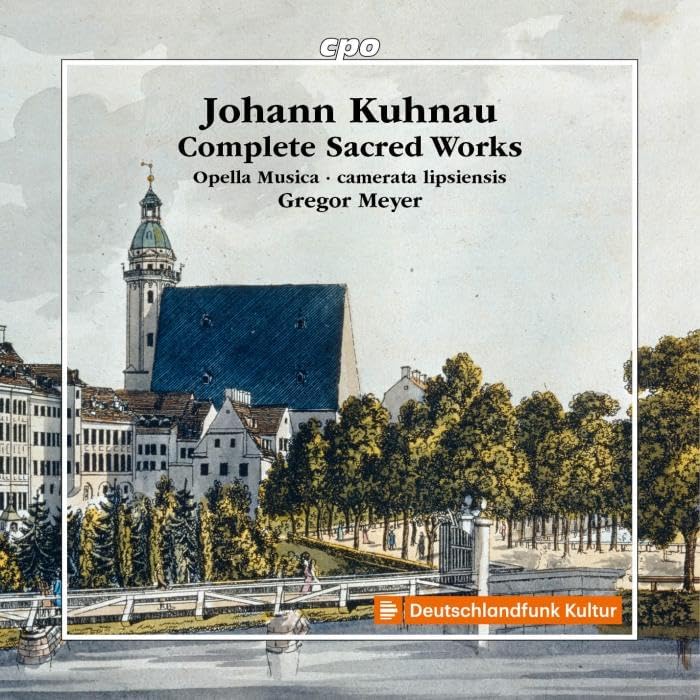
Opella Musica – camerata lipsiensis, directed by Gregor Meyer
8 hours 58 minutes (8 CDs)
cpo 555774-2
Once in a while a recorded project transcends commercial considerations to become nothing short of historic documentation. Such is this present collection of the complete surviving sacred works of Johann Kuhnau (1660-1722), Bach’s predecessor as Kantor at the Thomaskirche in Leipzig. Its academic credentials are indeed further established by the set being produced in conjunction with a new critical edition of Kuhnau’s works by David Erler, the countertenor of Opella Musica. Publication by Breitkopf and Härtel is currently in progress. Several of the individual issues have been reviewed by colleagues Brian Clark (vol 1) and David Stancliffe (vols 3, 5 & Zittau8), but the issue of the complete set seems an appropriate moment to attempt to place Kuhnau not only in the context of his time but also that of the sacred music of Bach.
Born to a Bohemian family that fled the Counter-Reformation, Kuhnau studied in Dresden and Italy before becoming interim Kantor at Zitttau and then a law student at Leipzig University. In 1684 he was appointed organist of the Thomaskirche, practised law and also found time to direct a collegium musicum. One of the last of the great musical polymaths, in 1700 he published Der musicalische Quacksalber, a novel satirizing modern trends in music and which mentions his now-lost opera Orpheus. The following year, Kuhnau was appointed Kantor of the Thomaskirche, a position that embraced civic in addition to religious duties. He retained it until his death, composing a huge amount of music of which only a small portion is extant.
The nearly nine hours of music spread across eight CDs includes works that look back to the 17th-century religious concerto and those that remind us that the modern cantata style of Bach is close at hand. In addition, there are a handful of Latin works, including a splendid and lavishly scored – three trumpets, timpani, two oboes and strings (five-part in ,Magnificat vol 3), and ‘Spirate clementes’ an exquisitely-wrought trio for two sopranos, bass and continuo on vol 8, which also features a concluding miscellaneous group of mostly secular vocal works including strophic songs and choruses written for plays. It would obviously be impractical to attempt analysis of the 40-odd works here, so I will content myself with a few general points that come to mind after listening to the discs over a period of time. But before doing so, there are a few observations regarding the performances which strike me as being close to ideal for a project such as this. All the choral works are sung one-voice-per-part, being finely balanced both as to ensemble and against the sometimes brilliantly conceived instrumental accompaniment. A total of five voices are employed throughout the set, giving it a pleasing unity. All are highly proficient singers more than capable of sustaining the melismatic writing Kuhnau at times introduces, especially in works like the Missa brevis for bass and strings that display Italian influence (vol 4). Just occasionally, as in this work, a more rhetorical, text-based approach would have been welcome, but at least the slight degree of understatement ensures there are going to be no aggravations on repeated listening. My only other small caveat relates to the many strophic songs and choruses, where one might have expected ornamentation to provide variation in the verses. The instrumental contribution deserves nothing but praise, and overall this is a very fine achievement that deserves fulsome congratulations.
Returning to the impressions gained from this unique overview of Kuhnau’s sacred music, there is one striking aspect that contradicts the received view of his conservatism. This gained much traction from his sometimes fractious relations with Telemann, whose poaching of Thomaskirche students for opera did not sit well with Kuhnau. Yet Kuhnau himself had played an important role in the founding of the opera company in Leipzig. More importantly, his music is consistently coloured by tone-painting given a strong character by its embellishment with daubs of chromaticism. Chorale cantatas are few, but the lovely Christmas cantata ‘Wie schön leuchtet der Morgenstern’ (vol. 7) (also of course set by Bach in his cantata BWV 1) is an enchanting exception. So how can we relate Kuhnau to Bach, who was certainly influenced by his predecessor? For me, for all his intellectualism, arm’s there remains in Kuhnau’s music a certain element of naivety that is not applicable to Bach. His God is a more approachable being than that of Bach, who almost always remains at a majestic arm’s length.
This set, an obligatory acquisition for anyone with an interest in Baroque sacred music, comes with a booklet including expansive (but microscopically printed) essays in German and English. For English translations of the German or Latin texts, you will need to go online.
Brian Robins