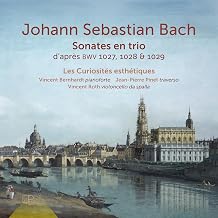
Les Curiosités esthétiques
En Phases ENP022
This is a delightful CD of elegantly played trio sonata movements. The surprise for readers of the EMR lies in the choice of instruments: a traverso (Jean-Pierre Pinet), a violoncello da spalla (Vincent Roth), and a pianoforte (Vincent Bernhardt).
The traverso is a copy by Giovanni Tardino of the only surviving instrument so far (2015) discovered by the famous maker Pierre-Gabriel Buffardin, who is credited with inventing the screw cap at the end of the crown and the telescoping adjustable foot-joint which made it possible to adjust the tuning. He is likely to have been a teacher of Quantz.
The copy of the Bartolomeo Christofori pianoforte by Kerstin Schwartz dates from 1995. The original – one of three surviving instruments – dates from 1726, and by this time Christofori was making his hammer heads from rolls of several layers of handmade paper, glued together; the strings were brass, with gauges not much different from Italian harpsichords. ‘The quiet, lute-like sound…’, writes Kerstin Schwartz, ‘took some getting used to, because it was such a completely different sound than what was known from the Viennese pianos of the end of the 18th century.’
The violoncello da spalla, popularised by Sigiswald Kuijken with La Petite Bande, was invented – according to Ernst Ludwig Gerber’s famous dictionary of 1792 – by J. S. Bach in Leipzig in 1724 with the aim of facilitating the bass part in difficult and fast passages. The basso continuo line before this time was normally entrusted to a kind of bass violin called a violone, sounding at 8’ pitch. This is the instrument, rather than the viola da gamba, of Bach’s earlier versions of BWV 1027, used in this performance, and a study of Bach’s reimagining of the viola part in cantata 199 in later performances reveals that it was subsequently played on a gamba and then on a violoncello piccolo. There was considerable interchangeability among these melodic instruments once we step away from our preconceived notions of ‘string basses’.
When he died, Bach’s estate included two bassetgens and two lute-harpsichords. The timbre of the pianoforte is such that when I first listened to the CD (which I always do ‘blind’ lest I be influenced by my preconceptions), I imagined that it was one of those lute-harpsichords I was hearing.
So I found the performances captivating – beautifully balanced, clear and distinctive – and utterly plausible. The booklet is a mine of information, and, as far as I can judge from my own research for Unpeeling Bach, gives a warranty for performances of these trios in this form.
Apart from these technical considerations, the performances here showcase the skills of these players and are a welcome addition to the way in which we can hear Bach’s chamber music and have our preconceptions challenged.
David Stancliffe