D James Ross reviews the
2026 St Magnus International Festival
It is hard to believe that this is the 50th St Magnus International Festival in Orkney, particularly as I attended the very first one as a student in 1976! I was very pleased to see a varied selection of early music in the anniversary 2026 Festival brochure – Orkney and early music seem to me to be a marriage made in heaven. The Festival’s founder Peter Maxwell Davies had a keen interest in Mediaeval and Renaissance music, and historically informed performances of early repertoire, often presented in the islands’ historical churches, have proved very popular in the past.
My first concert this year was a recital in Stromness Town Hall by the beguiling American-Armenian musician Lucine Musaelian, a singer who accompanies herself on the viola da gamba. Performing a selection of 17th-century love songs, gamba solos and traditional Armenian music, she held her audience entranced by the beauty of her singing and playing. With a bias towards female composers including Barbara Strozzi and the Caccini sisters, all composing in the attractive nuove musiche style, Musaelian also touched upon the wonderfully ornate repertoire of the virtuosic Concerto delle Donne composed by Luzzaschi as well as songs by Monteverdi. Observing that a painting, possibly representing Strozzi, shows a woman accompanying herself on the viol, Musaelian admitted a particular affinity with Strozzi, who with a striking extended song In medio maris provided her with the title for her programme. Musaelian’s formidable viol technique facilitated flawless accounts of complex but unobtrusive accompaniments representing up to three polyphonic lines, as in Cipriano de Rore’s Ancor che col partire, which she deftly followed with a set of viol divisions. Further solo viol numbers by Marin Marais and Monsieur de Saint Colombe took full advantage of the six-stringed viol and Musaelian’s impressive technique, but for me it was the songs, including the entrancing Armenian liturgical music by Nerses Shnorhali and Grigor Narekatsi and traditional tunes, which I found most enjoyable. Particularly intriguing was the way in which the traditional sobbing ornamentation and use of chest voice spilled effectively from the traditional material into the Renaissance songs, enhancing their emotional impact. While I expected to be familiar with much of the early repertoire, I was delighted with Musaelian’s consummate vocal and instrumental skills as well as the unique spin she put on the early repertoire, and as a bonus was pleased to recognize the traditional Armenian melody Hov Arek, a piece I enjoy playing on the duduk – it’s a small world!
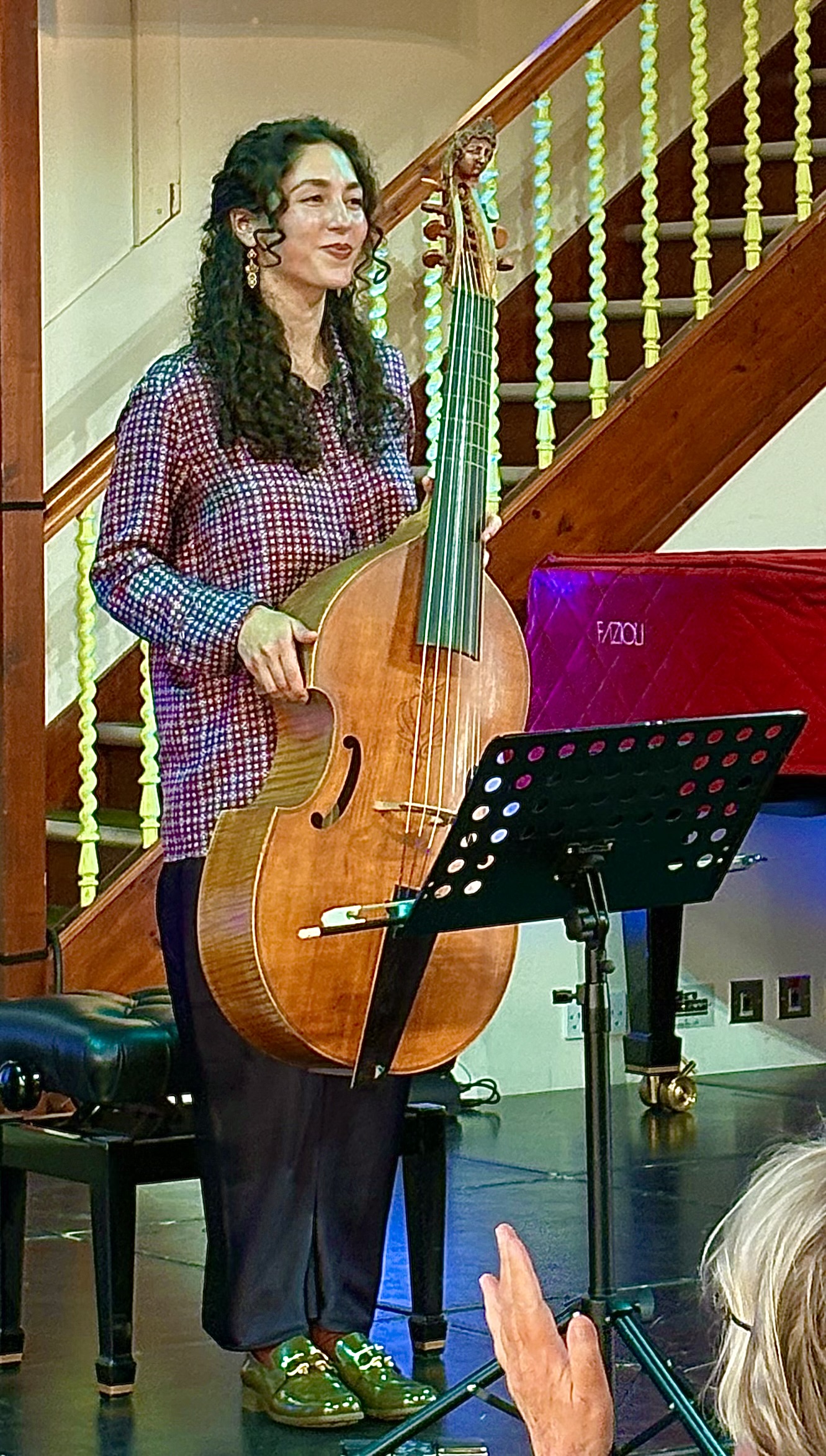 Lucine Musaelian’s performances
on voice and viol of 17th-century love songs
and Armenian traditional music were a revelation.
Making a long-overdue return visit to the St Magnus International Festival after ten years, the excellent Scottish choral ensemble The Marian Consort under their director Rory McCleery contributed two programmes in as many days, a concert based on the Western Wind theme in St Margaret’s Hope Church and a programme exploring a single Scottish musical manuscript in St Magnus Cathedral. The pretty village church in St Margaret’s Hope, at which my grandfather James Louttit was an elder, has taken the brave decision to remove dingy Victorian pews and pulpit, all too familiar to me from holiday visits to the village, turning the space into a bright, flexible and above all welcoming arts venue and place of worship. Its acoustic turned out to be pleasantly intimate, ideal for the Byrd motets and four-part mass movements as well as parts of the magnificent Taverner Western Wind mass. The Consort’s performances of the Taverner had a magnificent sweep and energy which combined with their wonderfully focussed sound and pinpoint accurate intonation to produce a very powerful account. In among the 16th-century repertoire we had a selection of fine contemporary pieces, including an expressive psalm setting from Nico Muhly and Tom Coult’s Souling, a work intriguingly interweaving folkloric elements into a rhythmically rich texture. In the Marian Consort tradition we also had a world premiere by Daniel Kidan and a spectacular setting of Verbum Domini by Edmund Finnis, to my mind the finest of the wonderfully varied modern pieces. Enthusiastic applause from a capacity crowd elicited a truly lovely encore performance of John Sheppard’s meltingly beautiful Libera nos, salva nos.
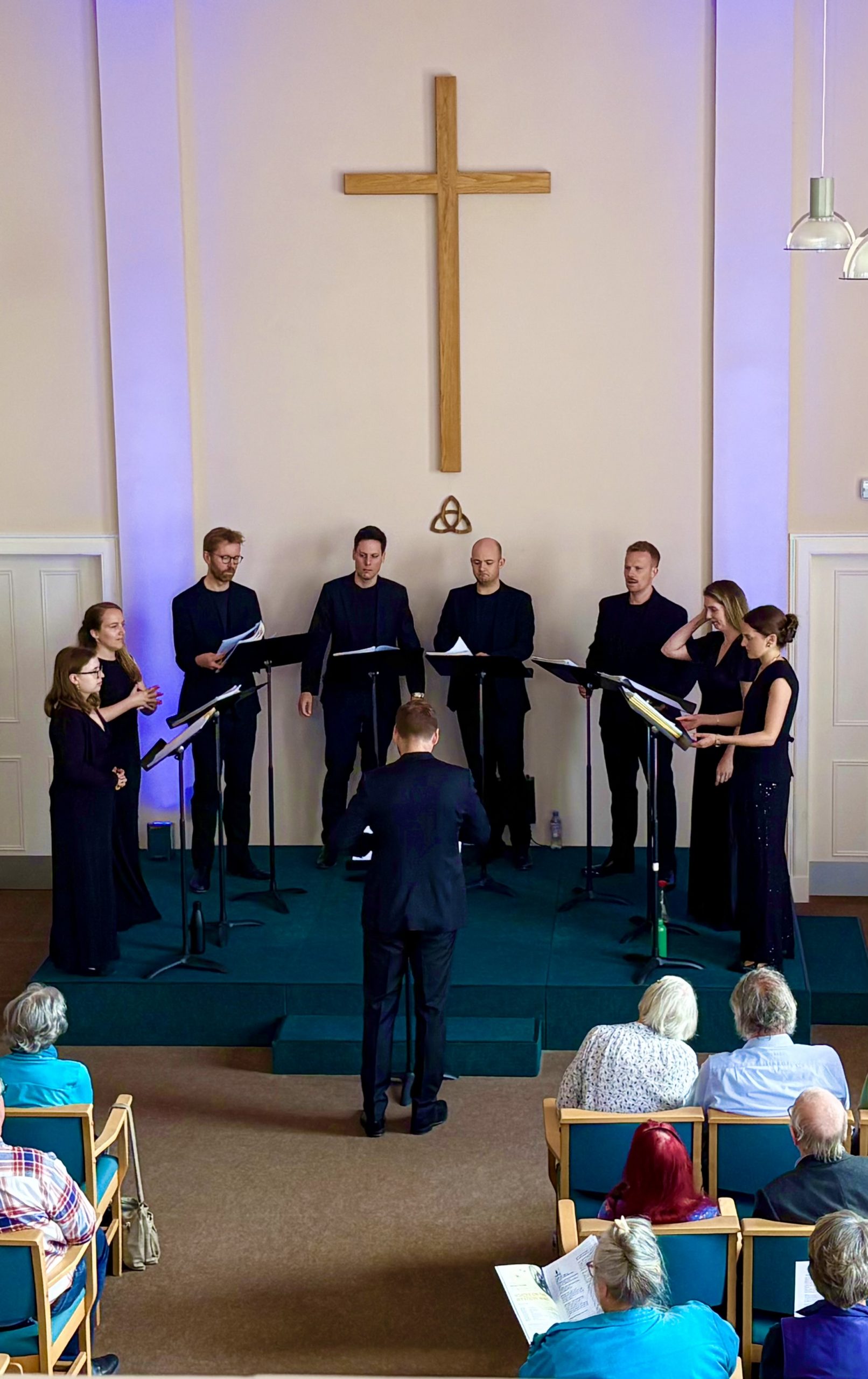 The Marian Consort and their director Rory McLeery
about to perform in St Margaret’s Hope Church,
an attractive new venue in South Ronaldsay.
The Consort appeared again the following evening in the magnificent St Magnus Cathedral for a concert entitled The Auld Alliance, focussing on one of the handful of surviving Scottish Renaissance church music manuscripts, the Dunkeld Antiphoner. In fact, five of an original set of six partbooks are associated not with Dunkeld but with Lincluden Collegiate Church; nowadays the collection is more accurately referred to as the Lincluden or Dowglas/Fischar Partbooks, referencing two signatures in the manuscript. In addition to containing major works by important French and Burgundian masters such as Josquin, Pierre Certon and Johannes Lupi, all of whom featured in this fascinating programme, of particular interest are two six-part Masses probably by Scottish composers, although they are frustratingly anonymous in the manuscript. If the Mass Felix Anna, from which the Consort sang the Kyrie, Credo and Sanctus, lacks the flamboyance of the contemporary mass settings of Robert Carver (which incidentally may include the Mass Cantate, the other Scottish Mass preserved in the partbooks), it is an impressively rich and consistently imaginative work, given a beautifully effective account by the Consort. It is a piece I am very familiar with, having performed it several times around thirty years ago with my group Musick Fyne, and even having recorded it – I have to admit that it has further grown on me over the years, and McLeery and his Consort found unexpected depths in it, persuading me to return to it shortly! This concert was being recorded for future broadcast on BBC R3, and the Consort were on peak form for this important opportunity to reach a wider audience with this fine but neglected repertoire. Their opening account of Josquin’s powerful Benedicta es was simply exquisite, while Certon’s Inviolata was a revelation and the concluding eight-part Salve cereberrima virgo by Johannes Lupi was truly magnificent. If the world premiere of Emily Hazrati’s sâye seemed a little out of place in this programme otherwise so intensely focussed on a single 16th-century manuscript, it proved to be an intriguingly imaginative and innovative piece impeccably performed by the Consort – and a particular delight to have the young composer present to accept her share of the applause. An encore of the ubiquitous Tallis Canon proved a soothing conclusion to a memorable concert, of which the star was undoubtedly the enigmatic and eloquent anonymous Scottish Mass Felix Anna.
A group making their first visit to the St Magnus International Festival are Voces Thules, an ensemble dedicated to the exploration of their native Icelandic musical heritage. As one who has dabbled in the performance of the Norse sagas, I was looking forward greatly to their first programme, Sagas, Skalds, Songs, and intrigued as to just what they were going to be performing. We had reluctantly come to the conclusion that if the saga texts had ever been ‘performed’ it would have been in the form of dramatic declamation of the Old Norse text to the simple accompaniment of perhaps a Viking lyre – in fact, unambiguous internal evidence made it disappointingly clear that the sagas were generally ‘read’. Voces Thules, five male vocalists who double on a number of mediaeval instruments, were clearly going to take a very different approach. Drawing on the two rich traditions of the sagas and the oral tradition of Icelandic folk music, they largely combined the two in lively accounts of passages from the Sturlunga and Grettis sagas, using various combinations of voices and instruments and frequently resorting to drones and organum. The instruments ranged from a variety of drums and timbrels, a bunch of crotal bells, a primitive folk flute, a mediaeval symphony, Viking lyres and the distinctive Icelandic langspil, a simple bowed psaltery with drones and a melody string – the brief appearance of a plastic Aulos sopranino recorder was both disappointing and unnecessary. Generally speaking, the solo voices and the male voice consort were both very effective, while the instrumental element complemented the voices well. The group’s obvious commitment to their material and the energy of their performances were greeted with enthusiastic applause in a packed St Margaret’s Hope Church. Notwithstanding my reservations, I enjoyed these honest accounts of the sagas as well as the several items of Icelandic traditional music which followed, also given the distinctive Voces Thules treatment – my appetite had definitely been whetted for their second performance in St Magnus Cathedral in which they were to present early Icelandic sacred music, which I knew would be more firmly based on archival sources.
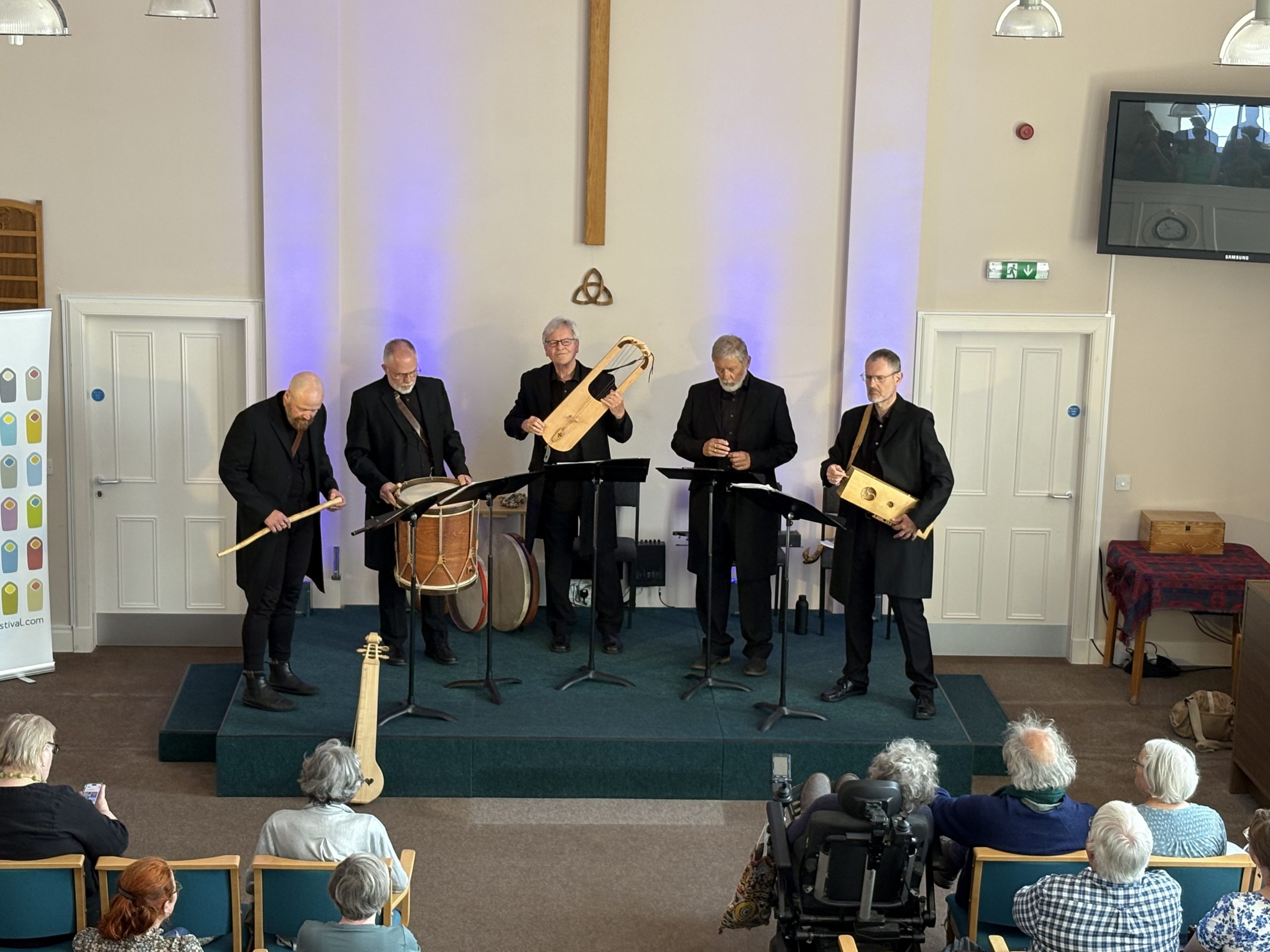 Voces Thules with a selection of their instruments
in St Margaret’s Hope Church, South Ronaldsay.
After a moment of trepidation when I spotted a modern ebonite clarinet lurking among the waiting instruments, I was soon swept up in the opening group of plainchants, sung with admirable subtlety and unanimity by the five male voices. As I had hoped, this time they drew on the surviving written sources of Icelandic church music to bring us a wealth of intriguing sacred material ranging from melody and drone through organum, faburden, ars nova polyphony, compelling call and response structures and simple accompanied melodies of beguiling beauty. Remarkably, the material came exclusively from Icelandic sources from the 14th to the 18th century, with one noble exception – the iconic Hymn to St Magnus : Nobilis, humilis preserved in Norway and possibly composed there or even here in Orkney. It was given a lovely and moving performance by the group, standing in the Saint’s magnificent Cathedral not twenty paces from his mortal remains in the pillar behind them. In several pieces they used the same range of instruments to enhance the vocal textures as previously, with the addition of a tenor crumhorn and small bells. The clarinet made mercifully only one appearance, playing a simple cantus, which honestly could have been played by anything – given their otherwise admirably HIP approach, the excuse ‘I know it’s not mediaeval but it’s useful’ doesn’t really cut it! My only other criticism of an intriguing and enjoyable exploration of very unfamiliar material was the hesitant (and in the Cathedral acoustic largely unintelligible) verbal commentary as well as an occasional ‘faff’ about who does what. Again, the group’s utter commitment to their material and the brilliant idea of involving the audience in the call and response of their final processional won them sustained and enthusiastic applause. Their encore from the Sturlunga saga overlooked the fact that many of their audience would probably have attended their earlier concert – perhaps this was the point at which the Hymn to St Magnus could have achieved maximum musical and emotional effect…
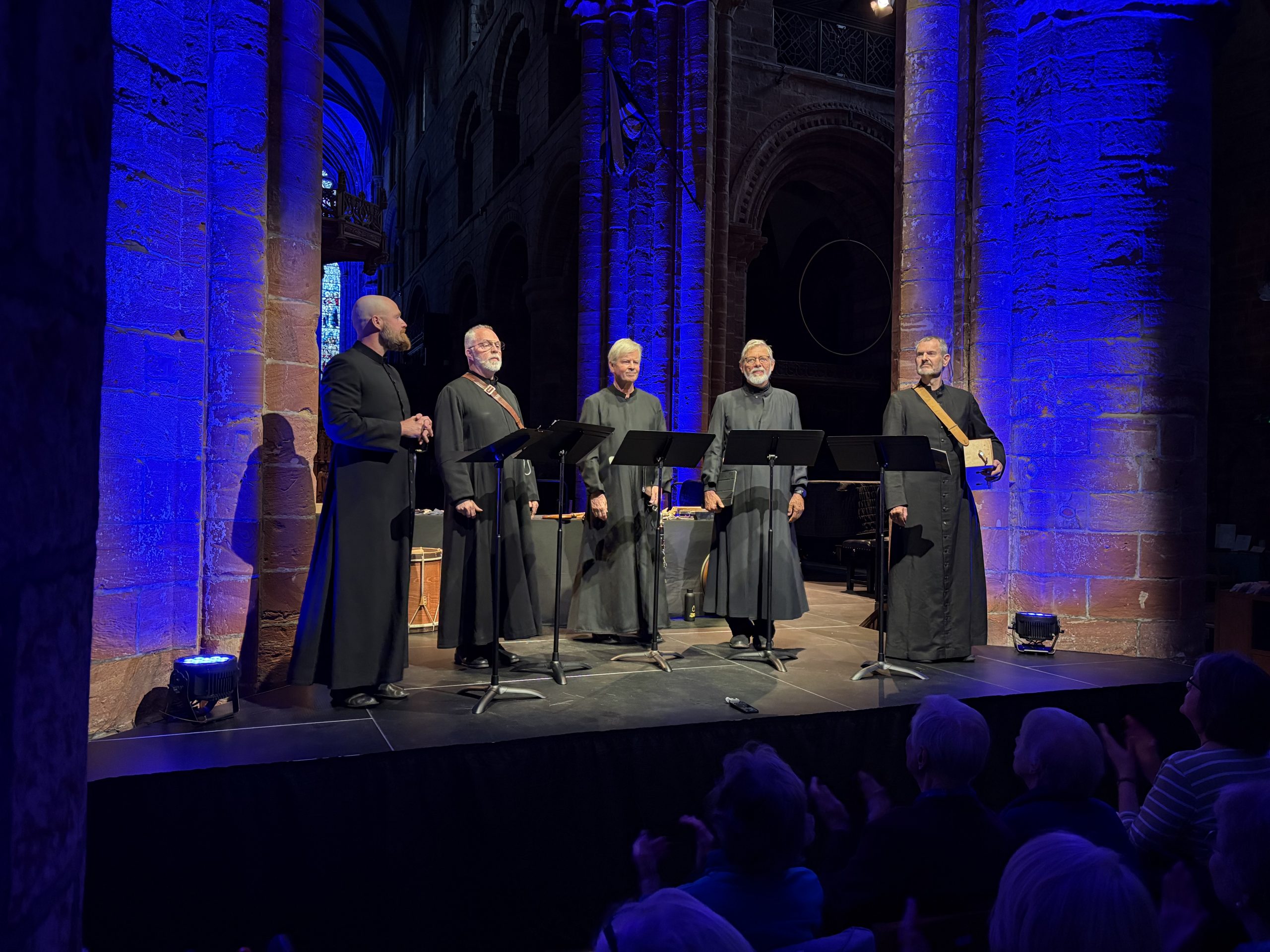 Voces Thules in the ecclesiastical garb
preparing to perform in St Magnus Cathedral.
My final concert at this year’s festival was a homage to the late John Wallace, whose arrangement of Giovanni Gabrieli’s Canzoni and Sonate of 1615 called The Invisible Symphony involved some thirty brass players including Wallace’s own celebrated Wallace Collection reinforced by The Cooperation Band playing an hour-and-a-half long compilation from the 1615 publication. I am a huge fan of Giovanni Gabrieli and particularly of his music for wind ensembles, so I was definitely looking forward to this programme – sadly I had more reservations about it than I had imagined. The musicians were positioned in one large circle in the centre of the nave of St Magnus Cathedral around conductor Katrina Marzella with the audience ranged in two equal blocks to the west and east of this. Essentially, notwithstanding the alternation of the musicians playing each piece, for us the sound came from the same direction, and I found my eyes straying to the many galleries, the aisles and the choir stalls, all of which could have housed musicians for the truly dramatic polychoral experience associated with St Mark’s in Venice – and surely hinted at by Wallace’s title. As it was, the conductor and perhaps the musicians were the only ones to experience the music in its full three dimensions. Further problems arose from the upper cornetto lines being assigned to trumpets – the quirky scampering figures, which work wonderfully on cornetti, sounded unidiomatic and risky on the upper brass instruments, and there were disappointingly frequent cracked and fluffed notes and a couple of car-crash moments. Sadly, the decision to stick these short pieces by Gabrieli, intended to be performed singly as an occasional splash of colour in longer liturgical contexts, into an extended suite came across as rather too much of a good thing, emphasising the relative lack of variety both of texture and performance. This is not to deny that the larger-scale pieces involving most or all of the players sounded extremely impressive in the resonant Cathedral acoustic, but to me much of the rest of the programme sounded breathless, unidiomatic – and eventually a bit tedious. The loud ovation which greeted The Invisible Symphony’s spectacular conclusion clearly demonstrated that my opinion was firmly in the minority, and to look on the bright side I am sure that this concert valuably brought Gabrieli’s remarkable music in largely unadulterated form to a whole new audience. This was just not for me, steeped in HIP accounts of this music by the likes of the Gabrieli Consort, Taverner Players and King’s Consort, and even the magnificent final peroration was tainted by the knowledge that some Wagnerian phrases had been insinuated into the texture. There was a lovely moment at the end of the concert when the five members of The Wallace Collection took their own bow – a fitting tribute to their late inspirational founder/director John Wallace.
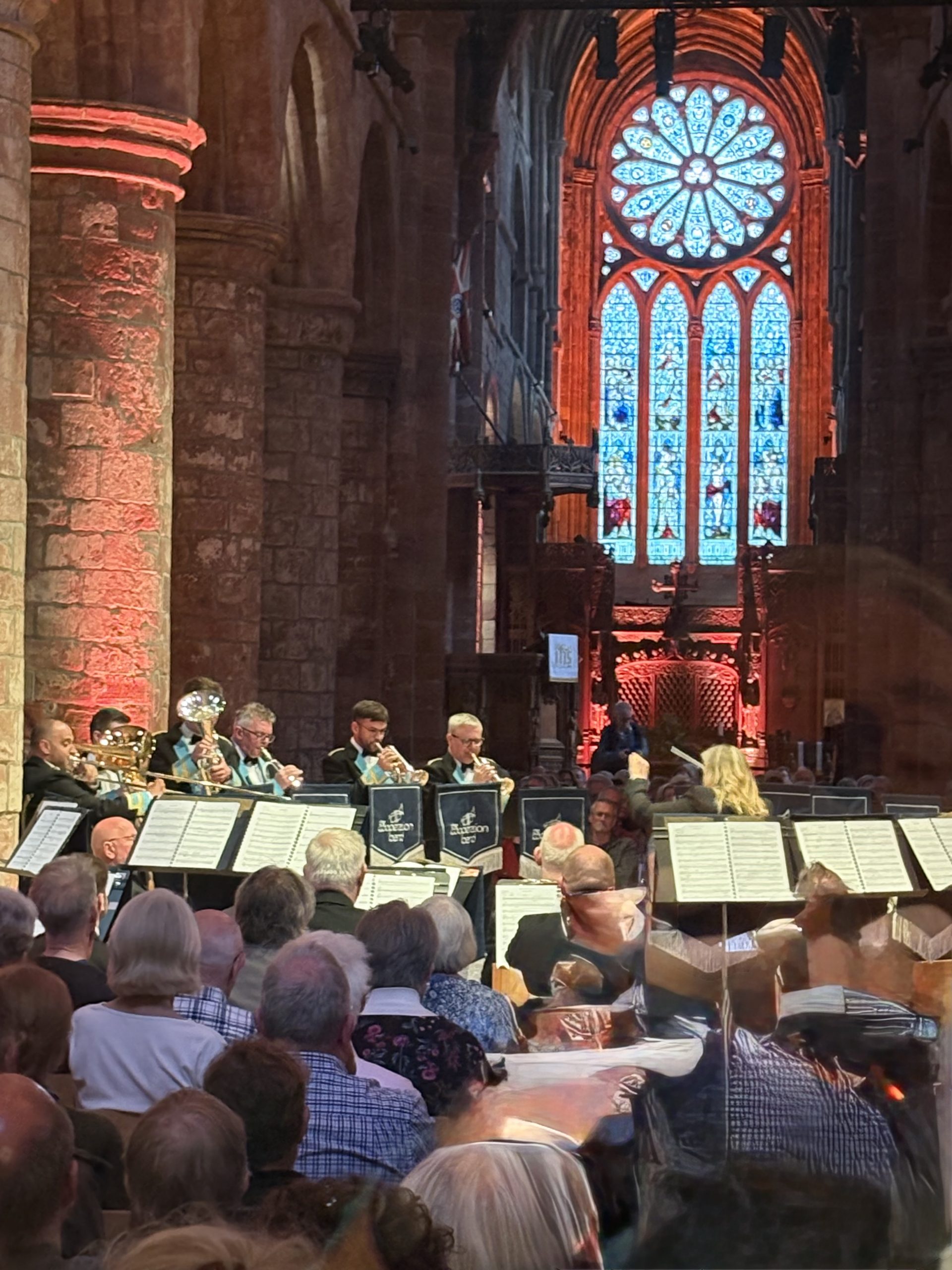 Members of the Cooperation Band
in performance in St Magnus Cathedral.
The main joy of attending a thriving international festival such as the St Magnus International Festival is the sheer variety of music on offer – even my own selective concert list, ranging from Mediaeval Icelandic secular and liturgical music, via state-of-the-art performances of Scottish and continental Renaissance and contemporary polyphony to a Venetian brass spectacular reflects the imaginative planning behind one week of events offering a truly unbelievable range of musical experiences.