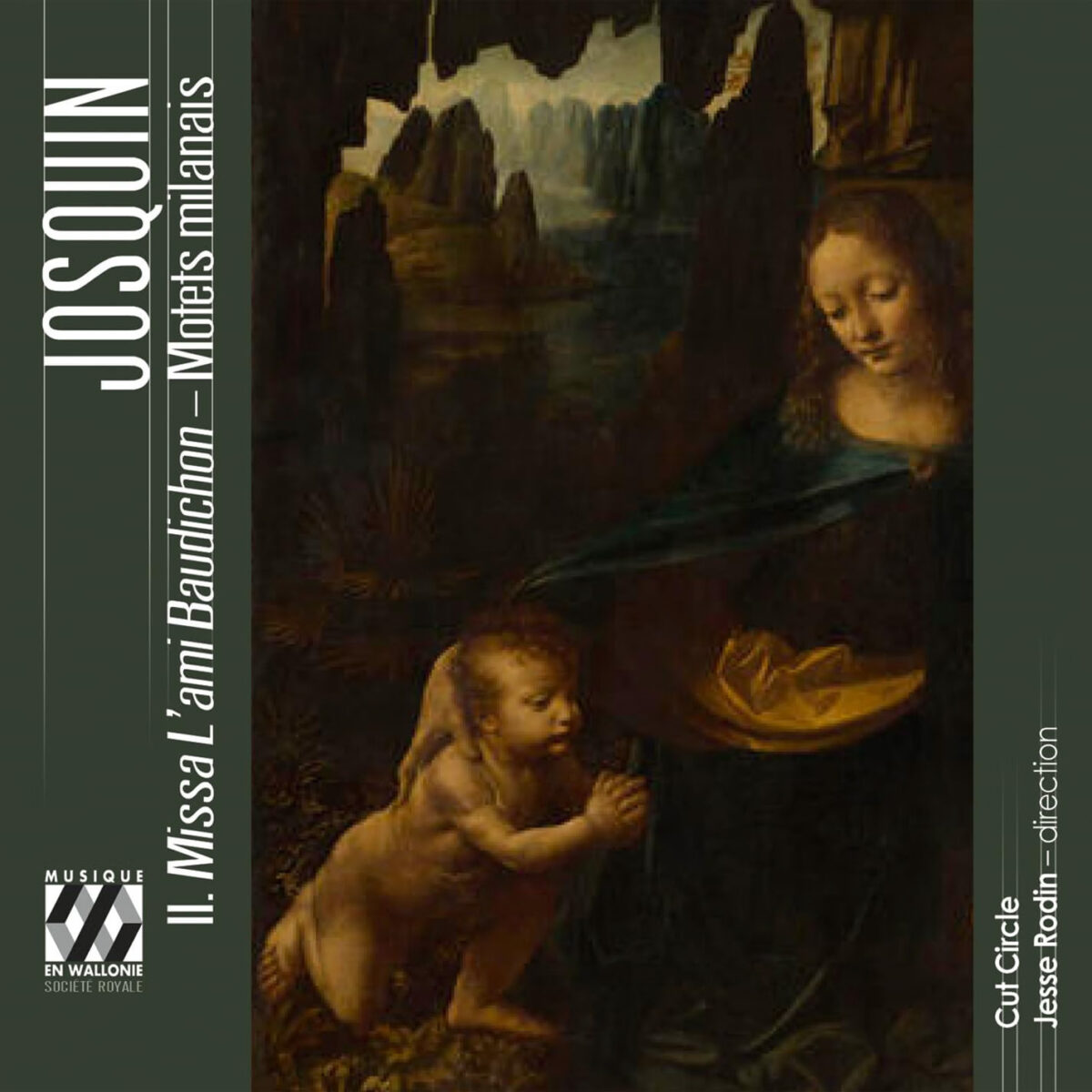
Cut Circle, directed by Jesse Rodin
65:41
Musique de Wallonie MEW 2514
‘His talent was so versatile in every way, so equipped by a natural acumen and vigour, that there was nothing in this field which he could not do …’ Thus the Swiss humanist and theorist Heinrich Glarean, writing of Josquin in 1547, during the course of one of the earliest detailed assessments of a composer. At the heart of that output lies the attribution of 31 masses, though fewer than twenty have been authenticated as the work of Josquin.
The four-voice Missa L’ami Baudichon is one of the earlier Josquin masses. It may possibly date from the period Josquin was in Milan in the service of Cardinal Ascanio Sforza (two periods between 1484 and 1489, the latter the year in which we subsequently find him in the pay of the Sistine Chapel as a singer. As the title suggests, the Mass is founded on a popular song, in this case following what was apparently a trend during this period to use a bawdy song as the cantus firmus, which, as usual, is heard throughout in the tenor line. In this case the song is particularly bawdy, making use of the ‘c’ word twice.
The performance by the Belgian one-voice-per-part ensemble Cut Circle is one of a series devoted to Flemish polyphony, with CDs of music by Ockeghem, Dufay and anonymous masses issued to date. In his note, director Jesse Rodin speaks of the sensuality of the music on the disc, which also includes a chanson-motet cycle Que vous ma dame and Vultum tuum deprecabuntur, the latter in particular following the pattern of similar works identified with Milanese compositions. There is indeed a raw energy about the performances that places them far from the ecclesiastical ambiance of performances by such as the Tallis Scholars, yet that sensuality is also present in the long melismatic lines so favoured by Josquin at this stage of his compositional career. The opening Kyrie, for example, weaves sinuous lines, the voices working in pairs much of the time, the four-part writing richly expressive. Quite apart from the distinctive character of the performances, this is a rare and rewarding glimpse of the young Josquin.
Brian Robins