Weser-Renaissance Bremen
74:30
cpo 555 642-2
Born in what is now Massa e Cozzile in Tuscany in 1637, Bernardo Pasquini spent his life as an organist and composer in Rome, where he became, with Corelli, a member of the famous Arcadian Academy in 1706. A noted harpsichord player and teacher, he numbered Francesco Gasparini and the German composers J. P. Krieger and Georg Muffat among his pupils. Closely associated with the Roman aristocracy, including the self-exiled Queen Christina of Sweden, who appointed him her ‘Principe della musica’, Pasquini lived from around 1669 until his death in 1710 at the Borghese Palazzo Nuovo, working in the service of Prince Giambattista Borghese and other members of the Roman nobility. His seventeen extant operas were performed at the palaces of the Colonna and Pamphili families in addition to the Tordimona and Apolloni theatres.
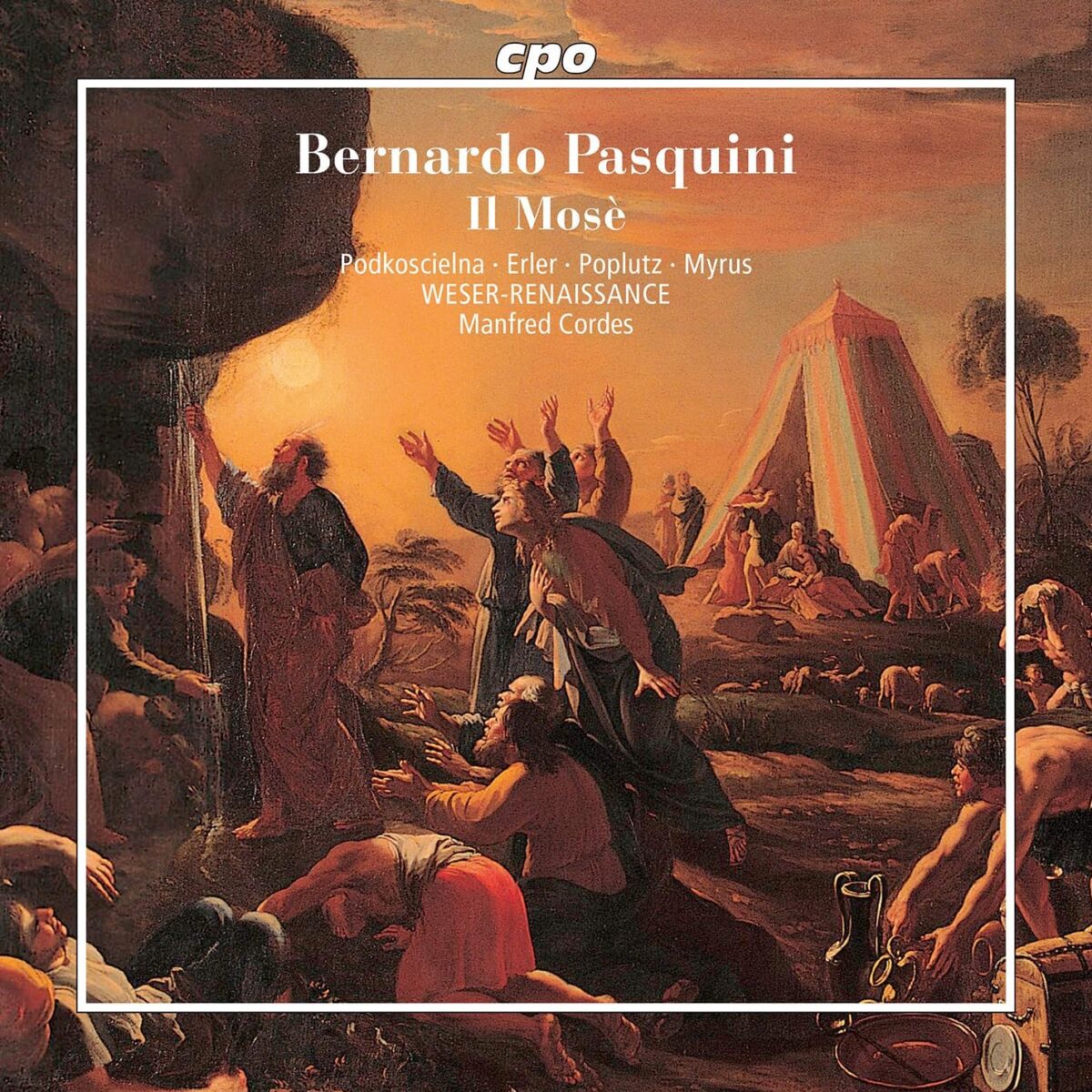
In addition to operas, Pasquini also composed 13 or 14 oratorios, according to which source is consulted, of which seven survive today. Regrettably, cpo’s extensive notes provide no background details to I fatti di Mosè nel deserto (to give the full name of the publication), being almost entirely devoted to Christina’s admittedly interesting life after she settled in Rome in 1655. However, thanks to the extensive notes for a rival version on Da Vinci Classics – they can be read online – we learn that the oratorio was first given in Modena in 1687, one of seven oratorios commissioned by the Duke of Modena from various composers covering the life of Moses. Pasquini’s contribution is concerned with Moses and the Israelites in the desert following the flight from Egypt. In the first of the two parts – the customary design of 17th-century oratorios – thanks are given to God for the safekeeping of His chosen people, while in the second they are attacked by an enemy, Amalek, but led to victory by Joshua. The arias are mostly cast in a brief, simple ABA structure (but not yet the da capo form introduced around this time by Alessandro Scarlatti) and, as in Pasquini’s operas, a significant number have only continuo accompaniment. In addition, there is a single duet for Moses and his father-in-law Jethro, while each part concludes with a chorus. The scoring is for four-part strings, and Weser-Renaissance have opted for single strings-per-part (as does the Da Vinci version), but it seems to me that a small string ensemble would be perfectly appropriate.
The oratorio is a capable, efficient piece of work though hardly to my mind compelling listening. Like the only opera of Pasquini’s with which I’m familiar, L’Idalma (Palazzo Capranico, Rome, 1680), the principal drawback is a lack of memorable melodic invention, with one aria succeeding another in quick succession without leaving any significant mark. That may, in part at least, be down to a performance that, although capable in a basic way, is like the work itself, hardly memorable. The role of Moses, originally intended for a castrato, is sung by a soprano, Magdalena Podkoscielna, whose bright, piping voice hardly suggests the dignified authority of the prophet. Much the best of the four singers is the fine tenor Georg Poplutz, who takes the role of Testo, or narrator. His diction is also superior to that of his three colleagues, but although the singing is in general competent enough, it is plain, being largely unadorned by added ornamentation; the arrival of cadence after cadence with little or no attempt at decoration becomes somewhat tedious. The instrumental playing is fine, though as is usual these days the continuo chittarone is at times too obtrusive.
I have not heard the Da Vinci version in full, but anyone whose interest in I fatti di Mosè nel deserto has been aroused might find it worth checking it out before investing in this very average performance.
Brian Robins