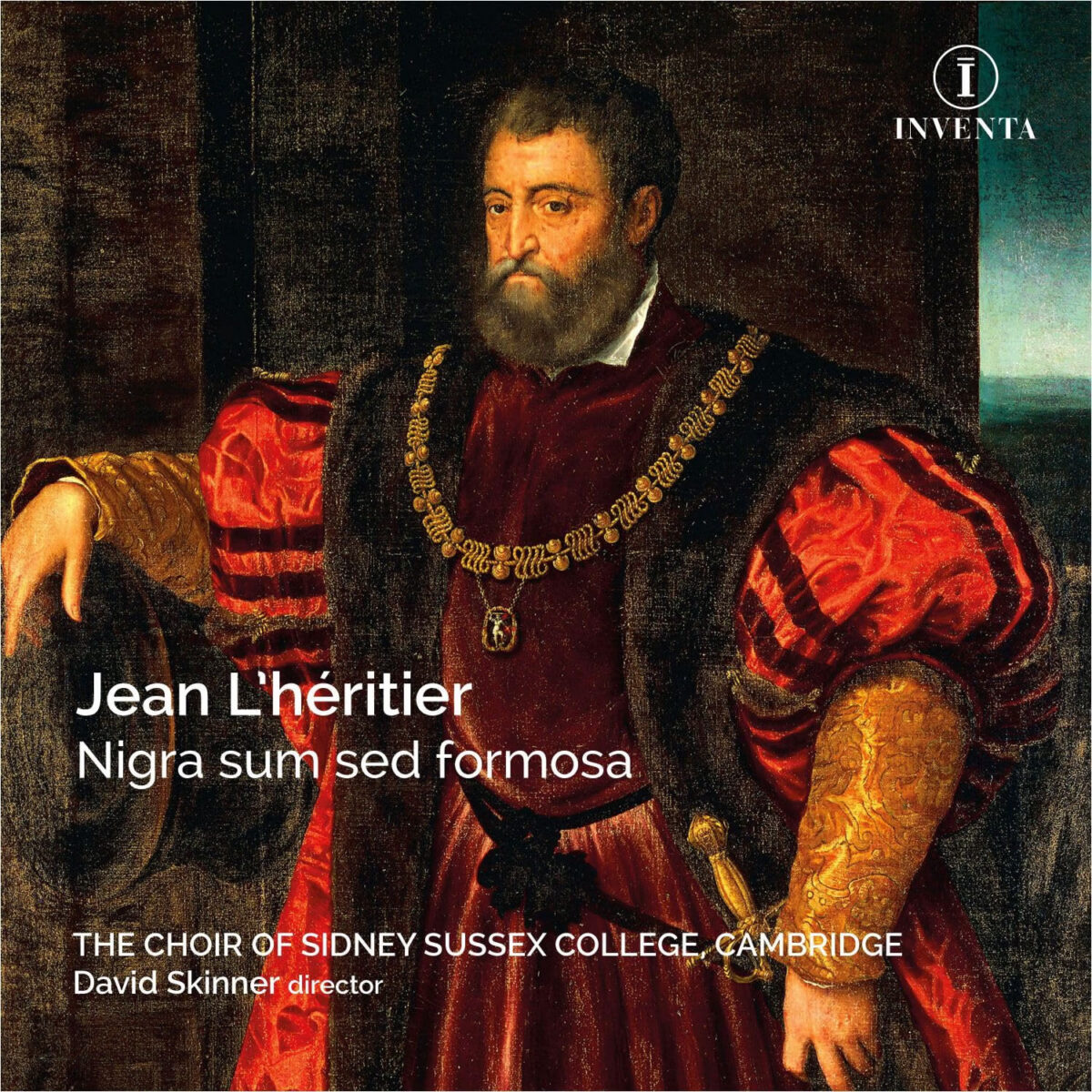
The Choir of Sidney Sussex College, Cambridge, conducted by David Skinner
78:00
Inventa INV1020
If you are already aware of Jean Lheritier, it could be through his motet Nigra sum sed formosa, upon which Palestrina based one of his masses. The good news is that Lheritier made three wonderful settings of this text, for respectively four, five (the one borrowed by Palestrina) and six voices, and they form a centrepiece to this superb recording. Also featured is his Missa super On a mal dit de mon amy for four voices, which is his only surviving mass setting. An historically informed improvisation on this song played on the harp by Andrew Lawrence-King begins this album, followed by a performance of the original song composed by Antoine de Fevin, on which Lheritier bases his mass. Several more of his consistently excellent motets provide the rest of the contents of this most rewarding disk.
Jean Lheritier was born around 1480 in the diocese of Therouanne, which is in the extreme north-west of France. The city was razed during the sixteenth century and the bishopric disappeared. It is now a small town of barely a thousand people. Like many gifted Franco-Flemish musicians, such as Jacques Colebault (Jacquet of Mantua), Lheritier – said to have been a pupil of Josquin – spent most of his adult professional career in Italy, achieving fame while working for the most illustrious employers, such as the Este and Gonzaga families and the Pope, before retiring to his native France where he died in or after 1552, possibly in Avignon.
As more of their music becomes known through publications, recordings and performances, it becomes ever more apparent that the Franco-Flemish composers of the late fifteenth and earlier sixteenth centuries – Lheritier, Fevin and Colebault already mentioned plus (to name only a few) Manchicourt, Crecquillon, Mouton, Phinot and, arguably most distinguished of all, Gombert and Clement (Jacobus Clemens non Papa) – are formidably talented, producing a sublime thread of music following Ockeghem and Josquin, culminating with Palestrina, who owes a great deal to his predecessors, at his best. Of the works on this album, besides those three settings of Nigra sum, Lheritier’s Ave verum corpus can comfortably be mentioned in the same sentence as the sublime setting by Byrd, and if his impressive nine-part Locutus est Dominus does not quite emulate Byrd’s acrobatic creativity in his own nine-part monster Domine quis habitabit, there are few works in the repertory to match the Frenchman’s deft combination of dissonance and suavity in Sub tuum presidium or his narrative skill in the serious secular song Cum rides mihi. And on the evidence of Missa super On a mal dit mon amy it is a shame that this is the only surviving setting of the mass by Lheritier.
Sidney Sussex Choir sounds entirely at home in Lheritier’s unique, sometimes quite hypnotic, sound-world, as they did in their recent recording of Colebault/Jacquet of Mantua, which was well reviewed in EMR by James Ross last year. Credit must also go of course to David Skinner, outstanding musicologist and conductor, who brings out the best both in the choir and in the music: listen how he moves the nine-part Locutus est Dominus from a searching, almost cautious beginning to a mighty climax, while he adopts exactly the appropriate – more restrained – tone throughout the liturgical mass. This disc is full of awe and delight, a showcase for yet another wonderful composer off the Franco-Flemish musical taxi rank, ideal for inspiring and stimulating further appreciation, recognition, recordings and performances.
Richard Turbet