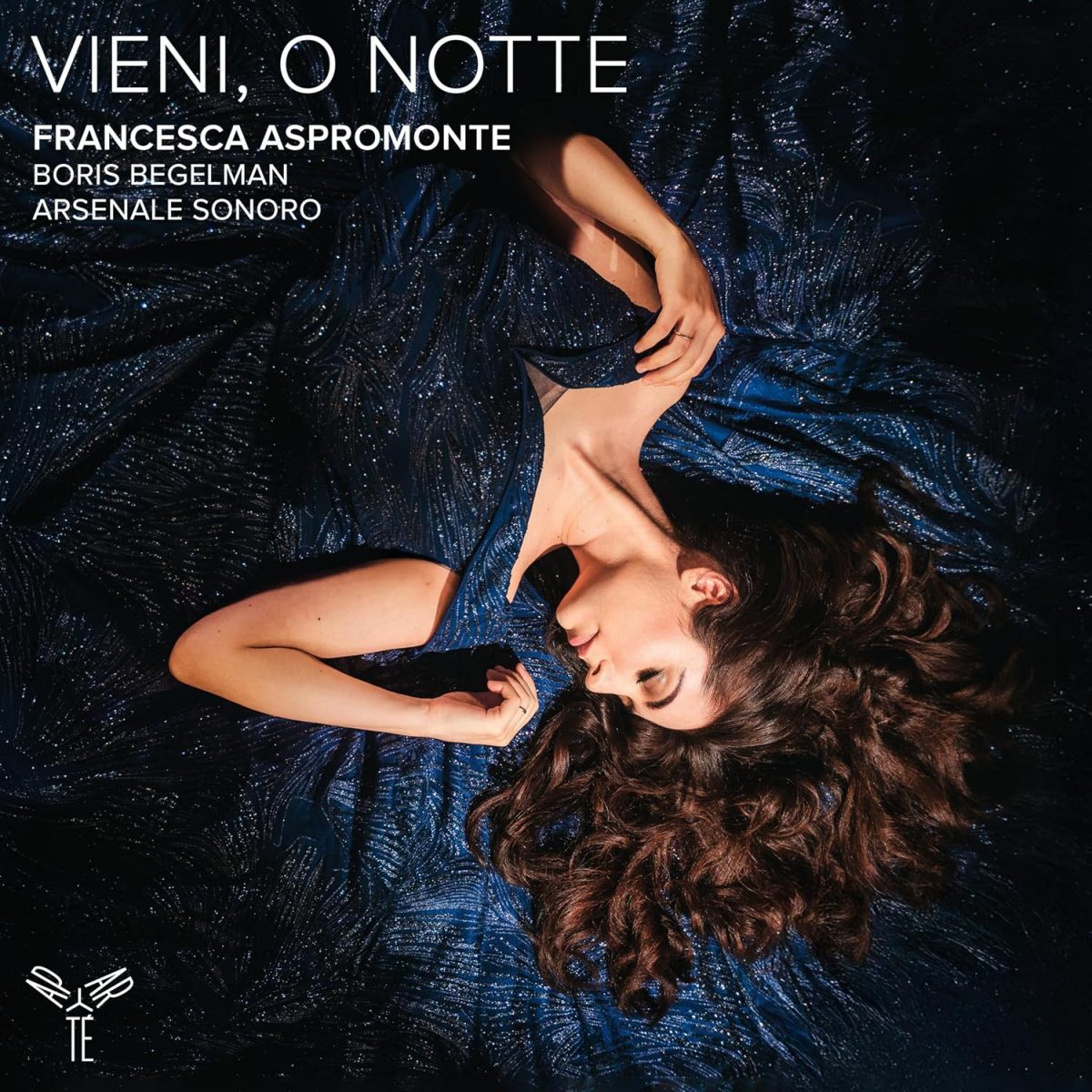
Cantatas and sonatas by Alessandro Scarlatti
Francesca Aspromonte soprano, Arsenale Sonoro, directed by Boris Begelman violin
69:00
Aparté AP428
Much of the music included in this intriguing collection serves as a reminder that Alessandro Scarlatti was one of a small body of musicians – Corelli was another – who was a member of the Roman Arcadian Academy. Remembered today in the music world for its major role in the reformation of dramme per musica, the literary society sought to return to the purity of classical Greek simplicity. The Arcadians turned to pastoral themes, explored at its soirees held in the palace gardens of Rome’s sacred and secular nobility. The three extended chamber cantatas include two that are actually termed serenatas, the term used for outdoor works given in the evening. While all three feature night as a trope, there is no evidence of composition for Arcadian concerts.
‘Notte ch’in carro d’ombre’, H 480 and ‘All’hor che stanco il sole’, H 33 are both multi-movement works with an instrumental introduction scored for solo soprano, two violins and continuo. Both probably date from the early years of the 18th century, while ‘Silenzio aure volanti’, H 662 has fewer movements and is identified in the singer’s booklet note as dating from a little earlier in the 17th century. What all three works share is a narrative pursued by characters whose names are familiar from pastoral poetry – Tirsi and Amarilli in H 480, unnamed in H 662, and Fileno and Clori in H 33 – and a freedom of form that ranges over plain recitative, accompagnato, arioso and aria, at times blurring the boundaries between them. In the early movements of H 480, night and its shadows are evoked by the restless lover in the hope that now day is done they will lead the lover to his beloved under cover of darkness. The mood in the opening sections is restless, yet at the same time evocative of night’s mystery and secrecy. The mood is beautifully captured by Francesca Aspromonte, whose rich, almost burnished soprano never spreads or becomes too fulsome. Her ornamentation is restrained but stylish. My only slight reservation concerns the final aria, where the exhausted Amarilli calls for death as a permanent answer to the pains of love. Here Aspromonte is arguably a little too overtly operatic. The instrumental support is fine, although throughout the programme the continuo playing is not infrequently too keen to assert itself and is indeed often more of an obbligato character than basso continuo. It is, as I have observed on numerous occasions and will doubtless do so on numerous more, one of the greatest plagues of modern Baroque performance, with lutenists in the forefront of culprits.
H 662 opens with a long, melismatic line, a call to the winds to be still, ‘Silenzio aure volanti’ repeated at the end of the first passage of recitative, actually more quasi-arioso, a mark of the freedom with which this text in particular is treated. The superb H 33, for which this is claimed as a first recording, explores the sequence of emotions passed through by the rejected lover. At its heart is the exquisite aria ‘Aure placido e serene’, a call to gentle breezes to convey the tears of the forlorn lover to his beloved, that finds Aspromonte employing her mezza voce to particularly exquisite effect.
The vocal works are punctuated by two of Scarlatti’s Sonate a Quattro senza cembalo, No 4 in D minor and No 3 in G minor. Both are scored for strings alone and are cast in four movements, serious works that unflaggingly explore fugal writing or contrapuntal textures. Although some of the movements of the sonatas were included in a set of Concertos cobbled together by Benjamin Cooke and issued in 1740, they are not be confused with the more famous set of 12 Concerti Grossi by Charles Avison, published in 1744, which were drawn mainly from harpsichord sonatas by Domenico Scarlatti. They are persuasively played by Arsenale Sonoro, making a positive contribution to a CD of all-round interest to a general audience in addition to fans of Francesca Aspromonte.
Brian Robins