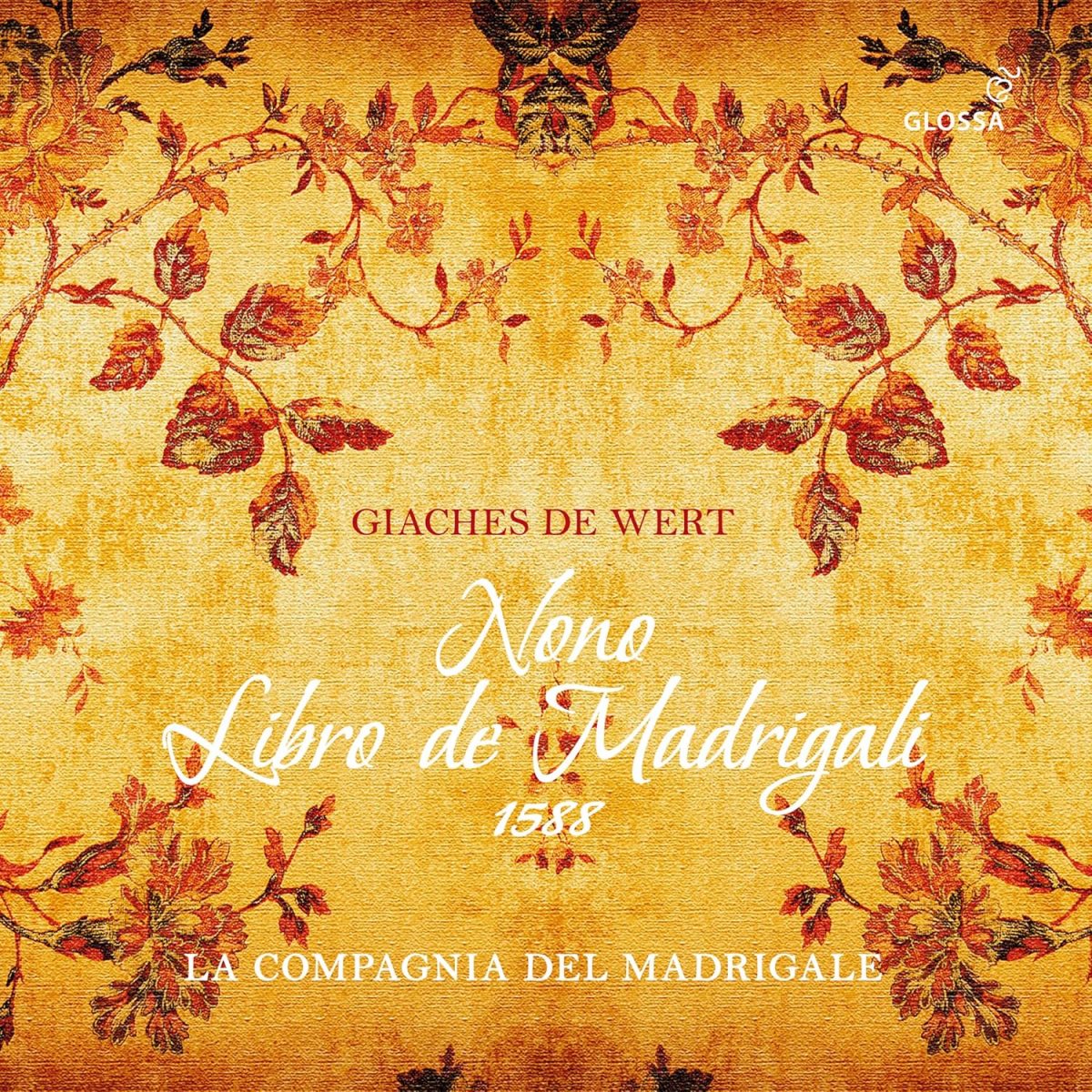
La Compagnia del Madrigale
57:18
Glossa GCD 922813
Although recognised, along with Luca Marenzio, as arguably the greatest of the ‘pure’ madrigalists, the reputation of Flemish-born Giaches de Wert (1535-96) has not translated into significant contemporary recognition. A quick trawl through the archives of EMR revealed only the odd work in collections, usually in association with de Wert’s significant influence on Monteverdi. The only real exceptions to this neglect I can trace are the Consort of Musicke’s recording of the 7th (of 12) Book of Madrigals (1581) (Virgin Classics, 1988) and a mixed selection of five-part madrigals by Cantus Cölln, under Konrad Junghänel (harmonia mundi, 1997). This makes this new issue of the 9th Book of Madrigals for five and six voices from La Compagnia del Madrigale extremely welcome, especially given the excellence of the six singers involved, all of whom are Italian.
Little is known of de Wert’s early years, but apparently he was taken as a child to serve as a singer at the court of the Marchesa della Padulla at Avellino near Naples. In 1588 he entered the service of the Gonzaga family, spending the remainder of his life in the employ of the powerful family in Mantua, but also in his later years in the restlessly experimental environment of the Este court in Ferrara. Book 9 was published in 1588 and consists of 14 madrigals, four scored for six voices, the remaining ten for five. The literary level of the poets drawn on is extremely high, including as it does Petrarch (five madrigals), Tasso (two) and Guarini, represented by a couple of poems highlighting the lighter and more cynical aspects of love. But more generally the mood is passionately serious, the often imitative polyphony closely woven and including telling passages of chromaticism. But despite de Wert’s close association with the sometimes reckless experiments of Ferrara-based composers, his use of dissonance never becomes a major feature of his writing. Around the time of Book 9, Wert’s close associations with Ferrara were enhanced by his hopeless love for the poet and singer Tarquinia Molza, hopeless given that as a widower whose wife had been guilty of taking part in a conspiracy to murder an aristocratic family, de Wert would hardly have been permitted to form a liaison with a lady of the court. Perhaps something of his personal agony informs the intensity of the setting of Petrarch’s canzone ‘Valle che de’ Petrarchlamenti miei se’ piena’. Here the raw pain of the chromatic inflection on the word ‘lamenti’ and its slow, melismatic lines barely lets up before culminating in the near-mystical eroticism attained by the end of the madrigal – ‘Here once I saw my lady, and along this path where naked she ascended into heaven, leaving on earth her lovely mortal body’.
At the other extreme is the enchantingly vital ‘Or se rallegri il Cielo’ (Now let Heaven rejoice). Joyously light on its feet, with exuberant, rapid exchanges between the voices, it was composed for the ‘Coronation of the Duke of Mantua’ in 1587, the duke in question being Vincenzo I, patron of Monteverdi and Rubens. But perhaps the most remarkable piece in the set is ‘Padre del ciel’, a setting of a religious canzone by Petrarch. Its progress is slow, solemn with little touches of melisma until the extraordinary peroration, the words ‘rammenta lor com’oggi fosti in croce’ (Remember how, on this day, You hung upon the Cross) set with a quiet dignity that is at the same time extraordinarily powerful.
I’ve already suggested that the performances are on a high level and so indeed they are. The blend of voices is exemplary, the purity and freshness of the two sopranos especially rewarding. Perhaps my only reservation is that there were times when it is possible to feel that the text might have been a little more passionately coloured; to suggest that while being aware that we remain in the world of the prima prattica that of Monteverdi and the seconda prattica is only just over the horizon. Yet by any standards these are splendid performances of great music that has been neglected for far too long.
Brian Robins