Categories
Recording

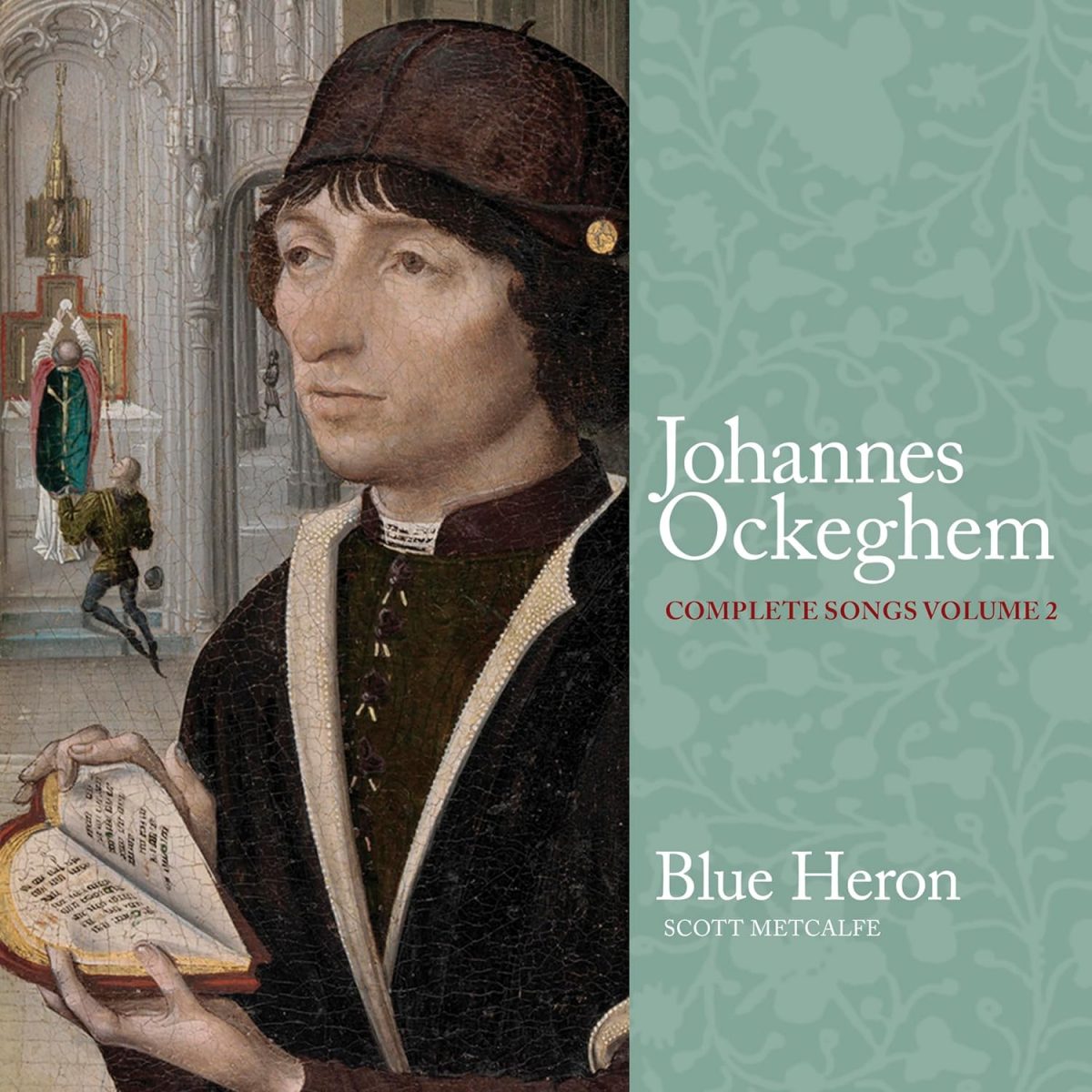
Ockeghem: Complete Songs volume 2

Blue Heron, director Scott Metcalfe; Dark Horse Consort
Blue Heron BHCD 1013
70:27

To say that Blue Heron’s second and final disc of Ockeghem’s songs has been awaited eagerly is an understatement. My review of the first volume (BHCD 1010) is dated 21 February 2020, and shortly afterwards (15 October 2020) I reviewed a double album of all Les Chansons released by another American ensemble Cut Circle (Musique en Wallonie MEW 1995). Both of these releases are superb and in their different ways whetted the appetite for Blue Heron’s second excursion into this repertory. Has the wait – four years – been worthwhile?

Back in 1993 I attended the 21st Annual Conference on Medieval and Renaissance Music at Bangor University. I was giving a paper on Byrd – who in those days we still thought had been born in 1543 – and he shared much of the programme with papers about Ockeghem, the quincentenary of whose death was imminent (1997) and the subject of eager preparations. Knowing nothing of the composer except by reputation, I attended these sessions, some of which were illustrated by excerpts from those commercial recordings of his music – on this occasion his masses – then available. To me, compared with how well Byrd was beginning to be performed on disc, these recordings were atrocious (think postwar close harmony groups with crewcuts, clicking fingers and chortling “shoobie-doobie-doobie-doo-WAAAHHH”), and in one lecture I started to guffaw, stifling my contempt when I realised that my fellow attendees were listening without adverse reaction. Before long I was in the bookshop at Lincoln Cathedral, still pursuing Byrd. In lieu of simply making a donation, I impulsively bought a disc of The Clerks’ Group version of his Missa Ecce ancilla Domini, partly by way of contributing to the Cathedral’s funds, and partly remembering Bangor and thinking that there must be more to Ockeghem than the racket that I had heard there.

And so there is. More wonderful recordings of Ockeghem’s masses by Edward Wickham’s excellent ensemble have been followed by, amongst others, two recordings of his complete secular songs which I mentioned above, made by a couple of outstanding American vocal groups with not a crewcut in sight and no clicking of fingers. Suffice to say this second disc by Blue Heron continues the good work of the first. The quality of Ockeghem’s songs is such that they deserve to be performed and recorded by the best ensembles after the indignities his masses suffered on disc during the latter decades of the previous century.

Unlike Cut Circle, Blue Heron employ instruments on some tracks, more so on this second disc than on their first. This is always done sensitively, and the reasons for doing so are given clearly in the accompanying booklet. For instance, Cut Circle perform La despourveue as a vocal trio whereas Blue Heron give it as a solo song accompanied by two stringed instruments, a fourth higher, so that the soprano Sophie Michaux (where do these amazing singers keep coming from?) does not have to descend so far into her mezzo range as did the differently impressive Sonja DuToit Tengblad. And on Ung aultre l’a the “intriguing downward octave scale in the [sung] bass part”, to which I referred in my review of Cut Circle, is played sweepingly on the harp. Throughout this recording, Blue Heron sing with the ideal balance of intensity and engagement – an engagement with the songs themselves and also an engagement with the listener: in other words, this engagement not only extends from the musicians to the music, but also reaches out and embraces the listener – they penetrate the meanings of the songs but also project these meanings outward to their audience. This is expressed as well as anywhere in Baisies moi in which the three singers achieve an ideal balance of intimacy and animation.

Three of the works on this disc are not by Ockeghem himself. The Dark Horse Consort, a quartet of brass instruments, plays an anonymous arrangement of the almost heartbreaking Je n’ay deuil of which the singers perform the four-part version on the preceding track. Of the other two songs, one is by Binchois and the other is by the Spaniard Juan Cornago, but their links to Ockeghem and his music are explained in the booklet, a most helpful and illuminating document written by director Scott Metcalfe and musicologist Sean Gallagher.  Scott himself participates on the harp and fiddle and, as on the first disc, is joined by Laura Jeppesen also playing the fiddle. Cornago’s lovely song for three voices Qu’es mi vida is the penultimate track, and the disc, indeed the project, is brought to a close by Ockeghem’s four-part transformation, given here by Sophie Michaux and three instruments: the fiddle played by Scott plus a doucaine and – as a nod to the song’s Spanish provenance – a vihuela de arco. It is difficult to imagine anything more beautiful.

Richard Turbet
Categories
Recording

Haydn: Symphonies 15 – La Reine

Kammerorchester Basel conducted by Giovanni Antonini
66:29
Alpha Classics Alpha 696

Most enthusiasts will by now surely need no introduction to this treasurable series of the complete Haydn symphonies, a project planned to reach completion by 2032, thus marking the 300th anniversary of the composer’s birth. For those that might be making their first acquaintance with the series, the recordings are divided between the Kammerorchester Basel and Giovanni Antonini’s own Il Giardino Armonico and is intended to eventually include Haydn’s entire symphonic output.

From the outset, the performances have been marked by a rare and felicitous combination of strongly incisive playing of diamantine clarity combined with warm sensitivity.  In the present set of performances one need only, for example, bring to mind the celebratory opening movement of Symphony No 50, with its trumpets and timpani cutting through the texture like a sabre to illustrate the first point, while the delicacy of the light-footed Romance of No. 85 serves ideally as an example of just how sensitive and elegant Antonini’s direction can be.

The symphonies on the present CD most obviously have in common that all three have a slow introduction, but there are more subtle links, too.  The earliest is No 50 in C, a fully scored work with a pair of trumpets and timpani dating from 1773. Its first two movements are believed to have originally formed  part of the now-lost incidental music for Der Götterrath, which forms the prologue to Philemon und Baucis, first given in the marionette theatre at Esterháza for the Empress Maria Theresa. The Andante moderato (ii) is notable for its richly warm colouring – here beautifully captured – with obbligato cello doubling the melodic line, while the Minuet brings back the trumpets and drums for one of those dance movements you find it difficult to imagine being actually danced.  Symphony No 62 in D probably owes its existence to a familiar modern problem – building works overrunning their completion date. In this case, it was the new theatre at Esterháza that opened in 1780 on St Theresa’s Day, the name day of the empress. It had been intended to open with Haydn’s new La fedelta premiata but the elaborate stage machinery not having been installed it was replaced with a play. In order that his Kapellmeister should still be represented, Prince Nicolaus apparently asked Haydn for a new symphony. Haydn obliged with the present hybrid work, one with a history too complex to go into here. Suffice it to say the unusual Allegretto that forms its second movement is a remarkably individual passage that proceeds into curiously mysterious territory.

Much the best known of these symphonies is No. 85 in B flat, one of the six so-called ‘Paris Symphonies’ (no’s 82-87) probably written in 1785 as a commission from the famous Concert de la Loge Olympique. It acquired its nickname ‘La Reine’ very early on, a reference often mistakenly attributed to Maria Theresa, but in fact referring to her daughter Marie Antoinette, who had become Queen of France in 1774. The opening Adagio – Vivace provides a perfect example of the supreme merits of the mix of robust energy and lyricism Antonini brings to his Haydn, the lovely cantabile oboe solo that dominates the secondary idea here splendidly played. And there could be no better illustration of the deliciously featherweight lightness of touch he obtains from his players than the opening of the Presto finale before it bursts into forceful operatic drama to carry the symphony surging to its conclusion.

This is quite simply another splendid addition to a series at present bidding fair to be the set of Haydn symphonies.

Brian Robins

Categories
Recording

Charpentier: Médée

Véronique Gens (Médée), Cyrille Dubois(Jason), David Witczak (Oronte), Le Concert Spirituel conducted by Hervé Niquet
170:43 (3 CDs)
Alpha 1020

It is nearly 50 years since William Christie’s first recording of Marc-Antoine Charpentier’s Médée (harmonia mundi) vividly illustrated that French Baroque opera meant more than Rameau and the occasional nod in Lully’s direction. Since then Médée has become firmly established and acknowledged not only as Charpentier’s operatic masterpiece – though I would argue that David et Jonathas (1688) should be considered its equal – but one of the peaks of the repertoire.  First performed at the Paris Opéra (Académie Royale de Musique) in 1693 it was one of the first operas given there after Lully’s monopoly was ended by his death six years earlier. Despite the presence of Louis XIV at the premiere, the opera was not a success, receiving ten performances before being withdrawn and not revived until the 20th century.

Cast in five acts with the usual prologue, Médée is a tragédie en musique that for once lives up its genre, a feature that may have some bearing in its contemporary unpopularity. By the end of the opera not only are Créon, King of Corinth and his daughter Créusa, the new amour of Jason dead, but in her fury at Jason’s treachery the sorceress Médée (Medea) has committed filicide. Yet it is measure of the quality of Thomas Corneille’s libretto that far from being simply an irredeemable villain poisoned by jealousy, Médée emerges as a deeply ambivalent character driven to madness by the ingratitude of Jason. The picture becomes more opaque still if her earlier services (the Golden Fleece) to Jason are taken into account. And it is more than just the text, for Charpentier gives to Médée not only music that is highly dramatic but in her act three air ‘Quel prix mon amour’ the most touchingly beautiful music in the score. Musing on whether she should murder her sons, the product of her love for Jason, also give momentary relief from the derangement from which Médée  now suffers, her servant Nérine a little earlier having spoken of her ‘Eyes staring wildly, her steps unsteady’. The role is one tailor-made for Véronique Gens, one of the great tragediennes of our day and a singer to compare with the creator of the role, Marthe Le Rochois, the creator of all the leading female roles in Lully’s tragedies lyriques and who was considered without parallel for her mastery of the declamatory styleGens’s mastery of the role ranges from the imperious in the infernale scene at which she is at her most powerful, displaying some awesome chest notes, to the sheer, pure beauty of her singing in the air noted above.

Her errant husband is given a poor hand by comparison, at his best in the tenderness he displays toward his new love Créuse, its cynical political implications drowned out in the exquisitely sensitive music Charpentier gives the couple in their scenes together (act 1, sc 5 and act 4, sc 2). The experienced Judith Van Wanroij (the cast listing spelling is used in the heading but here the more usual spelling is adopted) is at her best in this kind of gentle heroine role and here she is utterly engaging. There are, too, few finer stylists in haute-contre heroic roles than Cyrille Dubois, though here the fast vibrato that is a part of his voice does occasionally threaten to be a distraction. The only other significant role is that of Creon, which asks for little more than Thomas Dolie’s richly authoritative baritone until the great scene in which he is made mad by Médée (act 4, sc 8/9). Then considerable vocal acting powers are called upon, a demand met admirably by Dolié. 

Among smaller roles baritone David Witczak’s Oronte, the deposed suitor of Créuse, should be noted, as should the enchantingly fresh soprano of Jehanne Amzal in several comprimario roles. Her singing of the Italian air included in the act 2 divertissement is one of the delights of the set. Hervé Niquet’s direction of the prologue, the customary panegyric dedicated to Louis XIV with Glory, Victory and Bellone (goddess of war) doing the honours, is curiously – if arguably understandably – briskly uninvolved. Thereafter it improves significantly without ever becoming one of his finest achievements. Notwithstanding the set is required listening for all Gens’s many fans, who will also encounter a great opera and much excellent singing.

Brian Robins 

Categories
Recording

Virtuoso harpsichord music

Melody Lin
51:30
CRD 3546

What should a young harpsichordist include in their first recording? The traditional choices are either to pick a minor composer and concentrate on making their music available, or to present a mixed recital that displays ability over a broader range of repertory. The Taiwanese harpsichordist Melody Lin has chosen the latter course in this short CD which ranges from the English Virginalists Farnaby and Byrd, through J. S. Bach, to Rameau and Forqueray. She has recently completed a doctorate in performance at Claremont Graduate University in California and this recording presumably reflects her work for that degree. The informative programme notes have been written by her teacher Robert Zapulla, who has also produced the disc. He praises Lin’s virtuosity, which is indeed much in evidence here. This is a formidable programme and, on the whole, Lin steps up to the challenge. Her virtuosity is still a bit self conscious, and the simpler sections can be a bit plodding at times; there are occasionally some awkward joins between sections in the earlier music. That said, there is some excellent control of contrapuntal writing in the Byrd A minor Fantasia and Bach’s D major Toccata. Lin plays on a William Dowd harpsichord, after an instrument built by the Blanchets around 1730.  It is a good compromise instrument, at its best in the French music, but bringing good clarity to the more contrapuntal pieces. The recording quality is excellent. There is much to admire here, even if there are more polished recordings of these pieces available elsewhere. We can look forward to her next recording, where Lin might perhaps concentrate on a particular area of the repertoire and further refine her playing.

Noel O’Regan

Categories
Recording

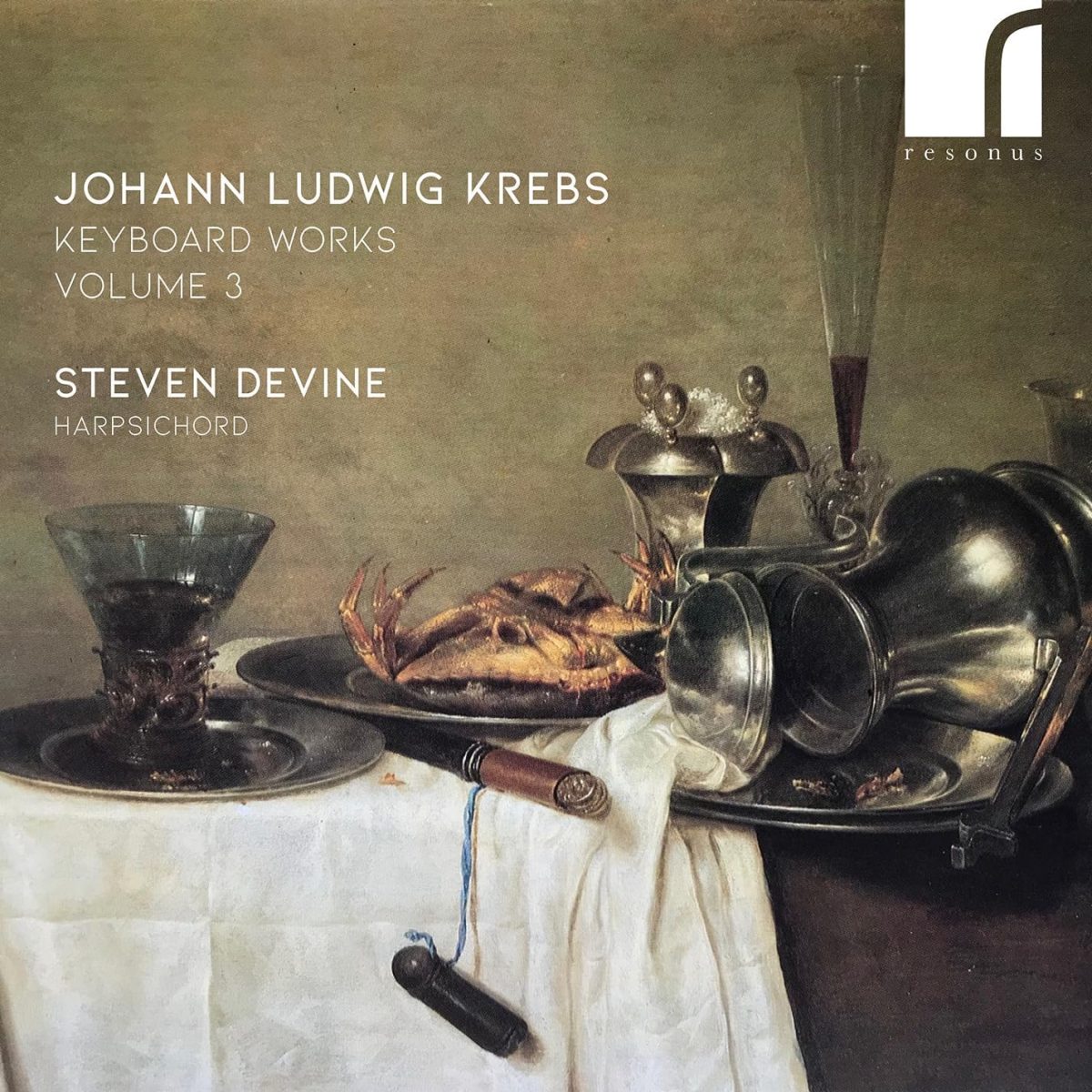
Johann Ludwig Krebs: Keyboard Works volume 3

Steven Devine harpsichord
77:30
resonus RES10329

Steven Devine continues his highly successful series of recordings of the complete surviving keyboard music of Krebs, a favoured pupil of J. S. Bach at Leipzig who went on to settle in nearby Altenburg.  As well as the substantial 6th partita, this volume includes six sonatas which only reappeared in 1999 in Kyiv, the manuscript having been moved from Berlin during the Second World War; this is their first appearance on disc, in Devine’s own edition.  In a standard three-movement Italian form, they show Krebs revelling in the new galant style.  More predictable than those of his contemporary, CPE Bach, these sonatas make a delightful listening experience, relying on logical sequences and echo effects, with some resonances of Handel’s keyboard writing.  Devine has registered them expertly, bringing out both sequences and echoes and wearing his virtuosity very lightly.  He revels in these contrasts and plays throughout with great versatility and verve.

The sixth partita, one of only three surviving from a presumed set of six, shows a fascinating mixture of styles and is a reminder that, although we now see Bach’s partitas as iconic, other versions were available.  There are reminders of the 17th-century toccatas and ricercars of Froberger in the Prelude, echoes of Handel elsewhere, while the chromatic quirkiness of the Sarabande suggests C. P. E. Bach.  There are added galanterien which give a nod to those of J. S. Bach.  With ten movements in total, this work is a compendium of possibilities, all expertly exploited by Devine.  The two surviving sources for the work vary considerably, pointing to continued revision, and the playing here brings out all the possibilities inherent in Krebs’s treatment of the various dance movements. 

Devine plays throughout on a double-manual harpsichord by Colin Booth after a single-manual by Johann Christof Fleischer (Hamburg, 1710), the same instrument he used for the previous volumes in the series and one which suits this music admirably.  His control of the instrument allows the listener to have complete confidence in the playing and in the interpretation.  This recording is definitely to be highly recommended.

Noel O’Regan

Categories
Recording

Charpentier: David & Jonathas

Clément Debieuvre David, David Witczak Saul, Edwin Crossley-Mercer the ghost of Samuel/Achis, Jean-François Novelli Joabel, Jean-François Lombard Pythonisse, Natacha Boucher Jonathas, LesPages et les Chantres du Centre de musique baroque de Versailles, Orchestre Les Temps Présents, directed by Olivier Schneebeli
122′ (2 CDs in a CD-sized book)
aparté AP342

David et Jonathas owes its existence to the tradition of the Jesuits of the Collège Louis-le-Grand in Paris staging plays and musical dramas during the course of carnival season. It dates from 1688, when it was staged between the acts of a now-lost spoken drama. It should be recognised that it is an opera, not an oratorio and as such has a framework familiar for the tragédie en musique, that’s to say a prologue and five acts. Only the relative brevity of the work, with less importance attached to the divertissements and fewer dances than usual mark it out as unusual in that respect.

As was widely recognised from its first performances David et Jonathas is a powerful masterpiece. It is indeed one of the great pieces of late 17th-century French theatre, apparent from the outset of the prologue, which to the best of my knowledge is unique in being a part of the action. In concerning itself not with the usual royal panegyrics but rather with the visit of Saul to the Witch of Endor (Pythonisse) and the fateful utterances of the ghost of Samuel, it provides an introduction to the drama that will unfold, drama culminating in the final tragedy of the deaths in battle of Saul and his son Jonathan. Yet because the opera has a didactic purpose its ending is not tragic, but rather a brilliant paean of praise to the victorious David, the man who remained obedient to God’s laws, in contrast to the defeated Saul, who has not. More importantly still, the opera is an investigation of human relations on a psychological level rare in opera of this period, specifically the complex love between Saul and David, and those of the brotherly love between David and Jonathan. At their heart are the great monologues given to all three, their lyricism again a distinguishing feature of an opera in which récitatif plays a smaller than usual role.

In 2022 the opera was given a superlative production and performance in the Chapelle Royale at Versailles, a highly appropriate venue given its original commissioning by the Jesuit fathers of the Collège Louis-le-Grand. That performance has already been issued on CD and DVD on Versailles Spectacles. The set to hand was made live at Versailles, but was a concert performance given in the Opéra Royal the previous year. Ironically it is this performance that seeks to come closer to the original 1688 performance than the staged production in the Chapelle by using a children’s choir for the upper voices and a child for the role of Jonathas, though in this instance a girl rather than a boy. The present performance also almost certainly comes closer to the original performance at the Collège by using considerably smaller orchestral forces, although the playing of the somewhat oddly-named Orchestre Les Temps Présents (it is a period instrument band) is excellent. Also giving a hint of the context of the Jesuit performance is the inclusion of brief spoken 17th-century ‘déclamations’ placed as introductions to each act and, especially movingly, immediately after the death of Jonathan. Thus rather than a play serving as the context, the spoken word provides interludes to a music drama.

One of the features of David et Jonathas is that in contradiction to the title, the leading character is neither Saul’s son nor his much loved David, but the king himself, his tortured soul revealed in a manner and to a depth rare in Baroque opera. The role is here taken by bass David Witczak, heralding the overwhelmingly searing and insightful  characterization he brought to the role just over a year later in the Versailles production. David is sung by contre-ténor Clément Debieuvre, an alumnus of the CDMBV. His voice is lighter and more youthful in timbre than that of Reinoud Van Mechelen, whose assumption of the role was one of the glories of the production. Since the biblical David was young, some may feel Debieuvre’s sensitive if less authoritative performance is more authentic, but there’s no gainsaying Van Mechlelen’s authority. There is of course no valid comparison between the respective interpreters of Jonathas, but the sweet-voiced Natacha Boucher achieves an immensely touching degree of sensitivity in the events leading up to his death (act 5).

The remaining smaller roles are all well filled, with the experienced Edwin Crossley-Mercer a resonant Ghost of Samuel (in the prologue) and Achis, Saul’s general.

There is no question that David et Jonathas is one of the masterpieces of Baroque opera. The story is dramatic, Charpentier’s music magnificent. And like all masterpieces, it is capable of responding to alternative approaches. This version – orientated as it is toward its original college production – is in any event very different to the magisterial Versailles recording. Both have a more than valid place in the catalogue, as indeed does the earlier Erato set under the direction of William Christie.      

Brian Robins

Categories
Recording

Haydn: Baryton Trios

Treasures from the Esterháza Palace 2
Valencia Baryton Project
62:55
NAXOS 8.573504

Haydn’s employer, Prince Nikolaus Esterháza, was a proficient player of the baryton, essentially a bass viola d’amore – with strings stopped over a bridge and played with a bow and a series of sympathetic strings that resonate and can be plucked with the thumb. The composer was commissioned to write new music for the Prince and he produced over a hundred trios with viola and cello. Each begins with its longest movement, followed by a minuet and trio (or a similar dance), and concludes with a short, quick movement. Many of them are in A major because of the tuning of the baryton, but this selection of six by the Valencia Baryton Project (Matthew Baker as the Prince on baryton, Estevan de Almeida Ries as Haydn on viola, and Alex Friedhoff on cello) includes one each in C, D and G major. The music is – of course – charming, especially so when the viola and cello accompany the main attraction with plucked notes. I have heard several recordings of this repertoire (though not these particular pieces) before and have rarely been so aware of the sympathetic strings, the metallic buzz of the plucked notes. I mean that positively – the engineers have done an excellent job of capturing the sound quality without distorting it or upsetting the balance with the other instruments. I was sure a couple of tracks would be more than enough, so imagine my surprise when the music stopped – I’d happily listened to over an hour of Haydn played by the same three instruments! It really was a very pleasant hour.

Brian Clark

Categories
Recording

Sperger: String Quartets op. 1

Mitglieder der Kammerakademie Potsdam
55:51
cpo 555 470-2

Johann Matthias Sperger‘s three string quartets, opus 1, were printed by the renowned Berlin published Hummel in 1791, the year of Mozart’s death. Comparisons with the younger man’s work are inevitable. Although Sperger’s works very definitely deserve to be heard (and this excellent performance on modern instruments can only help lift the composer’s popularity), these three substantial pieces could have been written by a young Mozart, not the man who had just died. As noted in the booklet, Sperger’s more introspective moments (especially in the slow movements, but always when he wanders into a minor key) are his strongest. He was not a shy musician, dedicating his music to the Russian Tsar and the King of Prussia, and I think he had good reason to think his output good enough. There are at least six more quartets awaiting discovery – perhaps a period quartet out there would like to take up the baton?

Brian Clark

Categories
Recording

Popora: Music for the Venetian Ospedaletto

Josè Maria Lo Monaco contralto, stile galante, Stefano Aresi
67:36
Glossa GCD 923537

On the inside cover of the booklet, along with the other credits, we read: “This recording is an outgrowth of musicological research seeking new insights on historically informed performance practices based upon the acoustics of the Ospedaletto in Venice”. That all sounds great, but there is no further explanation or, indeed, any other comment on the actual performance apart from a half-hearted explanation of the presence of a cello concerto on an otherwise vocal programme because there it is known that one of the women in the orchestra there was a known virtuoso on the instrument…

While the disc is promoted as an exploration of music at the Ospedaletto, in fact it focuses very much on the activities of a single singer for whom Porpora conceived a valuable body of work during his several years there (having also worked at the three other similar institutions in Venice), the alto Angiola Moro. With a range from the A below middle C to the E flat at the top of the treble clef, she apparently had no problem with chromatic scales, wide arpeggios and leaps, or rapid scales. As the “early music voice” seems to get bigger and bigger, it is no surprise to find a singer of the calibre of Josè Maria Lo Monaco tackling this repertoire, and she does it very well.

Whether or not it was played by Niccolosa Fanello, Porpora’s G major cello concerto is beautiful; its opening movement was very reminiscent of some of the slushier passages from the concertos attributed to Wassenaer. The booklet notes tell us that Porpora’s official appointment (after two years of working for free – musicians, it was EVER thus!) the violin teacher asked for extra resources to support him in getting his musicians up to the standards of the “new music”, and – if they were up to playing this piece – he clearly succeeded.

Brian Clark

Categories
Recording

Apollo’s Cabinet: Musical Wanderlust

Charles Burney’s European Travels in Pursuit of Harmony
Apollo’s Cabinet, Alexander Armstrong narrator
Prima Classic PRIMA036CDEN

What a jolly time Dr Burney must have had! This is a proper romp around Europe – with performances by the children of Red Priest and an excitable percussionist. The musical items include some balletti by Schmelzer, movements from a Vivaldi concerto pushed to its limits among a smorgasbord of bleeding chunks (Goldberg Variations, a Tuma partita, some Loeillet of Ghent, an aria from a Telemann opera, some folk tunes among them. I fear few of the composers would recognise their music, but who cares? This sort of disc isn’t an academic recreation, it’s taking Burney’s diaries (extracts of which are read by Mr Pointless, Alexander Armstrong) and fleshing out his comments on music and entertainment with lively (sometimes bonkers) arrangements of music he might have heard on his travels. It’s the sort of disc that will sell VERY well after live gigs, and will thrill concert-goers when they play it and remember a fabulous evening’s entertainment. And – very appropriately for Mr A – it’s absolutely perfect for Classic FM listeners!

If I get a chance to see these guys live, I will leap at it – while I don’t think it’s the sort of CD I will often listen to at home, I can certainly imagine how gripping they’ll be in the flesh. Check out their website

Brian Clark