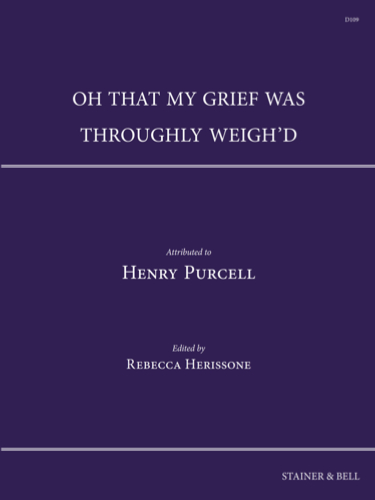
In her extensive introduction to this 106-bar devotional song for three male voices, Rebecca Herissone makes a convincing case for re-assessing Philip Hayes’ role as a collector and copyist of Purcell’s music in general and for re-instating this to the catalogue of the composer’s canon in particular.
Given the amount of detail she gives, it is surprising that she decided to omit the figured bass symbols on the grounds that it was impossible to distinguish between Hayes’s 18th-century additions (as witnessed in his other transcriptions of Purcell sources that still exist) and what might have been in the original; I should have thought making that statement would have been enough explanation had she left them in rather than (rather shadily) using them “to inform choices in the editorial continuo part”.
She casts the piece as a “homosocial” duet for high and normal tenor voices with a bass joining in for a refrain (in which it really does very little that add text and rhythm to the continuo line). The angular melodies and piquant harmonies are typical of the composer’s style. It is a pity that the three-part section (which neatly fits on to two pages) could not have been laid out on a spread rather than have a page turn in the middle of it both times.
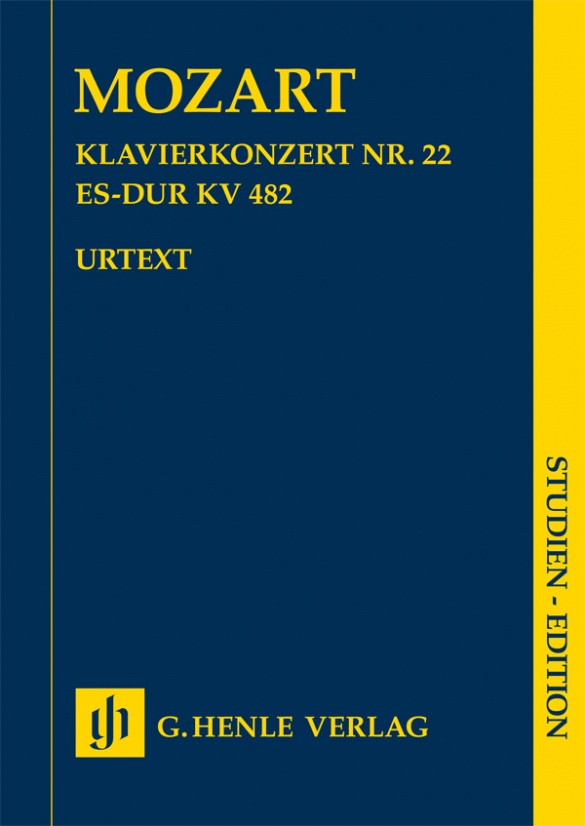
Haydn: Sinfonie F-Dur, Hob. I:89 Edited by Andreas Friesenhagen (originally 2010, in Joseph Haydn Werke I:14) [VI]+46pp, HN 9057, ISMN 979-0-2018-9057-9
If there is one thing you can rely on with G. Henle Verlag it is quality, both in terms of the fine presentation and of the contents. These three additions to the catalogue (the first two as off-prints from the full-sized complete edition) contain the introductions in three languages (German, English and French) and the commentary in the first two. Despite (obviously) being much smaller than their library shelves cousins, they retain the clarity of print that makes both a pleasure to use.
I confess myself to have been ignorant of these two Haydn symphonies. My eye was caught by the editor’s note that while “solo” meant “you have the tune” in the second movement Largo, in the trio section of the following movement it meant “only one player”. Clearly I wasn’t alone in being slightly confused by this apparent lack of logic (since all the parts were copied by the same person, and – since the original score is lost – the fact that Haydn had made corrections to them, they are given the authority of Primary Source); in a recording I listened to online, in fact, the cello part in the Largo *was* played as a solo. I do like the fact that Haydn only introduces the trumpets and timps in that same second movement – he liked keeping listeners on their toes!
Following the score as I listened to Malcolm Bilson play the Mozart concerto reminded me of my days as a student, when we were encouraged to do so as part of classes in orchestration – no matter how good one’s ears are, there are always details than one misses without having access to the notes. It also rather reminded me that my regular listening has become a little too narrow – my ears need to get out more! So that’s another reason to thank Henle for producing such attractive and conventiently sized scores. I have only praise for them.
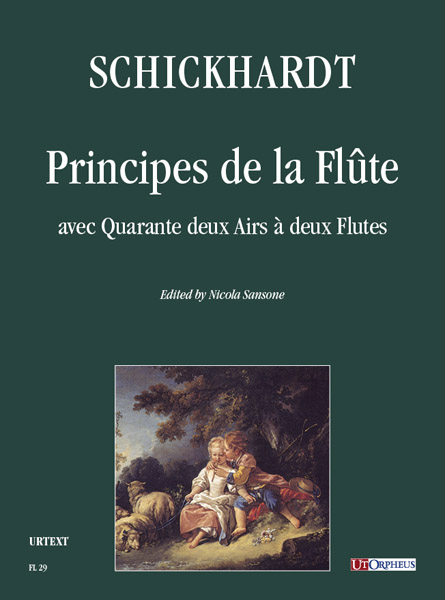
Schickhardt: Principes de la Flûte avec Quarante deux Airs à deux Flutes Edited by Nicola Sansone vi + 43pp. FL29 ISMN 979-0-2153-2555-5 £18.95 (UK retail; from website €16.95 + P&P)
After what must be the briefest introduction to notation ever (Schickhardt’s four tables with explanations in French and Flemish), and a fingering chart including trills, it is straight into the music. The first piece is all of six bars and played in unison; the second is shorter but has more notes and tonguing indications, then the third is already conceived in two voices, introduces binary form and only has tonguing marks for certain parts, then the remaining 39 pieces work their way through a variety of keys and dance styles as well as occasional through-composed movements. While the upper voice might “take the lead” more, it certainly does not hog the limelight; the composer is very careful to involve both players in a thoroughly musical dialogue. None of the pieces is longer than two pages, and the majority are far shorter, so these are study rather than recital pieces. That said, I can definitely see a market for this nicely printed volume.
Buchner: 2 Sonate a Tre from Plectrum musicum Op. 4 (Frankfurt 1662) Edited by Nicola Sansone iv + 16pp. FL30 – ISMN 979-0-2153-2556-2 £21.95 (UK retail; from website €19.95 + P&P)
Ostensibly published as a set of sonatas for strings, the “Viola da braccio” part-book for these two sonatas (nos. 10 & 11 in the set) give the scoring as “Flautto vel Viola da braccio”, so the editor is correct to publish them as recorder music but sadly a little hopeful in describing the piece on the cover as “Treble Recorder in G” – unless, of course, that is a misunderstanding of the English usage of Treble in this context to refer to Alto. Printed originally in the soprano clef (middle C on the bottom line), the opening phrase of Sonata X extends to E which is below the instrument’s standard range. But worse is to come – just in case someone was screaming at the screen about fudging that note – as bar 67 has a D, and then bar 78 has a C. Sonata XI has the same range, so there is little doubt that the music is actually far better suited to a Tenor Recorder. Were I to have edited this piece for publication, I would have ignored that fact that there is a separate bass part, since it is identical to the continuo line; rather than fifteen staves per page with the (also identical) figured bass squeezed into the available space, the layout would be much more comfortable. The music is well worth playing, and groups programming – for example – sonatas and concertos by Telemann for the same line-up should not hesitate to deploy these as variety.
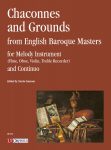
Chaconnes and Grounds from English Baroque Masters Edited by Nicola Sansone v + 30pp. HS253 – ISMN 979-0-2153-2542-5 £23.50 (UK retail; from website €20.95 + P&P)
The eight pieces in this very useful volume are by Thomas Williams and Gottfried Keller (one ground each) and Gottfried Finger (three grounds and three chaconnes), all of them taken from four volumes printed in Amsterdam at the beginning of the 18th century. The range of the solo part suites the treble (=alto) recorder perfectly and the music here is far more demanding than in the Schickhardt collection above. Violinists should not be put off, though, as there is much elegant music here which will help younger players in particular to find ways to differentiate between each iteration of the theme above which they must weave their filigree. Ut orpheus has already published the source books (FL2, FL6, FL11 and FL17), should you fancy playing more of the repertoire than variations on a bass!
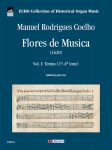
Manuel Rodrigues Coelho: Flores de Musica (1620) Vol. I: Tentos (1st-4th tone) ECHO Collection of Historical Organ Music [volume 3] Edited by João Vaz xxvi + 128pp. ECHOM3 – ISMN 979-0-2153-2606-4 £56.50 (UK retail; from website €50.95 + P&P)
I am by no stretch of the imagination a keyboard player. That said, in order to develop something akin to a reasonable technique, I remember shutting myself away in a practice room at university and devoting hours to playing Andrea Gabrieli’s organ music; it had the perfect blend (from my perspective, at least!) of sustained chords and moving parts, limited harmonic movement and few – if any – demanding leaps (especially in the left hand). That is also how I would described the contents of this excellent volume which contains 12 Tentos (three in each of the four modes). The original (as shown in the facsimiles dotted throughout the book) was printed on four staves; in compressing them on to two, the editor has (to my mind) sometimes been a little too pedantic (why print a superfluous bar’s rest when there are two other parts vying for the space on the staff at the time?) and not pedantic enough at others (where a note is inflected in one voice but not in the other, if the second accidental is not in the original, should it not be bracketed as an editorial insertion?) One small quirk of the printing is the notation of triplets; instead of the standard chunky 3 over the middle of the figure, this volume prints small 3s over the first note of each group which, in keyboard music, made me think they were fingering instructions. These are, however, minor faults in such an excellent volume. If I had access to an organ (or even a piano!), I think I might be tempted to sit down and play these pieces!
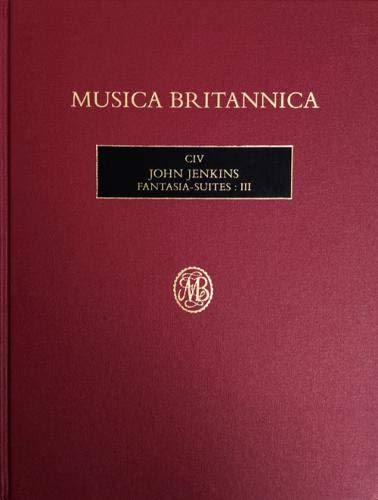
Musica Britannica CIV Transcribed and edited by Andrew Ashbee Stainer and Bell, 2019 ISBN 978 0 85249 956 6 (ISSN 0590-2954; ISMN 979 0 2202 2545 1) xxxvii (including three plates), 186pp. £105
This third volume of Ashbee’s edition of Jenkins’ fantasia-suites for treble, bass and organ includes the 17 entries in the Viola da Gamba Society’s Group I (comprising a fantasia, almain and ayre) and bothof their Group IV entries (where the sequence is fantasia, air, corant). There are four sources for the first group and five for the second and, with typical care and precision, the editor lists even the smallest variance between them.
I cannot recall ever hearing these pieces in performance. As Ashbee says in his introduction, the last two suites are entirely different in character from the first 17. For one thing, both of the string parts are far more technically demanding – the fantasy of no. 18, for example, has wide leaps and demisemiquaver (32nd note) scales as well as chords for the bass viol. The original organ part survives for only the first movement of these two suites, and even the figured bass that exists for the next three movements is lost for the final air and corant; Ashbee has done an excellent job in reconstructing them.
As usual with Musica Britannica, the book is itself thing of great beauty, printed on luxurious paper and handsomely bound. This is the sixth volume in the series devoted to Jenkins, and I am sure it will not be the last.
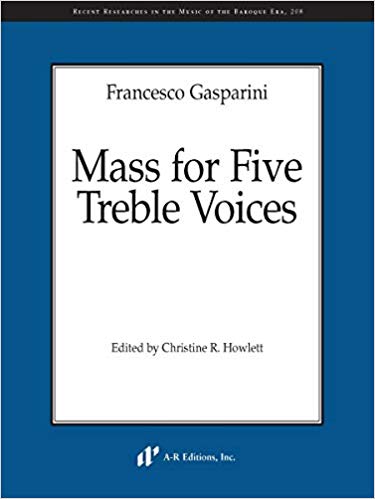
Recent Researches in the Music of the Baroque Era, 208
Edited by Christine R. Howlett
x, four plates, 80pp.
A-R Editions, Inc. ISBN 978-1-9872-0281-6 $150
I have known about this work for many, many years so it is a real pleasure to welcome a fine edition of it. Unusual not only for its scoring (SSSAA & Basso contiuo) but also the fact that it is a full mass (with Credo AND Agnus Dei), it is – as Christine Howlett says in her fine introduction to the work – a showstopper for the female singers of the Pietà in Venice, where Gasparini was maestro di coro from 1710. There are solos and duets but much of the work actually does use a five-part texture, though the composer is careful to deploy the voices in a variety of combinations to maximise aural variety, including having two or more voices sing passages in unison. All in all, this is an excellent edition of a very exciting work and I sincerely hope that it can be made available at bulk discount price to female choirs who will simply love it!
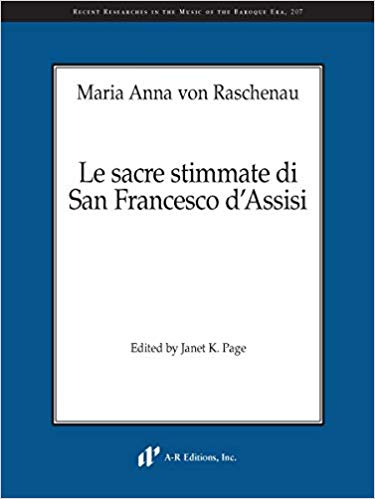
Edited by Janet K. Page Recent Researches in the Music of the Baroque Era, 207
xxxviii, six plates, 92pp
ISBN 978-1-9872-0255-7 $180
One of seven similar works known by the composer,Le sacre stimmate di San Francesco d’Assisi was performed to Emperor Leopold I on St James day at the convent of that name in Vienna. The eight characters (SSSATTTB voices for St Francis, Christ, the narrator and five seraphim) are allocated arias, duets, trios and choruses, interspersed with secco recitative (and some arioso). The writing is melodic if rather brief (though not dissimilar to music by Bertali and Schmelzer for the Imperial court chapel, so perhaps that says more about the emperor’s preferences?) The voices are accompanied by a string group; the editor has chosen to interpret “viole” has violas da gamba and curiously (to my mind, at least) decided to number them 1-3, although the two numbers for which they are specified in only use two, albeit in different clefs. I would question the idea of someone sitting around with their soprano-clef viola, waiting just to play in one movement. Such a level of prescription when there is none in the source strikes me as counterintuitive. Likewise, I see no mention in the (detailed and highly interesting) introduction of that fact that the top violin and the top viola parts pretty much double one another an octave apart for most of the time – which, in turn, largely double the alto part. As the only musical source is a score copied by an imperial scribe (apparently Leopold liked to follow the music as he listened), its authority is dubious and this quirk ought as least to have been mentioned. I absolutely take my hat off to Janet K. Page for meticulously tracking down almost all of the Biblical references given in the printed libretto; while I’m not sure that Latin was absolutely essential, and I’m not 100% convinced that modern performers require such background when the editor has also provided a beautiful translation of the sung Italian text, it shows an exemplary thoroughness. As far as the edition goes, it is laid out in traditional A-R format and follows (broadly) their usual editorial approach. The only thing that I don’t particularly like about that is the tacit suppression of original accidentals; retaining them would have made challenging the dubious D flats in bar 41 on page 41 more difficult (as it is, if there were no flat on the penultimate note of the previous bar, I would have probably added an editorial natural at that point!), and on page 50, surely the brackets in the continuo part are superfluous, since the pitch of the note continues over the barline. But these are very, very small points in a thoroughly excellent edition. I hope performers will be encouraged to investigate this largely unknown part of Hapsburg music history.
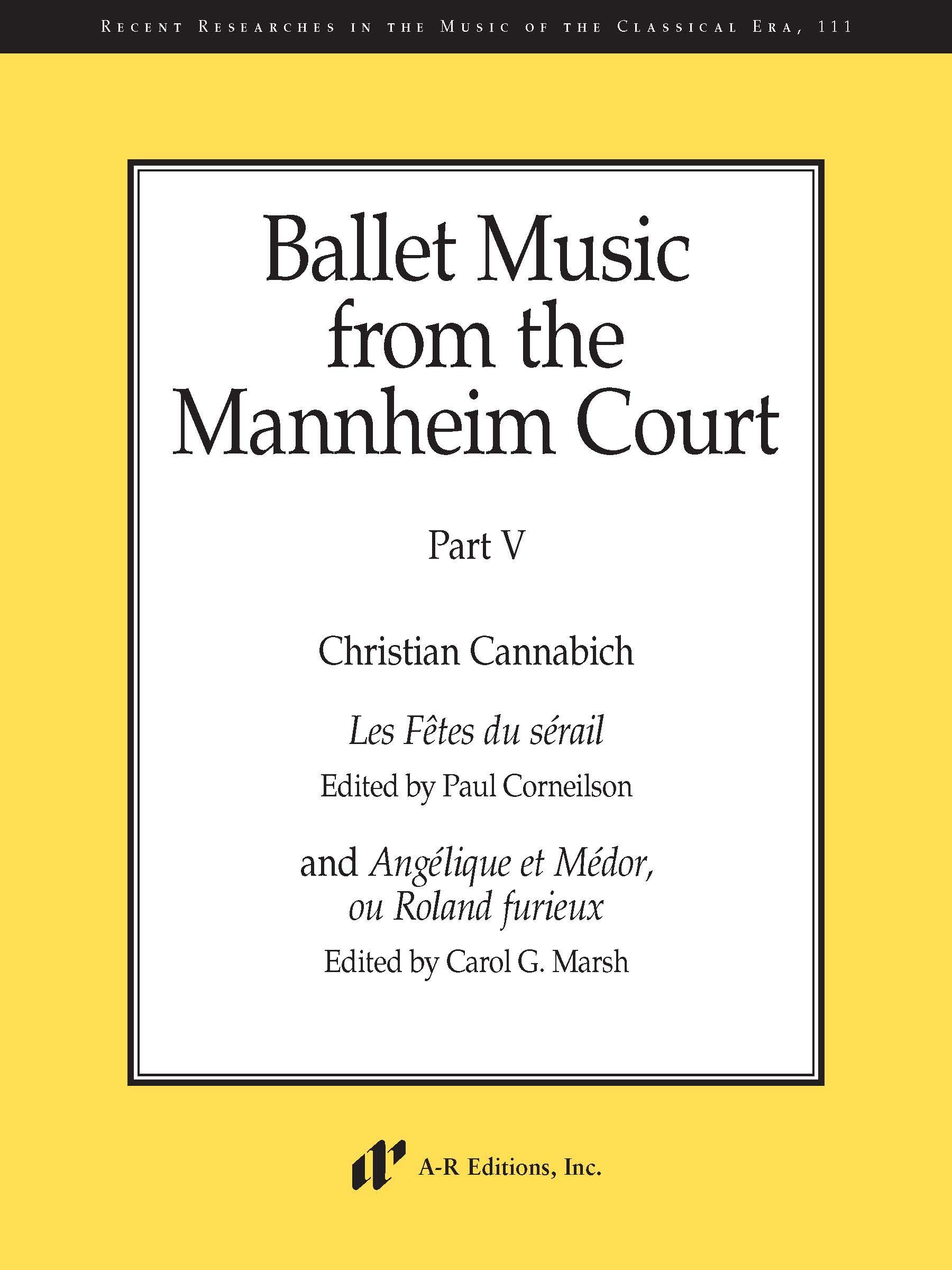
Edited by Paul Corneilson & Carol G. Marsh Recent Researches in the Music of the Classical Era, 111 xxxii + 207pp, $375 A-R Editions, Inc ISBN 978-1-9872-0170-3
These excellent editions of Cannabich’s Les Fêtes du sérail (Corneilson) and Angélique et Médor ou Roland furieux bring this series to a fine conclusion. With 21 and 25 numbers respectively (not counting the overtures), these are substantial pieces which, with the help of two contemporary sources (one given in translation as the original is freely available online, and the other given side-by-side in French and English), the editors hope not only will orchestras pick up the music and perform it, but ballet companies will also take up the challenge of creating suitable choreographies for both sets. The scores feature all the instruments you’d expect to find in a classical orchestra, and Les Fêtes throws in a pair of piccolos and some percussion for good measure. The music mixes through-composed pieces with movements consisting of repeated sections and Da Capo structures; some have nuanced dynamics, others are left to performers’ discretion; both end with susbtantial Contredanses. Both editors provide excellent introductions to the works, as well as comprehensive editorial commentaries. RRMCE now has 111 volumes – what a monumental achievement!
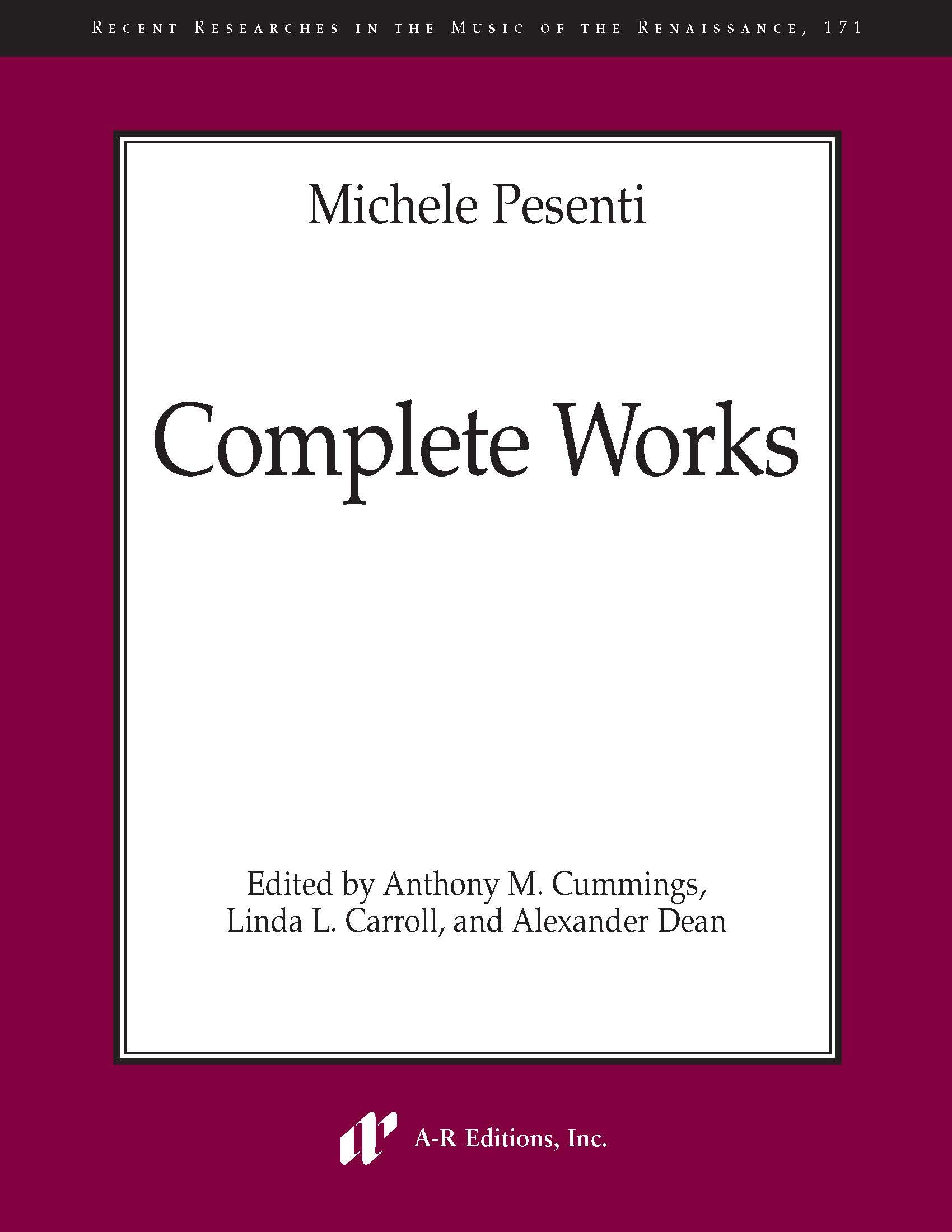
Edited by Anthony M. Cummings, Linda L. Carroll, and Alexander Dean Recent Researches in the Music of the Renaissance, 171 liii + 218pp, $350 A-R Editions, Inc ISBN 978-1-9872-0139-0
So there are a total of 36 surviving pieces by Michele Pesenti (c. 1470-c1528), of which only three are sacred. The remainder survive as settings in four parts (mostly with only the top part texted) or for voice with lute. This excellent volume not only provides performing versions of them all, but goes to great lengths to explain how the poetry of the time works (and how that has guided the editors to underlay the text in the most appropriate fashion), as well as detailed commentaries on and translations of them all. Two of the secular pieces are Latin odes. The works with lute give both tablature and staff notation versions, making this music accessible to all performers of this neglected repertoire – it would be intriguing to hear the various settings of the same text one after the other (definitely NOT in one of these “mix and match” programmes that is de rigeur at the moment!).
This is a great example of scholars working together – thank goodness not all musicologists are as territorial as some I have encountered!
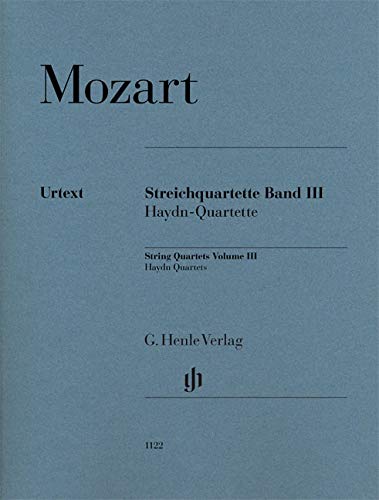
Mozart: String Quartets Vol. 3 (performing materials) Henle 1122 €32 Mozart: String Quartets Vol. 3 (study score) Edited by Wolf-Dieter Seiffert Henle 7122 €22 [Also available for tablet] Mozart: Piano Trio K. 442 (performing materials) Edited by Wolf-Dieter Seiffert with Piano fingerings by Jacob Leuschner Henle 1379 €29.50 Haydn: Symphony in C, Hob I:82 (study score) Edited by Sonja Gerlach & Klaus Lippe with a preface by Ullrich Scheideler Henle 9050 €13 [Also available for tablet]
Any new issues from G. Henle Verlag are to be welcomed. The latest consignment paired Urtext study scores of Mozart’s celebrated “Haydn” quartets with a set of performing materials (of which the Violin 1 part includes the prefaratory material and critical commentaries that enhance the score!), a piano trio consisting of not one but two completions of three fragments – the first by the composer’s friend, Maximilian Stadler, and the other by celebrated Mozart expert, Robert Levin – as well as the movement Stadler added to make a more balanced work (after discarding one of Mozart’s!), and finally another Urtext study score, this time of Haydn’s C major symphony, “The Bear”.
It goes without saying that the printing is beautiful and the paper of the highest quality. The typography is also exemplary, both in the detailed introductions and critical commentaries (in three languages!) and the music itself. Outstanding work at unbelievably reasonable prices!
Part 2 – Masses Recent Researches in the Music of the Renaissance, 167 Edited by Eric Jas xii, 438pp. $350.00 A-R Editions 2019 ISBN 978-0-89579-881-7
Don’t beat yourself up if you are unfamiliar with this composer – pretty much the only concrete evidence of his existence (besides the music, of course) are accounts of money paid to him for around six months’ service as singing master at a church in Ghent (1525-26).
Vas’s excellent edition consists of two five-voice masses, two more that add a sixth voice for the final Agnus Dei and one for four voices of slightly dubious attribution. After ten dense pages of critical notes, there is an appendix containing the models for Vinders’s “parodies,” including works by Appenzeller, Pipelare and Josquin (with translations and separate critical notes).
All five masses are printed at the pitch of the sources; the dubious Missa La plus gorgiase and the 5/6-part Missa Stabat mater use F3 clefs so might required downward transposition in performance.
Obscurity notwithstanding, Vinders reveals himself as a fluent composer whose works merit re-discovery. Vas has essentially done the groundwork for two revelatory CDs of some very fine music.