Categories
Sheet music

Rosetti: Der sterbende Jesus

Recent Researches in the Music of the Classical Era, 114
Edited by Sterling E. Murray
xx, 4 plates, 227pp.
ISBN 978-1-9872-0335-6. $320

Click HERE to buy this at the publisher’s website.
[PLEASE NOTE: This link is NOT sponsored]

Though perhaps best known nowadays as a composer of symphonies, concertos and partitas, Antonio Rosetti (who was born in Bohemia, spent years of his early life in St Petersburg, then Wallerstein before dying, aged only 42, a mere two years after being appointed Kapellmeister in Schwerin) also wrote some impressive vocal music.

Der sterbende Jesus is a passion-oratorio in the tradition of Graun’s Der Tod Jesu. The four characters (a soprano as Mary, St John who was sung by a tenor, an alto as Joseph of Arimathea and Jesus himself, bass) are accompanied by a fairly large orchestra of flute, 2 oboes, bassoon, 2 horns, 2 trumpets with timps, and strings. The work is a sequence of recitatives and arias, interspersed with movements called “Chorale” in which a four-voice is accompanied by the woodwinds (including horns) and others labelled “Chorus” in which the whole ensemble performs. There are elements of narrative drama, but essentially it is a series of reflections initially on Jesus’s death but ultimately in his triumph over death, and that sense of a glorious overcoming of the “power of the grave” is skilfully captured in Rosetti’s final chorus. Music by the lesser masters of this period is often overlooked because of the perceived superiority of their illustrious contemporaries, Haydn and Mozart. On the evidence of this score, Rosetti’s vocal music certainly ought to be better known; the parts he wrote for Mary and St John is particularly demanding.

A-R Editions continue to champion repertoire that has been ignored for too long. Someone, let’s have a recording!

Brian Clark
 

Categories
Sheet music

Purcell: Sacred Music Part IV

Purcell Society Edition, volume 28
Edited by Robert Thompson
xli (including four pages of facsimiles) + 198pp. £75.
ISBN: 9780852499603 ISMN: 9790220225970

Click HERE to buy this from the publisher’s website.
[PLEASE NOTE: This link is NOT sponsored]

As well as updating to include the latest background information, the principal purpose in producing this volume is to re-order the music contained in it according to the dates of composition. Since The Purcell Society first issued editions of the composer’s anthems, a lot of source work has been done that has informed the newly established chronology. Robert Thompson presents the evidence in a way that is mostly very readable; sometimes there is just too much information for comfort, but how is one to avoid this when there is a wealth of disparate evidence?

The 14 continuo anthems included in the volume are presented in the now-familiar Purcell Society style. They are: Turn thou us, O good Lord (Z62), Who hath believed our report? (Z64), Lord, who can tell how oft? (Z26), Blessed be the Lord my strength (Z6), Let God arise (Z23), O Lord our governor (Z39), Give sentence with me (Z12), O praise the Lord, all ye heathen (Z43), I will love thee, O Lord (ZN67), The Lord is King (ZN69), Let mine eyes run down with tears (Z24), Hear my prayer, O God (Z14), O Lord, thou art my God (Z41) and Out of the deep (Z45). Appendices include a short re-arrangement of a repeat of Z64 by Philip Hayes, an organ part for Z6, an earlier working of a passage from Z24 and an organ part thought possibly to be by a young Purcell for Humfrey’s By the waters of Babylon.

Typically this kind of volume is destined to sit on library shelves. Anyone performing the music it contains, though, should certainly seek it out for the valuable information it contains.

Brian Clark

Categories
Sheet music

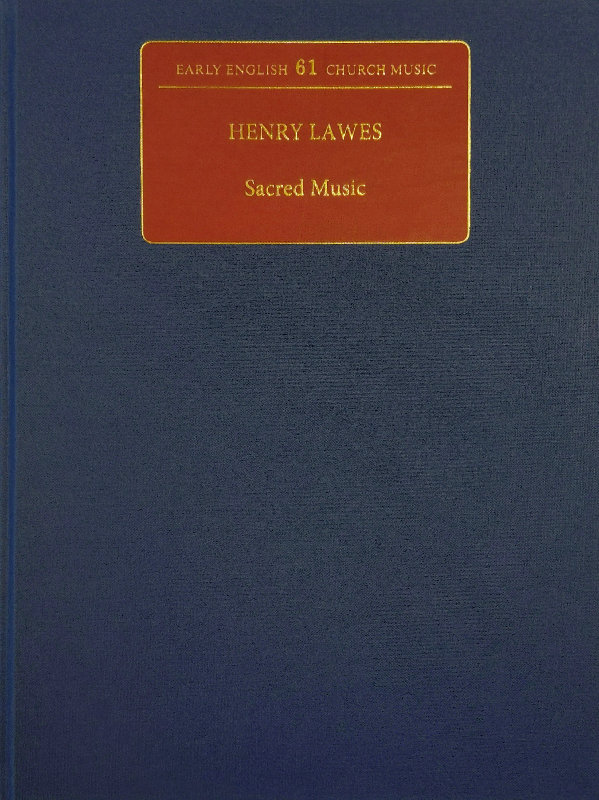
Henry Lawes: Sacred Music

Early English Church Music Volume 61
Transcribed and edited by Jonathan Wainwright
xxxviii+176pp. £75
ISBN: 9780852499610 ISMN: 9790220225987

Click HERE to buy this from the publisher’s website.
[PLEASE NOTE: This link is NOT sponsored]

This heavy and handsomely bound book contains all of Lawes’ known sacred music: five anthems (three of which are fragmentary), five “symphony anthems” (don’t get excited – the symphonies are reduced to organ accompaniment), 29 devotional anthems for 2 sopranos, bass and continuo, seven “sacred songs” for soprano and continuo, 24 metrical psalms for soprano and bass (here with the text of the opening verse printed below the upper voice and the remaining verses as poetic stanzas below), three Latin motets (Laudate Dominum for 2 sopranos, bass and continuo, Predicate in gentibus for bass and continuo, and Quis sicut Dominus Deus noster for soprano, bass and continuo), three rounds for three voices and the texts of eleven pieces that are known to have been lost. An appendix has Matthew Camidge’s 1789 re-working of the psalm tunes.

As well as this hugely generous amount of music, you get a LOT of musicology; there’s a lengthy introduction to Henry Lawes and his music, then an exhaustive list not only of the sources but also articles that have already explored them in depth, and a comprehensive bibliography. Then, each subsection of the book (essential the seven categories I described above) has its own introduction along with detailed critical notes. The music is beautifully laid out. The original orthography of the texts is retained. I am not a great fan of “dashed bar marks” in vocal music as I find it quite difficult at a glance to see where they fall. Nor do ficta accidentals above repeated notes of the same pitch strike me as particularly useful. That said, these are very, very minor criticisms. Henry Lawes’ music deserves to be much more widely known and this beautiful book makes it readily accessible.

Brian Clark

Categories
Sheet music

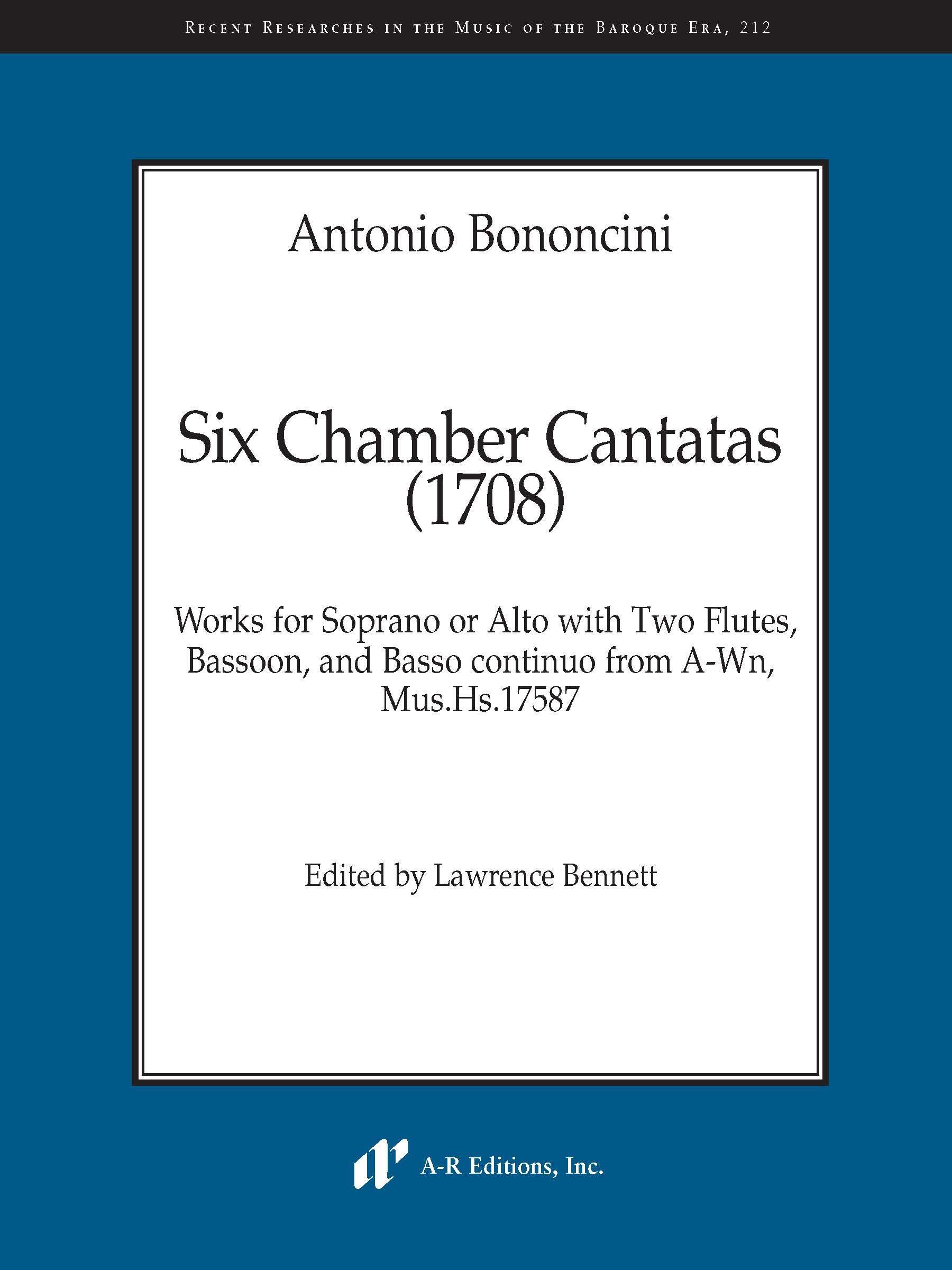
Antonio Bononcini: Six Chamber Cantatas (1708)

Works for Soprano or Alto with Two Flutes, Bassoon, and Basso continuo from A-Wn, Mus.Hs.17587
Edited by Lawrence Bennett
Recent Researches in the Music of the Baroque Era, 212
xv, 3, 162pp. ISBN 978-1-9872-0533-6. $190

Click HERE to buy this volume at amazon.co.uk

One of four manuscripts of cantatas by Antonio Maria Bononcini (1677–1726), Mus.Hs.17587 contains three works each for solo soprano and alto with two recorders and basso continuo. The fact that it is only acknowledged in a footnote that the upper woodwinds are NOT flutes makes me suspicious of everything else about the edition. For example, the fact that Mus.Hs.15931/7–9 contain parts, one of which is for bassoon, does not of itself give these sufficient authority to include a separate line throughout the edition as if it were an obbligato instrument. To me, a far more sensible solution would have been to add [senza Fag.] instructions above those passages where the wind instrument should drop out – by the editor’s own admission, these (and, indeed, the score) are the work of a professional copyist, not the composer, after all.

Each cantata has either three or four movements (the latter adding a recitative before the first aria). In one of the arias in each cantata, there is only one line for recorders; in cantata 2, this is marked as a Recorder 1 solo, while both instruments play in unison (as they do in other Viennese cantatas of the period, by Caldara, for example) in the others. There is no denying the quality of the music; Bononcini knew well how to write both for the voice and for instruments. No points for guessing the subject matter, or for imagining that they are open to some very dramatic performances! Singers will need to combine their acting skills with some real vocal agility, and the recorder players, in particular, will require nimble fingers!

Brian Clark

* Parts are available from the publishers for $68.

Categories
Sheet music

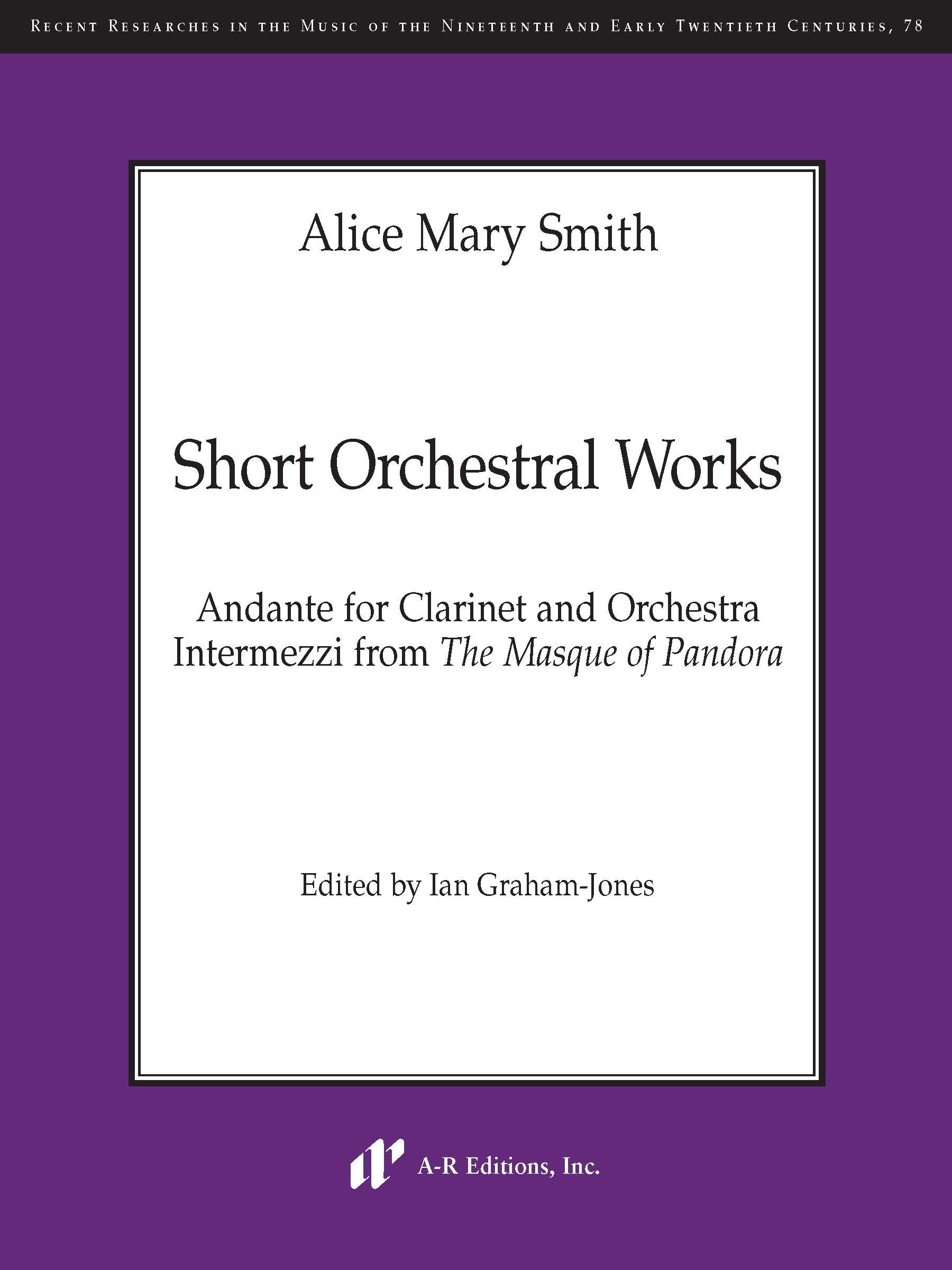
Alice Mary Smith: Short Orchestral Works

Andante for Clarinet and Orchestra, [2] Intermezzi from The Masque of Pandora
Recent Researches in Music of the Nineteenth and Early Twentieth Centuries, 78
Edited by Ian Graham-Jones
ix, 2, 65pp. ISBN 978-1-9872-0452-0. $144

This is the latest of several volumes Ian Graham-Smith has devoted to Alice Mary Smith. An acknowledged expert on the lady and her output, his introduction to these three works is positively bulging with background information.

The clarinet solo began its life as the middle movement of a sonata with piano. The dedicatee and original performer, Henry Lazarus, commissioned the orchestration and played it with universal approbation. Whether or not the composer (who had also been the “accompanist” at its premiere) ever produced a full concerto (as it is described in at least some of the press coverage of performances) is unclear.*

The two intermezzi also originated in a larger work, this time a “grand choral cantata” setting words by Longfellow. “After the storm”, an Andante movement moving from common time into 9/8 then back again, was transposed from its original B flat minor down a semitone to facilitate a more gentle segue into “In the garden”, which is in A major and 9/8.

These are, indeed, brief pieces – at 148 bars, the clarinet solo is longer than both of the others put together. Yet, there is a charm to all three (and not a little virtuosity about the Andante for clarinet!) which makes them ideal introductions to the composer and her music.

Brian Clark

* The publisher also lists two parts for clarinet and piano of just this work for $10.

Categories
Sheet music

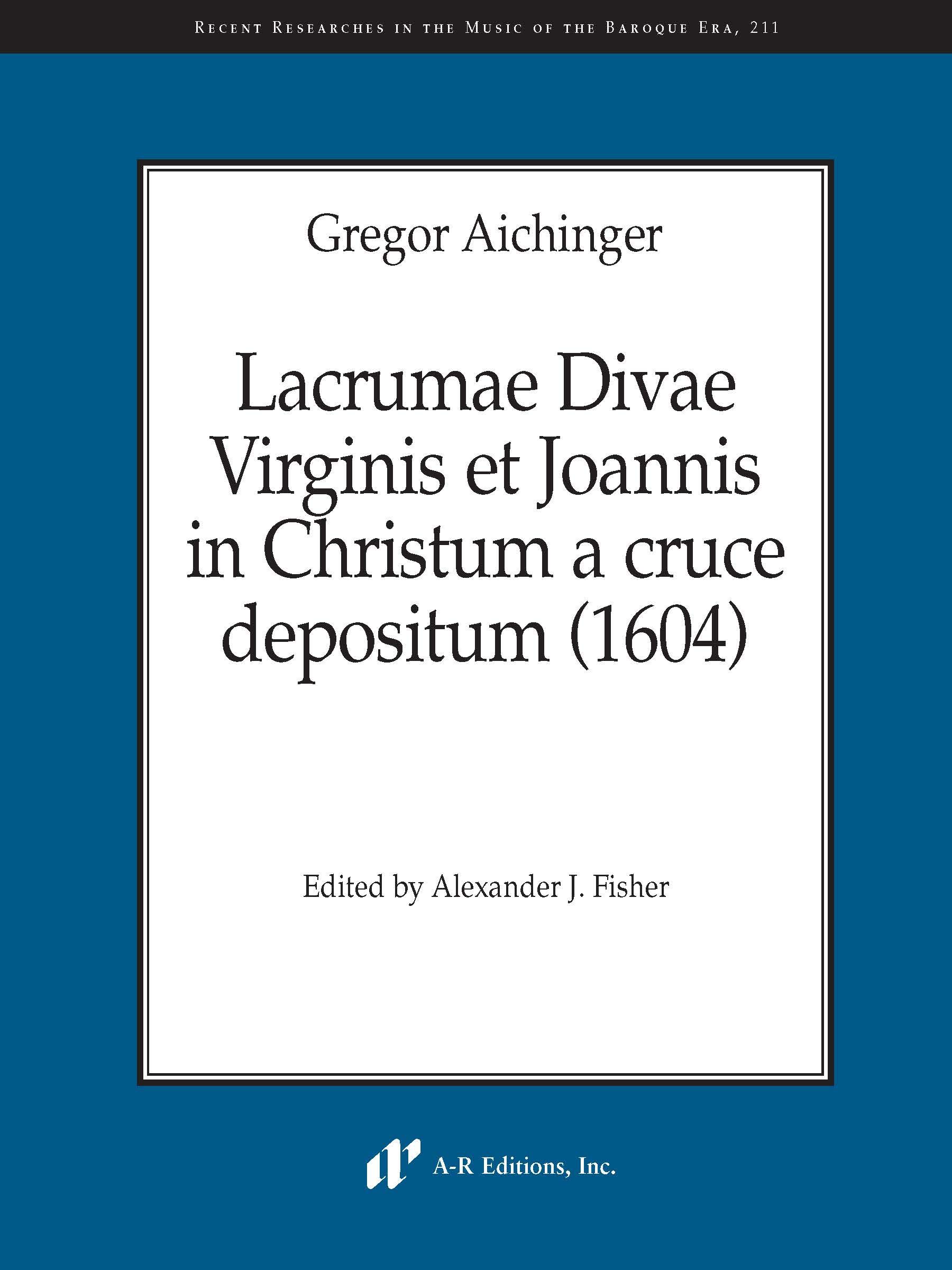
Aichinger: Lacrumae Divae Virginis et Joannis in Christum a cruce depositum (1604)

Edited by Alexander J. Fisher
xviii, 5, 63pp.
Recent Researches in Music of the Baroque Era, 211
ISBN 978-1-8972-0549-7 $100

Throughout his life, Gregor Aichinger was associated with the “richest family in the world”, the Fuggers. Sponsored by them to travel and study in Italy, he repaid them with many publications (and doubtless other musical tributes), among them this set of eight a cappella motets. They set texts by Marcus Welser, a wealthy city official in Augsburg, where (among other duties) Aichinger played the organ (financed – of course – by the Fuggers) at the church of SS Ulrich und Afra. The building houses a large bronze “Crucifixion” by Hans Reichle (the first of five illustrations in the edition) which was completed in 1605 – the year after the publication of Aichinger’s music. Fisher’s “loose connection” between the three (though he acknowledges the striking thematic links) is surely an overdose of academic caution!

Although Aichinger studied in Venice with Gabrieli, there is little evidence of that in these motets. That is why, in addition to the Baroque tag, I have added a Renaissance tag, too – this music inhabits the grey world of musical stylistic change around 1600. The first seven short pieces are scored for five voices (SMATB), while the last adds a second tenor. Mostly cast in 4/2 bars, Fisher opts to represent tripla (3) in 3/1 in the fourth motet but in 3/2 in the final piece. I cannot help thinking that this is because he (like others) is afraid to acknowledge that our modern barring system (and subsequently some of our understanding of the interrelationship between time signatures) just does not like joins, where half of a bar is notionally a triplet version of the other half. That said, this is a well laid-out volume with minimal editorial intervention. Having such a clean page allows one to appreciate one aspect of the music that Fisher draws attention to in his rich introduction: the way Aichinger respects the clarity of Welser’s texts.

Brian Clark

Categories
Sheet music

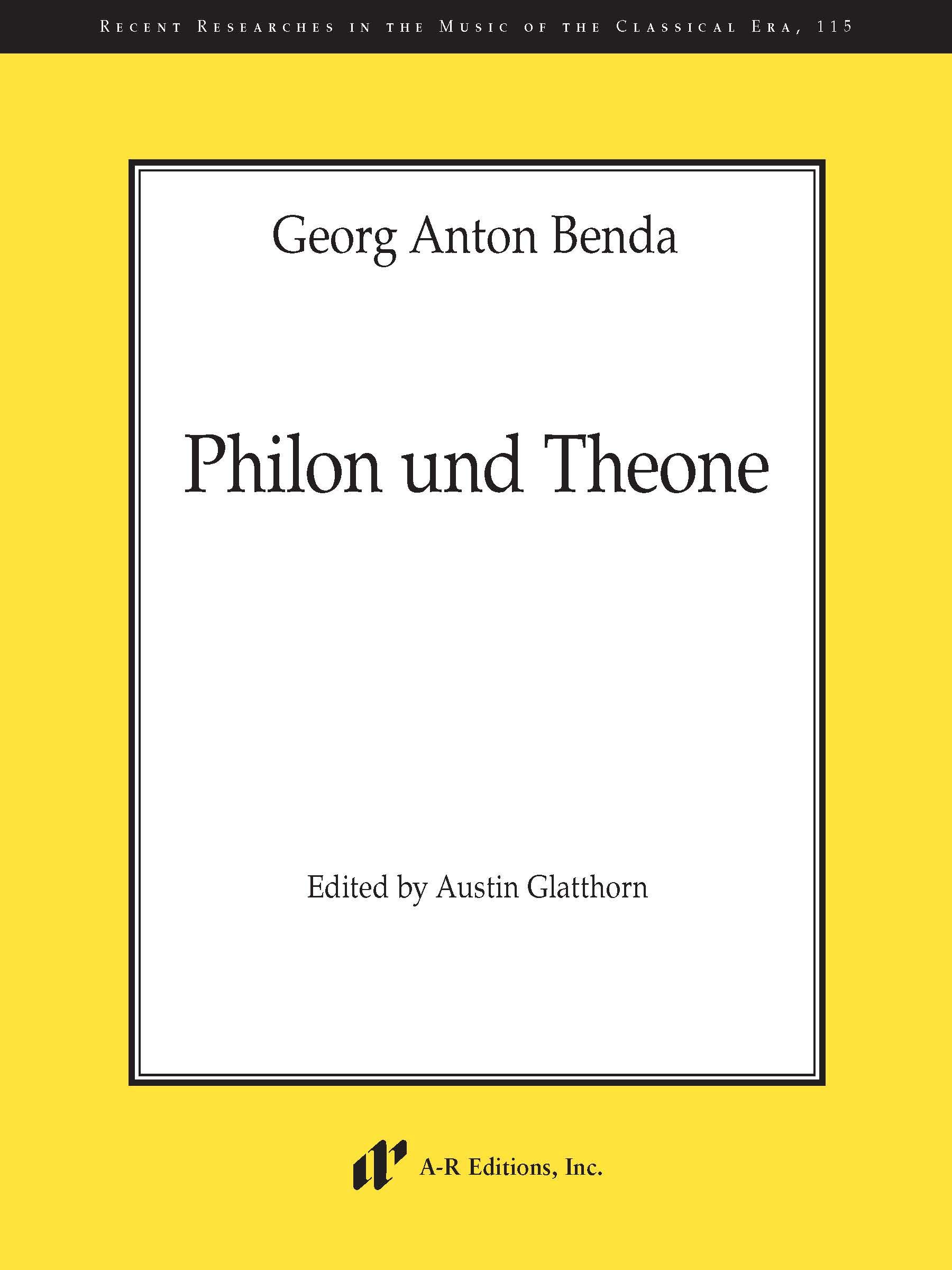
G A Benda: Philon und Theone

Recent Researches in the Music of the Classical Era, 115
Edited by Austin Glatthorn
xxiv, three plates, 166pp.
A-R Editions, Inc. ISBN 978-1-9872-0456-8. $270

Click HERE to buy this on amazon.co.uk

The latest volume in this excellent series from A-R Editions includes not only Benda’s version of his last melodrama, but also the revised version of some movements (made by the glass harmonica player, Johann Ludwig Röllig, who commissioned it) for performances in Prague (the original Viennese production having been cancelled). Unlike Benda’s other melodramas, Philon und Theone (which tells of lovers separated by a sea storm, her protection by spirits, and their ultimate reconciliation) is not restricted to instrumental music interspersed with narrative; Theone is a sung role and the spirits sing two- and four-voice choruses. This, as the thorough and impressive introduction explains, brings the work closer to Singspiel and opera, and it is not beyond the realms of possibility that Schikaneder and/or Mozart (the latter certainly knew of Benda’s music) were acquainted with the work. The original version (for a string orchestra with pairs of flutes, oboes, bassoons, horns, and trumpets with timpani) runs to p. 103, and the remainder is given over to Röllig’s Almansor und Nadine (the revision). The translation is given of all the words, and the music looks lively and effective, as Benda’s output tends to be – it still surprises me how few performances and recordings there are on the market! Congratulations to Glatthorn and A-R Editions on a very fine publication.

Brian Clark

Categories
Sheet music

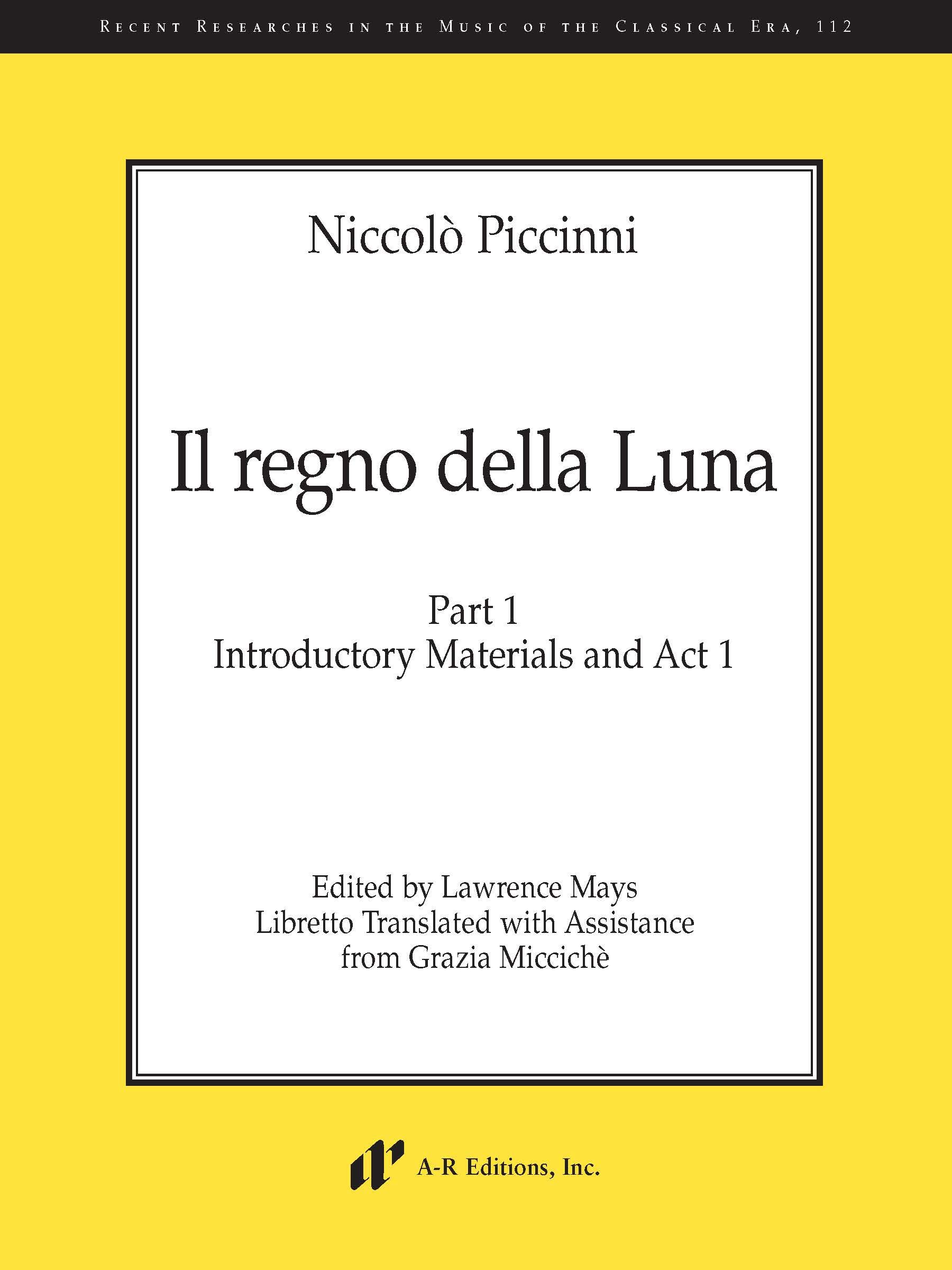
Piccinni: Il regno della luna

Edited by Lawrence Mays, libretto translated with assitance from Grazia Miccichè
Part 1: Introductory Materials and Act 1
lxii, 6 plates + 243pp.
Recent Researches in the Music of the Classical Era, 112
A-R Editions, Inc. ISBN 978-1-9872-0215-1 $415
Part 2: Act 2, Act 3, and Critical Report
vi + pp. [245]-555.
Recent Researches in the Music of the Classical Era, 113
A-R EDitions, Inc. ISBN 978-1-9872-0300-4 $415

Buy it HERE

This three-act opera is unusual in that it is set on the moon! Unlike other moon-themed operas of the Baroque and Classical periods, the libretto tells of the visit of some Earth-living humans to a society where women are very much in control, peace reigns and the desire to be successful in business is viewed rather disapprovingly. Thus the men in the party get into difficulties trying to boast their way into the lunar princess’s good books, and the Earth-women decide the moon is such fun they’d rather stay than go home!

Piccinni’s original setting of 1770 for Milan is lost, so Mays’s edition is based on materials for the Dresden revivals later in the decade, where it is scored for pairs of oboes, horns and trumpets with drums, strings. The seven characters are two sopranos, a mezzo, two tenors, a baritone and a bass. Arias were cut from the Milan libretto for the Dresden performances and it is noticeable that while there are six arias in Act 1, there are only four in Act, and only one in Act 3; conversely, the number of ensemble pieces rises as the opera progresses and the secco recitative gradually gives way to accompagnati. The music is hardly sophisticated (like many contemporary operas, there is a little too much repetition built into the phrases for that) – nor indeed is much of the libretto! – but it is tuneful and full of the necessary energy to carry the action.

A welcome addition to the catalogue of available operas – will someone take on a production?

Brian Clark


Categories
Sheet music

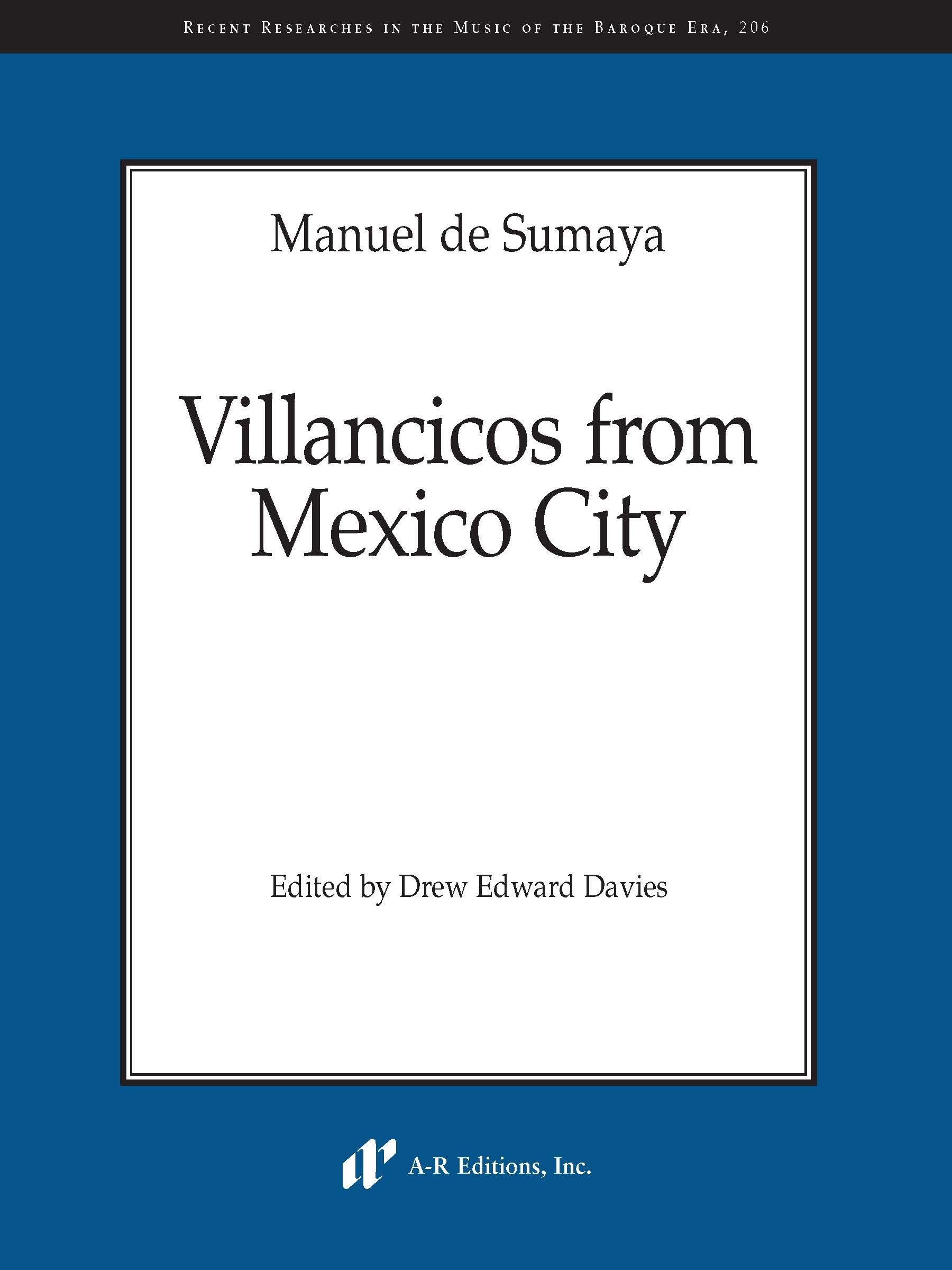
Manuel de Sumaya: Villancicos from Mexico City

Edited by Drew Edward Davies
Recent Researches in the Music of the Baroque Era, 206
xliii, [6 plates] + 231pp.
A-R Editions, Inc. ISBN 978-1-9872-0202-1 $275 (Violin parts available $14)

Buy it HERE

Manuel de Sumaya (c. 1678-1755) was chapel master at the cathedral in Mexico City from 1715-39 and the 32 complete works in this impressive volume (plus transcriptions of two further fragments) date from this period.

The villancico form has a verse and refrain basis. Sumaya’s Mexico city pieces include 14 for one “choir” (of between two and four voices, two with added violins), 14 more for two “choirs” (four to eight voices, again two with strings), and four for three “choirs” (11-12 voices). It is difficult to look at music for choirs where the bottom line of each is called bass and the rhythm mostly matches the voices above (and thus diverges from the basso seguente at the bottom of the texture) and not assume that these lines must have been sung too; but that is superimposing European expectations – played by the instruments Davies suggests in his detailed introduction, the lack of a texted bass part might be irrelevant.

Some of his translations of the texts are a little less literal than they could be, but a great help for performers is the fact that all of the verses are underlaid so there is no need for the mental gymnastics required with other editions on how to elide the various words ending and beginning with vowels so that the text is properly stressed! One of the strangest pieces is no. 20, for the feast of the Assumption, Hoy sube arrebatada. As well as a tenor voice, it features two violins with bass, as well as untexted treble and bass parts that make up “choir one”. As elsewhere, the string writing is more elaborate than that for voices; Davies’s suggestion that the untexted treble be played on a wind instrument (and the bass, too, presumably) might make sense of something that just looks quite odd!

In all honesty, I cannot see choirs queueing up to pay so much for what is a very worthwhile volume of interesting music, so I sincerely hope that A-R Editions can be persuaded to authorise off-prints for inclusion in concerts.

Brian Clark

Categories
Sheet music

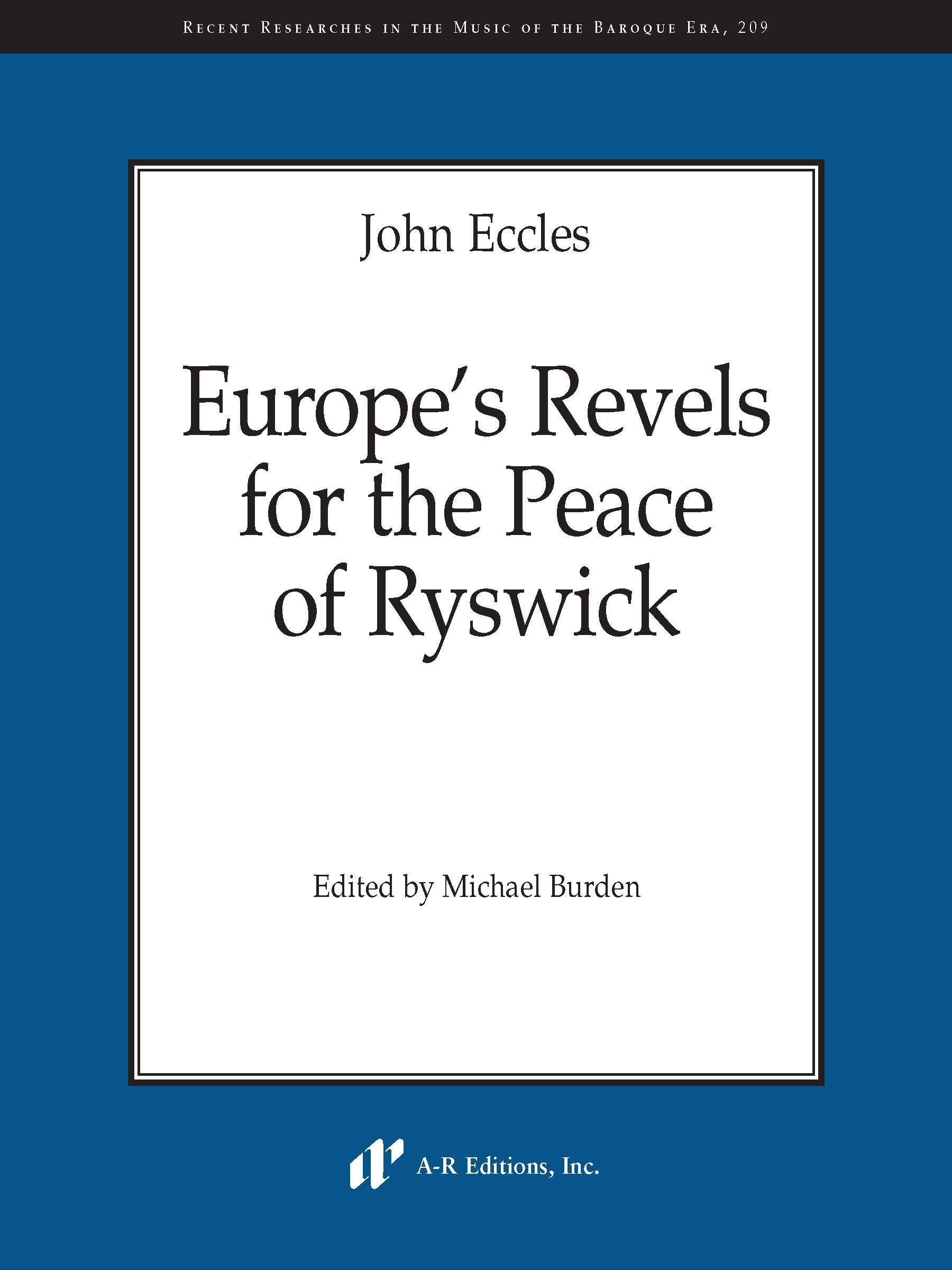
John Eccles: Europe’s Revels for the Peace of Ryswick

Edited by Michael Burden
Recent Researches in the Music of the Baroque Era, 209
xxvii, [6 plates] + 97pp.
A-R Editions, Inc. ISBN 978-1-9872-0306-6 $180

Buy it HERE

For those whose historical knowledge of the late 17th century is a little sketchy, the Treaty of Ryswick was signed at the conclusion of the Nine Years War, fought between France under Louis XIV and a Grand (and somewhat unusual) Alliance between Protestant England and Holland on the one hand and Catholic Spain and the Holy Roman Empire on the other.

Kathryn Lowerre (one of the General Editors of this “complete works of Eccles” sub series from A-R Editions) has written extensively about the piece and both its background and contents. Michael Burden’s fine edition supplements that with illustrations, a fully annotated (and, when necessary, translated) libretto (with those sections of Motteux that were omitted from performance in one of three appendices) and a thorough but remarkably short Critical Report.

As usual, my only reservation about the edition is the sometimes impractical layout; numbers 8 and 9, for example, cover two pages but they both have page turns – in the case of number 9, that means turning to play five bars and then turning back. Someone should think about the possibility that these volumes may not be destined to languish on scholars’ shelves and that musicians might be inspired by Anthony Rooley’s foreword to the edition and actually stage a performance; then all the hard work would finally be shown to have been worthwhile.

Brian Clark