1747 – Bach’s journey to Potsdam
Le Caravansérail
67:21
Ramée RAM2508
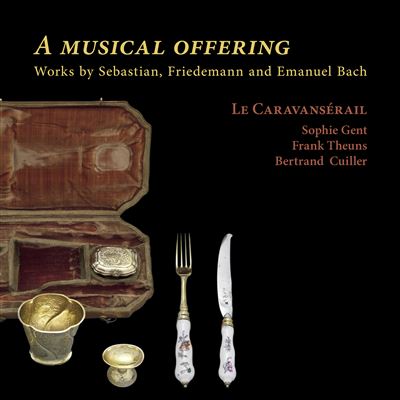
BEWARE: this interesting and elegantly prepared CD is not another recording of The Musical Offering, but a musical offering by the trio Le Caravansérail, traverso, violin and harpsichord, presented in a card case illustrated by the elements of an 18th-century travelling picnic satchel.
The trio plays a number of works, including parts of BWV 1079 – the Ricercar a 3, the Sonata and the Canon perpetuus super thema Regium – and also a plausible version of BVW 1032, here reconstructed by Frank Theuns from its mutilated state and transposed to G minor. By C.P.E there is a sonata (Wq 143) and a Trio a Cembalo obligato e Violino (Wq 72), and by Wilhelm Friedemann a trio a 2 Flauti e Cembalo (Fk 49). Of the instruments, listed with their makers and the originals they are made after, the actual period survivor is Sophie Gent’s violin, a Jacob Stainer of 1676.
The numbers that form the programme are strung together round the concept of the arduous journey to Potsdam, at the end of which Johann Sebastian was thrust into the King’s presence to perform at once, only later to complete his fully worked and majestic contrapuntal chef-d’oeuvre. Writing the liner notes, Frank Theuns makes a good case for displaying the talents of the better-known of Bach’s family members together as a kind of holiday photograph album.
The group’s style of performance is French orientated, with lovely languid slow movements and vivid notes inégales, and swaying, dance-inspired faster movements of the sons’ galant style. Balance is good, and the decision not to use a string bass with the resonant bass register of the harpsichord is vindicated here.
Whether you will feel moved to buy this CD, I am not sure: the performance has merits, and the concept is worthwhile, but I am not sure I will return to it often. It is the kind of programme you would delight in finding on offer at a late evening recital in a busy festival.
David Stancliffe