Categories
Recording

La la hö hö

Sixteenth-century viol music for the richest man in the world
Linarol Consort
67:26
inventa INV1005

Click HERE to buy this on amazon.co.uk
[These sponsored links help the site remain alive and FREE!]

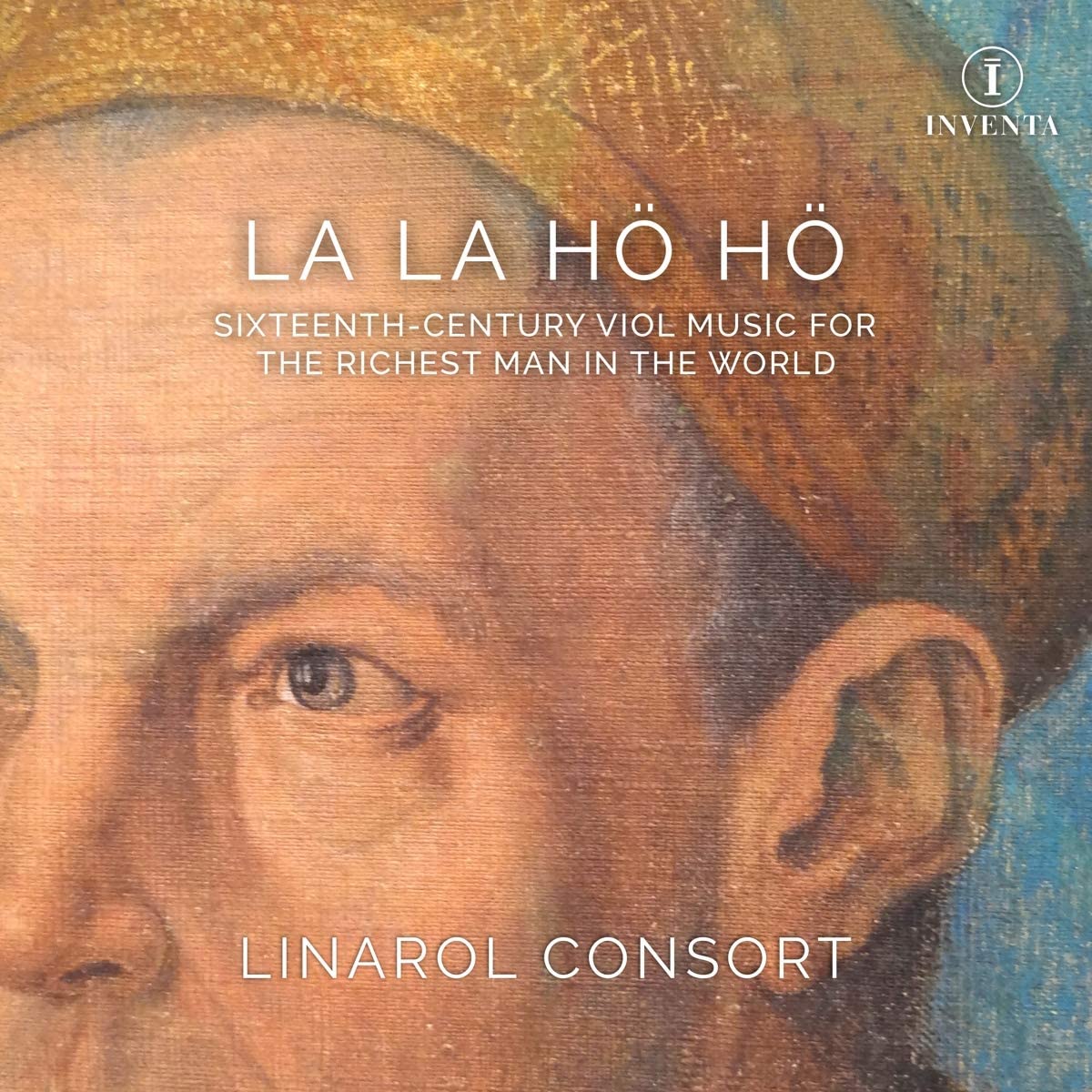
In our own days when the richest men in the world are vying with one another in the realm of space flight, it is nice to recall a time when prestige was measured in the cultivation of the arts. Jacob Fugger, head of the wealthy banking family of Augsburg at the beginning of the 16th century, when he was probably indeed the richest man in the world, was a great sponsor of music, and the manuscript for viols on which the current CD is based was probably compiled for him. I recall a previous CD entitled ‘Music of the Fugger Time’ – I did wonder what this would mean to English-speaking listeners – which celebrated the role of the Fugger family in the cultivation of music, but the present, more tightly focussed CD is a wonderfully evocative tribute to this all-powerful family, financiers to kings and emperors. A roll-call of the composers represented in ms 18810 from the National Library of Austria – Isaac, de la Rue, Josquin, Hofhaimer, Brumel, Senfl and Rener – indicates a very selective approach to music collection, ensuring that music in the Fugger household was of the same superlative standard as every other aspect of their lives. The Linarol Consort, playing four viols by Richard Jones of Powfoot in Dumfries, give us wonderfully idiomatic and vivid performances of this early 16th-century repertoire. And fittingly overseeing it all, Jacob Fugger’s gimlet eye glares out of his portrait by Dürer on the front cover of the CD.

D. James Ross

Categories
Recording

Lorem Ipsum

Combo Cam
58:37 (CD1, including dialogue), 54:11 (CD2, just music)
Genuin GEN 21724

Click HERE to buy this on amazon.co.uk
[These sponsored links help the site remain alive and FREE!]

Lorem ipsum is gobbledygook. This dog’s dinner of a production deserves that to be my whole review. The double CD set is presented in such an offhand, arch and downright annoying manner that had I not been impressed with the actual music playing I would hardly have gone in search of the performers’ names, waded through Doris Meeresbüchner’s rambling notes or tried to work out what on earth was going on. I remember when making one of my own CDs insisting that ‘incidental noises’ – wind players and singers breathing, the spinet player changing stops – not be edited out. However, to include tracks of the performers walking in at the start, discussing what they are doing etc etc seems to stretch realism ad absurdum. The repertoire seems to be music from the Renaissance, mainly Spanish in origin, and the performances are dynamic and idiomatic. However, I eventually gave up working out what Doris Meeresbüchner had to do with the whole lamentably presented project, as Viola Blache is credited with the vocals and the phrases ‘hier ist Doris Meeresbüchner dabei’ on CD1 and ‘wo ist Doris?’ on CD2 are less than helpful. There is a deplorable level of arrogance and self-indulgence in making these two fine CDs of music and then releasing them in a format and package which deprives the listener of the supporting information to permit full understanding and enjoyment of the recording. The silly inserted tracks, the obscure presentation and the squandered opportunity to inform nearly drove this reviewer ad distractionem – if you plan to invest in Lorem ipsum, good luck to you.

D. James Ross

Perhaps a German speaker would like to send us an alternative review? Could it be that we’re missing a big joke?


Categories
Recording

Maria & Maddalena

Francesca Aspromonte (soprano, I Barocchisti, conducted by Diego Fasolis
62:09
Pentatone 5186 867

Click HERE to buy this on amazon.co.uk
[These sponsored links are your only way to support the site and continue to enjoy these reviews FREE!]

Francesca Aspromonte’s first recital CD was a somewhat disparate collection of excerpts from operatic prologues. Here, as related to both topic and musical idiom, she here essays a more cohesive collection. It is based around the two Marys, the Virgin and Mary Magdalene as portrayed in oratorios dating from around the turn of the 18th century, itself one of the more fascinating periods of musical history.  On paper it would be hard to imagine two more contrasted figures than the two Marys, one chosen as the immaculate conceiver of God in the human form of Jesus, the other a woman torn between spiritual and carnal love. Yet there are links between them in their love for Jesus and their sharing of suffering at the Cross, in the case of the Magdalene love and suffering sufficiently ambiguous to inspire in a great novel like Katzantzakis’s The Last Temptation, a novel that enraged the Roman Catholic church.

Here, unsurprisingly for works that owe their existence to the Counter-Reformation, we meet with no such ambiguity. In the case of the Virgin there are texts that summon up the mystery of the Incarnation, as in the aria ‘Ecco qui l’incomprensibile’, provided by the spiritual and highly musical Holy Roman Emperor Leopold I for Antonio Draghi’s Il Crocefisso per Grazia (1691). This is the earliest of the oratorios represented and significantly the only aria in strophic form at a time it was rapidly being superseded by the da capo aria. Another nod back to the fading 17th century can be heard in the highly expressive recitivo cantando from the little-known Giovanni Lulier’s Oratorio à 6 per la Nascità. Probably composed not long before his death in 1700, the extended passage is the Virgin’s lullaby on the fate awaiting the infant who lies under her gaze. Most exceptional of all the music for the Virgin on the disc is the closing sequence from Alessandro Scarlatti’s La Santissima Annunziata composed in Rome in 1700 or 1703 to a text by Cardinal Ottoboni. It opens with an exquisitely lovely aria, ‘Stesa a pie’ prefaced by chromatic orchestral stabs to the heart in which the Virgin’s gaze is now directed to the broken torso of her son. A more animated central section follows in which she evokes ‘redeemed mankind’, a topic expanded upon in the following recitative. The oratorio’s final aria is an animated message in which Mary recognises she will become a symbol of refuge for future generations.

Among those much influenced by Scarlatti was the young Handel, whose Roman sojourn was capped in 1708 by the oratorio La Resurrezione, from which Aspromonte sings two of Mary Magdalene’s arias, the first, ‘Ho un non so che nel cor’ from scene 2 expressive of her hope, but also disquiet, the second Mary’s final aria, ‘Se impassibile, immortale’, a joyously buoyant celebration of the Resurrection. We meet the more vulnerable, penitent side of the Magdalene in two arias from Antonio Caldara’s Maddalena ai piedi di Cristo (c. 1700), an outstanding work recorded complete by René Jacobs in 1995. Of exceptional beauty is the recitative and aria from Part 2, ‘Deh, s’un tempo’ … ‘In lagrime stemprato’, in which a tearful Mary invites Jesus into her heart over a throbbing repeated note pattern in the accompaniment. The music has a dignity that at the same time cannot hide the deeper feelings lying barely beneath the surface.

It’s a repertoire that suits Aspromonte well. The voice itself is full and rounded, yet hints of vibrato are kept well under control. In the many cantabile arias here, she shapes lines with great musicality and if an occasional suggestion of lack of control in the upper register creeps in it is never a major problem. Passaggi are cleanly articulated, the mostly tasteful ornamentation less so and there is regrettably no sign of a trill. But most importantly Aspromonte sings with excellent diction and real communication skills, projecting the varied emotions of the two Marys with a vivid immediacy.

The experienced Diego Fasolis and his I Barocchisti provide well played support; the lovely cello obbligato in the first of the Caldara arias is especially noteworthy. Just occasionally Fasolis’ old habit of clipping notes comes to the surface but here it is not a serious problem. An outstanding and lengthy booklet essay sets the seal on an issue that is of real value, not only for the quality of the repertoire, some of it rare, but the manner in which it is performed.

Brian Robins

Categories
Recording

Parla, canta, respira

Barbara Strozzi | Eri De Luca
Lise Viricel, Peter de Laurentiis, Le Stelle
74:24
Seuletoile SE 02

Click HERE to buy this on amazon.co.uk as a digital download
[These sponsored links keep this website free for your enjoyment]

This Seuletoile CD combines music by Barbara Strozzi with poetry by contemporary Italian novelist and poet Eri De Luca. The accounts of Strozzi’s songs by Lise Viricel and the instrumentalists of Le Stelle under her direction are exquisite – unhurried, thoughtful, beautifully expressive and musically delicious. The instruments used include harp, lirone, gamba, organ, violin, cornet, sackbuts and bassoon, which create a wonderfully varied palette of timbres, and occasionally for further variety they give us instrumental renditions of Strozzi’s music. I think it important that the vocalist directs the instrumental ensemble, as Strozzi herself would surely have done, as this leads to a stunning level of integration. I found the subtle contribution of the wind instruments most persuasive – too often they are limited to bombastic music of this period, but the wind players of Le Stelle demonstrate that they can be as expressive and tasteful as viols when accompanying the voice. Peter de Laurentiis’ accounts of De Luca’s poetry, evidently praising the attributes of beautiful women, complement the music perfectly, Italian being such a musical language that he could be reading out the Neapolitan phone book. I say this, as the CD notes and texts appear only in French and Italian, of neither of which can I claim any degree of mastery. Ultimately the main strength of this delightful CD is the voice of Lise Viricel and the wonderfully responsive accompaniment of the musicians of Le Stelle.

D. James Ross

Categories
Recording

Baruffe Amorose del Settecento

Eighteenth-century love squabbles
A. Scarlatti: Palandran e Zamberlucco
Anon: Selvaggia e Dameta
Cappella Musicale di San Giocaomo Maggiore in Bologna, Roberto Cascio
63:30
Tactus TC 660005

Click HERE to buy this recording on amazon.co.uk
[These sponsored links help the site remain alive and FREE!]

These two intermezzi, one by Alessandro Scarlatti and one anonymous, consist of comic musical interludes to be inserted into more substantial and serious dramatic works. In Scarlatti’s Palandrana e Zamberlucco a comic dialogue between an old widow and a young blade is set with operatic flair, while the anonymous Selvaggia e Dameta features an old shepherd and his young companion who engage in quarrels and deception. The first of these is accompanied by a chamber ensemble of strings and oboe, while the second, more overtly comical in character and scored for three unspecified instruments and continuo, is performed by three recorders. Heard in the cavernous acoustic of the Palazzo Zabeccari in Bologna, where it was almost certainly performed in the 18th century, I found this lightweight music rather outlived its welcome in spite of the energetic performances. Nothing dates as quickly as comedy, particularly comedy in a foreign language, and perhaps the visual element of an actual performance was needed to bring these pieces fully to life. Or perhaps, by definition, intermezzi written as light relief from more serious matters are always going to sound a little trivial on their own. I was intrigued to hear in the second intermezzo a line from Monteverdi’s Il Combattimento di Tancredi e Clorinda – well, from Torquato Tasso – and wondered how much more of the humour was lost to me in an Italian text, of which no translation was provided.   

D. James Ross

Categories
Recording

I Diporti della villa in ogni stagione 1601

Gruppo vocali Àrsi & Tèsi, Tony Corradini
65:06
Tactus TC 590005

Click HERE to buy this on amazon.co.uk as a digital download
[These sponsored links help the site remain alive and FREE!]

The madrigal collection ‘The pastimes of the Villa in each season’ published in Venice in 1601 consists of settings by eminent composers of the day, some better remembered than others – Giovanni Croce, Lelio Bertani, Ippolito Baccusi and Filippo de Monte – of verses by the aristocrat Francesco Bozza. Each composer takes a complete season, treated in five parts and interestingly each referred to in the dedication as a single song. The parallels with the almost exactly contemporary ‘Triumphs of Oriana’ are interesting and point at an urge towards the encyclopaedic at the time. The balance of the music on the CD is made up with sundry other madrigals which mention the seasons by the familiar Nanino, Marenzio, de Lasso and Schütz, and the rather more obscure and interesting Rinaldo del Mel and Mogens Pederson. The quality of the madrigals in the collection as well as the added material is high, and they are beautifully sung by the vocal ensemble. This could well have been just an aristocratic vanity project, but the fact that the composers clearly liaised, not to say competed, with one another ensured a consistently high compositional standard. The structure of the publication and its title makes it very clear that it was viewed as a single large four-part work, and was intended to be performed in its entirety, as it is here. The astute choice of complementary material makes this CD thoroughly engaging and entertaining, while the expressive and technically flawless performances ensure that the attention never wanders.

D. James Ross

Categories
Recording

See, see, the word is incarnate

Choral and instrumental music by Gibbons, Tomkins and Weelkes
The Chapel of Trinity Hall, Cambridge, Newe Vialles, Orpheus Britannicus Vocal Consort, Andrew Arthur
70:51
resonus RES10295

Click HERE to buy this album on amazon
[Doing so supports the artists, the record company and keeps this site available – if no-one buys, no money is made and the site will disappear…]

Despite a long and distinguished history, Trinity Hall, founded as early as 1350, is one of the lesser-known colleges that make up the University of Cambridge. It must be tired of reviewers and others attributing this to the subsequent foundation in 1546 of the bigger and wealthier Trinity College, allegedly given so similar a name deliberately by its founder Henry VIII to spite Trinity Hall’s then Master, Stephen Gardiner, who had opposed the king’s marriage to Anne Boleyn. I was well aware of Trinity Hall but am mortified to confess that I knew nothing of its chapel, nor of its chapel choir and its several discs released before the one currently under review here. On the basis of this recording, the state of its music is certainly of a piece with the college’s eminent stature. The mixed Chapel Choir has 23 members (7S 6A 5T 5B) and verses are sung by members of Orpheus Britannicus, the Ensemble in Residence which consists of seven singers who are well kent in early music circles. Accompaniments are provided by the organ scholar James Grimwood or the five-strong consort Newe Vialles (named after the new group of six viol players brought from Italy to England by Henry VIII), while the several organ solos are played by the college’s Director of Music, Andrew Arthur, who also conducts.

The contents of this recording (similar in scope to I Heard a Voice by The Choir of King’s College, Cambridge, and Fretwork, Warner Classics 3944302, 2007) can be viewed from two perspectives. For those who do not routinely sing or hear late Tudor and Jacobean music, it consists of some of the finest music from before the time of Purcell. For those who routinely hear or perform the repertory of Tudor and Jacobean music, the list of contents would seem to consist of disappointingly familiar fare – even the instrumental items by Weelkes, the least populated area of his output, have had their fair sprinkling of recordings. That said, most commercial recordings require the mystical “USP”, the unique selling point that differentiates them from others in the field. Not too many discs can be expected to sell simply on the strength of the performers: probably a CD of Stile Antico gargling would sell by the bucketload, but choirs such as Trinity Hall need that elusive USP. Fortunately it is present on this disc, and it is the tempi at which most of these works are sung: slowly. This might seem unpromising, but works such as Gibbons’ Short Service were not composed to be sung at the dismissively hurried lick which too many conductors take during cathedral or collegiate Choral Evensongs and on commercial recordings: the writing is full of subtleties which are lost at speed. That said, just plain slow performances can be sluggish, but it is entirely possible to sing a piece slowly yet with care and momentum so as to bring out its harmonic, melodic and technical beauties, and this is precisely what Trinity Hall achieve both in the settings for evensong, and in the full and verse anthems. For instance, the ultra-famous This is the record of John normally comes in at just over four minutes, while here it takes a luxurious 5’06; similarly See, see the word is incarnate usually runs for around seven minutes while here it is given 8’14. And nowhere throughout the disc is there a dull moment, half because of the quality of the music and half because of the leisured intensity of the performances.

The booklet is good, being both informative and well illustrated. Unfortunately the author trots out the tired old fiction that viols might have been employed “in the Chapel Royal and other private chapels”. There is not a shred of surviving evidence that any such performances ever took place during the lifetimes of the composers represented here. Where liturgical verse anthems with accompaniments for the organ survive with authentic alternative accompaniments for viols, it is clear from the provenances of the respective sources that the latter were intended for domestic performance; it is, therefore, perhaps all the more authentic for these versions to be sung with female participation.

And finally, what of the performances here? They are consistently good. There is a richness about the tone of the choir which suggests a Baroque sensibility rather than the more austere Anglican approach which is often adopted for the music of these composers. Thanks to the slower tempi, individual parts are easily audible while the voices blend beautifully. This is a most impressive recording. For potential purchasers unfamiliar with the repertory but keen to give it a hearing (or just keen to support Trinity Hall), it is a delightful introduction. For those familiar with this music, and who possess recordings of all these pieces, it is well worth buying this disc for the singularly ripe yet penetrating performances.

Richard Turbet

Categories
Recording

Telemann: Harmonischer Gottesdiesnst Vol.7

Bergen Barokk (Franz Vitzthum alto, Peter Holtslag flute, Thomas C. Boysen theorbo, Markku Luolajan-Mikkola viola da gamba, Hans Knut Sven harpsichord/organ)
62:31
Toccata Classics  TOCC 0182

It must be said that this recording has taken quite some time (several years!) to finally appear – recorded in 2008, we wondered if the project would continue, so this is a wonderful pre-Christmas gift; and we are in safe hands with both composer and ensemble. If you were told to go and hear six liturgical cantatas with exactly the same, limited instrumentation, you might expect some momentary lulls in interest, yet these finely crafted works are easily on par with Handel’s nine German Arias, and offer a very decent range of unforced expressivity for the solo vocalist (here a male alto) and instrumentalist (transverse flute). A very well observed trait in the continuo section, the canatas alternate between harpsichord and organ across the CD, neatly marking out the dual application of these well-conceived works for possible domestic use and/or divine worship.

It is a double joy to encounter some new works among others that are familiar, especially when the bright, mellifluous musicality takes hold from the very first: Ew’ge Quelle…other notable openings are found in both TVWV1:994 and 1:449, the first has echoes of the last aria in the “Landlust” TVWV20:33 from the Moralische Cantaten of 1736, with its nightingale imitations (superbly captured by Peter Holtslag, who is excellent throughout alongside Fritz Vitzthum).

Upon closer inspection of Stig Wernø Holter’s  most insightful notes, some minor “slips” in translation can be clearly noted: for example, track 9 (on page 8) “Thus heaven will be the prize”; and in the second cantata’s first aria, the final verb is “verbannt” , which means “banished” or “cast out”. These (and a couple of other near-misses) do little to affect one’s pleasure with such engaging performances, combining to form an intimate, edifying listen to some beautifully contoured cantatas from Telemann’s 1725-6 published cycle. A fine continuation of the series.

David Bellinger

P. S. Only 30 fabulous cantatas to go before the project is completed!

Categories
Recording

Hammerschmidt: Ach Jesus stirbt

Vox Luminis, Lionel Meunier
70:27
Ricercar RIC418

Click HERE to buy this album on amazon
[These sponsored links help the site remain alive and FREE!]

A key figure in the mid-17th-century German world is Andreas Hammerschmidt (1611/2-1675) who was fluent in the emerging cantata style and equally at home in monody or the madrigalesque style of Italy. His sacred works were published over 15 volumes printed between 1639 and 1671 and combine polychoral motets with solo and dialogue pieces, many using thematic material derived from chorales. In some ways overshadowed by his better-known contemporary Schütz, he was among the creators of the sound world of Lutheran church music in which the contributors to the Altbachisches Archiv and ultimately Johann Sebastian Bach himself were formed. A lot of attention has been paid to Schütz and Schein, and to Buxtehude in the north, while Hammerschmidt is unjustly – on the basis of this fine recording – neglected.

Partly to remedy this, Vox Luminis – here using 13 singers – recorded this selection of his works in 2019, using the substantial organ by Dominique Thomas of 2002 in the north transept of the church of Notre-Dame at Gedinne in Belgium, where in 2017 they had recorded motets by Schein and Ahle for inclusion in an interesting CD devised by the remarkable Breton bassoonist, Jérémie Papasergio. The Hammerschmidt programme is structured around texts for Passiontide and Easter, beginning with the elegiac motet Ach Jesus stirbt, which is the title given to the whole CD. They work with the string group CLEMATIS, (2 violins, 2 violas and violone) and brass (2 trumpets, 3 trombones and bassoon), although the majority of pieces have just basso continuo with the voices.

Vox Luminis are at the heart of their comfort zone with this colourful and often surprisingly adventurous music. The balance, clarity and diction for which the group is justly celebrated are all in evidence in these subtle and well-paced performances. This is an important introduction to Hammerschmidt’s unique voice, but it is also a quite excellent performance of gripping music.

I like it a lot, and it offers far more than just filling another gap in the complex jigsaw of 17th-century Germany, where cross currents between national styles, composers’ opportunities to travel and the myriad small courts with their musical establishments was all part of creating an emerging late Baroque synthesis. Each performance is beautiful and moving in itself, but the cumulative effect is distinctive and compelling.

Some motets are in more in the old cori spezzati style; others employ echo effects, like Siehe, wie fein und lieblich ists in three choirs. In a newer and more obviously modern style, Ach Gott, warum hast du mein vergessen has four character voices, beginning with Ps 22.1 and ending with Alleluias, so taking us from the cross to the empty tomb. Its companion piece is Wer wälzet uns der Stein, where a pair of sopranos ask the question ‘Who will roll away the stone?’ A pair of violins dialogue with them, while violas and violone shadow the lower voices and a bright organ sound adds to the outburst of Easter joy. Restrained and sung by just four voices with continuo is O barmherziger Vater, while Christ lag in Todesbanden makes polyphony out of the chorale, setting it for two trebles and a tenor with three trombones and continuo. Easter is celebrated in a less antique Lutheran style in Triumph, Triumph, Victoria, which has upper voices in pairs – two sopranos, two tenors and then a different pair of sopranos – for the verses with two trumpets and three trombones with the tutti. For Ascension Day we have a motet based on upward scale passages that cumulates in tuttis capped by three trumpets. Very different is Vater unser, with four favoriti, a five-part string group and a capella of five voices joining for the tutti, and the poignant words Ist nicht Ephraim mein theurer Sohn, set memorably by Schütz, receives a haunting performance with just five voices.

As so often with Vox Luminis, the performances seem just right: no individualistic voices unbalance the perfect restraint, yet the outbursts of Easter joy are life enhancing. The choice of music not only illustrates the multiple styles to be found in Hammerschmidt, but shows how rich was the melting pot of middle Europe in these mid-17th-century years. This is an important CD, and no one should be without it.

David Stancliffe

Categories
Recording

Bach: Ich hatte viel Bekümmernis, Herz und Mund…

Núria Rial, Wiebke Lehnkuhl, Benedikt Kristjánsson, Matthias Winckhler, Gaechinger Cantorey, Hans-Christoph Rademann
65:54
Carus 83.522

Click HERE to buy this recording on amazon.co.uk
[These sponsored links help the site remain alive and FREE!]

These two substantial cantatas are as good an introduction to Bach cantatas as you are likely to get, and they are presented in this CD published by Carus Verlag as an up-to-the-moment take on how to do the cantatas.

The pair is well-chosen: both are the results of the routine into which Bach’s new appointment at Leipzig threw him, and show the composer adapting compositions from the Weimar period to novel contexts. Both are substantial works in two parts. Ich hatte viel Bekümmernis (BWV 21) was probably originally composed as a test piece for a post in Halle in 1713, from which Bach later withdrew. He used it for the 3rd Sunday after Trinity in 1714, again for a trial in Hamburg in 1720 in D minor, presumably in Cammerton, and it was included in the first cantata cycle of 1723 on June 13th, reworked for C in – presumably – Cammerton. The original key in Weimar seems to have been C at Chorton, and by 1723 in Leipzig it was back in C, but at Cammerton, with four colla parte trombones in movement ix. It has everything: the division of the singers into soli and tutti, an opening sinfonia with a solo oboe, a soprano/bass duet between the soul and the vox Christi, illustrative writing, a recitative accompanied by two oboes da caccia, and a blazing finale with a choir of trumpets – a veritable showcase of styles and techniques.

Only a few weeks later Leipzig heard BWV 147, Herz und Mund und Tat und Leben, which was written originally for the fourth Sunday of Advent 1716 in Weimar, of which nothing survives except the opening chorus. For its re-use for the feast of the Visitation, 2nd July 1723, Bach retained Salomo Franck’s arias but composed three recitatives incorporating Marian allusions and the celebrated extended setting of the chorale we know as Jesu, joy of man’s desiring, repeated at the end of both parts. This extended chorale setting, where the lilting 9/8 melodic material of the ritornelli is derived from the chorale itself, is the first of such extended settings of final chorales which provide occasional, more elaborate alternatives to the plain four-part setting. Was it Dame Myra Hess, frequently playing a transcription for piano in her war-time concerts, who so popularised it among English speakers?

In general, the performances are fine: the tempi are good, the text is clear and the playing of a high quality, with 4.4.3.2.1 strings plus oboes, trumpets and a quartet of trombones. But there are two caveats: first, I found the tone of this harpsichord brittle and at times over-obtrusive; no details are given of any of the instruments played, and either the harpsichord was recorded too closely or the instrument was too jangly. Secondly and more importantly, Rademann persists in using a quartet of ‘soloists’ who take no further part in those chorus numbers in which they led off with the parts marked ‘solo’ once the parts are marked ‘tutti’ and doubled by instruments. Even if Rademann – like most German conductors – refuses to accept that these cantatas were sung with one voice to a part, plus ripieno singers on occasions, surely he must recognise that to start a chorus with single soloistic voices and then to silence them when tutti is marked in the score is nonsense. Some of solo voices – Nuria Rial and Benedikt Kristjánsson – would blend with other singers perfectly well, others – and particularly the contralto, Wiebke Lehmkuhl – would not. Her voice – rich and dark though it is – is peculiarly unsuited to Bach. This exposes the dilemma for conductors: if you can’t follow the logic of the scholarship as well as the musical plusses that says “Bach’s primary group of singers – the Concertisten – sing everything: add to them some ripienists if you like in choruses unless it specifically says ‘solo’’, then either choose soloists who will not stand out in the tutti like a sore thumb and make them sing everything, or get single voices from your ‘choir’ to do the incipits if you want different ‘soloists’ to sing the recits and arias.” But both on the grounds of scholarship and plain musicality, Rademann’s solution simply does not work.

This fairly major cavil apart, this would be a good CD to give someone who has no idea what a Bach Cantata is, and needs an introduction; but it will help perpetuate a now rather dated style of performance in which vocal timbres and ensemble skills have not kept pace with the strides taken in the past fifty years by wonderful period instrumental players.

David Stancliffe