Categories
Recording

The Taste of this Nation

Clara Hendrick mezzo-soprano, Spiritato directed by Kunga Ujszászi
74:26
Delphian DCD34236

Click HERE to buy this on amazon.co.uk
[These sponsored links help the site remain alive and FREE!]

With this imaginative CD Spiritato open a window on the London music scene just prior to the arrival there of Handel. Resident musicians such as the three represented here were already introducing the Italian taste to the English – it has to be said that they are very much ‘silver’ composers, and I found myself constantly wondering what a first-rater like Purcell would have been writing in their place had he survived. Perhaps the best known of our trio, and probably the best composer among them, is Prussian-born London resident Pepusch, whose four cantatas beautifully sung by Clara Hendrick vividly bring the scene to life, and directly prefigure the operatic world of Handel. The most striking of these is his ‘While pale Britania sate’, the very impressive precursor of so many similarly patriotic numbers by Handel and in which Hendrick duets stirringly with the group’s trumpeter, William Russell. Perhaps the biggest surprise for me were the Concerti Grossi of Obadiah Shuttleworth, music I was completely unfamiliar with. Perhaps wisely relying on the inventiveness of Corelli, Shuttleworth reworks this composer’s op 5 Violin Sonatas into very effective concerti grossi. In doing so, he usefully introduces Corelli’s music to London, but more than that he too is preparing the way for the greater master to come, Handel and his ground-breaking op 6 Concerti Grossi. Of the three composers represented here, the most English and the one who owes most to the previous generation of English composers is William Corbett. There are constant echoes of Purcell, although his Sonata for Oboe and Trumpet recalls the work of the Czech-born but London resident Godfrey Finger. With these wonderfully passionate performances, Kinga Ujszászi and Spiritato prove powerful advocates of this largely unfamiliar music, and make a powerful case that even in the few years between the death of Purcell and the arrival of Handel England was anything but a ‘Land ohne Musik’.

D. James Ross

Categories
Recording

Lully’s followers in Germany

El Gran Teatro del Mundo
68:24
Ambronay AMY314

Click HERE to buy this album on amazon
[These sponsored links help the site remain alive and FREE!]

At first glance it may seem odd to have a Telemann ouverture-suite alongside works by the first-wave of lullists in germanic lands, but this is a perfect lesson in musicology, where the date that a work was copied does not imply its actual date of inception. This particular suite (TWV55: Es4) belongs to a small handful to have been transmitted through keyboard settings, some just a few movements (TWV55: E1 and E2) that long pre-date the copied versions; here we know that Bach’s eldest brother, Johann Christoph made a complete keyboard copy in the “Andreas Bach book” c.1708-12. Thus, the original may be from Telemann’s student days in Leipzig (1701-5) or when he was in the employ of count Erdmann von Promnitz at Sorau (1705-8). Compilations of Lully’s works first began to appear in 1682, when Jean Philippe Heus published two collections called: Ouvertures avec tous les airs, extracts from Cadmus et Hermione and Persée.

These works were the creative catalyst for the succession of germanic Lullistes to begin to capture the livel y“theatrical style” and place it into their own compositions; Kusser, Erlebach, Fischer, Fux, Muffat, Aufschnaiter and Steffani did just that. The early Telemann suite fits into this timeline just behind the first-wave of composers. Muffat studied under Lully for six years, and absorbed a great deal from source. This was at the very beginning of the vibrant cosmopolitan blend in music known as vermischter Geschmach or Gouts Réunis (“Mixed Taste”).

The disc opens with a fairly well known G-minor sonata (concerto grosso) from Muffat’s “Armonico tributo”, given a rather playful interpretation with fewer strings than we may have been accustomed to hearing, yet with attractive additions of oboe and recorder and an actively strumming theorbo to bolster the basso continuo section. The overall effect is much slighter, and the graves aren’t in any way onerous or overbearing.

Next the splendid Suite no1 in C from Fischer’s Journal du printemps (1695), again a lovely flowing, dulcet interpretation which makes for very clear melodic lines, especially in the unfolding final chaconne. Following on, another later Muffat work Nobilis Juventus from his 1698 Florilegium Secundum which does have a certain theatrical flair, well captured by the ensemble’s delicate tones.

Closing with the (nine-movement!) Telemann suite, originally for strings, we can hear the neat interplay of French, Italian and Polish elements from an early date. The Entree is a direct adoption from French opera, often employed for scenic changes. The menuets are wonderfully done here, before a far-too-ponderous, introspective reading of the loure (twice as long as the version on Carus 83.337!) followed by a vibrant italianate gigue, and a fine set of the bourrees. Next, a playful, neatly done polonaise and cheekily inserted “prelude” (Not original, not needed!) before the Aria, which I again felt was in too slow to be fully emotive. Lastly – in vivid contrast – the blithesome passepieds.

All are played with a polished delicatesse and relish, just waning in the latter slower movements of the final suite, yet overall capturing the essence of the emergent “mixed taste” with cosmopolitan flair.

David Bellinger
Categories
Recording

Jéliote, haute-contre de Rameau

Reinoud Van Mechelen, A nocte temporis
78:51
Alpha Classics Alpha 753

Click HERE to buy this recording on amazon.co.uk.
[These links are the only way you can support the site financially and keep it alive…]

CD booklets continue to amaze me, usually in a bad way. Here we have a recording (very good, by the way) in which the heroic tenor/haute-contre is also the musical director but he gets barely a line of credit and no biography. Fortunately Google can supply what Alpha denies us.

This recital surveys the career of Pierre de Jéliote, creator of more than 50 roles, interpreter of yet more, darling of the Opéra, all but indispensable to Rameau and one of the great singers of his day. The programme traces his career from Hippolyte et Aricie to Les Boréades and includes not only airs by Rameau but also by half a dozen of his contemporaries. And there is also an item by M. de Jéliote himself for, to quote the booklet, ‘in addition to being an accomplished musician, he was a composer too’.

This is some of the best singing of this repertoire that I have heard for a very long time. The high tessitura seems no problem to Reinoud Van Mechelen, whose tone is always sweet; he delivers the virtuosic passages with bravura; and overall he has the much-to-be-treasured good taste.

Even if the booklet (French and English) tells us nothing about him, we are at least well-informed about the inspiration for the project and the shaping of the programme, and the texts and translations are given in parallel columns. And a final shout-out for the orchestra, who give the singer unstinting and graceful support and enjoy the various overtures and dances scattered among the vocal tracks.

David Hansell

Categories
Recording

Handel: Concerti Grossi op 3

Van Diemen’s Band, Martin Gester
57:32
BIS BIS-SACD-2079

Click HERE to buy this on amazon.co.uk
[Doing so supports the artists, the record company and keeps this site available – if no-one buys, no money is made and the site will disappear…]

When I spotted this CD of the Handel opus 3 Concerti Grossi on BIS directed by Martin Gester, I wondered if this was the companion album to the opus 6 set by the same director which I had reviewed in 2008, and which has become my favourite account of the Handel opus 6. And indeed it is! The ensemble may have changed to the punningly named Van Diemen’s Band, but the light, idiomatic touch is the same. Gester’s readings are full of insights and surprises – sometimes tempi are markedly slower than anticipated – but nothing is left to chance here in these wonderfully considered interpretations. I have loved these and the opus 6 concerti, ever since investing as a child in the wonderful Academy of St Martin in the Fields’ vinyl boxed set, and apart from the move to period instruments and HI performance, it is the innate musicality of these performances which appeals to me most. It is no mean trick to combine impeccable preparation and spontaneity, and this is a feature shared by my much-loved ASMF accounts and these lovely performances. Somebody once shrewdly observed that all Baroque music is essentially dance music, and this is certainly the case here as the stringed and wind instruments dance through their lines, bringing some of Handel’s finest instrumental music vividly to life. So now I have a new favourite account of Handel’s opus 3 Concerti Grossi.
D. James Ross

Categories
DVD Recording

Vivaldi | Guido: Le quattro stagioni

Andrés Gabetta, Orchestre de l’Opéra Royal
93:28 (2 CDs in a card box with DVD 70′)
Château de Versailles Spectacles CVS042

Click HERE to buy this on amazon.co.uk
[These sponsored links help the site remain alive and FREE!]

So, to the list of ‘seasonal’ composers we can now add Giovanni Guido (1675-1729), who, like Lully, was an Italian who ‘made good’ in France. He was the star violinist in the service of Philippe d’Orléans. His Scherzi amonici sopra le Quattro stagioni dell’anno have no known connection with Vivaldi’s famous concertos though, like them, are based on anonymous poems to which the music responds in some detail: l’Este’s 24 lines elicit a 13-movement divertissement, seven of them less than a minute in duration. Guido’s scoring is for trois dessus and continuo, probably a string ensemble, though he does suggest the addition of woodwind to reinforce the strings in places.

This licence has stimulated this ensemble to prepare an elaborate arrangement involving a broad palette of instrumental colours ranging from hurdy-gurdy to high-pitched recorders plus a few sound effects. In 2021, this is very well done and good fun. Whether or not anything like it would have happened in 1721 is a different matter.

Those same sound effects also appear from time to time in Vivaldi’s famous sequence. This is played with great technical brilliance though I question the very flexible approach to tempo within movements. These performances also offer an opportunity to hear the music ‘as it was heard in Dresden’ with additional parts for woodwind and horns in some of the tutti sections.

As well as the CDs devoted to Vivaldi and Guido respectively the package also includes a DVD filmed in the Hall of Mirrors. This is simply a recording of the music (no audience) with no index points of any kind or ‘extras’. For me, it added little to the CDs.

The booklet (in French, English and German) is informative but falls down in its grouping of the essays by subject rather than language. Having read the French introduction on p7, one then has to turn past its English and German translations to pp12/13 and then to p18 for further enlightenment. But full marks for including parallel translation of the poems which inspired the music.

Sadly, I have yet again to beseech Versailles to get the English texts checked by someone with a better grasp of the language’s idioms.

David Hansell

Categories
Recording

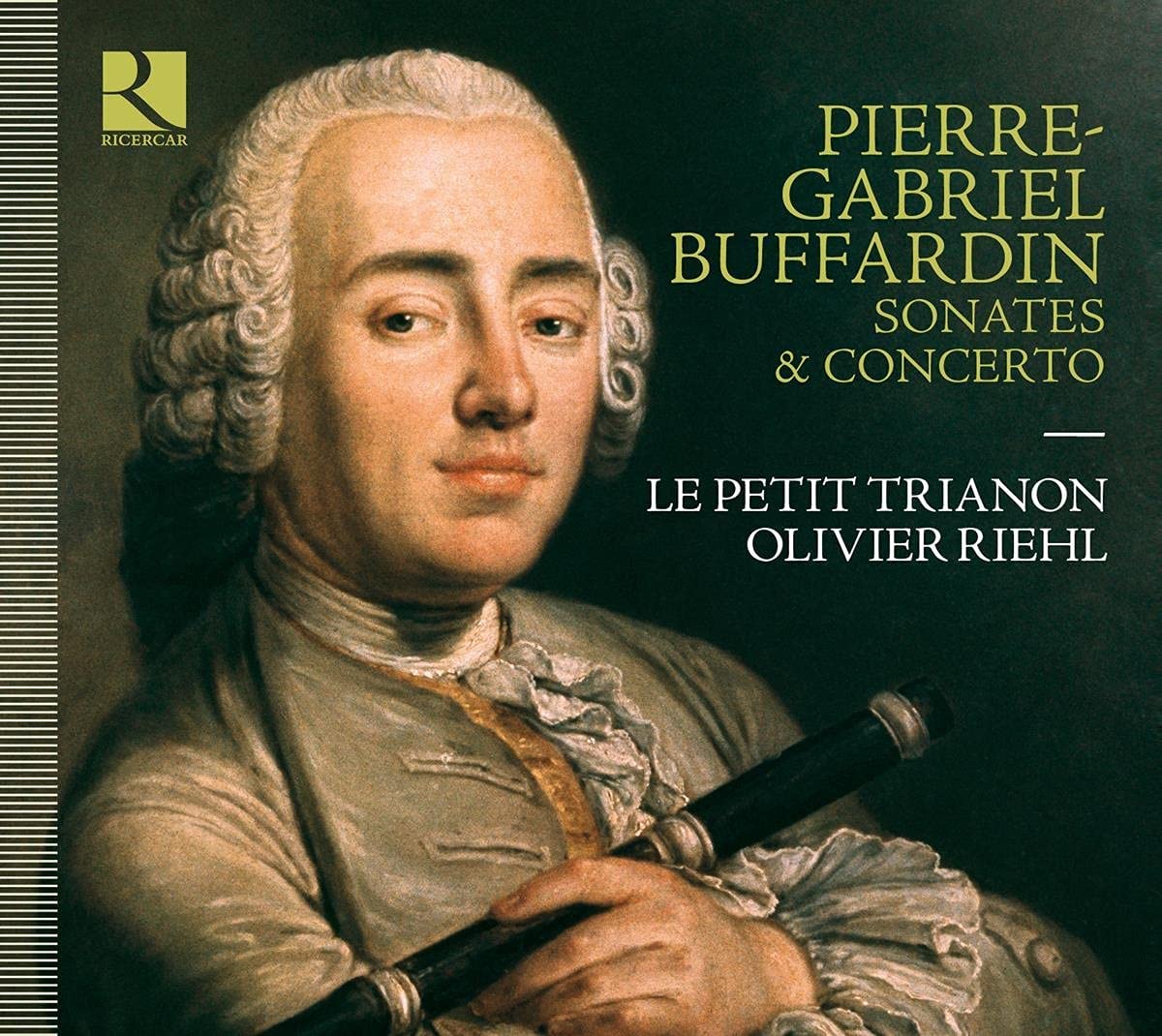
Buffardin: Sonates & Concerto

Le Petit Trianon, Olivier Riehl
75:48
Ricercar RIC 428

Click HERE to buy this on amazon.co.uk
[These sponsored links help the site remain alive and FREE!]

Buffardin is perhaps most famous as the teacher of Quantz and the inspiration for some of Johann Sebastian Bach’s most elaborate flute writing, including the finest sonatas. Here he emerges as a composer of competence and charm, and often more than that: the cadences in the D major sonata’s Allegro would grace the music of any of his contemporaries.

And this is news, for these sonatas are either recent discoveries or ascriptions to Buffardin. I therefore regret that two of the six sonatas we hear include additional parts by or for members of the ensemble, transforming the solo movements into trios/quartets. Indeed, over-elaboration is an unfortunate feature of several items, with the combination of two linear instruments on the bass line too strong for the flute (a modern copy of one of Buffardin’s own) and all but overwhelming the harpsichord.

Having said that, however, it must also be added that all the playing positively bristles with life and commitment, perhaps heard at its best in the opening of the fine concerto, a work which first achieved ‘fame’ in a Musica Antiqua Köln recording 40 years ago. So, although it does come with a few health warnings, this is a disc that will give much aural pleasure with the booklet (English, French and German) offering adequate support.

David Hansell

Categories
Recording

Vivaldi: Concerti per violino IX ‘Le nuove vie’

Vivaldi Edition vol. 67
Boris Begelman, Concerto Italiano, Rinaldo Alessandrini
73:18
naïve 7258

Click HERE to buy this recording on amazon
[This is the only way you can support the musicians and this site!]

If ever proof were needed that Vivaldi did not write the same concerto 600 times, Boris Begelman have provided it. His performances of the six incredibly demanding works on this disc (which, in stark contrast to the previous issue in the series, do not beef up the Vivaldi sound!) are often astonishing. Just listen to the cadenza to Track 10 and you will see what I mean. And the way Vivaldi liberates the cello in the opening tutti of the following track is the perfect demonstration the he was no “one trick pony”. Quite apart from the ridiculous virtuosity (which Begelmann pulls off with seeming ease), the concertos all have their own qualities; the final E minor concerto, for example, starts uncertainly with the movement in the bass line, while the middle movement is wistful and dreamy, and the concluding triple-time Allegro sets off as if it’s on a mission. With 33111 strings (including Begelman) and archlute/harpsichord continuo, Concerto Italiano is about as perfect a group as one could hope for in this repertoire.

Brian Clark

Categories
Recording

Vivaldi: Concerti per fagotto V

Vivaldi Edition vol. 66
Sergio Azzolini, L’onda armonica
78:00
naïve OP 30573
RV 467, 476, 479, 481, 486, 489, 497

Click HERE to buy this on amazon.co.uk
[These sponsored links help the site remain alive and FREE!]

If you ever get a chance to see Azzolini perform, move heaven and earth to ensure that you do. I’m not a great fan of “show men” but there is something about his style of story-telling that draws me into his world and even though I’m writing a review of a recording I can “see” him acting his way through these seven concertos, which – controversially, I would argue, for a “complete edition” – he has orchestrated according to his findings in the Dresden library, which is second only to the University in Turin for Vivaldi manuscripts. While I appreciate and understand his argument that scores only tell us half the story, while sets of parts and anecdotal references reveal 18th-century assumptions that there was no need to annotate everything in scores (notably the presence of doubling woodwinds), it would, I think, have been more interesting still to hear the “straight” versions alongside the expanded ones. As there is no reference to this infelicity on the cover of the box, the unsuspecting public would rightfully assume they were listening to the music as Vivaldi intended it. And, while it might argued that these versions are exactly what he expected to hear, the fact that Azzolini goes one step further and bases cadenzas on actual Vivaldi examples from violin concertos pushes the probably even further down the road. Four of the concertos are in C major, the others being in A minor, D minor and F. Beautifully played and recorded, this is an excellent CD, but its take on Vivaldi will have purists jumping up and down – and I’m still in two minds about joining them!

Brian Clark

Categories
Recording

Haydn: Les Heures du Jour

Haydn 2032, vol. 10
Il Giardino Armonico, Giovanni Antonini
78:36
Alpha Classics Alpha 686

Click HERE to buy this on amazon.co.uk
[These sponsored links help the site remain alive and FREE!]

For the latest instalment (the tenth) in their superb cycle of Haydn symphonies, Giovanni Antonini and his Il Giardino Armonico turn their attention to the earliest of Haydn’s symphonies to have retained a regular place in the affections of the composer’s admirers. In part, this is almost certainly due to the programmatic context of the trilogy, each of which bears a title devoted to the times of the day: morning, noon and evening. Yet equally special is the extraordinary concertante element in the three works, which could almost be thought of as an updated version of Bach’s Brandenburg Concertos.

An explanation for the profusion of solo passages can be found in the background to the symphonies, which date from 1761, the year in which Haydn was appointed vice-Kapellmeister to Prince Anton Esterházy. That year also coincided with the expansion of the group of chamber musicians employed by the prince to a full orchestra including a number of exceptional musicians. It seems the idea for an orchestral work that colourfully depicted a storm came from Esterházy himself and Haydn not only duly obliged in the final movement of ‘Le Soir’, in which we hear the first raindrops, thunder and then the full force of the storm, but added two further symphonies enabling him to exploit to the full the capabilities of the new orchestra. This Haydn did by providing both his wind and string players with numerous opportunities to shine in the many solos he gives them over the course of the trilogy.

Perhaps one of the most memorable programmatic moments occurs right at the start with the slow introduction to ‘Le Matin’, a depiction of a sunrise from the first rays, here barely heard, followed by a crescendo which spellbindingly builds dissonance upon dissonance. In Antonini’s hands it’s a wonderfully controlled breath-taking moment, dispelled only by the brightness of the morning’s sunny, cheerful allegro, led by the first of a number of outstandingly played flute solos. Among other special moments in a set of works teeming with incident is the highly original slow movement of ‘Le Midi’, cast as a full-scale opera seria accompagato recitative followed by an expressive adagio aria. The recitative starts out broadly, but bursts into a highly dramatic central section before again subsiding to more contemplative mood that leads to the aria, largely a duet between violin and cello, but also incorporating other solos.

The performances maintain the near exemplary standard that has been a hallmark of the entire series. Outstanding playing, superbly balanced orchestral sound, swinging between exhilarating, full-blooded verve and the most delicate, filigree textures, they are in the main also beautifully paced.  Antonini avoids the trap of taking final movements too fast, which would obscure some of the many points they have to make. Only in the case of the bassoon-coloured Andante (ii) of ‘Le Soir’ did I feel the tempo might be a little slow, but it is so lovely, with wonderful contributions from the solo cello, that to make too much of it would be excessively ungrateful.

In keeping with previous issues there is an addition to the symphonies, in this case Mozart’s well-known Serenade in D, ‘Serenata Notturna’, obviously an appropriate encore to a group of works concerned with times of day. Its three movements are as stylishly conveyed as would be expected, the timpani that give the first movement in particularly that feeling of mocking pomp crisply played. The final movement is played with a great sense of fun, with what sound like spontaneous and witty embellishments adding to a sheer joie de vivre that Mozart would surely have relished.

In sum little more need be said. If you’re following this series you’ll need no encouragement from me to add this CD to the collection. If you’re not, well, it’s time you were!

Brian Robins

Categories
Recording

Vivaldi’s Seasons

Bolette Roed, Arte dei Suonatori
154:51 (2 CDs in a card triptych)
Pentatone PTC 5186 875

Click HERE to buy this on amazon.co.uk
[These sponsored links help the site remain alive and FREE!]

The starting point for this project is recorder player Bolette Roed’s thought that ‘many of Vivaldi’s concertos comfortably fit into the ‘seasons’ theme if one thinks about it.’ What she and Arte dei Suonatori have done here is teamed up three further concerti from Vivaldi’s output with each of his iconic ‘Four Seasons’ concerti on the basis of their perceived mood. I have in the past lamented the fact that people feel free to meddle endlessly with Vivaldi’s ‘Four Seasons’ in the belief that to justify performing music, which to put it politely is already ‘over-performed’, you have to find a ‘new slant’. I suspect your reaction to this project will depend very much on whether you think Roed should be performing violin music on recorders at all, and whether she should be second-guessing the composer’s intentions, when he had already placed the four seasonal concerti in the context of a larger set. I must confess that I have set aside any musicological prejudices to simply enjoy some wonderfully dynamic orchestral playing from Arte dei Suonatori, and some exquisitely expressive and virtuosic recorder playing from Bolette Roed. I was unfamiliar with many of the concerti that have been selected as ‘honorary seasons’, so I set myself a test – if you didn’t know that these were mainly violin concertos, would you really know they weren’t originally for recorder? The answer was invariably no, and in fact, the same might well be the case for the actual Seasons if I didn’t know better. It is only occasionally that I feel Roed is having to find slightly less idiomatic recorder equivalents for violin effects, and most of the time these performances just sound like terrific recorder music. This is a testimony to Roed’s consummate recorder technique, but also to the depth of understanding of the music that gave rise to the original project. You could perhaps argue that we don’t need ‘yet another’ account of the Seasons, but the same cannot be said of the other less familiar music, and there is certainly no denying the superb musicality and wonderful energy of these performances. In the course of some 30 years reviewing, I have had to listen to some horrendously ill-conceived attempts to ‘improve upon’ Vivaldi’s Four Seasons – I am delighted that this CD does not come into this category. These are pleasing, revelatory and above all respectful performances of Vivaldi’s music.

D. James Ross