Categories
Recording

Virtù e Amore

Sinfonie and Arias from the late Baroque
Inés Lorans, Orchestra de Camera ‘Benedetto Marcello’, Mauricio Colasanti
53:02
Tactus TC 690003

This live recording of a recital of music by Porpora, Vivaldi, Handel, Tessarini, Jommelli and Araja features the voice of Franco-Spanish soprano Inés Lorans accompanied by the chamber orchestra ‘Benedetto Marcello’. Lorans is technically assured and has a pleasingly animated approach to the music, with some spectacular and deftly managed ornamentation as in her imaginative decoration of Tornami a vagheggiar from Handel’s Alcina. She sings some of the most celebrated arias of the period including the timeless Lascia ch’io pianga from Handel’s Rinaldo. In this, the orchestral forces are sympathetic and supportive, although elsewhere there is a slight feeling of ‘phoning it in’ from the ensemble, while intonation isn’t always entirely convincing – this is a live recording so perhaps there can be some excuse for the latter but certainly not the former. The Overture de La Stravaganza by the unfamiliar Carlo Tessarini fails to live up to its billing as demonstrating ‘musical creativeness, which never repeats itself’ – in this short example, creativity is in short supply, while repetition seems the order of the day. In short, this recording is a very mixed bag, and – in the highly competitive world of Baroque string playing – these lackadaisical performances just don’t cut it for me. This is a pity, as I think in different company and with a more consistently high-quality choice of repertoire the vocalist Inés Lorans would be much more convincing.

D. James Ross

Categories
Recording

António Pereira da Costa: Concerti Grossi

Ensemble Bonne Corde: Diana Vinagre
70:39
Ramée Ram 2104

Da Costa was one of the myriad composers having their music printed in London in the middle of the 18th century, and in fact almost nothing is known of him apart from his opus 1 Concerti Grossi published by John Simpson in 1741. Some of the few references suggest he was an ordained priest of Portuguese origin and born around 1697, and while it is just possible that he visited London without leaving a trace, it is more likely that he remained in Portugal, part of the time as Chapel Master of the Cathedral of Funchal in Madiera, publishing his music ‘at a distance’. While this may have been a shrewd move commercially as London was riding a wave of published Concerti Grossi, including Handel’s op 3 and op 6, all of which were in turn cashing in on the previous success of Corelli’s op 6, it came with its own hazards. Da Costa would certainly have encountered the latest sets of Concerti Grossi, including those of Corelli in his native Portugal, and certainly used the latter as models. Unfortunately, not being in situ for the publication of his own opus 1 set led to an edition peppered with errors, and while the concertino cello parts for the set would surely have been published along with the ripieno parts, they have subsequently disappeared – they have been expertly reconstructed  for the present recording by Fernando Miguel Jalôto. The circumstances of its publication would surely have doomed this music to obscurity were it not of such high quality. These recordings of half of the set make it clear that da Costa was an important talent with a sound compositional technique but also strikingly original ideas, which one would be tempted to identify as distinctively Iberian – ‘tropical Baroque’ to use the evocative phrase from the CD sleeve. Certainly, the performers are not averse to adding Iberian flavours in the form of lively cross-rhythms and the texture of the guitar. It is doubtful whether da Costa ever heard his opus 1 Concerti performed by orchestral forces, since it seems unlikely Funchal Cathedral would have been able muster the necessary players – intriguing then that he was able to digest the essence of the Concerto Grosso from the sources available to him and then infuse it with such inventive and imaginative elements in his head. 

D. James Ross

Categories
Recording

Geminiani: Concerti Grossi, op. 3

Accademia Bizantina, directed by Ottavio Dantone harpsichord
66:08
HDB-AB-ST-005

Born in Lucca in 1687, Francesco Geminiani spent most of his life in London following lessons with Corelli in Rome and a short period in Naples. Charles Burney’s story of how following his appointment to lead the orchestra there he was soon dismissed has frequently been related. Apparently, he was found to be such a wildly eccentric player as to timing and use of rubato that the other string players found him near-impossible to follow. Less often quoted is Burney’s view that the set of opus 3 concertos, first published in 1735, ‘established his character, and placed him at the head of all the masters then living, in this species of composition ‘.

This species of composition’ was of course the concerto grosso, typified by Corelli’s famous opus 6 set published posthumously around 1714. It created a rage for the genre, particularly in England where Corelli’s set became a model for dozens of publications suitable for the many orchestras that included both professional and amateur string players. That meant that the concertino players – in the case of Geminiani two violins, viola and cello – could take the demanding solo parts, leaving the less challenging parts to the body of strings (ripienists). Geminiani’s opus 3 consists of six concertos, four in minor keys, two in major, and he makes an important distinction in the music he writes for each. Those in major keys consist of four movements, often influenced by the dance, while those in the minor are liable to feature multi-part movement and concentrate on more serious contrapuntal structures. But all have in common a finely balanced and weighted quality that belies Geminiani’s tempestuous reputation as a performer.

Accademia Bizantina’s CD comes in luxury packaging, being the final disc in a trilogy of discs devoted to the concerto grosso entitled ‘The Exciting Sound of Baroque Music’. Few I think would disagree that the sound is indeed exciting, with full-blood tutti’s and strong, deep-rooted chords alternating at the extreme with delicately-drawn cantabiles. The opening Adagio of Concerto 1 in D minor provides a good indication of what is to follow. Here the beautifully shaded, caressing violin solo is disturbed by crunching chords almost violent in character. In quicker music – and it is a great asset of the performances that tempos are never extreme – rhythms have the power of powerfully delivered rhetoric. My one major disagreement with Ottavio Dantone, and it applies to the majority of his performances, is the manner in which he uses the continuo theorbo or rather what should be continuo theorbo but in the hands of his player becomes an extra concertino part. In fast chordal writing, it is at times used virtually as a percussion instrument, but it is in delicate solo passages that the arpeggiations and broken chords become an intolerable distraction, overlaying cantabile writing. If you want an especially damning example, listen to the exquisitely played Adagio third movement of Concerto No 5 in B-flat, where the long cantabile solo violin solo is unforgivably obliterated by the theorbo’s unwanted presence.

But such a view must not be allowed to distract from what is another outstanding set of performances that allow the composer’s voice to speak with an emphasis and determination that can only be compared with the delivery of a great orator. In addition to opus 3, the disc includes the famous ‘La Folia’ variations adapted from Corelli.

Brian Robins

Categories
Recording

Haydn 2032, no. 16 – The Surprise

Il Giardino Armonico, Kammerorchester Basel, Giovanni Antonini
84:47
Alpha Classics ALPHA 698

Volume 16 of Giovanni Antonini’s integral Haydn symphony series introduces for the first time works from his finest group, the so-called ‘Salomon’ symphonies composed for his two visits to London (1791-2 and 1794-5). Along with Symphony No 94 in G (‘Surprise’) and Symphony No 98 in B flat the CD includes Symphony No 90 in C, the first of three works commissioned by Count d’Ogny for the Paris-based Concert da la Loge Olympique. And as if that were not enough for a disc of extraordinary length we’re given a closing encore in the shape of the overture to Rossini’s La scala di seta. I’m not sure what the context is here, but it doesn’t matter; it is given such an exuberantly scintillating performance that as is often the case with encores it threatens to steal the show.

It doesn’t of course for the simple reason that we’re here considering some of Haydn’s greatest symphonies and I’m including the neglected No 90 in that category. The Loge Olympique orchestra was known for being one of the largest concert orchestras in Europe, with a complement of 17 violins, four violas, six cellos and four (!) double-basses plus the usual pairs of winds and brass noted in 1786, just two years before Symphony 90 was composed. It is therefore highly appropriate that for the first time in this series Giovanni Antonini has combined the two chamber orchestras with whom he is alternating for this series. That gives him forces that accord very closely with those of the Loge Olympique. To the best of my knowledge, no precise figures exist for the orchestral forces that played in Haydn’s concerts at London’s Hanover Square Gardens, but Antonini’s are also close to those employed by opera orchestras in the city at the time. This raises the interesting point as to whether or not the entire string section played in more lightly-scored passages with such a large body, bigger than we characteristically hear playing these works. Unless I’m mistaken Antonini does not, reducing them to achieve the light rhythmic delicacy in appropriate passages of, for example, the enchanting Andante of Symphony 90. This is incidentally a work that makes a fine fellow for the ‘Surprise’ Symphony (No.94), given that it also includes a joke to keep an audience on its toes. This is the false ending of the final Allegro assai – a full four-bar silence that suggests we have reached the end before the music resumes briefly and wittily in a new key that takes us back to the tonic only for the final coda.

Antonini’s performances have reached a point where they need little individual comment, given that their considerable assets have by now been frequently observed by me and others. These are in general terms of course ‘bigger’ pieces than the earlier symphonies with which the series has been mainly engaged, characterised and enhanced by the same muscular masculinity, even at times peremptory approach that nonetheless never precludes warmth, wit and affection. Tempi are invariably well judged, those of the Minuets of Symphonies 94 and 98 reminding us that Haydn’s markings – Allegro molto and Allegro respectively – are taking us ever closer to the minuet’s eventual replacement by the scherzo. The freedom of the writing for wind, which Haydn himself – perhaps with a touch of false modesty – felt had taken him long to fully attain, is underlined by some outstanding vignettes. Also admirable is the balance and clarity achieved by the conductor, making passages such as the wonderful contrapuntal development of No 98’s opening Allegro an especially enlightening moment.

In all this is a marvellous bargain of a disc and I’m especially grateful to Antonini for reminding me of what I’ve been missing myself by reprehensibly neglecting the towering Symphony No 90.

Brian Robins

Categories
Recording

Lost in Venice

Infermi d’Amore, Vadym Makarenko
65:12
eudora EUD-SACD-2206

This programme of music for strings incorporating concerti for solo violin, two violins, and cello respectively, and a sinfonia by Vivaldi, as well as an overture by Veracini and a violin concerto by Marcello, has been selected to represent a body of work which has been lost, left unfinished or found its way mysteriously to Venice. Some of the music has had to be reconstructed for the recording and – incredibly – two of the Vivaldi violin concertos and the sinfonia are recorded here for the first time. If the linking principle may seem a little tenuous, and the musicians should not feel the need to excuse performing such effective music, there is in fact a fugitive feel to many of these performances which seems to suit the music. The small ensemble of one solo and four ripieno violins, one viola, one cello and double bass, with bassoon, theorbo/guitar and organ/harpsichord gives the texture a volatility which is perfectly suited to this repertoire, and the players take full advantage of this with their spontaneous approach. The solo playing from violinist Vadym Makarenko and cellist Bruno Hurtado Gosalvez is stunningly effective, and this truly international ensemble whose members met up while studying at the Schola Cantorum Basiliensis exudes energy and enthusiasm.

D. James Ross

Categories
Recording

La Notte

Concertos and pastorales for Christmas Night
The Illyria Consort, Bojan Čičić
65:52
Delphian DCD34278

Opening with the predictable Vivaldi concerto La Notte and concluding with a premiere recording of a reconstruction by Olivier Fourés of Vivaldi’s string concerto RV270a Il riposo – per il santissimo Natale, this fascinating programme takes us on a wide-ranging tour through repertoire by Biber, Vejvanovsky, Rauch, Finger and Schmelzer. Since hearing Bojan Čičić play at the St Magnus International Festival in Orkney a couple of years ago, I have sought out his eloquent performances of Baroque music. This recording with his own ensemble The Illyria Consort is no disappointment, with stunning accounts of mainly unfamiliar repertoire. I found it difficult to put my finger on what appealed to me so much about Čičić’s playing, until a performance he gave in a small kirk in Orkney of the great Bach solo Chaconne moved him and all of us to tears, and I realised the extent to which his performances relied on his personal passion for his instrument and for the repertoire. This is what comes through in these performances too, as the wonderfully detailed and precise readings are injected with intelligence, musicality and above all passion. A major factor in the attractiveness of this CD is the crystal-clear Delphian sound, supervised by Peter Baxter and a hallmark of this excellent Scottish label. Just like a puppy, this revelatory recording is not just for Christmas, but provides deeply engaging insights into an important strand of Baroque string music.

D. James Ross

Categories
Recording

Bach: Concertos & Suite for recorder and strings

Hugo Reyne and Les Musiciens du Soleil
73:00
HugoVox 004

The experienced recorder player Hugo Reyne now lives in Les Sables d’Olone, where with his like-minded players who form Les Musiciens du Soleil, he has set up a festival and his own label, HugoVox. After a lifetime of pursuing French music of the Baroque – 11 Lully albums and 4 Rameau as a start – this CD is devoted to Bach, and he has reimagined three concertos and the Second Suite for recorder – using the two Altblockflöte that Bach wrote for in F and G.

He starts with BWV 1056 which has come down to us in a version in F minor for harpsichord, whose original form may well have been an oboe concerto from the Köthen period. He finds close similarities with Vivaldi’s recorder concerto in C minor (RV 441), and transposes it into C minor. For the second, he explores the recorder in G in an adaptation of BWV 1053, the harpsichord concerto in E transposed into C: he notes that the material was also used by Bach in cantatas 169 and 49. For the third, he steps beyond versions of harpsichord concertos to an adaption of Cantata BWV 209, Non sa che sia dolore, whose sinfonia and two arias, scored for traverso, soprano and strings are adapted for recorder and transposed up a tone into C. For the most part, the leading violin takes the vocal line in the two arias (Nos. 3 & 5), leaving the accompanying strings as they are. This reveals one of the potential weaknesses of the CD: while the viola and ‘cello/bass lines use single strings, there are three first and two second violins, so the texture is not quite as transparent as it might be with single strings all through.

There are fewer problems with the Second Suite, again transposed up a semitone into C. The French style of notes inégales is delightful in the Rondeau and Saraband, and if the 16′ bass is sometimes heavier than I would have liked, that is surely a matter of taste. He finishes the disc with a favourite encore, the Larghetto from BWV 1055, the harpsichord concerto in A.

I enjoyed the musicianship of the players and of Hugo Reyne in particular. The recorder can sometimes sound rather inflexible when compared to the traverso, but not here: it is flexible and melodically fluent in such capable hands. And his touch for how to repurpose music that has come down to us in its latest recension as harpsichord concertos, probably for the Collegium concerts in the Zimmerman Café, with shadowy pre-echoes of earlier versions seems entirely plausible. Bach reused his material in exactly this way and we should beware of thinking that the most recent version is automatically the best or most ‘finished’.

The pre-existence of trio sonata material that later found its way into concertos, organ works and many of the arias in cantatas that have come to be regarded as ‘solos’ with accompaniment should alert us to the great wealth of material which Bach was in the habit of repurposing himself when an opportunity arose.

David Stancliffe

Categories
Recording

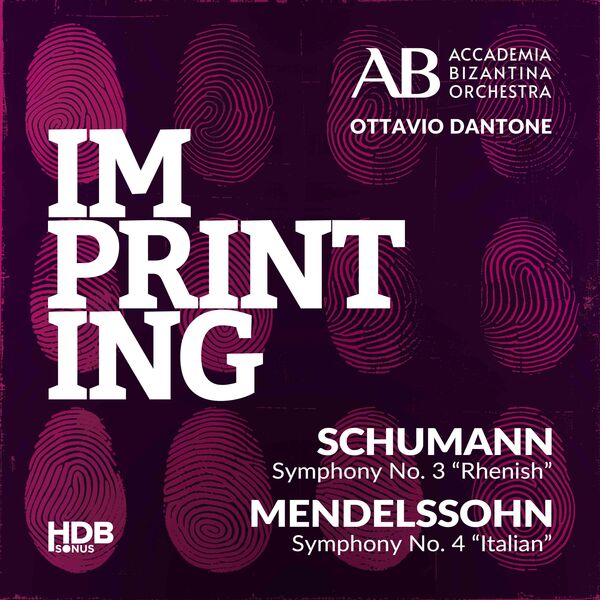
Schumann & Mendelssohn: Symphonies

Accademia Bizantina, conducted by Ottavio Dantone
59:08
HDB-AB-ST-004

An old cliché has it that Schumann’s symphonies suffer from thick, indifferently orchestrated textures. Not if they are played like this performance of the ‘Rhenish’ they don’t. Throughout both symphonies the listener is constantly struck not only by Dantone’s superb ear for balance but how helpful period instruments are when it comes to clarifying textures and providing colour. Thanks to conductors such as Mackerras and Norrington we are by now used to hearing this repertoire in this guise, but I do not recall previously being so aware of the rich inner detail of the contrapuntal writing in these works as there is here. It is relevant that in a perceptive note Dantone draws attention to the relationship both composers have with Bach, one of his great heroes. Thus, for example, in the development of the opening Allegro Vivace of the Mendelssohn, the counterpoint stands superbly revealed thanks to a lightness of touch comparable with the scintillating writing of the “Midsummer Night’s Dream” Overture.

‘Lightness of touch’ and ‘clarity of texture’ are two phrases that referring back to my notes I see recur time and again. They are benefits aided and complemented by the superb playing Dantoni inspires from an augmented Accademia Bizantina. String articulation is outstanding, the benchmark set by the cellos and double basses at the start of the Italian Symphony taken up and equalled by that of the upper strings in the secondary idea. The harmonie band is exceptional, too, never more telling than in the Andante con moto (the ‘moto’ well observed), where the delicate luminosity of the period flutes gives the music a magical ambiance. The beautifully paced Nicht schnell third movement of the Schumann finds lower strings and wind band exuding an affectionate, glowing warmth.

The succeeding Feierlich (‘solemn or grave’) is the most telling example of Dantone’s ability to span the architectural sweep of an entire movement, building the majestic edifice, said to have been inspired by a visit to Cologne Cathedral, to a quite overwhelming climax before gradually subsiding to a tranquil conclusion. In the final movement Lebhaft (lively, vivacious) Dantone avoids the temptation to take the heading to imply a fast tempo, keeping the movement moving at a brisk, but not rushed tempo which once again allows for admirable clarity of texture and building to an exuberant climax.

In his ‘Conductor’s Notes’ Dantone also discusses the importance of rhetoric in interpreting the music of the period, a topic that plays a major role in the recent Narratio Quartet recording of Beeethoven’s op. 18 String Quartets reviewed in EMR. It is fascinating to observe what seems to be an increasing preoccupation among some of today’s musicians with a topic whose importance, once a vital part of education, went out of fashion to the point where few today understand its linguistic let alone musical importance. Here there are fewer obvious cases of its application than in the Beethoven quartets; the use of portamento, for example, is subtly understated, often more hinted at then observed, but rubato is sparingly if tellingly applied at times, the second idea of the opening movement of the Schumann being an example.

In sum, I’ve found these performances revealing, challenging and endlessly fascinating. If, like me, you now infrequently visit works such as these, the music most of us grew up on, then do listen to these performances and prepare to have the senses refreshed.

It should be noted that the CD is available direct from www.accademiabizantina.it or www.hdbsonus.it  

Brian Robins

Categories
Recording

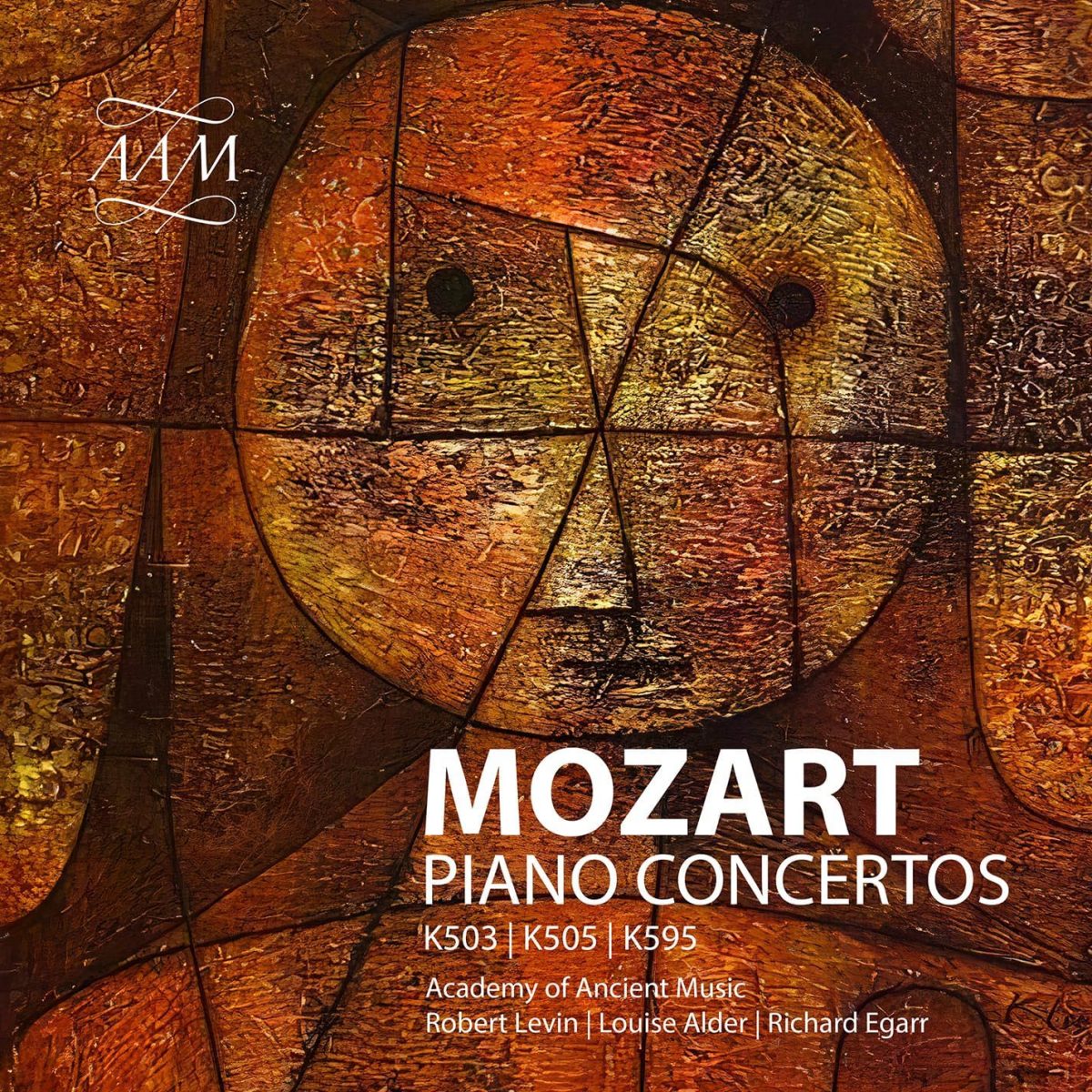
Mozart: Piano concertos K503 & K595

Robert Levin fortepiano, Louise Alder soprano, Academy of Ancient Music, conducted by Richard Egarr
66:39
AAM AAM045

This is a significant issue which finally brings to a close a series that was started thirty years ago but was brought to a halt after the AAM’s contract with Universal (Decca) ended. In 2023 the series was resumed on the AAM’s own label, the five CDs needed to complete the series now issued and reviewed by EMR. It is perhaps a piece of serendipity that this final CD is to my mind the most satisfying of the series since its resumption. I think there are three definable reasons: firstly, the restricted sound quality of several of the previous discs has concerned me. Here the venue is for the first time St John’s Smith Square and for whatever reason the quality is more open and spacious than other recent discs; also the fortepiano Robert Levin uses here is a beautifully-toned copy of a Viennese Anton Walter instrument of 1795 by Chris Maene of Ruiselede, Belgium. Warmly and roundly characterful across its range, it responds to Robert Levin’s fluent passage work to often mesmerizing effect. Finally, former AAM director Richard Egarr’s lively, positive direction seems to me a step up from that on other recent recordings in the series.  

A further reason to celebrate this issue is of course that the CD includes not only two of Mozart’s greatest piano concertos but also one of his finest concert arias. The scena consists of an accompanied recitative and aria, Ch’io mi scordi di te? … Non temer amato ben, K505, the reason it is included here being that it includes an elaborate concertante part for keyboard. It was written for Nancy Storace, his first Susanna in Le nozze di Figaro, on the occasion of her final concert in Vienna in 1786. Mozart’s catalogue of works records that it was written for ‘Mlle Storace and me’, underlining suspicions that the relationship may have been more than simply a professional one.  More importantly, it is sung with affectionate warmth by Louise Alder, who displays some fine chest notes and whose ornamentation is excellent with the exception of the absence of cadential (or any other) trills.

It has long been known that the oft-referred to ‘valedictory’ qualities of Concerto No. 27 in B-flat, K595 belong to the imagination, since it is now known to have been composed earlier, probably between 1787 and 1789, than was once believed. However, Cliff Eisen’s notes advance an argument for the same thing applying to Concerto No. 25 in C, K503 an idea new to me. Eisen argues that at least in part it may date from between 1784 and 1786, thus making it one of the works Mozart is known to have started and then put aside for completion when he wanted a new work. More importantly, as noted above, both works are among the greatest Mozart composed in a genre that he transformed over the course of his lifetime. For sheer grandeur he never excelled the opening Allegro maestoso of K503, the contrast with the reflective opening movement of K595 here underlined by the gentle, almost understated treatment of the latter.

Detailed comment on the individual concertos can be restricted to a few points. The opening of K503 might have benefitted from a little more ceremonial pomp, though that impression does not apply to its return after the development. The secondary idea in the same movement might be considered a bit brisk and inflexible. The ornamented entry by the piano in the central Andante of the same concerto is magical and the final Allegretto has a nice sense of operatic bustle. In K595 the unexpected restlessness that develops in the central Larghetto is well brought out, while the solo oboe’s beautifully played lead-back to the main theme can serve as a special example of the high quality of the AAMs playing.

Overall, the merits of Robert Levin’s playing by now need little further rehearsing. His ability to shape Mozart’s lines with equal idiomatic insight in both passaggi and cantabile is a joy, while his imaginative ornamentation never exceeds the bounds of stylish decoration. As already made clear this is a truly fitting conclusion to a series that for long looked as if it would remain a torso. Congratulations to all that oversaw its completion are very much in order.

Brian Robins

Categories
Recording

Berlin Harpsichord Concertos

Philippe Grisvard, Ensemble Diderot, Johannes Pramsohler
77:45
Audax Records ADX11211

This is a welcome recording of some unjustly neglected music.  Great composers cast long shadows and, in this case, those who overlapped with J.S. Bach and his son C.P.E. have not always had much of a look in. Grisvard and the Ensemble Diderot make an impressive start at remedying that situation with this recording of concertos by four composers who had strong connections to the Berlin court of Frederick the Great. They have deliberately avoided C.P.E. Bach in favour of introducing music by his near contemporaries. Peter Wollny’s very informative sleeve notes give short biographies and provide the context for the music. Christoph Nichelmann, Carl Heinrich Graun and Christoph Schaffrath were close contemporaries of C.P.E.; Ernst Wilhelm Wolf was twenty years younger. Nichelmann was a pupil in the Leipzig Thomasschule in the early 1730s and later served as second harpsichordist in Berlin for a time, until a personality clash with C.P.E. led to him leaving that court. Graun is mainly known for his operas and a Passion composed for Berlin. Schaffrath worked for Frederick as crown prince, and later for his sister Anna Amalia. Wolf did not actually work in Berlin – he served in Leipzig and Weimar – but came under the Prussian capital’s musical influence through the mediation of Georg Benda. 

The music draws clear inspiration from both Bachs, with a strong sense of Sturm und Drang clear from the first movement of Nichelmann’s D minor concerto which opens the disc. Schaffrath’s first movement is a muscular fugue in C minor, starting in the strings but later developed in an extended solo passage by the keyboard. Ritornello form predominates throughout these works, with extended solo passages for harpsichord, especially so in Wolf’s somewhat later concerto. The dialogue between soloist and strings is greatly assisted by the recording engineers, who have produced an excellent balance. Although there are only five string players, their playing and the recording quality tricks the ear into thinking that there are several more players in ripieno passages. Grisvard plays on a Mietke copy by Christoph Kern which has a full rich sound and good registrational capabilities. Cadenzas survive for the Nichelmann and Schaffrath works; Grisvard has developed his own for the other two which sound entirely idiomatic.  His playing throughout is both confident and nuanced, showing a real understanding of the style of this transitional period, with its predictabilities and idiosyncrasies. This comes across as very attractive music, played with energy and plenty of forward drive. These performances really whet the appetite for more of this music and the recording can be highly recommended.

Noel O’Regan