Categories
Recording

Makaris: Wisps in the dell

Classical era arrangements of traditional Celtic folk songs
67:54
New Focus Recordings FCR916

Click HERE to buy this CD on amazon.co.uk

This delightful CD offers a selection of Scottish and Irish folksongs in arrangements by classical composers. As part of the vogue in things Celtic which followed the Jacobite rising and the Ossian craze, a number of enterprising publishers in London secured the services of leading continental composers to ‘set’ mainly Scottish folk songs. In this process of ‘setting’, the angular modality of the melodies was generally ironed out, while the texts often had to be ‘civilised’ too – this would seem to us to water down the original appeal of the traditional music and powerfully raw folk texts, but this was the price of capturing the attention of the large amateur market which would make this enterprise viable. The settings by Haydn and Beethoven are relatively familiar, but the Makaris have spread their net wide and trawled in settings by Schubert, Pleyel, Hummel, Neukomm, Weber, Kuhlau, Kozeluch and Clementi. They take a free approach to the realisation of these settings, both from the point of view of instrumentation and elaboration of melodies and counter-melodies. In some accounts, a heavy fortepiano backbeat sounds a little bit of an indulgence, but elsewhere their approach definitely enhances their material. Vocalist Fiona Gillespie opts for a distinctly folky voice production, but her delightfully pure voice and subtle ornamentation represent a winning combination. Knowing many of these original folksongs, it is fascinating to hear the fingerprints of the better-known composers on their settings. Particularly striking is Beethoven’s uncompromising approach – his publisher worried that the settings would be beyond the amateurs he was targeting, but Beethoven refused to compromise! Equally charming are settings by Hummel and Weber, who fresh from the triumph of his ‘Freischütz’ is thoroughly imbued with folk melody. In a delightful touch, the band have commissioned their bass player to add to the repertoire with his own setting of ‘The Bonnie House o’ Airlie’ which takes this 18th- and 19th-century tradition firmly into the 21st century!

D. James Ross

Categories
Recording

Haydn : String Quartets opp 71 & 74

The London Haydn Quartet
155:52 (2 CDs)
hyperion CDA 68230

Click HERE to buy this recording on amazon.co.uk

Haydn’s opp 71 and 74 sets of string quartets were composed in Vienna in 1793 between his two London visits, and with London performances very much in mind. It is not too fanciful to speculate that the earlier London performances of some of Haydn’s op 64 quartets, the first time the composer had witnessed his quartets being presented to large audiences, may have influenced the style of the two later sets of quartets, which may sometimes seem to sacrifice intimacy in favour of a more public musicality, with boldly declamatory melodies and occasional flamboyant gestures. The London Haydn Quartet’s choice of acoustic, the relatively intimate ambience of Potton Hall, may seem to be at odds with this, and (to begin with) I found the relatively cramped sound a little off-putting. The Quartet’s superlative playing soon helped to overcome this, and the smaller bloom allows the listener to focus on their impeccable technical prowess, warm tone and perfect balance. Playing period instruments, the Quartet has also returned to the original 1796 publications of both sets, but more importantly, like their fellow period-instrument quartet the Quatuor Mosaïques, their freshness of approach allows us to experience this music as if it was new. The group was founded in 2000 with the specific aim of exploring the chamber music of Haydn on period instruments, and this delightful and packed double CD set provides wonderfully eloquent accounts of some of Haydn’s most satisfying string quartets.

D.James Ross

Categories
Recording

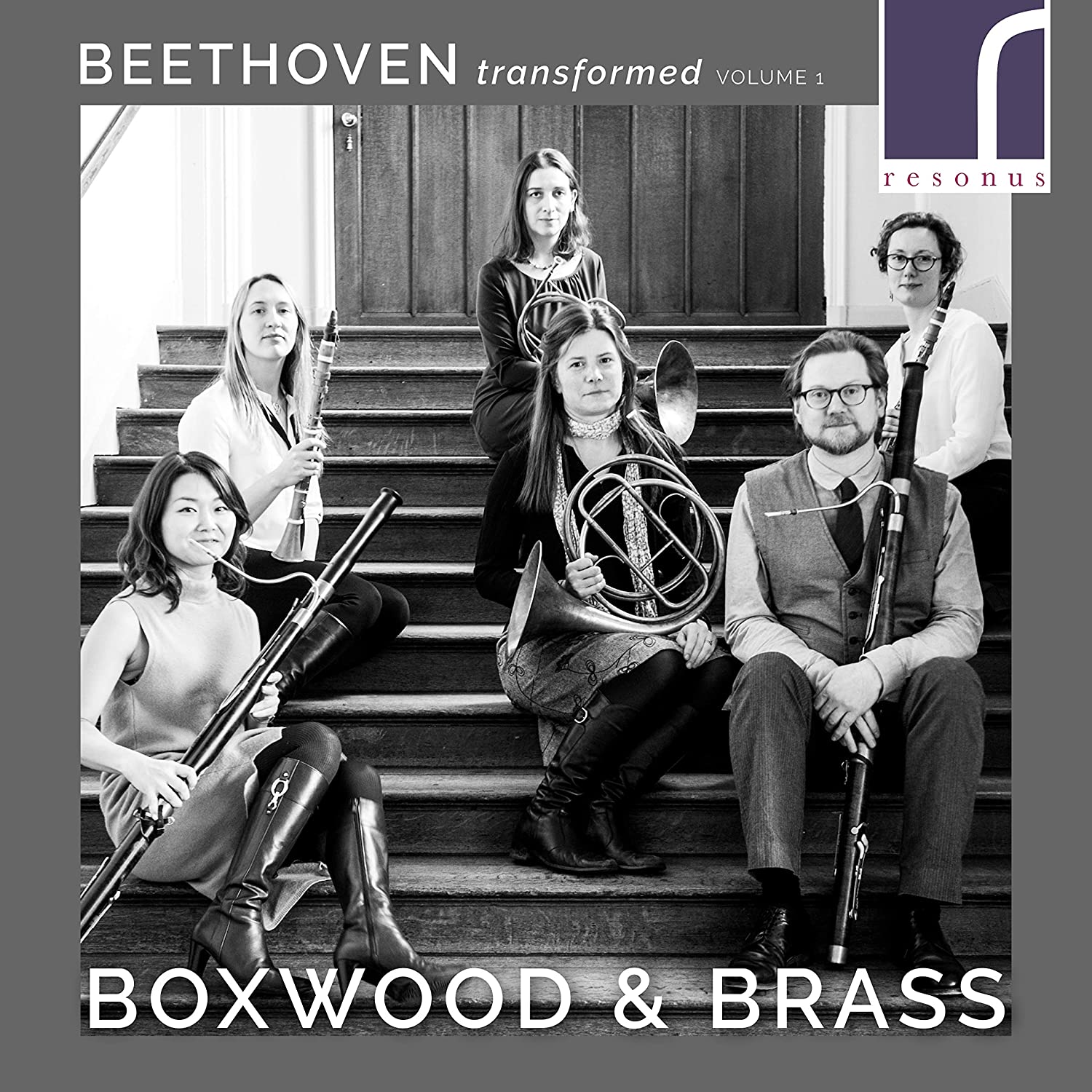
Beethoven transformed volume 1

Boxwood & Brass
61:40
Resonus Res10249

Click HERE to buy this CD on amazon.co.uk

This is the first volume of a projected exploration of Harmonie-Musik, including original music by Beethoven, as well as arrangements of his music by his contemporaries – hence the ‘transformed’. Thus it is that we have an arrangement for the standard Harmonie ensemble of two clarinets, two horns and two bassoons of Beethoven’s celebrated Septet, originally conceived for strings and wind. I have always struggled slightly to like Beethoven’s Septet – a disgraceful admission for a clarinettist – and remember vividly my heart sinking when, during a performance by the BPO Soloists, it dawned on me that they were going to do all the repeats… So it came as a surprise to hear the piece afresh in Czerny’s clever arrangement. To cover the violin part, he takes the first clarinet into risky and exciting altissimo territory, realised with enormous skill and panache on her boxwood clarinet by Emily Worthington. Perhaps it is precisely Beethoven’s rather cautious writing for the wind instruments in the original op 20 that failed to charm me – whatever the reason, Czerny’s arrangement is a valuable rediscovery, which to my mind enhances the original. The Septet’s companion piece on this CD is one of Beethoven’s actual Sextets, a later work (op 71), by which time the composer felt free to be more adventurous with the wind instruments. Both works are given charming performances by Boxwood and Brass, and indeed the distinctive sounds of their period instruments help to bring this music vividly to life. I have enjoyed very much both of the previous CDs by this enterprising group, and await with interest the continuation of this promising series.

D. James Ross

Categories
Recording

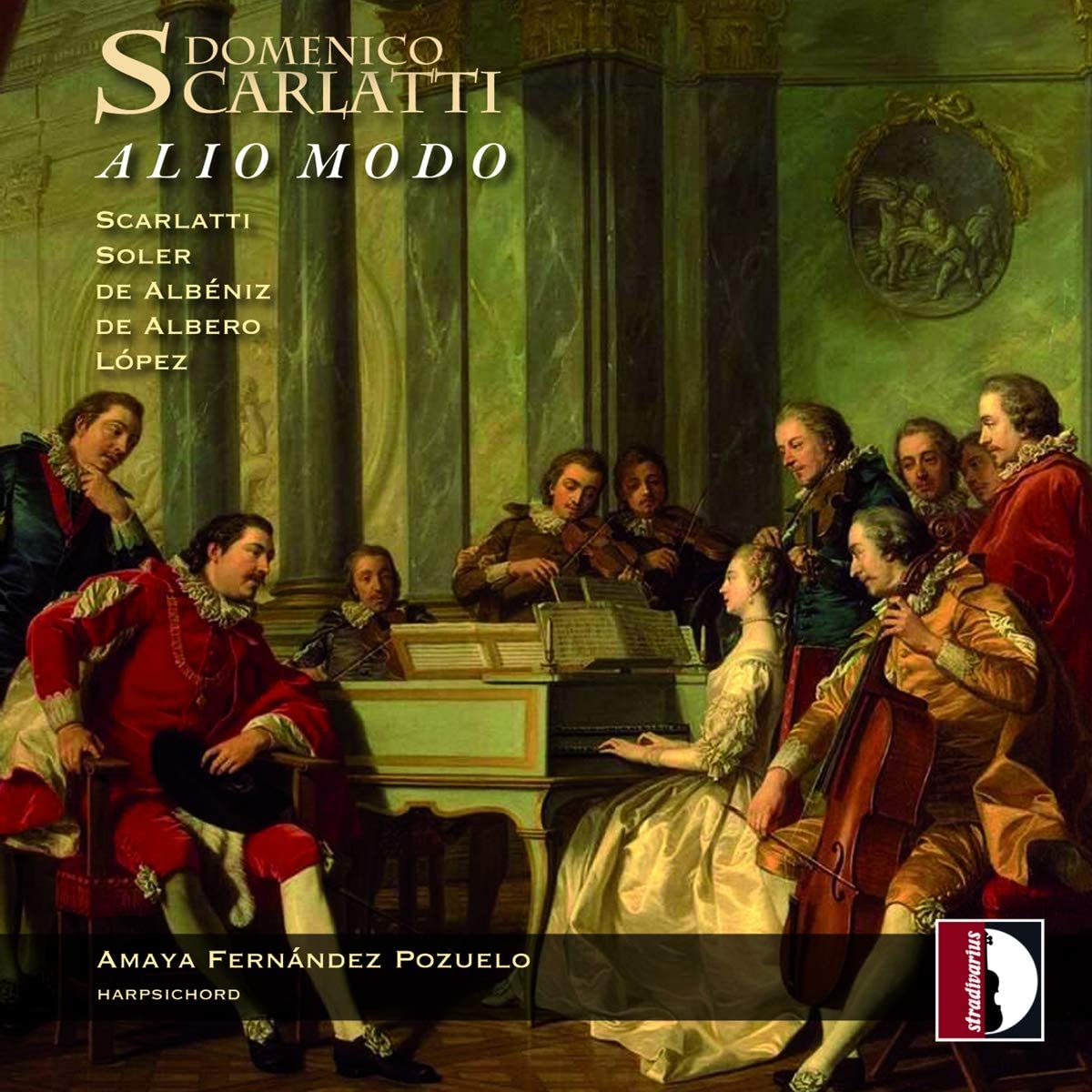
D. Scarlatti: Alio modo

Amaya Fernández Pozuelo harpsichord
67:28
Stradivarius STR 37140
+ de Albéniz, de Albero, López, Soler

Click HERE to buy this on amazon.co.uk

This is an impressive recording of keyboard sonatas by Domenico Scarlatti and four of his Spanish followers: Antonio Soler, Sebastián de Albero, Felix Máximo López and Mateo Pérez de Albéniz. The last three were new to me, though I did recognise what is the sole surviving sonata by Pérez de Albéniz. López’s variations on a ‘Minué afandangado’ are an entertaining fusion of French and Spanish dances, played here with panache. De Albero’s Sonata no. 12 is very much in Scarlattian mode. Fernández Pozuelo is a persuasive advocate for her ‘alio modo’ of performing this repertory: it involves considerable flexibility in tempo, lots of added ornamentation and variation in phrasing, as well as more than unusual asynchrony between the hands. This allows her to explore the rhetorical possibilities of the music successfully and to provide a greater level of contrast than is customarily found in performances of this repertory. This is particularly the case in her fine performance of the extended D minor Scarlatti Sonata K213. Other pieces show bravura and a real joy in the music. Her interpretations are helped considerably by some fine recording engineering, which gives her copy of a Hemsch harpsichord by Fernando Granziera of Milan real presence, highlighting the richness of its sound. My only disappointment is with the booklet, where some informative notes on the composers and the music are printed only in Italian and not translated into other languages. There are translations of some summary notes and a lengthy rumination on the instrument used, but these are not so useful and the English translator struggles to convey the rather flowery sentiments of the original Italian. However, the recording itself is highly recommended.

Noel O’Regan

Categories
Recording

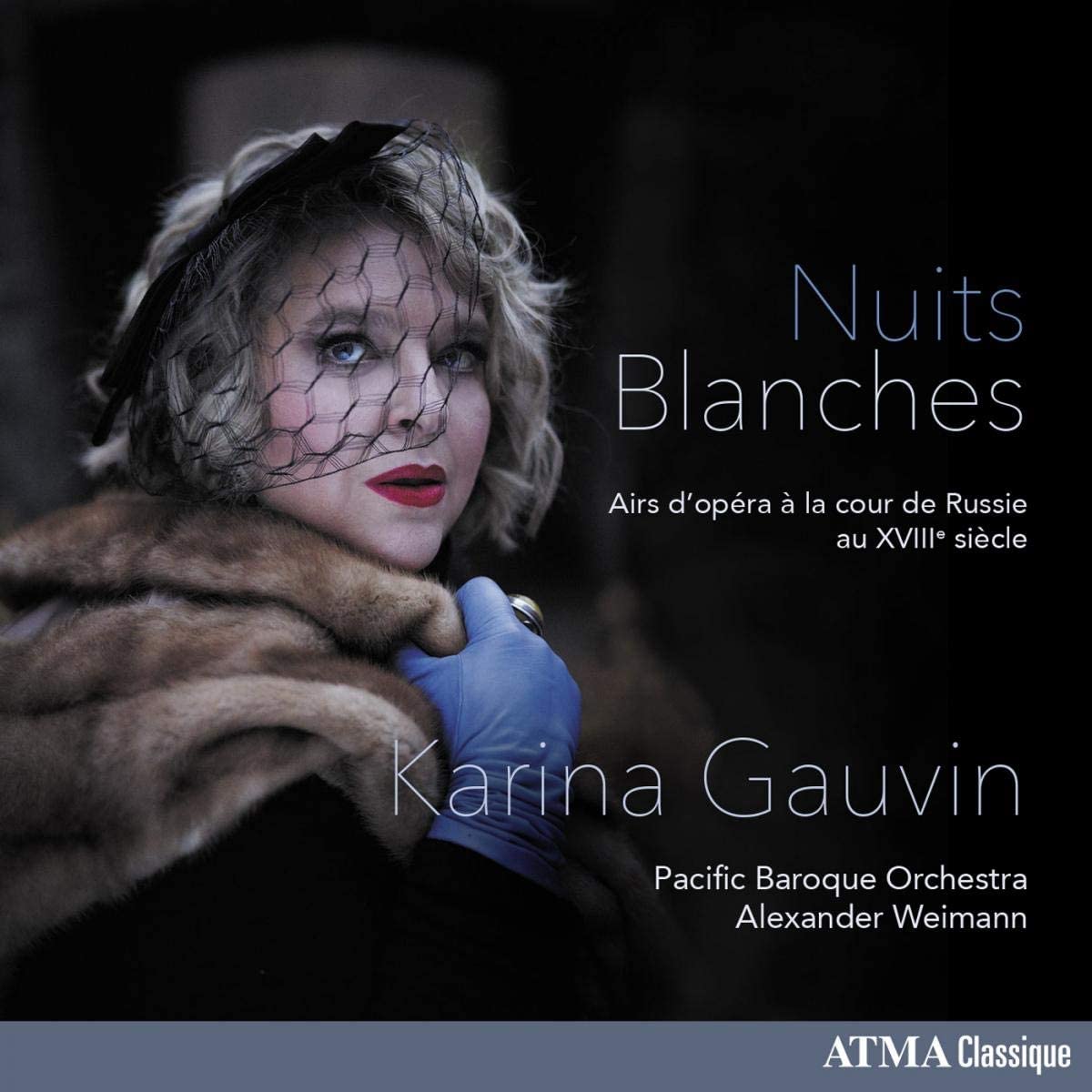
Nuits blanches

Airs d’opéra à la cour de Russie au XVIIIe siècle
Karina Gauvin, Pacific Baroque Orchestra, Alexander Weimann
TT? ca. 58:00?
Atma Classique ACD2 2791

Click HERE to buy this on amazon.co.uk

Although subtitled (in French) ‘Arias from the 18th-century Russian court’, the CD under consideration, in fact, includes little with a direct connection to the court, in contrast to Cecilia Bartoli’s ‘St Petersburg’ (Decca). That included music by Francesco Araia (1709-c.1770), who can be considered the father of opera in Russia, and Hermann Raupach (1728-1778), the father of Russian language opera. Neither feature on the present not-so-generously-filled disc, the greater part of which is devoted to extracts of operas first given in Italy by the Ukrainian-born composers, Maxime Berezovski (1745-1777) and Dimitri Bortnianski (1751-1825), and Gluck, extracts from whose Armide are included for the tenuous reason that Berlioz introduced it to Russia, long after the death of its composer.

Berezovski’s credentials as an ‘Italian’ opera composer are impeccable. In 1766 he was sent at the expense of the Russian court to Bologna study under Mozart’s mentor, Padre Martini, being awarded the diploma of the famed Accademia Filarmonica. His Italian sojourn concluded with a successful production of his opera Demofoonte in Livorno in Carnival 1773. Today only four arias survive, two of which are performed here by Canadian soprano Karina Gauvin. Particularly impressive is ‘Misero pargoletto’, sung by the Thracian prince Timante as he reflects on a letter that appears to prove that his young son was unsuspectingly born of an incestuous relationship (he wasn’t, of course). Set in contrasting moods of reflective horror and dramatic exclamation, the aria makes interesting use of da capo form.

That the name of Bortnianski is rather better known is accounted for by his splendid a cappella church music, mostly composed during the period of his tenure as director of the imperial chapel choir. Prior to that, his career followed a similar trajectory to that of Berezovski. In 1769 he followed his compatriot to Italy, where he may have studied with Galuppi, who had only recently himself returned from a highly successful period in St Petersburg. While in Italy Bortnianski composed three drammi per musica, of which three extracts from Alcide (Venice, 1778) are given here. The first is an aria in which the young Alcide (Hercules) having been led to a crossroads at which he must choose between the difficult, rocky route of virtue and the easy track of pleasure is torn between the two, the aria effectively dramatising the conflict, a long accompanied recitative that brings more agonising over the choice that must be made. Finally comes a gracious lyrical andante in which Hercules expresses his thanks to the gods for guiding him on the right path, which is of course virtue. The story will be familiar to many readers from settings by Bach and Handel. All three extracts, pleasing if not especially memorable, testify to a thorough assimilation of the Neapolitan style then dominating European music. Le faucon is a later work, one of three opéras comiques composed for Crown Prince Paul, into whose service Bortnianski entered after his return from Italy. Despite the genre and language, the gracefully flowing and felicitously orchestrated through-composed aria ‘Ne me parlez point’ remains thoroughly Italianate in style. The brief orchestral pieces by Domenico Dall’Oglio and Fomine are unremarkable.

All this music is very well sung by Karina Gauvin, whose lustrous full-bodied soprano here seems in better shape than when I last heard her live. She is particularly suited to the role of Gluck’s Armide, the extracts including the big scenas ‘Enfin, il est en mon puissance’ and the end of the opera ‘Le perfide Renaud me fuit’. The latter is built to a powerful climax, well supported by the Vancouver-based Pacific Baroque Orchestra, admirable throughout under the direction of Alexander Weimann, who contributes a rather tinkly-sounding fortepiano continuo. Even if it doesn’t quite do what it says on the tin, this is an enjoyable disc that will certainly appeal to admirers of the singer and anyone interested in exploring the outer boundaries of 18th-century opera.  

Brian Robins
Categories
DVD

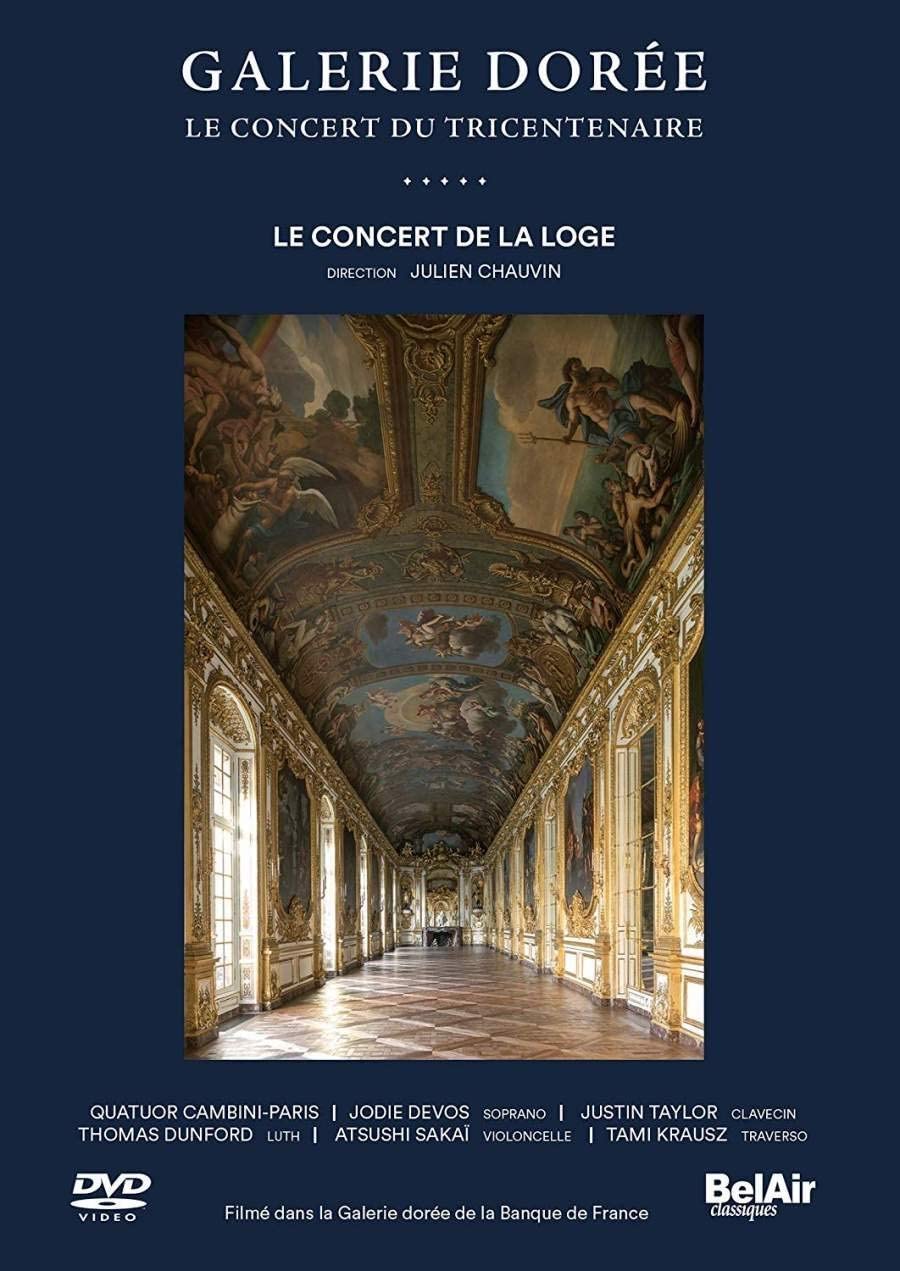
Galerie Dorée

Le concert du Tricentenaire
Le Concert de la Loge, Julien Chauvin
+ Quatuor Cambini-Paris, Jodie Devos, Justin Taylor, Thomas Dunforn, Atsuschi Sakaï, Tami Krausz
77:00
BelAir classiques BAC171 (DVD) BAC571 (BluRay)

Click HERE to buy this on amazon.co.uk

The Banque de France’s Galerie Dorée was constructed in the late 1630s and then refurbished and refashioned 1714-1719. This DVD marks the 300th anniversary of that undertaking. There are many splendid pictures both on the bank’s own website and online generally.

The contents of the disc are partly a film of a commemorative concert, partly an exhibition of the building’s decorative artwork and partly a tour of the building itself with musicians playing in spectacular surroundings. But, for me, the whole enterprise doesn’t quite come up to the mark on any of those counts. Filming the concert was clearly problematic as the long thin venue with the orchestra halfway down the long side offered no opportunities for decent camera positions, and as far as the building and the art are concerned the shots are not really long enough to appreciate the detail of what we are being shown. Yes, the accompanying book is very informative and lavishly illustrated but you can’t look at that and the screen, and if you pause the picture for study you also pause the music. In addition, the book doesn’t deal with the music in the order in which it is played but the order in which we encounter the art in the building. I also found the camera work too fiddly (and not always well aimed) and the editing not particularly skilful, and there were times when imperfect coordination of sound and vision made me think I might not be hearing the performance I was seeing.

As noted above, the main gallery where the concert took place is long and thin and the orchestral items are filmed here mostly with the audience present though sometimes without. This latter option was a mistake as the rows of empty red chairs in the background look pretty awful. Surely they could have been removed? There are no such visual issues with the other venues which, with more space and fewer performers, look very much better.

The music itself is inspired by the art, which is a reasonable enough idea, though it does mean we get ‘movements from’ rather than complete works. The repertoire is enterprising though: when did you last hear a movement from an early Haydn symphony or a string quartet movement by Félicien David (terrific viola playing in this)? All the playing has much gusto and the live audience clearly loved what they got. But class will out, and, for me, in currently sunny Surrey (UK) the solo harpsichord Couperin and Rameau steal the show.

David Hansell

Categories
Recording

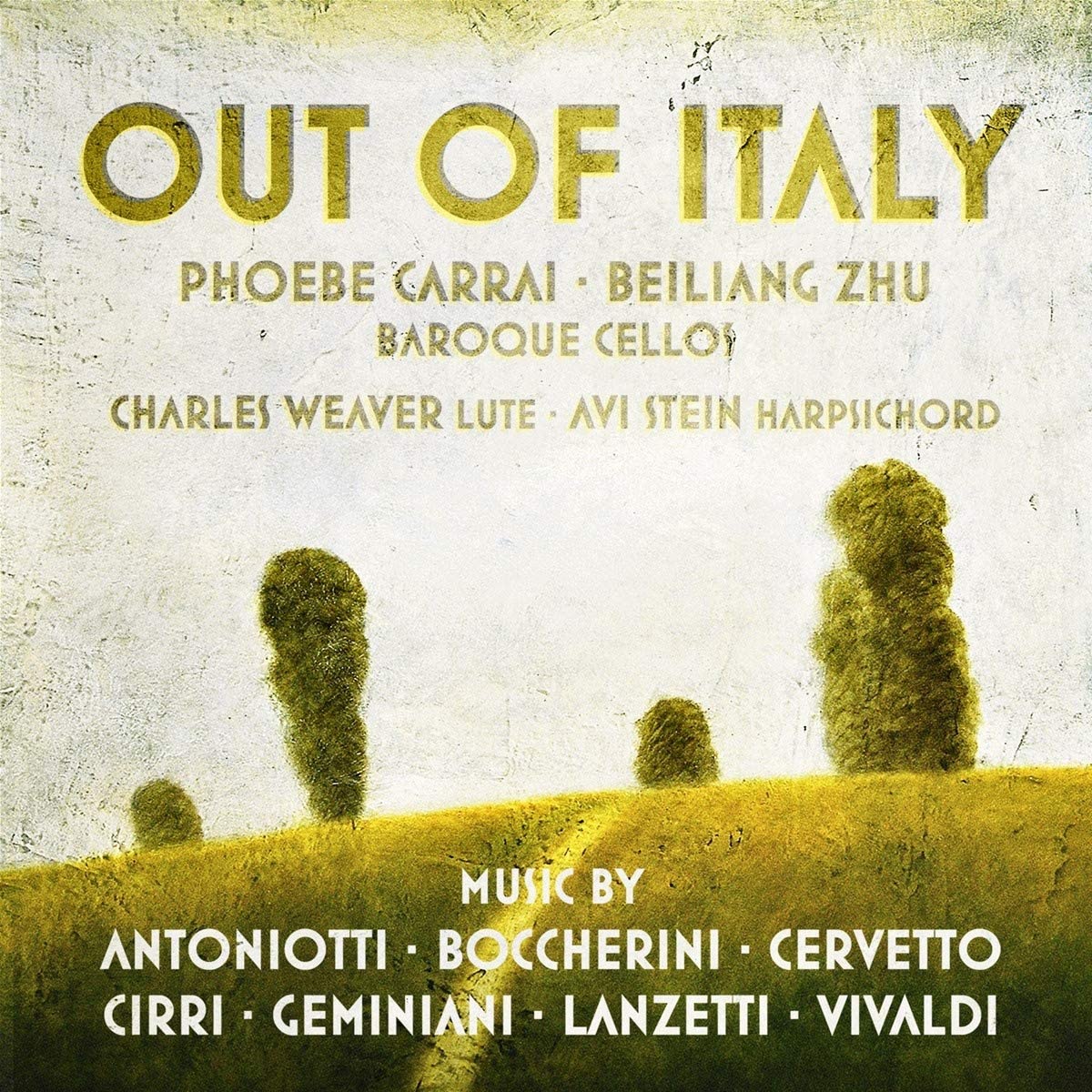
Out of Italy

Phoebe Carrai, Beiliang Zhu baroque cello, Charles Weaver lute, Avi Stein harpsichord
72:25
Avie AV2394
Music by Antoniotto, Boccherini, Cervetto, Cirri, Geminiani, Lanzetti & Vivaldi

Click HERE to buy this on amazon.co.uk

This CD celebrates the music of Italians in exile, mainly in London. As the short but perceptive programme note by Reinhard Goebel points out, the reasons behind this mass exodus of composers from Italy in the mid-18th century are not entirely clear, although it may just be that the all-consuming Italian obsession with opera had simply squeezed instrumental music into a corner. The subsequent decline in instrumental technical prowess in Italy contrasts dramatically with the creative ferment in other European capitals where Italian composer/players chose to settle, to compose, to perform and to teach. A number of teacher/student duet pieces survive, of which the Divertimento for two cellos by Giacobbe Basevi Cervetto is a particularly charming example. Cello music, beautifully played by Phoebe Carrai and Beiliang Zhu, is the focus of this CD, and further cello duets by Boccherini and Giovanni Battista Cirri mean that this delightfully intimate genre is thoroughly explored. The rest of the repertoire consists of Cello Sonatas by Giorgio Antoniotto, Geminiani, Vivaldi, and Salvatore Lanzetti, in which the two cellists take it in turn to play the solo and BC parts, joined by Charles Weaver on the lute and Avi Stein on the harpsichord. While the majority of the composers found a conducive home in London, Boccherini settled in Madrid, and while Vivaldi’s music was famous throughout Europe, he left emigration until late in life and was on his way to the musically dynamic city of Dresden when he died en route in Vienna – how very different might have been the history of music if the 63-year-old had either lived to settle in Vienna or even made it to Dresden! The playing of this fascinating programme is beautifully evocative and technically impressive, although I have some reservations about the slightly uncomfortable ‘fronty’ recording of the solo instrument relative to the continuo team.

D. James Ross

Categories
Recording

The Dubhlinn Gardens

Anna Besson, Reinoud van Mechelen, A nocte temporis
69:17
Alpha Classics Alpha 447

Click HERE to buy this on amazon.co.uk

This CD is the pet project of the group’s flautist Anna Besson, whose idiomatic traditional approach to the Baroque flute gives these performances a wonderful authenticity. The music belongs to the vogue for music from the ‘celtic fringes’ of the British Isles, which followed the storming success of The Beggar’s Opera with its use of traditional Scotch and Irish melodies. While many of the instrumental tracks have a suitable twinkle in their eye, the songs are less effective. Belgian tenor Reinoud van Mechelen does his very best, but doesn’t seem to ‘get’ the idiom and struggles with the Irish accent the texts seem to cry out for. Perhaps we would have done better with a singing actor type (as featured in the original performances of The Beggar’s Opera) than van Mechelen’s rather cultivated tone and delivery. This is a pity as much of the selected repertoire is unfamiliar and delightfully lyrical, and the overall idea of the project is an exciting one – the vocal tracks however do tend to labour a little or just to sound a bit worthy. In the slower airs, van Mechelen seems more at home, and his account of “Ah! The poor shepherd’s mournful fate” is lovely, although again the ornaments in the unaccompanied “Eileanóir a rún” sound more like Monteverdi than the subtle inflections of the folk singer.

D. James Ross

Categories
Recording

innamorato | triloia italiana

accordone, macro beasley, guido morini
188:54 (3 CDs in a card folder)
cypres CYP9620

Click HERE to buy this on amazon.co.uk

For this collection of Italian music from the 16th, 17th and 18th centuries, Accordone have selected three recordings from their back-catalogue dating from 2005, 2006 and 2007. It has to be said that the rigour of the background scholarship and the spontaneity of the performances mean that these have not dated at all. The initial disc focuses on Frottole, and is a delightfully engaging journey through the 16th century, bringing familiar composers such as Lassus and Tromboncino together with a host of less familiar names, such as Marco Cara, Pietro Paolo Borrono and Guglielmo il Giuggiola. This unearthing of unknown music by unknown composers is one of the main strengths of all three CDs, as indeed is the distinctive voice of Marco Beasley. His pleasing tenor is a major factor in the appeal of all three CDs – it is an individual sound, with a similar texture to the voice of Nigel Rogers and equally adept at sparkling ornamentation. In the Frottole volume, the ensemble manages a wonderfully spontaneous sound, verging on the performance style more often associated with traditional music. This proves ideal for the no-nonsense directness and beguiling charm of these Frottole. In the second CD Recitar Cantando we encounter repertoire for solo voice and continuo with obbligato instruments again by familiar names such as Monteverdi, Frescobaldi and Caccini and unfamiliar contemporaries such as Cherubino Busatti along with instrumental music by Giovan Battista Fontana. The slightly elusive programme note for this CD doesn’t detract from the delight of the performances, although a more detailed account of how and why the performers felt free to adapt the messenger scene from Monteverdi’s Orfeo and his dramatic madrigal Il Combattimento di Tancredi e Clorinda for solo voice and small consort would have been helpful and interesting. Just occasionally, as in Il Combattimento (which is by far the most substantial piece on the CD), Beasley, who has to sing all three characters himself, doesn’t quite imbue the vocal lines with the drama they seem to demand – there is a reference in the programme note to letting the character sing rather than the performer. This seems to be a little lacking here. For the third CD Il Settecento Napoletano we visit the musical hot-spot of 18th-century Naples. In a city where we now know opera was a major focus of attention, it is no surprise that solo secular cantatas were also very popular. It seems to my ear that these performances of ‘cantatas in the Neapolitan language’ are sung in a distinctive Neapolitan dialect, and again while Alessandro Scarlatti and Nicola Matteis (who supplies a trio sonata) are relatively familiar, Giuseppe Porcile, Giulio Cesare Rubino, Alonso dei Liguori and Guido Morini are new to me. As in all three CDs, it is interesting how the music by the ‘unknowns’ is invariably every bit as effective as that by the big names. These attractive pieces are greatly enhanced by the imaginative scoring of the accompaniments, while vocalist Marco Beasley seems more in tune with this later idiom. This is an enjoyable collection of CDs currently otherwise unavailable and definitely to be recommended for their underlying intellectual rigour and the musicality of their performances.

D. James Ross

Categories
Recording

La morte della ragione

Il giardino armonico, Giovanni Antonini
73:07 (CD in a hard-backed book)
Alpha Classics ALPHA450

Click HERE to buy this CD on amazon.co.uk

Under the title the death of reason, Giovanni Antonini has brought together a rather random collection of pieces from the 15th to the 18th centuries. If you don’t worry too much about finding a linking theme, you can just sit back and enjoy the accompanying lavishly illustrated colour book while wondering at the stunning virtuosity of Antonini (recorders) and his ensemble. In fact, the contents of the book amount to a rather slight essay translated into various languages, followed by a series of chunks of related source material on the music and aspects of performance in an extended appendix. So spontaneity, even anarchy, is the flavour of the moment, but there is some lovely music imaginatively performed here. We have works by Christopher Tye, Hayne van Gizeghem, Josquin, Agricola, Dunstable, Gabrieli, Gombert, Viadana, Gesualdo, Scheidt, and van Eyck to name but a few, performed instrumentally, imaginatively and never less than very musically by the ensemble – perhaps best to read the appendix section on ‘tremoli and vibrati’ to help with understanding Antonini’s idiosyncratic recorder playing. One of the chief joys of this set remains the wealth of colour illustrations from a range of Renaissance paintings and books to enjoy as an accompaniment and enrichment to the music. To sample the virtues and some of the randomness of this CD, listen to the group’s highly individual interpretation of the familiar Susato Battle Pavan (track 13).

D. James Ross