Categories
Recording

Bach: St John Passion

Cantata Collective, Nicholas McGegan
114:41 (2 CDs in a card triptych)
Avie AVIE 2605

This performance of the Johannes-Passion from the Cantata Collective under Nicholas McGegan was recorded live in Berkley in Passiontide 2022, and bears the hallmarks of what to many people is their essential annual Passiontide experience: singing or playing in a live Bach Passion. Throughout its performance history from the year in which it what first written – 1724 – till the final performance in 1749, Bach used the same set of parts – revising them each time. So – apart from the second performance on Good Friday 1725 when, in the year devoted his second, chorale-based, cantata cycle – Bach made a considerable number of changes which he never used again. All subsequent performances were essentially similar and we have no means of knowing whether changes were dictated by constant trial in search of perfection, changes of circumstance, or some other external circumstance as McGegan says in his liner-notes.

The band has two upper strings to a part, so numbers fifteen in all, playing period instruments. The Collective is 12 singers, to which are added six ‘soloists’ with an independent Evangelist and Jesus in addition to those who sing the arias, none of whom – as far as I can judge – takes part in the choruses: in this sense, it is an old-style performance, with McGegan directing from the sparingly used harpsichord.

The Evangelist Thomas Cooley is ideal – nimble, and with a story-teller’s command of the German narrative; the bass who sings Jesus is clearly articulated and the basso continuo when he sings is suitably weighted. The chorus in the turba parts are a bit careful so some of the interchange in the central section before Pilate lack that edge some professional singers can bring to it, but their Lasset uns den nicht zerteilen is splendidly managed, as is the chorale in Mein teurer Heiland.

The aria tempi are moderate, and of the aria singers, the soprano is too wobbly for my taste, as is the chorus member who sings the Maid (and that goes for the top line in the chorus throughout); but the others are splendid – the Arioso Betrachte and the aria Erwege lyric and rhythmic, Eilt is well balanced and the Alto in Es ist Vollbracht sustains his line with the gamba well. The best of the arias is Mein teurer Heiland. Here the lyrical 12/8 cello obbligato is truly matched by the bass, Harrison Hintzsche, whose experience as a consort singer makes him for me the star among the solo singers.

What makes this performance so distinctive is the energy and commitment of the ensemble. We hear not just one more concert performance, but a radiant Good Friday liturgy, where John’s Gospel comes alive. From early times, it has been John’s account of the Passion that has formed the centre-piece of Good Friday’s worship, so underlining the theological truth that in the crucifixion and death of Jesus the work of redemption has been triumphantly concluded and new life has been freely offered. Bach understood this, so immediately after Jesus dies on the cross, a jaunty cello obbligato in 12/8 launches the aria Mein teurer Heiland in D major, the key of trumpets and resurrection. This sense that the crucified Christ reigns from the cross as he inaugurates his new creation pervades the whole of this recording, and McGegan’s infectious energy is almost tangible throughout. As a modern HIP version, it will not please the purists on every page, but as a record of the power of the Johannes-Passion to inspire and move, it scores highly.

David Stancliffe

Categories
DVD

Robert Gleadow (bs), Arianna Vendittelli (sop), Florie Valiquette (sop), et al, Ballet, Choeur & Orchestre de l’Opéra Royal de Versailles, conducted by Gaétan Jarry
184:00
Versailles Spectacles CVS115 (DVD & BlueRay)

This video stems from performances of a new production of Don Giovanni given by the Opéra Royal in the ravishing 18th-century court theatre in the palace of Versailles in November 2023. Generously both a DVD and a Blu Ray disc are included in the package; I viewed the DVD. Having been present on the opening night, I’m disappointed that on my admittedly not-wonderful TV, the picture of the stage is considerably darker than it was in the theatre. Of course, much of Don Giovanni takes place at night or least evening so that is to be expected to some extent but this stage picture frequently lacks clarity. The set itself, unchanging but for backdrops that aid in identifying the action as interior or exterior, is a town square in roughly star shape, the buildings including a couple with galleries for such scenes as Giovanni serenading Elvira’s maid. In general, it all works well, though the Commendatore’s statue turning up on Elvira’s doorstep seems a little incongruous.

The delightful multi-hued and busily decorated costumes owe an obvious debt to the commedia dell’arte tradition and interestingly both the Don and Leporello wear near-identical clothing, maybe as a suggestion that the latter is merely a more plebeian copy of his master. The link with commedia dell’arte was also apparent in the direction by Marshall Pynkoski, whose stated intention had been to make the piece fun. And indeed much fun was elicited, notable for the sheer exuberance and dynamism of such numbers as Leporello’s ‘Catalogue’ aria (although would he have behaved toward Elvira with quite that degree of familiarity?) or the finale of Act 1, which also benefitted from the spirited choreography of Jeannette Lajeunesse Zingg. Yet paradoxically the scenes that remain lodged in the mind are some of the more dramatic and serious moments. The supper scene, notoriously difficult to bring off convincingly, is outstandingly done, the swirling silvery mists around the magnificently authoritative statue of the Commendatore chilling in effect. Less commendable is the decision to allow the raucous laughter of the Don to have the final word. It contradicts the ultimate message of the opera, articulated in the words of the final ensemble: ‘This is the end that befalls evildoers’.

That the opening scene has a thrilling dramatic verve, can be not least attributed to the strongly projected Donna Anna of Florie Valiquette, who also responded to the recognition that Don Giovanni was her father’s killer with an accompagnato and succeeding aria ‘Or sai chi l’onore’ with real intensity and thrilling tone. In act 2 ‘Non mi dir’ and its preceding accompagnato bring another special moment, an oasis of stillness in the midst of manic activity. The Elvira of Arianna Vendittelli was also a performance of outstanding quality, culminating in a ‘Mi tradi’ that, with its preceding accompagnato brought another scena of interior and touching quality, a revelation of the vulnerability of a woman hopelessly in love.

The performance of Robert Gleadow as the object of that love, his first Don, occasions a more mixed reaction. Characterful and strongly and securely sung, Gleadow’s  Giovanni projects a predator of animal energy. It was much in keeping with the kind of Don most producers tend to encourage these days. Yet it is a creation that not only overlooks the fact that Don Giovanni is a nobleman, not a slob that puts his feet on the table when eating dinner but, equally importantly that Francesco Benucci, the singer for whom Mozart created the role, was renowned for the finesse and grace of his singing and acting. Interestingly, when Don Giovanni was repeated in Vienna (it was of course written for Prague), Benucci sang Leporello; it is easy to imagine Riccardo Novaro’s outstanding Leporello stepping into the Don’s shoes. As indeed also applies to Jean-Gabriel Saint Martin, whose richly rounded Masetto was a revelation, one of the best I have seen. A more general observation regarding the singing is the tasteful and appropriate decoration added. Not the least aspect of the generally favourable impression of the cast was the manner in which it responded to Pynkoski’s long experience as a director who seeks to work with gesture and historically informed theatre, much in evidence in the highly effective groupings of the ensemble numbers – the production of the great act 2 sextet was a special highlight in this respect.

It is sad to have to report that amidst this truly excellent performance a large fly lurked in the ointment. In his fine book on the birth of conducting, Peter Holman has convincingly argued that the piano never superseded the harpsichord as a continuo instrument, yet opera conductors continue to employ it. Yet rarely can the piano have been put to such damaging use as it is here, where trite teashop tinkling pervades not only recitatives but at times also the orchestral texture, most ludicrously in the Don’s canzonetta, ‘Deh, vieni’, where what is supposed to be his mandolin accompaniment enters into a forlorn duel with the fortepiano.

Notwithstanding this blot on the performance, this was a splendid achievement all round, thoroughly enjoyable and insightful. Although not always in full agreement with Pynkoski’s work, I do admire without reservation the rare integrity he brings to all he does. This Don Giovanni is no exception.

Brian Robins

Categories
Recording

JS Bach & JC Bach: Motets

Solomon’s Knot
Prospero PROSP0073

This recording of the Bach Motets (BWV 225-230) also includes Ich lasse dich nicht (BWV 1164 – or Anhang 159) and four by Johann Christoph Bach: Lieber herr Gott, Der Gerechte, ob er gleich, Fürchte dich nicht and Herr, nun lässet du deinen Diener in Friede fahren. These motets from the Alt-Bachisches Archiv, known to have been performed by Johann Sebastian in the last decade of his life, are performed at A=440 with a higher pitched organ, while the motets by Johann Sebastian are sung at A=415 with a slightly more substantial instrument and occasionally a large violone.

These performances are committed, with Solomon’s Knot’s characteristic off-copy style of singing, meaning that their ensemble is faultless. Their admirers will love these readings recorded in the generous acoustic of the Bachkirche in Arnstadt. There are no instrumental doublings such as Johann Sebastian provided for the funeral motet Der Geist hilft (BWV 226). Lobet den Herrn (BWV 230) is sung with the voice parts doubled, and the liner-notes refer to the possibility that the genesis of this motet (whose authenticity has sometimes been questioned and the only one where a basso continuo line is absolutely essential) may be a movement from an early cantata, re-purposed for this new use. For the rest, all is much as you would expect.

But not everyone will be content with some of the individualistic mannerisms of each singer. The continuing tradition of formation in boys’ choirs in Germany like the Thomanerchor and the Tölzer Knabenchor ensures a seamless unanimity of sound which few mixed groups of professional singers can emulate. While the two sopranos of Solomon’s Knot give their parts a controlled and pure line in Johann Christoph’s Fürchte dich nicht, in Johann Sebastian’s more complex setting they, with most noticeably the tenors, revert to the ‘one-size-fits-all’ type of voice as their fall-back mode. Notes tied over the bar-line are given a push rather than being left to float in the air, and the squeezing of long notes in a 20th-century manner give a very different overall sound to that produced by groups like Vox Luminis. Listen to the first soprano and the tenor in the Aria section of BWV 225, Singet dem Herrn, for example. Sometimes their obvious enjoyment of this great music unfetters the soloistic inner self that lurks beneath the corporate discipline demanded of all consort singers, as in bars 29ff of BWV 228, Fürchte dich nicht. BWV 229, Komm, Jesu, komm seems to fare a little better than Singet dem Herrn in this respect, perhaps because the singers are in more reflective mode. Perhaps the best performance is in Jesu, meine Freude (BWV 227) where the OVPP lines and the robust organ playing combine to give both a sense of the inherent drama and also a more convincing ensemble.

This is classic singing by highly disciplined professional singers at the top of their game. Whether you think it is a suitable vehicle for the closely wrought, highly ornamented and imitative style of Johan Sebastian’s concerto-style writing in the motets is a different question. For me, the high quality of Solomon’s Knot’s musicianship does not outweigh my sense that this style of singing often fails to deliver the clarity and unanimity of vocal sound that Bach’s intricate and instrumental style of polyphonic writing demands.

David Stancliffe

Categories
Recording

Legrenzi: La morte del cor penitente

Ensemble Masques, directed by Olivier Fortini
77:28
Alpha-classics Alpha 975

This was one of the very first pieces I edited after graduation from St Andrews, and it was the first I convinced the BBC to record. Nigel Rogers, who sang the role of the sinner in and directed those performances, was a great advocate for the work – and the composer’s music in general. Labeled an oratorio, there is no narrative thread; rather, two sopranos (in the guises of Hope and Penance, as the booklet note translates them) give the tenor options for entering Heaven – he should either repent his sins and accept the pains that are their reward, or succumb to the love that has made him sinful in the first place and trust in Heaven’s pity. The second half opens after he has chosen the path of penitence, and a “Choir and Pains” (from which various members emerge to continue the dialogue with the main character) persuades him that the death of his heart is the only way to secure everlasting life. Perhaps best known today for his chamber music, Legrenzi was one of the leading composers of his day, writing everything from solo motets to operas (including one whose staging involved live elephants!) – much like Handel, who incidentally was familiar with his music, he was an expert in conveying emotions. The present performance embraces the theatricality in a way that I don’t recall from previous outings the score has had, pushing and pulling the tempo to suit the mood and deliberately overlapping the cadences of some sections with the beginnings of others for dramatic effect. Rather naughtily, Ensemble Masques insert extra sinfonie; while these are hardly random points in the work, some mention might have been made in the booklet note. All the more forgivable, of course, when the playing – like most of the singing – is so fabulous. Throughout the piece, the (mostly very short) arias recall those from the set of solo motets published posthumously by his nephew, and the ensembles that end each half have sections that echo passages from the Compline service the composer had published eleven years earlier. This excellent recording vividly highlights the latent dramatic qualities of this fine work.

Brian Clark

Categories
Recording

Leopold I: Requiem, Lectiones

Weser-Renaissance, directed by Manfred Cordes
70:26
cpo 555 078-2

He may have been Holy Roman Emperor but, when listening to this music, we hear a heart-broken man outpouring the unimaginable grief of losing not one but two wives; the former perhaps even his true love, the tragedy made even worse by the fact that she was carrying his unborn son. The Requiem for the Empress Margareta of 1673 is a stunning work in the typical 17th-century patchwork style; each verse of the text is treated differently, and the composer gave himself lots of options by employing muted trumpets and cornetti as well as trombones and strings. The musical architecture of the three Lectiones he wrote three years later for his second wife, Claudia Felicia, was largely dictated by the texts, but even here he creates a clever design whereby the first and third are similar and the second one different from both. This excellent CD is completed by his motet for the Feast of the Seven Sorrows of the Blessed Virgin Mary, which was a major event in the Hapsburg liturgical calendar. The recording was made in 2016 after a festival celebrating the Emperor’s music and it is evident that the performers have been immersed in it – the six singers and 15 instrumentalists (including Jörg Jacobi, author of the booklet note and editor of the music, on organ) give fabulous accounts of this emotionally charged music.

That booklet note should have been copy edited; it presumably started life as a concert programme when the music was performed in a different order… I would also respectfully suggest to Jörg Jacobi that the reason that the separate sections are listed of larger works in the Distinta specificatione is exactly because of the document’s function: it describes the forces required to perform works in the Imperial library.

Brian Clark

Categories
Recording

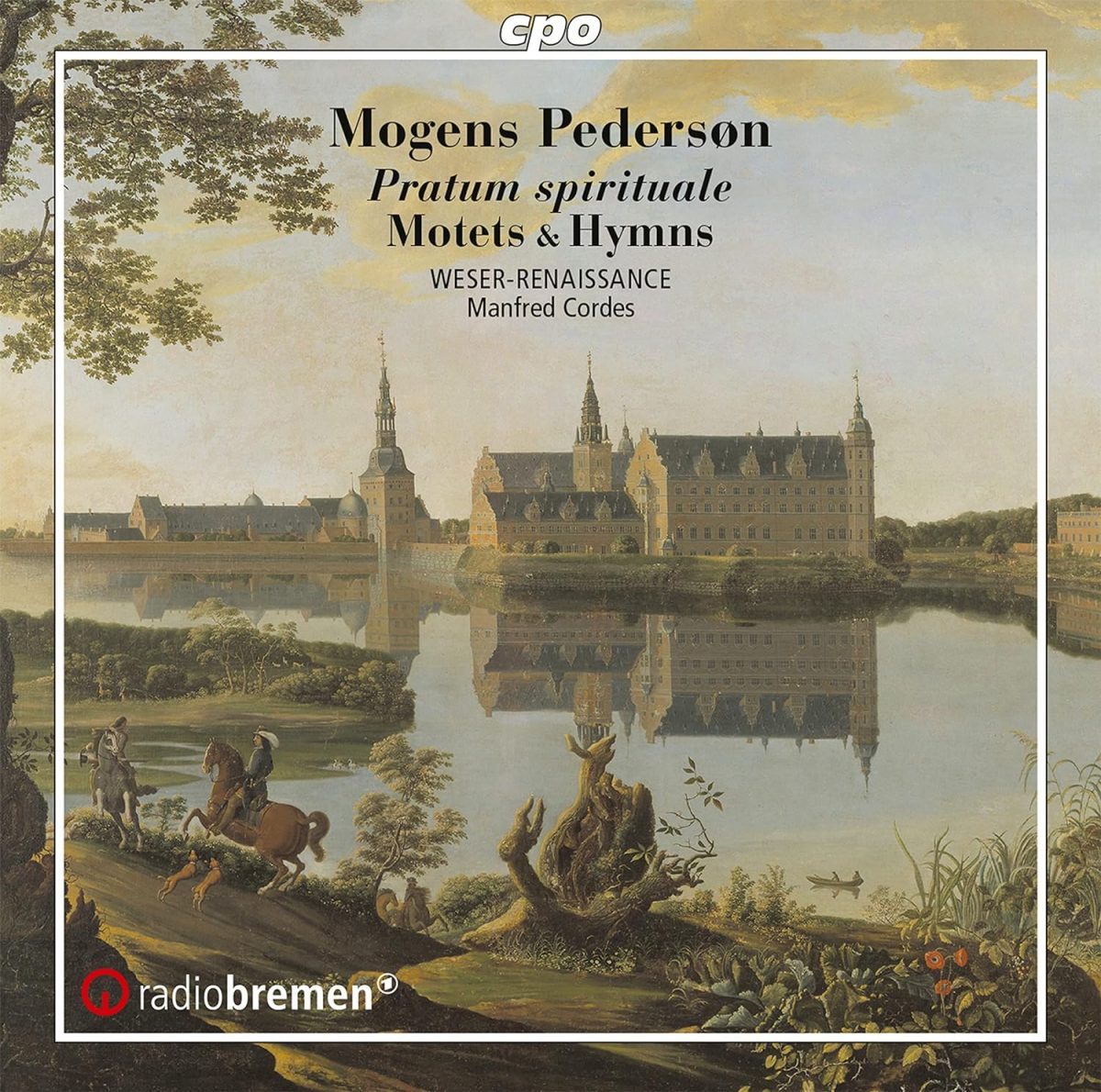
Mogens Pedersøn: Pratum spirituale

Motets & Hymns
Weser-Renaissance Bremen, Manfred Cordes
60:15
cpo 555 216-2
 
If you have heard of this Danish composer at all, it will almost certainly be through his madrigals. Like many a northern European disciple of the Gabrielis in Venice, his “right of passage” publication was a book of secular music to demonstrate his complete immersion in the Italian style of day. Less well known – but equally impressed for combining that with the needs of the Lutheran church (again, like many of his contemporaries) was his 1620 “Pratum spirituale”, a collection of “masses, psalms and motets… for use in Denmark and Norway”. This engaging recording (you should never expect any less from these forces!) presents a selection of pieces, including a mass for five voices, Latin motets and hymns in Danish. Some are performed tutti, some with solo voice(s) and groups of strings (violin with gambas) or winds (cornetto with sackbutts and dulcian) and continuo, sometimes varying the scoring of the various verses of the hymns. (The booklet listing is wrong for “Ad te levavi”, as only one singer is credited, where I can hear two.) The booklet notes mention Venetian two-choir writing several times, but do not expect to hear any here; “Pratum spirituale” is for five voices. This is a valuable project for illustrating the performance of Latin-texted music (including that mass with its curtailed Credo and Benedictus-less Sanctus!) within Lutheran liturgies, and also for confirming the quality of Pederson’s output.
 
Apologies to the musicians and the recording company for the delay in reviewing this wonderful recording; I have just found it in a box that was put in my attic (and “lost”!) when I moved house.
 
Brian Clark
Categories
Sheet music

Croft: Three odes with orchestra

Edited by Alan Howard
Musica Britannica MB108
ISBN: 9780852499696 ISMN: 9790220228100
xlviii + 127pp, £115.00
Stainer & Bell

This excellent volume contains the two pieces Croft wrote to celebrate the Peace of Utrecht in 1713 – an earn his Oxford doctorate – and an ode (the editor Alan Howarth argues) to mark the Peace of Ryswick in 1697. if, as likely, that is the case, the composer would still have been a teenager, so the infelicities identified in the informative introduction might be forgiven. The main problem with the source (a later copy by one of Croft’s students from the 1720s) is the labelling of the instrumental parts – in the opening movement, there is a trumpet line (or two trumpet lines?) with unplayable notes, and the editor interprets the next four lines as violins where it strikes me as more likely that the first pair are oboes and the next pair violins. In the following movements, an alto is accompanied by recorders, the soprano and bass by strings, the bass by violins, and the full ensemble renders the short concluding chorus. The Utrecht pieces, whose performances in Oxford were noticed in the press, are far more substantial and it is clear that in the intervening years, Croft has matured as a composer. His debt to the Purcellian court ode is self-evident. Where we nowadays tend to think of him as being obscured by Handel, there is no sense in which this music is overshadowed by the German’s music for the Utrecht celebrations – indeed, some of his best choral writing might suggest that the influence worked in the opposite direction! I hope the availability of these fine pieces will inspire musicians to take up his cause – there really is a wealth of beautiful music here!

Brian Clark 

Categories
Sheet music

Requiems by Giovanni Croce and Giovanni Rovetta

The Requiem Mass at St Mark’s, Venice, in the Seventeenth Century
Edited by Jonathan R. J. Drennan
Recent Researches in the Music of the Baroque Era, 238
xvii, six plates + 50pp $140
ISBN 978-1-9872-0865-8

This is the first of three volumes surveying Requiem settings at the basilica of San Marco from the 17th to the 19th centuries. After a detailed introduction, Drennan presents the two settings in the traditional A-R format, meaning that my usual gripes about wasted space and dumbing down of time signatures apply. Both works are written for ATTB choir and were intended to be sung from the bigonzo, a large raised “tub” (the edition includes two excellent photographs of the space); only Croce’s setting splits into two groups – and even then only for the Dies irae. Several pages could have been saved if, instead of printing eight staves every time one choir answered the other (on p. 21 meaning Choir 1 has ONE BAR at the end of the page), they were simply both presented on four staves and clearly labelled. This almost certainly have meant that the Sanctus and Agnus Dei would have appeared on an opening, rather than over two pages. Rovetta adds continuo to his setting but – again – space could have been saved (by printing the chant as a single line, for example!) and those two last movements would fit a spread. The music itself is written in the stile antico; polyphony is limited but both composers know how to use rhythm to keep their music interesting while fulfilling the necessity to declaim the text clearly. Both settings are extremely brief; Drennan suggests that has more to do with restrictions set by church authorities than the composers.

Brian Clark

Categories
Recording

Monteverdi: Vespro della Beata Vergine

Pygmalion, Raphaël Pichon
102:00 (2 CDs in a cardboard box)
harmonia mundi HMM 902710.11

Raphael Pichon’s account of Monteverdi’s Vespers of 1610 has been through a process of metamorphosis since a rather unsatisfactory Proms performance in 2017 followed by a much more convincing account, filmed live in the Versailles chapel which I reviewed enthusiastically in 2019. This version still attempted to set Monteverdi’s music in something of a liturgical context, while unfortunately the DVD subtitles and support materials did a poor job in identifying the interleaved plainchant. This latest CD version for harmonia mundi accepts the current thinking that, far from being a discrete ‘piece’, the publication is a collection of Monteverdi’s best service music written for lavish celebrations of St Barbara at the Gonzaga court of Mantua and gathered together in a portfolio dedicated to the Pope in the hope of employment in one of the important papal institutions in Rome. The failure of this enterprise and Monteverdi’s subsequent career in Venice has frequently influenced performances of this extraordinary music, but actually the important point of reference ought to be the musically flamboyant court of Mantua. The practice of combining the sacred and secular musical resources for the most magnificent Mantuan services for St Barbara justifies the truly epic scale of Pichon’s presentation. It also obviates the need for a liturgical context, and even allows for the aesthetically satisfactory return to the opening fanfare set to relevant text to bookend the whole performance. Epic is the word that keeps coming to mind in describing this latest version of the Vespers, with over seventy musicians performing in the resonant acoustic of the Temple du Saint-Esprit in Paris. Pichon’s control over these large forces is breath-taking, and as previously his line-up of superlative soloists provides us with exquisitely decorated accounts of the solo and small ensemble material. Also prominent in these more intimate moments, although also adding magically to the tutti textures, is a superb team of continuo players, including two harpists, three theorbists, and three harpsichordists, one doubling organ. Their contribution is wonderfully imaginative and perfectly responsive to the voices. The brass and string sections, particularly the two double basses, provide an impressively rich texture to the tutti passages, while the four cornettists contribute virtuosic cadential embellishments which are simply stunning – just listen to them in the concluding doxology of Laetatus sum! Singing at ‘high’ pitch, Pygmalion’s chorus exudes energy and musical purpose and is a model of perfect phrasing and unanimity, while the harmonia mundi engineers have captured this whole remarkable sound in all its vividness. You can tell that this is a performance of a now familiar work which I found thrilling and engaging – it caused me to look back at my favourite accounts by Suzuki, Christophers, and Gardiner’s three versions, and further back to pioneering accounts in the early 1950s by Eugen Jochum and even Leopold Stokowski. What struck me is that for all their scholarly and stylistic shortcomings, the earliest versions had an epic sweep, which has sometimes been missing in later versions. It strikes me that Pichon has managed to embrace the scholarly and the epic dimensions of this music, while modern standards of recorded sound capture this in all its richness and subtlety. This version is not without its quirks – not everybody will like the rather ‘romantic’ dynamic variations (including the curiously ‘cowed’ opening of Dixit Dominus), while the decision to perform the opening and concluding verses of Ave maris stella a capella, when previous conductors’ instincts have been to combine the vocal and instrumental forces accrued in all the other verses, is a curious one. The fact is we have very little idea of the details of performance styles at the time, but knowing that opera singers joined forces with sacred musical forces for the larger-scale religious celebrations suggests that the inherent drama of the music might have been further enhanced for these courtly spectacles.

D. James Ross

Categories
Recording

Lully – Te Deum

Les Épopées, Les Pages et les Chantres du Centre de musique baroque de Versailles, directed by Stéphane Fuget
68:24
Versailles Spectacles CVS117

This is the fourth in the indispensable series of Lully’s grands motets being undertaken by Stéphane Fuget and his vocal and orchestral ensemble Les Épopées, recorded in the glorious acoustic of the Chapelle Royale in the Palace of Versailles. Here, tackling the Te Deum of 1677 – perhaps the most brilliant and theatrical of all the motets – they are augmented by the forces of the Centre de musique baroque de Versailles to form an ensemble close to 100 strong.

The Te Deum was first given at Fontainebleau not to celebrate some great military victory, the usual reason for running up a Te Deum, as might be supposed but rather the more intimate occasion of the christening of Louis, the eldest son of Louis XIV (whom he predeceased) and Queen Marie-Thérèse. The king, who one suspects was more the target of its praise than the infant, was so delighted with it that he asked for it to be given again the following day. Thereafter it was repeated on several occasions, the last of which was in January 1687 when it was given to celebrate the king’s recovery following an operation. This was the famous occasion on which Lully injured his foot with the staff with which he beat time, an accident that resulted in his death from gangrene some weeks later.

The Te Deum is preceded, as it surely would have been on ceremonial occasions, by a pair of marches by the Philidor brothers, the first for timpani including a fascinating piece of syncopation. Perhaps the most striking aspect of the Te Deum is that, unlike so many occasional ceremonial works of its kind, it is far removed from being just a spectacular tub-thumper. Even in the most brilliant sections employing all the performers, the level of musical invention remains on an impressively high level, while many of the more intimate passages for the petit choeur or soloists have a calm, inner radiance. As so often with this genre, just as you think the ear is going to be overwhelmed by sheer splendour and brilliance along comes an ineffable, lyrical passage of heart-stopping beauty, here memorably realised. In common with most works in this genre, the key is thus contrast, contrast that spans the splendour of the opening and closing pages to the supplicatory verses from ‘Dignare, Domine’ (Vouchsafe, O Lord), beautifully sung here by an unidentified  bass, through to the wonderful trio (two haute-contres and bass) into which the petit choeur steals almost imperceptibly.

The other motet included makes for an ideal companion piece given that it was apparently customary for Exaudiat te Dominus, Psalm 19 (20) to be performed after the Te Deum at major ceremonies, as it was indeed after the performance to give thanks for the king’s recovery mentioned above. Interestingly it is markedly different in style, a more succinct setting with more clearly defined sections and more solo passages. Less brilliant than the Te Deum, the trumpets and timpani are silent until the doxology, they are of course required to round off the coupling of the two works with a suitably flamboyant flourish .

The performances are electrifying in the more overtly ceremonial passages, at the same time achieving an interiority and prayerful grace in more intimate music. The involvement of all is underlined by remarkable diction, not easy in this building with its blessedly long reverberation, while the solo singing and that of the petit choeur is of exceptional quality as indeed is that of the full choir and orchestra. This is yet another quite exceptional and uplifting achievement from Stéphane Fuget and his exceptionally gifted forces. 

Brian Robins