Categories
Recording

Schütz: Historia Nativitatis

Ensemble Polyharmonique
84:25 (2 CDs in a single jewel case)
cpo 555 432-2

Click HERE to buy this recording on amazon.co.uk
[Please use these sponsored links – we have no other source of income!]

Ensemble Polyharmonique, led by their primus inter pares and alto Alexander Schneider, have embarked on an interesting project: Schütz published the narrative of his Historia without the rich and characterful intermedii scored for the richly furnished Dresden court orchestra, with the comment that these additional parts could be hired for a small fee. He was clearly trying to make the Evangelista’s narrative widely available as the framework for a Christmas reflection and encouraged prospective performers to compose or gather their own material for intermedii to be inserted in his narrative. This is what Schneider’s Ensemble have done, and the result – performed by the six singers, two violins and a basso continuo of organ, theorbo and harp, with gamba/violone and dulzian/flauto – makes a good programme, bringing the outline of the work within reach of those who do not have the extensive resources of Schütz’s Kapelle in Dresden. A note says that the score and parts of the entire programme are available online at www.polyharmonique.eu , but I think you would have to ask them for it.

The narrative is divided into three parts: there is a Marian/Advent section (tracks 1-5) featuring Hammerschmidt, Michael, Schütz, Eccard and Frank’s fine Hosianna dem Sohne David before we reach the Birth of Jesus itself and the message alerting the Shepherds, where Schütz’s narrative based on Luke’s gospel forms the storyline. The intermedii include just one from Schütz’s Weihnachtsoratorium – Ehre sei Gott, with its scoring of six voices, two violins and fagotto with bc fitting the available resources exactly. Otherwise, the material includes interesting versions – usually more richly set than we hear in our carol services – of well-known German Christmas music like Ein Kind ist uns geboren, Joseph lieber Joseph mein, Es ist ein Ros entsprungen and Psallite unigenito.

On CD 2, we move to Herod, the visit of the Three Kings and the Flight into Egypt. Here there are more treasures: a version by Schein of Nikolaus Herman’s chorale associated with Christmas, Lobt Gott, ihr Christen allzugleich, that features at the end of BWV 151 and 195; a setting by Hammerschmidt based on the Kings’ enquiry to Herod, scored for voices and two violins; and music by Carl, Gesius and Briegel setting the Matthean texts that intersperse the narrative before Schütz’s setting of John 1.14 from his Geistliche Chor-musik (1648) and Scheidt’s triumphal setting of In dulci jubilo conclude this well-crafted Historia.

And the performances as usual with this group are excellent. OVPP singing, with a handful of instruments and a well-tuned basso continuo group in a flattering but clean acoustic make this a welcome addition to their discs of 17th-century German music. Let’s hope many will that up their – and Schütz’s – offer to plan an inventive and tuneful Historia next Christmastide.

David Stancliffe

Categories
Recording

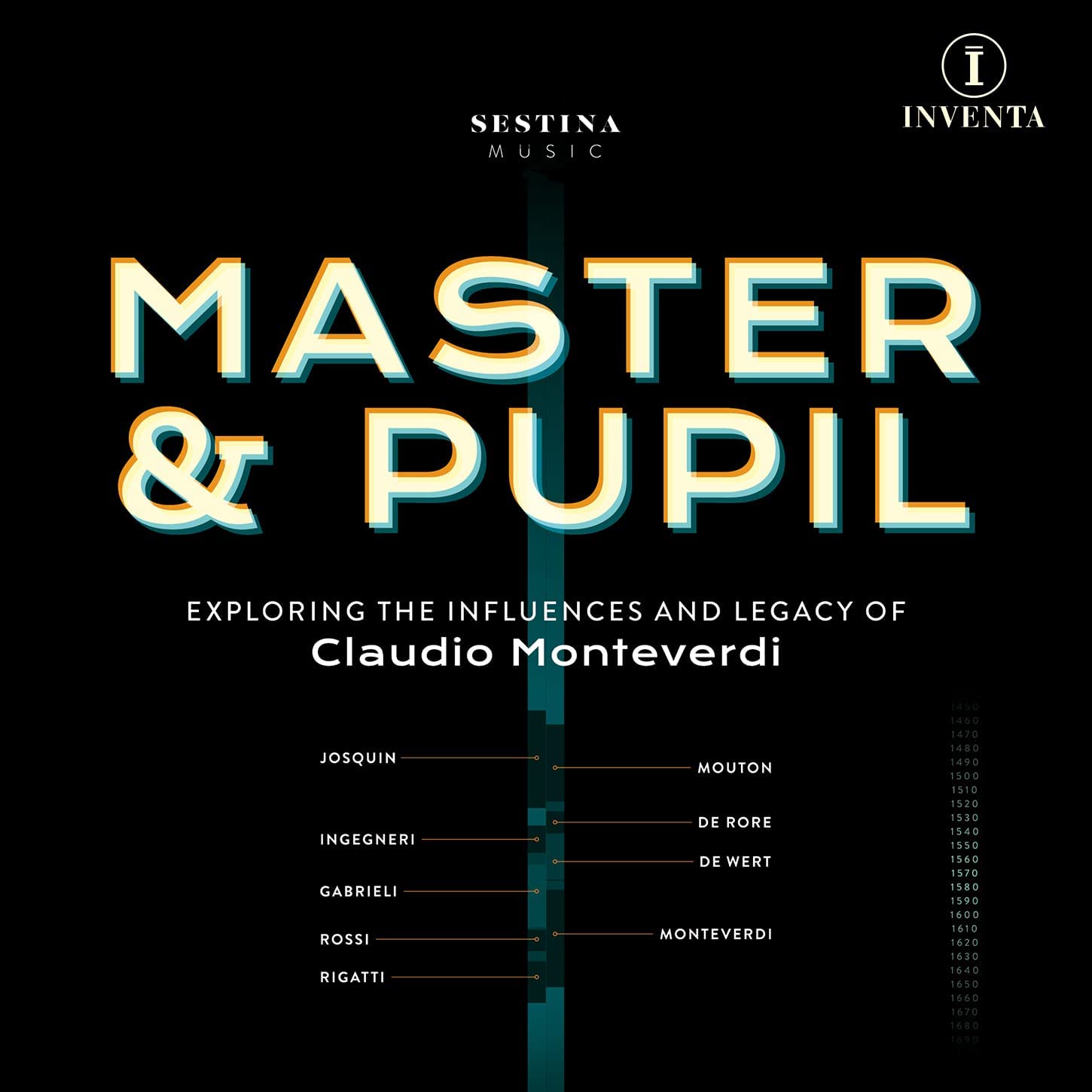
Master & Pupil

Exploring the influences and legacy of Claudio Monteverdi
Sestina Music, Mark Chambers
71:18
resonus Inventa INV1007

Click HERE to buy this recording on amazon.co.uk
[These sponsored links keep this website FREE TO ACCESS]

This is an interesting CD, exploring both the influences on and the legacy of Claudio Monteverdi. So, as well as music from Scherzi Musicali of 1607 and Selva morale of 1640/1, it contains music by Josquin, Mouton, de Rore, Ingegneri, Andrea Gabrieli and de Wert from among those who influenced him and by Rossi, Rigatti and Giovanni Gabrieli whom he may, in turn, have influenced himself.

There are 18 singers – frequently singing several to a part, while the instrumentalists are two violins/violas, violone, two cornetti, two sackbuts and a dulcian, with chitarrone/guitar, harp and organo di legno. In music like the Dixit secondo from 1641, the scoring is enriched by sackbuts, and the dulcian is given characterful obbligato lines to play. The scoring is modest, and elegant, and is played by our best practitioners: Oliver Webber and Theresa Caudle, violins, Peter McCarthy, violone; Gawain Glenton and Conor Hastings, cornetti, Emily White and Martyn Sanderson, sackbuts; William Lyons, dulcian, with Paula Chateauneuf, theorbo and guitar, Aileen Henry, harp and Jan Waterfield playing Walter Chinaglia’s organo di legno from the English Organ School at Milburne Port. Details of all the instruments are in the booklet, and for the Chinaglia organ, see the review of his project that I wrote for EMR in 2019.

The choice of this particular organ is significant, as the singing quality of the open wooden principal pipes is important in encouraging singers to create the right sounds for the music of the first half of the 17th century. And that is the key to this CD. When I heard the first track, I thought: ‘ Oh, no: here we go again,’ as, after an elegant string sinfonia, multiple voices burst in with a rumbustious balletto – De la bellezza from Scherzi Musicali – in the beer-cellar style. I should have had more faith in Mark Chambers, since this balletto was followed at once by some ravishing singing from the upper voices of Josquin’s Recordare Virgo Mater in quite a different style. Trained upper voices do not always find it easy to eschew their singerly tendency to use vibrato on unexpected notes, but there is a genuine and interesting attempt here to match vocal timbre to instrumental, even if I am rarely convinced by the vocal doubling Chambers uses.

The two Rossi instrumental pieces are exquisitely played, but the most instructive part of the disc for me was the juxtaposition of the sections of the extraordinarily rich and colourful Mass by Giovanni Rigatti (written at the age of 27 and antedating the publication of Monteverdi’s Selva morale by six months or so) with Giovanni Gabrieli’s 10-part Maria Virgo from 1597. Rigatti has an interesting comment on instrumental doubling, which I’d like to see in context – and in Italian (I suspect ‘gentle’ is a mistranslation):

… the gentle musician who finds himself with the proportionate
number of voices and instruments is advised to double the parts …
so that they will be more melodious and harmonious 

This is a well-prepared and meticulously researched CD. But it is much more: these are really good performances and should help practitioners to understand more about how to balance voices and instruments in this period. I recommend both the scholarship and the performance to as wide a range of listeners and performers as possible.

David Stancliffe
Categories
Recording

Bach: Two-Part Inventions | Sinfonias

incantati (Emma Murphy recorders, Rachel Stott viola d’amore, Asako Morikawa viola da gamba)
59:57
First Hand Records FHR122

Click HERE to buy this recording on amazon.co.uk
[These sponsored links help keep this site free]

This delightful CD of duets and trios by Bach was recorded in May last year, and so is a fruit of the liberation from lockdown. While the chosen instruments all have associations with each other in some of Bach’s early scoring (like BWV 152, for example), hearing three friends playing together spontaneously is a delight, and reminds me of many occasions when groups like this would look in the cupboard for some Bach that would work on the instruments that happened to be at hand and set to, armed with sonatas, concertos, the Art of Fugue and chorale preludes.

One of the great delights of Bach is that you can play his music on almost any combination and it will sound terrific. Bach was an inveterate arranger and parodist of his own music as well as that of others, and his trio chamber music versions of concerto movements or the Schübler organ preludes, transcribing movements from cantatas for organ, show the way. In this selection, where keyboard music, including one of the six trio sonatas for organ, is played on instruments, the clarity and distinctness of the instrumental lines is always preserved, which makes these copy-book examples of Bach’s endlessly inventive skill in canonic and polyphonic composition a delight. I find myself smiling at each fresh take as I re-discover hidden treasures. And how much better this is in the hands of such delightful musicians than the other way round, when complex polyphonic compositions are reduced to endless percussive piano arrangements.

I enjoyed this venture, and continue to play the CD with pleasure.

David Stancliffe

Categories
Recording

J. S. Bach – Works for Flute and Keyboard

Sonatas, Fantasias, Improvisations
Toshiyuki Shibata flute, Anthony Romaniuk fortepiano
58:30
Fuga Libera FUG 792

Click HERE to buy this on amazon,co.uk
[These sponsored links help keep these review FREE TO VIEW]

These two artists met in the summer gap in the 2020 lockdown in Antwerp, and agreed to get playing together. Both were baroque musicians and also jazz players, used to improvising. The result is this CD centred on Bach’s Flute Sonatas in E, E minor and B minor, for which Shibata commissioned a flute after Quantz as well as one after Eichentopf from around 1720. The harpsichord used by Romaniuk is by Detmer Hungerberg while the fortepiano after Silbermann used in the B minor sonata is by Kerstin Schwartz-Damm and has an intriguing variety of stops and makes an ideal partner to the Quantz flute. The pitch they play at is 402Hz after Quantz, which gives a lovely relaxed and unhurried feel to their playing.

In addition to their Bach sonatas, they introduce their improvisations, observing that often a piece was preluded in the 18th century, and that a baroque score was often more akin to jazz lead-sheets, where not only was a degree of ornamentation expected but in realising the basso continuo sometimes an additional melodic line was contrived more in the style of the right hand part in BWV 1030.

Before the purists sniff at this performing style, I urge them to listen to the results of this collaboration and decide whether this style of music-making does not have a good deal to teach the most HIP of practitioners, even if we might do it slightly differently. Bach was celebrated for being able to improvise an extra voice to a complex polyphonic structure whether in the right hand of a keyboard continuo instrument playing in a sonata or a violin descant to a chorale, as in many of the Weimar period cantatas. I have learned a lot about his compositional style by watching him at work in these modes as he crafted the organ chorale preludes, which, like the solo keyboard compositions, most likely had their origins in improvisations in preluding a chorale for Lutheran worship.

So while I put this CD aside while I made room for other more obviously attractive discs I had been sent, I am grateful for having heard it, and glad of the stimulus as well as the opportunity to eavesdrop on two able and thoughtful musicians at work as they ponder the place of what is now called improvisation in the performance of the high baroque.

David Stancliffe

Categories
Recording

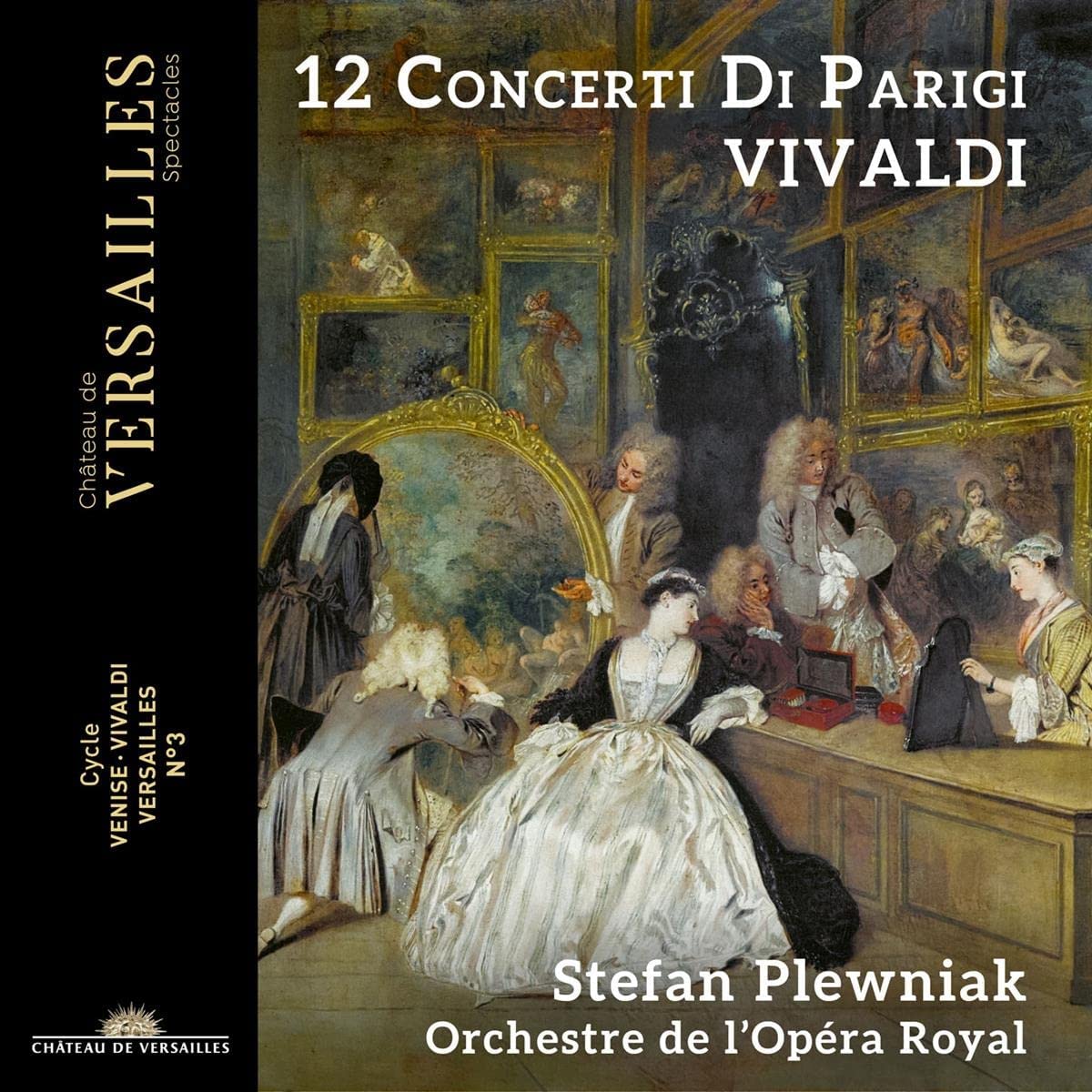
Vivaldi: 12 Concerti Di Parigi

Venise – Vivaldi – Versailles No. 3
Orchestre de l’Opéra Royal, Stefan Plewniak
60:21
Château de Versailles Spectacles CVS065

To buy this recording on amazon.co.uk, click HERE.
[Sponsored links are the only source of income we have!]

Ten of the twelve concerti in this Paris manuscript are known from other sources, suggesting that the manuscript was drawn up at relatively short notice as a presentation piece for a potential patron. The set is associated with a visit to Trieste by the Austrian Emperor Charles VI, in whose retinue was the keen amateur violinist Franz Stephan, who seems to have acquired the set. This perhaps explains why they are all ‘ripieni’ concerti, spotlighting the whole ensemble rather than a soloist. The subsequent enormous popularity of Vivaldi’s music in France can hardly be put down to these concerti, as they lack the sparkle and originality of several of the master’s other manuscripts and publications. Plewniak and his orchestral forces seem determined to make up for the risk of any musical mundanity with the sheer energy of their performance – however, this seems frequently to err on the side of aggression. Each energetic track is preceded by what sounds like a sharp intake of breath from all concerned, while the percussive attack on the stringed instruments is given further edge by some very choppy guitar playing. It is a pity that this element of aggression is allowed to creep into these performances, as many of the more relaxed movements are lyrically and tastefully presented. I don’t want to sound too unenthusiastic about this latest in a series of thought-provoking recordings to emanate from the Palace of Versailles, but at the same time it seems part of a fashion of ‘overplaying’ Vivaldi, when often his music should be allowed to speak more for itself.

D. James Ross

Categories
Recording

Vivaldi: Flute concertos [op. 10]

Carlo Ipata, auser musici
47:30
Glossa GCD 923530

Click HERE to buy this recording on amazon.co.uk
[If more people do not use these sponsored links, the site will disappear…]

This account of Vivaldi’s six flute concertos op10 (1729) takes the subtitle of the French publication literally, using single players on each of the four string parts, but adds considerable weight in the form of a double bass, while replacing the stipulated organ with a harpsichord and theorbo – it might have been interesting to hear what a difference an organ continuo might have made. However, the forces used here and the wonderfully rich Glossa recorded sound add a textural opulence to this music, which is most enjoyable and impressive. The opus 10 includes three famous ‘programmatic’ concerti, La Notte, Il Gardellino and La Tempesta di Mare, as well as three further concerti, two of which are reworkings of pieces for ‘third flute’ and the third of which was composed specially to make up the numbers. This publication was hugely popular, and if Vivaldi’s public didn’t feel short-changed by being presented with largely non-original material, neither should we at the relative brevity of this CD. The main reason for this is Carlo Ipata’s expressive flute playing, which it has to be said is more effective in the more dynamic movements than in the contemplative sections, where I occasionally felt he could have made more of Vivaldi’s simple lines. Overall, though, these are engaging and technically assured performances, and Ipata’s warm-toned flute is always in perfect balance with the orchestral forces. We hear so many exaggerated and otherwise ‘souped-up’ performances of Vivaldi these days, that something more restrained and tasteful, such as we have here, is a genuine treat.

D. James Ross

Categories
Recording

Giuseppe Sammartini: Sonatas for recorder and basso continuo vol. 2

Andreas Böhlen, Michael Hell, Daniel Rosin, Pietro Prosser
73:20
AEOLUS AE-10306

Click HERE to buy this recording on amazon.co.uk
[These sponsored links generate very little income, but they do keep this site FREE!]

Older brother of the better-known Giovanni Battista Sammartini, Giuseppe has come to be somewhat eclipsed from the days when his name was mentioned in the same breath as Corelli and Geminiani. After training in Milan with his oboist father, Giuseppe took the well-worn route to London where he advanced from jobbing musician to entering the employment of Frederick Prince of Wales. By the time of his death in 1750 at the age of 55, he was rated as ‘the finest performer on the hautboy in Europe’. His 32 surviving works for alto recorder suggest an intimate knowledge of this instrument too, and indeed it was common at the time for musicians to double on several woodwind instruments. While Sammartini’s sonatas may not have quite the technical demands of Vivaldi’s recorder writing, they are to my mind much more idiomatic, reflecting the lively professional and amateur interest in the instrument. Andreas Böhlen’s accounts are strikingly musical and deftly ornamented, while the rapid passage-work is stunningly well executed. He plays a set of four alto recorders in F modelled on originals by Steenbergen, Bressan and J Denner, as well as an instrument in G by J C Denner, each with a distinctive and engaging voice. His continuo ensemble of lute, harpsichord and cello is superbly supportive and responsive, and used in various permutations to imaginatively vary the textures. As an ensemble, they are clearly all immersed in the chamber music of this period, and their performances are wonderfully expressive and evocative, as is David Lasocki’s comprehensive and stylishly written programme note. I enjoyed enormously volume one of Sammartini’s Sonatas by these performers, and this second volume has more than lived up to its promise. We look forward to further volumes exploring the rest of this gifted composer’s output.

D. James Ross

Categories
Uncategorized

Dominico Mazzocchi: Prima le Parole

Madrigali a Cinque Voci, Roma 1638
Les Traversees Baroques, directed by Etienne Meyer
52:47
ACC 24384

Click HERE to buy this recording on amazon.co.uk
[Doing so helps maintain this free-to-view site…]

Over-petalled garlands of lyric poetry by Tasso, Ciampoli and others are responded to in the most extraordinary ways by Domenico Mazzocchi. This Roman composer is less known than his older contemporary, Monteverdi, whose influence can be heard, extended by later developments and by Mazzochi’s own fecund imagination. We need not hear the words to know that here we are descending a staircase of sleep or despair, there on a mountain top, open to breezes or distant echoing valleys. Particularly vivid are the tumbling mountain streams, swathes of swaying flowers and rumbles of bad weather – and all symbolic of course of the one universal topic. These effects are wonderfully enhanced by the imaginative choices of instrumentation in the continuo mix and concerted instrumental parts. A remarkably flowing and lyrical cornett sound, along with truly breath-inspired recorder playing, judicious use of dulcian and a varying spectrum of continuo sounds provides appropriate background canvasses for the vivid vocal parts. These vary from dramatic dialogues to rich quintets, sung with not a little ebullience. Another illuminating recording from this creative ensemble.

Stephen Cassidy

Categories
Recording

Purcell: Royal Odes

Le Banquet Céleste, Damien Guillon
63:23
Alpha Classics ALPHA 780

Click HERE to buy this recording on amazon.co.uk
[These sponsored links keep this site FREE TO VIEW]

I have recently rather late in the day encountered ‘Perpetual Night’, the superlative CD (harmonia mundi) of 17th-century English repertoire by mezzo Lucile Richardot and Sebastien Daucé’s Ensemble Correspondances. Now here’s another disc from a distinguished French vocal ensemble to demonstrate compellingly how flawed our thinking is when we take on a proprietorial attitude to our own early music. That applies especially to Purcell, who many mistakenly tend to regard as quintessentially English and in so doing overlook the influence in his work of both French and Italian music.  

If Continental influences are undeniably at work in Purcell’s music, the concept of the celebratory royal ode was an entirely English one, though one might perhaps find some analogy in the sycophantic opera preludes addressed to Louis XIV by Lully and his contemporaries. Today their principal interest, leaving aside the astonishing quality – out of all proportion to their occasional purpose – of the music Purcell provided for them, is their commentary on and reflection of historical events. Thus of the three odes included here ‘From those serene and rapturous joys’ (Z 326) is the welcome ode for Charles II composed in 1684, in the September of which the king returned to Whitehall following a summer spent partly in Winchester, thus the poet John Flatman’s references to the ‘rapturous joys a country life alone can give’. Rather less easily explained are the references to the raising of Lazarus. But it’s a splendidly variegated work, with a French overture, florid Italianate solo airs, and a very English ground bass in the superb bass air ‘Welcome as soft refreshing showers’. The welcome ode for 1683, ‘Fly, bold rebellion’ (Z 324) is also linked to a specific historical event, in this case the so-called Rye House plot, a thwarted attempt to kill both Charles and his brother James earlier in the year. There is not unexpectedly considerable menacing tub-thumping, but the jewel of the work is the exquisite trio for two sopranos and countertenor, ‘But heaven has now dispelled’, in this performance the delicately interwoven filigree of the voices and ethereal lightness of touch forming a striking contrast with much of what has gone before.  

With the third and longest of these odes, ‘Why are all the Muses mute?’ (Z 343) we come to the first welcome ode Purcell composed for a new king, James II after his accession to the throne in 1685. The anonymous text is ostensibly largely a panegyric, though not without barbs and ambiguities, in which the new and unpopular Catholic monarch is throughout addressed as Caesar. Its opening is unique. Instead of the expected overture, we are drawn into the work by an introverted solo for high tenor set to the words of the ode’s title, here beautifully done with rapt concentration by Nicholas Scott. Only after this verse does Purcell introduce an instrumental prelude. Other highlights in a remarkable piece include ‘Britain, that now art great’, a ground bass air for countertenor – in this case, another of the CD’s stars, Paul-Antoine Bénos-Djian – succeeded by a ravishingly lovely orchestral ritornello.

The scale of the performances is similar to that employed by Robert King in some of his more recent re-recordings of the royal odes. That is to say two voices per part in choruses and single strings per part. King himself has recorded ‘Why are all the Muses?’ in this way, which reflects the kind of forces Purcell would have employed. Comparisons are fascinating, with Guillon generally taking a more lively approach than the latter-day King, whose stellar group of soloists are inevitably more individualistic than Le Banquet Céleste’s beautifully tuned and integrated ensemble. Both approaches have their own value, with the mostly French performers relishing the marvellous expressive qualities inherent in Purcell’s writing and, unsurprisingly, the strong feel of dance it includes. An outstanding disc that underlines convincingly the fundamental fact Purcell is fully exportable to and performable by our near-neighbours. Coincidentally, while working on this review a newsletter from Le Banquet Céleste arrived in my in-box. Upcoming are two concert programmes devoted to 17th-century English music. And that can only be good news for all of us.

Brian Robins

Categories
Recording

Telemann: 12 Fantasias for Solo Violin (without bass) 1735

Tomas Cotik
62:48
Centaur CRC3949

Click HERE to buy this recording on amazon.co.uk
[Using these links to buy recordings keeps this site FREE TO VIEW]

Quite a few violinists (50+?) have thrown their hats into the ring to tackle these neatly-crafted works, which do clearly befit the definition of Fantasias, breaking rules of form and giving a sense of an improvisatory flow; more than this, we have clever capsules of music expounding the sonata forms of the past, juxtaposed with more progressive Galant elements, plus some suite-dances and rustic sections, as per the final “Giga” movements in the Fantasias nos 2, 4, 9 and 10, that mirror the over twenty closing movements found in the extant Suites. These well-thought-out fantasias come some twenty years after the composer’s first publication (1715) and just after the famous “Musique de Table” 1733, and sit alongside the publication of other fantasias for solo flute and gamba, and the Sonates Corellisantes of 1735. The opening “Capriccio” of the A major work no 5 is conceived within an overt Corellian mode and style. In a printed catalogue of 1735, Telemann listed the violin fantasias as: “12 Fantasias for violin without bass, of which 6 include fugues and are: ‘Galanterien.’” These pieces offer up some real “roller-coaster” mood swings and stylistic changes with some passing lyricism for melodic effect, and some have that “ear-tricking” double-voice effect, found in the flute fantasias too. Here also that famous rustic style closing nos 11 and 12. In nearly all the fantasias, Tomas Cotik has keenly and clearly articulated these modes and moods with deft fingering and technique, shaving off minutes in many, except no 6 in E minor which exceeds all the recordings I own by some two minutes! There’s an often pulsing, strident acceleration and almost “explosive” delivery from this Marc de Sterke (2000) violin with baroque bow, which makes for a formidable display of technical ability, yet this can detract slightly from a more even- tempered approach given by others notably Andrew Manze (1996), Rachel Podger (2002) and Angele Dubeau (1993/5). Maya Magub on the CRD label (2012) held a finely balanced “middle way” with some lovely subtle embellishments. Here, sometimes, I felt the envelope was often being “pushed”, which I dare say would count as sparkle in the concert hall, yet on repeated listening might feel more like over-exuberance, an involuntary frisson! The slower introspective moments were well interpreted, so too the openings of no. 7 and (Dolce) no. 8 (Piacevolmente), yet I found the opening Prelude of the G major (no  2) had oddly applied tremulous “shudders” and the final Menuet from the F minor (no 3) became all rather spikey to my ear! This brings to a head the instant dichotomy of how to interpret these works in a fluent chain of musical ideas that look back to the old and forward to the Galant; each violinist must find their own path and method of delivery within the intended guiding improvisational flow. These versions are unabashedly driven, backed by a slick technical ability, yielding a bold, fleet, forthright ride through the challenging yet rewarding contours of these mixed modes, occasionally dance-infused, and forward-looking Fantasias.

David Bellinger