Categories
Recording

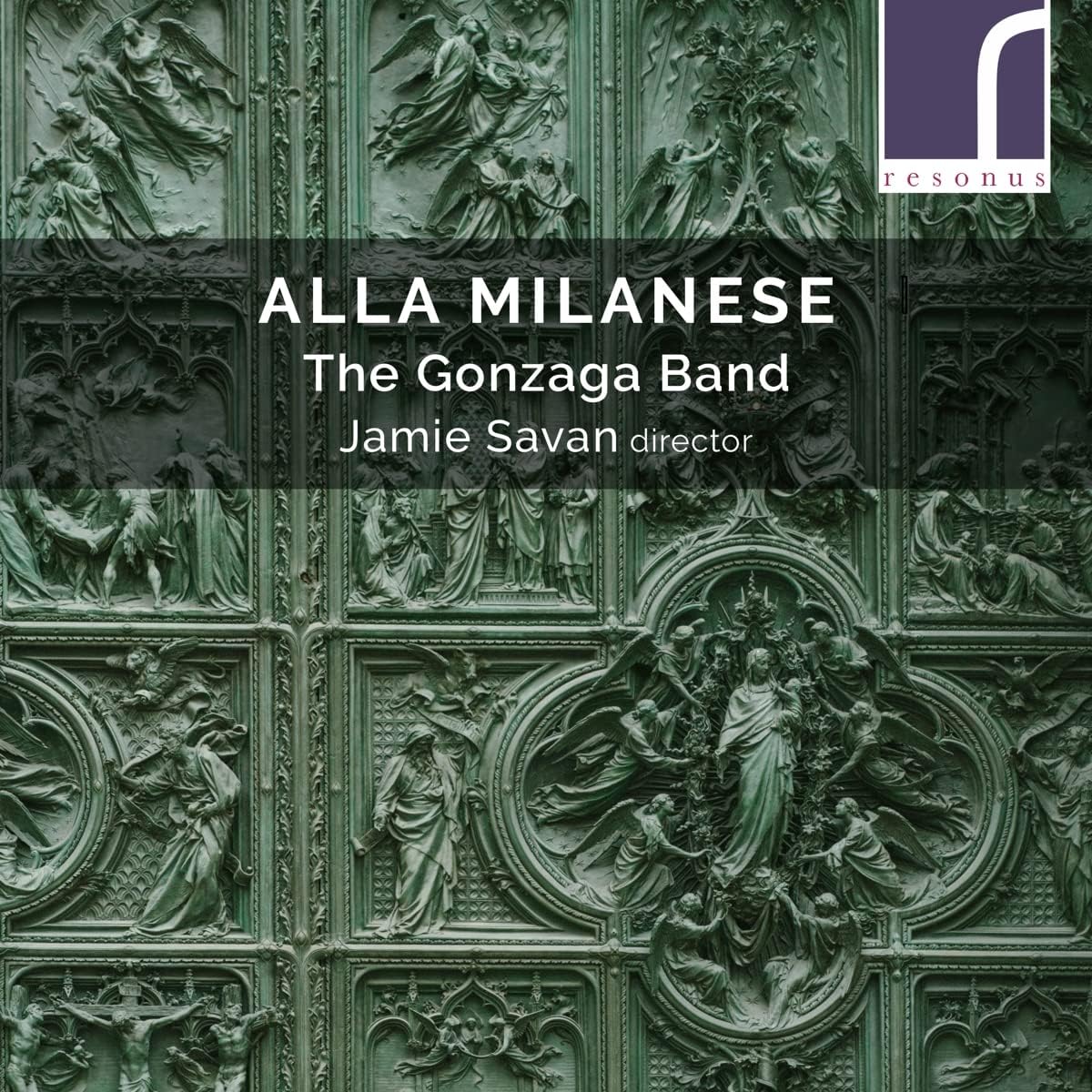
ALLA MILANESE

The Gonzaga Band directed by Jamie Savan
74:19
Resonus RES 10314

The Gonzaga Band is small group of acclaimed experts who deliver music-making of extraordinary power, where the whole seems miraculously more than the sum of its parts.

Partly this is because their expertise is forged in bringing exactly this music – music written in the years when Renaissance polyphony was just bursting out of its ecclesiastical shell into a more florid, instrumental-driven freedom of divisions or passaggi as these techniques of ornamenting the four-square polyphonic writing were called – to life. It was this development – along with the development of instrument-making – especially in violin making – that would enable Corelli and Vivaldi and their associates to emerge into what we know as the high Baroque, and Milan was particularly important in the development of the violin and its music in this period.

But partly also it is because their leader, Jamie Savan, researches and prepares music for performance that is not only a pleasure to listen to, but which makes the links between Milan’s past and future as a distinctive player in the extraordinary flowering of the Nuova Musica along the Po valley from Lombardy to the Veneto. Savan’s liner notes are always a model of good practice: the sources are listed, along with the performing pitch (A=465Hz) and the temperament (1/4 comma mean tone); so are the instruments they all play, including the Hauptwerk organ sampled from S. Maria d’Alieto, Izola, Slovenia used by Steven Devine. I would love to hear them play with an organ by Walter Chinaglia based on open wooden principal pipes described in his Duoi organi per Monteverdi, https://www.organa.it/monteverdi/ for details.

Attention to balance and allowing space for sonorities to bloom is second nature to this group, and we should be grateful for a glimpse into such a wide variety of music. There is a good deal of the best-known Milanese composer of the time, Giovanni Paulo Cima, and his Capriccio 8, 1606 (track 12) will give you a good idea of the instrumental sonorities offered here. Particularly interesting to me as examples of how the earlier polyphonic masterworks were being transformed by passaggi are the tracks 6, 11 and 15 where music by Palestrina, Lassus and de Rore is re-presented with divisions: here Mark Caudle’s violone playing in Rognoni’s version of Lassus’ well known Susanne un jour is a star turn, as are Jamie Savan’s cornetto divisions in track 15. Towards the end, we hear two tracks by Caterina Assandra, a novice nun who was clearly a remarkable composer in her own right at a young age.

Faye Newton has a wonderfully clear yet expressive voice, negotiating the passaggi and trills with ease, she manages to convey the varying moods of the music without the aid of those modern singerly conventions like vibrato or unaccountable swelling on weak notes. This means she matches the instruments splendidly: Cima’s Surge propera (track 16) is a motet with echo effects on the cornetto, and Rognoni’s Ave Virgo Benedicta (track 17) lets us hear her unadorned. You would expect a degree of athleticism from the cornetto, but here you can hear it from the bass sackbut too in the skilled hands of Guy Morely (tracks 5 and 18). Oliver Webber whose relaxed technique is so well-suited to this period’s divisions is heard on his own in Canzon ‘la Porcia’ by Antonio Mortaro with divisions by Francesco Rognoni (track 7), where Steven Devine is playing a harpsichord by Colin Booth (1998) based on one by Domenico da Pesaro (Venice, 1533).

The whole CD is a treat, introducing us to a distinctive sound-world which helps us make sense of the rise in instrumental skills which preluded the shift from Canzone to Sonatas and Concerti, marking the distinctive Baroque period both instrumentally and vocally. I commend it wholeheartedly.

David Stancliffe

Categories
Recording

LEMNISCATE

Bach: The Art of Fugue
New Collegium, Claudio Ribeiro
73:56
Ramée RAM2208

There are essentially two schools of thought about how to perform the Art of Fugue – provided you discount the ultra-purist view that says you should not perform this Last Will and Testament – only read it! The first seeks to minimise the different character of the numbers by using the same scoring, as in those versions performed by a single player on keyboard instruments like the Régis Allard version on the Aubertin organ in Saint-Louis-en-I’lle in Paris in 2005 or Vincent Groppy at St Benoît-sur-Loire in 2018 or those performed by a single group of instruments, like Fretwork’s classic version recorded in 2001 on viols or Brecon Baroque’s from 2015 on period strings and harpsichord. And the second, like this version by Claudio Ribeiro, which seeks to underline the differences in style using the autograph’s last version and presenting the character of each fugue or canon with a wide variety of instrumental scoring, using winds as well as strings and harpsichord, and even the more old-style cornetto and trombones.

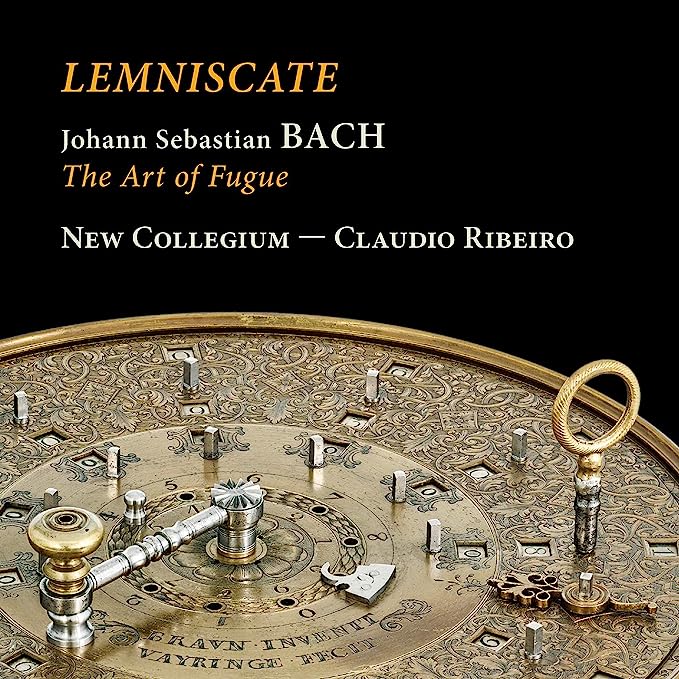
Under the title of LEMNISCATE, that figure of eight shape that I think of as a symbol for infinity, and with a striking cover image of a richly engraved and inlaid calculating machine of 1735 by Anton Braun and Philippe Vayringe to illustrate the complex interweaving nature of the canons and fugues that make up this complex summary of Bach’s contrapuntal genius, the group embarks on a novel presentation of this amazing music.

Starting with a sober, conventional account of Contrapunctus 1 played on a harpsichord, the group branch out in a variety of scoring to colour the various forms, giving titles to a number of the pieces to heighten their character: 1080/5 is headed ‘In Stile Antico’, scored for trombones and cornetto alongside strings and 1080/9 ‘Spiritoso’ with a high recorder and harpsichord joining strings in a concerto-like movement; 1080/10a entitled ‘Es ist ein Ros entsprungen’ uses a treble recorder, ‘cello and harpsichord to create a more contemplative feel; the oboe and traverso join the strings for the dotted Ouverture-like 1080/6 and we are back with more restrained string-playing for 1080/7 – ‘Memoria’. The most striking beginning is the opening of 1080/13,1 scored for oboe and recorder with harpsichord and its twin 1080/13,2 – a model for imaginative balance.

This process plays out most successfully in the final fugues 1080/18.1 & 2, where pairs of instruments decorate the harpsichord – first violin and violoncello, then flute and viol – in the style of Pièces de clavecin en concert. And the final great triple fugue begins with the cornetto and trombones, overlapping with and yielding to the strings and then the woodwind. The brass return with the BACH theme: this is a splendid climax which leaves us hanging in the air just when we imagine this music might go on forever. . .

The players are excellent – adopting a series of different personae easily as the music demands unfolding characterisation. Altogether I was entirely seduced by the colour, clarity and novelty they brought to this extraordinary music, and while I remain wedded to both Fretwork’s and Rachel Podger’s versions, I enjoyed this imaginative performance greatly.

David Stancliffe

Categories
Recording

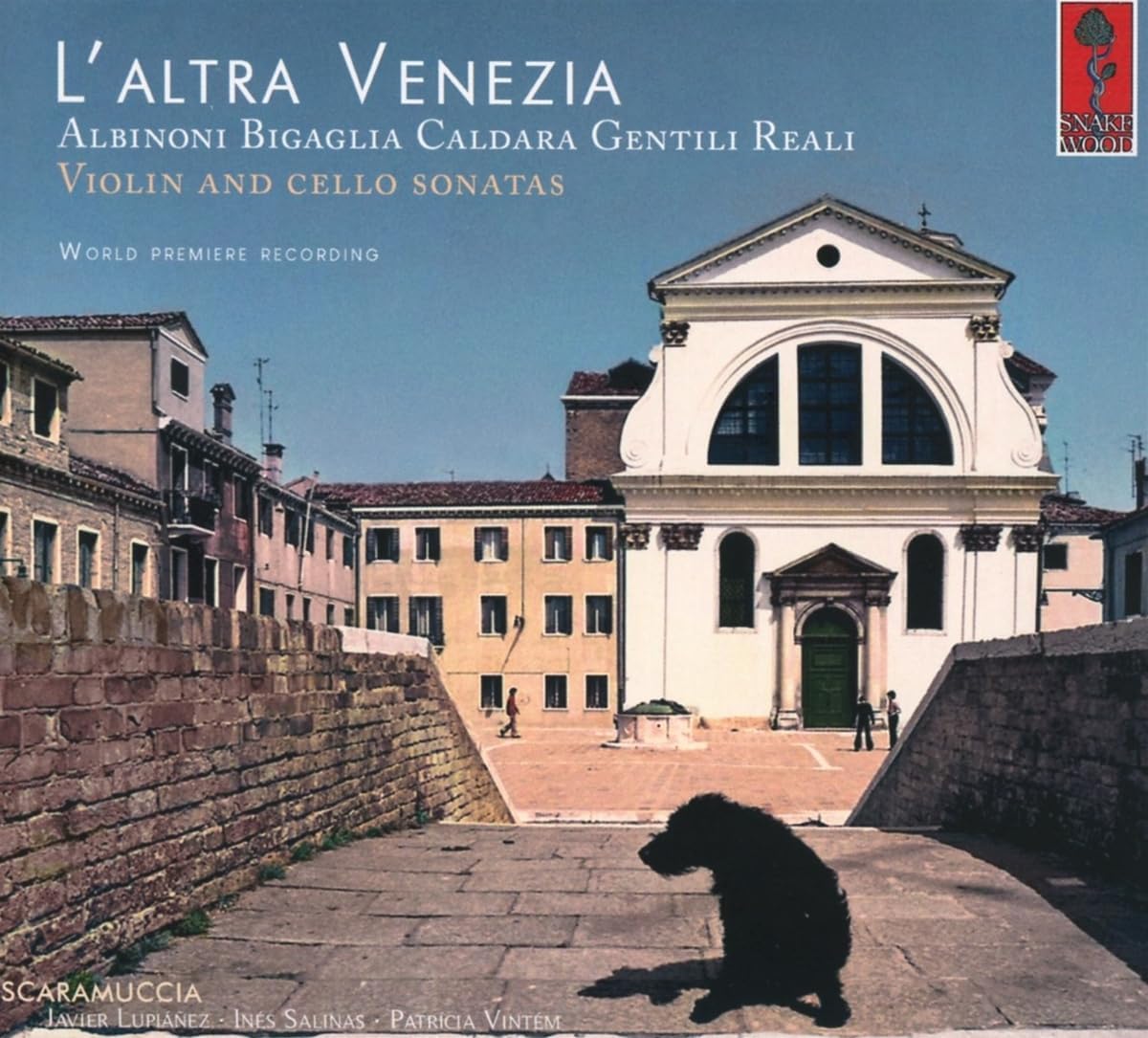
L’altra Venezia


Violin and cello sonatas
Scaramuccia (Javier Lupiáñez violin, Inés Salinas cello, Patrícia Vintém harpsichord)
77:23
Snakewood  SCD202301

This wonderfully presented recording takes us back to the famous musical city at the very turn of the 18th century, before it became synonymous with just a single composer’s works. These well-chosen sonatas display the keen seminal talents of a few known and possibly lesser-known composers, who all contributed to the city’s musical life in this early period. The two sonatas attributed to Albinoni are recent finds from 2021 in the Estensischen (Musikalien) Collection in the Austrian State Library in Vienna; the first work in G minor is redolent of Albinoni’s Balletti a quattro, the B flat major piece appears to exhibit the later Albinonian style. The ensemble’s fine violinist captures these refined elements with elegant poise and perfect phrasing! The opening Bigaglia piece was copied out by Pisendel during his Venice trip (1716-17), the third movement being in the famous Siciliana mode; although the composer isn’t named in the Dresden copy, the Amsterdam publication of 1725 echo and match his predominant style. The Caldara work in F major has an overt flamboyance and polished refinement which the leader of Scaramuccia captures with a panache; this piece also hails from the Estensischen Collection in Vienna.

After these excellent examples of the early sonata form, we encounter the Sonatas a Violoncello by Giorgio Gentili, which feel like expressive fantasias for the instrument. Inés Salinas is an accomplished cellist. The Capriccio da camera in B minor for violin, violoncello and cembalo of circa 1707 is a felicitous union that the ensemble fully relishes. The closing violin piece by Reali nods towards the Corellian modes of expression.

This is a perfect survey of these works by significant “other” composers who deserve their place in the development of this seminal genre from this famous musical city.

It must be said that the CD notes are never prolix or overburdened by detail, being superbly written by Michael Talbot; indeed, this could be also said of the playing here, never overburdened or laboured, the perfect phrasing and understanding of the stylistic elements on display makes for an informed and beautifully balanced approach to these incipient contributions by “significant” others in this “other” Venice.

David Bellinger

Categories
Recording

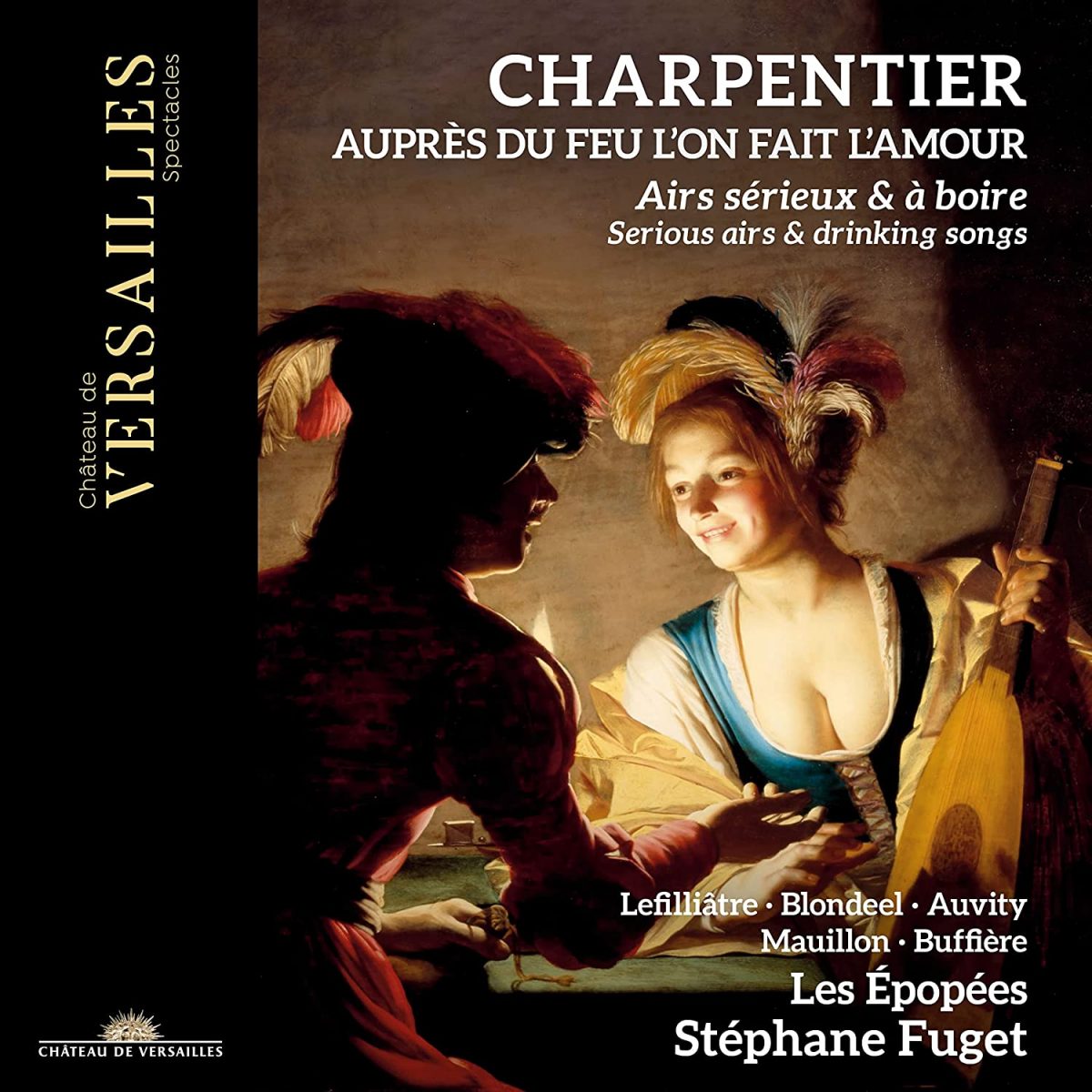
Charpentier: Auprès du feu l’on fait l’amour

Airs serieux & à boire
Les Épopées, directed by Stéphane Fuget
76:29
Versailles Spectacles CVS 089

The history of the French air de cour goes back to the end of the 16th century, when it played an important role in the lavish ballets mounted by the court. Later it would be taken over as a major component in Lully’s creation of French opera and still later would form a separate, though related genre that played an important role in salon life and in its more bucolic form other perhaps less salubrious gatherings. While usually written for a solo voice and continuo, airs for two or three voices are also found.

Marc-Antoine Charpentier’s contribution to the repertoire includes nearly forty extant examples of which some three-quarters are gathered on this appealing CD. They are found in three major sources: the famous political and cultural publication Mercure de France, with whose editor Charpentier enjoyed an excellent relationship and which were issued under the title Airs serieux et à boire; pieces issued posthumously by the publisher Ballard; and various unpublished manuscripts found in other sources, in particular the Bibliothèque Nationale.

While the drinking songs basically speak for themselves, being straightforward drunken ditties (‘Veux-tu, compère Grégoire’) or satirical (‘Beaux petits yeux l’écarlate’ is a particularly vicious example), the serious airs cover a wide range of topics, with pastoral love and its vicissitudes a favourite topic, but here also including two panegyrics to Louis XIV. While many of the airs are simple strophic songs, occasionally with a refrain, some follow a more complex course. That applies to none more than ‘Non, non, je ne l’aime plus’, one of the most sophisticated and extended (most last an average of barely two or three minutes). It is virtually an operatic scène, opening with a strongly declamatory air before proceeding to an alternation of récits and airs of which ‘Je pense au temps heureux’, a bitter-sweet reflection on happier days has a special beauty, the air as a whole an affecting expression of conflicting emotions. It is outstandingly, even passionately sung by haute-contre Cyril Auvity, the busiest singer in the programme, unsurprisingly given the composer himself was an haute-contre and must have often taken part in performances of this repertoire. Equally as memorable is the following air, ‘Ah! Laissez-moi rêver’, unusually termed aire tendre, it is the lament of a shepherdess for her lost love. Consisting of only a sestet with the opening words acting as a refrain, the constant repetition demands artistry of the highest order if it is to make an impression, the variants of colour and heartrending expressivity found by soprano Claire Lefilliâtre in the simple opening word ‘Ah!’ alone a masterclass in interpretative subtlety.

Such standards are common to the performances of these exquisite little gems, with the drinking songs given a great sense of character by Auvity and his two male colleagues, Marc Mauillon, perhaps best described by the modern term ‘baritenor’, and baritone Geoffroy Buffière – try the aforementioned ‘Veux-tu, compère Grégoire’ to get a sense of the bucolic fun at one extreme of these airs. The second soprano Gwendoline Blondeel is well contrasted with Lefilliâtre, having a less bright and marginally heavier voice, but her diction is not always as good as those of the other singers. The continuo accompanying instruments are bass violin, bass viol, theorbo or guitar and harpsichord, the last named played by director Stéphane Fuget.

Versailles Spectacles’ presentation is as stylish as usual and includes an excellent essay on the songs by Charpentier expert, Catherine Cessac. Less laudable is the lack of identification of the singer(s) of each item, so easily done just by putting initials against the number concerned. (Please don’t write in to tell me there are two ‘GB’s; the second would be ‘GBu’!)

Brian Robins

Categories
Recording

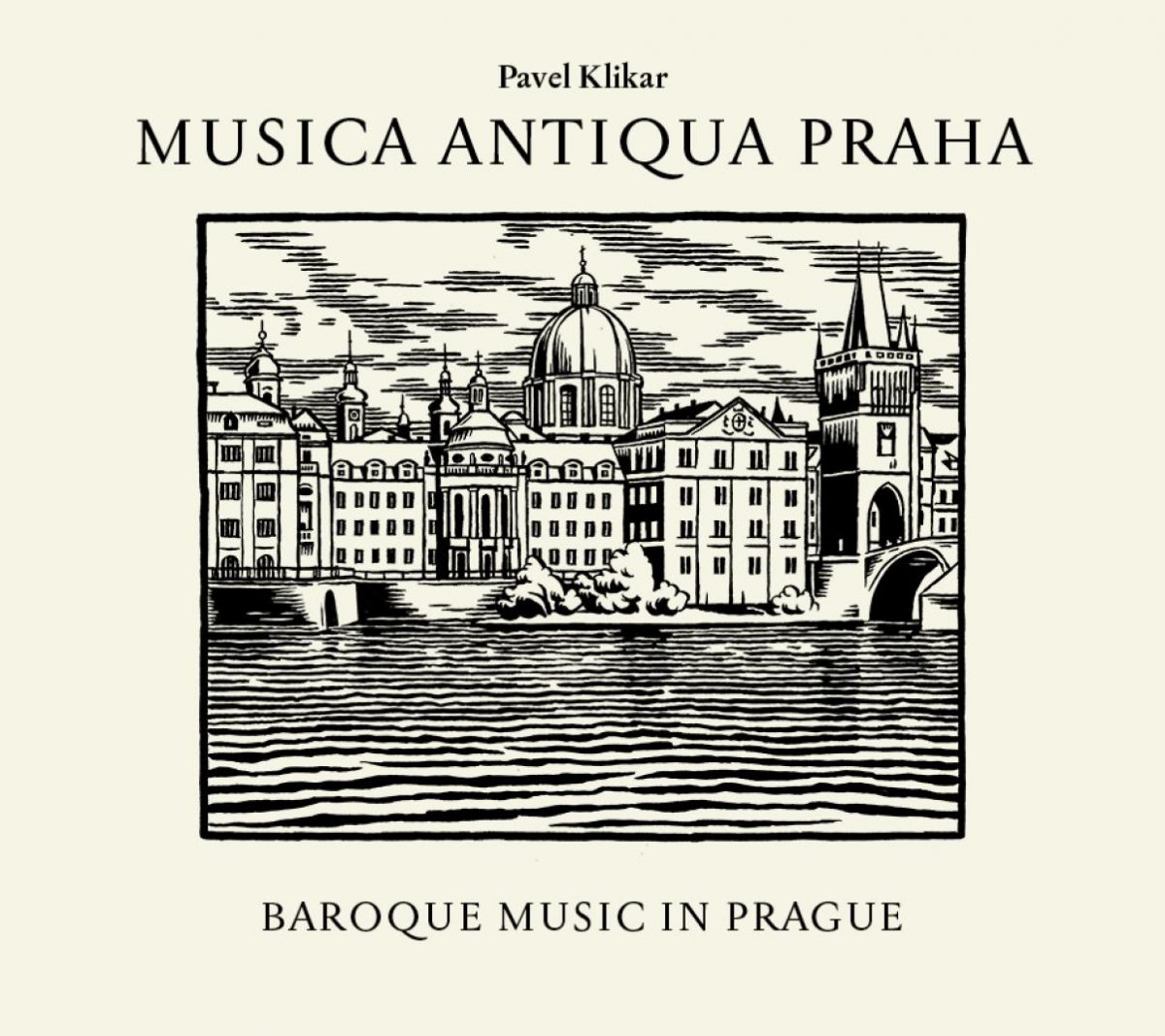
Baroque Music in Prague

Musica Antiqua Praha, Pavel Klikar
57:00
Animal Music ANI 108-2

When the record company got in touch about this recording, I was simultaneously intrigued and delighted; thirty years ago, a German friend invited me to join her on a trip to Prague, and one of the many exciting things we did was attend a concert in the beautifully restored Waldstein Palace (apologies to Czech readers for giving its name in translation!) by a group I’d never heard of, Musica Antiqua Praha. I was so impressed by the recital (including music by Grandi and Rovetta – and possibly the first time I’d ever encountered sonatas by Bertali!) that I bought the CDs that were available and later reached out to their director, Pavel Klikar, who kindly sent two more and one by his “other group” (the Original Prague Syncopation Orchestra!) Later, he also shared copies of his transcriptions as well as plans for future recordings which included, after a wonderful CD of previously unrecorded music by one of my favourite composers, Giovanni Legrenzi, and others devoted to Rigatti and Grandi (who are also on that list!) Just as suddenly as it had begun, the correspondence dried up and I haven’t heard anything for (or about) the group since. Until now!

This new disc of music from the archive of the Monastery of the Order of the Knights of the Cross with a Red Star (it’s even more of a mouthful in Czech!) is – like its predecessors – an absolute delight. Six vocal pieces and one instrumental sonata by composers who scarcely make it into the “also ran” category, all of them beautifully shaped and carefully crafted. The sessions may have been recorded in May 1996 but the sound is as crisp and bright as if they’d taken place yesterday. The booklet notes give insight into the history and activities of the Order, and describe each of the pieces with a brief biographical sketch of the four composers: Johann Caspar Ferdinand Fischer, Ferdinand Tobias Richter, Georg Reutter (the Older) and Benedikt Anton Aufschnaiter. Each of the pieces is cast in the familiar patchwork style with solos accompanied by strings, voices engaging in melodic duos and trios, and beautifully flowing contrapuntal Amens and Alleluias. The singing (as it always was with this group) combines lustre and clarity with warmth when required, and the playing complements it perfectly. A second note pays tribute to Klikar and the pivotal part that he played in putting Czech musicians at the forefront of the Early Music revival, and notes that the remarkable sound quality of these recordings is down to his decision to use only two well-placed microphones.

This beautiful disc filled me with joy (despite not understanding the Latin texts), tinged with a little sadness that there are no further tapes in the archive, so although the Grandi disc did appear, I’ll never hear their Rigatti performances.

If you’ve never heard of the group, I recommend you get hold of this and look for their other recordings (there is an absolutely beautiful Bohemian Christmas disc) – you won’t be sorry you did!

Brian Clark


Categories
Recording

A. Scarlatti: Cantate da camera

Lucile Richardot mezzosoprano, Philippe Grisvard, harpsichord
69:58
Audax Records ADX11206

Given that Alessandro Scarlatti wrote some 500 chamber cantatas, it is not surprising that recordings of them can frequently claim to be premieres. No fewer than four of the five included on the present CD are identified as such; I’m in no hurry to attempt verification or otherwise. The cantatas are set off by interspersed keyboard works, in particular two Toccatas (in A minor and G minor) that in keeping with the typical 17th-century character of such works are both virtuoso pieces that include quasi-improvisatory arpeggio passages. They are played with great dexterity by Philippe Grisvard on a modern instrument inspired by 18th-century Italian instruments.

Grisvard, whose notes are otherwise intelligent and helpful, opens by implying that opera in Rome in the second half of the 17th century was essentially an underground operation due to papal disapproval. It’s a curious misnomer and one that certainly does not, as he suggests, explain the popularity of the chamber cantata, which served the function of providing entertainment for the sophisticated audiences that gathered in the palace salons of sacred and secular princes. Almost entirely concerned with the Roman Arcadian literary movement that played such an important role in operatic reform around the turn of the century, the chamber cantata was predominantly the milieu of shepherds and shepherdesses and the complications of their love lives. The treatment ranged from tragedy to humour, but texts frequently alluded to allegory or metaphor, being written by such leading Roman figures as Cardinal Benedetto Pamphilj, one-time patron of both Scarlatti and Handel. One of his cantatas, ‘Sarei troppo felice’, figures in the present collection and is particularly interesting as an example of the extreme flexibility the form enjoyed. While most cantatas were cast as a simple alternation of plain recitative and aria, or the reverse, here the opening is an exquisitely set two-line rumination, ‘I would be only too happy, If I were master of my thoughts’, that becomes a linking ritornello for a series of philosophical musings that enjoy the freedom to move with ease between recitative and aria. The effect is extraordinarily modern, rather akin to a stream of consciousness dialogue.

Far from simply purveying the simple innocence of the pastoral life, the best of the chamber cantata repertoire is a demanding one for singers. I have lost count of the number of recordings of the genre that fail because singers treat it as an extension of opera, even as miniature operas. In fact, its demands are quite different, requiring an intimate approach in which text and music can be directly conveyed in a nuanced manner to an audience that is in close proximity to the performers.  The French mezzo Lucile Richardot and her accompanist well understand this. She is the possessor of what is intrinsically an unusually dark-hued mezzo, more contralto in timbre. Yet the voice has great range and colour, upper notes having the capability to surprise, sometimes bursting into brightness like the sun emerging from a darkened sky. Her chest notes are exceptional. Understandably she has particularly made her mark in French opera, yet recently she recorded a quite sensational Penelope in Monteverdi’s Il ritorno d’Ulisse in patria, a powerful assumption that drew full value from the all-important text. That attention to text is what makes these performances so completely engaging and idiomatic, along with a subtle and never overuse of rubato and portamento. Richardot also captures so well the humour, allegory and ambivalence of ‘La lezione di musica’, a cantata that delivers an unexpectedly painful conclusion.

There is so much here that is admirable – more than admirable – that it seems churlish to enter a caveat, but Richardot’s ornamentation is not as convincing or as efficiently articulated as it could be. Grisvard makes the point that the performers felt da capo ornamentation needed to be kept to a minimum in these works, which is arguable, particularly in the case of ‘Là dove a Mergellina’, Scarlatti’s last cantata, which is a more bravura work. But embellishments in general are not as fluently turned as is desirable. But that is a relatively small flaw in what from nearly all aspects is an exceptional recording of outstanding works.

Brian Robins

Categories
Recording

BACH

Barnaby Smith countertenor, Illyria Consort
72:16
VOCES8 Records VCM152

The countertenor Barnaby Smith has followed a CD of Handel with one of Bach, and this too is excellent. Not only is Barnaby Smith a first-rate musician: he is used to singing with others (in Voces8 most evidently) and he treats his instrumentalists as equal partners in his music-making, but he is an experienced director. This is all too rare among singers, many of whom are used to being soloists and to having lesser mortals as accompanists.

Not so on this finely prepared and executed CD, where attention to every line – instrumental as well as vocal – in this well-chosen programme counts. It begins with the 1735 version of the solo cantata BWV 82, Ich habe genug, where Barnaby Smith sings within himself, varying the tone and approach between the three very different arias and the more dramatic recitatives as old Simeon welcomes the Christ child and prepares to let go of this life. From the first, we are introduced to the kind of music-making we are to expect. In the opening phrase, the admirable oboist Leo Duarte subtly varies the rising figure between the first and the second (and fuller) entry of the rising theme, and this elegant rhythmic flexibility is mirrored by the voice when the singer enters.

This pattern of interchange between voice and instruments that is such a hallmark of Bach’s writing is exhibited in the next group of arias. First, in Erbarme dich from the Matthäus Passion, where the interweaving between Bojan Čičič’s violin and the singer stresses this group’s commitment to performing Bach as what the modern world knows as chamber music, a style stressed by including the duet Et in unum from the B minor with Katie Jeffries-Harris. In Es ist Vollbracht from the Johannes Passion, Reiko Ichise joins the starry cast of players and the virtues of playing one to a part are exhibited in the central section, where the paschal victory of the Lion of Judah is anticipated by the semiquavers of the strings as they underscore the D major trumpet calls of the brilliant vocal part.

In cantata 170, another solo cantata for alto, it is the turn of Steven Devine, the organ player, to shine. Not only does he lead the jaunty concerto-like last movement with a perky obbligato, but he manages the two intertwined lines above the basset bass of upper strings on a single manual. A comparison with the fine recording of this cantata by Damien Guillon with Le Banquet Céleste using a substantial organ at A=415hz, built in 2007 for the Église du Bouclier in Strasbourg, is instructive. Barnaby Smith comes out with a clarity of tone and an enviable flexibility that makes blending with his players sound easy and natural, the result of singer and players listening to each other, players picking up the phrasing dictated by the underlay, and the singer alive to how the instruments articulate each passage.

The other plus of this CD is Barnaby Smith’s liturgical sense. We end this recital with two pieces – the well-known Agnus Dei from the B minor mass and an aria of Mary Magdalen’s from the Easter Oratorio. In the Agnus, we hear the voice in its unadorned purity of line as it is given sinuous counterpoint in dialogue with the upper strings, and in the aria Saget, saget mir Geschwinde we jump into a sprightly movement, where the oboe d’amore takes wing and provides the colour in the ritornelli that seem to be part of a concerto for d’amore until the voice takes centre stage. Here we hear some other delights: a fagotto seems a natural addition to the continuo line (as does a harpsichord), and we might hardly be aware of its presence till in the piano at the start of the middle section it – very properly – dips out. It is this kind of attention to detail in the preparation of this performance that makes it not just a musical delight, but an important exercise in how to perform this music which everyone interested in performance practice should study.

This is a superlative recording, and the clips of various numbers from the CD available on Youtube will increase its value. All readers of EMR should buy it, and learn from it. This is how to do it.

David Stancliffe

Categories
Recording

J. S. Bach Libro Primo | 1720

Guillaume Rebinguet Sudre violin / harpsichord / organ
150:00 (2 CDs in a card triptych)
Encelade ECL 2001

These two CDs of the Sei Soli are a novel addition to our experience of Bach and multi-tasking. Like Bach, Guillaume Rebinguet Sudre plays both violin and keyboard instruments: the violin is a copy by Christian Rault in 2015 of a Jacob Stainer of 1699, the harpsichord he made himself in 2015 and is modelled on three Mietke instruments (Bach is known to have travelled to Berlin in 1719 to take delivery of one that had been ordered by the Prince of Anhalt-Köthen) and the organ is by Andreas Silbermann of 1718 and was restored by Blumenrode in 2015 for Sainte-Aurélie, Strasbourg. The performances were all recorded in lock-down, and like others of that period offer an insight into how players passed that time in a series of rather introspective, self-critical solo performances. 

Exploring the resonances and implied if not entirely realised harmonies is a good mental exercise and bears out C. P. E. Bach’s comment that his father composed in his head but afterwards would try it out on a keyboard. Bach was already experimenting from the two-part inventions onwards how to develop a melodic phrase in such a way as to make it capable of being the germ of a complex polyphonic structure. Such a phrase might immediately suggest a countersubject, or be capable of inversion, augmentation or diminution. Such compositional skills had been an expected stock in trade of those early Renaissance composers like Obrecht, Ockeghem and Josquin, but reappear as key techniques in Bach’s ever-resourceful inventiveness. It was this ability to hear the implied harmonic structure of a particular melodic line that is revealed by his pupil J. F. Agricola’s comment that Johann Sebastian would sometimes play one of the suites or partitas he had written for a solo instrument on a keyboard, filling out the implied harmonies: 

their author often played them on the clavichord himself and added as much harmony to them as he deemed necessary. In doing so he recognized the necessity of resonant harmony which in this kind of composition he could not otherwise attain. 

This is what these CDs offer: CD 1 opens with the cembalo version of the opening Adagio of BWV 1005, which we hear in its violin version on CD 2.7. 

CD 2 opens with the Prelude BWV 539 which has been added to the keyboard version of the Fugue from the violin sonata BWV 1001.ii which we hear on CD 1.3. We do not know whether the transcription of the fugue for keyboard is from Bach’s own hand, and the authenticity of the Prelude is doubted, as no version before c. 1800 is known. On CD 1 the third Sonata is the cembalo version of BWV 1003, BWV 964. So we hear Rebinguet Sudre play the organ (manualiter) and harpsichord as well as the violin. He plays with a considered gravitas, emphasised when he moves to a more resonant acoustic for the violin recordings on CD 2, and offers us a take that might not have seen the light were it not for the lockdown. 

While I am grateful for his passion and dedication – not least in the very fine harpsichord he has built – I am not entirely convinced by his mystical account of Bach’s supposed state of mind as he wrote these pieces. 

David Stancliffe

Categories
Recording

Hebenstreit’s Bach

La Gioia Armonica (Margit Übellacker dulcimer, Jürgen Banholzer organ)
66:10
Ramée RAM 2101

This recording is a delightful re-imagining of a number of Bach sonatas and movements for solo violin or violoncello played on a dulcimer and organ. It is inspired by Margit Übellacker’s conviction that the hammered dulcimer – developed by Bach’s near contemporary Pantaleon Hebenstreit – was the instrument that Bach came across when a ‘foreign musician’, possibly Hebenstreit himself, came and displayed his instrument at the court of Köthen in July 1719. Hebenstreit’s instruments were made by Gottfried Silbermann and were one of the inspirations behind the development of the fortepiano, being admired by Bach’s predecessor in Leipzig, Johann Kuhnau, who was intrigued by the possibility of shading rapidly from forte to piano that the dulcimer offered. 

Übellacker’s instrument is a tenor dulcimer made by Alfred Pichlmaier of Fraunberg in 1997 and the organ is the 1990 instrument built to hang over the gallery in the Erlöserkirche in Bad Homberg by Gerald Woehl, after a specification by J. S. Bach for Bad Berka in 1743. 

The works presented are the sonatas in G (BWV 1019) and A (BWV 1015) for violin and obbligato harpsichord, the sonatas in E minor (BWV 1023) and G (BWV 1021) for violin and basso continuo, two movements from the cello suites (BWV 1009.iv and 1007.i) and one from Partita III (BWV 1006.i). Like other adaptations (and here I am thinking especially of the versions of the Trio Sonatas for organ arranged by Richard Stone for Tempesta del Mare, Chandos: CHAN 0803), I rather enjoy these performances: they make you listen with new ears, and the surging arpeggios seem to suit the instrument well, so for my money the Preludio in C BWV 1006.i, a version of Partita III in E or the Prelude in D BWV 1007.i from the G major cello suite sound the most plausible. 

This may be an acquired taste, but it certainly has more claims to authenticity than performances on a fortepiano. You should listen to it, and read the campaigning essay by Margit Übellacker. 

David Stancliffe

Categories
Recording

Beethoven: Piano Trios, op. 1, nos. 1 & 2

Rautio Piano Trio
60:36
resonus RES10305

To my mind, one of the great pleasures of early Beethoven is encountering the future giant as he flexes his muscles, makes his first confident flights of fancy and exercises his ever-increasing power and strength. While admitting there is of course more than a fair share of wisdom after the event about making such an observation, it is nonetheless substantially true. It certainly is, I think, regarding the three Piano Trios of op 1. First given in 1793 at the Viennese home of Beethoven’s patron Prince Lichnowsky, to whom the trios were dedicated, they were revised before publication two years later. Advised by Haydn to make changes, Beethoven not only admitted to his youthful profligacy, observing he had introduced into one work ‘enough music for twenty’, but thanked Haydn for his advice. When the trios were published in 1795, very likely courtesy of a secret subvention by Lichnowsky, they were a great success among the Viennese. It is said they earned him nearly two years’ worth of the salary he had been paid in the post he occupied in Bonn before coming to Vienna.

One of the first things to be noted about the op 1 trios is their ambitious scale. Unlike the three-movement trios of Haydn and Mozart, they are cast in four movements and planned as expansive works, which, if no longer containing enough ideas for twenty, are arresting pieces overflowing with the young composer’s sheer joie de vivre and the unadulterated pleasure of composing. It is these qualities that are so convincingly and compellingly communicated by the period-instrument Rautio Piano Trio (Jane Gordon, violin; Victoria Simonson, cello and Jan Rautio, fortepiano). Both string players play original 17th-century instruments, by G B Rogeri and G Granico respectively, while Rautio’s is based by Paul McNulty on an 1805 Viennese fortepiano built by the Walters. It’s an exceptionally fine-sounding instrument, with an appealingly silvery top and a richly endowed bass capable of powerful chords when necessary. To hear how well and beguilingly the instruments can interact, try the lovely Adagio cantabile (ii) of the Trio in E flat (No 1), where the violin’s song-like melody is joined in dialogue by the cello and then delightful filigree work by the piano, all beautifully balanced. Throughout tempi are well judged, with the players not misled in the ‘slow’ movement of the G-major Trio by the Largo con expressione marking, achieving just the right flow for the movement. And for sheer exuberance go the Finale of the same Trio, with its headlong chasse-like impetus disrupted only by what sounds like a bucolic dance. Technically the playing is of a high order, with Rautio himself, as one might expect in these works, stealing the thunder, his splendid articulation and clean finger-work being a constant pleasure.  Just occasionally I thought the violinist’s tone a little thin, though this may be the recording, which in all other aspects is fine. Overall this is an outstanding addition to the catalogue and it is much to be hoped that the Rautios will complete the set with the C-minor Trio.

Brian Robins