Categories
Recording

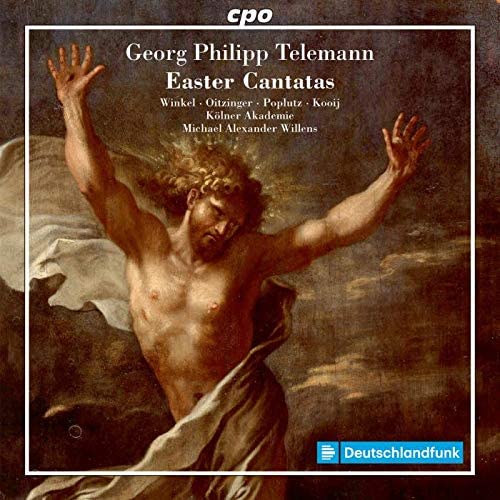
Georg Philipp Telemann: Easter Cantatas

Johanna Winkel, Margot Oitzinger, Georg Poplutz, Peter Kooij, Die Kölner Akademie, Michael Alexander Willens
71:40
cpo 555 425-2

Click HERE to buy this on amazon.co.uk
[These sponsored links help the site remain alive and FREE!]

This label appears to be on a mission to explore the many varied facets of this prolific baroque master’s oeuvre, and here we have a fine selection of cantatas for Eastertide from some rather lesser-known cycles, notably the Lingen II and the “Cycle without Recitative”. There is also a work from the Brussels holdings which might just be in borrowed plumage of another’s colours or a “Cuckoo’s egg” in the nest as Prof. W. Hirschmann’s booklet note puts it. Hermann Ulrich von Lingen was court secretary in Eisenach; the first cycle was conceived in Hamburg 1722/23, the second in 1728/29. The show piece here is TVWV 1:1424, Triumph! ihr Frommen freuet euch, opening with a very fine Sinfonia for trumpets and drums, moving through some really resplendent and effective movements, concluding with two splendid choruses and a chorale. The triumphant sheen of Eastertide victory is delivered with extremely accomplished playing and singing. The CD opens with much more modest forces (two violins, viola and continuo*) which provide ample contrast from sepulchral textures to befittingly lively passages as per the text: Ich war tot und siehe, ich bin lebendig! [I was dead, and behold, I am alive!] The chorales here feel a tad rushed to my ear. Now to the possible cuckoo, Er ist auferstanden TVWV1:460. While it has some quite nice features, it is not as finely woven; it feels rather terse in expression and ends abruptly with the chorale, Nun danket alle Gott. The two remaining works fall comfortably back into home territory with some highly expressive writing for the strings. Brannte nicht unser Herz in uns TVWV1:131 (from the “Cycle without Recitative”) cuts along with some exceptional movements: the soprano aria “Ach wie selig” is a dazzling display of Johanna Winkel’s talent. The other soloists deliver cogent and most deft performances, notably Georg Poplutz, whose diction is amazing (just listen to track 30). Verlass doch einst, o Mensch TVWV1:1470 (from the Lingen II cycle) offers much to admire, even with modest forces.* The descriptive scope inspired by the text reveals a composer both musically and spiritually aware and able. These are tremendous explorations of lesser-known cycles outside the “Telegentzia”, and there’s plenty more where these came from. How some of these facets do truly sparkle!

David Bellinger

Categories
Recording

Handel: Messiah

Julia Doyle, Tim Mead, Thomas Hobbs, Roderick Williams, RIAS Kammerchor Berlin, Akademie für Alte Musik Berlin, Justin Doyle
134:30 (2 CDs)
Pentatone PTC 5186 853

Click HERE to buy this on amazon.co.uk
[These sponsored links help the site remain alive and FREE!]

This is a beautifully crisp and clear account of the iconic Dublin 1742 Messiah with a fine period-instrument ensemble in the Akademie für Alte Musik Berlin, a fine choir in the RIAS Kammerchor and a stellar line-up of soloists and a sensitive and conductor. The pacing of the music is to my mind perfect, the English soloists decorate their da capos with imagination and authenticity, the smallish orchestral forces are seriously impressive (I love the inclusion of a lute in the continuo section and a contrabassoon in the orchestra, but would like to have read some sort of justification) and the choir sing with exemplary definition and clarity. So what is not to like? Well, let me tell you – inexplicably the entire programme note consists of a spurious and frankly silly dialogue between Handel (‘Freddie’) and his librettist, Jennings. I have to admit to hating the trend towards programme notes as dialogues between conductor and expert, or among performers, but surely a makey-uppy chat between composer and librettist featuring the phrase ‘Gladly. But after that we’ll keep arguing. Deal, Freddie?’ strikes an all-time low. Whose appalling idea was this? This shocker is compounded by the disrespect of including no biographical details about the soloists or the conductor – the ubiquitous and superb Roddy Williams requires no introduction, but the others do, and it is a great shame that they are denied the profile they deserve. I would suggest that you buy this recording, whose virtues are many, and particularly that you google the soloists and conductor, but please tear out the fortunately easily detachable programme note and throw it away before it annoys you as much as it did me!

D. James Ross

Categories
Recording

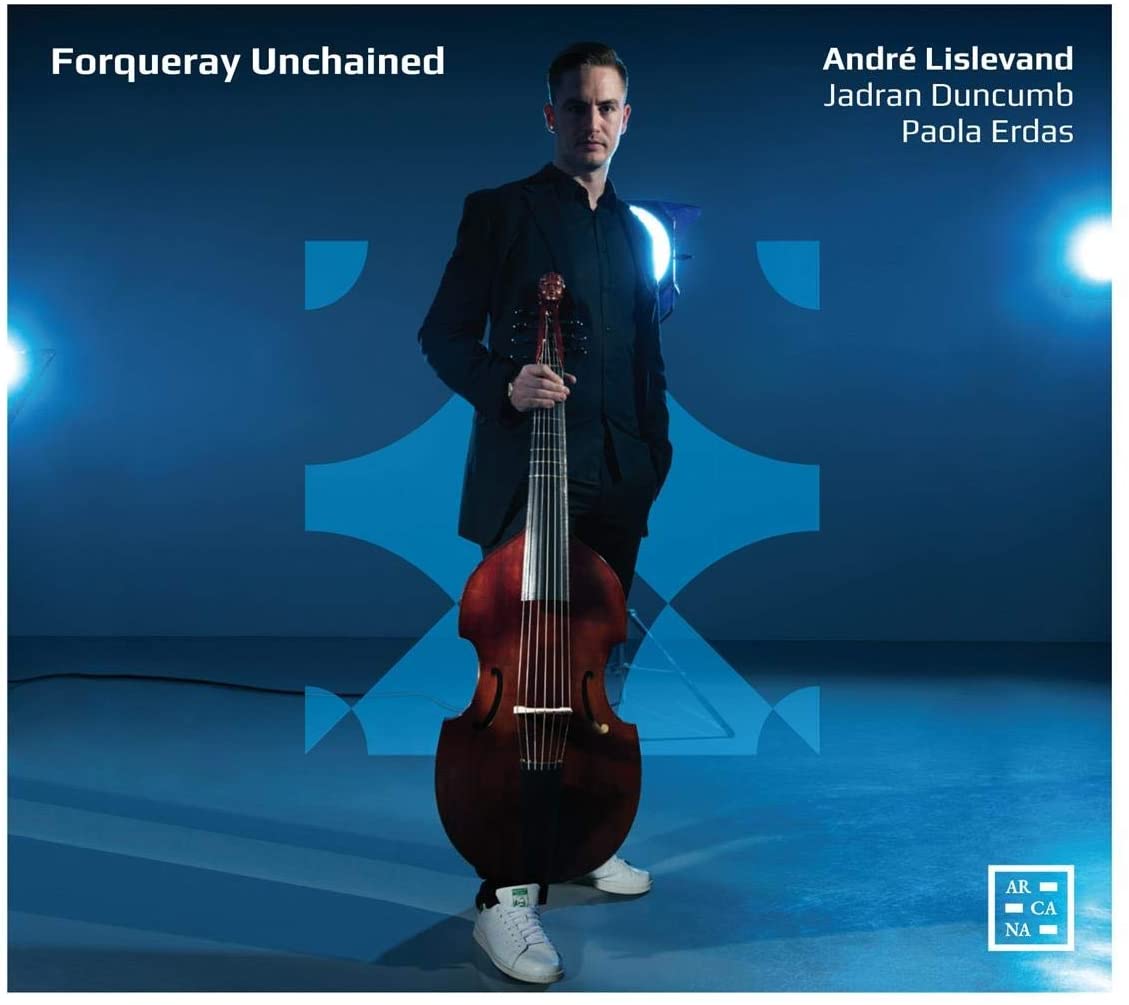
Forqueray Unchained

André Lislevand, Jadran Duncumb, Paola Erdas, feat. Rolf Lislevand
61:49
Arcana A486

Click HERE to buy this on amazon.co.uk
[These sponsored links help the site remain alive and FREE!]

I’ve been hoping for some Forqueray (who was born in 1671) in this anniversary year and here we have three artist-compiled suites in which his music is predominant, but complemented by selections from the work of Marin Marais, Robert de Visée, and Louis Couperin. The gamba is mostly accompanied by theorbo, though occasionally (and unnecessarily) also by harpsichord. I did, however, enjoy the keyboard’s rich solo – Couperin’s Passacaille.

Forqueray’s demands on his interpreters are considerable, but André Lislevand is absolutely on top of his game and not afraid to explore the extremes of his instrument’s aesthetic world though without ever losing touch with le bon goût. From time to time he is perhaps a little too gentle compared with the more incisive theorbo, though it might be, of course, that the latter needed to curb his enthusiasm in places. But theirs is an audibly happy collaboration and the actual programme is excellently conceived.

The booklet (in English, French, and Italian) contains the usual biographies and three short essays which, as seems to be the current fashion, give us the music’s context but say little specific about its content, though this would surely be welcomed by anyone new to the repertoire.

David Hansell

Categories
Recording

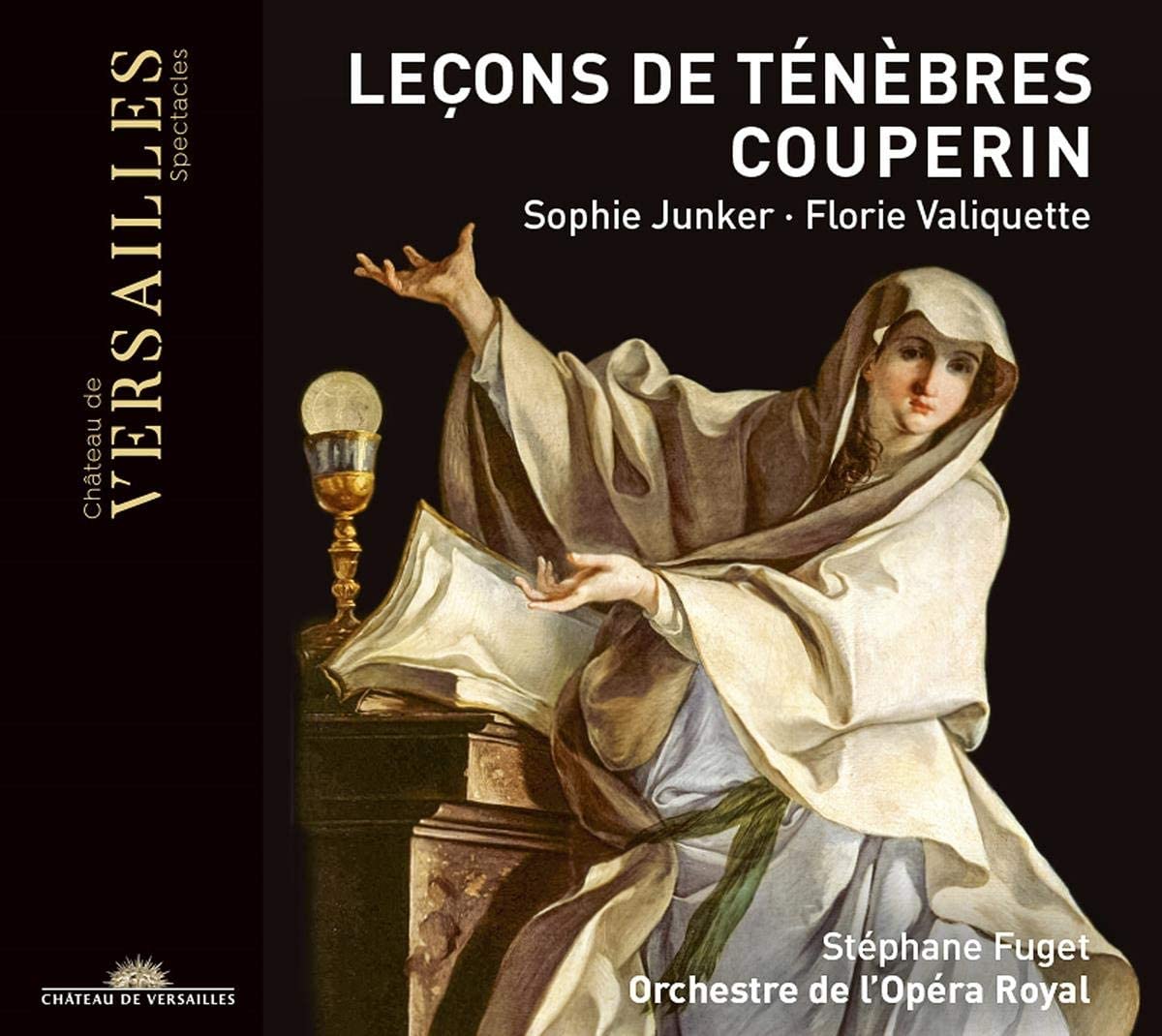
Couperin: Leçons de ténèbres

Sophie Junker, Florie Valiquette, Orchestre de l’Opéra Royal, Stéphane Fuget
53:03
Château de Versailles Spectacles CVS034

Click HERE to buy this on amazon.co.uk
[These sponsored links help the site remain alive and FREE!]

I usually end with a few comments on the booklet of the releases I review for EMR, but here I’m going to start with it. It’s odd! The essays (in French, English, and German) are a very general survey of ornamentation practice in France and an equally all-purpose biography of Couperin which devotes just half a dozen lines to the recorded repertoire. And the Lalande Cantique, the second-longest item in the programme, is not mentioned anywhere. At least the sung texts are translated into all the languages used elsewhere.

I’m sure that EMR readers will be aware of this brilliant music, and the equally brilliant recording by Emma Kirkby and colleagues. For me, that remains the benchmark for its purity of line and overall ability to let Couperin’s music speak to us directly. Here, I find I am over-aware of the performers: the singers just try too hard, and this leads to the upper voice dominating the duet sections. Also distracting are the changes of continuo sonority within a piece. Couperin does suggest both harpsichord and organ as possibilities but I doubt that he imagined this alternation.

It was brave of the ladies to programme the Easter motet Victoria as Emma and co. did. I’m afraid they don’t really come up to the mark, with a lack of clarity in the coloratura sections and some very clipped phrasing. And the balance in the duet sections is not good – again the higher voice dominates.

Overall, therefore, this has to go down as a disappointing release from a source that usually offers more joys.

David Hansell


Categories
Recording

La Famille Rameau

Justin Taylor harpsichord & piano
78:41
Alpha Classics Alpha 721

Click HERE to buy this on amazon.co.uk
[These sponsored links help the site remain alive and FREE!]

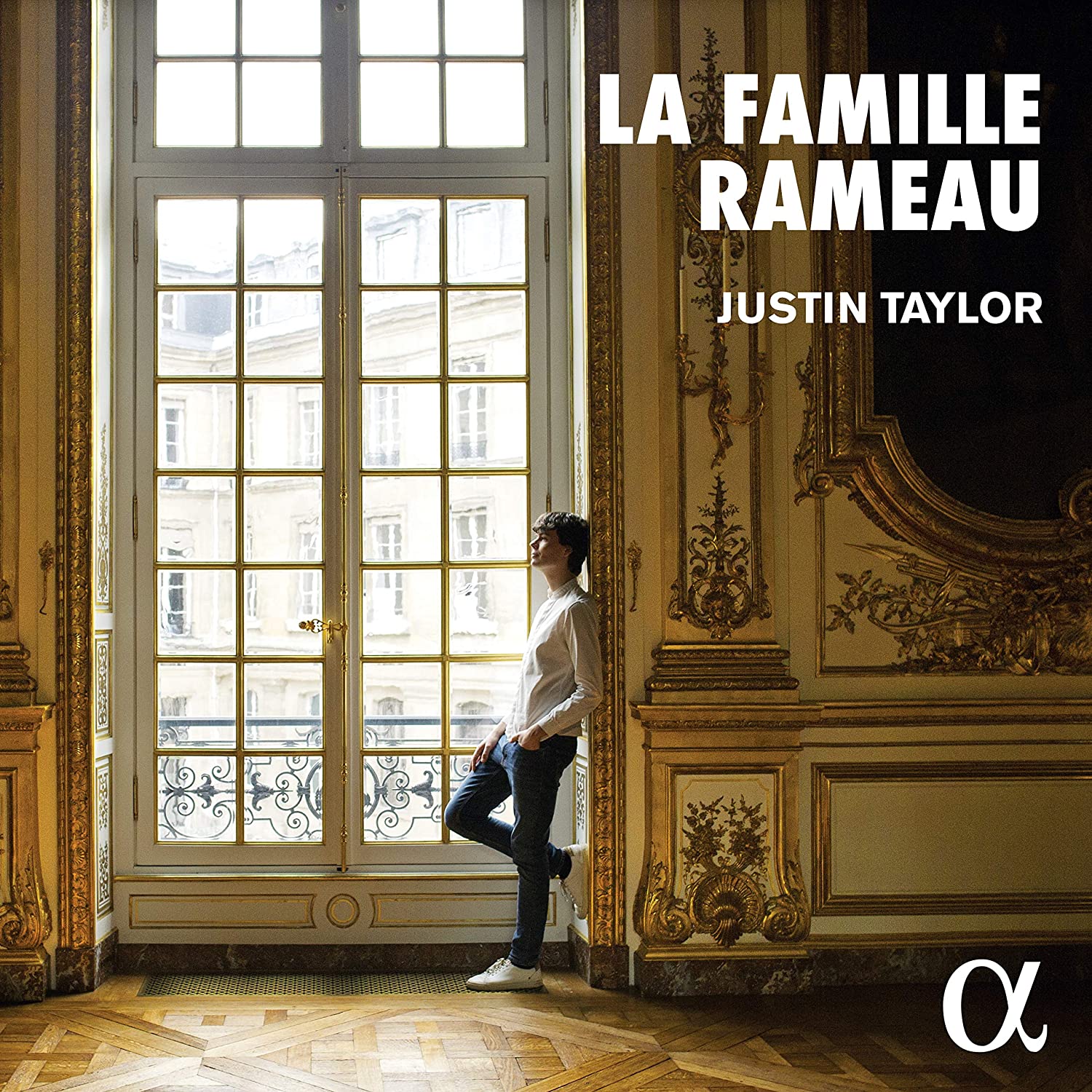
Justin Taylor’s La Famille Forqueray now has a sequel of the highest standard. This programme includes a number of Jean-Philippe’s more popular pieces and music by one of his sons, his younger brother and a nephew. In addition there are two tributes: a set of variations on Les sauvages by J-F Tapray and (pause for fanfare and drumroll) Debussy’s Hommage à Rameau. This is played on a lovely 1891 Erard piano, a worthy complement to the fine double-manual harpsichord attributed to Donzelague used for the bulk of the programme.

Such splendid instruments deserve splendid playing and from the multiple-award-winning Justin Taylor they certainly get it. He is not afraid to go his own way with the ‘standards’ (though I did find his tempo for J-PR’s famous gavotte a little ponderous, even if the variations did not disappoint) and unfamiliar repertoire has been well chosen and thoroughly prepared.

Taylor also wrote the contextualising essay (the booklet is in French, English and German) though I doubt that it was his decision to print his biography as a page all in upper case type! This looks quite bizarre and is actually difficult to read.

But the playing and programme are tremendous. Treat yourself!

David Hansell

Categories
Recording

Soleil Noir

Arie da e per Francesco Rasi 1574-1621
Emiliano Gonzalez Toro, I Gemelli
51:45
naïve V 5473

Click HERE to buy this on amazon.co.uk
[These sponsored links help the site remain alive and FREE!]

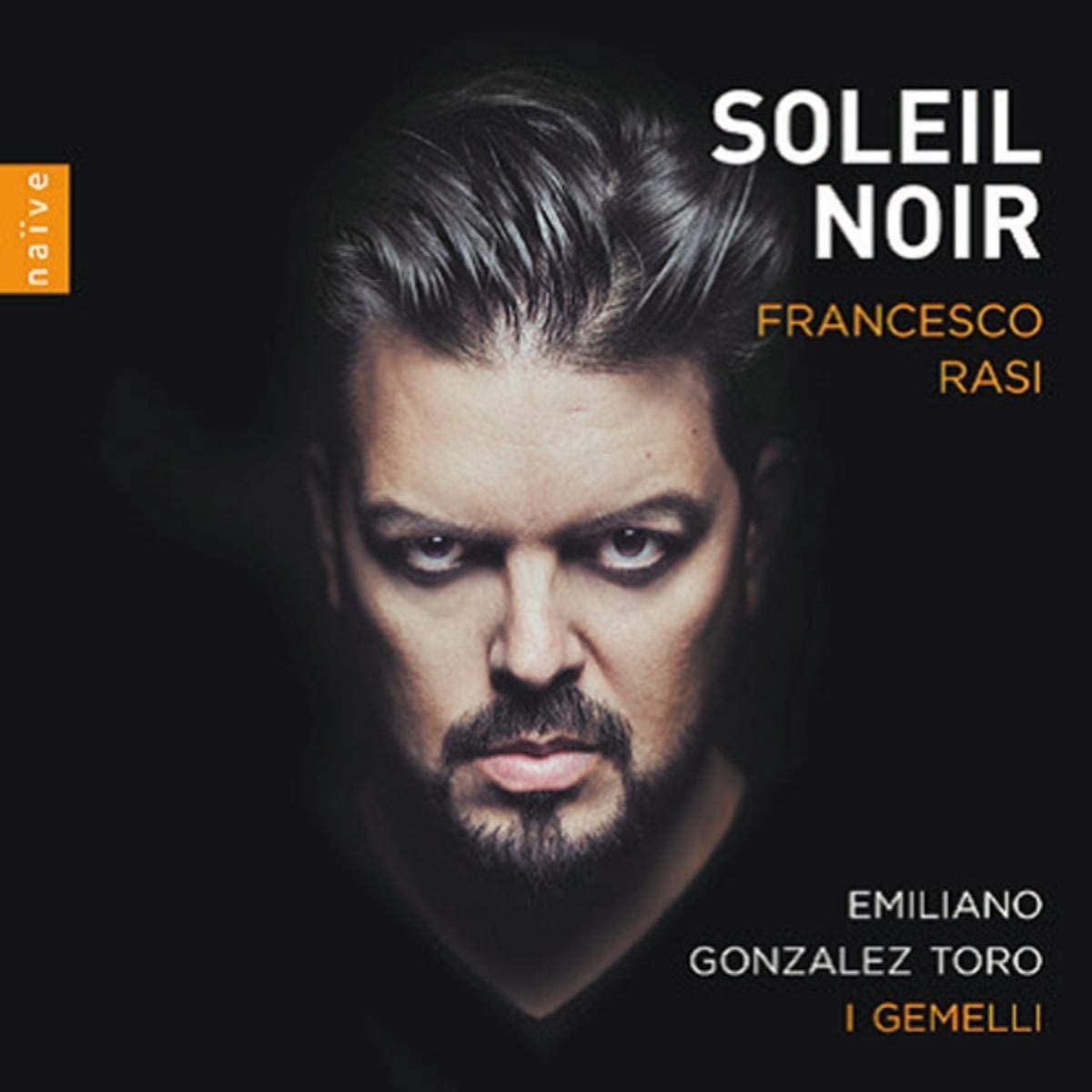
Don’t be put off by the sombre title (black sun) or the cover photo of a satanic-looking Emiliano Gonzalez Toro. Yes, there is darkness here, but there is also light, humour, joy and whimsy in this superbly performed collection of music from the late 16th/early 17th century.

It is centred on the music of one of the lesser-known composers of the day, Francesco Rasi (1574-1621). But like so many composers at the dawn of the new century Rasi was also a singer – and not just any old singer but one of the greatest of the period. Monteverdi enthusiasts will indeed need no reminding that he was the creator of the role of Orfeo in that composer’s eponymous opera. Born into a noble Tuscan family, Rasi studied with Caccini, becoming a singer and chitarrone player at the Florentine court. Later his colourful life led him to Rome, to Mantua (where he served the Gonzaga family and encountered Monteverdi), to travels in Italy with Gesualdo, to Poland and a ten-year exile from Tuscany after being implicated in a murder. Gonzalez Toro and his co-note writer Mathilde Etienne tell us that Rasi was a ‘dark, cruel and tormented figure’, a description that hardly accords with his contemporary Severo Bonini’s testimony that ‘his sweet and robust voice together with his majestic and cheerful countenance made his singing angelic and divine’.

‘Sweet and robust’ would provide an eloquent summation of the singing of Gonzalez Toro here. As he notes the present recording was done after much work on Monteverdi’s Orfeo, work that subsequently resulted in a superlative recording of the opera issued at the end of 2020. Appropriately enough the new CD opens with a quite stunning setting of a lament for Orfeo by Rasi himself. It embraces the whole armoury of technique employed by singers of the day, with ornamentation at least as extravagant as that Rasi provided for Monteverdi (which is what we today usually hear in performances of the latter’s opera), acutely observed word-setting, and the most internal of responses to sensitive and grief-laden passages. It’s an inspired piece that makes one greatly regret the loss of Rasi’s two operas. It is sung with all the superb technique and insight Gonzalez Toro brought to Monteverdi’s title role, with perfectly articulated ornamentation, acute, insightful attention to the text and where appropriate exquisite mezza voce singing that recalls to mind the ‘angelic and divine’ description of Rasi’s singing.  Among six other pieces by Rasi, we are given in the opportunity to hear him with a more ‘cheerful countenance’ in the delightful ‘O che felice giorno’, a strophic song articulating the near-breathless ecstasy of the lover welcoming the beloved home after having been parted from him.   

The recital is however by no means all about Rasi, including as it does music by other composers, intelligently chosen to complement his music with that of contemporaries with whom he was associated. For example, in 1608, the year after he had premiered Orfeo, Rasi sang the role of Apollo in Marco da Gagliano’s La Dafne, the heartfelt lament for Apollo in recitar cantando is included here in a performance notable for its elegance and style encompassing a range of emotions, the final prayer-like invocation sung with a graceful eloquence that touches the heart. To give mention to all the treasure here is not feasible in the context of a review, though I cannot resist the temptation to include Caccini’s strophic ‘Dalla porta d’Oriente, the playful exuberance of its hemiola rhythms irresistibly carried forward by Gonzalez Toro.

In addition to the vocal items, each member of the continuo ‘backing group’ (viola da gamba, harp and theorbo) is given a moment to shine, a well-deserved bonus for them and the listener. Two niggling complaints: the playing time is very short and, perhaps more seriously, the font used for the texts is absurdly small, about 8 I’d guess. Still, I’m not going to let that stop me enthusiastically hailing this wonderful CD by arguably the most stylish and finished interpreter of this repertoire singing today.

Brian Robins

Categories
Recording

Kerll: Complete Harpsichord and Organ Music

Matteo Messori
173:05 (3 CDs in a case)
Brilliant Classics 94452

Click HERE to buy this on amazon.co.uk 
[These sponsored links help the site remain alive and FREE!

This 3 CD set of all Kerll’s surviving keyboard works is likely to become the benchmark recording, and was only released in 2021 despite having been recorded in 2012, it appears. There is an excellent and substantial (10 page) essay on Kerll by Matteo Messori in the liner notes, together with details of the instruments on which the recordings were made. As well as being a harpsichordist and organist with many recordings to his name, Messori also founded Cappella Augustana with whom he recorded the complete Schütz for Brilliant Classics: these are fine recordings and established his credentials as a scholarly and musical interpreter of 17th-century German music.

In his lifetime, Kerll was a famous keyboard player and teacher and enjoyed the patronage of the Imperial Court, so spent time in Vienna, where he wrote his Missa in fletu solatium at the time of the plague and the Turkish invasion of 1683. An influential teacher, who probably taught Pachelbel as well as Fux and had his compositions parodied by Bach and Handel, his keyboard music is in the post-Frescobaldi style popularised by Froberger. Having been a pupil of Carissimi in Rome, his operas and much of his church music has been lost. Some masses survive and these keyboard works including the justly famous Modulatio organica, that sets verses of the Magnificat to alternate with the Gregorian chant in all eight modes.

The organ used in this recording is the 1732 instrument built by J. I. Egedacher in the Pfarrkirche in Vornbach am Inn, which was conserved by Kuhn in 2009, having its pitch of A=465 reinstated. It has a Bavarian/Italianate style that matches Kerll’s musical pedigree and is well recorded for this project. Kuhn’s website provides details of the complex history of the instrument and the specification; no details are given in the liner notes of the detailed registration chosen. Of the three harpsichords used, two are copies by Romain Legros – one of an anonymous instrument in the Ca’ Rezzonico museum in Venice and another after Giovanni Battista Giusti (Luca 1681) – and one by Barthélémy Formentelli after a southern French instrument. All three have a full resonance and seem suitable, though no details are provided of the originals.

CD 1 has the toccatas and canzone, CD 2 the four suites with the Ciaccona, Passacaglia, Capriccio sopra il Cucu and Battaglia played on the three harpsichords, and CD 3 the Modulatio organica super Magnificat octo Ecclesiasticis tonis respondens  (1686) played entirely on the organ. The acoustic in the church is not overpowering, so the change from one of the harpsichords to the organ in CD 1 seems perfectly plausible, even though the slight pitch difference provides a little frisson. After the fluent, improvisatory nature of the toccatas the measured part-writing of the canzone provides a welcome contrast and the use of a single 4’ on the organ for the central section of Canzone quarta is a good touch.

Modulatio organica super Magnificat, the work for which Kerll is best known, takes us through the proper transpositions of the eight tones and allows us to experience the clarity of the various registrations of the organ in the contrapuntal part-writing. Each organ verse is preceded by its proper plainsong sung by the male soprano, Lukasz Dulewicz, to fine effect. Messori captures the improvisatory nature of what might often have been the quite short extemporised verses performed by Kerll very convincingly and confirms my belief that this is the definitive performance for this oeuvre.

Anyone who needs to understand the link between the Italian and the German composers for keyboard in the seventeenth century will be rewarded listening to these enlightening performances.

David Stancliffe

Categories
Recording

Bach: Concerto à Cembali concertati vol. 4

Concertos for 3 & 4 harpsichords
Aapo Häkkinen, Miklós Spányi, Cristiano Holtz, Anna-Maaria Oramo, Helsinki Baroque Orchestra
77:45
Aeolus AE-10107
+Müthel: Duetto in E-flat major

Click HERE to buy this on amazon.co.uk
[These sponsored links help the site remain alive and FREE!]

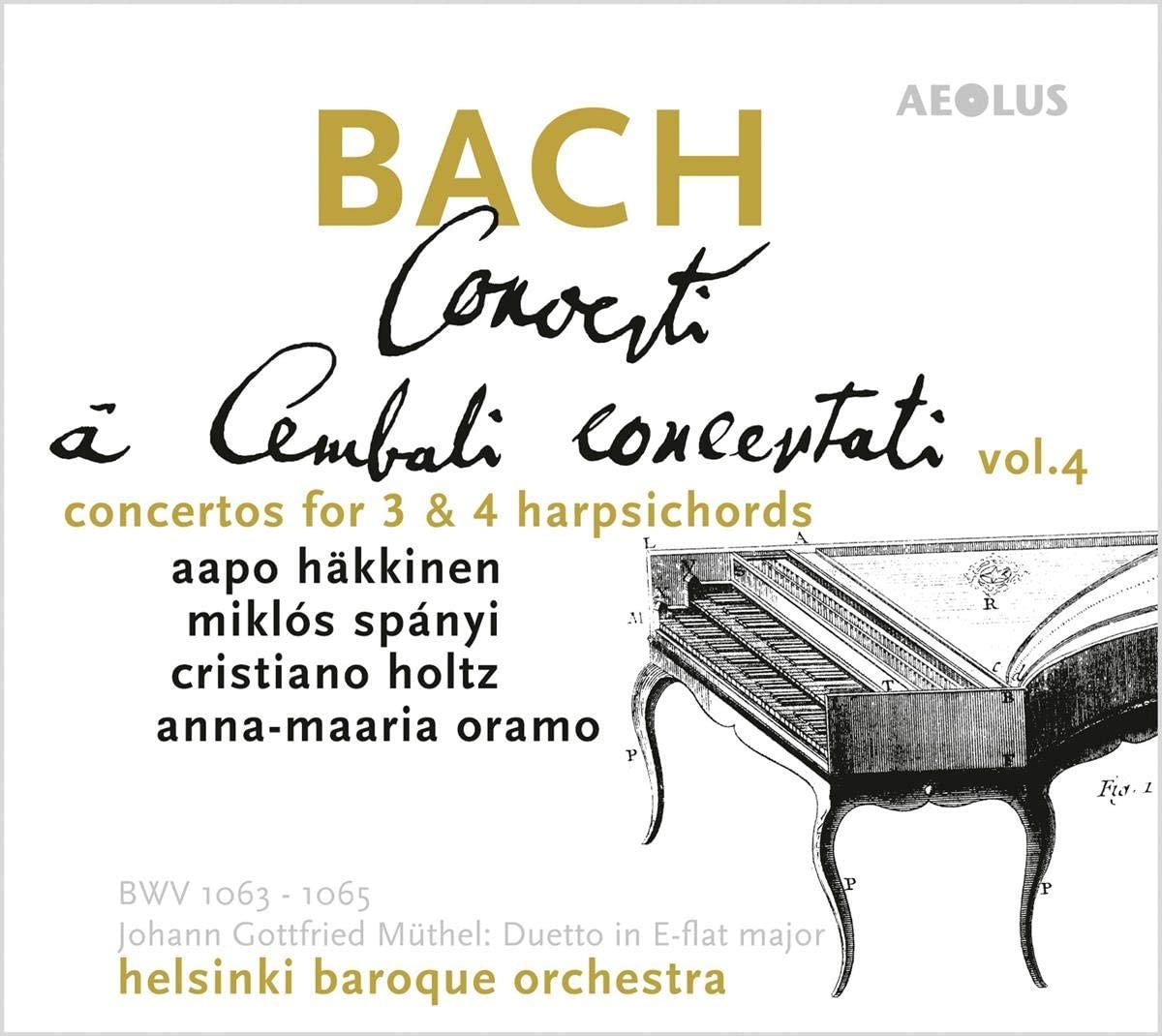
This recording brings the set of four CDs of Helsinki Baroque Orchestra’s recording of Bach’s Concerti à Cembali concertati, with Aapo Häkkinen as the leading harpsichordist, to a conclusion. The first volume was released in 2012.

The playing is light and bright, and with one-to-a-part strings, the harpsichords – especially in BWV 1065 – are in no danger of being smothered. As in the previous recordings, the Helsinki Baroque Orchestra plays on an interesting array of instruments with violins by Stainer and Klotz, a viola by Leclerc c. 1770 and a ‘cello from Rome c. 1700. The odd one out is a Bohemian double bass dated 1840, and it sounds like it: much too boomy in some places. Clearly, they do not always play with a 16’ – there is a delightfully transparent Youtube video of their performance in Japan of Brandenburg V which not only eschews a 16’ violone but has only two other upper strings alongside the concertante violin! So why use a double bass when a slighter-toned violone would have matched the other strings far better?

The ‘filler’ in this volume – it has included pieces for single harpsichord in the earlier volumes like the Italian concerto – is a quite different piece: Johann Gottfried Müthel (1728-1788)’s Duetto in E-flat major of 1771 is in three movements played here on two closely-recorded clavichords from the very end of the 18th century, reminding us of the continuing popularity of the clavichord as a boudoir instrument, which is just what is right for this piece.

I have quite a few recordings of the complete set of harpsichord concerti: Ton Koopman with the Amsterdam Baroque Orchestra from the early 1990s, Trevor Pinnock with The English Concert, Lars Ulrich Mortensen with Concerto Copenhagen, and there is Pieter-Jan Belder with the Amphion Consort for Brilliant Classics and Davitt Morony with colleagues on historic instruments – all of which have strong claims as a complete set.

Only the more recent like Concerto Copenhagen, the Amphion Consort and the emerging (but not yet complete) series with Francesco Corti and Il Pomo d’Oro use (rightly to my mind) single strings, so this recording may be a good choice.

David Stancliffe

Categories
Recording

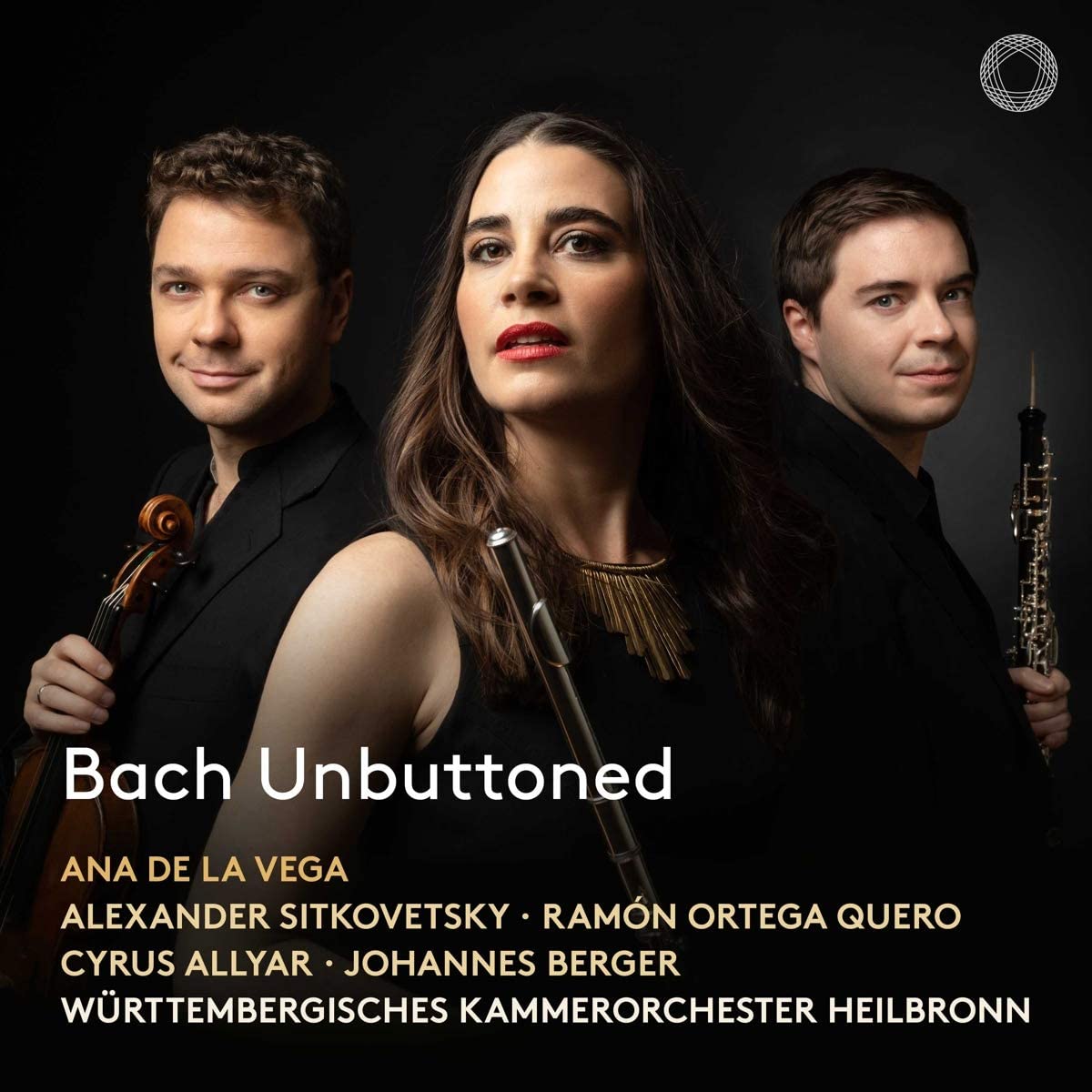
Bach Unbuttoned

Ana De La Vega flute, Ramón Ortega Quero oboe, Alexander Sitkovetsky violin, Cyrus Allyar trumpet, Johannes Berger harpsichord, Württembergisches Kammerorchester Heilbronn
62:26
Pentatone PTC 5186 893

Click HERE to buy this on amazon.co.uk
[These sponsored links help the site remain alive and FREE!]

This is a CD of Brandenburgs 5, 4 and 2 with the double concerto in D minor played enthusiastically by Ana de la Vega and Ramón Ortega on modern flute and oboe. ‘Regards to instrumentation,’ writes de la Vega in the liner notes, ’in those days it was usual to play a musical line on the instruments available, depending who was on your castle staff and up to the job. Hence we have taken similar licence, playing Brandenburg no. 4 with flute and oboe (instead of two flutes) and the famous double concerto with two different melodic instruments, that happened to be ‘at hand’. (No mention of the fact that in 4 it was two recorders, rather than traversi anyway.)

As an exercise in enjoying playing Bach, this is a polished and wizzy spree. The players are classy, and once you have got used to the high pitch, it sounds well. BUT – and there needs to be a warning ‘but’ – there are regrettable consequences. First, the balance between the instruments goes up the creek – the accompanying orchestra is many players per part, so it becomes the dominant sound with the bass particularly thumpy – and the harpsichord, even in the first movement of Brandenburg 5 is so reticent – why? Second, the ‘solo’ instruments need to have their volume ‘enhanced’ to compete and they lack the natural fluency of the period instruments and their unobtrusive blendability, which is cruelly exposed in Brandenburg 2.

Perhaps surprisingly, I found the slow movement of the D minor double concerto, with its almost trio sonata quality, the most plausible – it reminded me of playing the same work with just that same scoring in the 1950s before we had period instruments. Most Bach can be played on whatever is to hand with a degree of enjoyment. Viva la musica!

David Stancliffe


Categories
Book

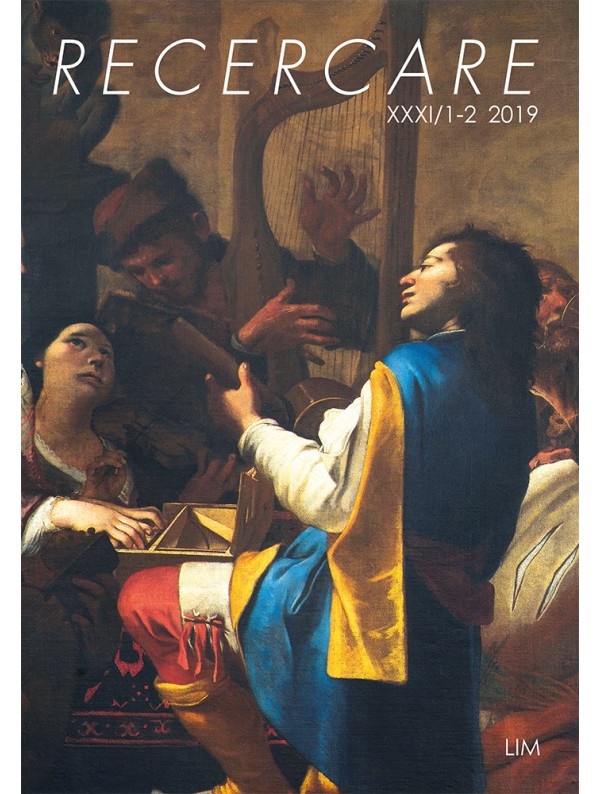
RECERCARE XXXI/1-2 2019

Journal for the study and practice of early music
Arnaldo Morelli
LIM Editrice [2019] 230 pp, €30 ISBN 978-88-5543031-9

Click HERE to buy this volume at the publisher’s website

The 2019 RECERCARE contains three studies in English and three in Italian plus a detailed, illustrated “Communication” by Giacomo Silvestri on his discovery of a surviving 18th-century  recorder, Un nuovo flauto diritto contralto di Castel a Perugia, now in Perugia’s Museo Diffuso di Strumenti Musicali. As always the summaries are in both languages and quite informative on their own. Recercare means ‘to investigate’, and its articles always have a cultural or geographic connection to Italy or Italians or Italian culture outside of Italy. Paris figures in two studies, Venice and Rome in several others, and they are ordered chronologically.

Memory of the past and perception of sound in the Renaissance: the Aristotelian perspective by Stefano Lorenzetti addresses the specific Humanistic perception of music and the dual roles of theory and practice in what the theorists, composers and musicians of the Renaissance were actively concerned within writing, composing and playing. They positioned themselves as followers of those whose influence they acknowledged, but often their dialectical concepts about the ‘new’ versus the ‘old’ had limitations. Musical texts are not music until performed and heard, and subjective performances are lost, lasting only briefly in memory. Lorenzetti interestingly distinguishes (using Latin as theorists of the Renaissance usually did)  between what we think of as an opus by an author (a composition or text), and what Aristotle meant by the labour, or work, the activity of producing and performing a work. Subjectivity injected human qualities (at times inspired by historical and religious movements) to the performance of music by techniques that were themselves inculcated by memory. Lorenzetti sees the Aristotelian perspective – a potential activity and its realised product – inherent in treatises of the 16th century.  Ganassi, in 1535, had explicitly juxtaposed two abstract terms in his chapter Declaration of the ‘effects’ caused by diminished ‘acts’. And in 1596 Zacconi stressed the art of diminution as a means of renewal of written music.

Examples show Aristotle’s underlying concepts echoed in Zacconi, the most interesting competition in 1555 between Andrea Festa and Benedetto Spinone, each challenged to add a sixth voice to a madrigal by Adrian Willaert and one by Cipriano De Rore, composed in Willaert’s revered style. Willaert himself, reluctantly, was persuaded to be the judge, receiving the submitted parts sent to Venice from Genoa. Rather than just scrutinizing the two radical rewritings of each madrigal, he had them performed by his singers at St Mark’s. His judgements were thus based on fleeting executions – newly performed ‘repetitions’, of madrigals the singers might have already known.

Lorenzetti’s writing is fine, but the study’s title, alluding to three mental functions, makes it more difficult to follow! A simpler one might be ‘The Humanistic Perception of Music and its Roots in Aristotle’. He gives the Italian or Latin wording of citations he translates: readers should look at these in every case. For example, translating Zacconi’s materie as ‘subjects’ might misleadingly suggest contrapuntal themes, whereas here the theorist must have meant poetic ‘subject matters’. And ‘… popular singers … expected nothing more than pure & simple modulatione’ does not refer to changes of key, mode or pitch names (here), but rather to intonation or melody itself. Instead of using the cognate ‘modulation’, perhaps ‘melody’ would do? Cognates are deceptive traps, best left in italics, as Lorenzetti does in the case of accento, which here means any sort of ornament, and often (e.g. in Diruta) a specific one.

We are again in Venice in Marco Di Pasquale’s Silvestro Ganassi: a documented biography, again at the time of his contemporary, Adrian Willaert. RECERCARE always excels in presenting detailed biographical articles on figures about whom little is yet known. This very detailed account, if sometimes fragmentary or circumstantial, is beautifully illustrated (paintings, prints and portraits such as the 1577 fire at the Doge’s palace; a map by G. A. Magini of the territory of Bergamo; other historical events and figures; a procession of trombe, piffari, tubae et barbiton on Palm Sunday by M. Pagano and another by G. Franco), and is followed by 25 pages of 50 transcribed documents.

Perhaps this biographical study was translated into English for the sake of non-Italians who could never hope to locate so many unpublished documents;  and additionally because the treatises of Ganassi (?1492 – after 1571) on recorder playing (La Fontegara, 1535), the viola da gamba (Regola Rubertina, 1542) and the violone (Lettione Seconda, 1543) are of such great interest to players. Here these works are discussed only in relation to their printing, publication, dedications, and commercial longevity.

Silvestro, his father, two of his three brothers and one of his sons were musicians (two, as was common in Venice, working also as barbers). At least four of them were among the six prestigious pifferi del doge [the duke’s private pipers, trumpeters and trombonists, founded in 1458], who accompanied ceremonial events and played for an hour daily from a balcony of the ducal palace in St Mark’s Square. Silvestro was appointed piffero in 1517 and was still an active player there in 1566. He was also a lutenist, a gamba player and a teacher of professional musicians. His son Giovanni Battista was also a virtuoso cornettist, and the family performed for aristocrats as a private free-lance ensemble. Much of the study shows how free Venetian musicians were to play in various venues, such as the Scuole, St Mark’s and palaces. An open question (among many) is whether Silvestro played with Willaert. Fires, upheavals (and floods?) destroyed many of the historical archives over the centuries, so we will probably never know.

In Pietro Aretino’s bantering Dialogo of 1543 Silvestro Ganassi is addressed with friendly sarcasm as a ‘musician, painter and philosopher’. Di Pasquale cites other references to his serious interest in painting, possibly earning him admiration for his portraits. Numerous links to other figures in cultural circles are discussed as likely or possible, but so far without hard evidence. The study is a perfect example of RECERCARE’s function: pointing out new directions for further research.

Paolo Alberto Rismondo’s article Antonio Grimani ‘musico galileiano’ tra Venezia e Roma also provides scattered facts, references and hypotheses about the life and activity of an esteemed castrato (? -1665) who took his surname from the noble Grimani family who raised him and whom he first served. The study connects him significantly to Galileo because he later served a highly respected liberal Florentine prelate and poet, Giovanni Ciampoli (1589-1643), travelling with him and singing at his gatherings in Venice and in Rome, which were frequented also by Galileo. There are letters to Galileo in 1630 specifically inviting him to some of these in order to hear Grimani. Up to 1632, Ciampoli enjoyed the favour of Pope Urban VIII (Maffeo Barberini) and Antonio thus became active in Roman clerical circles. He also sang in Parma under Monteverdi in 1628, in the Marches after Ciampoli fell into disfavour with Urban and became governor there, and in Venice at St Mark’s from  January 1617 (‘cantor soprano eunuco’) to at least 1637, and at the Scuola Grande di San Rocco.

Grimani began his career performing chamber cantatas for the nobility but continued it in the opera theatre, to which his voice was less suited. He sang: the title female role in Giovanni Felice Sances’ lost opera-tourney La Ermiona, performed in Padua (1636) in a place suitable for the processions and stylized battles with horses and armaments; the principal role of Clizio in Benedetto Ferrari’s Pastor regio (1641); and that of the old nurse Delfa in Francesco Cavalli’s Giasone (1649). There is a note – possibly by Barbara Strozzi herself – about Grimani singing in praise of her for the Accademia degli Unisoni. His life was an extremely lucky one if indeed he was the orphan of Turkish parents: he benefitted from the care, education, contacts and inheritance of the important Grimani family, with its widespread cultural and clerical connections.

Michael Klaper’s article An Italian in Paris: Giovanni Bentivoglio (1611-1694) and a neglected source for seventeenth-century Italian cantata poetry is about a 790-page manuscript of 1050 poetic works, begun in Rome in the late 1630s, mainly written in France from the early 1640s to the late 1680s, and now no.19277 in the Biblioteca Nacional in Madrid. Two-thirds of these works were for musical settings (sonnets, cantatas, madrigals, canzonettas and serenatas), making this source unique. A copyist entered the poems up to 1670. The remainder are in the hand of the poet, the Abbey Giovanni Bentivoglio. Born in Ferrara, he worked in Rome in the 1630s, and lived in France from the early 1640s to the later 1680s. The Italian composers for whom he wrote also went to France in the 1640s. Together they responded to the demand for Italian music in the court of Jules Mazarin, and then Louis XIV’s, and for public occasions from 1643 to 1715. Klaper’s table of 62 cantata texts shows the number of works for which an actual musical setting and possible dates of composition are known, and whether the text was written in Italy or in France. There are: 1 by Marc-Antoine Charpentier (1643-1704); 8 by Teobaldo di Gatti (1650-1727); 26 by Marco [dell’Arpa] Marazzoli (ca. 1602 – 1662); 1 by Atto Melani (1626-1714); 1 by Francesco Petrobelli (1618-1695); 13 by Luigi Rossi (1598-1653); and 12 are anonymous.

The second part of the study describes the works for Marco Marazzoli, identified by concordance with Chigi manuscripts, and possibly for a Roman soprano in Paris. Five cantatas were for ceremonies, meetings, or publicly celebrated occasions. It is assumed that many of the texts for these were set by other composers – the music and the concordance lost. Bentivoglio’s poetry might have been set by Cavalli in 1660-1662 or by Lully. Thanks to manuscript 19277 we know that 7 of Gatti’s 12 Airs italiens, published in 1696, are set to poems of Bentivoglio. It is probable that the poet and Gatti had direct contact, but nothing excludes the possibility that Bentivoglio’s poems were set to music by others and later borrowed by the composers of the concordances we now know.

Klaper also gives a telling example of lyrics not properly allotted to the right voice in a musical setting, compared to the text as written or corrected by the poet. The author’s version improves the structure and meaning of a dialogue between an Amante and his Amata. In this case, a correction to the music can easily be implemented, since the Lover and his Beloved are both sopranos: the notes themselves are fine, and can easily be sung by the right singer!

Alessio Ruffatti’s study ‘Un libro dorato pieno di ariette’: produzione e circolazione di manoscritti musicali tra Roma, Parigi e Venezia nel Seicento also treats Italian vocal music exported to Paris, illustrating particular investigative challenges and opportunities. He describes some general characteristics of manuscript sources of 17th-century Roman cantatas, how historical conclusions can be deduced from them, and he concentrates more on one exceptional source. This fascinating study shows how potentially useful the analytical techniques of musical palaeography and philology are, and the ‘golden book full of airs’ itself is of great interest. By coincidence – and before seeing Recercare XXXI – I had downloaded from IMSLP the first half of the large ‘golden’ Roman manuscript of cantatas (F-Pn, Rés Vm7. 59-101) in order to accompany two of its 47 cantatas. I thought immediately about the ambiguous accidentals and continuo figures, but not at all about its physical characteristics! Ruffatti’s analysis of such evidence, as applied to Roman vocal sources of this period, uncovers their makers, purpose, chronology, sponsors, and reception. He is a musicologist, a professor of music history, a singer, and an authority on this repertoire and on Luigi Rossi in particular.

Now in the Bibliothèque Nationale in Paris (F-Pn Rés Vm7 59-101 and 102-150), these cantatas were bound and probably sent to Richelieu in Paris in 1641. They attest to a very early demand for ‘contemporary’ Italian Roman vocal chamber music, especially laments modelled after Monteverdi’s influential Lamento di Arianna (Ariadne), an aria from his otherwise lost opera (1608), later published by the composer as a madrigal (1614), as a monody (1623), and in Latin as a lament of the Madonna (1641). One of the two extant manuscript copies of the monody, now in the British Library, is in fact in Luigi Rossi’s hand1. It cannot be over-estimated how it inspired a taste for dramatic ‘airs’ and cantatas in Italy and quickly thereafter in France.

The contents of such codices say a lot about the music in vogue in courts in Rome, Venice, Naples, and those of Louis XIII, Mazarin, and Louis XIV in Paris: as the demand grew, the figures who ordered manuscripts to be copied for execution abroad, and the letters and reports of ceremonial occasions yield possible dates for some copies. Physical evidence, however, is often ambiguous: the paper could have been produced and watermarked long before it was used, the ink and the handwriting, even of well-known copyists, varied over time and could have been deliberately adopted for specific jobs. The more equivocal these clues are, the more Ruffatti gleans from them: specialized professional scribes worked in teams – some notated the music, some the texts, still others the decorated initial letters. And they knew how to imitate the styles of other scribes! To produce each and every codex these processes were sequential.

The potential to uncover more clues multiply when many different sources, as in the cases described by Ruffatti, share some of the same cantata repertory, with inevitable variants in the musical and poetic texts. Philological reasoning attempts to ascertain the historical lines of transmission between sources, which then leads back to History, and musicology overlaps with musicianship in the final challenges of editing or performing from the sources.

The Appendix provides three useful tables. The first lists in alphabetical order by title the 15 cantatas shared between three sources: the first and second parts of manuscript F-Pn Rés. Vm7 59-150 (59-101 and 102-150) from before 1643; and the later manuscripts I-Rc 2505 and I-Nc 33.3.11. In only one case is the composer unknown, and 7 of the other 12 are by L. Rossi. For each cantata, Ruffatti gives the poet, the voice or voices, and the library shelf numbers. The second table lists the 18 cantatas of the Naples Conservatory source in order, of which only 5 have known composers (Carissimi, Savioni, and L. Rossi). The third lists all 47 cantatas in order of the first Rés Vm7 volume, of which 41 for solo soprano, followed by the 50 cantatas of the second, of which 48 for solo soprano. The first volume can be downloaded under Cantates italiennes de différents auteurs.

1  Monteverdi, Claudio: Lamento d’Arianna and Addendum, for soprano and b.c., a critical performing edition edited by Barbara Sachs. (London: Green Man Press, 2001)

Giacomo Silvestri’s Un nuovo flauto diritto contralto di Castel a Perugia follows the previous studies as a short technical ‘communication’. With close-up photographs and measurements, it meticulously describes an 18th-century alto recorder by [N.?] Castel, to which 5 keys were added, probably in the 19th century, possibly suggesting that the instrument was for an amateur. It was recently discovered by Silvestri and is housed in the Museo Diffuso degli Strumenti Musicali in Perugia. The communication includes his findings about this instrument maker or team of makers, and the rest of their surviving production: 18 wind instruments, including oboes and transverse flutes along with recorders.

Barbara M. Sachs