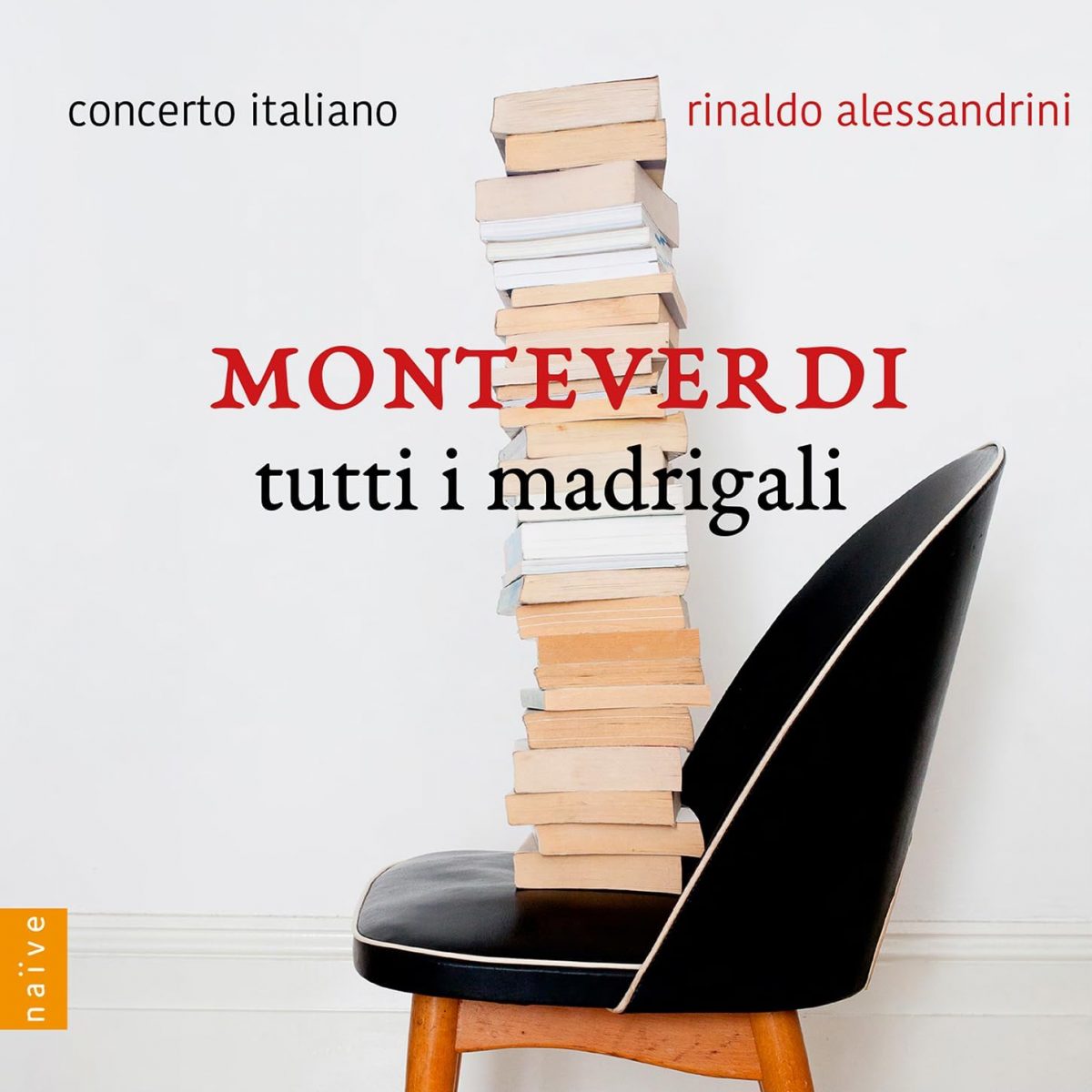
Concerto Italiano directed by Rinaldo Alessandrini
707:62 (11 CDs)
Naïve OP7547
There are many cases where it is possible to chart the development of a composer through a specific genre, Haydn’s symphonies being a good case in point. But I know of no comparable example when it comes to plotting the development of musical history to the madrigals of Monteverdi, which starting with Renaissance polyphony transitions unfalteringly through eight published books into the new world of the Baroque. To explore the intégrale within a brief period is to feel a sense of privilege, to wonder afresh at the genius of their creator.
The present opportunity comes via the set recorded by Concerto Italiano under their founder and director Rinaldo Alessandrini over a period of nearly thirty years. The final instalment, featuring Book 1 and the posthumously published Book 9, has unlike the other books not been previously issued. Needless to say, the vocal ensemble utilised over the years has involved many different singers, the prize for the greatest number of appearances being soprano Monica Piccinini, who participates in no fewer than seven of the books. In the succeeding review it is not my intention to comment to any extent on individual performances, except in the case of solos. In general terms, I find the ensemble singing in the earlier contrapuntal madrigals to be extremely satisfying to a degree that perhaps is not quite so rewarding in the later books, where solo work is liable to reveal more flaws. This applies particularly to the important contribution of the two tenors in the later works. But in general terms the overall level of performance is not only very high but admirably consistent given the period over which the recordings were made. Given the bargain price – you should expect to pay around £45 – there are unsurprisingly no texts or translations, though there is a 96-page booklet that includes helpful notes by Alessandrini. It is also possible to download the texts and English translations provided with the complete Naxos set, one of two currently available rivals, the other being the excellent La Venexiana recording (Glossa).
Like all great works of art, the magnificent madrigal legacy Monteverdi left us with did arise from a void. The first three books, published respectively in 1587, 1590 and 1592, all of which exploit the ‘pure’ unaccompanied one-voice-per-part polyphonic madrigal stem from Monteverdi’s studies with Marc’Antonio Ingegneri (1535-1592), the composer of eight books of madrigals and himself the pupil of one of the most distinguished of madrigal composers, Cipriani de Rore (1515/6-1565). The most famous of the madrigals included in Book 1 is ‘Baci soave e cari’, a sensually lovely work to a text by Battista Guarini, the writer of Il pastor fido and a poet Monteverdi would turn to frequently. Like all the madrigals of the first three books, it is in five parts and like many combines contrapuntal writing with simpler homophonic passages, a favourite device of Ingegneri in his sacred works.
Book 2, published at much the time Monteverdi moved from his home city of Cremona to the court at Mantua, is particularly notable for the domination of texts by Torquato Tasso (1544-1595). Nearly half the contents are settings of Tasso and commentators have noted that his poems seemed to have particularly inspired Monteverdi. In keeping with the time-honoured tradition of putting something especially striking at the head of a publication, Monteverdi opens the book with the two-part ‘Non si levava’ancor l’alba novella’, a Tasso narrative in which two lovers that have a spent a blissful night without sleep greet the dawn with reluctance, knowing parting is close. This is one of several magical evocations of dawn in Monteverdi’s madrigals, while the sweetness and passion of the night are drawn with unerring tenderness. The preoccupation with Tasso continues into Book 3, which also features poems by Guarini, the lighter pastoral moods of the latter contrasting with the deeper expressions of emotions found in Tasso, two of the madrigals extracts from his great epic poem Gerusalemme liberata. Also apparent is the greater level of virtuosity making its way into the madrigals, possibly as a result of Monteverdi having become familiar with the music associated with Ferrara and its famous ‘concerto delle donne’, an ensemble of virtuoso women singers employed by the court and renowned for its virtuosity. This kind of ensemble would be emulated at the Mantuan court, spurring Monteverdi to introduce more bravura solo work in madrigals of the most up-to-date type.
The greater emphasis on virtuosity, solo episodes and fragmentation undermining the contrapuntal texture becomes more emphatic in Book 4, published in 1603, a long gap during which Monteverdi became a fully- mature composer who had been appointed director of music in Mantua. It is likely the contents were assembled from works composed over a period of time. Here the texts are concentrated on Guarini, although it is worth noting that ‘Sfogava con le stelle’ one of the most radical settings has a text by Ottavio Rinuccini (1562-1621), the librettist of the earliest operas and Monteverdi’s lost opera L’Arianna (1608). It opens with an appropriately thoughtful narrative employing the title words – ‘Communing with the stars’ before suddenly exploding like a star burst as the lover takes up his anguish; ‘O sweet images of the one I adore’. Gone completely is the balance of contrapuntal writing, replaced by mannerist solo writing that pushed the virtuosity of the singer ever further. It’s an astonishing example of the way in which Monteverdi is pushing the limits of the classical madrigal ever closer to breaking point.
That point arrives in Book 5, which quickly followed in 1605. Again the lion’s-share of texts are by Guarini, while the increasing part played by solos and homophonic writing at the expense of polyphony is again apparent. At times that affects the present performances negatively, the greater demands for the communication of text not always met by singing that perhaps concentrates too much on beauty. The moment where Monteverdi takes the madrigal firmly into the 17th century arrives some two-thirds of the way through the book. In ‘Ahi, com’a un vago sol cortese giro’ we hear a lute accompanying the singers, a capella works henceforth absent. The span of the madrigal is greater, the texture now freed to allow for more concentration on solos and a greater degree of melismatic writing and its attendant bravura. The book concludes with ‘Questi vaghi concenti’, a virtuoso madrigal about music itself, complete with instrumental introduction (string ensemble) and accompaniment.
The subsequent close relationship of the madrigal with opera is apparent from the outset of Book 6, published in 1614, the year after Monteverdi arrived in Venice to take up the post of choirmaster of St Mark’s. Monteverdi’s own first experience with opera had come with Orfeo in 1607, succeeded the following year by the lost L’Arianna. All that remains of it is the ‘Lamento d’Arianna’ that the composer put at the head of Book 6. In the course of its four parts, the tortured Ariadne pours out her feelings after being abandoned by Theseus, her emotions veering wildly from distress to vengeful anger. The madrigal became a seminal work in 17th-century music, imitated in a thousand laments. On the present set, it is powerfully sung by Anna Simboli. It is followed by one of Monteverdi’s most enchanting works, ‘Zefiro torno’, its scherzo-like lightness (but for the devastating final line) providing an effective contrast between serious and light, a hallmark of Book 6.
The two final books published in Monteverdi’s lifetime take us into realms undreamt of by earlier composers of the classic a capella madrigal. Book 7, published in Venice in 1619, includes madrigals for 1,2,3,4 and 6 voices, in other words anything but the disposition of the earlier standard 5-part madrigal. The texts are by a variety of composers, not excluding the composer’s favourites, Guarini and Tasso. Among a dazzling variety of forms are two pieces employing the new recitative or rappresentativo style, both solo monologues for lovers, the one in the form of a letter written to the beloved, the ‘lettera amorosa’, the other the parting words of a lover, ‘partenze amorosa’. Book 7 closes with what is in effect a miniature opera, the pastoral love of Thysis and Chloris in dialogue leading into a choral dance of the kind familiar from Act 1 of Orfeo.
If Book 7 is wonderfully variegated, Book 8 ends Monteverdi’s career as the man that split the madrigal asunder with a set for which the term tour de force hardly suffices. Published in Venice in 1638, Monteverdi divided the contents into two, the ‘madrigali guerrieri’and ‘madrigali amorosi’, madrigals of war and love, though the topics are more frequently concerned with wars of love than being literally concerned with military war. It should be noted that while the two groups were published with their contents grouped together Alessandrini does not perform them in this order, preferring his own juxtapositions and contrasts. Given no one would perform the whole book in sequence there can be no objection, though it does make following the text and translation rather more challenging. To do justice to this magnificent collection in a line or two is impossible, but it is interesting to note that Alessandrini opens with another quasi-opera that is one of its greatest glories, the Combattimento di Tancredi e Clorinda. The text, taken from Tasso’s Gerusalemme liberata, tells the story of the tragedy of Tancredi, who in battle unknowingly kills Clorinda, the woman he loves. It thus fulfils a story that is both one of literal war and its metaphor of love. It is also significant for introducing a new musical device, the stile concitato – the rapid reiteration of notes – used here for the battle sequences and frequently thereafter by composers to signify great agitation. The other major extended work is very different and involves song and dance. Il ballo delle ingrate relates the story of the fate awaiting proud women that scorn love. The Book also includes what is perhaps the greatest of all madrigals, ‘Hor che ’l ciel’, a wonderful poem of Petrarch’s that is a corollary of ‘Sfogava con le stelle’. Here there is no joyous dawn awakening but the lover that has passed a tormented night alone, text and music a vivid description of his intense suffering.
Finally Book 9, published in Venice in 1651, nearly a decade after the composer’s death, consists mainly of lighter canzonette for three voices, a relatively insignificant supplement to one of the great glories of musical literature, here given performances that match its stature.
Brian Robins