Categories
Recording

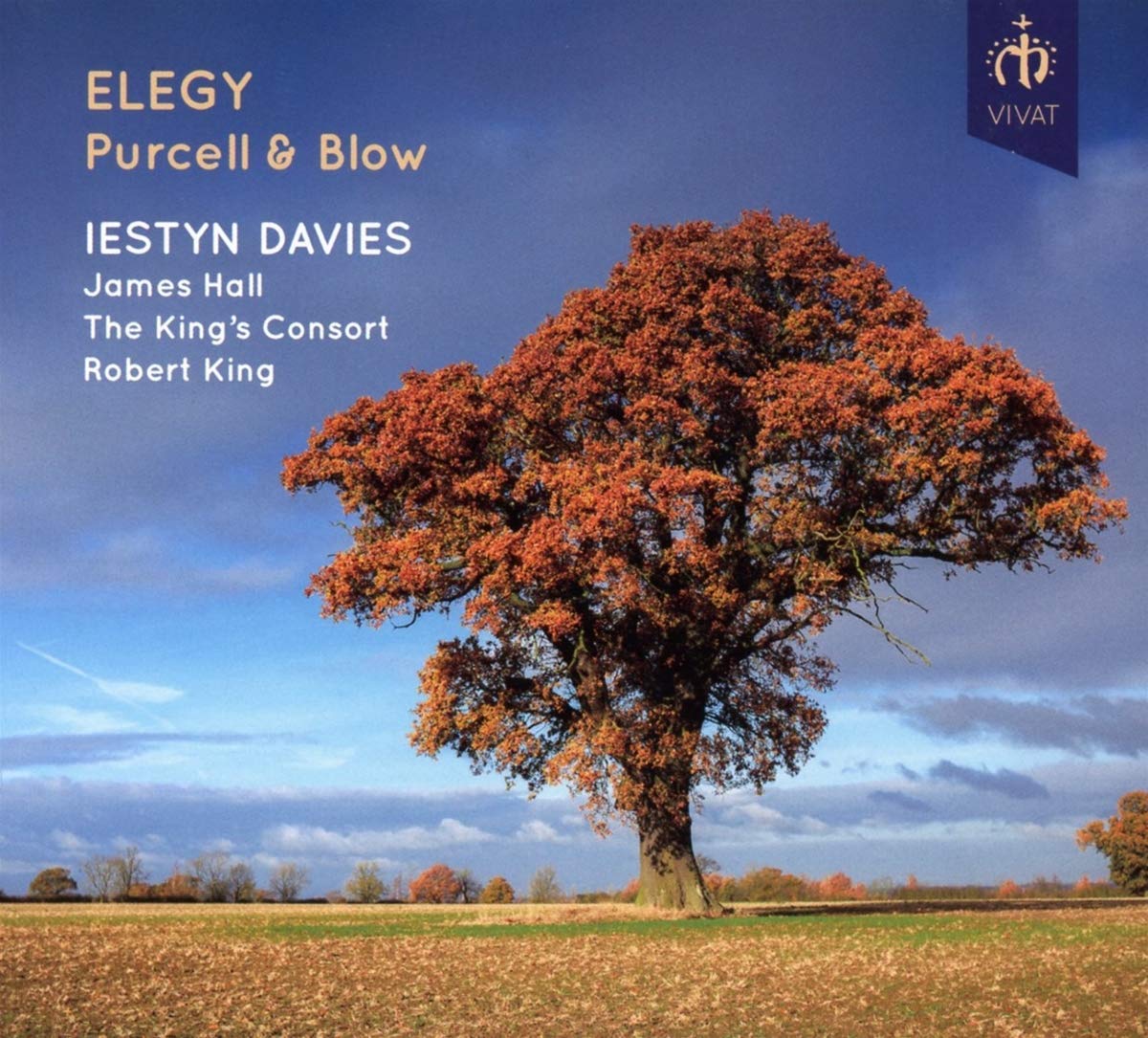
Elegy: Purcell & Blow

Iestyn Davies, James Hall, The King’s Consort, Robert King
77:33
Vivat 118
 

Duets for the countertenor or high tenor voice – often not easy to distinguish between – were popular repertoire during the Restoration, the CD under review featuring a number of well-known examples such as Purcell’s ‘Sound the trumpet’ from the ode Come ye sons of art, ‘O solitude’ and ‘O dives custos’, one of the elegies written to commemorate the death of Queen Mary in 1695, and John Blow’s moving ‘Ode on the death of Mr Henry Purcell’, the most extended work on the disc. There are also a number of solos sung by Davies.

There is therefore rather a concentration on sombre or more reflective topics that seems to have cast something of pall over the CD as a whole. It gets off to a good start with the bright warblings of ‘Hark how the songsters’ from Timon of Athens, Shadwell’s adaptation of Shakespeare. Here the two voices expertly combine with a pair of recorders to weave a colourful tapestry of sound in one of the more agreeable of the Baroque’s ubiquitous bird songs. The following ‘In vain the am’rous flute’ from the Ode for St Cecilia’s day Hail, bright Cecilia is admirable for the sheer sweetness of the sound and the musical way in which the two voices shape the long, melismatic lines. Yet nagging questions start to arise. Does the slow tempo chosen leave it sounding somewhat pedestrian? Is the less than clear enunciation responsible for the lack of engagement felt by at least this listener? A pattern is thus established that extends for the remainder of the disc. The voices are beautifully matched and duet together sympathetically, but is difficult to avoid a feeling of ever-encroaching blandness. Just occasionally something more potent arises, such as Iestyn Davies’ ‘Incassum Lesbia’, particularly at the heartfelt words ‘Regina, heu Arcadiae regina’, where he finds an emotional response to the text not often in evidence elsewhere.

As it happens, over 30 years ago, Robert King recorded for Hyperion a record with almost the same content sung by an earlier generation of countertenors, James Bowman and Michael Chance. I dug it out to find whether it confirmed my impressions of the new disc, which it unquestionably does. Everything on the older recording is brighter, more alive, even the more sober numbers having a deeper expressive quality than those on the new CD. Neither is the presentation on the latter as good, with no source or Z number given in the contents listing, as it was on the Hyperion. The disc will doubtless please the many admirers of Iestyn Davies – though it is worth noting that the lesser-known James Hall is by no means overshadowed – but to my mind it is another reminder that the last quarter of the 20th century was a golden age for the British early music revival.

Brian Robins

Click HERE to buy this CD on amazon.

Categories
Recording

Alessandro Grandi: Celesti Fiori – Motetti

Academia d’Arcadia, UtFaSol Ensemble, Alessandra Rossi Lürig
62:39
Arcana A 464

During his lifetime, the Venetian Alessandro Grandi was regarded as the equal of Monteverdi and his influence on the motet was profound. The works recorded here illustrate the dramatic concertato style in which he composed and indicate an original creative genius at work. Blending voices and continuo with cornetti and sackbuts, these performances illustrate how he animates the texts he is setting with rapidly changing bursts of expressive musical ideas, but is also capable of more sustained expressions of passion. The singing and playing here is generally suitably passionate too, with very effective detailed ornamentation subtly applied where appropriate. I have some reservations about the soprano voices which both have more vibrato than is comfortable. Annoyingly they seem able to minimise this at will, but too often they don’t, leaving them sounding unsettlingly wobbly compared to the cornetti and, indeed, the gentlemen. The 15 motets recorded here range from simple two-voice dialogues to larger-scale pieces culminating in a handsome eight-part setting of Nisi Dominus. The recorded sound is best in the smaller-scale works and is a bit crowded in the larger pieces, where surely more use could have been made of the acoustic in the Basilica Palatina di Santa Barbara in Mantua. This CD with Alessandra Rossi Lürig’s detailed and informative programme notes makes a strong case for exploring further Grandi’s sacred music, which has survived in large quantities but of which only a small portion has made it into modern editions. [Ed. Dennis Collins’ fine editions are available from primalamusica and he is one of several editors working on a complete edition for CMM.]

D. James Ross

Categories
Recording

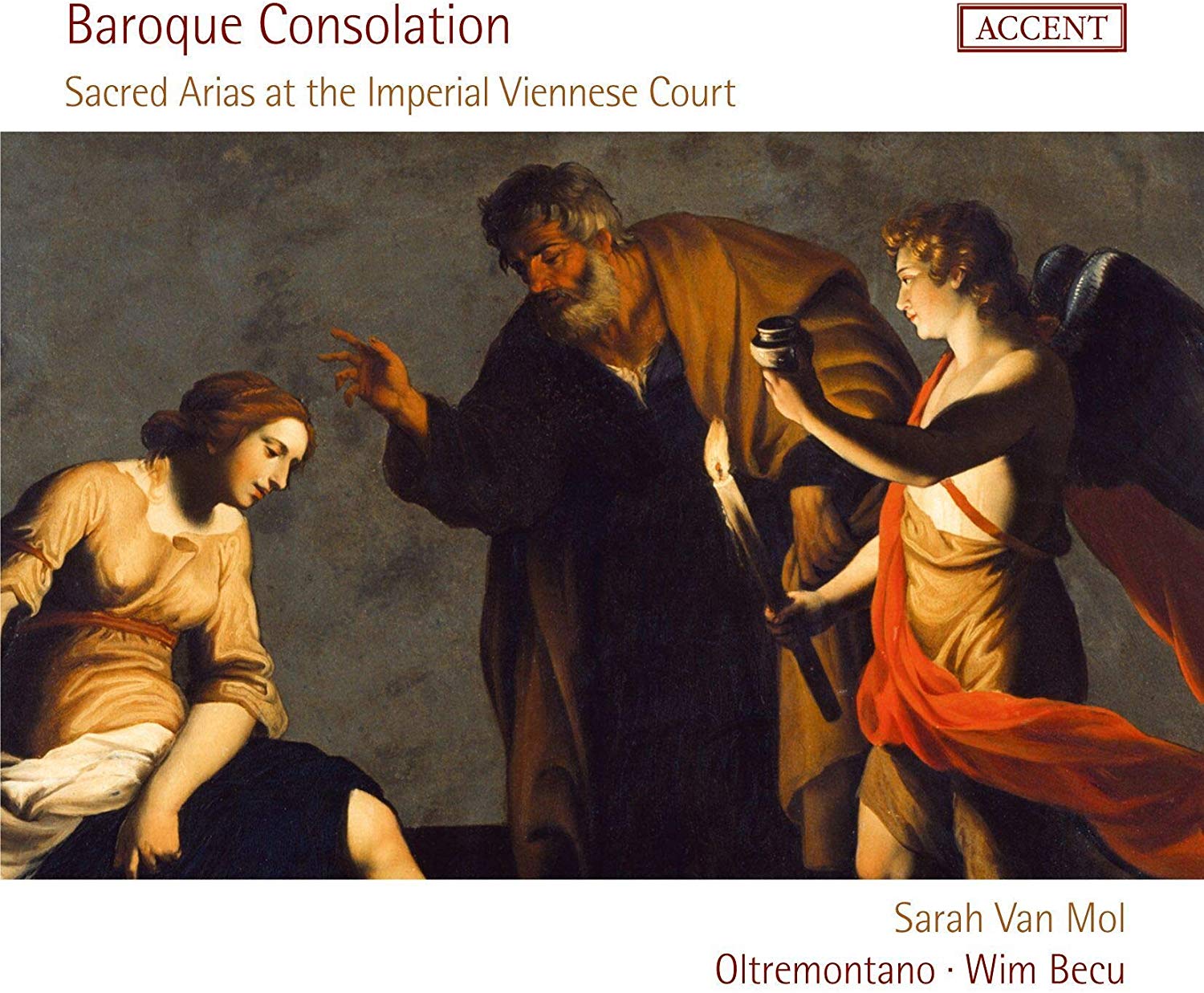
Baroque Consolation

Sacred Arias at the Imperial Viennese Court
Sarah Van Mol, Oltremontano, Wim Becu
58:04
Accent ACC 24349
Music by Caldara, Conti, Emperor Joseph I, Froberger, Fux, Muffat, Pachelbel, M. A. & P. A. Ziani

The enormous affluence and political success of late-17th- and early 18th-century Vienna allowed it to support a cultural life of the highest standard, and master musicians, many of them Italian, flocked to the Imperial Court. One such was Pietro Andrea Ziani, whose nephew Marc’Antonio took his uncle’s winning formula of motets for solo voice with two obbligato violins and developed it into the distinctively Viennese form in which the violins were replaced by an obbligato trombone. A family of trombone virtuosi, the Christians, flourished in Vienna on the back of this vogue, and veteran Baroque trombonist Wim Becu – a stalwart of many period brass ensembles – brings this neglected repertoire vividly to life here. The sweet-voiced Sarah Van Mol is also a positive asset here, singing with beautiful clarity and expressiveness. Further character is added by the use of the 18th-century ‘Ziverin Orgel’ by J B Forceville for solo items by Pachelbel and Froberger, while a 2013 Jos Moors organ adds distinctive colour to a number of the ensemble motets. These are persuasive performances of repertoire which, notwithstanding pioneering work by the great René Clemencic, remains underperformed. Perhaps Vienna should reserve some of the stardust lavished so generously on the Strauss family for composers such as Georg Muffat and Johann Joseph Fux who did so much to put Vienna on the musical map.

D. James Ross

Categories
Recording

L’Occhio del Cor

Francesco Landini
La Reverdie & Christophe Deslignes
64:56
Arcana A462

In the case of Landini the title ‘the eye of the heart’ holds an extra poignancy as the composer was blind, and many of his ballades feature sight denied, absent or otherwise thwarted. In this delightful compilation, La Reverdie have chosen specifically those songs in which sight features, interspersing them with instrumental performances of other ballades. As all five members of the group in addition to playing lute, recorders, vielles, rebec, harps and tamburello also sing, the permutations are endlessly interesting, a variety further enhanced by the organetto playing of Christophe Desligne. A profuse composer, Landini’s music comes in a bewildering variety of moods and styles, from the languidly melancholy to the frenetically dynamic. At his most creative, as in the exquisitely beautiful ballade Muort’oramai deh misero dolente, Landini plucks at the heart strings, and in these beautiful and effortlessly elegant performances his music is heard to best advantage.

D. James Ross

Categories
Recording

Teatro Spirituale (Rome, c. 1610)

Alice Fouccroulle, Reinoud Van Mechelen, Inalto, Lambert Colson
72:15
Ricercar RIC399
Music by Anerio, Cavalieri, Cifra, Frescobaldi, de Macque, Marenzio, Quagliati & anon

This charming selection of spiritual songs from early 17th-century Rome is proposed by the performers as the sort of repertoire which would have graced the Oratory of St Philip Neri, founded in Rome in 1575, and which offered a daily diet of prayer, sermons and sacred music. The singing, particularly of Alice Foccroulle and Reinoud van Mechelen, in these performances is very fine indeed and very persuasive. Director Lambert Colson makes a good case for the variation in scoring for each stanza of the songs presented, which provides for a constantly varying kaleidoscope of textures. The five vocalists and four sackbut players, with Colson playing cornett and mute cornett, are augmented by the sounds of two lirones, theorbos and archlutes, harpsichord and the splendid 1509 Montefalco organ in San Francesco in Trevi. Unfortunately a printing error in my programme notes means that two whole pages are missing, driving a bit of a coach and horses through Colson’s interesting and informative notes. The Neri Oratory’s enormous popularity meant that the size of its ‘congregation’, the quality of the performers keen to play and sing there and the scope of the compositions were all on the increase in the early 17th century, and this is reflected in the opulence of the present recording. And notwithstanding the penitential tone of much of the music, it also captures the positive and optimistic atmosphere known to prevail at these gatherings. This is an involving and intriguing exploration of mainly unfamiliar repertoire, in many cases by unfamiliar composers, and underlines the wealth of repertoire associated with the Eternal City at this time.

D. James Ross

Categories
Recording

Vivaldi: Musica sacra per alto

Delphine Galou A, Accademia Bizantina, directed by Ottavio Dantone
59:47
Naïve OP30569

As the massive Naïve Vivaldi edition starts to reach its later stages – this is volume 59 – it is inevitable that there will be issues that have the feel of tidying-up loose ends. This is one such, a collection of sacred works including two introdutioni, solo motets that lead to a Mass section or Vespers psalm, the Salve Regina, RV 618, a brief antiphon Regina coeli, RV 615 and the Vespers hymn Deus tuorum militum, RV 612. In addition there is the Violin Concerto in D for the Feast of the Assumption, RV 582, composed, like the rest of the programme with the exception of the hymn, for the Pietà. With the exception of the motet Filiae maestae Jerusalem, RV 638, a sombre masterpiece that formed an introduction to the Miserere, none are particularly well known, though all the vocal works were of course included in Robert King’s complete traversal of the sacred music for Hyperion.

It is the two introdutioni, both designed to precede settings of the Miserere (of which there are no extant examples by Vivaldi) sung at Tenebrae in Holy Week, which form the substance of the disc. RV 638 is an especially striking work with a text concerned with the events of the Crucifixion’s ninth hour, with outer accompagnati, one of moving intensity, the other a powerfully dramatic episode depicting ‘shattered rocks’ and the renting of the veil of the Temple, framing a delicate, pain-soaked aria. The performance, as throughout the programme, is outstanding. In the aria Galou, who I continue to think of as an alto, rather than the contralto label Naïve use, sings with fluent ease and evenly produced tonal beauty across the range, displaying real insight and sensitivity for the text, while shaping the cantabile line with the utmost musicality. In the da capo her discreet embellishments are finely turned, while her husband Ottavio Dantone provides admirably well-judged and finely balanced support. In the accompagnati both find the drama inherent in the highly potent text.

Like RV 638, Non in pratis, RV 641 was also written as an introduction to the Misere and also has a text related to the Crucifixion, though the opening plain recitative seems to draw its inspiration from the Song of Songs. Here an accompagnato and extended aria are framed by plain recitatives, the final one being directly addressed to the suffering Christ as a plea for mercy. Again the aria conveys a mood of infinite sorrow, the double string orchestra effectively used to imitate cascades tumbling over each other, perhaps an illustration of the text’s ‘torrent of blood’. In the B section the winding upper strings unsupported by bass convey a sense of being lost in mystery, the playing of Accademia Bizantina absolutely lovely, the singing of Galou profoundly touching. None of the other vocal works match the motets. The hymn is a brief, simple setting for alto and tenor (Alessandro Giangrande) in which Vivaldi set the three odd verses, the even ones of which would have been sung in plainchant. Given that the disc is quite short measure it would have been agreeable to have those to form a contrast.

The finely judged gradual crescendo at the start of the Salve Regina could well be used as a fine example of the care that Dantone brings to all he does, while the long, languid melismas of the opening aria are again beautifully shaped by Galou, whose veiled tone is most effective. Again, ‘Ad te suspiramus’ (iii) turns the focus on the sheer beauty and contrasts of tonal colour of Galou’s singing, while the second and fourth section bring a sense of heightened urgency. The final vocal work, Regina coeli is sung by Giangrande, here ostensibly as an alto, though the awkward break in the voice only emphasises the fact that he is naturally a tenor, rather than a countertenor.

The Violin Concerto in D is a fine work in three movements calling for considerable virtuosity from the soloist, which it here gets from Alessandro Tampieri, whose playing of the florid passage work in the opening Allegro and the capriccio section of the final movement is outstanding. Perhaps more impressive still is the sense of hazy poetic mystery he brings to the central Grave, with its high lying line unsupported by bass and only minimal touches of accompaniment. This is a highly rewarding addition to a unique series, particularly valuable for the two motets.

Brian Robins

Categories
Concert-Live performance Festival-conference

The Cesti International Singing Competition

Innsbruck 2019

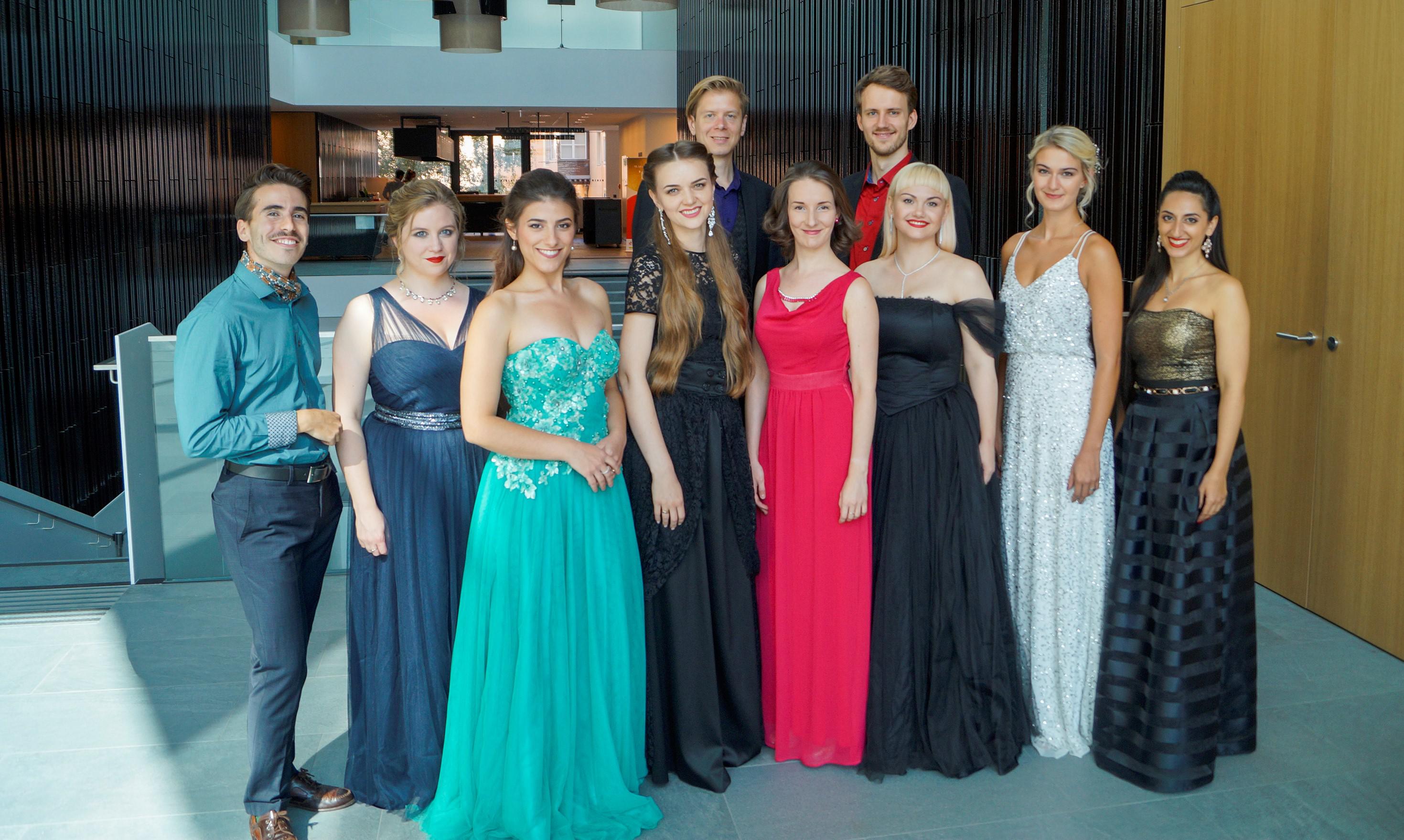
The ten finalists. Winner Grace Durham is second from the left. Photo © Celina Friedrichs

For the past decade an important component of the prestigious Innsbruck Early Music Festival has been the singing competition named after Pietro Antonio Cesti, several of whose operas were premiered in Innsbruck during the period he spent there as a court composer to the Archduke Ferdinand Karl. 2019 also sees the 350th anniversary of the death of Cesti, an event that will be commemorated later in the festival season with a production of his opera La Dori, first given in Innsbruck in 1657.

The singing competition was inaugurated ten years ago as the brainchild of the Innsbruck Festival’s artistic director Alessandro De Marchi, with past prize winners including a number of singers who have gone on to make an international career, most notably Hungarian soprano Emőke Baráth, who will take the title role in La Dori. Such is the eminence of the competition today that this year’s edition attracted over 200 entrants, their number reduced initially to 99, then to the ten finalists who contested two rounds before the final, broadcast live and held before the jury and an audience on 8 August in the Grosser Saal of Innsbruck’s imposing modern Haus der Musik.

The format for the evening involved each finalist singing two arias, one taken from Alessandro Melani’s L’empio punito (Rome, 1669), which will be staged at the 2020 Festival with a role for the winner. The other was free choice, it being perhaps a little disappointing that the majority of singers rather unambitiously selected Handel arias. On offer were three major prizes awarded by an international panel of jurists, in addition to which there was an audience prize, a young artist’s prize and an engagement with Resonanzen, the early music festival held in Vienna each January. The roster of finalists was dominated by higher voices, including six sopranos (one a male falsettist) and two mezzos, with only a bass and a baritone to represent lower registers.

When he came to introduce the prize awards, jury chairman Michael Fichtenholz (Zurich Opera and Karlsruhe Handel Festival) made the perhaps revealing observation that the jury wished them well on whatever path their career might take them, perhaps tacit recognition that on the evidence of what we had heard not all the finalists seemed likely ultimately to pursue a career in early music. Perhaps more predictable were the inevitable platitudes to the effect that all the contestants deserved a prize. In some senses Fichtenholz was right. The overall professionalism and ability to communicate and articulate text was impressive, as was the general technical level of achievement in such as generally well-articulated passaggi. However it could equally be argued that in other respects none of the contestants deserved a prize in an early music singing contest. Throughout twenty arias, only one singer (the eventual winner) came anywhere near attempting a trill, a basic requirement of Baroque singing technique, and we did not hear a single example of that most beautifully expressive and greatly prized Baroque ornament, the messa di voce. It continues to perplex me that singers looking to perform early music are sent out into the world so ill-equipped to do it justice in such respects. Poorly controlled vocal production was another of the problems for several of the singers with larger voices, while another matter to which some of them might also attend are disagreeable facial expressions that would not have passed Tosi’s dictum to avoid making an ugly face while singing.

The three lesser prizes awarded went to the same singer, the Austrian soprano Miriam Kutrowatz, the youngest singer in the competition and obviously a popular choice. Belying her age (22), she sang both her arias with a range of colour and nuance beyond most of her seniors, while also displaying a charming personality. She came very close to being my overall choice, though in the end my vote went to the Hungarian soprano Orsolya Nyakas, who sang her Melani aria with an engaging sweetness and character, while displaying absolute security and a touching emotional response to Melissa’s ‘Ah, spietato!’ from Handel’s Amadigi di Gaula. Her da capo ornamentation and cadenzas were also more stylish than those of most of her rivals. The second and third placed sopranos, Dioklea Hoxha from Kosovo and the Cypriot soprano Theodora Raftis both sang with great commitment if not always perfect control, but they are singers I would expect to find moving quite happily on to later repertoire. While feeling pride that the competition produced a British winner, mezzo Grace Durham will I suspect also be unlikely to follow an early music career, an impression underlined by her CV. The voice itself has a lovely warm and rounded quality, but though her singing of ‘Son qual misera’ from Hasse’s Cleofide had its impressive moments, I found myself disagreeing with the jury, finding some of her singing poorly controlled.

The Cesti Singing Competition, in which the singers were faithfully supported by members of the Cesti Orcestra under the direction of harpsichordist Mariangiola Martello, proved to be a rewarding, compelling and thought-provoking experience.

Brian Robins

Categories
Sheet music

Michele Pesenti: Complete Works

Edited by Anthony M. Cummings, Linda L. Carroll, and Alexander Dean
Recent Researches in the Music of the Renaissance, 171
liii + 218pp, $350
A-R Editions, Inc ISBN 978-1-9872-0139-0

So there are a total of 36 surviving pieces by Michele Pesenti (c. 1470-c1528), of which only three are sacred. The remainder survive as settings in four parts (mostly with only the top part texted) or for voice with lute. This excellent volume not only provides performing versions of them all, but goes to great lengths to explain how the poetry of the time works (and how that has guided the editors to underlay the text in the most appropriate fashion), as well as detailed commentaries on and translations of them all. Two of the secular pieces are Latin odes. The works with lute give both tablature and staff notation versions, making this music accessible to all performers of this neglected repertoire – it would be intriguing to hear the various settings of the same text one after the other (definitely NOT in one of these “mix and match” programmes that is de rigeur at the moment!).

This is a great example of scholars working together – thank goodness not all musicologists are as territorial as some I have encountered!

Brian Clark

Categories
Recording Uncategorized

Festive masses from Lambach Abbey

St. Florian Sängerknaben, Ars Antiqua Austria, Gunar Letzbor
66:31
Accent ACC 24358

There are obscure composers and then there are the likes of Benjamin Ludwig Ramhaufski and Joseph Balhasar Hochreither! The latter was born halfway through the lifetime of the former and, mostly on account of the prominent trumpet parts, there is not much to distinguish their music; indeed, on a blind listening, I defy even a seasoned lover of 17th-century music not to assume it’s either Schmelzer or Biber… Such is the quality of the polyphony and the lyrical ease of the melodies. Combining boy’s voices with those of six men works very well and the instrumentalists clearly enjoy the chamber music feel. Gunar Letzbor’s quest for “true sound” typically gives a dry edginess to his recordings, but here the rather warmer acoustic allows the sound to blossom a little without detracting from the detail. I have enjoyed having this CD in the car for the past few weeks – it is bright and uplifting, and I highly recommend it.

Brian Clark

Categories
Recording

Er heißet Wunderbar!

Barokkanerne, directed by Alfredo Bernardini
67:38
LAWO LWC1169

This is a beautiful CD combining cantatas by three of the candidates for the vacant Thomascantorate with a concerto by a fourth. The one-to-a-part singing lifts the music by Fasch and Graupner to a whole new level when compared to performances by choirs who have hitherto been the only ones to champion the repertoire, especially with four such skilled singers in fine voice and instrumental partners whose lightness of touch elevates the sound even more. Cecilia Bernardini’s rendition of Telemann’s little-played Concerto in E minor with two obbligato oboes is very impressive – I swear she must use olive oil on her bow rather than resin, so even and effortless do the pyrotechnics for both hands sound (rather like a swan, serenely gliding by frantically paddling out of sight!) “Schwingt freudig euch empor” is one of my favourite Bach cantatas and this performance is right up there amongst the best I have heard.

All the more frustrating therefore to read “For who has heard of Graupner, or of Fasch, and do we in hindsight really take the nimble multi-arted Telemann all that seriously?” in the booklet notes. Such opinions are fine, but actually printing them in a booklet like this undermines years and years of work to restore these composers’ reputations even to public notice at all. And even if the note writer doesn’t have much respect, Herr Bach most certainly did, so perhaps there’s a lesson to be learned there.

And then there is “The [Fasch] cantata’s brevity (perhaps a world record here) may suggest that the performances in Zerbst were not a significant part of the service”… First, the piece in question survives in a secondary source so who is to know what had happened to it in transmission? Secondly, a letter Fasch wrote in 1752 reveals that he had been told that music was taking up too much of the services so he had to halve the length of the figural music – and in those days you did as you were told. Besides, on a major church feast, the service also included a Missa brevis with Credo, so pretty much the equivalent of three cantatas in one sitting. Not to mention a Te Deum with “unter Paucken und Trompeten”. A little knowledge is, indeed, a dangerous thing – maybe someone who actually knows about the music might be asked to contribute their next booklet essay.

Brian Clark