Categories
Recording

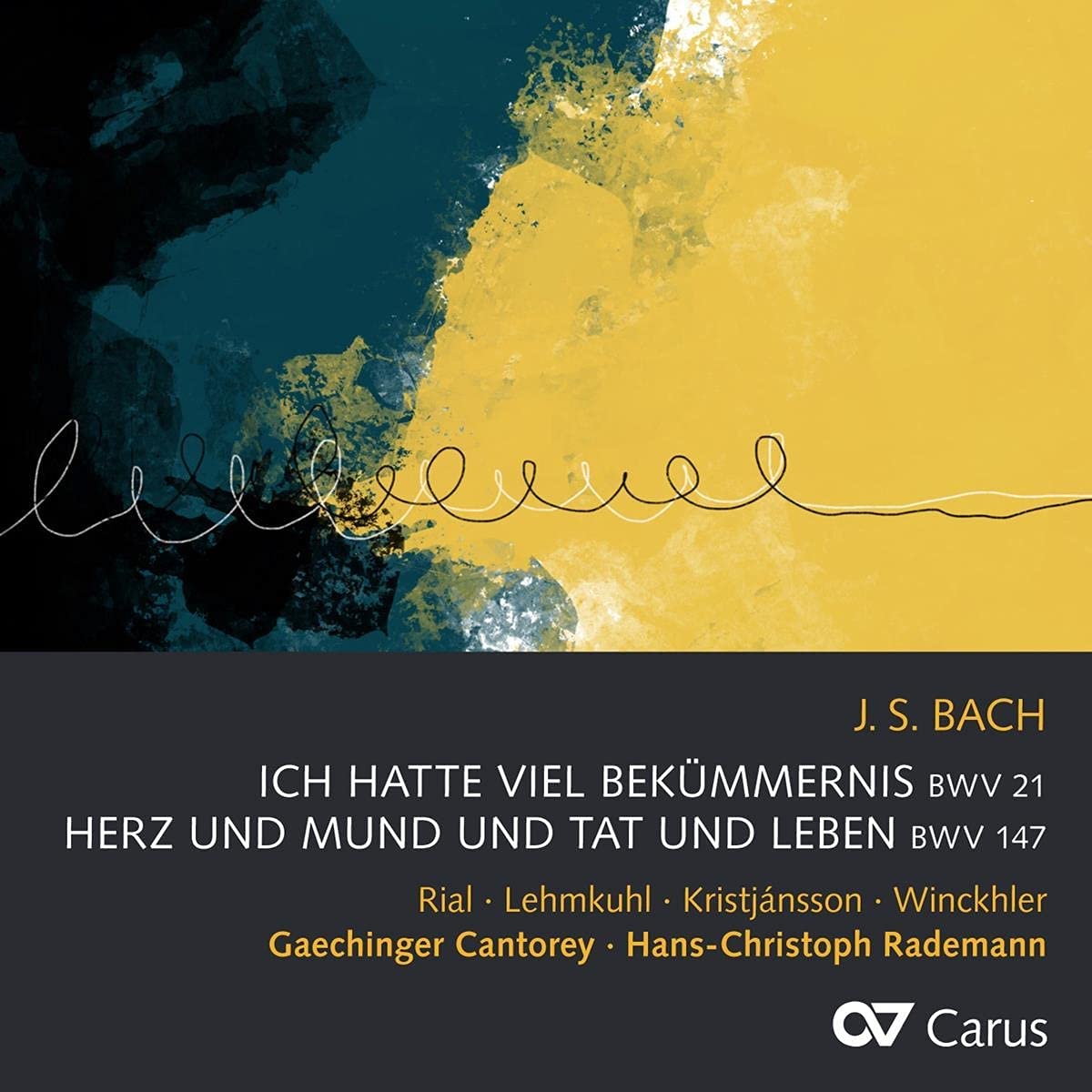
Bach: Ich hatte viel Bekümmernis, Herz und Mund…

Núria Rial, Wiebke Lehnkuhl, Benedikt Kristjánsson, Matthias Winckhler, Gaechinger Cantorey, Hans-Christoph Rademann
65:54
Carus 83.522

Click HERE to buy this recording on amazon.co.uk
[These sponsored links help the site remain alive and FREE!]

These two substantial cantatas are as good an introduction to Bach cantatas as you are likely to get, and they are presented in this CD published by Carus Verlag as an up-to-the-moment take on how to do the cantatas.

The pair is well-chosen: both are the results of the routine into which Bach’s new appointment at Leipzig threw him, and show the composer adapting compositions from the Weimar period to novel contexts. Both are substantial works in two parts. Ich hatte viel Bekümmernis (BWV 21) was probably originally composed as a test piece for a post in Halle in 1713, from which Bach later withdrew. He used it for the 3rd Sunday after Trinity in 1714, again for a trial in Hamburg in 1720 in D minor, presumably in Cammerton, and it was included in the first cantata cycle of 1723 on June 13th, reworked for C in – presumably – Cammerton. The original key in Weimar seems to have been C at Chorton, and by 1723 in Leipzig it was back in C, but at Cammerton, with four colla parte trombones in movement ix. It has everything: the division of the singers into soli and tutti, an opening sinfonia with a solo oboe, a soprano/bass duet between the soul and the vox Christi, illustrative writing, a recitative accompanied by two oboes da caccia, and a blazing finale with a choir of trumpets – a veritable showcase of styles and techniques.

Only a few weeks later Leipzig heard BWV 147, Herz und Mund und Tat und Leben, which was written originally for the fourth Sunday of Advent 1716 in Weimar, of which nothing survives except the opening chorus. For its re-use for the feast of the Visitation, 2nd July 1723, Bach retained Salomo Franck’s arias but composed three recitatives incorporating Marian allusions and the celebrated extended setting of the chorale we know as Jesu, joy of man’s desiring, repeated at the end of both parts. This extended chorale setting, where the lilting 9/8 melodic material of the ritornelli is derived from the chorale itself, is the first of such extended settings of final chorales which provide occasional, more elaborate alternatives to the plain four-part setting. Was it Dame Myra Hess, frequently playing a transcription for piano in her war-time concerts, who so popularised it among English speakers?

In general, the performances are fine: the tempi are good, the text is clear and the playing of a high quality, with 4.4.3.2.1 strings plus oboes, trumpets and a quartet of trombones. But there are two caveats: first, I found the tone of this harpsichord brittle and at times over-obtrusive; no details are given of any of the instruments played, and either the harpsichord was recorded too closely or the instrument was too jangly. Secondly and more importantly, Rademann persists in using a quartet of ‘soloists’ who take no further part in those chorus numbers in which they led off with the parts marked ‘solo’ once the parts are marked ‘tutti’ and doubled by instruments. Even if Rademann – like most German conductors – refuses to accept that these cantatas were sung with one voice to a part, plus ripieno singers on occasions, surely he must recognise that to start a chorus with single soloistic voices and then to silence them when tutti is marked in the score is nonsense. Some of solo voices – Nuria Rial and Benedikt Kristjánsson – would blend with other singers perfectly well, others – and particularly the contralto, Wiebke Lehmkuhl – would not. Her voice – rich and dark though it is – is peculiarly unsuited to Bach. This exposes the dilemma for conductors: if you can’t follow the logic of the scholarship as well as the musical plusses that says “Bach’s primary group of singers – the Concertisten – sing everything: add to them some ripienists if you like in choruses unless it specifically says ‘solo’’, then either choose soloists who will not stand out in the tutti like a sore thumb and make them sing everything, or get single voices from your ‘choir’ to do the incipits if you want different ‘soloists’ to sing the recits and arias.” But both on the grounds of scholarship and plain musicality, Rademann’s solution simply does not work.

This fairly major cavil apart, this would be a good CD to give someone who has no idea what a Bach Cantata is, and needs an introduction; but it will help perpetuate a now rather dated style of performance in which vocal timbres and ensemble skills have not kept pace with the strides taken in the past fifty years by wonderful period instrumental players.

David Stancliffe

Categories
Recording

Monteverdi: Daylight

Stories of songs, dances and loves
Concerto Italiano, Rinaldo Alessandrini
61:47
Naïve OP7366

Click HERE to buy this CD at amazon.com
[These sponsored links are your only way to support the record company and to keep this FREE website alive…]

This collection forms an ancillary to ‘Night. Stories of Lovers and Warriors’, which was performed live and recorded to celebrate the 450th anniversary of Monteverdi’s birth in 1567. In an introductory note Rinaldo Alessandrini suggests that this disparate programme is perhaps not intended for purists. Well, I’ve been called a purist – a term incidentally that I do not take to be derogatory – on more than one occasion and found the CD totally irresistible.

There are two principal reasons for that. Firstly one can point to the consummate skill with which the programme has been assembled, bringing relevant music, much of it familiar, from across the whole of Monteverdi’s output and creative life to create a narrative. More on that anon. Then there is the sheer quality of the performances. Over the years the constitution of Alessandrini’s Concerto Italiano has inevitably changed, here indeed even since the recording of ‘Night’, but all five singers employed in the madrigals and other ensemble pieces are outstanding, blending superbly without ever losing individuality. The instrumental playing is equally impressive.

The programme begins with the Sinfonia that opens act 3 of Orfeo, thus providing a link to the earlier disc, which started in the same way, before the marvellous two-part madrigal ‘Non si levava … E dicea l’una sospirando’ (from Book 2, 1590), which depicts a Romeo and Juliet scenario as two lovers awaken to the dawn after a night of passion. This is music of the utmost sensuality, using exquisite dissonance to convey the blissful eroticism of the sentiments expressed in Tasso’s marvellous text. The mood lightens to a trio of three-part pieces, interspersed by instrumental works including the first of several dances by Biagio Marini – all urging shepherds and birds to rise and get the day underway. The singing here achieves a delicious lightness of touch that serves to mask the consummate execution of performance. Among other favourites too numerous to mention in detail are ‘Zefiro torna’ (Scherzi musicali, 1632) and the canzonetta ‘Chiome d’oro’ (Madrigals Book 7, 1619). Most of the items are brief but a sense of symmetrical structure is given by the inclusion of two scenes from the late operas, both concerned with the amorous exploits of servants. From Il ritorno d’Ulisse in Patria we get the flirtatiously playful scene in act 1 between Penelope’s maid Melantho and Eurymachus, beautifully sung and vocally acted by soprano Sonia Tedla and tenor Valerio Contaldo, which is counterbalanced by that for the innocent (or maybe not so innocent ) page Valletto and Damigella (damsel) from act 2 of L’incoronazione di Poppea, equally enticingly played out by soprano Monica Piccinini and tenor Raffaele Giordani.  There is a sense of exuberant, scintillating joie de vivre about the whole programme that would sweep away the bluest of moods. Recommended without reservation.

Brian Robins

Categories
Recording

Regnart: Missa Christ Ist Erstanden

Cinquecento Renaissance Vokal
64:45
hyperion CDA68369

Click HERE to buy this recording on amazon.co.uk
[These sponsored links support the artists and the record company, and help the site remain alive and FREE!]

Having been poleaxed by the way Cinquecento’s excellent singing complemented the excellence of Isaac’s music on their previous release but having been less impressed by their previous disc of Regnart (2007), I approached this recording with circumspection. None required. Like the former, it is another superb recording of revelatory music. Regnart’s praises were being sung over four hundred years ago by none other than Lassus. Like the rest of us, the greatest creative artists can reveal lousy taste, or speak up for an untalented friend, or favour someone inferior to make themselves seem even better, but Lassus, about ten years Regnart’s senior, was bang on the money when he came to recommending him for advancement.

The two masses that take up most of this programme are best heard after the little hymn tunes on which they are based. In both cases, Regnart’s varied treatment of the tunes within his masses makes for two outstanding compositions; listening to them is spiritually rewarding and an aesthetic pleasure. This is well exemplified in the Gloria of Missa Christ ist erstanden. There is some fine sequential writing approaching the movement’s first close at “Patris”, followed by a well-judged slowing of tempo to a sumptuous cadence on “miserere nostri”, and an extended Amen brings the movement to a close with another gorgeous cadence. There are fine moments in other movements, with an excellent passage for three of the five voices in the Credo at “et iterum …”, and another striking cadence in the Sanctus at “tua”. Missa Freu dich is no less distinguished. The Credo is notable for some animated syncopation in the “Crucifixus” section, with further rhythmic vitality approaching the end of the movement. The Sanctus ends with a climactically high note on the last word “tua” for the countertenor. Perhaps most to be relished is the Agnus, with exciting dissonance at “peccata mundi” and a lovely cadence on “nostri”, repeated, to round off the entire disc, on “pacem”.

The three fillers are well chosen. Maria fein, du klarer Schein is a beautiful sacred song in five parts, while the other two works are later contrafacta of what were originally “light Italian love songs” according to the excellent notes by Erika Supria Honisch. She informs us that Ruhmbt alle Werck was originally “Vorrei saper da voi”. For those who are interested, the original of Wann ich nur dich hab was “Tutto lo giorno”, 1574.

This is a disc of glorious polyphony, especially memorable for its undulating phrases, sung superbly by Cinquecento, with not only a feeling of bracing air between the individual parts, but also, where appropriate, concentrated warmth during deeper sonorities.

Richard Turbet

Categories
Recording

Madonna della Grazia

Anna Reinhold mezzo-soprano, Guilhem Worms bass-baritone, Ensemble Il Caravaggio, Camille Delaforge
68:13
Klarthe K120

Click HERE to buy this on amazon.co.uk [mp3 version only]
[These sponsored links help the site remain alive and FREE!]

This CD cleverly alternates extended Baroque compositions dedicated to the Virgin Mary with the mainly anonymous tradition of popular sacred songs on the same subject. The former consist of the Stabat Mater by Giovanni Felice Sances, Alma Mater Redemptoris by Giovanni Antonio Rigatti, In Sanguine Gloria by Isabella Leonarda, O Quam Suavis by Francesco Cavalli and Tarquinio Merula’s Canzonetta spirituale alla Nina Nana, to which more tenuously the group have added Brunelli’s Lamento della Ninfa. This latter piece is played and sung with great energy and imagination, while the anonymous sacred songs and chants exude a suitable folkloric piety. The singers, Anna Reinhold and Guilhem Worms, pass with ease between these two worlds, the latter bringing a knowledge of traditional ornamentation to bear on this evocative music. The instrumental ensemble Il Caravaggio makes a suitably vivid contribution throughout, and the director Camille Delaforge is to be congratulated on an enterprising project brought to a very successful conclusion.

D. James Ross

Categories
Recording

Telemann: Cantatas for the Hanoverian Kings of England

Hanna Zumsande, Dominik Wörner, barockwerk hamburg, Ira Hochman
70:16
cpo 555 426-2

Click HERE to buy this from amazon
[PLEASE DO: You’ll be supporting the musicians, the recording company and this site!]

In truth, only a little over half of this recording is devoted to the works one would expect from the title: a congratulatory piece for solo bass with trumpets, timpani and strings for George II, a funeral piece of similar scale for the same monarch, and a slightly longer but hardly substantial duet cantata with added flutes for his successor, George III. The title is, of course, spin, since the pieces were written in German, to be performed in Germany, in honour of the kings in their capacity as rulers of Hanover. No explanation is given why the other two surviving pieces of similar vein were not included on the recording, nor indeed why it is filled out with a cantata for the anniversary of the Augsburg Confession and another for the 23rd Sunday after Trinity, even if the latter did cause a furore in Hamburg after it’s first performance. That notwithstanding, there is some very fine music here. The opening of the George III cantata, in particular, is very strong. Hanna Zumsande and Dominik Wörner make a good pairing – both have clear, strong voices which they wam occasionally with vibrato, and they blend well. The band play crisply and in a manner that is sensitive to the voices without being deferential. It is a pity two other voices could not have been brought in for the middle parts of the chorales.

Brian Clark

Categories
Recording

Telemann: Liebe, was ist schöner als die Liebe

Julia Kirchner soprano, Georg Poplutz tenor, La Stagione Frankfurt, Michael Schneider
76:17
cpo 555 300-2

Click HERE to buy this recording at amazon
[Doing so supports the recording company, the artists and this website]

This recording presents one of the rarer genres to which Telemann contributed, the wedding serenata. Intended as evening’s entertainment (presumably for wealth patrons who could afford to pay the musicians required), it is less a mini-opera and more a light-hearted debate on the virtue of love. In response to Ametas the soprano’s opening question “What is more beautiful than love”, the tenor Crito just laughs. They proceed to throw arguments and counter-arguments in a sequence of recitatives and arias, with tempers rising but finally they are reconciled and sing a duet to the newly weds, hoping they will soon have something to rock in the cradle! There follow two solo cantatas with wedding connections, if not as directly as the serenata. “Lieben will ich” was published as the fifth of a sex of six secular cantatas with instruments by the composer in 1731. The tenor must tell the tale and play the two parts! In “Der Weiberorden”, the soprano tells of the “delights” (and otherwise!) of marriage in rather racy language. The disc abounds with charm – Telemann knew how to hold an audience – and all of his fans will have to have this recording.

Brian Clark

Categories
Recording

Cantica Obsoleta

Forgotten Works from the Düben Collection
[Hélène Brunet, Reginald Mobley, Brian Giebler, Jonathan Woody SATB], ACRONYM
79:33
Olde Focus Recordings FCR917

Click HERE to buy this recording
[These links support the artists AND keep this site alive!]

As someone who has spent most of his adult life exploring the riches of the Düben Collection, named after a 17th-century family of musicians and music collectors/transcribers, this recording is an absolute joy. Even being fortunate enough to be able to “hear” music just by reading it off the page, nothing beats hearing it played/sung, especially when those performing it are a versatile and committed group like ACRONYM. This is not the first of their discs I have heard (or reviewed), but still I find things in their readings of this repertoire that make me smile. The tone of this recording is set right from the get-go: Schmelzer’s 5-part sonata in D minor takes no prisoners and the fiddlers in particular get stuck right in, and I totally LOVE it! There’s no break before Johann Philipp Krieger’s Cantate domino canticum novum, on whose text the disc’s subtitle is a play. This neatly introduces us to the four singers, whose voices blend well together. Thereafter, we have music by Carissimi (perhaps the only well-known name on the list), Geist (who would have known the Dübens personally), Löwe (whose instrumental music does not deserve the neglect in which it languishes), Capricornus (who should also be heard far more frequently), Flor, a very rare piece from the collection by a female composer, Caterina Giani, Radeck, Ritter and finally Eberlin, who contributes the longest work in the programme at just over nine minutes. In the course of the disc, we have pretty much been put through the emotional wringer – life in the 17th century was tough, and many of the texts set to music tended to be on the bleaker side, which inspired some fantastic works which, in turn, sought to inspire believers. In recording this rich repertoire, ACRONYM will hopefully inspire further exploration of the Düben Collection – and its fellow repositories in Berlin and Dresden. I cannot wait to hear their next CD!

Brian Clark

Categories
Recording

Rigatti: Vespro della Beata Vergine

i Disinvolti, UtFaSol Ensemble, Massimo Lombardi
76:54
Arcana A121

Click HERE to buy this recording on amazon
[Doing so your only means of keeping the site alive!]

When we think of Giovanni Rigatti (if we think about him at all, so overshadowed is he still by Monteverdi, despite the very obvious attraction and quality of his output!), our minds typically turn to the glories of San Marco and the sounds of a multitude of voices with violins, cornetti, trombones and organs. This fabulous recording spotlights his “Messa e salmi ariosi a tre voci concertati, & parte con li ripieni a beneplacito” of 1643 (the year of Monteverdi’s death). It is an incredibly brave thing to do, having just three singers (one of whom is also the director), but it really comes off – the two tenor voices are suitably differentiated to mean that there is always aural interest. The ripieni parts (which are really just reinforcements at structural points in the psalm settings) are taken by cornetto and three trombones. Continuo is provided by viola da gamba, theorbo and organ. The “service” is filled out by plainsong antiphons, organ music by Andrea Gabrieli, Milanuzzi’s setting of Deus in adiuvandum, a sonata by Riccio, motets by Serafino Patta (?!) and Banchieri, a canzona by the latter, a recercar by Francesco Usper and Del Buono (?!)’s hymn, Ave maris stella. The fact that my attention did not wane once in just under 80 minutes is testimony to the quality of both the music and the performances – I really did not want it to end! The recorded sound and the booklet maintain the quality – and when 13 of the tracks are claimed as world premiere recordings, that is all the more impressive. More please!

Brian Clark

Categories
Recording

Andrea Gabrieli: Motets & Organ Works

Weser-Renaissance, Manfred Cordes
69:07
cpo 555 291-2

Click HERE to buy this recording on amazon.
[Doing so is your only way to help keep the site alive!]

Like Bach’s sons, Mendelssohn’s sister and Schumann’s wife (among many others), Andrea Gabrieli is one of those unfortunates whose relative has somehow eclipsed their own valuable output. I remember in my first year at university how much I enjoyed playing through volumes of Andrea Gabrieli’s keyboard music as I “taught myself the piano” (anyone who has heard me play know that it’s very much still work in progress…) At the Early Music Society, we played canzonas by Giovanni Gabrieli and it was only much later in life (at the Gloucester courses run by Alan Lumsden and Philip Thorby) that I really came to appreciate just how good a composer Andrea Gabrieli was.

This new recording on cpo confirms everything I ever thought. Veronika Greuel’s incisivce and extensive booklet note contextualises the music, which the one-to-a-part ensemble, mixing voices with a variety of the instruments one would expect (violin, cornetto, three trombones, dulcian, chitarrone and organ), then perform in a suitably “big” acoustic with lots of air around the notes. There are four organ works by the composer, and a fifth an entabulation by the performer (Edoardo Bellotti on a modified reconstruction of a late 17th-century instrument), neatly played and revealing the breadth of the composer’s mastery of styles. All in all, I cannot imagine a better way to advocate for Andrea’s rightful place in the Early Music Hall of Fame.

Brian Clark

Categories
Recording

Threads of Gold II: Music from the Golden Age

The Choir of York Minster, directed by Robert Sharpe, Benjamin Morris organ
74:22
Regent REGCD544

Click HERE to buy this on amazon.co.uk
[These sponsored links help the site remain alive and FREE!]

I gave the first disc in this series, recorded during 2016, a favourable review in EMR dated 27 May 2017, tipping my hat in conclusion to the excellent notes provided by John Lees. This time I am commencing with a short paean to John for another fine commentary on the background to, and contents of, a second superb disc. He is entirely accurate and up to date regarding current musical research on the period, yet is circumspect when contemporary documentation is in short supply, as in the case of Tomkins having been Byrd’s pupil. Meanwhile this is all expressed in a style that is reassuringly scholarly and a pleasure to read, something to which those of us who write about music can all aspire.

As it was in the case of the first disc, the high quality of the booklet notes and the music itself and the performance of the music all complement one another. If Tallis and particularly Byrd did best numerically on that outstanding initial disc, with one or two items emerging from “left field”, then it is the young guns Tomkins and particularly Gibbons who do well on this second offering. Yet while it is Gibbons who scores highest with six items, it is Tomkins who emerges with the only actual premiere on the disc: his beautiful verse anthem Praise the Lord O my soul is new to CD, having previously appeared only on a fine LP, never reissued, by Newport Cathedral Choir in 1983 (Alpha APS 343). That said, works such as his powerful full anthem in eight parts O God the proud are risen and a couple of Gibbons’s verse anthems Behold I bring you glad tidings and We praise thee O Father are quite elusive. One of the less familiar Tudor evening services, William Mundy’s In medio chori, was included on the first disc, and another such is selected here, the Latin setting by Tallis. Disc I began and ended with two of Byrd’s greatest Latin works, and the Latin pattern is followed here, with Robert Parsons’ sublime Ave Maria opening the proceedings, and another of Byrd’s masterpieces Peccantem me quotidie bringing them to a conclusion.

The quality of the singing is every bit on a par with that on the preceding disc. Only listen to the exquisite layering in the final chord of Byrd’s Sing joyfully – quite the best unaccompanied ending to this anthem on disc (there is currently a stirring version by Musica Secreta accompanied fittingly by The English Cornett and Sackbut Ensemble on Chandos CHAN 0789) – in which it is so easy for inner parts to be swamped as everyone exhales on the conclusion of Byrd’s short sharp test of vocal endurance; and to the impact of the trebles’ thrilling entry at “O spare me a little” in Gibbons’s Behold thou hast made my days. Meanwhile the full choir can sing with the intimacy that Byrd would have anticipated in performances of Justorum animae whether domestic (it was published in book 1 of Gradualia 1605 and the volume was approved by Richard Bancroft, then Bishop of London) or clandestine (during illegal Roman Catholic masses). Robert Sharp unerringly chooses tempi appropriate to the individual pieces and to the acoustic of the recording venue, while Benjamin Morris’s accompaniments are sensitive and tasteful. Compared with the previous disc, the Choir itself, recorded during 2019, sounds different, as one would expect three years onwards, and the acoustic seems less reverberant – it is stated simply that disc I was “recorded in York Minster” (perhaps the chancel?) whereas disc II is said to have been recorded in the Lady Chapel. The Choir, who can not only blend mellifluously but also project individual parts where necessary, is a credit not only to York Minster but to the Church of England, while the verse passages are sung responsively by soloists, each with characterful voices not drilled to a uniform sound, who are in turn a credit to the Choir. Everything about this disc is distinguished, and it cannot be praised too highly.

Richard Turbet