Categories
Recording

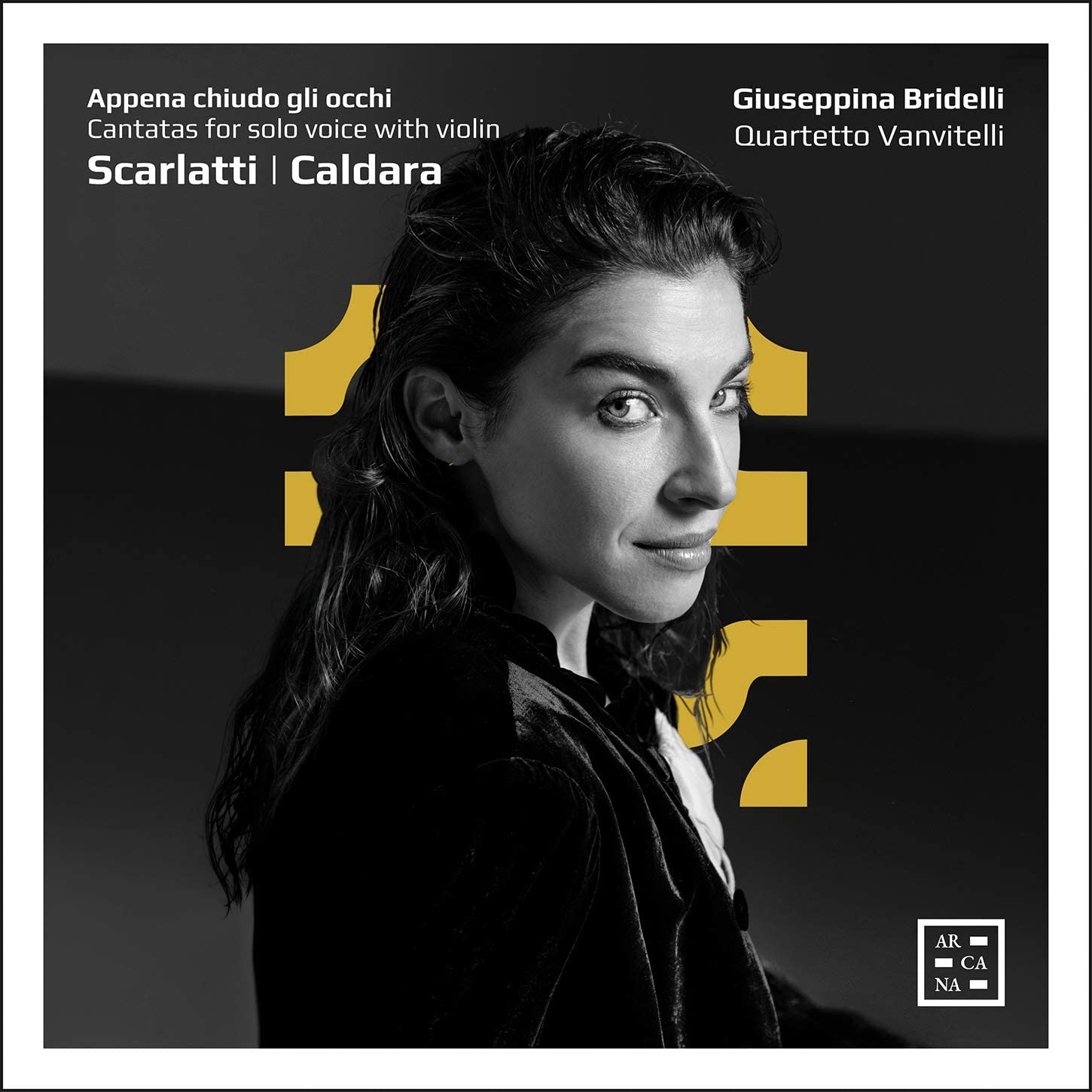
Scarlatti | Caldara: Appena chiudo gli occhi

Cantatas for solo voice with violin
Giuseppina Bridelli, Quartetto Vanvitelli
76:57
Arcana A487

Click HERE to buy this on amazon.co.uk
[These sponsored links help the site remain alive and FREE!]

As noted in reviews for EMR down through the years, there is a special art to performing chamber cantatas, one all too frequently not satisfactorily met. They are not, as the impression is often given, operatic scenas, suited to being sung with full-throated dramatic intensity, but rather intimate works invariably composed for princely patrons and intended for a sophisticated invited audience. As such, they demand a subtlety of vocal interpretation and close attention to textural clarity that allows them to communicate directly to their audience. These quite exceptional performances achieve this level to a rare degree.

However, before going into further detail about those performances, a few words about the works. Among the literally thousands of cantatas composed, those for voice with a solo violin are comparatively rare. The scholarly note suggests there may be as few as three examples by Alessandro Scarlatti, two of which are included here. In the striking Dove fuggo? A che penso? the rhetorical questioning of the opening recitative is preceded by fantasia-like flourishes from the solo violin, doubtless a reflection of the deranged state of mind of the girl who wishes to hide herself away from torment. In general, however, in the arias that include the violin, voice and instrument duet on equal, often imitative terms, though in the aria ‘Povera Clori’ from the same cantata the violin reflects the text by acting as an echo, while it complements the more elaborate vocal writing of ‘Zeffiretto amorosetto’ from Caldara’s Vicino a un rivoletto by imitating the ‘augelletto garruletto’ (garrulous little bird) sent by the lover to his beloved. All four cantatas here are fine works, the palm perhaps going to the most extended, Dove fuggo?, an alternation of no fewer than four pairs of recitatives and da copo arias, but although less elaborate Scarlatti’s Appena chiudo, which opens with an instrumental sinfonia and has alternating pairs of recitatives and arias, is an affecting setting of a text in which the sleepless lover is haunted by images of the absent beloved. Also worthy of special mention is the unexpectedly profound aria ‘Ahimé, sento il mio core’ that concludes Caldara’s Vicino.

And that aria provides an excellent entry point to consider further Giuseppina Bridelli’s singing of these cantatas, for several of her strengths are on full show there. Not the least of these is the sheer tonal beauty of her mezzo, which is not only evenly and securely produced across its range, but capable of colouring the text with the finest of shades. Here, too, one notes the exquisite shaping of the long phrase that indelibly paints the word ‘languendo’ (languished), the ravishingly lovely mezza voce, the rock-steady chest notes, and Bridelli’s totally stylish and beautifully articulated ornamentation (which includes trill) of da capos. And throughout all four cantatas, the impression is convincingly conveyed that every word has been given significance, the recitatives projected with excellent diction. In short, these are not only beguilingly lovely performances but a display of the highest musical intelligence.

In addition to the cantatas, the excellent Quartetto Vanvitelli plays a five-movement sonata for violin and continuo by Giuseppe Valentini (1681-1753) taken from his opus 8, published in Rome in 1715. It is particularly notable for its gracious opening Andante, much the most substantial movement, which is played with beautiful pure tone by the Vanvitelli’s violinist  Gian Andrea Guerra. Finally, having so often complained of obtrusive continuo lutenists, it is only fair to make a special point of praising the perfectly judged contribution of Mauro Pinciaroli. This is a special recording in every respect.    

Brian Robins

Categories
Recording

Anachronistic Hearts

Héloïse Mas mezzo-soprano, London Handel Orchestra, Laurence Cummings
76:35
muso mu 045

Click HERE to buy this on amazon.co.uk
[These sponsored links help the site remain alive and FREE!]

Fresh from enjoying Joyce Di Donato’s fabulous new complete recording of Agrippina, I was eased into this CD of Handel operatic arias with the familiar strains of Poppea’s charming “Bel piacere”. A compilation CD such as this relies heavily on the charms of the soprano soloist, and, in this case, we are fortunate to be in the hands of Héloïse Mas, a singer of great musical instinct and superb technique, who like Di Donato is able to bring Handel’s operatic music dramatically to life. Ably supported by the London Handel Orchestra under the direction of Laurence Cummings, Mas conjures up the relevant characters in the course of one short aria and gives expression to their innermost feelings. In among the operatic music are arias from early oratorios as well as a secular cantata, written in Italy in 1707; La Lucrezia, with its narrative of rape and revenge, provides powerful and contrasting emotions for the composer to tap into and for the performers to revel in. All of these performances by Mas demonstrate a voice at the peak of its powers, underpinned with musical and dramatic intelligence, which animates every single moment of this programme.

D. James Ross

Categories
Recording

Al-Basma: Voyage au coeur d’Al-Andalus

ames RossCanticum Novum, Emmanuel Bardon
78:31
Ambronay AMY057

Click HERE to buy this on amazon.co.uk
[These sponsored links help the site remain alive and FREE!]

Under their director Emmanuel Bardon, Canticum Novum continue their exploration of the early music of the Iberian peninsula with this selection of music from Andalusia including Arabic songs and material from the Codex of Montpellier and the Cantigas de Santa Maria. Inhabiting the ground somewhere between traditional and mainstream early performance, Canticum Novum use a variety of vocal techniques and early instruments to bring this music vividly and convincingly to life. What is striking about the integration of early Arabic material with the medieval manuscripts is the cross-fertilisation easily heard between the two worlds. In the Middle Ages, Andalusia was a cultural mixing pot of various ethnicities and nationalities, and this is apparent in this cleverly constructed programme. Recorded in the resonant acoustic of L’Abbaye de Sylvanès, Canticum Novum move seamlessly from solo to ensemble repertoire, genuinely exploring the music and letting it speak eloquently to us down the centuries. Having specialised for many years in this earliest repertoire, they manage to make it sound very natural in performances which belie the scholarship and technical assurance that underlie them.

D. James Ross

Categories
Recording

Campana: Arie a una, due, e tre voci

Ricercare Antico, dir. Francesco Tomasi
64:31
Brilliant Classics 96008

Click HERE to buy this on amazon.co.uk
[These sponsored links help the site remain alive and FREE!]

Born in Rome around 1610, Francesca Campana was known as a singer and spinet player, and her set of Arias in one, two and three parts published in 1629, when she was probably still a teenager, reveals a remarkable facility. While female composers were not unknown in Italy at the time, to have an entire publication devoted to your music as a woman was an unusual tribute and is surely a mark of the respect in which she was held. This is underlined by a letter of recommendation of 1633 in which her playing and singing are specifically and extravagantly praised. Her marriage to the composer Giovan Carlo Rossi seems to mark the end of her own compositional career although she lived on until 1665. The arias in the collection comprise solo airs with accompaniment as well as ensemble pieces we would be inclined to describe as madrigals. The writing is expressive and colourfully evocative – it is likely that Campana was writing largely for her own voice and an ensemble, and would probably have performed this music as well as benefiting from its publication. The performances here are imaginative, delicately ornamented and eloquently presented. The slightly close recording has an unfortunate deadening effect, and, as a result, some tracks sound a little plodding – perhaps a little more ambiance might have helped the music breathe a little more and the voices to ring more pleasingly. The arias themselves are interspersed with a beguiling selection of largely Neapolitan instrumental works from slightly earlier than the Campana pieces. This repertoire is catchy and engaging, and the playing is again charming and provides the perfect foil to the arias.

D. James Ross

Categories
Recording

Love enfolds thee round

Tenet, directed by Jolle Greenleaf
62:30
Olde Focus Recordings FCR 919

Click HERE to buy this on amazon.co.uk
[These sponsored links help the site remain alive and FREE!]

I have been waiting for this CD – my first Covid recording of choral music. It has to be said that apart from the masked ensemble picture inside the CD cover you would be blissfully unaware of the recording’s context, and this is how it should be. The American ensemble Tenet presents a varied programme of 19th- and 20th-century close-harmony music, both familiar and unfamiliar – Parry, Howells Vaughan Williams, Holst, Warlock, John Goss, as well as traditional music and earlier repertoire. The group’s director, Jolle Greenleaf, features frequently as soprano soloist, and her gleaming tone is very pleasing and also sets the flavour of the whole ensemble. They have a delightful almost ‘light music’ ease with their phrasing, and their impressive blend and intonation are redolent of ‘close-harmony’ singing as much as customary ‘European’ early music singing. Some of the solo voices introduce a degree of vibrato, but this is carefully controlled in the ensemble context, and only where the harmonic progressions are more challenging, as in Howells’ A Spotless Rose, does the intonation wobble a tiny bit. This is a very enjoyable CD, and it holds out the prospect that many other choral ensembles will have weathered Lockdown and will be able to return to superlative form very soon.

D. James Ross

Categories
Recording

Tiranno

Kate Lindsey, [Nardus Williams soprano, Andrew Staples tenor], Arcangelo, Jonathan Cohen
75:34
Alpha Classics Alpha 736

Click HERE to buy this on amazon.co.uk
[These sponsored links help the site remain alive and FREE!]

The tyranny of the title is that of the infamous Emperor Nero, coincidentally the subject (as I write) of a new exhibition at the British Museum that seeks to redress at least some of the infamy associated with his name. Unsurprisingly there is little redemptive in this collection featuring extracts from Monteverdi’s L’incoronazione di Poppea and a group of cantatas from the late 17th and early 18th centuries, the most famous of which is the youthful Handel’s superbly freewheeling drama Agrippina condotta a morire, the confused and tormented words of Nero’s mother following her condemnation to death by her son. The locus topos of two cantatas by Alessandro Scarlatti could not be more different, Il Nerone finding the emperor in full tyrannical flow, ordering the death of his mother, his wife Ottavia and his old teacher Seneca, while his own death is the subject of La morte di Nerone, claimed as a first recording and obviously an early work since its arias are brief strophic verses rather than the usual da capo structures of the mature cantatas. Finally, and placed with little apparent sense of irony after the extreme sensuality of ‘Pur ti miro!’ (the final duet of Poppea), comes La Poppea by the little-known Bolognese composer Bartolomeo Monari (1662-97), a cantata recounting the lurid death of the pregnant Poppea following reputedly being kicked in the stomach by her husband. The work itself, incorporating both narrative and the words of the dying Poppea herself does not match the grim scenario, being relatively tame and concluding with a moralizing aria on the transience of beauty, a favourite trope of the period.

It goes without saying there is scope for highly dramatic interpretation in much of this music, dealing as so much of it does with extreme emotion. American mezzo Kate Lindsey has seemingly built a considerable reputation as a dramatic actress in a wide operatic range and employs it to the full here. Sadly it’s thoroughly 21st-century drama, at times, especially in the Handel, reducing the music to something like a modern psycho-drama, replete with overwrought self-indulgence and a vulgar use of portamento and other mannerisms, that quite forgets the ease and naturalness that the singing masters of the period expected. Ironically, it comes in the company of poor diction, one of Lindsey’s besetting sins and a particularly serious one in this repertoire. This is especially true of plain recitative, where the approach is too cantato and the tempo at times too slow.

Otherwise, my feelings on Lindsey’s singing are somewhat mixed. Were the programme to be judged on the basis of the opening Scarlatti cantata (Il Nerone), it would almost surely be dismissed by me out of hand, for the vibrato here is wide and near consistent, the interpretation highly mannered. Curiously, however, in more restrained moments and particularly when employing a lovely mezza voce in the middle range there is markedly less vibrato in evidence. Indeed a break in the voice at times gives the disconcerting impression that we are hearing two quite different voices.

The anachronistic character of these performances suggests they are unlikely to have great appeal to specialist readers of EMR. The Monteverdi and Monari are certainly better in this respect, though Ottavia’s  ‘Addio Roma!’ brings a fresh outburst of frenetically undisciplined singing. Lindsey is effectively supported in the Poppea extracts, especially by Nardus Williams in ‘Pur ti miro!’,  rather less so by the continuo players of Arcangelo, whose thrumming theorbist is a near-constant irritant.       

Brian Robins

Categories
Recording

Isaac: Missa Wohlauff gut Gsell von hinnen

Cinquecento Renaissance Vokal
hyperion CDA68337
78:03

Click HERE to buy this on amazon.co.uk
[These sponsored links help the site remain alive and FREE!]

In any history of music, or any listing of the greatest composers of a particular time, certain names can be expected always to turn up. Alongside Josquin, there is usually a nod, or a gesture more animated, in the direction of Isaac. The likes of Josquin have flourishing academic industries committed to perpetuating their fame, but just as some rediscovered composers have to be added to this pantheon, so The Usual Suspects need to have their music scrutinised periodically to confirm that it really is as good as it is cracked up to be, in the light of continuing musical rediscoveries, and is not just reeled out as being rated among the best uncritically because it always has been. This is the value of a recording such as the one currently under review. Now that we are increasingly aware of just how many outstanding composers there were around the time of Josquin and in his wake, does an established star such as Isaac still deserve his elevated status?

The evidence of this disc is a stentorian affirmative. It is an extraordinarily good recording, as much for the quality of the music as for its performance. It is Cinquecento’s best recording since Palestrina’s second book of Lamentations (Hyperion CDA68284) and one cannot praise it more highly than that. They have made recordings of music by truly excellent, undeservedly neglected composers, besides some established fixtures, but sometimes a composer elbows his way out from among those who are even that good, and confirms that here is someone who is simply world class. That is what happens on this disc. Every track is outstanding, and Isaac is manifestly on a par with the greatest – you name them, he is their equal, from Machaut to Byrd via Josquin and, as we have seen, Palestrina. And he is aided by Cinquecento in blistering form. They can be monochromatic and pedestrian, but here they hit their straps, their interpretations fully complementing the quality of Isaac’s music. Besides the Mass, the programme includes six motets (one possibly by Obrecht rather than Isaac) and Josquin’s setting of the song on which Isaac bases his Mass.

First, to the Mass. As David J. Burn explains in his excellent notes, it is based upon a song that survives with both German and French texts. This is why Josquin’s setting in four parts with the French text Comment peult avoir joye? – itself a minor masterpiece – is included. Isaac’s Mass is in six parts, but a high proportion of its many sections are for reduced voices. He takes every aspect of the song and seems to present it in every way possible to a composer of his time. His judgment in varying the numbers voices, and reintroducing all six, is faultless, and Cinquecento duly respond faultlessly. Their voices resonate sonorously yet whether singing down to three parts or up to the full six, whether low in their register or high, whether loud or soft, every line is clearly audible, and its relationship to its fellows is perfectly balanced, while retaining the momentum essential to sustaining the rhetorical and narrative flow. Such is the quality of Isaac’s music and of Cinquecento’s execution that, for this listener, their excellence seems to grow with repeated hearings. So many passages clamour for notice; one in particular for this reviewer is the third and final Agnus in which Isaac’s effortless canonic contortions bring about breath-taking suspensions, while he allows the outline of his chosen tune to conduct the Mass to a sublime and satisfying conclusion.

In their different ways the motets, all in four or five parts, are just as fine. They range from the majestic O decus ecclesia in five parts, running to over twelve minutes – just before midway through the second part there is a divinely contrived descending sequence, subsequently repeated in outline ascending as well as descending again, the nature of which will be familiar to listeners acquainted with masses by composers as late as Rogier and Monteverdi – to the comparably minute Parce Domine at less than two minutes. Sonorities, melodies, harmonies, textures, narrative flow and rhythmic vitality are all products of the creative mind of a genius. These are served by Cinquecento with their best singing on disc, not only for the standard of their actual singing, but also for their interpretations, never bland, never exaggerated, always sensitive to Isaac’s settings of his texts. As the notes explain, the final work Judaea et Jerusalem might be by Obrecht. This seems quite possible to this listener, but even if it is by Obrecht, it sits well in this company, being the work of a composer whose stature is comparable to that of Isaac.

Admirers of Cinquecento will find themselves rewarded as never before by this recording. Admirers of Isaac who do not know this music, especially the mass, will find their admiration confirmed and perhaps even expanded. Explorers unacquainted with Isaac will discover a new musical territory replete with riches.

Richard Turbet

Categories
Recording

Jesu meine Freude

Ensemble BachWerkVokal, Gordon Safari
65:35
MDG Gold 923 2207-6

Click HERE to buy this at amazon.co.uk
[These sponsored links help the site remain alive and FREE!]

The neat concept behind this recording is both fascinating and attractive, drawing together works inspired that take their cue from the famous hymn, and observing how it ripples through time and the various composer’s works, thus delivering a stylistic overview. The CD is book-ended with Telemann’s offering from his “French Cycle” (the 1714/15 Neumeister variant)* and the wonderfully crafted setting by Johnn Ludwig Krebs. In between, we have the translucent motets of Johann Friedrich Doles and Johann Sebastian Bach, for four and five voices respectively. Within the limited accompaniment of these motets, we get some subtle variations, which feel just right, and the vocal lines are intimate and radiant, pert and clipped at the right time. The Doles variant of this famous Johann Frank hymn applies some slick touches of drama that stand out and impress. The Bach version (BWV227) is filtered through his great musical mind for some more conventional motet writing, and then delivers the goods with clever contrapuntal vocal threads, never losing sight of the hymn itself. One word of warning, though: no translation into English of these works, so swim well those who can – no life-jackets are supplied!

The opening Telemann cantata (TVWV 1:966) offers many attractions in its nine movements: the opening aria, Geht ihr heissen Seufzer… Klopfet… features four recorders “knocking” with soprano Electra Lochhead in full flow, hits the mark, and captivates. Before the final chorale, there is further descriptive writing in another stand-out aria: Schlage bald, gewünschte Stunde, with a mesmeric bell-motif. Listening blind, many might easily mistake the fine setting by Krebs (KWV110) for a lost JSB piece. It is tightly and neatly woven music with two sprightly oboes capturing the radiant hymnal theme. It is fascinating to hear the Krebs variant take on Schlage bald, geliebte Stunde!, here sung with great skill by the agile soprano Zsófia Szabó. Indeed, the singing from BachWerkVokal Salzburg throughout the disc is a rare delight, picking out the finery and drama, especially in the exposed intimacy of the motets.

This gathering of noteworthy works based on Johann Frank’s hymn displays various forms and styles in a way that cleverly reveals the development of musical styles over time. It is an innovative concept that the group under Gordon Safari has previously applied to “Singet dem Herrn”. A successful CD wrapped in MDG’s golden sound, it is also the first recording of the Telemann work, possibly also of the Doles and Krebs.

David Bellinger

* The complete recording of Telemann’s French Cycle will start on cpo in the Autumn.

Categories
Sheet music

Purcell: Sacred Music Part IV

Purcell Society Edition, volume 28
Edited by Robert Thompson
xli (including four pages of facsimiles) + 198pp. £75.
ISBN: 9780852499603 ISMN: 9790220225970

Click HERE to buy this from the publisher’s website.
[PLEASE NOTE: This link is NOT sponsored]

As well as updating to include the latest background information, the principal purpose in producing this volume is to re-order the music contained in it according to the dates of composition. Since The Purcell Society first issued editions of the composer’s anthems, a lot of source work has been done that has informed the newly established chronology. Robert Thompson presents the evidence in a way that is mostly very readable; sometimes there is just too much information for comfort, but how is one to avoid this when there is a wealth of disparate evidence?

The 14 continuo anthems included in the volume are presented in the now-familiar Purcell Society style. They are: Turn thou us, O good Lord (Z62), Who hath believed our report? (Z64), Lord, who can tell how oft? (Z26), Blessed be the Lord my strength (Z6), Let God arise (Z23), O Lord our governor (Z39), Give sentence with me (Z12), O praise the Lord, all ye heathen (Z43), I will love thee, O Lord (ZN67), The Lord is King (ZN69), Let mine eyes run down with tears (Z24), Hear my prayer, O God (Z14), O Lord, thou art my God (Z41) and Out of the deep (Z45). Appendices include a short re-arrangement of a repeat of Z64 by Philip Hayes, an organ part for Z6, an earlier working of a passage from Z24 and an organ part thought possibly to be by a young Purcell for Humfrey’s By the waters of Babylon.

Typically this kind of volume is destined to sit on library shelves. Anyone performing the music it contains, though, should certainly seek it out for the valuable information it contains.

Brian Clark

Categories
Sheet music

Henry Lawes: Sacred Music

Early English Church Music Volume 61
Transcribed and edited by Jonathan Wainwright
xxxviii+176pp. £75
ISBN: 9780852499610 ISMN: 9790220225987

Click HERE to buy this from the publisher’s website.
[PLEASE NOTE: This link is NOT sponsored]

This heavy and handsomely bound book contains all of Lawes’ known sacred music: five anthems (three of which are fragmentary), five “symphony anthems” (don’t get excited – the symphonies are reduced to organ accompaniment), 29 devotional anthems for 2 sopranos, bass and continuo, seven “sacred songs” for soprano and continuo, 24 metrical psalms for soprano and bass (here with the text of the opening verse printed below the upper voice and the remaining verses as poetic stanzas below), three Latin motets (Laudate Dominum for 2 sopranos, bass and continuo, Predicate in gentibus for bass and continuo, and Quis sicut Dominus Deus noster for soprano, bass and continuo), three rounds for three voices and the texts of eleven pieces that are known to have been lost. An appendix has Matthew Camidge’s 1789 re-working of the psalm tunes.

As well as this hugely generous amount of music, you get a LOT of musicology; there’s a lengthy introduction to Henry Lawes and his music, then an exhaustive list not only of the sources but also articles that have already explored them in depth, and a comprehensive bibliography. Then, each subsection of the book (essential the seven categories I described above) has its own introduction along with detailed critical notes. The music is beautifully laid out. The original orthography of the texts is retained. I am not a great fan of “dashed bar marks” in vocal music as I find it quite difficult at a glance to see where they fall. Nor do ficta accidentals above repeated notes of the same pitch strike me as particularly useful. That said, these are very, very minor criticisms. Henry Lawes’ music deserves to be much more widely known and this beautiful book makes it readily accessible.

Brian Clark