Categories
Recording

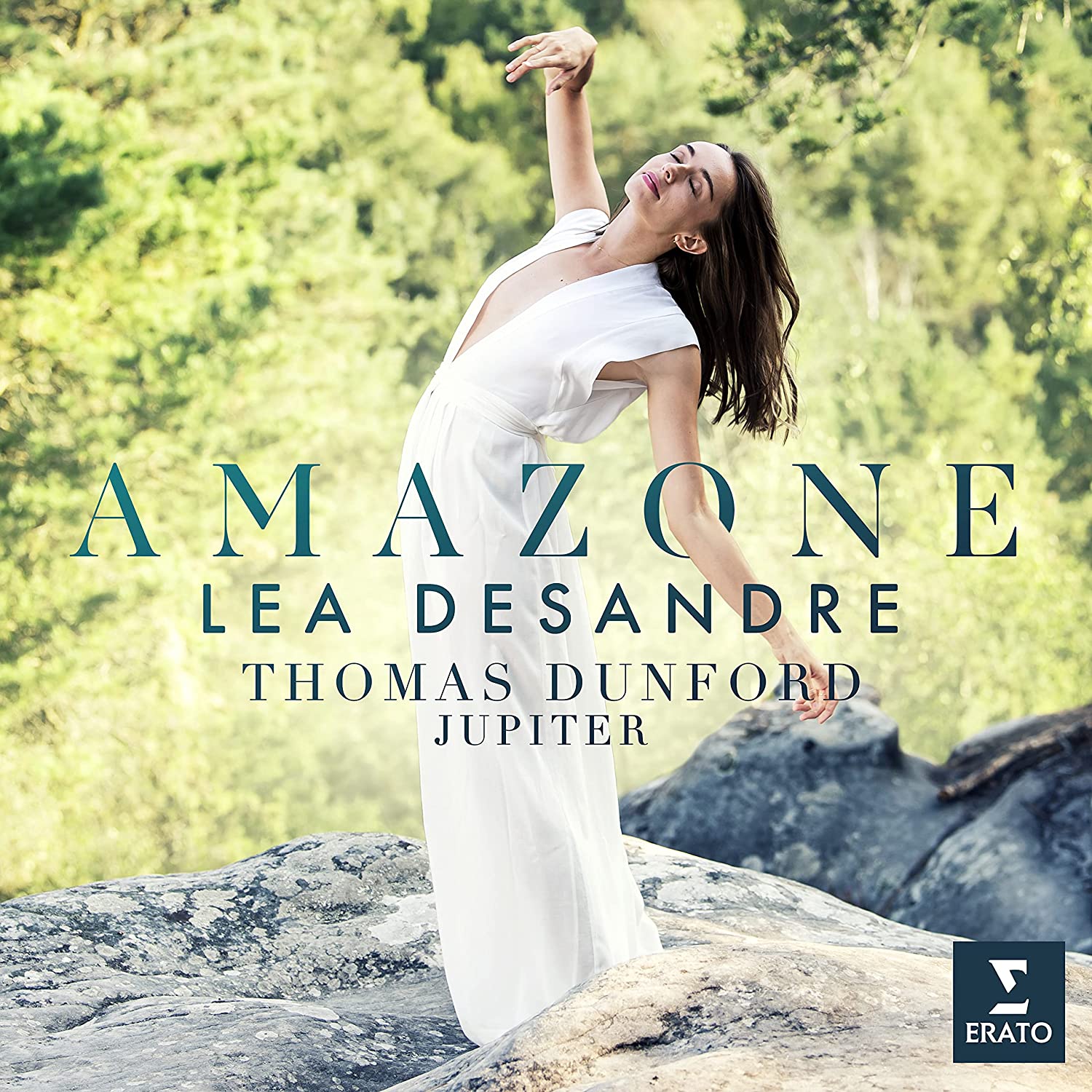
Amazone

Lea Desandre mezzo-soprano, Jupiter, Thomas Dunford
75:37
Erato 0 190295 065843

Click HERE to buy this album on amazon
[Doing so supports the artists, the record company and keeps this site available – if no-one buys, no money is made and the site will disappear…]

This is a recital of extracts from 17th- and 18th-century operas (French and Italian) that feature powerful female characters – Amazons of one kind and another. It is also, of course, a showcase for the powerful virtuosity of mezzo Lea Desandre. She is joined by no less than Cecilia Bartoli and Véronique Gens for duets (one each) and there are also a few short instrumental items. These include a performance of Couperin’s L’Amazône by William Christie, to complete the roster of guest stars.

This is an interesting concept, which introduces us to a lot of (to all intents and purposes) unknown music with several world premiere recordings claimed, all of which I am pleased to have heard. But I have multiple reservations about the performance practice on this disc. We hear a chamber ensemble throughout but would not most, if not necessarily all, of these composers have expected an orchestra? Yes, ‘domestic’ versions of operatic excerpts were published but would such an ensemble have included 16’ instruments? Why is there a lute as well as harpsichord in Louis Couperin’s Passacaille? Percussion?! And, as EMR writers so often observe, the singing is unreconstructed modern. Much is impressive in its way, though Ms Desandre is not always fully in control of her highest register. However, I’d like to hear her live in a fully-staged opera.

The booklet notes (in French, English and German) offer interesting comments about the concept but say little specific about the music, nothing about performance practice and nothing about the artists. Full texts and translations are included, however, but overall this is a release which the EMR/HIP community might find hard work.

David Hansell

Categories
Recording

Two Voices: Fair Oriana

Morley Canzonets to Two Voices (1595)
68:14
voces8 records
VCM134

Click HERE to buy this on amazon.co.uk
[These sponsored links help the site remain alive and FREE! Although we were sent a physical disc, only the four MP3 segments seem to be available at amazon – the link is to volume 3 which has five pieces, including the Owain Park piece mentioned below]

If, like me, you first met Morley’s two-voiced Canzonets as exercises in pastiche counterpoint composition, do not let this blind you to their musical delights. Here they are performed, with both conviction and delight, in four themed groups, each of which also contains other music including new (often rather good) commissions. These pieces contribute not only musical but also textural contrast, which makes the listener’s experience less austere than might otherwise have seemed the case.

The singers have voices which manage to both blend and contrast with each other and they are clearly separated in the recorded mix. This also offers different acoustics for the various elements of the programme beyond what might have been expected from the two venues used. At 10 minutes, Owain Park’s new Midnight poem is by far the most substantial work on the disc. For me, its varied styles did not wholly convince, though others may not feel the same. Similarly, the recorder on one of the parts in Ah Robyn was a definite intruder, as were the rather ‘arty’ breaths. The concluding arrangements of Purcell and Handel are effective in broad musical terms, though given that both composers contributed generously to the vocal duet genre might we not have heard more of ‘the real thing’?

So, not all early music, and not all HIP, but enjoyable anyway. The booklet (in English only) does not include the sung texts, which is regrettable, particularly in the case of the Park commission.

David Hansell

Categories
Recording

de Lalande: Grands Motets

Ensemble Correspondances, Sébastien Daucé
80:20
harmonia mundi HMM 902625

Click HERE to buy this album on amazon.co.uk
[Doing so supports the artists, the record company and keeps this site available – if no-one buys, this ad-free site will disappear…]

Michel-Richard de Lalande (1657-1726) is a rare example of a composer who knew nothing other than success and renown, a favourite of two French kings who served at Versailles for over forty years. Already in his twenties proficient enough to hold the position of organist at no fewer than four Paris churches, he first joined the court in 1683 as one of the sous-maîtres of the chapelle du roi. From there he went on to hold a number of posts culminating not only in leading the royal chapel, but in 1709 his appointment as maître da la musique de la chambre. He therefore became responsible for not only providing and directing the music for the king’s chapel but also providing secular music.

The main vehicle for the music of the royal chapel was the grand motet, a genre developed through composers such Henri Du Mont and Lully, but brought to a glorious fruition by Lalande, who wrote some 75 authenticated examples. Multi-sectional works scored for a substantial chorus and orchestra, the grand motet achieved a richly variegated texture by means of the introduction of solos and contrapuntal ensembles that contrast with the imposing grandeur of the largely homophonic choruses. The three included on this recording are the setting of the hymn Veni creator, composed in 1684, and a text that at Versailles had wider application than its usual Whitsun context, a large-scale and immensely imposing Miserere (Psalm 50) and an equally impressive Dies irae. This last departs from the norm in having been composed not for Versailles but the funeral of the Dauphine Marie-Anne-Christine of Bavaria at Saint-Denis, the historic location of princely funerals, in 1690. It became something of a fixture at state funerals and is believed to have been performed at the funeral of Louis XIV. In addition to the motets the recording sensibly separates the Dies irae and Miserere with a brief sample of Lalande’s secular orchestral music in the form of an extract from one of his Symphonies pour les Soupers du roi.

Over the past few years Sébastien Dauce’s Ensemble Correspondances has established a reputation enviable even in a country at present endowed with more than its fair share of outstanding early music ensembles and performers. The present CD will only enhance that reputation further. Given that the excellence of Daucé’s performers can by now be more or less taken for granted, perhaps the most notable aspect of these performances is the quite extraordinary depth and breadth he brings to the music where appropriate, particularly striking in the slower moving music of the Dies irae where Daucé creates a sublime spaciousness. The listener senses this right at the outset, where the period strings probe profoundly to bite into the rich orchestral texture, an impression only compounded when the profound strength of the opening chorus is added. Yet there is a wonderfully contrasted lightness and luminescence, too, in passages like ‘Quaerens me’ for two sopranos (the outstanding Caroline Weynants and Perrine Devillers). There is also a robust, uplifting vigour where appropriate. This applies especially to the later exuberant verses of Veni creator, brought to a resplendent peroration by the urgent vitality of the final doxology.

There are many, many more examples of the outstanding qualities of the performances that could be brought to notice, but I’ll restrict myself to a couple, the first of which provides a splendid illustration of not only the sheer variety of effect and texture, but also an acute textual awareness on the part of the composer that is one of the great qualities of Lalande’s compositions. In the Miserere the verse ‘Cor mundum’ (Create in me a clean heart, O God) starts with an exquisitely tender solo quartet, madrigalian in its weaving of imitative contrapuntal lines. The second part of the verse brings a greater urgency (‘renew a right spirit within me’) that Lalande responds to with lightfooted, dance-like verve, beautifully caught by Daucé. My other example takes us back to the Dies irae and the longest solo passage of récit and air in any of these works, the four verses commencing at ‘Liber scriptus’ and superbly sung and projected by alto Lucile Richardot, the possessor of a voice with the rare qualities of a genuine contralto.

I’m writing this in mid-January, which might seem a little early to start talking of ‘records of the year’. Notwithstanding I will be more than surprised if this superlative achievement is not way up there in the forefront of candidates.

Brian Robins

Categories
Recording

The Taste of this Nation

Clara Hendrick mezzo-soprano, Spiritato directed by Kunga Ujszászi
74:26
Delphian DCD34236

Click HERE to buy this on amazon.co.uk
[These sponsored links help the site remain alive and FREE!]

With this imaginative CD Spiritato open a window on the London music scene just prior to the arrival there of Handel. Resident musicians such as the three represented here were already introducing the Italian taste to the English – it has to be said that they are very much ‘silver’ composers, and I found myself constantly wondering what a first-rater like Purcell would have been writing in their place had he survived. Perhaps the best known of our trio, and probably the best composer among them, is Prussian-born London resident Pepusch, whose four cantatas beautifully sung by Clara Hendrick vividly bring the scene to life, and directly prefigure the operatic world of Handel. The most striking of these is his ‘While pale Britania sate’, the very impressive precursor of so many similarly patriotic numbers by Handel and in which Hendrick duets stirringly with the group’s trumpeter, William Russell. Perhaps the biggest surprise for me were the Concerti Grossi of Obadiah Shuttleworth, music I was completely unfamiliar with. Perhaps wisely relying on the inventiveness of Corelli, Shuttleworth reworks this composer’s op 5 Violin Sonatas into very effective concerti grossi. In doing so, he usefully introduces Corelli’s music to London, but more than that he too is preparing the way for the greater master to come, Handel and his ground-breaking op 6 Concerti Grossi. Of the three composers represented here, the most English and the one who owes most to the previous generation of English composers is William Corbett. There are constant echoes of Purcell, although his Sonata for Oboe and Trumpet recalls the work of the Czech-born but London resident Godfrey Finger. With these wonderfully passionate performances, Kinga Ujszászi and Spiritato prove powerful advocates of this largely unfamiliar music, and make a powerful case that even in the few years between the death of Purcell and the arrival of Handel England was anything but a ‘Land ohne Musik’.

D. James Ross

Categories
Recording

Basevi Codex

Music at the Court of Margaret of Austria
Dorothee Mields, Boreas Quartett Bremen
61:30
audite 97.783

Click HERE to buy this album on amazon
[These sponsored links help the site remain alive and FREE!]

The Basevi Codex is a music manuscript associated with the Mechelen Court of Margaret of Austria, produced by the famous Alamire workshop and containing mainly secular music by such big names of the early 16th century as Pierre de la Rue, Loyset Compère, Antoine Brumel, Matthaeus Pipelare, Johannes Ockeghem, Alexander Agricola, Johannes Prioris, Jacob Obrecht, Heinrich Isaac and Johannes Ghiselin. The Boreas Quartett of Bremen are a superb recorder quartet, who give beautifully nuanced instrumental performances of some of the material, while also blending wonderfully with the voice of Dorothee Mields – one of my favourite moments of the whole CD is in the account of de la Rue’s Plorer gemier where Mield’s voice magically emerges from the recorder ensemble texture singing the Requiem cantus. This enchanting blend amongst the recorders and in turn with the voice is a major asset of this revelatory CD. The account of three movements from Obrecht’s Missa Fortuna desperata highlights the expressive potential of this combination of recorders and voice, and makes a very plausible case for the performance of this fine music in a secular chamber context.

D. James Ross

Categories
Recording

M. Haydn: Endimione

Aleksandra Zamojska, Ulrike Hofbauer, Lydia Teuscher, Nicholas Spanos, Salvburger Hofmusik, Wolfgang Brunner
113:29 (2 CDs)
cpo 555 288-2

Click HERE to buy this album on amazon
[These sponsored links help the site remain alive and FREE!]

The serenata Endimione is part of a body of such miniature operas composed at the Court of Salzburg in the second half of the 18th century, which includes the azione teatrale il sogno di Scipione and Il re pastore by Mozart. Work by a number of ensembles, not least Salzburger Hofmusik, has increasingly brought Michael Haydn out from the shadow of his elder brother, Joseph, and this charming serenata highlights his skills with the voice and with orchestral writing. It is probable that the virtuoso soprano part of Endimione would have been taken by Mozart’s friend and collaborator, the celebrated Munich castrato, Tommaso Consoli, and it is sung impressively here by the countertenor Nicholas Spanos. A fine line-up of three excellent sopranos take the parts of Amor, Diana and Nice, producing the necessary vocal fireworks, while they are ably supported by the wonderfully responsive Salzburger Hofmusik under the direction of Wolfgang Brunner. While some ensembles take a much more aggressive approach to the music of this period, the Salzburger Hofmusik are always appropriately courtly, allowing the music to speak for itself. This pays dividends at moments such as Endimione’s accompanied recit Lode al ciel and Diana’s ensuing Cavatina, where Haydn’s delicious orchestration and sublime lyrical skills are allowed to unfold naturally. Indeed, this serenata is rich in such inspired passages, underlining the fact that Michael Haydn’s distinctive compositional voice has until recently been so unfairly overshadowed. Salzburger Hofmusik have already played a key role in highlighting the Court Kapellmeister’s skills as a composer of church music, but this present recording shows his equally remarkable abilities as an “operatic” composer.

D. James Ross

Categories
Recording

Vivaldi: Cantatas for soprano 1

Arianna Vendittelli, Abchordis Ensemble, Andrea Buccarella
62:42
naïve OP7257

Click HERE to buy this album on amazon
[Doing so supports the artists, the record company and keeps this site available – if no-one buys, no money is made and the site will disappear…]

It cannot be stressed too often just what an extraordinary project Naïve’s complete Vivaldi Edition is. With their striking, sometimes bizarre covers featuring models – this one a very 21st-century young woman adorned with a ruff and blossom in her tousled hair – each CD adds to a total of issues that with this addition devoted to soprano cantatas reaches volume 68.

By definition the Edition has introduced many new works to the catalogue, but Vivaldi’s 30-odd cantatas have in general been reasonably well represented on record and all six here (RV 650, 652, 669, 667, 660 and 665) are or have been previously available on CD. That is not to detract from the present issue, which, while not flawless, has a great deal to recommend it. Not the least of the appeal comes from the beguiling quality and personality of Arianna Vendittelli’s soprano, which heard at its best gives to these pastoral cantatas of love in its various guises an empathy and seductive warmth that is irresistible and frequently touching. Ornaments are neatly turned and passaggi negotiated with an agile ease, though I fear as so often it is necessary to report there is no convincingly articulated trill to be heard, though Vendittelli deserves credit for at least attempting this most elusive, but essential of decorations.  

If only that were the whole story, but sadly it is not. In common with so many singers today Vendittelli exercises less than perfect control over her higher register, which is too often unevenly produced. This is particularly in evidence in the most ambitious and outstanding of these cantatas, ‘Sorge vermiglia in ciel, la bella Aurora’ RV 667. In four movements alternating recitative and aria, it is, as it not uncommon, the complaint of the lover whose affections are not returned but who will still remain faithful to the loved one, in this case Sylvia. The passion and fervour are barely contained and the cantata, which concludes with a full-blooded aria di furia was obviously written for an exceptional virtuoso castrato or soprano, with expansive often awkward vocal leaps in all four movements. The opening recitative allows Vendittelli to reveal impressive chest notes in the lower register, but in the aria ‘Nasce il sole’ the lack of control is cruelly revealed, with the difference in volume between the chest notes and upper head notes running counter to everything we know about the technical requirements of the day (cf. Tosi). Yet what is disappointing is that both here and elsewhere Vendittelli shows she has a lovely mezza voce perfectly capable of ‘touching’ (Tosi’s word) upper notes. There’s an especially noteworthy example in the final aria, ‘Vedrò con nero’ from the delightful lighter cantata ‘La farfalletta s’aggira al lume’, RV 660. Here the word ‘splendor’ is positively caressed on its final appearance with each repetition. I relish, too, the undulations of the B section of this aria, with their little hints of portamento.

The singer is given well-played continuo support by the members of the Abchordis Ensemble (here harpsichord or organ, cello, chittarone or archlute) and bassoon (in slighter RV 669 and 665), but it is not always tastefully judged. This applies particularly to movements where the plucked instrument is given full reign to make a tiresomely over-intrusive contribution, while the introduction to the opening aria of RV 660 sounds positively twee rather than capturing Vivaldi’s delightful evocation of flitting butterflies and meandering bees. Nonetheless, and as stressed above, Vendittelli brings to these cantatas much that is to be cherished and relished. For that reason the CD is welcomed as yet another valuable addition to the Vivaldi edition.    

Brian Robins

Categories
Recording

Haydn: Die Schöpfung

Yeree Suh, Tilman Lichdi, Matthias Winckhler, La Capella Reial de Catalunya, Le Concert des Nations, Jordi Savallq
103:18 (2 CDs in a card triptych)
Alia Vox AVSA9945


Click HERE to buy this album on amazon.co.uk
[Doing so supports the artists, the record company and keeps this site available – if no-one buys, this ad-free site will disappear…]

Is there a more uplifting work in all music than The Creation? Even in a half-decent performance and for all the perceived naivety (by some) of parts of its text and the mimetic response they drew from Haydn, it juxtaposes glorious, iridescent power with reassuring companionability to a degree that is surely unique. Jordi Savall’s new recording, made shortly before his 80 birthday in May 2021, is, as one would expect, a great deal more than half-decent. The ethos of the performance is established at the very outset. Aided by the generous acoustic of the Romanesque church at Cardona in Catalonia, the portentous opening chord of the introductory ‘Representation of Chaos’ seems to last an eternity before finally dying. Again as one might expect, tempos are in general on the slow side, but only in Part 3 is there any feeling that there might have been more forward movement. In the opening duet with chorus for Adam and Eve that is more than mitigated by the manner in which Savall builds the movement to a magnificently controlled climax in the overwhelming outburst of praise to God, ‘Heil, dir’. Less convincing is the equally slow tempo for the more worldly duet that follows, ‘Holde Gattin!’, a wonderful example of the way in which Haydn throughout constantly alternates the godly with the world He has created.

This combination of the elevated, the spiritual with the everyday, the mundane world of cattle and worms, is to my mind at the heart of the humanity Savall finds in the oratorio. And time and again it is through the superb playing of his orchestra that he achieves that goal. Listen, for example, to the exquisite tenderness of the orchestral opening of the terzetto ‘In holder Anmut’ (In fairest raiment), so touching in its evocation of the beauties of nature and yet another number that will build inexorably, in this case from the pastoral to a glorious climactic point in the chorus ‘Der Herr ist gross’ (The Lord is great).

So where does that leave the soloists? Well, although all three sing well enough, particularly in ensemble work, I have to confess a certain disappointment. There is to my mind in common a shortage of strong personality, a lack of communicative skill that results in an inability to make the text tell in the way it can and must in this work. Most satisfying is the Korean soprano, Yeree Suh. Hers is a truly delightful soprano, fresh, youthful and supple enough to essay passaggi with fluent ease and turn ornaments with elegance. At her best, as in ‘Nun heut die Flur’ (With verdure clad), she is beguiling and charming, but overall she needed to pay more attention to enunciation. Tenor Tilman Lichdi’s Uriel is fine without ever challenging some of the outstanding singers of the role. The timbre is agreeable and he brings a pleasingly youthful lightness of touch to his opening aria, ‘Nun schwanden’ (Now vanish’), but in the magnificent accompagnato celebrating the division of night and day, the sun and the moon, the ear is constantly caught not by the singing but the orchestra’s magnificent evocation of sunrise and the mystery of moonlight. And so it is too with Matthias Winckhler, whose baritone is rather lightweight for Raphael’s music and is at times pushed to maintain a steady tone at Savall’s deliberate tempos.  But I would not wish to over-exaggerate any deficiencies the soloists might have; by any standard their contribution is at the very least thoroughly acceptable.

I’ve not so far mentioned Savall’s splendid hand-picked chorus, here just 20-strong (considerably fewer than Haydn had at his disposal in 1808) but sounding more numerous with the aid of the acoustic. The catalogue is graced by a number of outstanding recordings of The Creation. This one, for the reasons suggested, is rather special, and joins them as the product of the cumulative experience of one of the great musicians of our day.

Brian Robins

Categories
Recording

Centorio : Vocal and instrumental music

Cappella Musicale della Cathedrale di Vercelli, Denis Silano
60:42
Brilliant Classics 96242

Click HERE to buy this on amazon.co.uk
[These sponsored links let you read these reviews for FREE and without the distraction of advertising]

This CD is part of a broader exploration by Italian musicians of their local heritage, and this ensemble based in Vercelli in northern Italy has come up with Marco Antonio Centorio, a local composer of not inconsiderable charm, whose oeuvre remained in manuscript form. This selection of instrumental and vocal music presents a picture of an accomplished local musician of the early 17th century with a solid grounding in polyphony but also with distinctive elements of individuality and originality. There is some fine period instrument playing here, as well as a pleasing contribution from vocal soloists and small choir, the boys’ voices of the latter ensemble making a distinctive and idiomatic contribution. Denis Silano, the mastermind behind the project and who directs proceedings, makes a powerful case for Centorio’s music being more widely known, and it is clear from this CD that he is of more than local significance. It is good to see this ongoing exploration of regional Italian music-making in the 16th and 17th centuries by Italian ensembles, at the same time allowing us to witness the high standard of historically informed performance throughout Italy.

D. James Ross

Categories
Recording

Sacred Treasures of Christmas

The London Oratory Schola Cantorum, Charles Cole
76:30
Hyperion CDA 68358

Click HERE to buy this on amazon.co.uk
[These sponsored links mean you can read these reviews for FREE and without the inconvenience of advertising!]

This CD is part of a series recording the liturgical music of the various seasons as presented in the round of services in the London Oratory. St Augustine’s Church Kilburn provides just about the ideal acoustic for recording this lavish Christmas music, providing a pleasing bloom but also allowing us to hear the necessary detail. The choral music comes from throughout Europe and the composers represented include Sweelinck, Giovanni Gabrieli, Hassler, Mouton, Scheidt, Guerrero, Victoria, Palestrina, Lassus, Sheppard, Nanino and Tallis, while the choristers also sing some plainchant with the authority of familiarity. In fact the music covers the celebrations of Christmas, Epiphany and Candlemas, and ranges in mood from the overtly showy to the deeply contemplative. The singers capture the full range of moods in their chosen music, and the director Charles Cole does a superb job in marshalling his large choral forces to produce a sound which can be focussed and intimate, as well as wonderfully opulent. I think there is something profoundly different about a ‘working’ church choir from the small specialist ensembles who also perform this sort of repertoire, not just in their use of boys’ voices and their sheer numbers, but in their approach to the music. This is repertoire they sing every day of their lives as a vital element of church services, and they derive an unparalleled authority as a result. This is a thoroughly enjoyable recording which captures perfectly the joys of the festive season.

D. James Ross