Categories
Recording

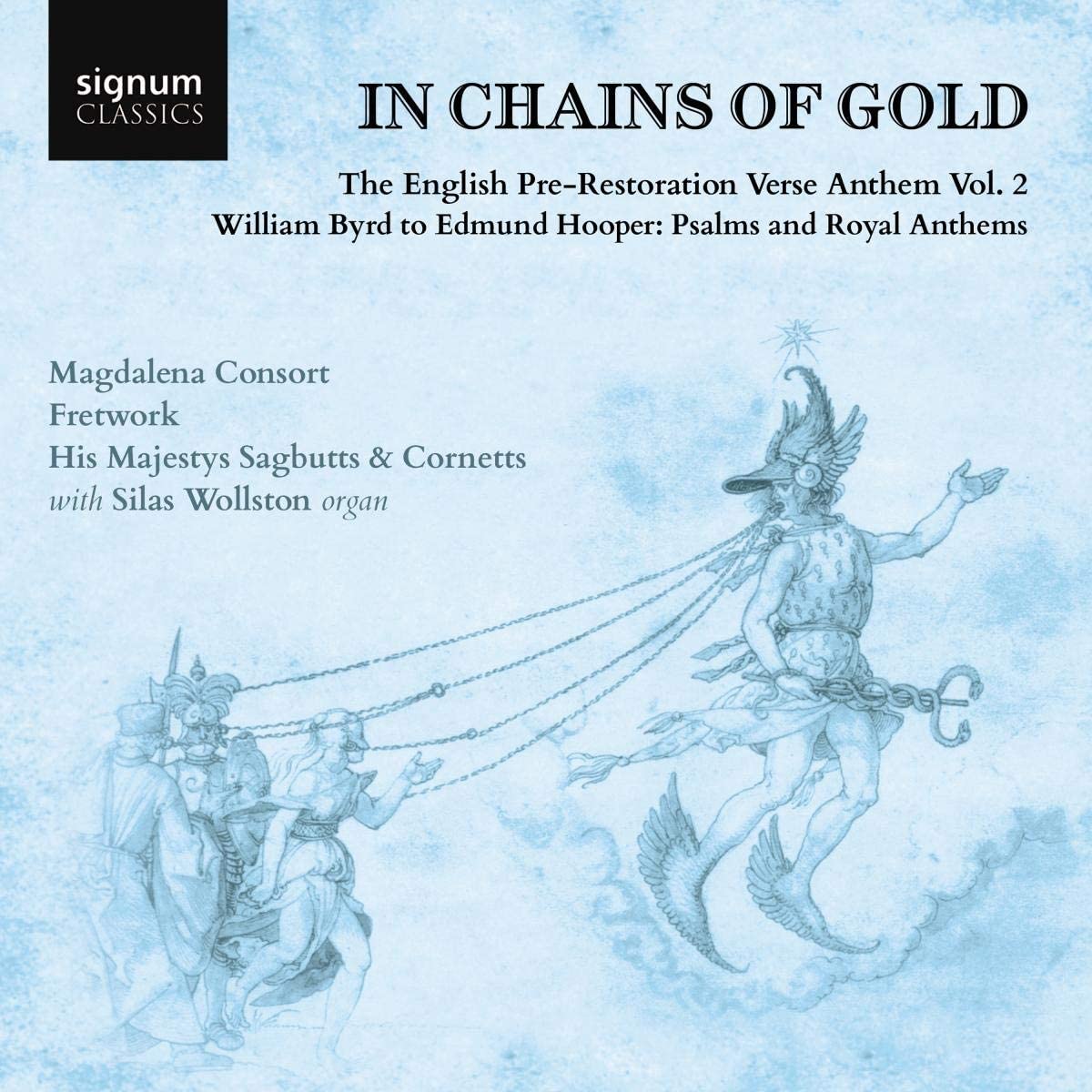
In chains of gold: The English pre-Reformation verse anthem, volume 2

William Byrd to Edmund Hooper: psalms and royal anthems
Magdalena Consort, Fretwork, His Majestys Sagbutts & Cornetts, Silas Wollston organ
70:29
Signum Classics SIGCD609

Byrd: Hear my prayer, O Lord rebuke me not, Have mercy upon me O God Fantasia BK46, Teach me O Lord, Christ rising again, I will give laud, Look and bow down Bull: Almighty God which by the leading of a star, Fantasia MB 16, Deliver me O Go. Cosyn: Voluntaries 1 and 3 Morley: Out of the deep Hooper: Hearken ye nations, O God of gods John Mundy: Sing joyfully

We were lucky enough to receive two copies of this recording for review, and here are the two reactions to it. Firstly (in the order in which they arrived in my inbox!), Richard Turbet then David Stancliffe.

This is the second volume in the series which began with a well-received disc of all the surviving consort anthems by Orlando Gibbons. It features Byrd, plus his pupils Morley and Bull, and their contemporaries Edmund Hooper and John Mundy, with organ solos by Benjamin Cosyn. The music itself is varied and of the highest quality, the performers are among the finest in this repertory, the scholarship behind it is in the distinguished hands of Andrew Johnstone whose doctoral thesis is on Byrd’s Anglican music, and the artistic director is Bill Hunt, founder-member of Fretwork who, at the time of writing, is engaged upon a doctoral thesis about consort anthems.

The proceedings get off to the best possible start with the first of three Byrd premieres: Byrd’s oeuvre runs to well over five hundred works, and his entire repertories of Latin, keyboard and consort music have been recorded. However, there are many gaps in the English-texted music, both sacred – liturgical as well as domestic – and secular. Hear my prayer, O Lord is one of Byrd’s three surviving verse anthems (with an accompaniment for the organ and therefore intended for use in the Anglican liturgy) but Andrew Johnstone feels that he has evidence that it originated as a consort anthem, with an accompaniment for viols indicating domestic performance. Although this is open to interpretation, it is entirely appropriate to be open to alternative possibilities and to air them in a project such as this. In any event, this piece is a gem and its eventual appearance on a commercial recording is greatly to be welcomed. O Lord rebuke me not is the second of Byrd’s surviving liturgical verse anthems on this disc, and again Andrew Johnstone feels that there is evidence of domestic origins. There have been a couple of previous recordings of it with an organ by cathedral choirs (Salisbury and Lichfield), but it is no less welcome here in this experimental – and, who knows, perhaps authentic – guise. The third of Byrd’s trio of surviving liturgical verse anthems Teach me O Lord is performed as such, with organ, but with an intriguing slant to its interpretation. The verse is in triple time, and the chorus in duple. Normally this is performed as dotted semibreve = semibreve when passing from verse to chorus (with the reverse from chorus to verse), as in volume 10a of The Byrd Edition (p. 43 passim) or simply retaining the value of each note, i.e. semibreve = semibreve. In this recording the verse and chorus are rendered with a proportional relationship between the triple and duple sections, resulting in the verse being sung much more briskly than is usually the case. Having recovered from the initial surprise and listened several times, I am still not convinced, but none of us were there at the time, Byrd’s manuscript does not survive, contemporary sources are inconsistent, and insufficient research has been published, so it is again thoroughly worthwhile to use this recording as a vehicle for such an experiment.

The second of Byrd’s premieres is I will give laud, one of several fragmentary songs that survive in a lutebook from the Paston collection from which crucial parts are missing, hence their skeletal appearance in volume 16 of The Byrd Edition. Andrew Johnstone has done heroic work in making this song performable, and there is word of a forthcoming publication containing several other such Byrd reconstructions. The text is the usual excruciating paraphrase of a psalm, in this case the luckless XXXIV, perpetrated by Thomas Sternhold, and the form is ten verses sung by a soloist in the measure of a galliard, accompanied by a quintet of viols, with a chorus repeating the final two lines of alternate verses.

The third of the trio of Byrd premieres is the majestic Look and bow down. Byrd, who was what we would nowadays call the Master of the Queen’s Musick, sets a poem by Queen Elizabeth thanking God for assisting mainly Herself in seeing off the Spanish Armada in 1588. Again, major reconstructive musical surgery was required from Andrew Johnstone. (At least two previous attempts, by experts on respectively Byrd and the Paston sources, had been made, to try to create a performable song out of the intractable fragments.) It was first sung outside St Paul’s Cathedral, so the decision was taken for this recording to use an accompaniment of winds, as would have been the practice at the time. Mean and triplex soloists respectively sing the first two verses, the final lines echoed by the chorus, then the soloists join together in the final verse, to make a glorious conclusion with the four wind instruments, the organ and, for the repetition of the final couplet, all the available singers. The resulting sound is magnificent, with the prevailing dignified minor tonality giving way to a moving evocation of “The soul of me his turtledove” in the final line.

That concludes the Byrd half of the disc, and it is followed by Bull’s famous Starre Anthem and Deliver me, O God, another premiere, which is set to a text said also to be by the Queen celebrating the defeat of the Armada. Towards the end of the record are two powerful anthems by Edmund Hooper, a fine composer who seems to have been neglected simply because of the sheer number of gifted contemporaries. He is no less gifted than most of them, however, and although there is a fine recording of his services and anthems by The Choir of Selwyn College, Cambridge under Andrew Gant (Lammas LAMM 096D), these two works receive their premieres on the present disc. Hearken ye nations is a bracingly grumpy work which loquaciously celebrates the failure of the Gunpowder Plot, while O God of gods was composed for the Accession Day of James I as king of England and, like Byrd’s Look and bow down, ropes in winds, a substantial chorus, and even a session musician on tenor dulcian, to bring the proceedings to an appropriately regal conclusion.

All the other pieces on this disc – the better-known anthems needing less editorial labour and the works for organ – go towards making this a most attractive and enthralling programme, supported by a booklet that is both scholarly and readable. From an engineering point of view, just occasionally the second vocal line down could have been given more presence (such as in the third verse of Look and bow down), otherwise this recording sounds as elevated as the quality of the music it presents. The performances leave nothing to be desired. The viols and wind are, as I have already said, the top of their profession. All the singers are excellent, among whom Elisabeth Paul and Zoe Brookshaw (“mean” and “triplex”) have prominent roles. But every individual performer, alongside their technical and musicological colleagues, has been crucial in making this an outstanding disc.

Richard Turbet


This is the second volume of Bill Hunt’s great project to edit and record the corpus of pre-Restoration Verse Anthems, of which Volume 1, focussing on Gibbons, appeared in 2018 and was reviewed in January of that year.

This second volume has a wonderful range of music starting with William Byrd and moving through John Bull and Thomas Morley, interspersed with short voluntaries for the organ by Benjamin Cosyn, to John Mundy and the great discovery for me – Edmund Hooper, whom I only knew as the composer of a set of evensong canticles. Three of Byrd’s penitential psalms begin the programme, and after Teach me, O Lord, Christ rising again and I will give laud (a splendid five-part reconstruction by Andrew Johnstone of a swinging lyric rather in the manner of Though Amaryllis dance in green), comes Look and bow down, a setting of words by Queen Elizabeth herself which was ‘performed at Sainte Pauls crosse in London’. It is accompanied by cornets and sackbuts on this recording as in all probability it was sung outside the cathedral after the Bishop of Salisbury’s sermon at the conclusion of the service to give thanks for deliverance from the Spanish Armada.

One of the welcome features of this distinguished recording is the care taken to make the texts clearly audible. This is where the Reformation concern for the clarity and audibility of the text and the musical seconda prattica championed by Monteverdi and the composers of the new dramatic word-settings emanating from Italy coincided. I particularly enjoyed the Magdalena Consort’s director Peter Harvey articulating the bass verses in John Mundy’s Sing Joyfully with such clarity and feeling: it is not always easy to make the bass part in such music melodically interesting as well as so wonderfully resonant. His rock-steady pitching against which the other voices can tune is a model for this kind of consort singing. For drama, I admired Benedict and Hugo Hymas’ passionate declamation and articulation of the expressive words – again possibly by Queen Elizabeth – in Bull’s Deliver me, O God, which follows his well-known ‘Starre Anthem’.

The ensemble singing is outstanding. This struck me most forcibly when the full voices entered after Elizabeth Paul’s opening verse with the viols in Byrd’s O Lord, rebuke me not. Breathing as one, the singers with the admirable Eleanor Minney on top contrive an organ-like unanimity of sound that contrasts with the single voice verse. Such alternation between a single voice with viols and this rich homophonic sound is a characteristic of the verse anthem genre, and throws the text into prominence by repeating it word for word. Only Andrew Johnstone’s illuminating note on the Byrd settings reveals that he is the reconstructing detective of several of these pieces, so imperceptible is his skilful hand, and I look forward to many of his Byrd reconstructions coming into the public domain.

While the singing is agile as well as rich (listen to the nimble rhythms in Christ rising again), the playing is equally elegant. Fretwork shares the bulk of it, and their sinuous lines weave a magical backdrop to the voices. Mostly the singers pick up a responsive style – much of this is music for private chapels and long galleries rather than the formal worship of church services, so a reflective, understated style is called for in many pieces. To my mind, only Zoë Brookshaw sometimes sings with too much vibrato on unimportant notes; otherwise, the singers vary their style between verse and chorus very perceptively.

But the real triumph of this project is to unite scholarship, performance practice and passionate music-making. Often two of these three are fulfilled, but rarely all three. You can sense the energy and passion in the project from the commitment of the musicians, all skilled practitioners in their fields. But behind them stand Andrew Johnstone and Bill Hunt – the presiding genius. And as always with Bill’s projects, there are unanswered questions: for me, the one I hope to pursue is that about the music desk in Bishop Andrewes’ chapel. I have a very clear memory of an enclosed pew with a central desk on the right-hand side of the chapel at Wolvsey, the palace of the Bishops of Winchester near the cathedral in Winchester. Am I right in thinking that this might well have held a consort of viols? Certainly, the substantial mediaeval chapel with its distinctive ‘Laudian’ fittings has never, as far as I know, had an organ.

To raise more questions than you answer and to excite your followers with the same passion to find out more is the mark of all inspired educators, and this CD is with its splendid notes is a fine example of that.

David Stancliffe
Categories
Recording

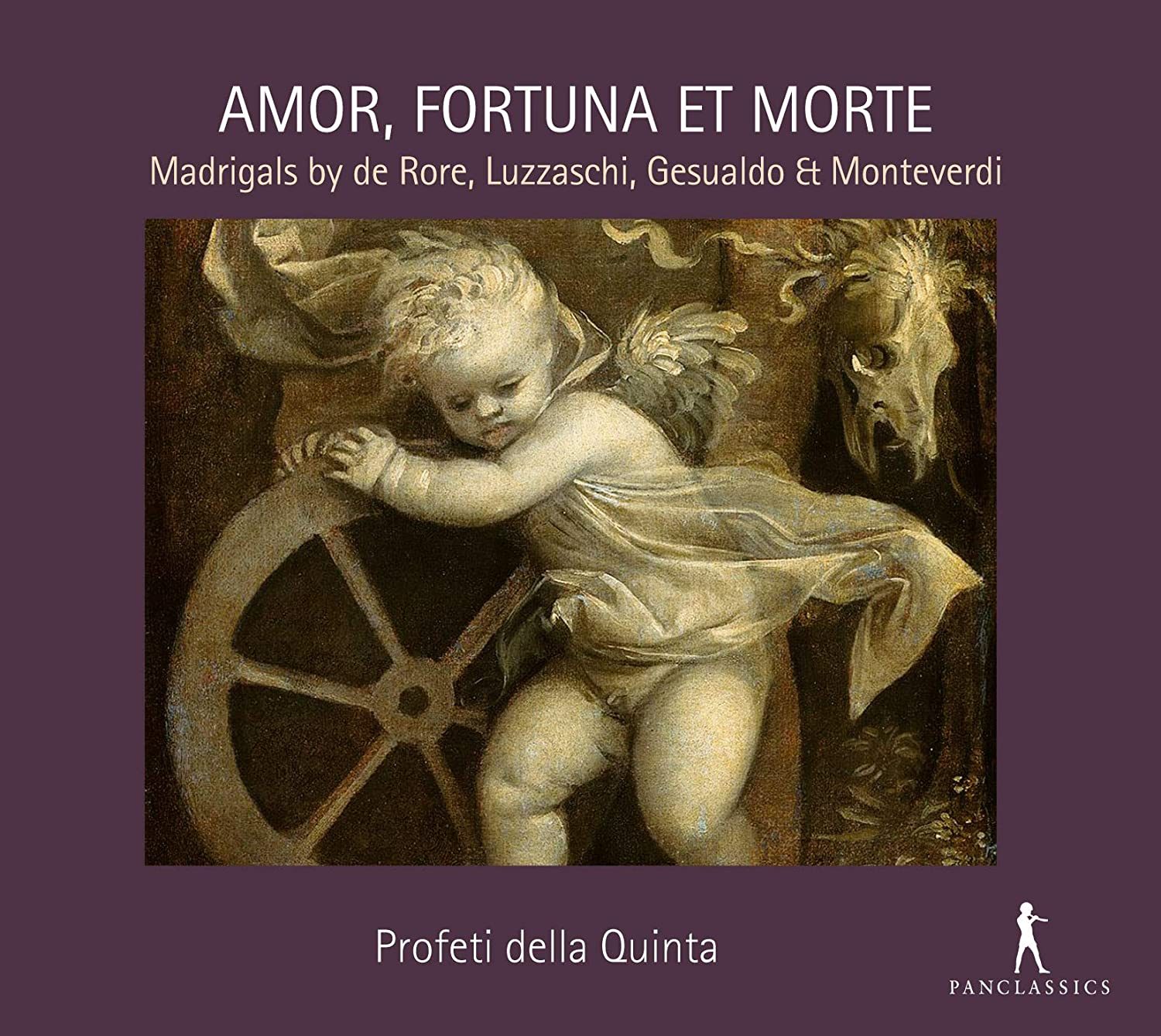
Amor, Fortuna et Morte

Madrigals by de Rore, Luzzaschi, Gesualdo & Monteverdi
Profeti della Quinta
64:21
Pan Classics PC 10396

Click HERE to buy this on amazon.co.uk

This collection of madrigals has been compiled for the excellent reason that the singers of the Profeti della Quinta love singing them. Interestingly the composers they choose span the 16th and the first half of the 17th centuries – Cipriano de Rore was born in 1515/6 and died in 1565, while Monteverdi was born in 1567 and died in 1643. While there is considerable variety here, various musical and thematic threads run all the way through the programme. The five male voices, joined in the later works by lute, achieve a remarkable blend and purity of intonation, and sing these madrigals with intense expression and musical intelligence. In addition to some very familiar material, we have an extraordinary madrigal by Scipione Lacorcia, who manages to outdo his model Gesualdo in harmonic eccentricity and melodic waywardness! The recording of Monteverdi’s “Lamento della Ninfa” (13) is a hair-raising aberration, as one of the group’s male altos hideously droops and swoops around Monteverdi’s melodic line in a style verging on caricature. Famously, Monteverdi asks the soloist to sing ‘at the beat of the emotions’ – however, this clearly means singing with a degree of mensural freedom rather than approximating the actual notes in a sort of anachronistic Sprechgesang. Just awful, but mercifully unique on the CD. Interspersed among the madrigals, we also have a number of pieces for solo lute, some of them very effective arrangements of madrigals. Founded in Galilee by the eminent singer/harpsichordist/director/composer Elam Rotem, Profeti della Quinta is now based in Basel.

D. James Ross


Categories
Recording

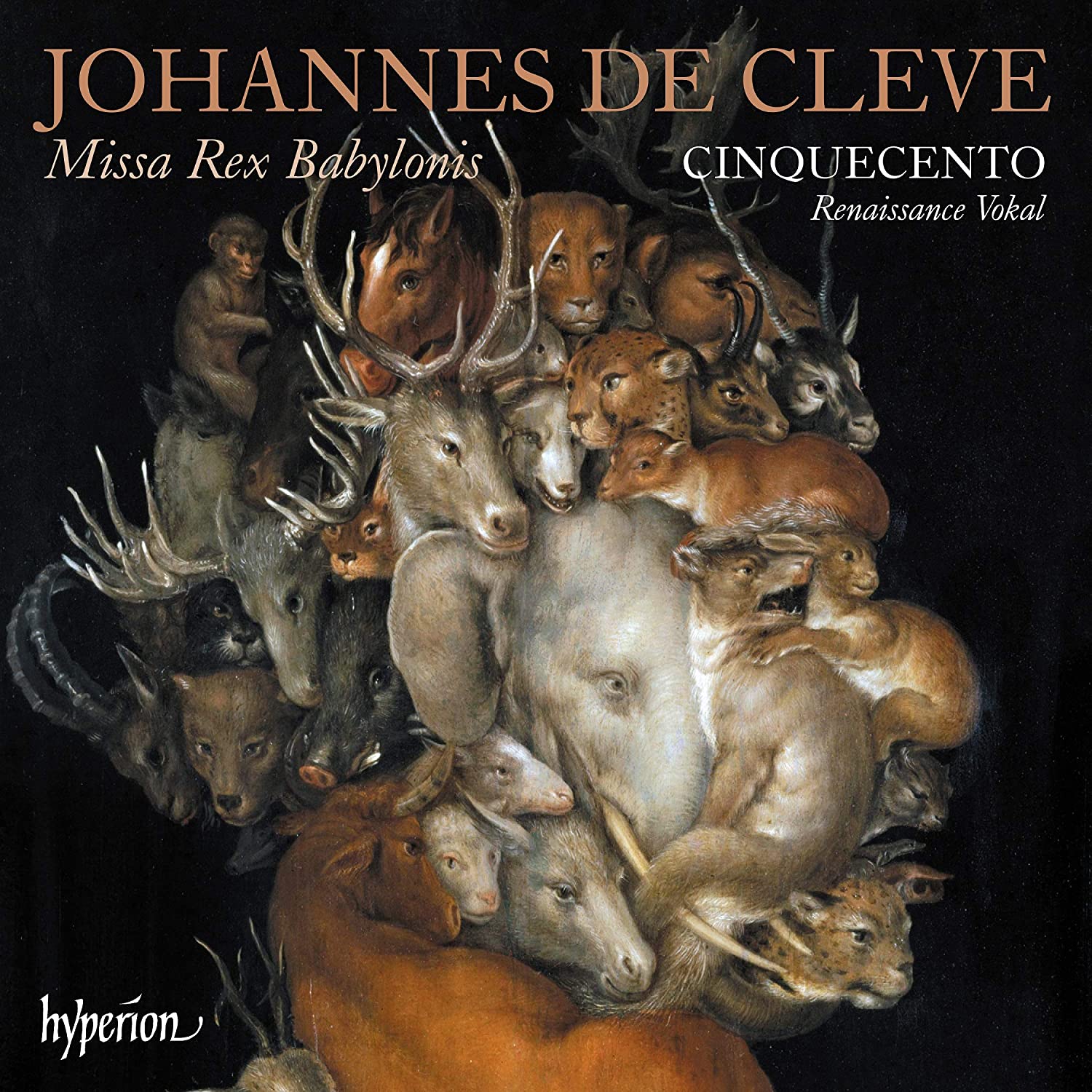
Johannes De Cleve: Missa Rex Babylonis

Cinquecento Renaissance Vokal
71:06
hyperion CDA68241

Click HERE to buy this on amazon.co.uk

Johannes de Cleve (1528/9-1582), while an almost exact contemporary of Palestrina, composed in a recognisably Franco-Flemish style, with its debt to Gombert and, earlier still, Josquin, while there are a few audible nods towards Italy. Originating from modern-day Kleve, the same neck of the woods as Henry VIII’s fourth wife, on the borders of modern Germany and the Netherlands, it is assumed that he was trained in the Low Countries before, in 1553, fetching up in Vienna and having his first book of compositions published in Antwerp. Their almost exact contemporary, the definitely Flemish Jakob Vaet (pronounced “vart”), born in what is now Kortrijk, also fetched up in Vienna, and provides the motet on which Cleve bases his mass. While Vaet is relatively well represented on disc, thanks in no small part to Cinquecento, Cleve is a virtual newcomer. Does his music deserve this extended recognition?

There is no getting away from the fact that Call-me-Vart is the better composer, for all his limited appearance on this disc. His motet lasts over nine minutes, and its sweeping musical narrative puts Cleve into perspective. In Cleve’s mass, there is a lack of subtlety in his use of salient features from Vaet’s motet which suggests that originality is in short supply. There is some stilted homophonic writing in the first section of Carole qui veniens just before some rather by-numbers syncopation, though there is compensation in a striking chromatic passage during the second section. That said, most of his works possess some good moments. His use of dissonance which, like his chromaticism, is touted in most commentaries about him, shows its head assertively in both settings of the Agnus in the Mass. The same animated and affecting Hosanna concludes the Sanctus and Benedictus. And there is some mellifluous polyphony in the Kyrie.

Recently for this journal, I reviewed a disc, sung by the Brabant Ensemble, of music by members of the Franco-Flemish wolf pack, Lupus Hellinck and Johannes Lupi (Hyperion CDA68304). Born three decades before Cleve, there are aspects of their music – fluency, spontaneity, originality, breadth and independence of creative thought – which make it superior to his agreeable competence. As for the performance, Cinquecento produce a rather thick texture and, as a male ensemble albeit with a falsettist, tend to gravitate to lower in the vocal range than a choir such as the Brabant Ensemble, which includes females, and whose renditions are a tad (very acceptably) rougher but whose vocal textures tend to be brighter. As I remarked in my recent review of Cinquecento’s recording of the second book of Palestrina’s Lamentations (Hyperion CDA68284), this rendered them perfect exponents for this more intense and static music, but it can lead to some monotony especially when applied to a composer such as Cleve.

Cleve’s well-wrought dissonances and chromaticisms, within his competent yet still conservative technique, earn him this revival by a major ensemble on a major label. Other composers tell a better story over the piece, but even a lesser composer within the Franco-Flemish School, albeit right at the end of its span, is better than a lesser composer from most other such circles.

Richard Turbet

Categories
Recording

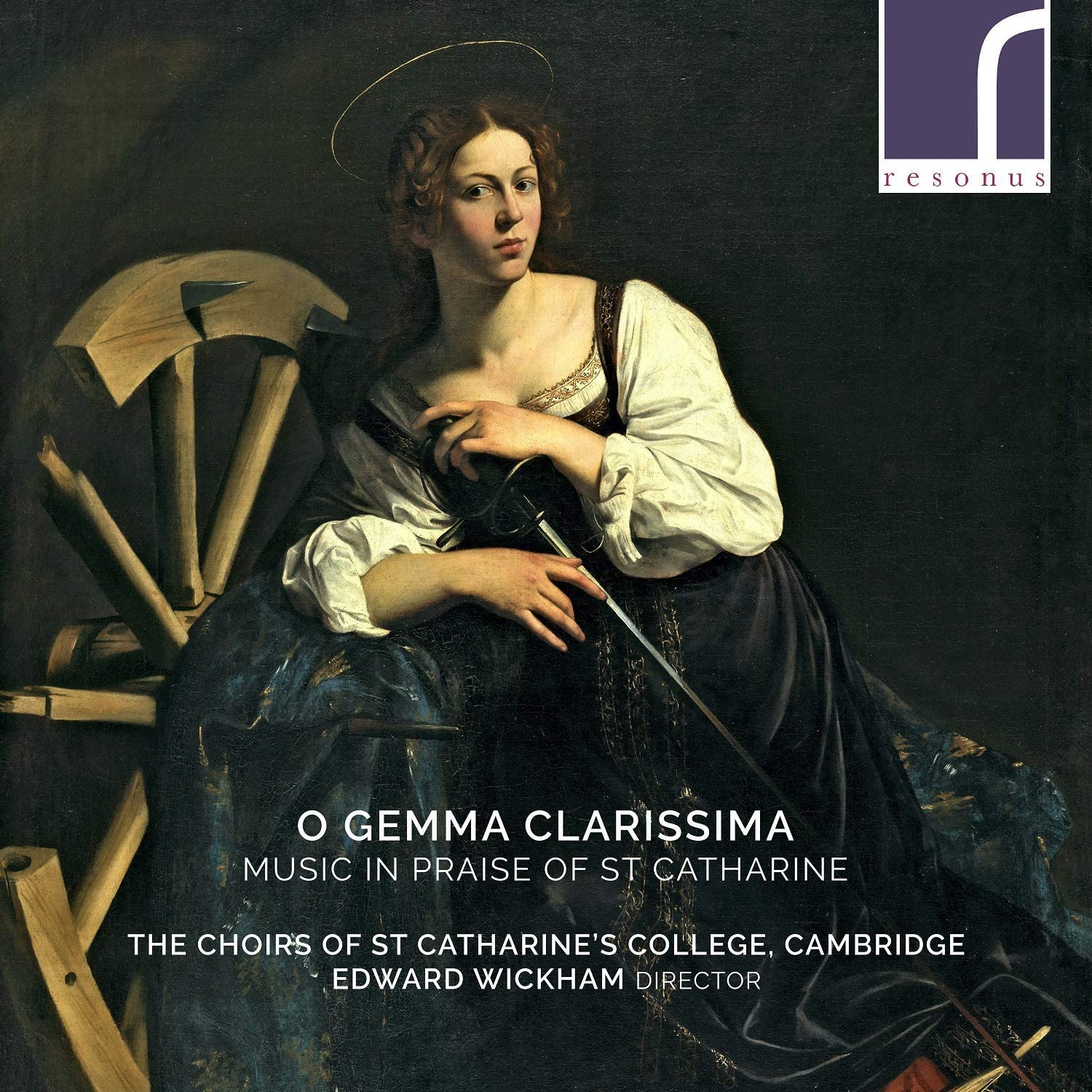
O gemma clairissima

Music in praise of St Catharine
The Choirs of St Catharine’s College Cambridge, Edward Wickham
72:02
resonus RES10246
Music by Fawkyner, Frye, Gombert, Jacquet of Mantua, Mouton, Palestrina, Regnart, Senfl, Vermont, Willaert, anon + sarum chant

Click HERE to buy this CD on amazon.co.uk

The combined forces of St Catharine’s College and Girls’ Choirs are directed by Edward Wickham in this recital of hymns, motets and chants devoted to the martyr St Catharine, after whom both the Catherine Wheel and the Cambridge College are named. The elaborate and gruesome means of Catharine’s martyrdom captured the Medieval imagination, and Renaissance and Medieval settings of texts relating to the saint abound. The choirs sing relevant plainchant and polyphony by Regnart, Senfl, Willaert, Mouton, Frye, Gombert and Palestrina as well as by the less familiar Pierre Vermont, Jacquet de Mantua and Richard Fawkyner. The singing is generally nice and expressive, although there is a slight ‘herd ethic’ resulting perhaps from the combination of the two choirs. The particular demands of Walter Frye’s Kyrie ‘Deus Creator omnium’ and the Eton Choirbook intricacy of Fawkyner’s ‘Gaude rosa sine spinas’ (a 15-minute choral tour de force) inspire some of the finest singing on the CD. The Girls’ Choir also makes some lovely contributions on their own, while the combined voices generally produce a consistently full expressive sound. Edward Wickham’s intelligent direction brings out the full nuances of this largely unfamiliar music, while his wonderfully knowledgeable programme note both entertains and informs.

D. James Ross

Categories
Recording

Rore: Vieni, dolce Imeneo

La Compagnia del Madrigale
69:27
Glossa GCD 922808

Click HERE to buy this on amazon.co.uk

The invocation of Hymen, god of marriage, in the title of one of these madrigals by Cipriano de Rore, which in turn provides the CD with its title, is indeed felicitous. These works, all from late or posthumous collections, demonstrate the clear marriage of text and music for which Cipriano was renowned in his lifetime and for some time thereafter. Monteverdi was a great admirer, and it is fascinating to hear how the latter master picked up the Cipriano baton and ran with it in his own madrigals. The singing of La Compagnia del Madrigale is generally stylish and engaging – just occasionally the voices do a little ‘settling in’ in the opening phrase of a piece, and (fortunately also only very occasionally) they do some of the newly fashionable expressive ‘drooping’ in pitch, by which I remain largely unconvinced. Mostly though, this CD is an unadulterated musical delight, and I found myself wondering at Cipriano’s sheer facility and confidence in this genre. In an excellent and comprehensive programme note, Marco Bizzarini puts each madrigal in its historical, cultural and political context. To provide variety, some of the madrigals are performed with a mixture of voices and instruments, an utterly convincing option which works beautifully here.

D. James Ross

Categories
Recording

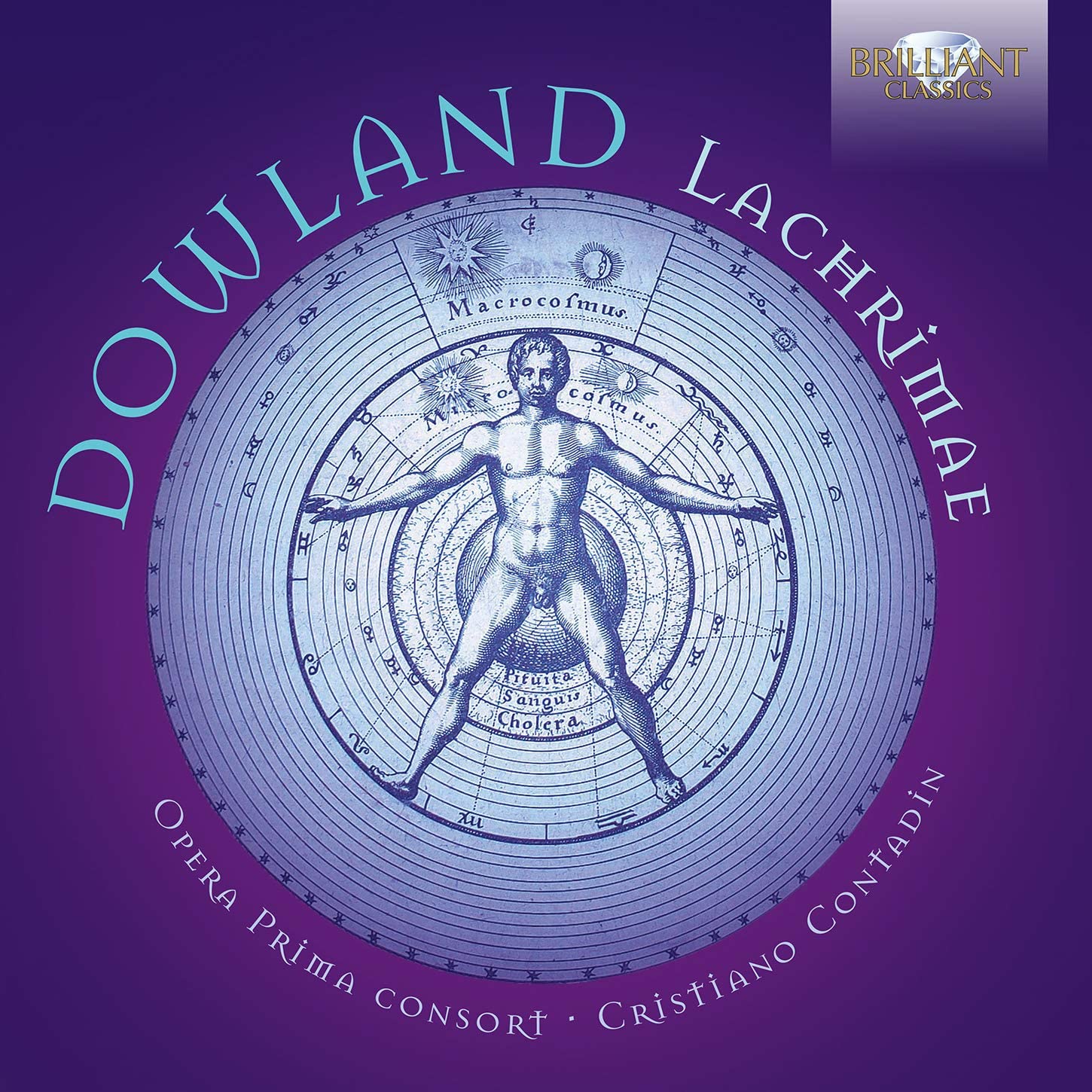
Dowland: Lachrimae

Opera Prima Consort, Cristiano Contadin
59:32
Brilliant Classics 95699

Click HERE to buy this CD on amazon.co.uk

This is a delightfully fresh look at the very familiar Lachrimae Pavans with associated Pavans, Galliards and Almands. The use of alto viola and violins on the upper lines is entirely authentic and gives the overall sound an engaging edge, while some daringly adventurous and ultimately beautifully musical divisions on the repeats of each section transform these performances into something very special. In addition to breaking the traditional viol consensus, Cristiano Contadin also introduces a recorder, which brings its own heightened level of intricacy to the repeat divisions. I am not entirely convinced by the recorder sometimes popping in and out, playing only on some repeats, and am happier with it playing the written line first time and then embarking on its divisions on the repeat having established its presence already. This is very much a personal whim, and I have to say that in practice both Contadin’s solutions, if a little unorthodox, work very well. The performances of the ensuing Galliards and Almans are wonderfully free and inventive, quirky and virtuosic, casting a bold new light on this terrific music. The playing is wonderfully expressive throughout, recalling my hitherto favourite 1985 account by Jakob Lindberg and the Dowland Consort on BIS. I have to say that the felicitous mixture of violins and viols and the deft ornamentation of repeats may just have won me over to this exciting new account! Highly recommended.

D. James Ross

Categories
Recording

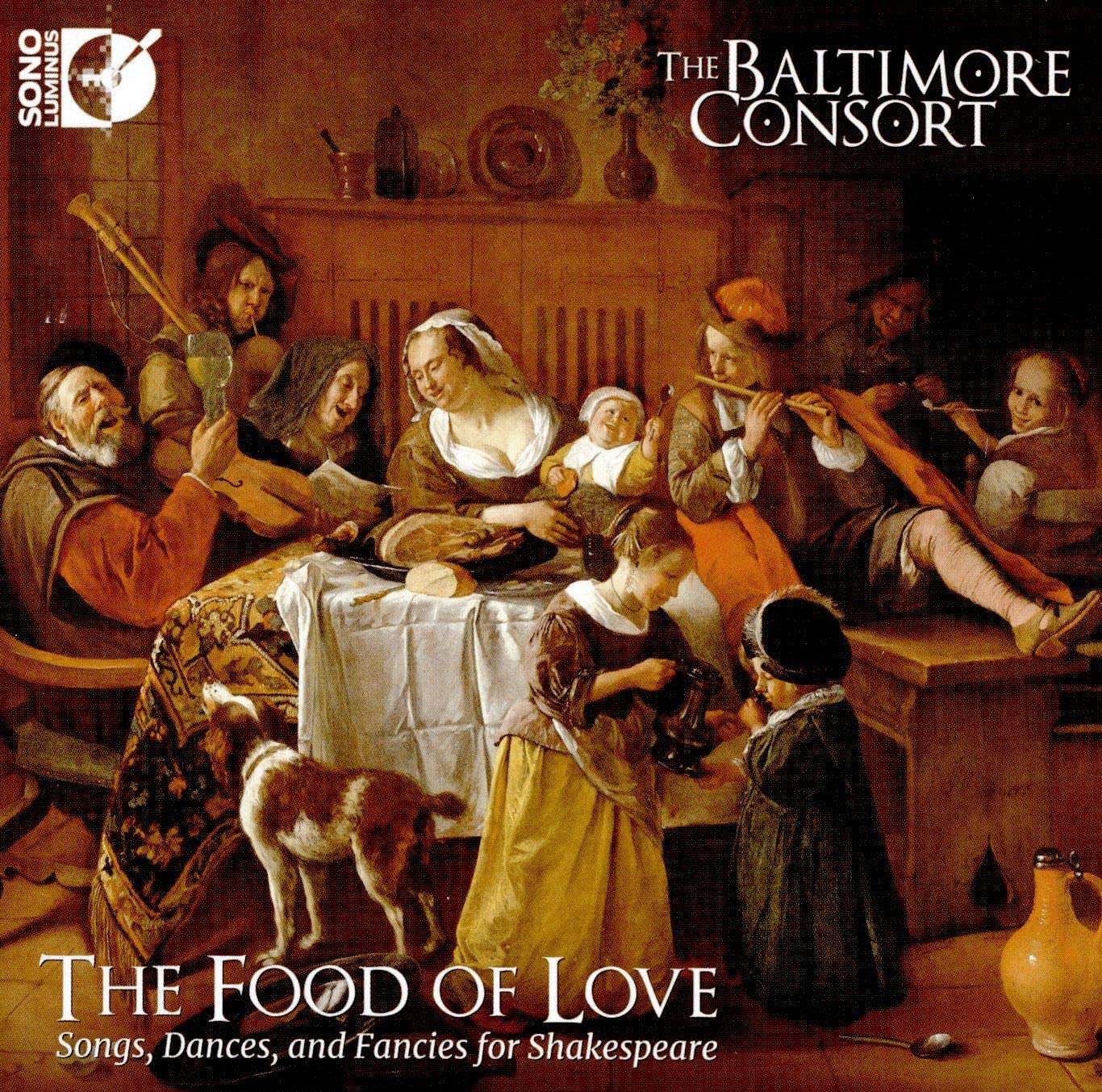
The Food of Love

Songs, Dances and Fancies for Shakespeare
The Baltimore Consort
68:04
Sono luminus DSL 92234

Click HERE to buy this on amazon.co.uk

It really is quite surprising that no music contemporary with Shakespeare’s plays which can be directly associated with them has survived, but this has not prevented musicians from compiling programmes based on music from the playwright’s lifetime which ‘relate’ to his plays or from just after his lifetime which reference the plays. There are some old friends here, played with imagination and sensitivity by the Baltimore Consort. They are at their most convincing when creatively riffing on some of the more traditional related material, but I found the same shortcomings as with another recent CD by the revived Baltimore Consort. Compared to the wonderful spontaneity of the vintage Baltimore recordings, the tempi here seem a bit ponderous, the ‘riffing’ a little contrived. Sadly, this may just come down to the change in personnel, and the departure of a couple of truly remarkable musicians. Even in ‘the golden days’, the group’s account of vocal music seemed its Achilles heel, and this still seems to be the case. Soprano Danielle Svonavec has a pleasantly pure voice and ornaments delicately and idiomatically, but there is something mannered and laboured about her pronunciation and presentation of the texts which makes the songs sound a little twee. I can’t help feeling that in my eyes these new Baltimore recordings suffer largely from comparison with the group’s own remarkable back-catalogue, which is possibly a little unfair, and it could be that listeners coming fresh to these recordings will be perfectly happy and, indeed, charmed by the group’s undoubted affinity with and creative approach to this repertoire. The playing and singing are technically impeccable and the recording admirably vivid.

D. James Ross

Categories
Recording

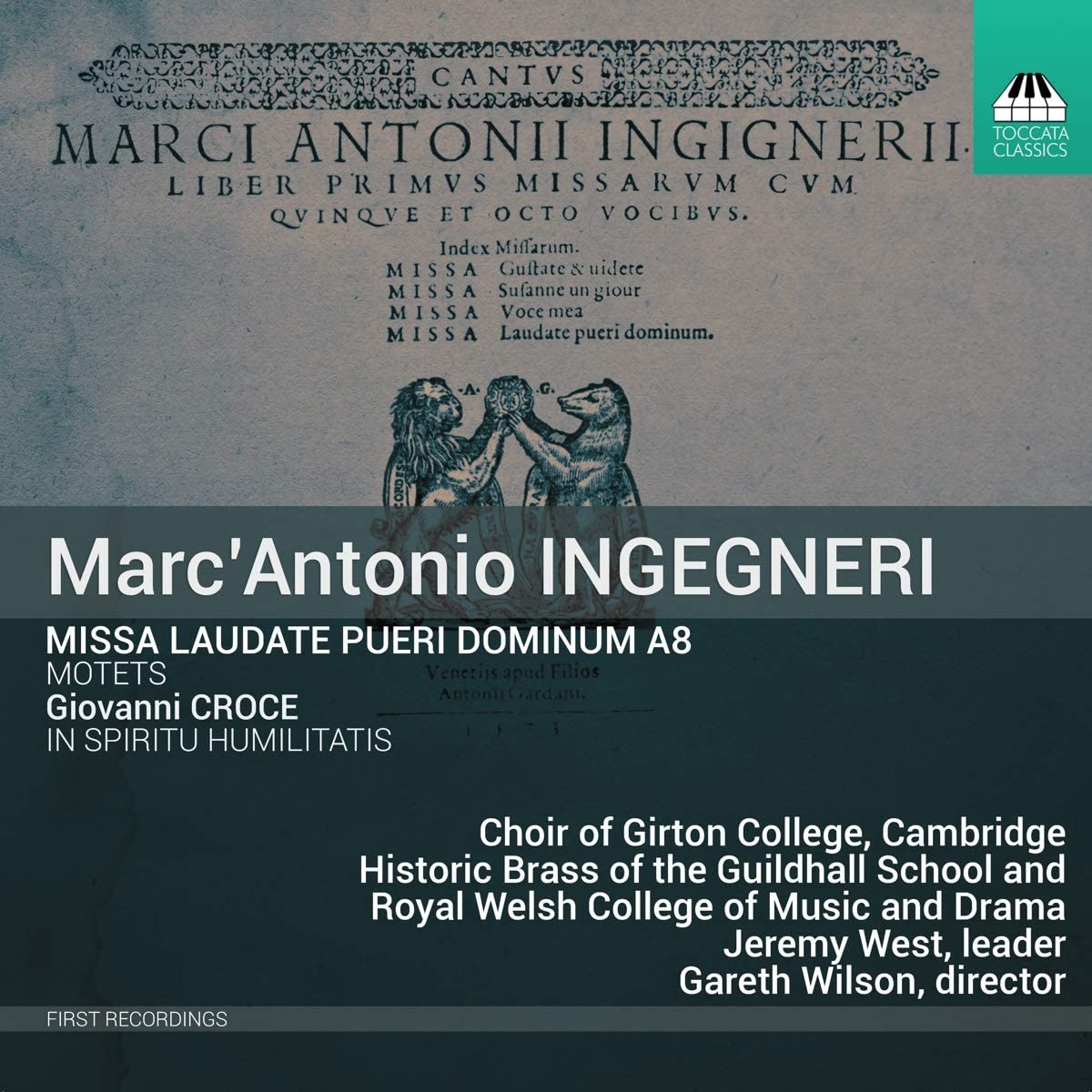
Ingegneri: Missa Laudate pueri Dominum

Choir of Girton College, Cambridge, Historic Brass of the Guildhall School and Royal Welsh College of Music and Drama, Jeremy West (leader), conducted by Gareth Wilson
70:03
Toccata Classics TOCC 0556

Click HERE to buy this on amazon.co.uk

Some luckless composers who deserve to be better known in their own right are encumbered with one particular identity tag before being passed over. So to focus us on Ingegneri alone, I will not mention whose teacher he was. Born in Verona either in 1535 or 1536, but working mainly in Cremona, Ingegneri is audibly a beneficiary of the preceding Franco-Flemish School but is even more audibly an Italian contemporary of Palestrina and a musical product of the Counter-Reformation. Indeed, Palestrina is one composer whom it is appropriate to mention in this context, as Ingegneri’s  Missa Laudate pueri Dominum in eight parts is based upon Palestrina’s motet on that text which, to adapt a phrase from the world of wine, also reveals, quite literally, some Franco-Flemish notes. Sometimes a derived mass can outstrip its original in quality or in other instances a strong original can dominate a less distinguished mass. The current instance is a perfect marriage of mass and motet, both being of the highest class.

The booklet is built around two fine essays – “The Council of Trent and the music of Marc’Antonio Ingegneri” by Giampiero Innocente, which provides a superb overview of the composer and his music on this disc (plus, where relevant, some which is not); and “For Love is as Strong as Death” by Gareth Wilson, which stems from the experience of himself and the Choir in performing and recording the music represented here.

Ingegneri judiciously selects what Innocente aptly describes as “fragments” from Palestrina’s teemingly laudatory motet (not included on the present disc, but there is a fine performance by Westminster Cathedral Choir on Hyperion CDA67099) and is entirely his own man in utilising them to project the text of the mass, sometimes with restraint and limited vocal resources, at other times letting rip with sonorous climaxes, but always with unerring judgment, with polyphony and homophony in exactly the right measures. He is also his own man when it comes to textures and harmony, so, for instance, Gareth Wilson draws attention to Ingegneri’s discerning use of the augmented sixth chord in the Credo which notoriously may or indeed may not also resonate in Byrd’s Civitas sancti tui.

The chosen motets are all impressive. They range from a couple of modest works in a mere five parts to “big biffers” in eight, twelve, and in the case of Vidi speciosam no fewer than sixteen parts. Nowhere does Ingegneri let loose mere grandiloquence in any of these works, and he always places his massed vocal resources at the service of the verbal text. Besides the movements of the Mass interspersed among the motets, another thread unifying the programme is the inclusion all of Ingegneri’s settings of texts from The Song of Solomon. For reasons not made clear in the booklet, the disc concludes with In spiritu humilitatis a8 by Giovanni Croce, which all but upstages Ingegneri’s own motets.

As on their previous discs of this repertory, the Girton Choir is in fine form. The accompaniments by the Historic Brass are historically informed (as such matters have to be nowadays if the participants desire credibility) and they complement the music perfectly, while the remarkable expertise of individual players comes to the fore in two motets in eight parts which are performed by brass alone. On the evidence of the music presented here, this recording deserves to be a landmark in a broader appreciation of Ingegneri’s music and by the same token Ingegneri deserves to be regarded in his own right as one of the outstanding composers of his day or of any other … regardless of whom he taught.

Richard Turbet

Categories
Recording

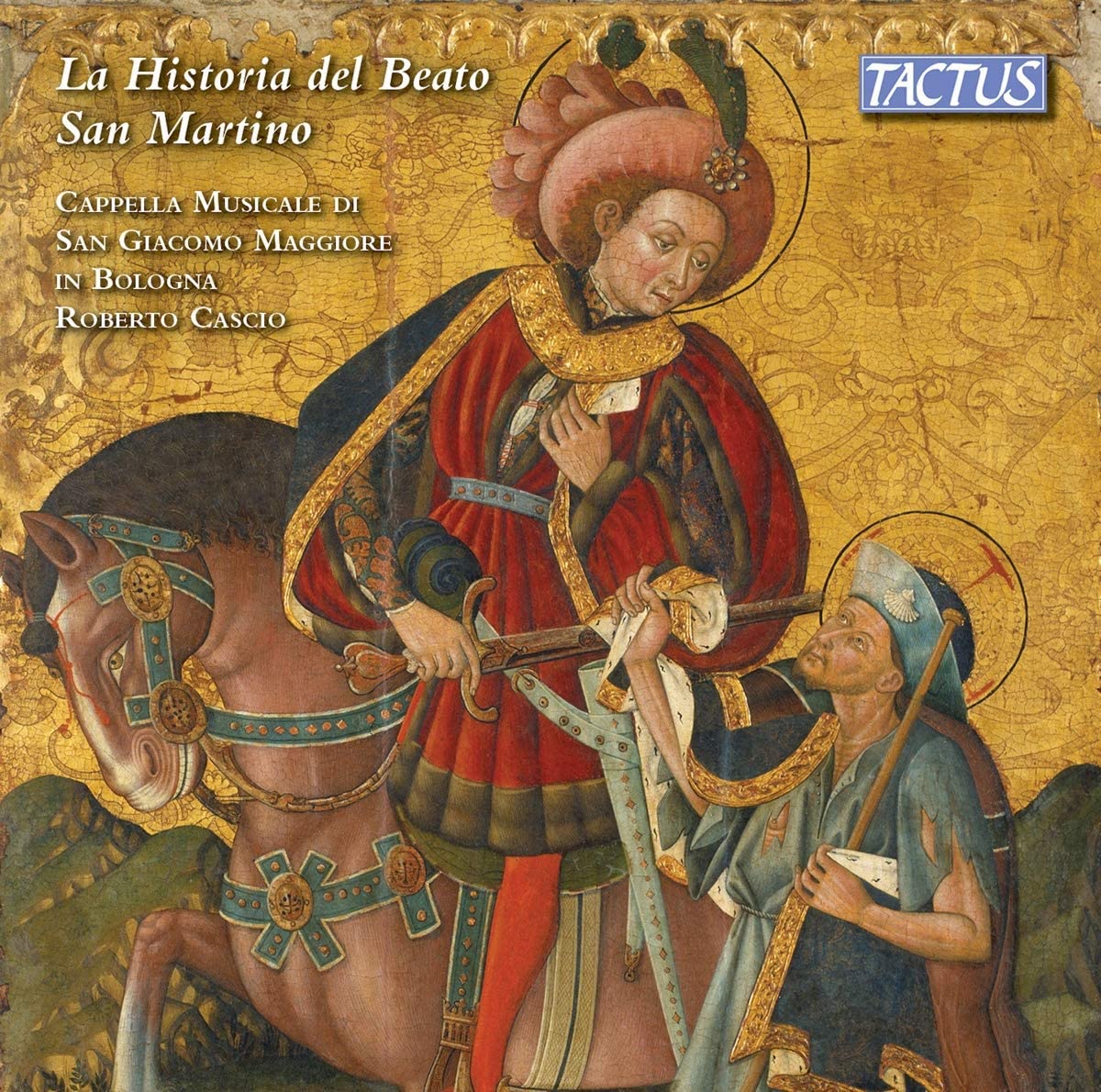
La Historia del Beato San Martino

Cappella Musicale di San Gaicomo Maggiore in Bologna, Roberto Cascio
61:47
Tactus TC 520003
Capirola, Cara, Dalza, Hedus, Josquin, anon & Cascio

Click HERE to buy this on amazon.co.uk

The first 17:44 of this CD consist of a recitation by Robert Cascio of the 1520/1558 Historia text with one or two (unidentified) musical interpolations – while the text along with the texts of the ensuing musical items appears on the Tactus website, I was unable to find any English translations. The programme notes appear in Italian and English with the CD, and the idea of associating the Historia with roughly contemporary Italian music is an interesting one. The musical part of the CD consists of Lauds, Chansons and Frottole from the late 15th and early 16th centuries, which appeared from the Petrucci Press in Venice from the early 16th century, so roughly contemporaneously with the prints of the Historia. However, there the link with St Martin ends – none of the music is specifically related to the saint or mentions him at all. I can’t help feeling that a Saint who warranted magnificent cathedrals in the likes of Lucca and Venice must have had poetry other than the Historia written about him, which in turn would have been set to music. Anyway, while it is not clear whether the term ‘world premiere recording’ on the CD refers to just the Historia or all of the material, the musical part of the programme is unfamiliar and generally well presented with a mixture of instruments and voices. The instrumental playing is generally good, while the solo vocalists are generally OK on their own, although sadly the same can not be said of the vocal ensemble pieces, in which the tuning is so uncomfortable that it fails to settle even at cadences. As sometimes happens, this has the feel of a concert programme, which probably went down really well live, being committed to CD without the additional work necessary to bring it up to standard.

D. James Ross

Categories
Recording

innamorato | triloia italiana

accordone, macro beasley, guido morini
188:54 (3 CDs in a card folder)
cypres CYP9620

Click HERE to buy this on amazon.co.uk

For this collection of Italian music from the 16th, 17th and 18th centuries, Accordone have selected three recordings from their back-catalogue dating from 2005, 2006 and 2007. It has to be said that the rigour of the background scholarship and the spontaneity of the performances mean that these have not dated at all. The initial disc focuses on Frottole, and is a delightfully engaging journey through the 16th century, bringing familiar composers such as Lassus and Tromboncino together with a host of less familiar names, such as Marco Cara, Pietro Paolo Borrono and Guglielmo il Giuggiola. This unearthing of unknown music by unknown composers is one of the main strengths of all three CDs, as indeed is the distinctive voice of Marco Beasley. His pleasing tenor is a major factor in the appeal of all three CDs – it is an individual sound, with a similar texture to the voice of Nigel Rogers and equally adept at sparkling ornamentation. In the Frottole volume, the ensemble manages a wonderfully spontaneous sound, verging on the performance style more often associated with traditional music. This proves ideal for the no-nonsense directness and beguiling charm of these Frottole. In the second CD Recitar Cantando we encounter repertoire for solo voice and continuo with obbligato instruments again by familiar names such as Monteverdi, Frescobaldi and Caccini and unfamiliar contemporaries such as Cherubino Busatti along with instrumental music by Giovan Battista Fontana. The slightly elusive programme note for this CD doesn’t detract from the delight of the performances, although a more detailed account of how and why the performers felt free to adapt the messenger scene from Monteverdi’s Orfeo and his dramatic madrigal Il Combattimento di Tancredi e Clorinda for solo voice and small consort would have been helpful and interesting. Just occasionally, as in Il Combattimento (which is by far the most substantial piece on the CD), Beasley, who has to sing all three characters himself, doesn’t quite imbue the vocal lines with the drama they seem to demand – there is a reference in the programme note to letting the character sing rather than the performer. This seems to be a little lacking here. For the third CD Il Settecento Napoletano we visit the musical hot-spot of 18th-century Naples. In a city where we now know opera was a major focus of attention, it is no surprise that solo secular cantatas were also very popular. It seems to my ear that these performances of ‘cantatas in the Neapolitan language’ are sung in a distinctive Neapolitan dialect, and again while Alessandro Scarlatti and Nicola Matteis (who supplies a trio sonata) are relatively familiar, Giuseppe Porcile, Giulio Cesare Rubino, Alonso dei Liguori and Guido Morini are new to me. As in all three CDs, it is interesting how the music by the ‘unknowns’ is invariably every bit as effective as that by the big names. These attractive pieces are greatly enhanced by the imaginative scoring of the accompaniments, while vocalist Marco Beasley seems more in tune with this later idiom. This is an enjoyable collection of CDs currently otherwise unavailable and definitely to be recommended for their underlying intellectual rigour and the musicality of their performances.

D. James Ross