Categories
Recording

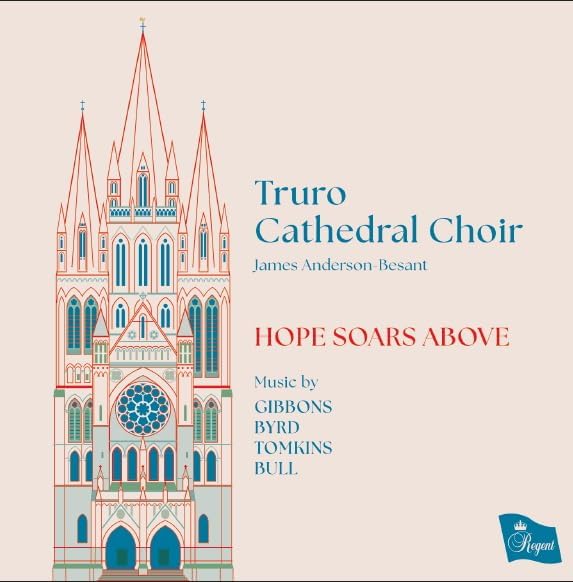
Hope soars above

Truro Cathedral Choir, James Anderson-Besant (Director of Music and Organist), Andrew Wyatt (Assistant Director of Music)
Regent REGCD599
56:38

Just when it seemed that the quatercentenary of Orlando Gibbons’ death would slip by with little discographical attention, two fine recordings featuring his choral music
have been released during November. A review of the disc consisting entirely of Gibbons’ music sung by The Choir of the Chapel Royal, Hampton Court Palace, was reviewed in EMR last month. The recording under review here features his music beside works by three of his most eminent contemporaries.

There are four works by Gibbons himself: a verse anthem, a fantasia for organ, and two evening Services, one a verse setting, the other full; both settings consist of the
usual two canticles, Magnificat and Nunc dimittis, providing six individual pieces. The verse anthem is O thou the central orb, the modern contrafactum of what was originally O all true faithful hearts but furnished with nineteenth-century words to offer a more general application, the original text having expressed thanks for King James I’s recovery from illness. Soloists from all four voices – treble, alto, tenor and bass – are required, as is an accompaniment for the organ. Similarly the expansive Second Service calls upon soloists from all voices with organ accompaniment. The Short (or
First) Service on the other hand is for voices alone and is a more succinct setting than the other. Gibbons’ piece for organ is the famous Fantazia of foure parts.

That was the easy bit. Now the controversy. Also attributed to Gibbons is the anthem for six voices Out of the deep. However, this is now considered to be an early
composition by Byrd. Three pre-Reformation sources provide attributions, of which two are to Byrd and only the third – merely an entry in an index – is to Gibbons.
There is also evidence within the music that the anthem is more likely to be an early work by Byrd. But the attribution to Gibbons has proved adhesive, and this is because the collected edition of Gibbons’ anthems (in Early English Church Music) was published several years before the similar volume of anthems by Byrd (in The Byrd Edition) and so the attribution to Gibbons took hold (three recordings, two predating the earlier recording attributed to Byrd) while the revised attribution to Byrd (two recordings) has taken time to seep through to general usage. Without going into
so much detail, the notes in the accompanying booklet, which are excellent throughout, by Alan Howard, reflect this dubiety surrounding the attribution to Gibbons. Notwithstanding the identity of the probable composer, and the early stage in his career when probably he composed it, the work is comfortable in this elevated company. It is the sort of piece which can be dismissed by some editors and
musicologists, whereas in performance it comes across effectively, and is anecdotally appreciated and enjoyed by singers – consider for instance the extended heartfelt outburst at “and with him is plenteous redemption”.

Incontrovertibly by Byrd is his anthem Sing joyfully, also for six voices, his most recorded sacred work in English, particularly popular in the USA, and as Alan Howard observes, an effective emotional counterweight to Out of the deep. The other (third!) work on this disc by Byrd is his well-known fantasia in C, A fancy for my Lady Nevell.

John Bull is enterprisingly represented not by one of his many fine works for keyboard but rather by his verse anthem Almighty God which by the leading of a star known to contemporaries as “the starre anthem”, a star anthem indeed, and one of only a handful of sacred works by him known to survive.

And to conclude the disc Truro includes two works by the greatest composer born in Wales, Thomas Tomkins. Both are sombre masterpieces: his great A sad pavan for these distracted times and one of the finest of all anthems in English Almighty God the fountain of all wisdom, its beautiful harmonies and melodies seasoned with a sudden profound and penetrating exploitation of dissonance, all followed by an Amen which can truly be described as divine.

Although all these works have received commercial recordings already, such is the quality of the music and, thankfully, of the performances that it is all worth hearing in these fine performances, however familiar one is with some or all of the works. For instance, Byrd’s Sing joyfully boasts no fewer than 35 current recordings on the Presto website, yet one would not want to be without Truro’s rousing yet sensitive rendition, with its resounding yet perfectly balanced final chord. The sleevenotes specify which treble line (14 boys, 13 girls) sings in which piece – both lines are excellent and they join for Out of the deep which has two treble parts, and for Gibbons’ Short Service. The 13 layclerks – five altos (two contraltos, three countertenors), and four each of tenors and basses – do a similarly good job on the lower parts. All three organists play a solo. Organ scholar Jeremy Wan plays Tomkins’ pavan – omitting the repeat of the second strain; assistant organist Andrew Wyatt plays Byrd’s fantasia; and in his first commercial recording as Cathedral organist James Anderson-Besant plays Gibbons’ familiar fantasia, but when it is played as well as this there can be no complaint about its inclusion. This is Anglican
cathedral music at its best, a credit to James’s predecessors, Andrew Nethsingha and Christopher Gray, in nurturing the tradition at Truro, and to the current choir and organists in sustaining it.

Richard Turbet
Categories
Recording

Orlando Gibbons at the Chapel Royal

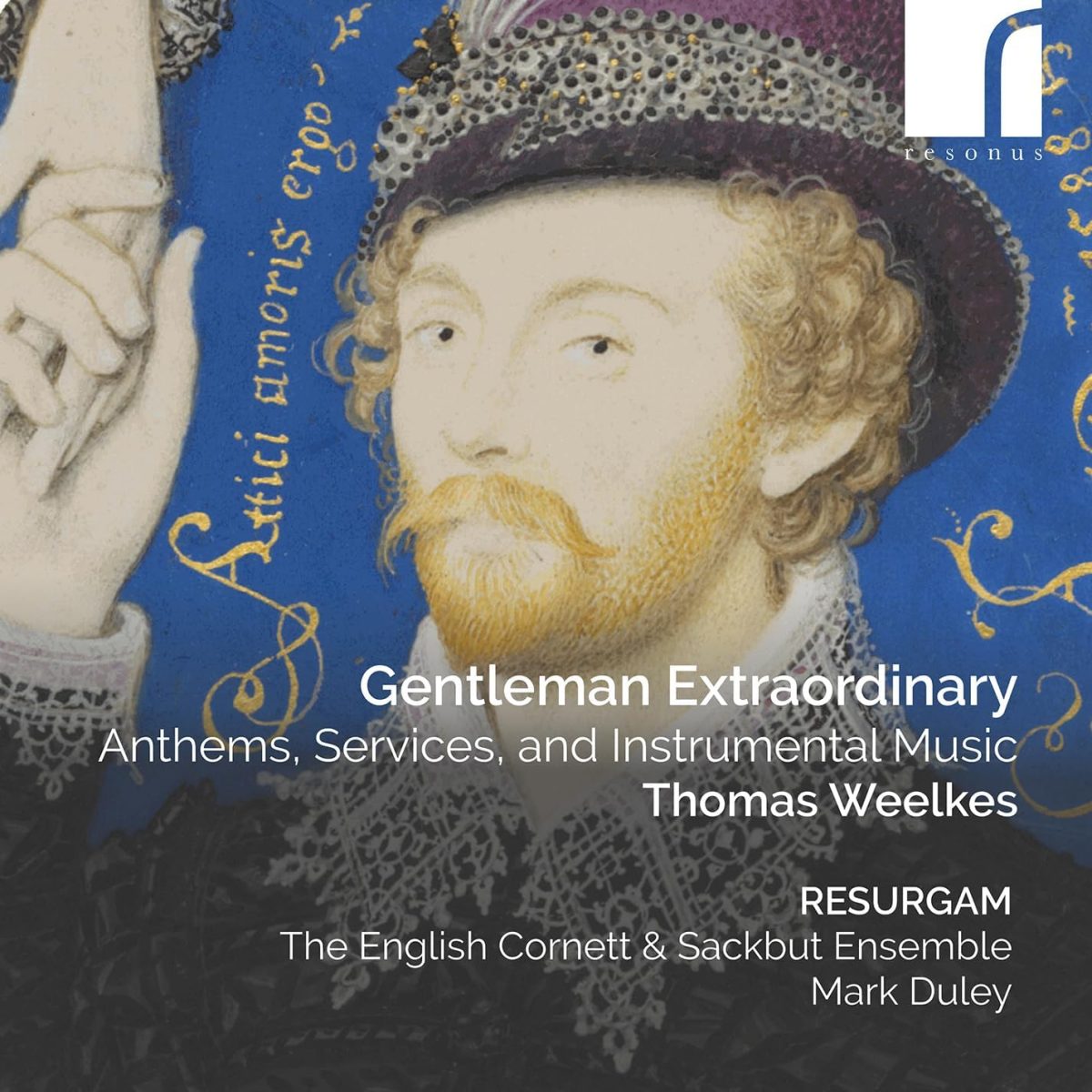
The Choir of HM Chapel Royal, Hampton Court Palace. The English Cornett and Sackbut Ensemble, conducted by Carl Jackson
Resonus Classics RES10375
67:00

Following the choir’s excellent discs of music by Tallis and Tomkins, this recording is all the more welcome for marking the quatercentenary of Orlando Gibbons’ premature death in 1625 at the age of only 42. The choral items are well chosen, and include hymns, full and verse anthems, and canticles. None of these are obscure or neglected items, with the possible exception of the morning canticles for the Second Service – the Te Deum and Jubilate – of which there have been few previous recordings. This pair makes for the heftiest contribution to the programme, emphasized by the use (seemingly warranted by contemporary documentation) of winds in the accompaniment, and inspired perhaps by the recording of Byrd’s Great Service by Alamire. They are also employed in the much more familiar evening canticles, and for those anthems which survive in versions as consort anthems.

A small but varied selection of Gibbons’ always attractive keyboard works is included, but the most significant items on the disc are those for consort played by the winds. Gibbons left us six such works in six parts which are definitely for instruments, plus two which are considered less likely to be instrumental and might be surviving wordless versions of choral works, plus one further which is considered even less likely to be instrumental. The six definites have all been recorded several times, and the ninth least likely one has been superbly recorded by the fine French consort of viols L’Acheron, but the intervening pair, numbers 7 and 8 (Musica Britannica v. 48, nos 37 and 38 in John Harper’s edition of Gibbons’ complete music for consort) had never received a commercial recording until now. Whether Gibbons’ individual pieces are familiar or not, all are unfailingly worth hearing, but the recorded premieres of these two works elevate this disc into the status of being essential for admirers of Gibbons, and highly recommendable for anyone interested in the music of this period.

The Hampton Court brand of Chapel Royal choir sounds in excellent voice, though the recording itself does no favours to the inner voices – countertenors and tenors – and favours trebles and basses. But all seems well for the winds, and the English Cornett and Sackbut Ensemble is of course a world leader in its field, a truism confirmed in its contributions to this exciting disc.

Richard Turbet

Categories
Recording

Love’s Labyrinth

Songs and Duets of Monteverdi and his Contemporaries
The Gonzaga Band (Faye Newton, Jamie Savan, Steven Devine)
deux-elles DXL1213
65:45

With the five-star artists of Jamie Savan’s Gonzaga Band, we know that the artistry of the players, their long history of working together in such small-scale projects and Savan’s meticulous scholarship in editing material will produce a programme that offers fine music in captivating performances.

To appreciate the interlaced threads that make up such a well-researched programme, you need to read Savan’s liner notes: these ten columns are a model for how to coax listeners into believing that they understand the nuances behind the choice of some obscure treasures, and to believe that we have been party to the way in which these pearls have been selected and strung together.

They perform this programme at A=440, and the keyboard instruments are tuned in ¼ comma mean tone. They include a harpsichord by Dennis Woolley after an original by Hieronymus Bononiensis (Rome 1521) in the V & A, a single-strung harpsichord by Colin Booth after a 1533 instrument by Domenico da Pesaro in Leipzig and an ottavino of his after a 17th-century original in the Kunsthistorisches Museum in Vienna. The organ is a digitally sampled keyboard after the Goetze and Gwynne St Teilo Tudor Organ.

Faye Newton has a beguiling voice: clear as a bell, yet delivered with a technical mastery that makes her the ideal singer for this Italian repertoire that spans the cusp of the 16th to 17th centuries. Her neat Italian diction coveys the changing emotions of the poems perfectly and the choice and arrangement of material, ranging from solo songs through duets to four- and five-voice madrigals, explores every possible combination of instruments, and, as with the Gonzaga Band’s other programmes, we are left marvelling at how so much rich music can be contrived with such minimal resources. As Savan’s note suggests, ‘If Monteverdi’s five-voice madrigals were performed in the context of the musica secreta in the 1590s, with its emphasis on female vocal virtuosity, they would likely have been so in some kind of arrangement for upper voices with keyboards, as exemplified by Luzzaschi.’

This is a delightful programme, and a very good introduction to the power of song as it was being rediscovered in those formative years for modern music.

David Stancliffe

Categories
Festival-conference

Ambronay 2025

COMING SOON!

Over three weekends next month, this wonderful festival that takes place in an abbey not far Lyon, Annency and Geneva covers everything from trio sonatas to the B minor mass, and from “a duet for clown and viola da gamba”(!) to Mozart’s precocious “Die Schuldigkeit des Ersten Gebots”. Performers include well-known ensembles such as Vox Luminis, Ensemble Correspondances, Cappella Mediterranea and Pygmalion, but also – a trademark of this talent-fostering organisation – plenty of young artists who will undoubtedly continue to grow as a result of such exposure.

If you’re lucky enough to be in the area, check out the programme here: Dossier de presse_Festival 2025 (in French only, and accurate at the time of printing!) and support Ambronay’s initiatives if you can!

Categories
Concert-Live performance

New Vivanco

If you’re a fan of the Spanish Renaissance and happen to be in London at the end of June, you won’t want to miss this exciting event! The choir is on Facebook if you want to keep up to date with their activities.

For those who can’t manage, the choir has Crowdfunded enough to make a CD, which will be available – and reviewed in due course on this website – next year.

Categories
Recording

Maria: Josquin in Leipzig

amarcord
80:25
Raumklang RK AP 10124

Before I listened to this fabulous recording, I hadn’t realised how much I miss the music of Josquin. My first encounter (after a cursory introduction in my first year at St Andrews, when it all sounded terribly dry and dull) was the Hilliard Ensemble’s Reflexe tape (remember them?!) that opened – as does the present recital – with his gorgeous setting of Ave Maria, gratia plena. By the time I’d made it to fourth year, this was set as one of the test pieces in my “musical paleography” exam, which, trust me, was what we now call “a challenge”…

Amarcord’s performances are anything but a challenge; the voices blend beautifully and the recorded sound is rounded and crisp, capturing the natural decay of cadences before the composer’s next masterstroke is delivered.

Although I bought several, I was never taken by the mass recordings by The Tallis Scholars. I suspect that has more to do with having seen them perform and watching someone “conduct” two singers and not being able to get that out of my mind. Here, amarcord can interact freely with one another so that we hear Josquin, rather than someone’s interpretation of Josquin.

An interesting difference between the Hilliards and amarcord is their approach to ficta (the application of accidentals that are not in the original notation but may have been understood and applied by singers of the time). Especially at cadences, our modern ears “expect” a sharpened leading note if the bass note is what in our terms is the dominant of the “home key”. Applying that principle, the Hilliards sharpened many more notes than amarcord, but I cannot say for sure which version I prefer.

It is also a definite bonus to hear Ave Maria twice, the second time with its contrafactum text Verbum incarnatum , taken from a manuscript that is today held at the State Library in Berlin. Like the other manuscripts upon which the project is based, its origins lie in Leipzig; although there is no record of Josquin ever visiting the city, the rising popularity of printed music at the thrice-annual book fairs brought his music to Germany, where it was widely copied and performed. Other contrafacta on the recording include some of the composer’s secular chansons. Full marks to Raumklang, too, for the high-quality booklet; the informative essay, full translations of the texts, and a selection of magnificent illustrations from the sources.

If – like me – you have been lacking a bit of Josquin in your life, please do not miss this. Very rarely do I listen to a CD lasting over 80 minutes at one sitting – I enjoyed this twice this morning!

Brian Clark

Categories
Recording

Music for two

Duo Coloquintes
53:19
Seulétoile SEC 02

When I offered this recording to our regular Byrd reviewer, he (rightly) politely declined. The “problem” with it is that the musicians have taken keyboard music from around the beginning of the 17th century and “arranged it” for violin and viola da gamba.

This might be a radical approach but – as someone who once wrote a rave review of Bach on the accordion (and convinced his father, an accomplished folk player of the instrument, to listen and enjoy it!) – I could hardly pretend that I was offended by the idea.

The present review will also be a glowing one, as violinist Alice Julien-Laferrière and her gambist colleague, Mathilde Vialle, argue very strongly for their approach; neither is afraid to introduce harmonies where their instruments allow, and there is so much more to their arrangements (purists will doubtless be horrified by plucked notes, and layered dynamics!) than simply seeing how much of the original they can include. These are well-considered and – most importantly – convincing accounts of the repertoire, and, let’s be honest, the music they’ve selected (mostly from The Fitzwilliam Virginal Book) is not that familiar to anyone but keyboard specialists, and any recording that brings it more widespread attention is welcome.

Sometimes, it takes a radical approach to reveal new facets to something with which you thought you were familiar; having had to study TFVB as a set work at university, I can honestly say that nothing about it brought me any pleasure… Unfortunately, there were no such inspiring recordings as the present one around! And definitely, nothing as beautifully captured in spectacular sound!

Brian Clark

Categories
Recording

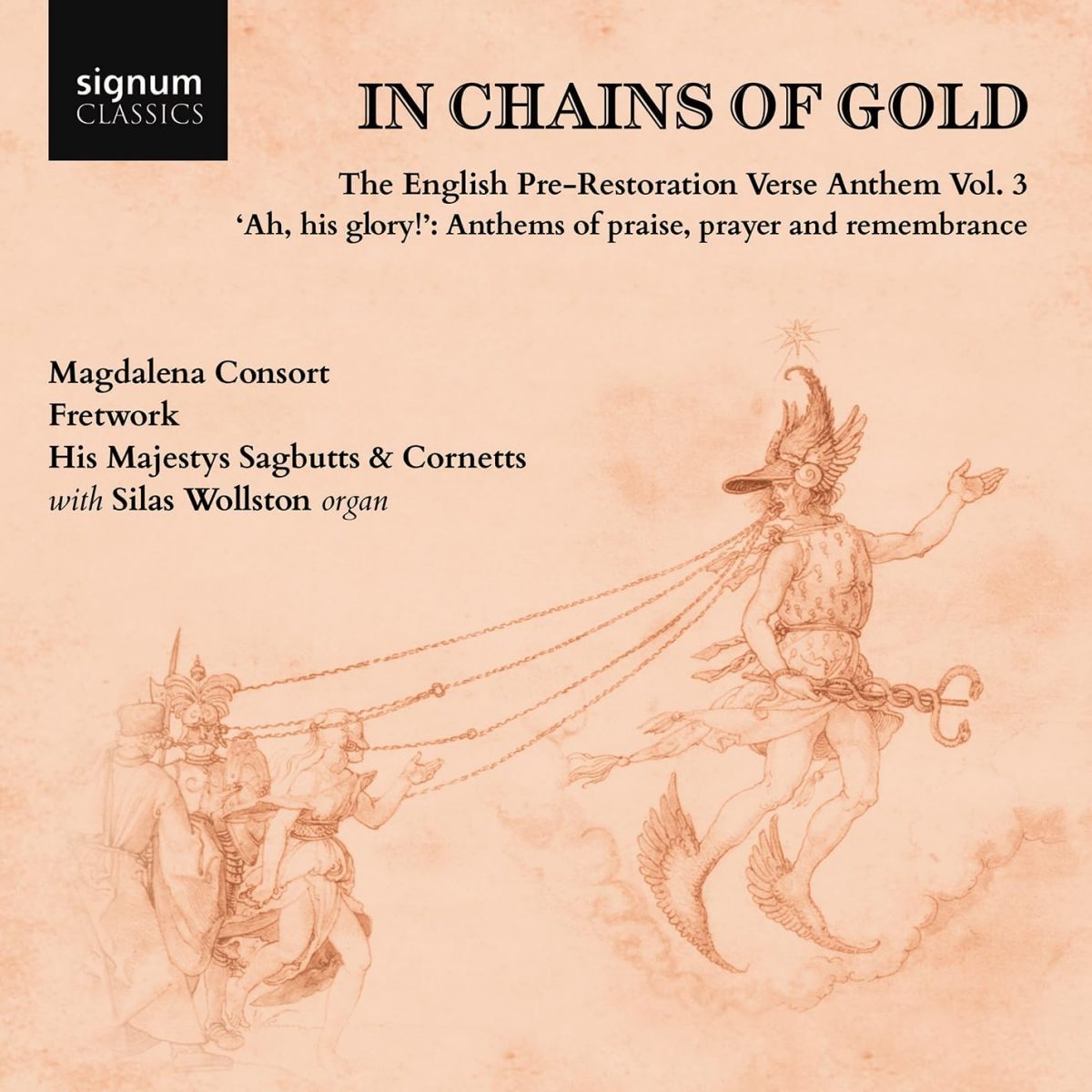
In chains of gold

The English Pre-Restoration Verse Anthem Vol. 3
Magdalena Consort, Fretwork His mAjestys Sagbutts & Cornetts with Silas Wollston 83:39
signum classics SIGCD931

This is the last of three discs in a series dedicated to the consort anthem in England during the Tudor and Stuart periods. The first contained all of Gibbons’ surviving pieces in this genre, the second featured Byrd and included works up to Edmund Hooper, and the prevailing presence over the current disc is Thomas Tomkins with a judicious combination of known and unknown musicians besides. These are anthems which were not performed liturgically in these versions, in the Anglican Church, because of their being accompanied by viols: only the organ was used in church; very occasionally on major festive, royal or other ceremonial occasions it is known that winds – usually a maximum of four waits using cornetts and sackbutts – supplemented the organs. Many consort anthems survive with alternative accompaniments for the organ, rendering these arrangements suitable for use in church; this is true of many of Gibbons’ verse anthems. While I have long stated the argument, in the face of opposition (not necessarily from this project!), for there being no evidence for the use of viols in the Established Church at this time, it is the experience of Fretwork accompanying these works in different environments during the course of this project which has led to the seemingly final acceptance of my position.

All the vocal works here are revelations to a greater or lesser extent. It is excellent that William Pising and Simon Stubbs are represented, given the minute numbers of their works that survive. They are short-winded but lively pieces, worth reviving. Thomas Ravenscroft will be considered by many as a miniaturist, but he is represented by two consort anthems, one of which – In thee O Lord – has considerable substance even among some of the other big hitters.

Who are these big hitters? John Ward certainly demands attention with two assertive pieces, one of which, accompanied by winds, begins the proceedings, the rest of which are dominated by two huge anthems (and several fine instrumental works) by Tomkins, Know you not and O God, the heathen are come. The surviving sources for both pieces required major elaboration (cf. Elgar/Payne, below) in order to become roadworthy, and have been recorded before. Know you not concludes the album with an opulent accompaniment for winds, appropriately given that the text laments the death of the youthful heir to the throne. Even mightier is O Lord the heathen, correctly listed as “Tomkins (attr.)” though the work is as certainly by him as it is possible to be without an actual contemporary attribution. Here Tomkins laments the devastation wrought upon the Church of England by the victorious Puritan forces, and to support him musically he turns to the most utterly bleak and visceral of all Byrd’s motets, Deus venerunt gentes, a work of astounding profundity and beauty which sets the same text, Psalm 79, and which illustrates musically so vividly that the music seems itself like an eye witness to the appalling events which it describes, in this instance the biblical devastation of Jerusalem as a metaphor for the barbarous executions of Byrd’s fellow Catholics. Tomkins makes his debt to Byrd crystal clear during the very first solo verse: his phrase at “and made Jerusalem an heap of stones” clearly echoes Byrd’s heartbroken and indeed heartbreaking phrase for “et non erat qui sepeliet”, and there was none to bury them. Both of these anthems are magnificent, and both reconstructions can, in the context of their own genre, be mentioned in the same sentence as Anthony Payne’s historic completion of Elgar’s Third Symphony.

Even now, there is one more anthem which requires special attention. Richard Nicolson’s When Jesus sat at meat narrates the first meeting of Mary Magdalen and Jesus, with incomparable sensitivity and pathos, never straying into sentiment, and while it is a substantial work, it never once outstays its welcome, maintaining its elevated tone throughout, besides radiating beauty. Nicolson’s setting of his text is most distinguished, his music clarifying and projecting its meaning in approved Protestant manner. Particularly notable are the dissonance on “thy faith have saved thee”, perhaps indicating the struggle that Mary endured to achieve that faith; and the exquisite phrase for “go thy way in peace”, with its fleeting consecutives, through which her Saviour imparts a reassurance for eternity.

This entire repertory has proved revelatory. Given the variety and quality of the material, consistent excellence has been essential for the performances and for the interpretations, and the musicians have delivered everything that is required. Nicolson’s anthem stands as the epitome of all that is best in Bill Hunt’s triumphantly successful project.

Richard Turbet

Categories
Recording

From Byrd

Trio Musica Humana, Elisabeth Geiger muselaar
42:59
Seulétoile SE12

This is an intriguing and quirky recording, built around Byrd’s Mass for Three Voices. The French Trio Musica Humana (CT T Bar) sing Byrd’s smallest mass superbly, with immaculate blend and intense engagement. They omit the Credo, and intersperse the remaining movements with other works for three voices by Byrd himself, Weelkes and Morley, and with works for keyboard by Byrd, Tomkins, Farnaby and Johnson. Some movements of Byrd’s Mass are performed with muselaar. It is easy to disagree with this approach, but contemporary accounts mention the participation of unspecified instruments in illegal performances of Catholic masses in Protestant Elizabethan England by recusants, so it is not out of order to experiment with instruments of that time. By current standards, this is a brief album, but is worth possessing by Byrd’s enthusiasts for the performances of the two sacred works by the composer which are included in addition to the Mass. Both are the only alternatives to previous recordings in omnibus projects. The longer of the two is Memento salutis auctor, from the Gradualia of 1605, following The Cardinall’s Musick (TCM) on disc 12 of their Byrd Edition. The other is the penitential psalm From depth of sin previously recorded only by Alamire on their complete version of the Songs of sundrie natures, which collection was originally published in 1589. The former interpretation is slower than TCM but every bit as fine. However, the USP of the current disc is the latter: Alamire sing From depth of sin divinely, and again Trio Musica Humana’s performance is slower than its predecessor, but at least for this reviewer their combination of tempo, blend, balance and perception achieves a perfection seldom conveyed on such recordings, elevating its two and a half minutes to the ranks of the very finest renditions of Byrd’s music on disc.

Richard Turbet

Categories
Recording

Reforming Hymns

Lassus, Maistre, Palestrina, Pederson, Schlick, Senfl, Walter
Musica Ficta, directed by Bo Holten
64:58
Dacapo 8.226142

This CD offers a guided tour through a musical world in transition. With a focus on Denmark, it illustrates the shift from traditional Roman Catholic worship to the Protestant rites which replaced it. The subtleties of this major transition are explored as vernacular texts gradually invade the world of Latin polyphony and chant, polyphony for professional choirs is gradually replaced by more four-square homophonic settings for congregations. Some of the items in the midst of this transition such as Mogens Pederson’s Kyrie / Gud Fader are extraordinarily beautiful and owe much to pre-Reformation music. Radically new is the pressing of secular songs into the service of sacred hymns – pre-Reformation composers had delighted in using secular melodies as cantus firmi, but hymns that were often just sacred contrafacta of secular songs were something entirely new. Often these were intended for solo voice with or without accompaniment, but very soon harmonised versions crept into the repertoire, and composers like Pederson rose to the challenge with lovely settings such as his Fader vor vdi Himmerig recorded here. The new hymn melodies, just like the ore-Reformation chants, were also now used as the basis of polyphonic organ works such as the anonymous Organ Chorale on Vater unser in Himmelreich, played here on a fine early organ of which sadly no details but perhaps in the Trinitatis Kirke, Copenhagen. It is lovely to hear really quite basic settings for the early Reformed church blossom into more complex and involving settings by Pederson, Johann Walter, Lupus Hellinck and Matthaeus le Maistre. I couldn’t help drawing parallels with a similar development in English and Scottish music around the times of their respective Reformations. Particularly illuminating in this recording is the decision to track one particular text such as Maria zart, Christ lag in Todesbanden and others through a number of settings by different composers. This programme, based on research by Bjarke Moe, who also provided the instructive programme note, is constantly fascinating. Add to this the beautifully idiomatic solo and choral singing of Musica Ficta under the experienced and intelligent direction of Bo Holten and the fine organ-playing of Søren Vestegaard and we have a lovely package that both educates and delights.

D. James Ross