Categories
Recording

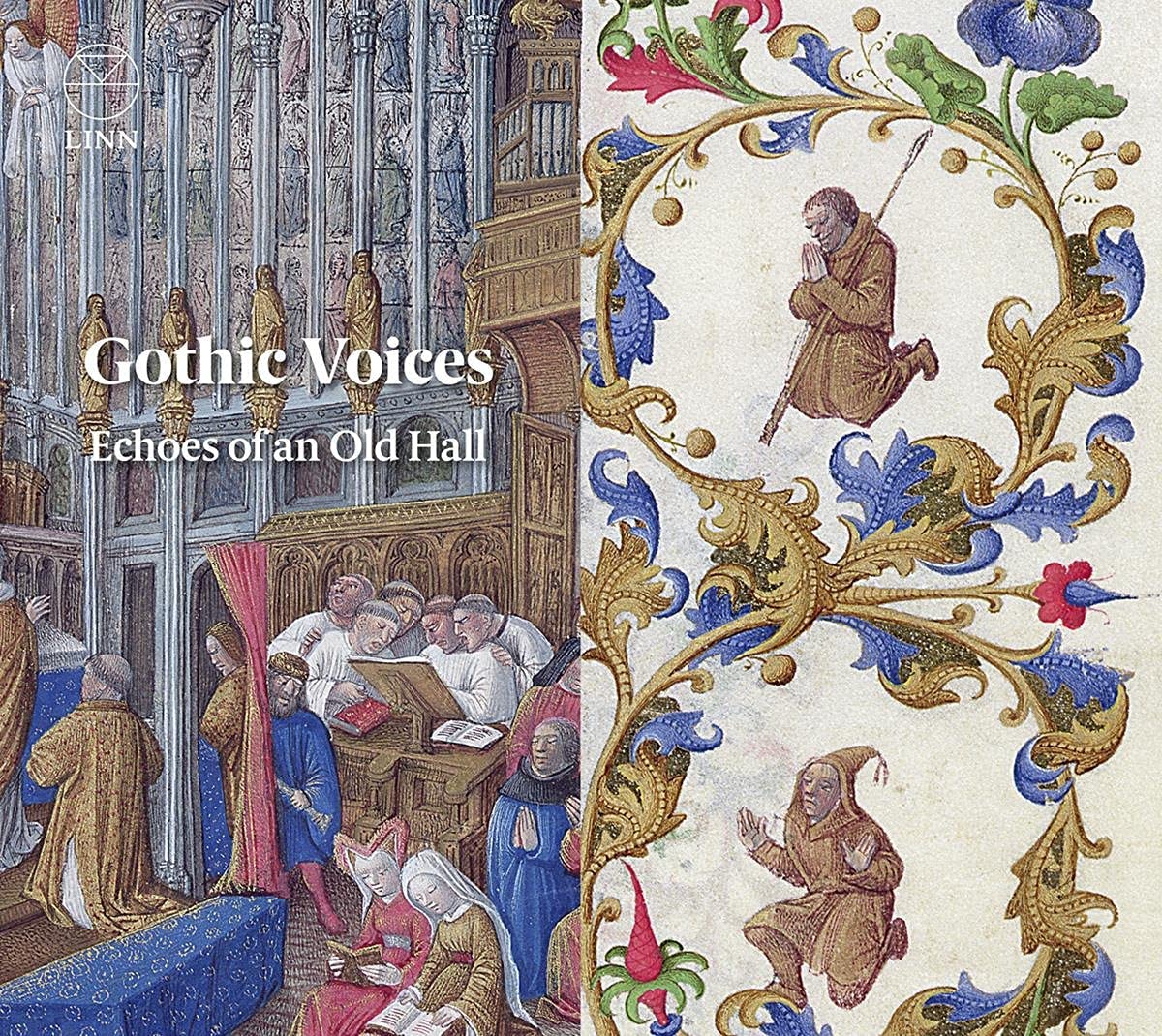
Echoes of an Old Hall

Music from the Old Hall Manuscript
Gothic Voices
76:03
Linn CKD 644

There is always room on my shelves for a new selection of music from the Old Hall Manuscript, particularly when the music is as well sung as it is here. Gothic Voices, always leaders in the field of mediaeval and early Renaissance polyphony, bring a wealth of joint experience to this CD, and relatively obscure names such as Cooke, Mayshuet, Damett, Forest and Lymburgia are once again allowed to rub shoulders with their more celebrated contemporaries, Power, Byttering, Dunstaple, Pycard, and even the ubiquitous Binchois and Dufay. How exciting to find a five-part Gloria by John Cooke which is similar in style to and the qualitative equal of the remarkable and more familiar five-part Gloria by Power, which concludes the first part of the programme. The true masterpiece of the programme must be another five-part Gloria by Pycard which concludes the programme, and which is extremely impressive in its ruggedly conservative style. This is not just a random and generous selection of music from Old Hall though – it is extremely carefully structured, using the extraordinary ‘singers’ manifesto’ represented by the opening piece, Arae post libamini by Mayshuet de Joan, as a template. The second half of the programme, headed ‘reverberances’ is recorded partly at a distance, a radical departure for a group that in earlier times usually insisted on a very close recording ambience. This is an enthralling CD, imaginatively programmed with an excellent note by Julian Podger and compellingly performed. It will undoubtedly win many new admirers to the remarkable Old Hall Manuscript and its hugely important contents.

D. James Ross

Categories
Recording

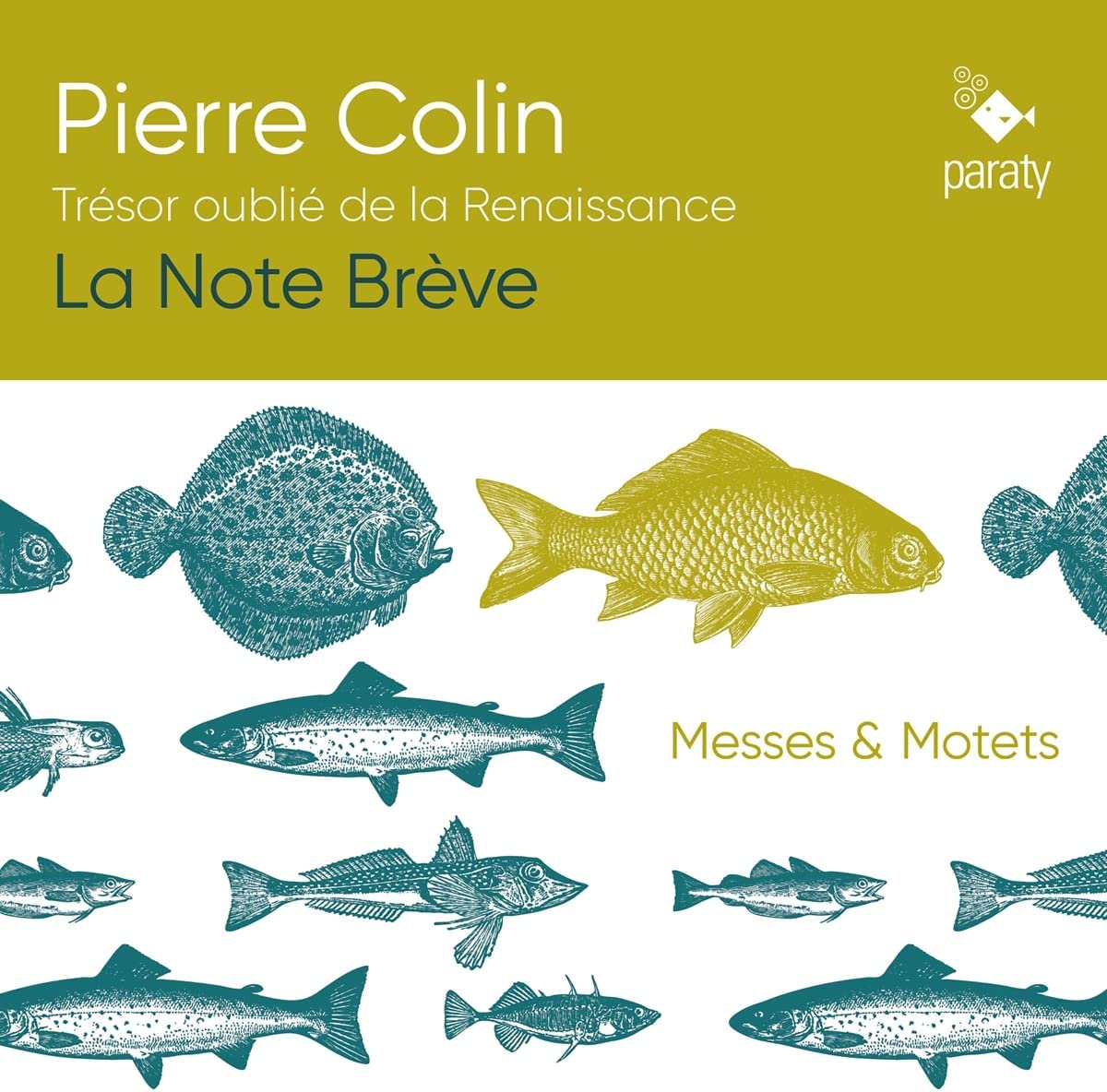
Pierre Colin: Trésor oublié de la Renaissance

Messes & Motets
La Note Brève
57:37
Paraty 7221120

Simon Gallot and his ensemble have done us a favour in introducing the neglected work of this mid-16th-century Burgundian composer. Although he seems to have spent his life in the relative musical backwater of Autun, Colin was scrupulous in seeing that much of his music made it to print. Still, while copies found their way into many of the great establishments of Europe, the music was often anonymous, and despite his best efforts Colin’s name lapsed into obscurity. His settings of the Mass and his motets, as well as his chansons, represented here by a performance on organ of L’oeil dict assez, are firmly in the mid-century style of the likes of Claudin. In tutti sections, the voices are accompanied by organ, an approach which suits the generally simple counterpoint rather well – the programme note suggests that Colin’s style is slightly more adventurous than the standard Parisian style of the period, with a greater tolerance of dissonance, but I can’t say that I was aware of this. However, Colin has a distinctive idiom and a thorough grasp of harmonic progressions and imitation, which means that this music is rarely dull. La Note Brève is a happy blend of male and female voices, producing a mellow sound and singing expressively. In their pursuit of authenticity, including convincing period pronunciation, this group belongs in the worthy tradition of French exploration of early choral music.

D. James Ross

Categories
Recording

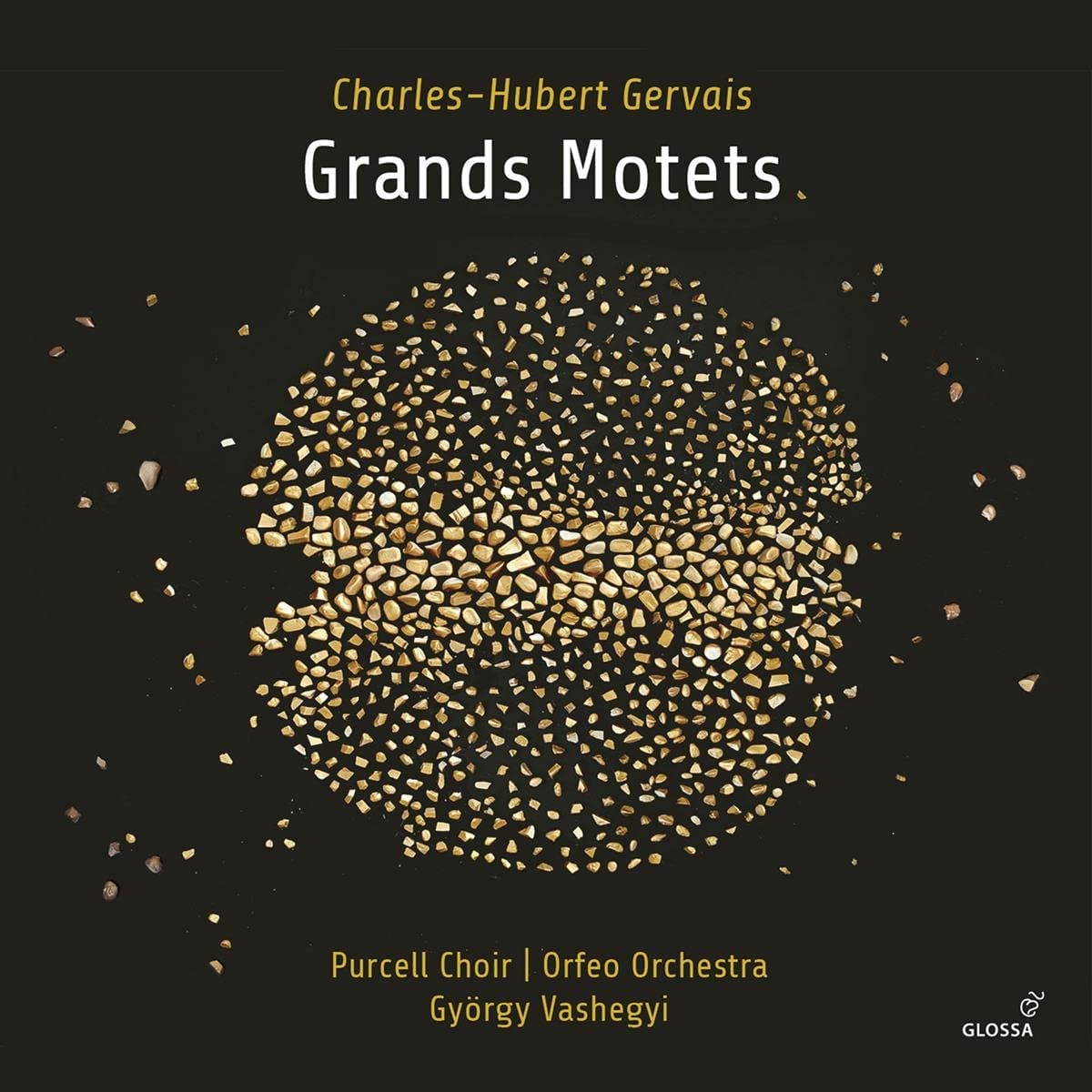
Gervais: Grands Motets

Purcell Choir, Orfeo Orchestra, György Vahegyi
72:04
Glossa GCD 924013

Charles-Hubert Gervais (1671-1744) became one of the sous-maitres of the Chapelle du Roy in 1722, one of those to benefit from the re-establishment and re-vamping of the court’s musical institutions after the relatively austere Regency years. He composed more than 40 grands motets, some of which remained in the repertoire right up to the Revolution. These are very much ‘after Lalande’ – indeed, the elder man’s music is alluded to or even quoted from time to time – but in many respects Gervais is very much his own man. Unusually, he often reduces the orchestral texture from its traditional five parts to three (violin, viola and bass) and is inclined to eschew vocal virtuosity in favour of more restrained expressive effects, such as harmony, despite his background in the theatre.

Among the soloists, haute-contre Cyrille Dubois is the stand-out, with the range, taste, and skill to deliver his music beautifully. The other soloists are never less than good, though all are guilty from time to time of trying to do a bit too much with their music. Choir and Orchestra are also on good form, and I note that, whereas in their earlier days, there was a significant number of western European players, almost all are now home-grown.

The booklet (in English, French and German) offers its thorough and interesting essay in all three languages though the Latin texts are translated only into English and there is no information about the artists.

David Hansell

Categories
Recording

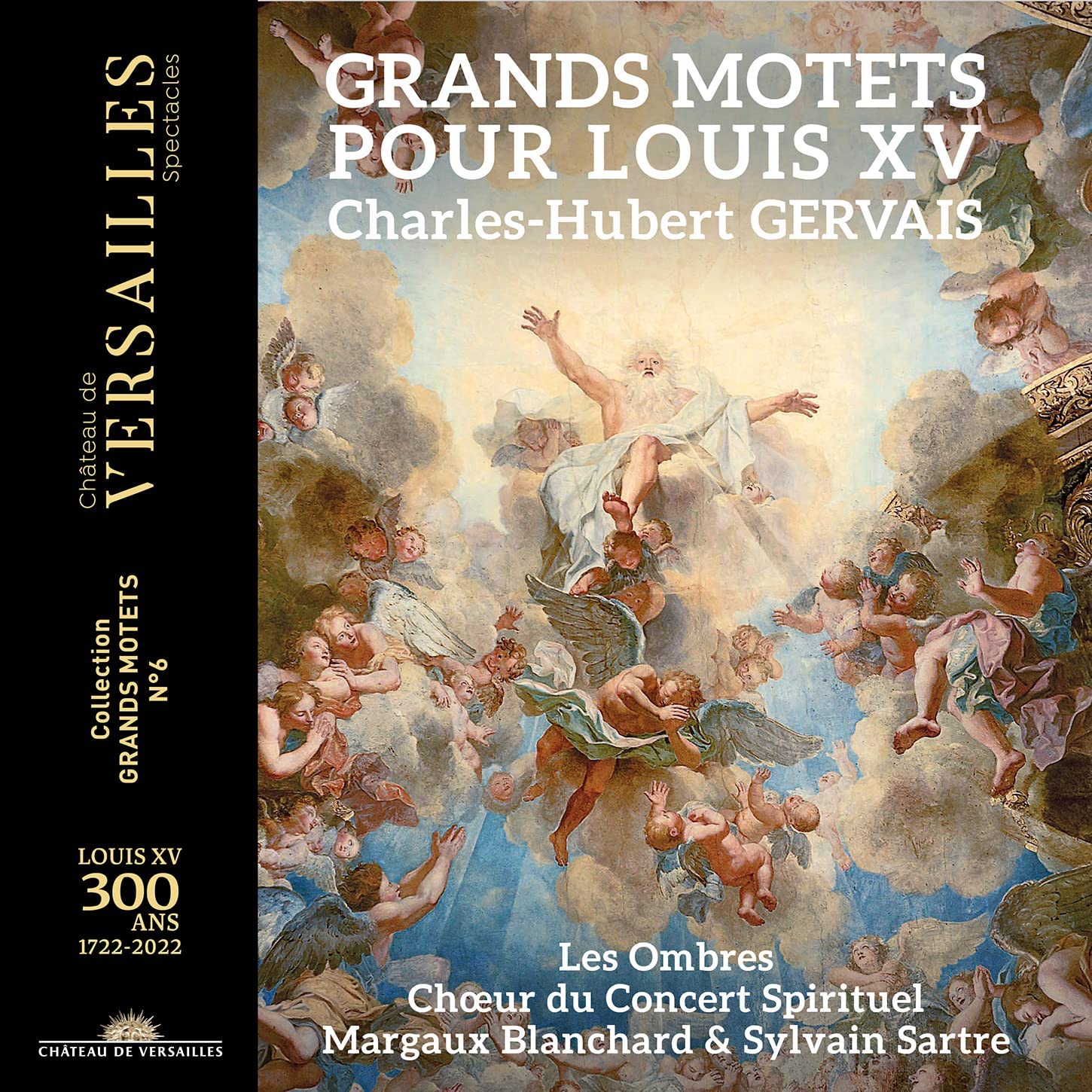
Gervais: Grands motets

Les Ombres, Choeur du Concert Spirituel, Silvain Sartre
57:21
Château de Versailles Spectacles CVS 073

Previous releases in this splendid series devoted to the grand motet repertoire and recorded in the Chapelle Royale at Versailles have been devoted to the known masters: Lully, Delalande, Rameau, and so on. Charles-Hubert Gervais will likely be a less familiar name to most prospective listeners.

Born in Paris in 1671, he spent much of his life in the service of the Duke of Orléans (the Regent from 1715), replacing his father as valet to the duke, who he assisted in the composition of two operas. In 1723 he was one of three composers (along with Campra and Nicolas Bernier) to succeed to three-quarters of Delalande’s position as sous-maître of the Chapelle Royale (traditionally a composer served as sous-maître three months of the year). He died, also in Paris, in 1744. Anecdotally Gervais apparently tried to avoid his position as sous-maître, claiming the Latin motet was not his favoured form of competition, yet, as is adequately demonstrated on the present CD, his achievements in the field merited the considerable fame and recognition granted him both in France and further afield.

The motets included here all follow the customary sectional form, with verses divided between soloists, petit choeur (solo ensemble) and grand choeur supported by orchestra comprising wind and strings. Each motet is given its own distinctive character in Gervais’s settings. Super flumina Babilonis is a setting of the well-known text of Psalm 137, ‘By the waters of Babylon’, with its dramatic juxtapositions into the largely yearning text fully exploited by the composer. The exquisitely lovely opening, announced by the orchestra and taken up by the chorus, captures all the nostalgia felt by captive Israel, the falling sequential figure an expression of intense longing. Later passages such as ‘Quia illic’ (For they that they led us into captivity), with its martial dotted rhythm introduce elements of the dramatic so strongly as to make the prospect of hearing one of Gervais’s tragedies lyrique mouth-watering.

Super flumina is a quite splendid work, arguably the pick of the three recorded here. Jubilate Deo (Psalm 100) is well known for its place in the liturgy. Gervais’s setting of it is for a work of joyous praise not inappropriately pervaded by the spirit of the dance. Introduced as a duet for two sopranos which is then taken up by the full choir, this opening is a fine example of the skill and confidence with which Gervais handles contrasting textures, both choral and orchestral. The final contrapuntal chorus (‘Be thankful to him’) is beautifully laid out and constructed. The final motet is a setting of the Miserere mei (Psalm 51), at once much the longest (it runs about half an hour) and most ambitious of those here. It is also, perhaps predictably, the most uneven, as a general observation more compelling in its penitential passages. That said it opens and ends superbly, starting with a broad, serious bass solo (well, if not outstandingly sung by Benoît Arnould) taken up first by the male voices of the chorus then the upper voices to build sonorously and impressively, a favourite procedure of the composer. The final section (‘That the walls of Jerusalem’) opens with a duet for two sopranos (Marie Perbost and Déborah Cachet, who excel in all they do in these works) before proceeding to a lively contrapuntal chorus that alternates the petit choeur with the grand, while introducing suggestions of modality. Elsewhere hints of the conventional occasionally crop up, but overall these motets reveal a composer well capable of taking his place alongside better-known names.

If marginally failing to attain the exalted level of some previous issues in the series, the performances by one of the lesser known of the profusion of ensembles that currently grace the French early music scene are extremely accomplished. Chorus and orchestra, both smaller than some that essay this repertoire, acquit themselves well, while as already intimated the soloists are first-rate, tenor Nicholas Scott particularly catching the ear among those not so far mentioned.

Brian Robins 

Categories
Recording

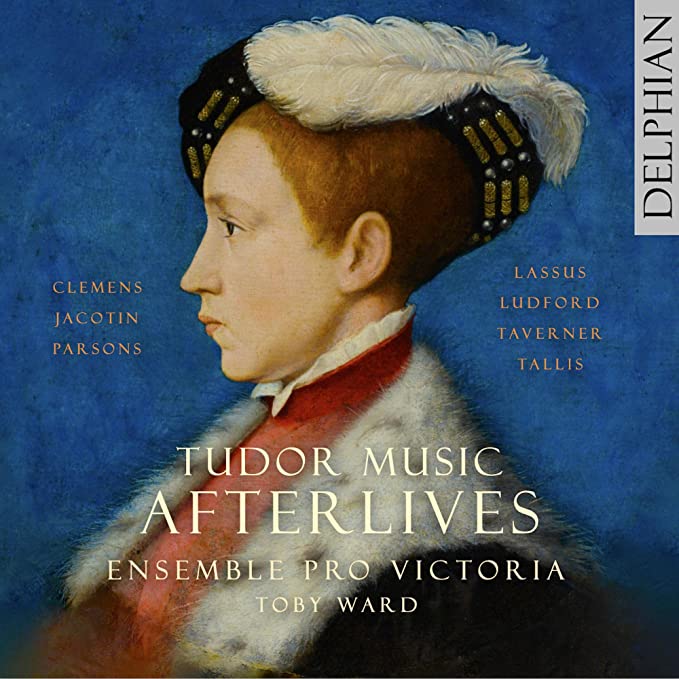
Tudor Music Afterlives

Ensemble Pro Victoria, conducted by Toby Ward, Magnus Williamson, organ. Toby Carr, lute
69:27
Delphian DCD34295

This is Ensemble Pro Victoria’s successor to their rewarding recording of music celebrating the quincentenary of Fayrfax, which I reviewed. And a very successful successor this album is too. The premise on which it is based might seem a tad academic, but it produces a fascinatingly varied yet coherent programme of music, containing some staggeringly fine pieces, excellently performed.

All these pieces are caught in their afterlife, and are presumed or known to have had a prior existence. There are several strands to this programme: “extreme” reconstructions of some of Sheppard’s many fragmentary psalm settings; reconstructions of sections of longer motets that survive only as solo songs with lute accompaniments; a reconstruction of a partsong by Robert Parsons – the stunningly beautiful When I look back – from isolated partbooks and a lute intabulation; Continental motets and chansons that have made their way over to England; excerpts from Ludford’s Lady Masses; two motets with only Elizabethan attributions to Taverner, who died over a dozen years before she ascended the English throne; and a famous work by Tallis – successively a fantasia, O sacrum convivium and finally (among other contrafacta) I call and cry – that seemingly began life as an instrumental work for a consort of viols, with an afterlife serving both the Roman and English Churches.

Musically the most interesting works are the two attributed to Taverner and the motet by Clement. It is unlikely that anyone listening to a “blind tasting” of Quemadmodum would guess that it is by Taverner; indeed, of its five surviving sources, two are anonymous, one ascribes it to Tye, and the other two to Taverner. All these sources are Elizabethan, and none provide any text beyond the initial word. The text of Psalm XLI can be fitted to the notes, so it is reasonable to conclude that it was composed as a motet but was performed instrumentally during its Elizabethan afterlife. What is beyond dispute is that it is one of the most strikingly beautiful works from the Tudor period. In the same class is O splendor gloriae which has Elizabethan ascriptions both to Taverner alone and jointly – respectively the first and second sections – to him and Tye (that man again!). It seems credible that the latter is accurate: either a work on which the two composers agreed to collaborate, or one that Taverner left unfinished and Tye completed; it is even possible that two independent compositions were at some point yoked together, as for instance seems to be the case with the two parts of Byrd’s anthem Arise O Lord/Help us O God albeit they are by the same composer. Clement’s Job tonso capite simply illustrates why he is among the finest composers of his own and of all time.

Musicologically the most interesting works are the five settings by Sheppard of Sternhold and Hopkins’ metrical psalms. These will be published in the forthcoming volume of Sheppard’s complete vernacular music in Early English Church Music, edited by Stefan Scot. Except in one case, only the upper voice of the original four survives for each of these 48 pieces, but the “extreme reconstruction” by Magnus Williamson mentioned above has produced five credible pieces of music for this disc. Given the constraints of a CD booklet it is good that Magnus has been able to summarise the process of reconstruction for each individual psalm. Meanwhile in the Mulliner Book there is an arrangement for keyboard of Sheppard’s setting of Psalm I, The Man is Blest, which, in the words of Stefan Scot, “permits a reconstruction and indicates something of the style of the remaining choral psalms.” Academia Musica Choir, conducted by Aryan O. Arji, recorded all of Sheppard’s Collected Vernacular Works on two discs (Priory PRCD 1081 and 1108, 2013 and 2015) and The Man is Blest is the first track on volume II. Mulliner’s arrangement is played on the organ by Michael Blake (who is scandalously uncredited!) on volume I, track 8.

The two Kyrie movements from different Lady Masses for three voices by Ludford perhaps fall within the category of worthy, albeit pleasantly so, and are enhanced by verses played on the organ by Magnus Williamson employing authentic methods of improvisation on given melodies called “squares”, but the third such movement, Alleluia. Veni electa mea, is, in modern colloquial parlance, an absolute belter, for all its brevity. Like the motet by Clement mentioned above, it illustrates why Ludford takes his seat at the same table as Clement himself, beside Sheppard, Lassus, Taverner, Tye and Tallis, to name only composers present on this disc.

Ensemble Pro Victoria sing all this varied music consistently well, be it plainsong or the augmented forces assembled for O splendor gloriae. I was concerned that the full-throated sound exhibited in some tracks on their disc of Fayrfax might be reproduced here and overwhelm the more understated material. This proves not to be the case. The performances and interpretations, whether assertive, neutral or restrained, are appropriate to each item. Toby Carr’s occasional contributions on the lute with the singers provide both variety of texture and authenticity. The organ played by Magnus Williamson, mentioned above, was built by Goetze and Gwynn in 2002 for the Early English Organ Project, and embodies evidence from fragments of pre-Reformation organs discovered in Suffolk. This combination of cutting-edge scholarship and outstanding performance gives us a recording of the highest quality, apt for edification and pleasure.

Richard Turbet

Categories
Recording

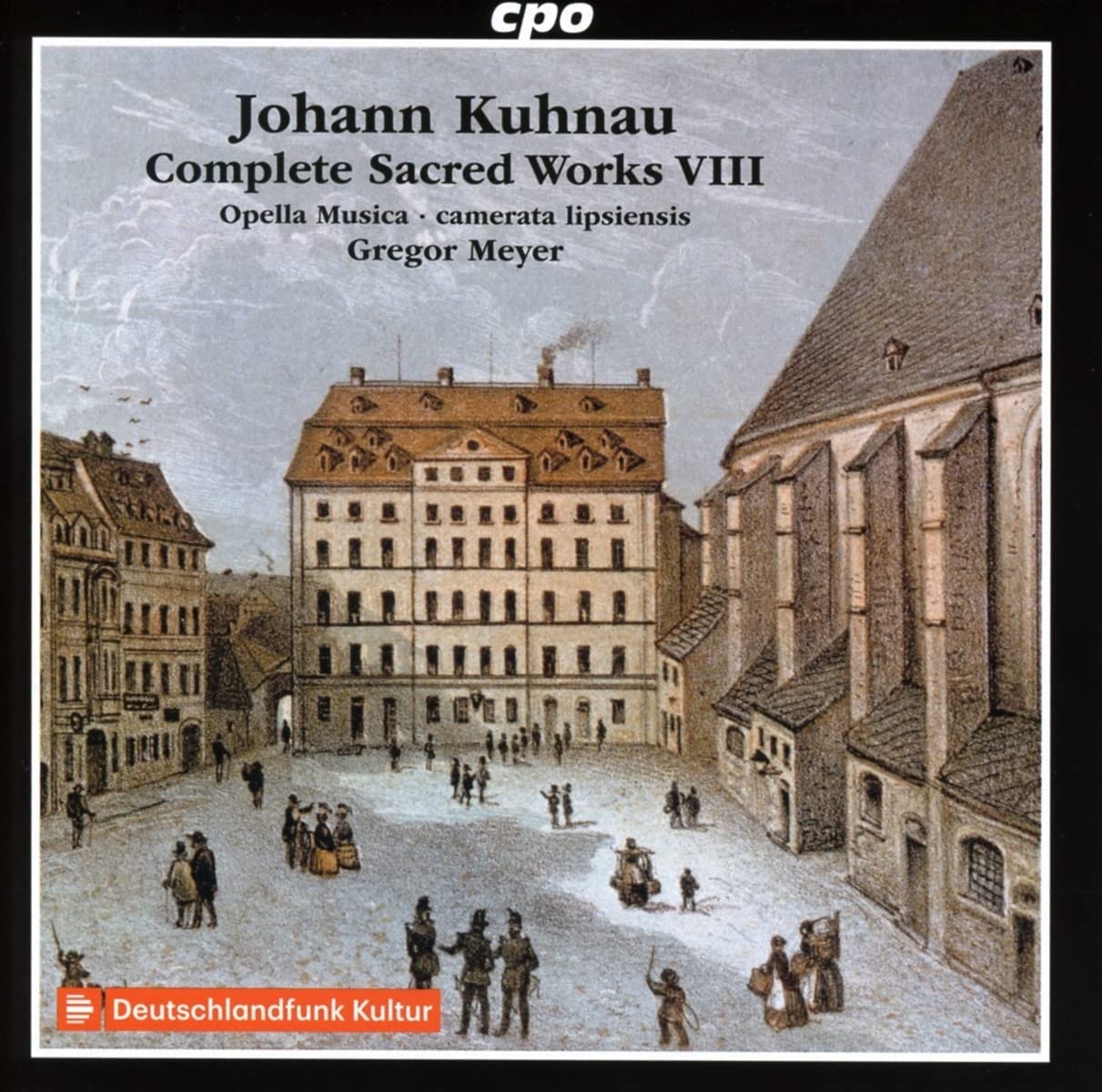
Kuhnau: Complete Sacred Works VIII

Opella Musica, camerata lipsiensis, Gregor Meyer
71:20
cpo 555 460-2

Although the title announces that this is Vol VIII of the Complete Sacred works, this final volume in the eight-CD set of all Kuhnau’s surviving vocal music is entitled ‘Complete Vocal Works Vol. 8’. The last volume I saw was 5, which I reviewed in Feb of 2020, since then Vol. 6 appeared in 2021 and Vol. 7 must have come in since. By contrast with all the earlier CDs, the contents of this final one are largely secular.

Christian Weise, the head of the Gymnasium at Zittau, was Kuhnau’s teacher and mentor, and Weise elaborated the potentially dramatic stories of the entwined relationships between the patriarchal families in the chapters of Genesis as school plays, providing a part for every student. As a 22-year old, Kuhnau was holding the musical fort in Zittau, and his music for this play Von Jacobs doppelter Heyrath (Zittau, 1682) survives in Weise’s collected works.

They are insertions not unlike Purcell’s The Fairy Queen and King Arthur. As well as these dramatic settings, there is a setting of Psalm 3 (which Purcell set likewise as Jehova, quam multi sunt hostes), Ende gut und alles gut – an extended setting of a Neumeister text for soprano, bass, violin and continuo, a group of three arias, perhaps for an outside celebration, and a Latin chamber cantata for two sopranos and bass with two violins and continuo in a rather Italianate style. These forays into a consciously more secular style are less interesting to me than the cantatas, whose influence on the style and performance of Bach’s cantatas is significant. But it is good that they are included in the project.

The performances remain immaculate both in conception and execution. Meyer has worked with essentially the same musicians over this past eight years, and David Erler, the group’s alto, is indeed preparing the material for publication by Breitkopf. In an interview in the liner notes, he comments on the richness and diversity of the instrumental accompaniments, noting horns, oboes and a transverse flute, virtuoso writing for trombone, and a surprise scoring including schalmei, trombone, a harp and an echo chorus.

The net result is a homogenous blend, where single strings and single voices with a rich variety of wind are backed by the splendid Silbermann organ in Rötha, together with harp and lute in the continuo group. The clarity of the sound is wonderful: every word is clearly projected. In the secular pieces, the style is perhaps more ‘theatrical’ than in the cantatas, but that is hardly surprising and the rather lightweight text does need some boost.

This great undertaking will, I hope, remain the benchmark for all performances of Kuhnau in the future. The complementary style of singing and playing is a model, and anyone interested in learning about the background to performing Bach cantatas needs to listen carefully to both Kuhnau’s compositional techniques as well as the performance style of this excellent project, led by Gregor Meyer.

David Stancliffe

Categories
Recording

Grandi: Lætatus sum – Vesper Psalms

Accademia d’Arcadia, UtFaSol Ensemble, Alessandra Rossi Lürig
73:26
Arcana A525

If you have heard any music by Alessandro Grandi at all, it was most likely a motet for one or two voices, maybe even with a pair of violins playing ritornelli between the vocal sections, with everyone coming together only for the last few bars. This recording will come as something of a shock – although he was very much the master of the musical miniature, Grandi (who had sung as a teenager in Gabrieli’s choir at St Mark’s in Venice) was perfectly capable of deploying larger forces to splendid effect. The present recording, which benefits from full-blooded singing (with the dexterity to handle the sometimes intricate ornamentation), fabulously articulated playing, and a not-too-rich-but-ample acoustic, takes music from three publications of 1629 and 1630 that reveal just what a loss to posterity the composer’s death from plague in that latter year was. Printed in Venice, the music was almost certainly conceived for his own ensemble at Bergamo’s Santa Maria Maggiore which he had built up since his arrival there in 1627. Rodolfo Boroncini’s excellent booklet essay puts it all into its historical context. Years after we have had multiple recordings of Monteverdi’s large-scale church music – as well as Rovetta’s and Rigatti’s – finally, Grandi’s time has come and I doubt he could have found more passionate advocates than the present performers. What a beautiful CD – one I shall treasure for a long time!

Brian Clark

Categories
Recording

Handel: Chandos Anthems

Choeur & Orchestre Marguerite Louise, Gaétan Jarry
66:33
Versailles CVS072

It is difficult to envisage a location more conducive to music-making – and by extension recording – than the palace of Versailles. Do you want opera? Then make for the beautiful 18th-century Opéra Royal theatre. Or perhaps you’re more inclined to sacred music? Then stroll through a couple of ornately decorated corridors and you reach the glorious Chapelle Royale, constructed around the turn of the 17th and 18th centuries.  The launch in 2018 of a record company concentrating on recordings produced in the palace – and the Salle des Croisades has also been used for recording – was a stroke of genius rewarded by numerous accolades to individual recordings and recently a Record Company of the Year award to the label itself, testimony to the current strength of the French early music scene. 

All of which leads to the present issue, recorded in the chapel in 2021 by one of the many outstanding French ensembles to have come to the fore in recent years. Handel’s twelve Chandos anthems were composed for James Brydges, first Duke of Chandos, whose ‘manipulation’ of finances when Paymaster-General to Marlborough’s armies between 1707 and 1712 had allowed him to amass a fortune with which he built himself a lavish country house called Cannons in addition to keeping a musical establishment. Handel’s period as composer-in-residence at Cannons (1717-1718) also produced Acis and Galatea and the oratorio Esther. The Chandos anthems recorded here include ‘O be joyful in the Lord’ (HWV, 247; No. 1), ‘O sing unto the Lord a new song’ (HWV 249b; No. 4) and ‘As pants the hart’ (HWV 251b; No. 6). All three are composed for three-part orchestra and chorus (without an alto line); No. 4 also includes solos for soprano (Florie Valiquette), tenor (Nicholas Scott) and bass (Virgile Ancely), while the other two feature just soprano and tenor.

Despite David Vickers’s notes suggesting that the strength of the forces involved has been ‘reimagined’ to allow for the wonderfully expansive acoustics of the Versailles chapel, Jarry’s are in fact only marginally larger than those employed by Harry Christophers in his highly-regarded complete Chandos set of the anthems (1998-1999) with The Sixteen. A difference listeners will notice is a cultural one, for while British choirs aim for an integrated choral sound with perfect ensemble, individual character is often a hallmark of Continental choirs;  thus it is here, with Jarry’s superb Marguerite Louise singers not fearful of displaying such individualism. That’s not to suggest loose discipline in any sense and you need only listen to the manner in which the sublime slow fugal opening chorus of ‘As pants the hart’ is sustained with a so-gradual increase in tension to be aware of Jarry’s total control. Elsewhere, as in the fugal chorus ‘Serve the Lord’ (from No. 1), there is an exuberance that blooms in the ambiance of the royal chapel, while the broad, spacious opening of the doxology of the same anthem is hugely impressive. Jarry’s soloists are splendid, with the palm perhaps going to outstanding British tenor Scott, who has most to do and is exceptional in the florid writing of the dramatic mimetic aria ‘The Waves of the Sea Rage Horribly’ from HWV 249a. And it would be an injustice not to mention the outstanding oboe playing of Neven Lesage in any number of obbligato passages.

The anthems are punctuated by Jarry’s own performances of Handel’s Voluntary in A minor and Chaconne in G minor, played on the great Cliquot organ in the Chapelle Royale. It certainly wouldn’t be my ideal choice for Handel, but Jarry’s playing is accomplished and fluent.  Strongly recommended without hesitation.

Brian Robins

Categories
Recording

The Mysterious Motet Book 1539

Siglo de Oro, Patrick Allies
67:14
Delphian DCD34284

For once the word “mysterious” used in a title is not an exaggeration or a misrepresentation. The provenance of this publication really is, and remains, a complete mystery. But first, what of the musical contents, 28 Latin motets of which twelve have been chosen for this recording? There is absolutely no mystery about the quality which, on the basis of this selection, is respectable and, in a few cases, high. Indeed, although the programme concludes with a work by Gombert and another which is attributed to him in this source but to others elsewhere – of which more below – it is pieces by lesser-known composers, or composers known better in other genres, which are the most striking. The disc opens with Salus populi ego sum, a work of seamless beauty punctuated by some delightful dissonances, composed by Pierre Cadeac. There is a fine animated setting of Haec dies by Johannes Sarton, with memorable “noe noe” refrains concluding both sections, while Postquam impleti sunt by Jhan du Bilon, after a rather bland beginning, develops with some wonderfully undulating phrases and intensifying harmonies, before releasing the tension for a satisfying close. Of the composers better known, Arcadelt’s Dum complerentur might be thought to contain more dissonances than would be expected in this context, for instance in the Alleluia, while a breath of madrigalian ethos occurs near the end at “ubi erant sedentes”. Willaert’s two items, Laetere sancta mater and Peccavi super numerum seem in these performances to be interesting rather than striking, the latter somewhat soporific beside the anguished setting by Byrd, and the disc concludes with two pieces by Gombert. Veni electa mea may not be by him, and Jacquet of Mantua receives equal billing as composer in the lists of contents, but although the relevant passage in the otherwise very informative booklet draws attention to the existence of attributions other than to Gombert, these – including Jacquet – are not explained in any further detail. The DIAMM website notes an attribution not only to Jacquet but also one to Jacques Berchem. There are settings of the similar text Veni dilecta mea by Gombert and of Veni dilecte mi by Jacquet, and the thought occurs that since identical or similar titles are a significant cause of misattributions during this period, perhaps this piece is the work of Berchem, who does not seem to have set such a text. Or, as the saying goes, not as the case may be. Judging by this performance, the work does not seem to shout that it is by either of the named composers. Nor is Laus Deo one of Gombert’s most distinguished works, always bearing in mind that even a modest work by Gombert is equal to the best works of many other composers. Perhaps in this instance the silvery sound of Siglo de Oro is less suited to the more bronze sound-world of Gombert’s music.

It remains to mention the two finest pieces on the disc. Apparens Christi is a wonderfully sustained work of over eight minutes’ duration, composed by Johannes Lupi. He shares a disc with Lupus Hellinck (Hyperion CDA68304) which I praised warmly in EMR (review published 1 February 2020) and this work confirms his status as an outstanding contributor to the Franco-Flemish repertory. Best of all on the current recording is Exsurge quare obdormis by Dominique Phinot. (There is a disc devoted to his music on Hyperion CDA67696 sung by The Brabant Ensemble.) Unlike Peccavi mentioned above, this setting really is fit to be mentioned in the same sentence as the sprightly setting by Byrd. Its luminous SAAAT scoring and minor mode, delivered with impressive momentum by Siglo de Oro, give it a hypnotic plangency, and Phinot’s sure-footed variations of texture beside his immaculate insertions of occasional striking passages of homophony within the prevailing polyphony make this motet irresistible. It is no surprise that in his booklet notes to the recording mentioned above, Roger Jacob – who is largely responsible for the modern revival of Phinot’s music – observes that “the theorist Hermann Finck in 1556 placed Phinot behind only Gombert, Clemens, and Crecquillon (and ahead of Willaert) in a list of composers he described as ‘foremost, most excellent, subtlest and, in my judgement, to be imitated’.” The evidence provided by the current recording bears this out.

The mystery in the title remains. Why was this book of blatantly Catholic music published in a blatantly Protestant city? (Significantly the motet by Phinot lauded above is one of three in the publication for which there are no known surviving manuscript sources.) Daniel Trocme-Latter offers some useful background in the accompanying booklet. Furthermore, there is certainly no comparison with the circumstances under which Byrd published either his Masses or his subsequent Gradualia in Protestant London. As the Philip Henslowe character repeats throughout Shakespeare in Love, “It’s a mystery”, and like the one in the film, this mystery looks set to remain.

Richard Turbet

Categories
Recording

Les Noces Royales de Louis XIV

Le Poème Harmonique, directed by Vincent Dumestre 
65:18
Spectacles du Château de Versailles CVS066166

Louis XIV’s wedding was part church service, part a tour of France and part peace treaty (between France and Spain). There was music of all kinds every step of the way but, sadly, details are hard to come by. Thus, this so-attractive title and concept/programme are almost entirely speculative but nonetheless constitute an attractive and well-performed anthology of the kind of music heard in French royal circles c1660.

The two major works are both sacred. Lully’s Jubilate Deo is a magnificent setting of a text compiled from several psalms and can be definitely associated with the royal wedding. Its splendour of both material and construction is the more striking when one recalls that it is the composer’s earliest surviving sacred work. Sources record that the nuptial mass itself featured music by Italian composers. Rather perversely these are evoked by a Cavalli Magnificat from his 1656 publication. Fine though this is, could we not have had at least a taste of the elaborate mass that opens that volume?

I suggested above that the performance standard of this release is high. This is true, but, as always with this director, there are questions to be asked about the performance practice of almost every item, chiefly concerning instrumentation and ornamentation which strike me as being rather ‘help yourself’.

David Hansell