Categories
Recording

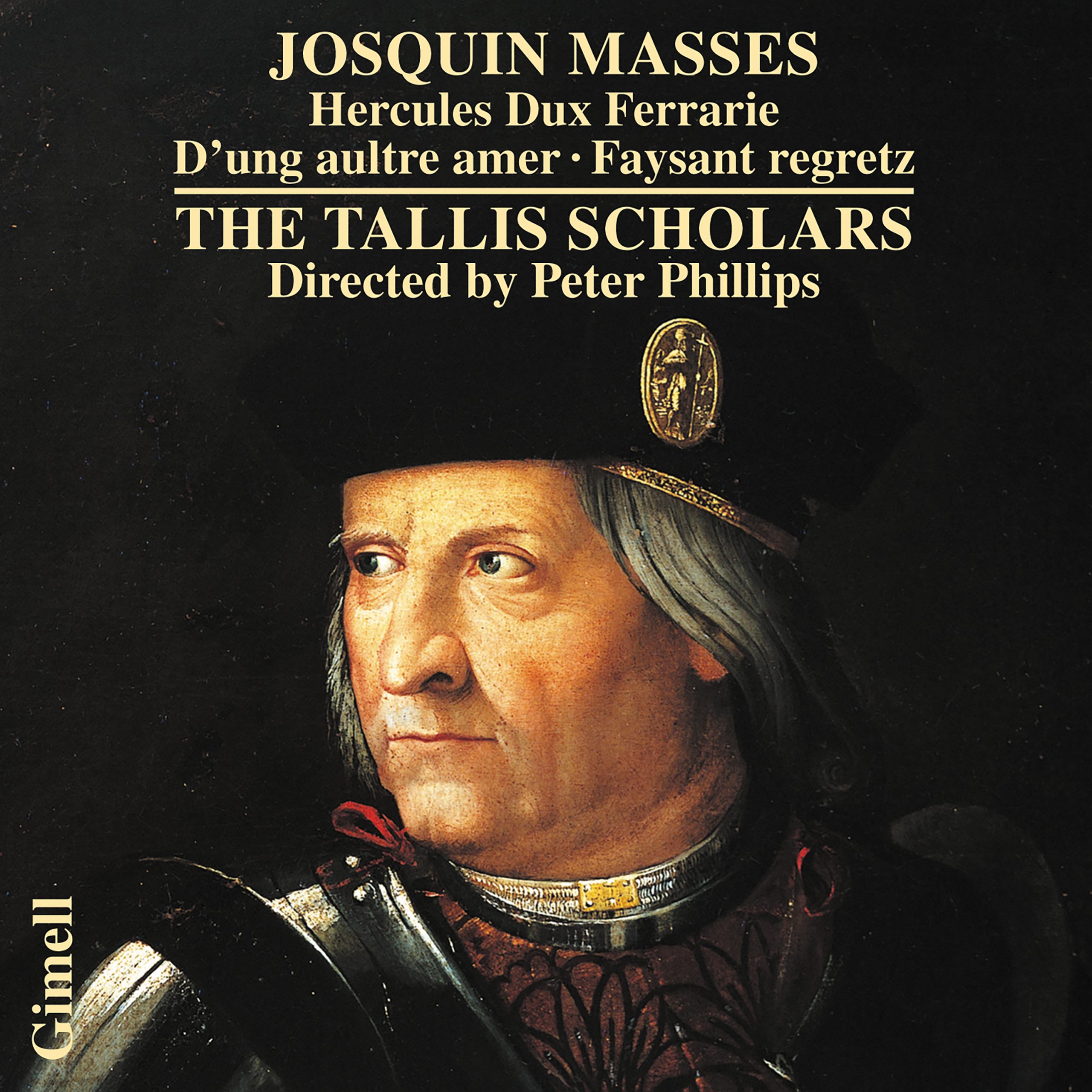
Josquin: Masses

Hercules Dux Ferrarie, D’ung altre amer, Faysant regretz
The Tallis Scholars, Peter Phillips
71:40
Gimell CDGIM 051

October 2020!
Click HERE to buy this on amazon.co.uk

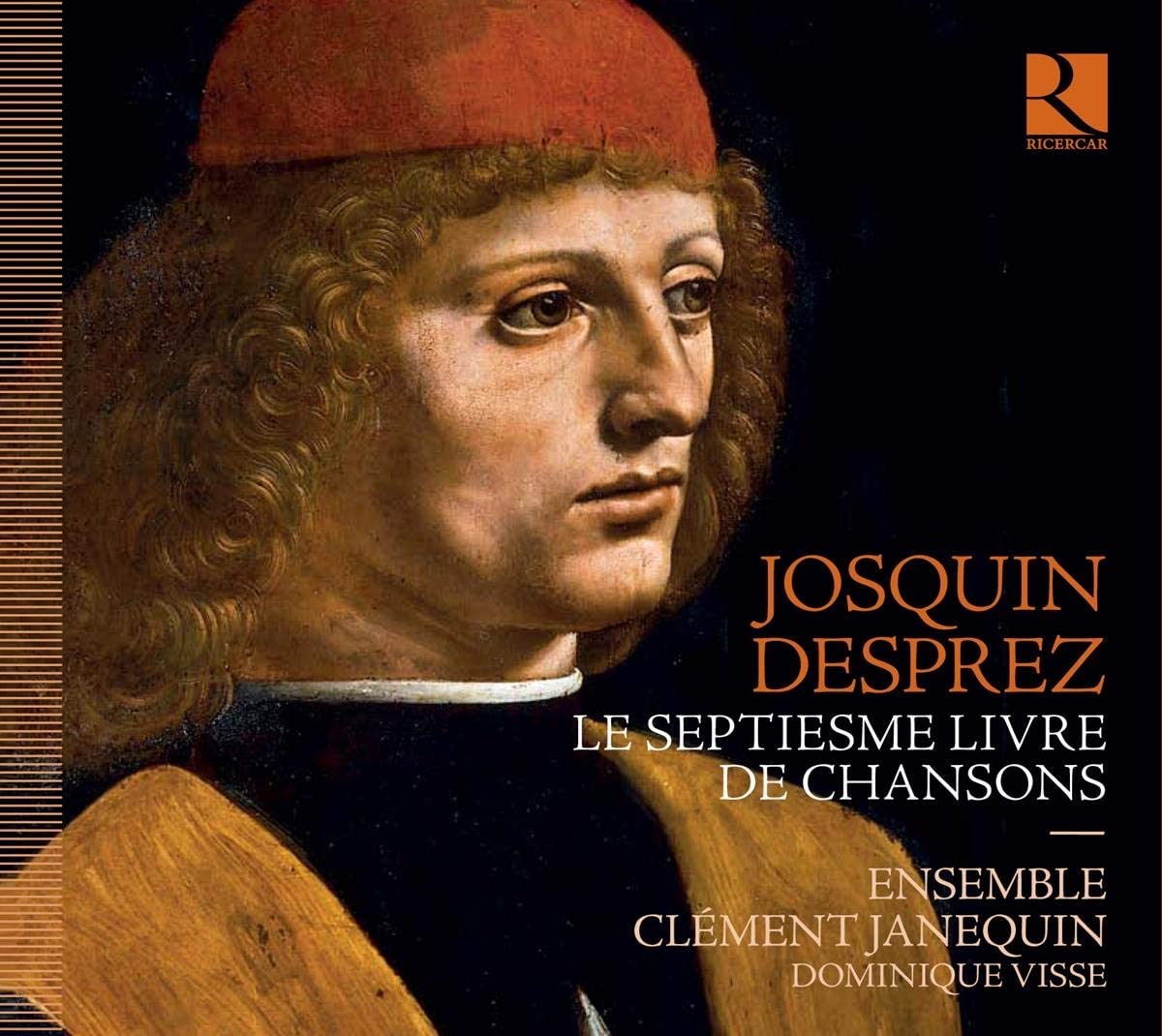
This is the final disc in The Tallis Scholars’ complete recording of Josquin des Pres’s masses. Perhaps it is just as well, because this reviewer is running out of superlatives for the music itself and for this choir’s performances of it. Peter Phillips makes substantial claims for these works in his accompanying notes, and it could indeed be said that, so varied is Josquin’s treatment of the Mass text throughout the entire series, many of the eighteen works could almost seem to have been composed by different composers. (Indeed, the Josquin canon has come under intense musicological scrutiny in recent decades, and Missa Da pacem, included in the series, is more likely to have been composed by Bauldeweyn, notwithstanding conflicting attributions to Josquin. This is clearly stated in the recording’s booklet.) This final disc provides some of the knottiest music in the series, and some of the most challenging for the listener. Much of it is music of obsession, with Josquin’s repeated use of one particular motif of four notes in Missa Faysant regretz set beside the egomania of Ercole I d’Este of Ferrera, dedicatee of Missa Hercules Dux Ferrarie. To illustrate this one can do no better than to quote Peter Phillips’s note in the accompanying booklet: “To understand how this Mass is constructed it is necessary only to remember that Duke Ercole liked to hear his name sung obviously and often. To this end Josquin took his name and title, HERCULES DUX FERRARIE, and turned their vowels into music by way of the solmisation syllables of the Guidonian hexachord, giving a very neat little melody: … re ut re ut re fa mi re … He then writes these eight notes to be sung 47 times …” The remaining piece Missa D’ung aultre amer is the antithesis of such constructions, being an essay in brevity and simplicity based upon one of Ockeghem’s finest chansons, no doubt as an act of homage by Josquin to the man who might have been his teacher.

A digression. Having seen the British gentleman I am about to mention with his wife at a concert of music by Byrd in the Wigmore Hall, London, a few years ago, I will of course no longer hear a word said against him, but I cannot resist mentioning the resemblance of Ercole, whose portrait is reproduced on the front of the accompanying booklet, to the prominent politician Lord Heseltine. I draw no conclusion other than that they share an ability to appreciate great Renaissance composers.

And as Byrd said of his own music in 1611, “a song that is well and artificially made cannot be well perceived nor understood at the first hearing, but the oftner you shall heare it, the better cause of liking you will discover.” Repeated hearings of the music on this disc keep revealing its felicitous qualities. The obsessive aspects of the music become part of a bigger, broader musical picture as Josquin manipulates them to support the overall construction and rhetoric of his masses. As Peter Phillips notes in his booklet, approaching the point from a slightly different direction, this is strikingly illustrated in the third Agnus of Missa Faysant regretz where, for the only time in the work, Josquin has the sopranos sing the complete superius line from the rondeau by Walter Frye (one source has Binchois) on which the mass is based, over the intricate counterpoint in the three lower parts. Missa D’ung aultre amer is eccentric. A remarkably brief Gloria clocks in at below two minutes, with a motet Tu solus qui facis mirabilia replacing the Benedictus, the final section of which, “Audi nostra suspiria”, begins with a striking passage in the style of mediaeval faburden, comparable with a similar briefer moment at “qui locutus est” in the Credo of the Missa Hercules Dux Ferrarie, and the entire mass concludes with an exquisite cadence.

For all Ercole’s entitled narcissism, it is mountainously to the credit of Josquin that his mass can be appreciated on its own terms as a piece of music without an awareness – or at least without taking any notice – of the repetitions of the autarchic Ercole’s name, no more than one needs to focus upon the plainsong while listening to an In nomine. In the accompanying booklet, Peter Phillips notes favourite passages in this and the other masses. These are the insights of someone who has conducted and indeed lived these eighteen works, experiencing them profoundly from the inside. From the humble outside, I would particularly mention the many wonderful passages in two parts in this mass, particularly “pleni sunt caeli” from the Sanctus, and all the duets in the first Agnus. Overall it is one of the major masses in this remarkable series.

The series began with what was even then almost frighteningly fine performances of the Missae Pange lingua and La sol fa mi re. The former gained all the attention, but for this listener it was the latter which left me even more astonished at both the music and the performance: I expected Pange lingua to be great, but was taken aback at the quality of a work more from the margins of Josquin’s output, its qualities laid bare by the forensically beautiful singing of The Tallis Scholars under Peter Phillips. And here they still are, 34 years later, doing a major work full justice and laying bare the glories of two more of those marginal masses.

Richard Turbet

Categories
Recording

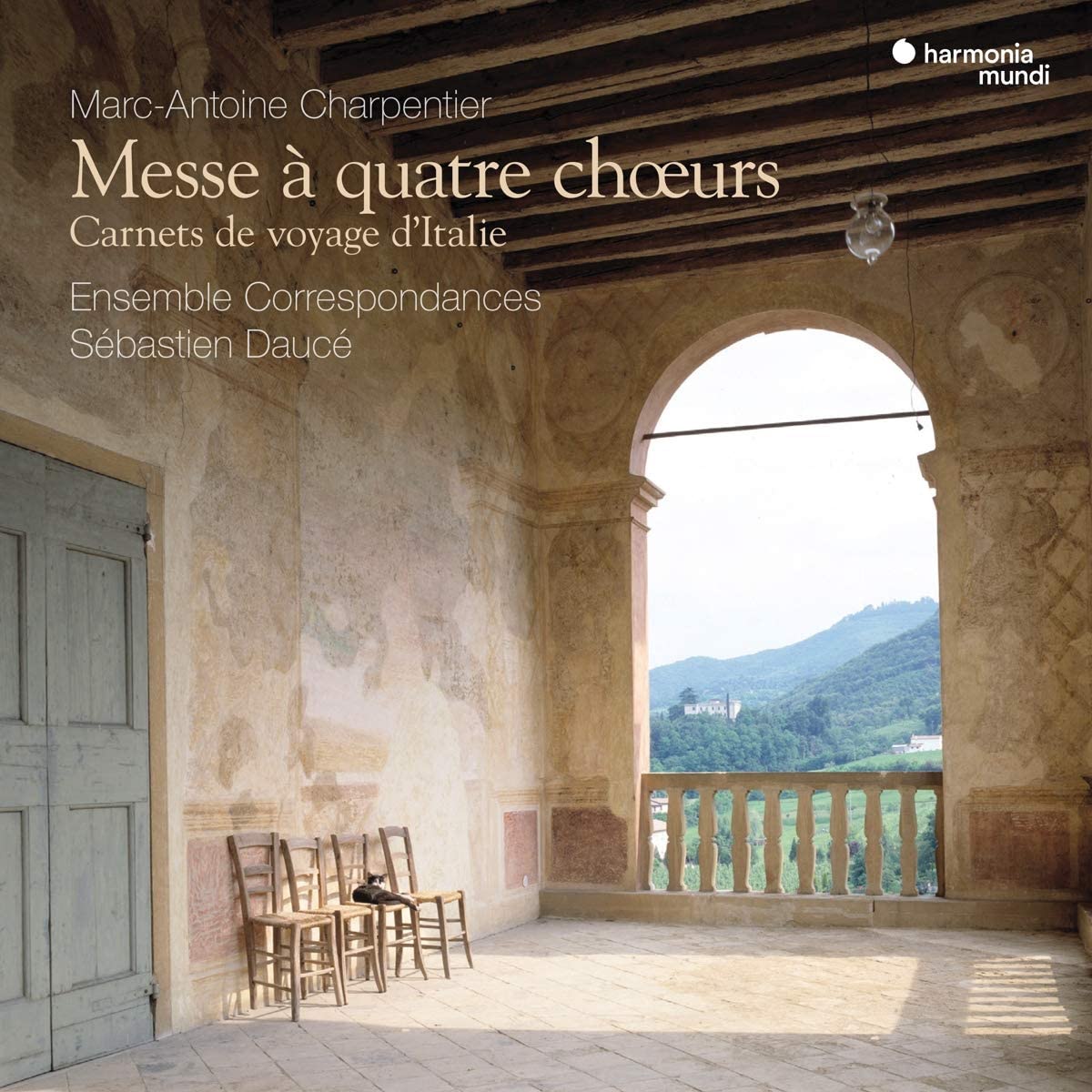
Charpentier: Messe à quatre chœurs

Carnets de voyage d’Italie
Ensemble Correspondances, Sébastien Daucé
TT
hamonia mundi HMM902640

Click HERE to buy this on amazon.co.uk

This programme is one of those ‘the composer may have visited here, heard music like this and then written this’ concepts, in this case credible and not pushed too hard in Graham Sadler’s fluent note. Most of the music (roughly two thirds) of the music is Italian and excellent it is too, in both content and execution, so full marks to whoever did the painstaking research this kind of thing requires. Cavalli’s Sonata is the stand-out for me, but very much as a primus inter pares. Charpentier is represented by extremes – a motet for three unaccompanied voices (SSA) and his mass for four choirs. This is sonically splendid with rich antiphonal effects, though the tutti sections have choirs doubling each other so the number of simultaneous independent parts is never more than seven. My preference is always for masses to interspersed with other music and not treated like later symphonies (we do not even get the organ interludes Charpentier requests), but that aside this release is very strongly recommended for both content and performances, which are stylish and expressive but never self-indulgent.

David Hansell

This is one of two releases I have reviewed as downloads this month. As such it is not possible to comment in the usual way on the overall physical presentation of the package but a few comments on the download experience are appropriate. This is no longer a novelty, of course, and the process for both the music and the booklet is perfectly straightforward. However, any printing of the booklet material needs care and may need a few experiments with single pages to find the optimum settings for both size and format. In particular beware of pages that are black with white print (a bad design idea anyway) and you may not want to print pages that are not in your language or which contain material of only passing interest. And do not assume that all publications from the same source will work in the same way! Once you get there you will find an excellent programme note (French, English and German), but the sung Latin texts are translated into French only.

Categories
Recording

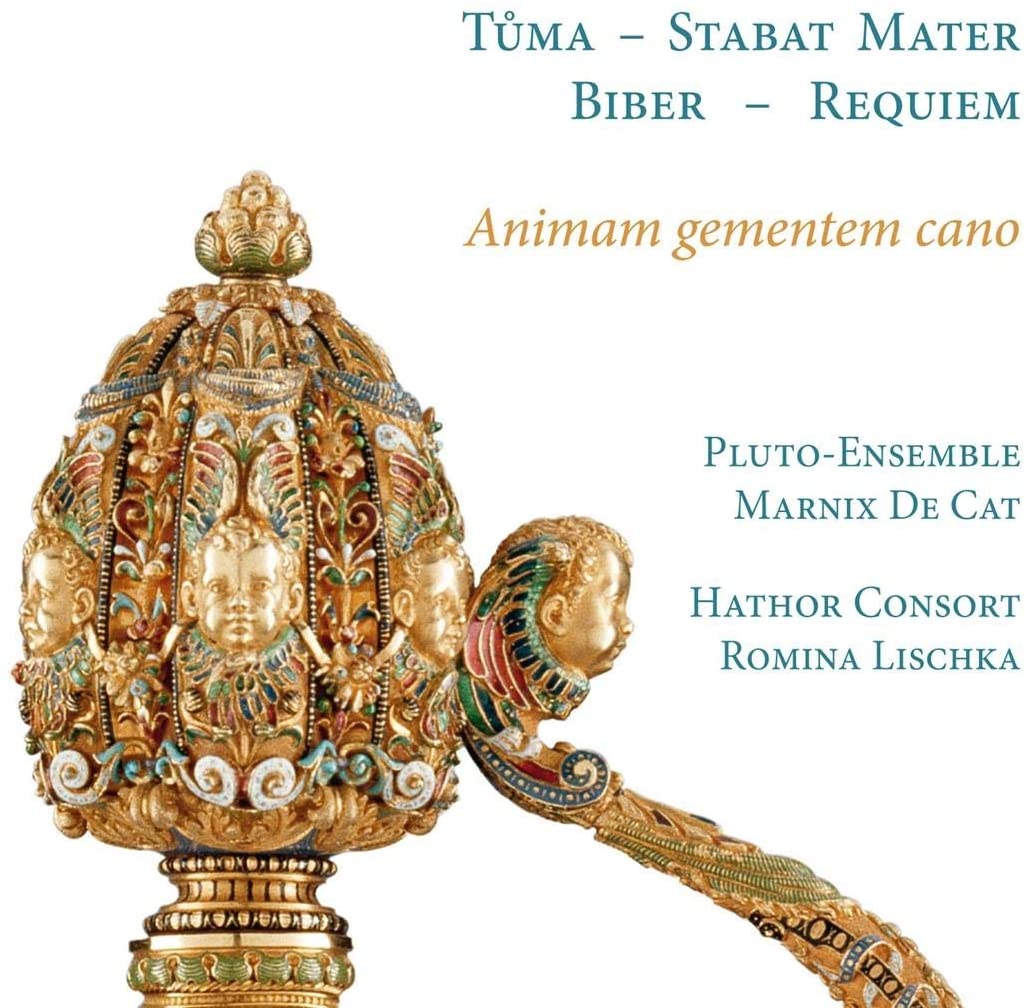
Animam gementem cano

Tůma: Stabat Mater; Biber: Requiem
Pluto-Ensemble, Marnix De Cat, Hathor Consort, Romina Lischka
61:34
Ramée RAM 1914
+Sonatas by Biber & Schmelzer, Partita by Clamer

Click HERE to buy this on amazon.co.uk

Tůma set the Stabat mater text several times; this recording features a previously unrecorded version, which the director of the Pluto-Ensemble came across in a library in Ottobeuren. Like Biber’s F minor Requiem, it is performed in the round with solo singers and one-per-part ripienists, single strings (with gambas playing the middle parts) and trombones and a “proper” organ. The recording captures a glorious sound, voices and instruments well blended in a warm but not overly resonant acoustic. As De Cat says during the YouTube video the group made for the launch, the violin floats above the texture – and Sophie Gent’s playing is angelic. In between the two pieces with voices, we hear sonatas in G by Biber and his fellow fiddler, Schmelzer, which in turn sandwich a four-movement Partita in E minor by Andreas Christophorus Clamer. I am not usually a fan of mixing violins and gambas in this repertoire, but I must confess that the Hathor Consort make a very convincing case for me broadening my mind! All in all, this recording takes us deep into the soul of the late 17th century and it is a marvellous and cathartic experience!

Brian Clark

Categories
DVD

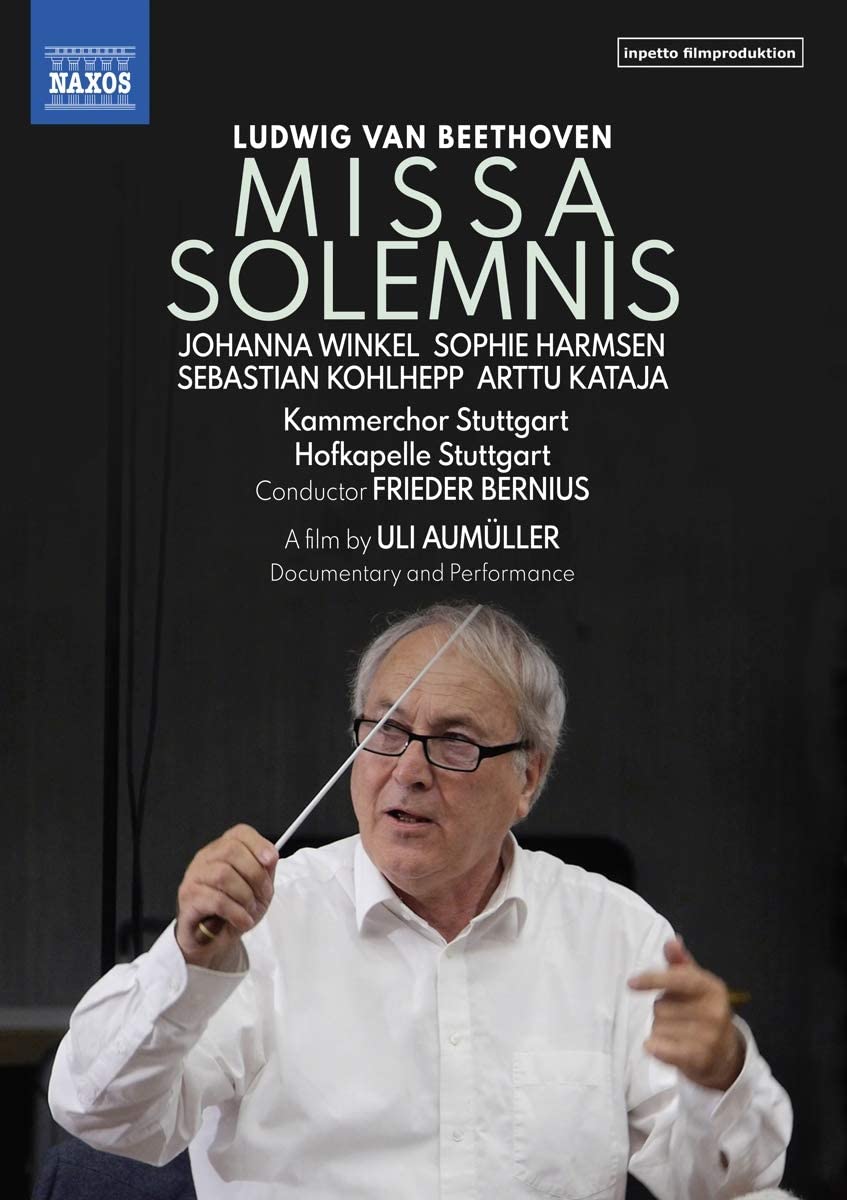
Beethoven: Missa Solemnis (DVD)

Johanna Winkel, Sophie Harmsen, Sebastian Kohlhepp, Arttu Kataja, Kammerchor Stuttgart, Hofkapelle Stuttgart, Frieder Bernius
Documentary and Performance
71:00 (music), 60:00 (documentary)
Naxos 2.110669

Click HERE to buy this on amazon.co.uk

How do we approach the Missa Solemnis in this Beethoven year, 2020? It is not an easy question to ask of a work that is so multi-faceted, a huge structure that both storms the heavens, as if shaking a fist at fallen mankind, and yet also provides that same mankind with the solace and comfort of the Elysian fields. Anton Schindler, Beethoven’s first biographer, noted that from the start of the Mass’s long gestation period (1818-1823) Beethoven was in a condition of ‘oblivion of everything earthly’. The concept of a large-scale celebratory Mass for the elevation of his royal pupil Archduke Rudolf to cardinal and archbishop in Cologne Cathedral – an event long since over by the time the Mass was completed – had been transcended by 1823. I confess to finding it difficult to provide firm answers to the question posed in my opening sentence.

Some help is certainly provided by this new Naxos release featuring a film of a recording made in October 2018 at Alpirsbach Abbey, Baden-Würtemberg. Not only do we see film of the recording itself, but also a fascinating hour-long documentary that includes valuable insights into the work and Frieder Bernius’s approach to it. For that reason, I would recommend watching the documentary before viewing the performance. Bernius is, of course, a long-established conductor and was the founder of the Kammerchor Stuttgart, whose 50th anniversary is also celebrated by this issue. One of the most interesting features of the film is the way in which Bernius works with his choir, often taking just a couple of choristers to give them individual tuition on the work in hand. Even more compelling is to observe that Bernius’s approach, inspired by his many years of working on earlier choral music, is text-based, the results of his insistence on detailed working on such matters as pronunciation and articulation clearly evident in the final performance. In addition to the interviews and rehearsal clips, there are some fascinating archival clips of Bernius at work with earlier incarnations of the Kammerchor, along with interviews with some of the present performers.

Moving to the performance itself it is clear from the outset of the Kyrie that Bernius knows precisely what he wants. Taken at a measured tempo, the music moves with calm assurance, while the solo entries announce a fine young quartet that throughout impresses particularly in the many ensemble passages, obviously encouraged by Bernius to make the most of the madrigalian textures with which the work abounds. Christe is beautifully managed, though the timpani and brass don’t quite achieve unanimity in the quiet transition back to Kyrie. The Gloria, too, sets out at a well-judged tempo, avoiding the feeling of being pushed. Indeed, the whole, vast movement is unfolded by Bernius like an epic poem. ‘Et in terra’ brings a moment of wondrous stasis in the midst of powerful drive, while the prayerful ‘Gratias’ is another memorably placid interlude succeeded by some splendidly incisive orchestral playing in the lead back to the opening tempo and ‘Domine Deus’. And it is worth mentioning at this point that although the period-instrument Hofkapelle Stuttgart is hardly the most illustrious orchestra to undertake the Missa Solemnis, its playing throughout is excellent, with many distinguished moments coming from its wind section. The overall grandeur of the movement is brought to a triumphant peroration in the final doxology.

Credo opens as powerful affirmation, the contrapuntal passages once again luminescent in their clarity of detail.  The start of ‘Et incarnatus’ finds the choral tenors handling this key moment with a real sensitivity complimented by glinting high wind, another treasurable moment. The stabbing pain of ‘Crucifixus’ is tellingly conveyed, as is the mesmerizingly lovely outcome at ‘et sepultus est’.  

Beethoven’s ‘Sanctus’ is not the exultant triple cry of so many settings but a reverential moment on bended knee in contemplation of God’s glory. The choral sopranos have a rare ragged moment of ensemble at the exposed entry on ‘Osanna’, but in general cope with Beethoven’s wickedly high tessitura very capably. The high violin solo a little later is very well played. The opening of Agnus Dei provides a fine moment for bass Arttu Kataja, to distinguish himself and lead his three colleagues into a gloriously sung exposition, while the militaristic flourishes (first introduced into an Agnus Dei by Haydn in his Missa in tempore belli) provide thrilling moments of dramatic extroversion.

As I hope is clear from the foregoing Bernius’s Missa Solemnis impresses by dint of its total integrity. It may not be the most imposing or the most dramatically enthralling version on record, but few will not be moved and touched by it. ‘From the heart, may it go to the heart’, wrote Beethoven of his monumental work. Here that mission is unquestionably accomplished.

Brian Robins   

Categories
Recording

Sheppard: Media vita in morte sumus

Alamire, David Skinner
16:30
Inventa INV1003

Click HERE to buy this on amazon.co.uk (from July 17th!)

“Beyond glorious … monumental”. These words are used by David Skinner, director of Alamire, in his notes accompanying this recording, to describe – without one atom of exaggeration – the music of John Sheppard in general and his antiphon Media vita in morte sumus in particular. Another word, sublime, has been worked near to death (sic) in recent decades, but in its essential meaning it too applies to this work. Indeed, no praise can be too high for this musical creation. It is one of those few works that one feels could almost represent Creation itself. It has been recorded a number of times over recent decades by a variety of distinguished ensembles, and here, another of the finest choirs in the realm performs this incomparable masterpiece, but in a new version never before recorded. At just over sixteen measured but purposeful minutes it is about half the length of the longest rendition of the hitherto accepted format, a riveting tour de force by the Choir of Westminster Cathedral (Hyperion CDA68187). And this is the point: between themselves, as David explains in his excellent notes, he and two other distinguished musicologists, Jason Smart and John Harper, have arrived at the conclusion that Sheppard’s musical volcano should consist of fewer repetitions than the version hitherto accepted and recorded, not shedding any of the actual music and retaining much of the chant, simply ordered differently. The recording itself dates from 2012, when Alamire was involved in a project for BBC television which featured an eminent historian who, in the current cultural climate, cannot be named (clue: he is No Relation of The Beatles’ drummer) but a commercial recording was not released at the time. It is an ill wind that blows nobody any good, and reworking of the audio files, from what was the previously accepted version, “happened during the Covid-19 lockdown” resulting in this premiere of what could well be the version of his masterwork that Sheppard might have expected to hear. Notwithstanding the evidence imparted by David, it is perhaps not impossible that there will be those who maintain the integrity of the previously accepted format. Pace David’s surprising defensiveness about “maintaining balance and interest [reviewer’s italics] in modern performance” – surely this is music of the spheres, that should be continuous and without end – this new dispensation deprives the listener of some repetitions of Sheppard’s heavenly polyphony, but then again one can always repeat the new version! Indeed, the revised format might make the work more accessible to choirs cautious about programming a single work from the 16thcentury that usually lasts 20-30 minutes. Alamire’s performance is excellent; for a choir which, as its director observes, “tend[s] to lean towards those darker sonorities” there could have been more pneumatic drill from the basses, but given the dimensions of the choir and the acoustic in which they were recorded, the pacing and blend are fine. In terms of the value of the music and the quality of the performance, not to mention the considerable amount of research behind it, this recording is a snip. It is recommended without hesitation. Don’t even wait just a minute – buy it now.

Richard Turbet

Categories
Recording

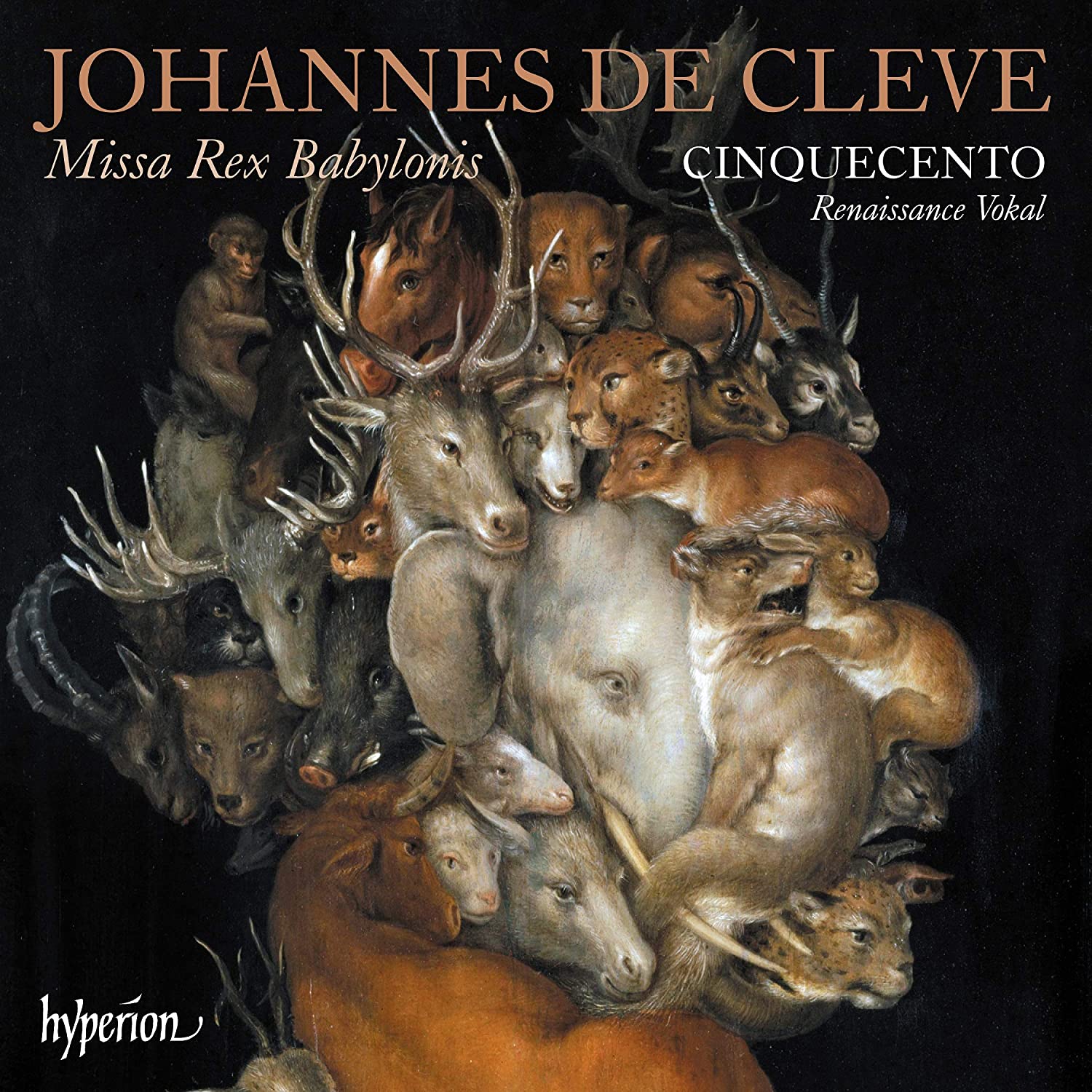
Johannes De Cleve: Missa Rex Babylonis

Cinquecento Renaissance Vokal
71:06
hyperion CDA68241

Click HERE to buy this on amazon.co.uk

Johannes de Cleve (1528/9-1582), while an almost exact contemporary of Palestrina, composed in a recognisably Franco-Flemish style, with its debt to Gombert and, earlier still, Josquin, while there are a few audible nods towards Italy. Originating from modern-day Kleve, the same neck of the woods as Henry VIII’s fourth wife, on the borders of modern Germany and the Netherlands, it is assumed that he was trained in the Low Countries before, in 1553, fetching up in Vienna and having his first book of compositions published in Antwerp. Their almost exact contemporary, the definitely Flemish Jakob Vaet (pronounced “vart”), born in what is now Kortrijk, also fetched up in Vienna, and provides the motet on which Cleve bases his mass. While Vaet is relatively well represented on disc, thanks in no small part to Cinquecento, Cleve is a virtual newcomer. Does his music deserve this extended recognition?

There is no getting away from the fact that Call-me-Vart is the better composer, for all his limited appearance on this disc. His motet lasts over nine minutes, and its sweeping musical narrative puts Cleve into perspective. In Cleve’s mass, there is a lack of subtlety in his use of salient features from Vaet’s motet which suggests that originality is in short supply. There is some stilted homophonic writing in the first section of Carole qui veniens just before some rather by-numbers syncopation, though there is compensation in a striking chromatic passage during the second section. That said, most of his works possess some good moments. His use of dissonance which, like his chromaticism, is touted in most commentaries about him, shows its head assertively in both settings of the Agnus in the Mass. The same animated and affecting Hosanna concludes the Sanctus and Benedictus. And there is some mellifluous polyphony in the Kyrie.

Recently for this journal, I reviewed a disc, sung by the Brabant Ensemble, of music by members of the Franco-Flemish wolf pack, Lupus Hellinck and Johannes Lupi (Hyperion CDA68304). Born three decades before Cleve, there are aspects of their music – fluency, spontaneity, originality, breadth and independence of creative thought – which make it superior to his agreeable competence. As for the performance, Cinquecento produce a rather thick texture and, as a male ensemble albeit with a falsettist, tend to gravitate to lower in the vocal range than a choir such as the Brabant Ensemble, which includes females, and whose renditions are a tad (very acceptably) rougher but whose vocal textures tend to be brighter. As I remarked in my recent review of Cinquecento’s recording of the second book of Palestrina’s Lamentations (Hyperion CDA68284), this rendered them perfect exponents for this more intense and static music, but it can lead to some monotony especially when applied to a composer such as Cleve.

Cleve’s well-wrought dissonances and chromaticisms, within his competent yet still conservative technique, earn him this revival by a major ensemble on a major label. Other composers tell a better story over the piece, but even a lesser composer within the Franco-Flemish School, albeit right at the end of its span, is better than a lesser composer from most other such circles.

Richard Turbet

Categories
Recording

O gemma clairissima

Music in praise of St Catharine
The Choirs of St Catharine’s College Cambridge, Edward Wickham
72:02
resonus RES10246
Music by Fawkyner, Frye, Gombert, Jacquet of Mantua, Mouton, Palestrina, Regnart, Senfl, Vermont, Willaert, anon + sarum chant

Click HERE to buy this CD on amazon.co.uk

The combined forces of St Catharine’s College and Girls’ Choirs are directed by Edward Wickham in this recital of hymns, motets and chants devoted to the martyr St Catharine, after whom both the Catherine Wheel and the Cambridge College are named. The elaborate and gruesome means of Catharine’s martyrdom captured the Medieval imagination, and Renaissance and Medieval settings of texts relating to the saint abound. The choirs sing relevant plainchant and polyphony by Regnart, Senfl, Willaert, Mouton, Frye, Gombert and Palestrina as well as by the less familiar Pierre Vermont, Jacquet de Mantua and Richard Fawkyner. The singing is generally nice and expressive, although there is a slight ‘herd ethic’ resulting perhaps from the combination of the two choirs. The particular demands of Walter Frye’s Kyrie ‘Deus Creator omnium’ and the Eton Choirbook intricacy of Fawkyner’s ‘Gaude rosa sine spinas’ (a 15-minute choral tour de force) inspire some of the finest singing on the CD. The Girls’ Choir also makes some lovely contributions on their own, while the combined voices generally produce a consistently full expressive sound. Edward Wickham’s intelligent direction brings out the full nuances of this largely unfamiliar music, while his wonderfully knowledgeable programme note both entertains and informs.

D. James Ross

Categories
Recording

Passio Iberica

García Fajer: The Seven Last Words of Christ; dos Santos: Stabat mater
Divino Sospiro, Massimo Mazzeo
65:21
Pan Classics PC 10401

This revelatory CD presents music for Holy Week by two largely unknown 18th-century Iberian composers, Francisco Javier García Fajer and José Joaquim dos Santos. García Fajer’s setting of a Castilian text contemplating the seven last words of Christ on the cross, was written in the wake of and under the influence Haydn’s famous setting of the Seven Last Words of 1792, commissioned by the Brotherhood of Nuestra Señora de la Cueva of Cadiz. García Fajer writes for two soprano voices with strings, and the seven sections all running to just about three minutes each are wonderfully evocative and melodic. He trained in Italy, at the prestigious Conservatorio della Pietà dei Turchini, before embarking on a career which saw him compose operas and oratorios and enjoy considerable success. For the last four decades of his life, he returned to Saragossa Cathedral, where he devoted himself exclusively to composing sacred music. While much of the music in his Siete Palabras is recognisably in the classical Viennese tradition, some of the more contemplative sections are distinctively Iberian and very atmospheric. The Stabat Mater by the Portuguese composer José Joaquim dos Santos for two sopranos, bass and strings of 1792 is also heavily Iberian in style, although it also owes a considerable debt to earlier settings such as that by Pergolesi. Dos Santos never studied in Italy but had close contacts with many musicians who had and was clearly well versed in the Italian idiom. The singing by Bárbara Barradas, Lucia Napoli and André Baleiro and the playing by Divino Sospiro of this unusual and distinctive music is of a high quality, and the recording both gives a context to Haydn’s unusual instrumental Seven Last Words as well as filling in an Iberian dimension to sacred music at the end of the 18th century.

D. James Ross

Categories
Recording

The secret life of carols

800 Years of Christmas Music
the telling
51:17
First Hand Records FHR94

Click HERE to buy this CD on amazon.co.uk

This selection of Christmas carols is gleaned from the 12th to the 20th centuries, sharing a sort of folk music quality, which suits the performance style of The Telling. Playing and singing in groups of at most three and sometimes solo, the two voices and two harps are at their best at their simplest. On the odd occasion, like track 3 “O Jesulein Süß”, when the two voices combine in harmony, the blend is less than comfortable, although each sounds fine in solo verses. The geographical range of the music seems neatly to match the cultural heritages of the performers, so we have mainly English, Irish, German and Finnish carols. I would have liked some more details about the medieval, baroque and ‘celtic’ harps played by Jean Kelly and Kaisa Pulkkinen, as well more information on the approach to the instrumental accompaniments – the iconic Gruber setting of “Stille Nacht” has a perfectly good accompaniment for guitar, but the accompaniment here on ‘celtic’ harp seems to be largely improvised. The stylistic range of the carols The Telling have chosen demands a considerable degree of versatility in performance, and I would confess that I don’t think they are equally effective with all the material – I think the medieval material seems best suited to the voices particularly. Reading their group CV, I think that their live performances usually include a dramatic dimension, and perhaps their recordings suffer a little by being deprived of this.

D. James Ross

Categories
Recording

Graupner: Das Leiden Jesu

Passion Cantatas III
Ex Tempore, Mannheimer Hofkapelle, Florian Heyerick
69:27
cpo 555 230-2
GWV 1119/41, 1124/41, 1126/41

Click HERE to buy this on amazon.co.uk

This is the third instalment of a series of selected Eastertide cantatas by Christoph Graupner to appear on CPO, based on the refined texts of the pastor, theologian, polymath Johann Conrad Lichtenburg (1689-1751) who besides interests in philosophy, mathematics, astronomy and architecture, was a very gifted religious poet – librettist, who wrote some 35 annual cycles, I. e., over 1500 sacred texts! He studied at Leipzig and Halle, the latter a bastion of pietism, which took hold in Germany in middle of the 18th century. Of the 1400 extant Graupner cantatas, some 1190 are from the most able quill of J. C. Lichtenburg; obviously a fruitful collaboration was at work! These cantatas from the 1741 cycle described as “Betrachtungen” (contemplations/reflections) on the circumstances surrounding the “Versöhnungsleiden” redemptive/propitiatory sufferings of our Saviour. The definition used here for “Reflections” shows alert respect for the prevailing Passion-oratorio format, and feels equally influenced by the text of B.H.Brockes’ Passion-oratorio set by many composers of the age; there are also hints of the other famous theologian, librettist, pastor Erdmann Neumeister (1671-1756) who had previously helped shape the incipient cantata for.

The CD opens with the work for the last Sunday (Estomihi) before Passiontide itself, with some strikingly original strokes of declamatory expression, more akin to an actual Passion’s chorale workings than a mere cantata. Some very bold, original writing, one might say in a hybrid style?

Not only are the thematic details well-observed with pertinent word-painting, but the attention to deftly applied instrumental colours depicting each of the subsequent tableaux, is most befitting, from two oboes, strings* and continuo in GWV1119/41, next we have flute, two oboes, bassoon and strings in GWV1124/41, and finally flute, three oboes and strings in GWV1126/41; the oboes are richly sonorous and plaintive.

At turns these works feel conventional, then surprise with clever twists, almost in a casual, experimental way, yet never straying far from elegiac or edifying. The chorales deserve a special mention, coming across as beautifully woven final flourishes; as with the famous last one on the CD (O Lamm Gottes, unschuldig am Stamm des Kreuzes geschlachtet). With more explorations of Graupner’s cantatas, we are beginning to see why he was indeed a worthy choice for the Leipzig post in 1722, and why his employer, the Landgraf of Hessen-Darmstadt, wanted to hold onto him. Florian Heyerick is a very alert and sensitive conductor, bringing the very best out of his choral and instrumental forces; the sopranos and basses seemed to me to really shine and excel.

This is a warmly recommended, third instalment of the Graupner/Lichtenburg cycle for Easter 1741 with some noteworthy additions to the Passiontide repertoire.

David Bellinger

(*Graupner specifies “Violette”, possibly a smaller member of the viola family; the Mannheimer Hofkapelle use violas)

NOTE: Apologies to the performers, the record company and the reviewer; this somehow fell through the cracks and is being published A YEAR LATE! Keen fans of Graupner may already have the 4th instalment in the series, since cpo released that to coincide with Easter 2020!