Categories
Festival-conference

The Lammermuir Festival comes of age

D James Ross at the 10th Lammermuir Festival 2019

{ Click here to download an eight-page PDF of this review }

One glance at the brochure for the 2019 Lammermuir Festival revealed that the organisers had really pushed the boat out for their tenth anniversary. At the heart of this ambitious programme were concert sequences by three internationally renowned ensembles, the Quatuor Mosaïques, Vox Luminis and the Dunedin Consort. It is two years since the Quatuor Mosaïques delighted the Lammermuir audience with revelatory accounts on period instruments of the music of classical Vienna, and their very welcome return opened the current Festival with performances of Haydn and Beethoven in the exquisite St Mary’s Parish Church, Whitekirk. The Festival prides itself in the innovative matching of venues and performers, and this 15th-century jewel of a building proved the perfect home for the Quatuor. Appropriately for a beautifully sunny day, the programme opened with a sparkling account of Haydn’s op 64/6. Composed towards the end of the composer’s period of employment with the Esterházy family, this is a work of classical perfection with an overlay of virtuosic writing for the first violin and some witty episodes of rusticity, recalling the eastern European folk playing Haydn must have heard all around him. With Viennese blood coursing through their veins, the Quatuor inhabit Haydn’s music with a definitive authenticity, revelling in the master’s quirky writing and eloquent idiom. The decision to employ gut strings seems to alter the dynamics within the ensemble, leading to a much more democratic sound, from which the first violin is allowed to emerge by dint of Haydn’s cunning use of the upper range – how his colleague, the Hungarian virtuoso violinist Johann Tost, would have relished these moments in the sun! Erich Höbarth’s easy virtuosity gave us an inkling of why these op 64 quartets caused such a stir in London during Haydn’s first visit there in 1791.

Six years later, Haydn composed his op 76 Quartets, and the Quatuor gave us the fourth of these, called the Sunrise. The sheer elegance of this work by perhaps the greatest ever composer of string quartets was captured beautifully by the Mosaïques, whose rich sustained playing contrasted perfectly with episodes of sparkling wit and inspiration. Just as the op 76 Quartets are perhaps the most complete contribution made to the genre, this group seems to offer the complete package in performing them: utter integrity, technical assurance, considered authenticity, towering musicality and that x-factor of Viennese spirit!

The concert concluded with the first of Beethoven’s Razumovsky Quartets, composed in 1806 and marking a radical departure in the genre from the 36-year-old composer. The first of the set is a wonderfully lyrical and eloquent piece, and the Quatuor seemed to find a new intensity in their playing to express this new sound-world. Particularly impressive in this account were the two inner movements, the ironic Allegretto, where Haydnesque wit tipped occasionally into Beethovenian rage, and the sublimely sad Adagio, which the Quatuor imbued with an almost unbearable intensity. This opening recital in the Quatuor’s series of three seemed to set a standard it would be very hard to match.

The opening day of the Festival ended in spectacular style in St Mary’s Parish Church Haddington and the Dunedin Consort, fresh from a triumphant visit to the Proms. ‘Parish Church’ hardly seems an adequate epithet for Haddington’s magnificent 14th-century Collegiate Church, an establishment built for music and where the acoustic seems to be an active participant in every performance. Under the direction of John Butt, the Dunedins opened their four-concert series with a programme comprising two of Bach’s Brandenburg Concertos, two of his Orchestral Suites and two violin concertos by Vivaldi. The stunning soloist in the Vivaldi and the First Brandenburg, as well as being in many ways the soul of this remarkable ensemble, was its leader, Cecilia Bernardini. It seems that every note she plays is from the heart, and her stunning virtuosity seems just another way of her exploring the truth behind the music she plays. It is this intense musicality and desire to explore every aspect of the music they are playing which seems to possess this ensemble whenever they perform. An exquisitely phrased account of the first Orchestral Suite proved a stunning curtain-raiser, with some spectacular contributions from the group’s wind section of oboes and bassoon. Vivaldi’s less familiar op 8/6 Il Piacere proved an absolute delight.

The first half ended in spectacular style with Bach’s first Brandenburg. It would be nice if this work were the first orchestral use of the horn, although of course it isn’t. They sound as if they have been kidnapped from the darkest German woods, still braying their hunting calls and never quite integrated into the orchestral texture! The playing of Anneke Scott and Joe Walters, horns held spectacularly aloft, underlined the untamed nature of the Baroque horn, although they made the hair-raising practicalities of playing the valveless instrument without hand-stopping look effortless. This was a wonderfully vivid account of Bach’s first Brandenburg, and boded well for the complete set, which we would be hearing over the rest of the Festival.

The strings were allowed to shine in the second half, which opened with Bach’s beautifully compact third Brandenburg, whose imaginative opening movement and scampering concluding Allegro were linked by a heartfelt cadenza from Bernardini. The ‘Summer’ concerto from Vivaldi’s Four Seasons seemed to be extra Italianate in a sunny performance by the Dunedins, in which the fiery Presto episodes sizzled with energy. For the concluding account of Bach’s second Orchestral Suite, the Dunedins were joined by flautist Katy Bircher, whose warm tone and flawless virtuosity added a gleaming festive quality to some of Bach’s most joyous music.

The Lammermuir Festival are privileged to be allowed access to Lennoxlove Castle the home of the Duke of Hamilton, and in this special anniversary year they found to my mind the perfect synthesis of venue and performers for a charming morning recital. Surrounded by the finest of Scottish art, recorder player Tabea Debus and her ensemble seemed to thrive in the baronial magnificence of Lennoxlove’s 14th-century barrel-vaulted Great Hall. The sounds of recorder, viol, guitar and theorbo seemed utterly at home here, and the group’s Ode to an Earworm programme took us from the Middle Ages to the Baroque touching on a series of cult melodies. Processing in to the haunting tones of 14th-century Lament of Tristan, Debus magically conjured up her consort for a version of the Monteverdi’s Ciaconna. Playing mainly two lovely Renaissance instruments in the first half, Debus’s beautifully even tone and eye-watering dexterity breathed life into a sequence of material, familiar and unfamiliar.

The second half opened again with Debus on her own, this time playing a modern work by Freya Waley-Cohen called Caffeine in which both composer and performer would seem to have over-indulged in this powerful stimulant – a witty and stunning performance of a very effective show-piece. Concluding with an end-stopped high C-sharp, Debus ended up standing with one leg raised like the god Pan himself! A set of flighty variations on another earworm, Daphne, by the 17th-century recorder virtuoso Jacob van Eyck were given a performance which combined technical prowess with expressive musicality, while the highlights for me of a selection of Baroque pieces played by Debus on a variety of Baroque recorders were a beautifully passionate account of Purcell’s Fairest Isle and a heart-stopping performance of Handel’s Lascia ch’io pianga, which would have made Farinelli weep. In response to a well-deserved ovation, the group gave us one last earworm, which appropriately enough various members of the audience were heard to be singing and whistling as we wandered away through the lovely Lennoxlove grounds. It is a tune known in some sources as Old Bob Morris, but it exists in a number of guises which over the years I have played and even recorded – but can I put a name to it…?

To the lovely arts and crafts style Chalmers Memorial Church in Port Seton for the second of the Quatuor Mosaïques’ concerts. Mozart had just been studying Bach’s fugues when he was inspired in 1788 to write an Adagio and Fugue. While technically saturated in the world of the Baroque master, Mozart manages to make both these movements distinctly classical in style, and being Mozart he sets himself quite a challenge with his fugue subject which he proceeds to surmount triumphantly. The Quatuor seemed particularly intent on bringing out the fugal infrastructure of the music, which they achieved emphatically without sacrificing the overall musicality of the piece. Mozart famously was less comfortable composing string quartets than many other chamber genres, but you would never guess this from the consummate mastery displayed in his Prussian Quartet K575, composed the following year. Mozart was at the height of his powers, and his renewed interest in counterpoint helped conceive a work which belies any struggle he experienced in composing it. Christophe Coin found a wonderful singing tone for the cello melodies Mozart gives him, while the group’s performance generally had a wonderful assurance and gleam about it.

The second of Beethoven’s Razumovsky Quartets is a dark piece, but the Quatuor found what light they could in a revelatory reading, which showed the work to be subtle beyond imagining. In this performance the lop-sided Allegretto, so often performed as something of a freak show, had a knowing grin on its face, while the preceding Molto Adagio never lost its hymn-like quality, even after moments of desperation. The finale, a bundle of energy, seemed more optimistic and positive than I have heard it. The group are preparing a set of recordings of these ‘middle quartets’, and it seems to me that they will shine the same revelatory spotlight on them as they have just done on the ‘late quartets’.

The Catholic Church of Our Lady of Loretto and St Michael in Musselburgh is a new venue for the Lammermuir Festival, and what a venue! Rebuilt in 1903, the apse features a spectacular set of murals depicting the five joyful mysteries of the rosary executed between 1945 and 1947 by George N Duffie. What better backdrop than gleaming, burnished gold angels for the first in a pair of concerts by the renowned Belgian choral group Vox Luminis featuring music by Palestrina and Victoria? In this mini-Sistine Chapel the choir performed Palestrina’s Missa Papae Marcelli, a work famously composed to show that polyphony and clarity of text were not mutually exclusive. As so often when composers are under pressure, they produce their finest work, and this beautiful six and seven-part setting of the Mass is one of Palestrina’s finest works in the genre. Vox Luminis directed by Lionel Meunier sing with a direct, edgy tone without vibrato, but with enormous integrity and intensity. Preceded by the magnificent Super flumina Babylonis, the Mass was sung at low pitch avoiding the uncomfortable tenor singing and intrusive soprano tone sometimes unjustifiably associated with Palestrina and providing instead a wonderfully rich texture, built on the low bass voice of which the director was one. This was a performance without extremes of tempo or fussy interpretative details, but with a magnificent flow and sweep which were irresistible. The second half was an account of Tomas Luis de Victoria’s 1605 Requiem. Victoria had trained and worked in Rome, where he probably collaborated with Palestrina, and a juxtaposition of the two men’s work was informative. Where Palestrina, the consummate contrapuntalist, produces music of supreme perfection, Victoria, an ordained priest, seems to be more interested in the ways he can use compositional devices to heighten the passion and persuasiveness of his music. Innately in tune with this aspect of Victoria’s music, Vox Luminis produced a performance of towering intensity and overwhelming passion. Victoria builds his polyphony on the relevant plainchants, which also link and introduce several polyphonic sections. I could see why the performers used measured forms of these chants rather than the more customary freer chanting style, as these dovetailed beautifully when the chant became just one of several polyphonic voices. Greeted with enthusiastic applause, the group reprised the lovely six- and seven-part Agnus Dei from the Palestrina Mass they had opened with. It was impressive that two of their singers were ‘stand-ins’ replacing performers who at the last minute were indisposed – one of them was David Lee, the author of the excellent programme notes, who as he penned them can hardly have imagined he would be singing this wonderful music!

The 15th-century Collegiate Church at Crichton was the venue for the final concert in the Quatuor Mosaïques’ fascinating series, and notwithstanding a few access issues it proved a spectacular setting. Again it was clear that this was a building constructed with music in mind, and its acoustic was beautifully resonant. In his quartet op 74/3 the Rider we find Haydn at his most affable, with a perky Allegro, which is indeed redolent of a ride in the country, and a wonderfully genial Largo, while wit and energy suffuse the Menuetto and Allegro con brio. Composed for his return visit to London in 1794, the op 71 and 74 Quartets were designed to have an immediate impact, and Erich Höbarth’s easy virtuosity and the ability of the ensemble to conjure just the right mood proved equally triumphant. It is as well that we had been soothed by Haydn’s charms, as the next item in the programme was Beethoven’s acerbic, explosive and disturbing Quartet in F minor op 95, a work which the composer himself labelled Serioso and at one point considered suppressing. This was my second op 95 in a fortnight, and if anything I found the Quatuor’s raw and biting interpretation even more disturbing. The composer was in suicidal mood and wrote music which is by turns furiously angry and serenely resigned. The Quatuor, the masters of turning the mood on a sixpence, found every nuance in this remarkable work, producing a monumental performance which clearly astonished the capacity audience. While the final Allegro, intentionally shallow and brittle, solves nothing, the audience seemed to clutch at it like a straw. How things had changed in the 17 short years between these two string quartet masterpieces!

The stage was set for the third of Beethoven’s Razumovsky Quartets, completing the cycle at the heart of these concerts. In many ways the third Razumovsky is the mosrt attractive and certainly the most popular of the three, and while it is the only one not to embody Russian themes, it has a recurring eastern European flavour which is beguiling. The group, who are planning to record these quartets soon, have clearly prepared them already to an advanced level, and communicate their sheer joy as they play them. As the opening Andante transitioned into a charming Allegro vivace a smile went round the players, and at various other moments their sheer delight in playing such original music was clear. This masterpiece of Beethoven’s middle period, written just two years before the doom-laden op 95, when the composer’s hearing was failing and his life was falling apart, couldn’t be more different from the later work. It exudes positivity, and in a wonderfully expressive account, the Quatuor Mosaïques demonstrated why they are probably the most admired period instrument quartet in the world. An ovation worthy of Glastonbury from a rapt audience elicited a calming performance of a movement from Haydn’s op 33 – how innocent and uncomplicated this sublime music from 1781 sounded!

It is useful to remember the profound effect that historically informed performances have had on mainstream modern instrument groups, and the Scottish Chamber Orchestra with their period brass and percussion and intimate grasp of classical phrasing and bowing techniques are a shining example. In a concert which included more contemporary music, their accounts of Haydn’s Symphony no 44 Trauer and Mozart’s Linz Symphony no 36 were models of classical poise and elegance. Although the use of modern strings and woodwind does create some balance issues with the period brass, the crispness of attack, the stunning sense of ensemble and the sheer musicality of this fine ensemble make their performances of this repertoire thrilling. Under the baton of Moritz Gnann, standing in for the indisposed Daniel Blendulf, the SCO were in fine fettle, mesmerising a capacity audience in Dunbar Parish Church, a building extensively remodelled in 1987 after a fire and which proved a very sympathetic venue.

For their second performance for the Lammermuir Festival, Vox Luminis appeared in the festival’s most magnificent venue, St Mary’s Parish Church Haddington. Showing their versatility, they were joined by a continuo group of organ, gamba and harp for choral music mainly from the 17th century. Appositely for the venue, their main subject was the Virgin Mary, although an outlier here was Monteverdi’s Lamento della Ninfa, with its own maiden in distress. Rather perversely the concert opened with the anonymous 13th-century Lamentation de la Vierge au pied de la Croix, a medieval work for unaccompanied solo voice exquisitely sung ‘at a distance’ in the apse. If the character of the rest of the concert proved to be very different, the theme was firmly established, and Antonio Lotti’s famous 8-part Crucifixus proceeded to pluck at our heartstrings. Its chains of plangent discords proved to be the perfect medium for an ensemble whose edgy vibratoless voices further turned the knife in the wound. More mellow was Monteverdi’s setting of Adoramus te Christe followed by his Lamento della Ninfa. The ‘backing group’ of commentating chorus and the solo soprano part were beautifully executed, although I did feel this attempt to open the theme to embrace all suffering women blurred an otherwise admirably focused programme. The first half of the concert ended with a work which I had never heard of by a composer I had also never heard of, the Lamentatio Virginis by Alessandro Della Ciaia. This extraordinary piece casts two voices as narrators, a solo soprano as the Virgin and a chorus of eight as Angels, and in a post-Monteverdian idiom with echoes of Caccini and even Gesualdo it conveys the suffering of the Virgin at the cross in such graphic and emotive music that I found tears forming in my eyes. An infrequent occurrence in a hardened performer/reviewer, my reaction is a testimony to the originality of this unique piece and the power and intensity of Vox Luminis’ performance. The concert was brought to an appropriately hard-hitting conclusion with a stunning performance of the ten-part Stabat Mater by Domenico Scarlatti, another work of enormous emotional and rhetorical power. Vox Luminis have an uncanny ability to maximize the intensity of the sound they are producing to create an almost unbearably overwhelming effect, making high-points in this Baroque repertoire deeply effective. The superbly sensitive continuo group were also a huge contributory factor in the success of the concert. Something which struck me only after the concert was over, was that the singers made minimal use of ornamentation, such as one might have expected in repertoire of this period – the fact that I didn’t even notice until after they had finished shows that their performances didn’t really need decoration of this kind. A calming five-part setting of Christe, adoramus Te by Monteverdi sent us out into a balmy Haddington night.

The third of the Dunedin Consort’s Brandenburg Concertos series brought us all to Prestongrange Church in Prestonpans, a rather sombre Presbyterian building with however a fine acoustic and whose unadorned windows let in the bright afternoon sunshine. The concert contrasted two of Handel’s op 6 Concerti Grossi with two Vivaldi concerti and Bach’s Fifth Brandenburg. While the fourth of Handel’s op 6 is a charming orchestral piece, the eleventh is a true concerto grosso with contrasting ripieno and concertino ensembles. The latter soloists chirp and twitter in imitation of birdsong evoking the Spring concerto of Vivaldi’s Four Seasons, which was played with lovely spontaneous ornamentation by Cecilia Bernardini. The decision to invite the group’s principal oboist Alexandra Bellamy to play Vivaldi’s op 8/12 was an inspired one – in c-major, the piece seemed to lie under her fingers, and the lovely rich tone of her Baroque oboe contrasted beautifully with the string ensemble. This fine concert concluded with Bach’s Fifth Brandenburg, a piece which like the First Concerto relied on the solo virtuosity of Cecilia Bernardini, this time in combination with Katy Bircher’s mellow Baroque flute playing and the harpsichord skills of John Butt. Essentially the earliest concerto to feature a solo keyboard instrument, Bach’s concerto sets the bar very high with blizzards of scales and arpeggios which demonstrated his own stunning keyboard virtuosity and spotlighted John Butt’s own remarkable keyboard prowess. The context in which the Dunedins have been placing Bach’s Brandenburgs as well as their novel insights into the works’ nuances and distinctive features have meant that a series which appeared to offer mainstream classic repertoire has been consistently thought-provoking and utterly revelatory.

While the chief joy of the Lammermuir Festival for me is the plethora of superb historically informed performances, many other concerts offer contemporary music, orchestral classics – indeed just about every other genre of music. I attended a beautifully executed account of Schubert’s Lieder cycle Die schöne Müllerin, or rather The Fair Maid of the Mill as it was sung in English by the legendary baritone Roderick Williams accompanied by Christopher Glynn – again an established classic but with a new spotlight shone on it. Cheek by jowl with a major new work by Stuart Macrae, the Prometheus Symphony, a work commissioned jointly by Radio 3 and the Lammermuir Festival, we enjoyed a truly stirring performance by the BBCSSO string section directed by Matthew Halls of Vaughan Williams’ Tallis Fantasia. Exploiting the lavish acoustic of St Mary’s Haddington, with the second orchestral group placed authentically towards the apse with the main ensemble and soloists in the cross, this masterpiece was allowed to blossom as its composer originally intended.

What better way to open the final concert of the Dunedin Consort’s Bach series, and indeed the final concert of the 2019 Lammermuir Festival, than Bach’s flamboyant Second Brandenburg Concerto. With its colourful line-up of soloists – treble recorder, oboe, violin and trumpet – the work extends the spectrum of timbres the composer has to play with, and of course the use of period instruments and historically informed performance practice causes apparent issues of balance simply to melt away. Trumpeter David Blackadder has arguably he most challenging job realising Bach’s intricate clarino writing on a valveless Baroque trumpet, but his performance was beautifully detailed and all exercised in a gleaming rounded tone. The recorder soloist László Rózsa managed to project his sound beautifully to emerge from the texture, while the ever excellent Cecilia Bernardini and Alexandra Bellamy completed a stellar concertino group in St Mary’s Haddington, which fairly rang to the tone of the period instruments.

The programme proceeded with another of the op 8 violin concertos of Vivaldi, no 10 La Caccia, a work invoking the sounds of the hunt and a cousin to Autumn in the Four Seasons. There was a little raggedness at the start of this charming piece and a couple of ‘rabbit in headlights’ moments later, perhaps understandable in the last in a series of such demandingly packed programmes. Handel’s urbane op 6 concertos have contributed heavily to the series, and now we heard no 10 which was played with a confident sweep within which every detail was audible. Vivaldi’s violin concerto op 8/11 brought the first half of this concert to a virtuosic conclusion. The remarkable Cecilia Bernardini, who in the course of the series had been the single or joint soloist in every single piece apart from the two oboe concertos, was as impressive here as she would be in Winter from the Four Seasons, which we would hear in the second half.

The second half opened with Handel’s op 6/9, a work in which the composer is at his most genial. The work features a magnificent hymn-like Larghetto and concludes with a wonderfully skipping Gigue – you can’t avoid the impression that the composer is working very hard to sound English here. A further contribution from the Consort’s principle oboist Allexandra Bellamy in the form of a charming account of Vivald’s op 8/9 proved technically challenging, but she brought the work to a convincing conclusion. The concert ended as it had started with the sparkling virtuosity of a Brandenburg Concerto, the Fourth with its nimble pair of treble recorders played by László Rózsa and the group’s flautist, Katy Bircher, whose flute playing had mesmerised us earlier in the week, and the ubiquitous Cecilia Bernardini. In this concerto Bach gives the violin cascading scales of notes in the manner of an early Baroque cornetto part.

It is fitting that we took leave of this tenth Lammermuir Festival with the sounds of Baroque instruments ringing around Haddington Collegiate Church, yet another wonderful coincidence of music and venue and a fulfilment of the Festival’s mission to combine beautiful music with beautiful places. Perhaps more importantly this was a festival replete with the very finest in historically informed performances, making it now the leading festival of this kind in Scotland today, and indeed now of European significance. Although the early music strand is just one of many which run through this remarkably eclectic festival, James Waters and Hugh Macdonald, the inspiring genius and driving force behind the Lammermuir Festival, continue to do a remarkable job in spotting ensembles which will enhance and enrich their programme and delight their audiences. Due to their efforts and those of a dedicated army of volunteers, the Lammermuir Festival has established itself at the top table of international music festivals, and we look forward with eager anticipation to its second decade.

Categories
Recording

Diderot: The Paris and London Albums

The Paris Album
Ensemble Diderot
65:13
ADX 13717

The London Album
Ensemble Diderot
66:10
ADX 13718

Many readers will own and still enjoy the three London Baroque recordings from ca. 2005 that explored the development of the trio sonata in England, France and Germany. They ranged widely (the English repertoire went back to Gibbons), an approach which these new releases (a Dresden-themed disc is already available) complement by focussing on the later 17th century. There is only one repertoire overlap with LB – Rebel’s Tombeau de Monsieur de Lully–- and four world premiere recordings are claimed on each disc, all of them strong pieces. Keller’s Ciaconna in G major in the London programme particularly impressed me, not least because of its unusual bass line which naturally broadens the harmonic potential of the work.

That same disc also includes three sonatas by Purcell, all very fine but also already much-recorded. Was there no other suitable repertoire of quality? It’s hard to believe that, for example, Draghi’s excellent work was just a flash in the pan. The Paris programme resists the pull of the biggest name (just one sonata by François Couperin) but does give us two pieces by Brossard (whom we perhaps think of as a man who wrote words rather than notes) which are consistently engaging, especially when the bass viol is liberated from its continuo role to become an obbligato voice in the tenor register, a device also used by Blow in London.

I do applaud the ensemble’s straightforward approach to instrumentation – the two violins on the upper parts and just a harpsichord for the continuo realisation. The bass line enjoys the finesse of a gamba in the French programme and bass violin/cello in London but would an appearance by the gamba and perhaps a chamber organ in that programme have been appropriate? The actual playing is terrific – fantastic ensemble even at high speed and excellent tuning. There are a few flourishes from the harpsichord which felt a bit 18th century but that won’t stop me splashing the stars, not least because the booklet notes are for once decently written, decently translated and useful!

David Hansell

[Editorial note: In the early days of the online version of EMR, we allocated stars to recordings so that reviewers could be clearer about where they had found virtue and where they had found it wanting. (It also gave lazy readers a quick and easy way to decide if they wanted to buy it or not!) David rarely gave five stars in any category to any recording; for these two, he awarded the full quota across the board, so while he didn’t explicitly say so, I think you could say these two disc really excited him.]

Categories
Sheet music

Mozart & Haydn from Henle

Mozart: String Quartets Vol. 3 (performing materials)
Henle 1122 €32
Mozart: String Quartets Vol. 3 (study score) Edited by Wolf-Dieter Seiffert
Henle 7122 €22 [Also available for tablet]
Mozart: Piano Trio K. 442 (performing materials) Edited by Wolf-Dieter Seiffert with Piano fingerings by Jacob Leuschner
Henle 1379 €29.50
Haydn: Symphony in C, Hob I:82 (study score) Edited by Sonja Gerlach & Klaus Lippe with a preface by Ullrich Scheideler
Henle 9050 €13 [Also available for tablet]

Any new issues from G. Henle Verlag are to be welcomed. The latest consignment paired Urtext study scores of Mozart’s celebrated “Haydn” quartets with a set of performing materials (of which the Violin 1 part includes the prefaratory material and critical commentaries that enhance the score!), a piano trio consisting of not one but two completions of three fragments – the first by the composer’s friend, Maximilian Stadler, and the other by celebrated Mozart expert, Robert Levin – as well as the movement Stadler added to make a more balanced work (after discarding one of Mozart’s!), and finally another Urtext study score, this time of Haydn’s C major symphony, “The Bear”.

It goes without saying that the printing is beautiful and the paper of the highest quality. The typography is also exemplary, both in the detailed introductions and critical commentaries (in three languages!) and the music itself. Outstanding work at unbelievably reasonable prices!

Brian Clark

Categories
Recording

Er heißet Wunderbar!

Barokkanerne, directed by Alfredo Bernardini
67:38
LAWO LWC1169

This is a beautiful CD combining cantatas by three of the candidates for the vacant Thomascantorate with a concerto by a fourth. The one-to-a-part singing lifts the music by Fasch and Graupner to a whole new level when compared to performances by choirs who have hitherto been the only ones to champion the repertoire, especially with four such skilled singers in fine voice and instrumental partners whose lightness of touch elevates the sound even more. Cecilia Bernardini’s rendition of Telemann’s little-played Concerto in E minor with two obbligato oboes is very impressive – I swear she must use olive oil on her bow rather than resin, so even and effortless do the pyrotechnics for both hands sound (rather like a swan, serenely gliding by frantically paddling out of sight!) “Schwingt freudig euch empor” is one of my favourite Bach cantatas and this performance is right up there amongst the best I have heard.

All the more frustrating therefore to read “For who has heard of Graupner, or of Fasch, and do we in hindsight really take the nimble multi-arted Telemann all that seriously?” in the booklet notes. Such opinions are fine, but actually printing them in a booklet like this undermines years and years of work to restore these composers’ reputations even to public notice at all. And even if the note writer doesn’t have much respect, Herr Bach most certainly did, so perhaps there’s a lesson to be learned there.

And then there is “The [Fasch] cantata’s brevity (perhaps a world record here) may suggest that the performances in Zerbst were not a significant part of the service”… First, the piece in question survives in a secondary source so who is to know what had happened to it in transmission? Secondly, a letter Fasch wrote in 1752 reveals that he had been told that music was taking up too much of the services so he had to halve the length of the figural music – and in those days you did as you were told. Besides, on a major church feast, the service also included a Missa brevis with Credo, so pretty much the equivalent of three cantatas in one sitting. Not to mention a Te Deum with “unter Paucken und Trompeten”. A little knowledge is, indeed, a dangerous thing – maybe someone who actually knows about the music might be asked to contribute their next booklet essay.

Brian Clark

Categories
Recording

J. S. Bach: Sonatas for Viola [da Gamba] and Harpsichord

Antoine Tamestit viola & Masato Suzuki harpsichord
Arrangements of BWV 1027-9, and BWV 5iii

Peter Wollny writes the liner notes to these arrangements for viola and harpsichord to make the case for rearranging gamba music for the viola, Bach’s known preferred instrument for ensemble playing. But, apart from the obvious similarities in tessitura and the fun to be had playing the gamba parts on the viola if that is your instrument, there are not many convincing arguments. We can indeed imagine JSB picking up his viola and playing one of these pieces to improve his children’s keyboard skills, but . . . 

One of the casualties of these kinds of arrangement which is perhaps most obvious in the G major BWV 1027 sonata is that the tones of the viola are so luscious that the right hand of the harpsichord – recorded rather more reticently – doesn’t really stand a chance against the viola. This is not a true marriage of equal tones, as it is on a thinner-toned viola da gamba, nor does Tamestit on the ‘Mahler’ Stradivarius of 1672 he was loaned for this recording really display much HIP awareness. It isn’t just the rubati and the fulsome tone: it’s those little give-away tricks like swelling through long notes and giving us a concernedly subservient tone for the ‘less important’ counter-subjects.

The tenor aria BWV 5iii is one of the few that is likely to have a viola obligato; though no instrument is specified the part is written in the alto clef. But however much this is a true trio sonata, the right hand of the harpsichord only becomes a true partner for a few bars at the start of the middle section from bar 69 onwards.

They are both fine players, but not well matched here. They play at A=415, but there is no information on matters like temperament. Viola players may be glad to hear these plausible arrangements, but many listeners will think that Bach’s music is best served by his chosen scoring.

David Stancliffe


Categories
Recording

J. S. Bach: Wo soll ich fliehen hin

cellini consort
65:44
Ramée RAM1911

For the most part, these transcriptions for three viols are reworkings of keyboard pieces and so are going in ‘a direction which is consciously the opposite of what was typical for Bach as an arranger’. The expert players, based in Switzerland, note that ‘many of Bach’s viola da gamba pieces are in fact rearrangements of his own works.’

They are mindful of the fact that at Weimar Bach wrote extensively for low concertante instruments, and the fugal writing of e. g. the Fantasia and Fugue BWV 905, the organ trio on Nun komm, der Heiden Heiland BWV 660 and the eponymous Wo soll ich fliehen hin (BWV 646) suits the low pitch and sonorous clarity of the viols really well. I was frequently reminded of my favourite version of the Art of Fugue by Fretwork. I find these versions more plausible than for example the Italian Concerto.

What cannot be faulted is the technical and musical skills of the three players, Tore Eketorp, Brian Franklin and Thomas Goetschel. This CD is another example of how Bach can be played in a great variety of ways on many combinations of instruments. No-one who knows the way English chamber music developed from Orlando Gibbons through to Purcell will regret hearing these dedicated players enjoying appropriating Bach’s keyboard music for their own education and enjoyment. The recording is first class and the result is a delight.

David Stancliffe

Categories
Recording

Bach: Cello Suites

Rachel Podger violin
127:38 (2 CDs in a card triptych)
Channel Classics CCS SA 41119

The able and delightful Rachel Podger has recorded the six Cello Suites with a dancing fluency and an ease of manner which meant that never for a moment did I question her appropriation of this set of dance suites for the violin.

She describes how she grew up with them as part of her aural landscape, and had never entirely appreciated those classic performances we used to hear until she heard a performance on a Baroque ‘cello with its lighter bow. And began to appreciate that they were sets of dances. Later, when coaching cello players, she often found herself playing along with them. And then one day she decided to borrow them and play them properly, and has never regretted it. Nor do I: they sound fresh and light as the higher pitch and smaller instrument aids her characteristic fluency. She had wondered, she says, about the Sarabandes – would they have enough weight? I found them perfectly acceptable in this medium, and think that these performances are bewitching. Bach was an inveterate borrower and arranger of his own works, and – like Rachel – I can’t see anything wrong when (except for the Sixth Suite) they fit so perfectly.

She plays them, as you would expect from the tuning of a violin with G as the bottom note, up an octave and a fifth, which works perfectly for the first five. But what to do about the Sixth, written for a 5 string ‘cello? After various experiments with five-stringed viola and violin, she settled for playing it up an octave on her own violin, and getting her recording engineers to piece in the lower passages played on her viola. I cannot tell any break in the seamless result.

You may not approve, but I think they are splendid, and have listened to them a lot.

David Stancliffe

Categories
Recording

Opus 1 – Dandrieu, Corelli

Le Consort
61:45
Alpha Classics Alpha 542

If, like me, you’ve only ever heard keyboard music by Jean-François Dandrieu, you are in for a treat – especially if you are a fan of the baroque trio sonata! Le Consort (2 violins, viola da gamba, cello and keyboard) play all six of his op. 1 (hence the CD’s title), alongside three trios by Corelli (op. 2/8 & 12, op. 4/1) and an instrumental version of the French composer’s “La Corelli”.

Published almost 20 years before Couperin’s Les goûts ré-unis, Dandrieu’s trios are so Italianate that honestly, if I didn’t know the Corelli pieces from two years of keyboard harmony classes at university, I should have had trouble knowing who wrote what. Walking bass lines, chains of suspensions, clever counterpoint – they are all here in abundance, but they are not mere imitation; rather, it is as if Dandrieu has turned off his “Frenchness”, preferring to simplify the range of harmonies in order to achieve Corellian “perfection”, and it is quite wonderful to listen to. (Geek alert!)

The five players of Le Consort produce a lush sound – suave violins with lithe bow work and a sensuous approach to dissonance, supported by an unobtrusive continuo team whose string players drive the music forward as required. The recorded sound is first class (as you’d expect from Alpha!). Essentially there is absolutely no reason why you wouldn’t want this fabulous disc in your collection.

Brian Clark

Categories
Recording

Sonatas for two violins

Johannes Pramsohler, Roldán Bernabé
63:04
Audax Records ADX13714
Guignon, Guillemain, Leclair & Mangean

Any new release on the Audax label is going to be more than worth hearing – the level of performance and recording engineering are astonishing. For this recent recording, the two violinists of the “house band” (Ensemble Diderot) enjoyed some continuo-free time in a programme of frankly daunting duet sonatas. The “usual suspects” are there – Leclair (op 12/6), Guillemain (op 4/2) and Guignon (Les sauvages et La Furstemberg, a worled premiere recording, and his Folies d’Espagne), as well as the little-known Etienne Mangean (op 3/6, also a first outing on CD). Pramsohler and Bernabé are perfectly matched – for proof, listen to Track 13, where the bow strokes of their détaché chords sound as if they’re played by the same person, then marvel as they toss phrases back and forth, swapping roles absolutely effortlessly. Of course, it is anything but effortless – these guys must have invested hours, practising this until they agreed on how each passage should be and then there’s the remarkable feat of pulling off such captivating performances. This is a disc I have enjoyed for months and am only now able to put into words how gorgeous it all is! If you haven’t already acquired it, or you worried that a whole disc of duets might not be your thing, please do your ears and soul a favour…

Brian Clark

Categories
Recording

Theile: Seelen-Music

Sacred Concertos
Dorothee Mields, Hamburger Ratsmusik, Simone Eckert
68:35
cpo 555 132-2

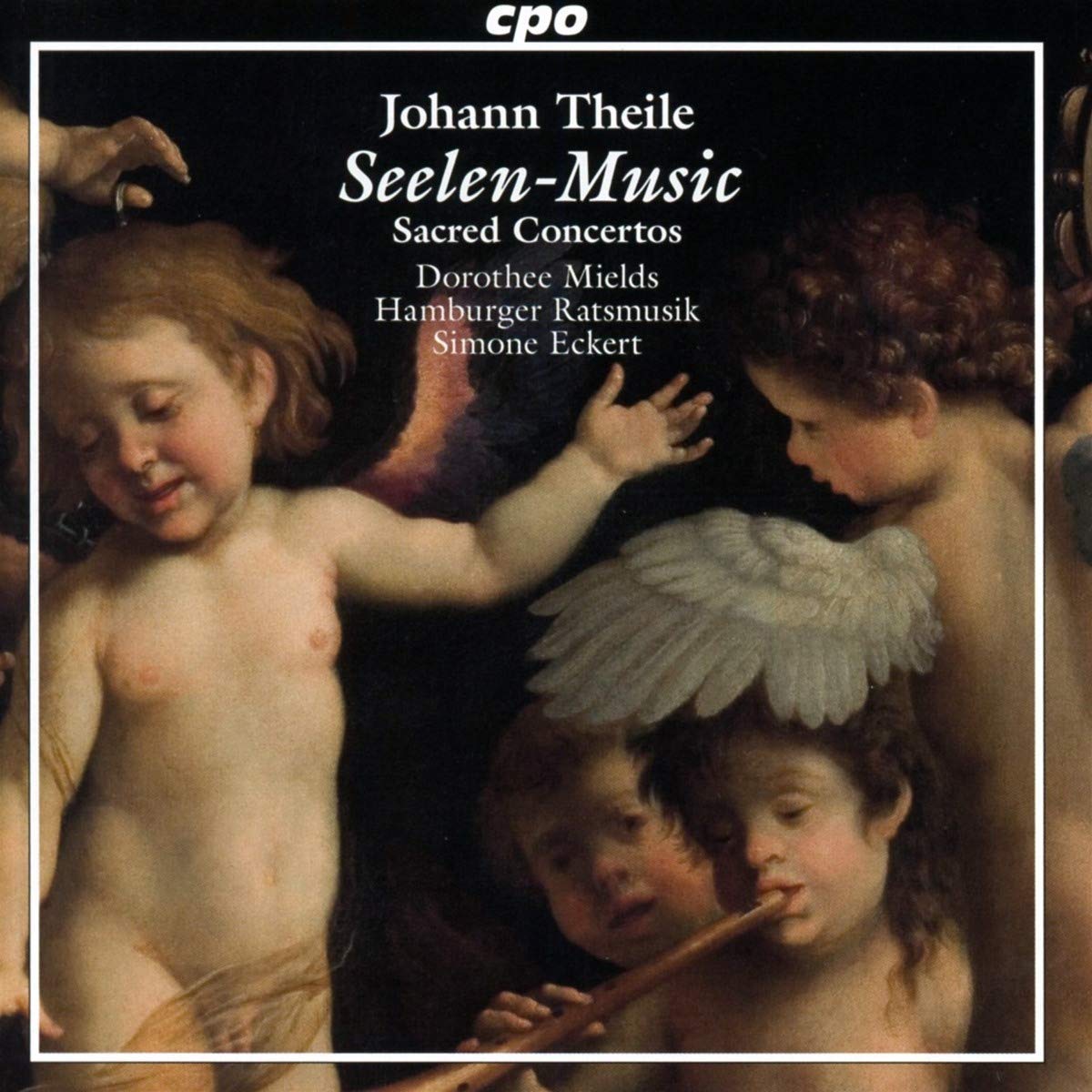
There is more to this disc than meets the eye; for a start, half of the music is not by Theile! There are two substantial vocal pieces by the rather more obscure Christian Flor (1626-97), as well as three four-part instrumental suites by the (to me, at least!) totally unknown Gregor Zuber (c. 1610->73).

The five gamba players of Hamburger Ratsmusik are complemented by theorbo and keyboard continuo. They produce a bright consort sound, each of the lines clearly (though not artificially so!) delineated. I was reminded at various points of William Lawes and John Jenkins. The singing is gorgeous – no-one who visits the site very often will be surprised, as Dorothee Mields (certainly in this repertoire) can do no wrong; crystal clear pronunciation, delicate phrasing and shaping of individual notes. In short, the ideal performer for this music which drew even a heathen like me into its soul. I imagine gamba players will be familiar with Zuber’s suites – if they are not, they should seek them out. Christian Flor may nowadays be deemed obscure, but his two contributions (one in Latin and one in German) are no mere padding – they well deserve a place on this very enjoyable recording.

Brian Clark