Categories
Recording

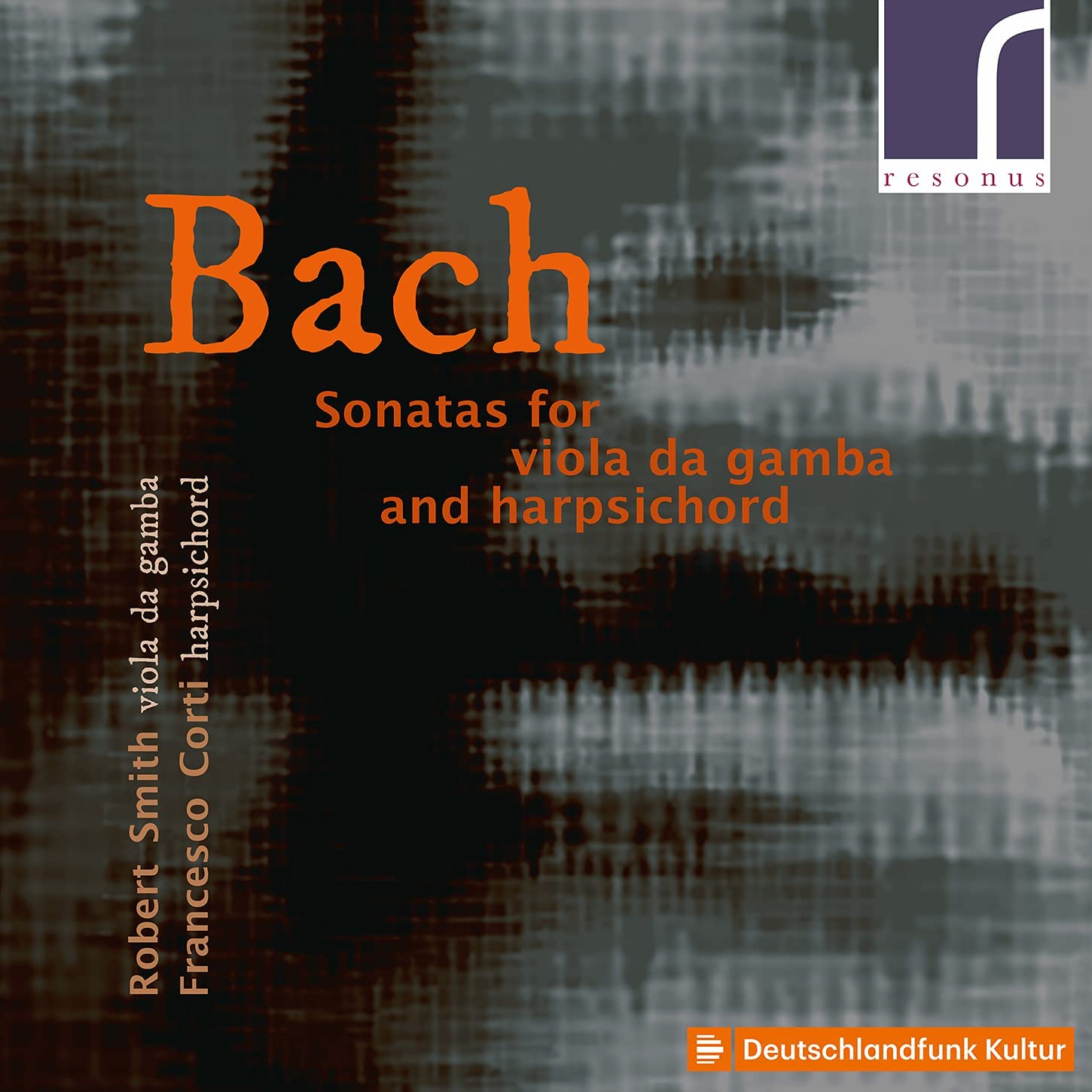
Bach: Sonatas for viola da gamba & harpsichord

Robert Smith viola da gamba, Francesco Corti harpsichord
62:51
resonus RES10278

Click HERE to buy this on amazon.co.uk
[These sponsored links help the site remain alive and FREE!]

This is a beautiful CD, and I recommend it wholeheartedly. Both performers are wonderful players and seem instinctively at home playing together. Smith’s poise, fluency and eloquence are matched by Corti’s impeccable sense of timing, where nothing is rushed but everything sparkles: they must have enjoyed making this recording immensely: listening to it repeatedly will not only be endlessly invigorating but forever reinforcing the cardinal skill of how to attend to each other. Smith plays a gamba by Pierre Bohr after Colichon and Corti a copy of a Mietke by Christoph Kern.

A bit of a mystery surrounds the gamba sonatas: once thought to date to that fertile period for chamber music in Cöthen, they now seem to be later, and perhaps part of Bach’s endless reinvention of his compositions in a variety of forms. In spite of what we know of the household’s music-making, so few trio sonatas seem to survive: was the double concerto in D minor for two violins originally a trio sonata for two violins and continuo? And were the Trio Sonatas for organ never played at home on a variety of melodic instruments? The opening movement of Sonata IV (BWV 528) had a previous life as the sinfonia for oboe d’amore and gamba that opened the second part of BWV 76 that dates from 1723. Bach was clearly a pioneer in trio sonatas where a single instrument is paired with the two hands of a Klavier, and the G major gamba sonata exists in an earlier form for two traversi and continuo. In these three sonatas, almost every style seems to get an airing, and while the fast movements reveal the players’ skills, the slow movements show just how far they can enter into each other’s emotional space.

Some of the sense of the unexpected is given to this CD by an additional sonata for gamba and harpsichord by Christopher Schaffrath (c.1710-1763). This three-movement sonata is in the lighter gallant style and provides a contrast to the Bach sonatas; but an even greater contrast is provided by Robert Smith’s own Dido’s Torment – a five-minute charged improvisatory solo, reminding us of the gamba’s history in the hands of Marin Marais and others as a favoured instrument for solo, late-night meditative playing.

But it is their Bach that is so memorable: no-one should be without it.

David Stancliffe
Categories
Recording

Odile Edouard: En attendant J. Sebastian Bach

Quatre cordes en vibration
La collection de l’oreille
les éditions de la matrice.m
https://www.sonarmein.bzh/en-attendant-johann-sebastian-bach.html

One of the effects of the enforced isolation of lockdown is that we have had the opportunity to reflect on how we have got to where we are. Amid the rash of autobiographical outpourings, musicians like the rest of us have been assessing where they are. Deprived of the normal context of music-making with others, solo recordings have multiplied. 

Odile Edouard has been an experienced and passionate teacher of HIP violin at the celebrated Conservatoire in Lyon since she was 24, and this CD of music for solo violin is her response to the deprivation of playing with others during the lockdown. The CD and its accompanying autobiographical booklet open a window on her passion for her instrument and the music she presents chronicles her pilgrimage via many different composers and widely varying styles in the century before Johann Sebastian’s Ciaccona that concludes the programme. We are introduced to Thomas Baltzar, Nicola Matteis, Heinrich Franz von Biber and Johann Paul von Westhoff played on a violin by Marieke Bodart after Stainer, and her bows are described as well – each one being listed beside the piece. For the later composers – including Vilsmayr, Pisendel and Telemann – she moves to her Klotz, made in Mittenwald in 1757. A third violin that we might have heard was stuck with the luthier during the lockdown.

The playing is elegant, committed and rhapsodic, and the storyline is intriguing. But whether this kind of reflective musing is what you are looking for in a CD that will be a long-time companion on your shelves is not a question I can answer.

I was glad to have heard it, and I suspect it might be inspiring for a young enthusiast, waiting to be captivated as Odile was when she was 14. If you have a grandchild or godchild or just know a wistful would-be young star violinist, give it a try. It might change their lives.

David Stancliffe

Categories
Recording

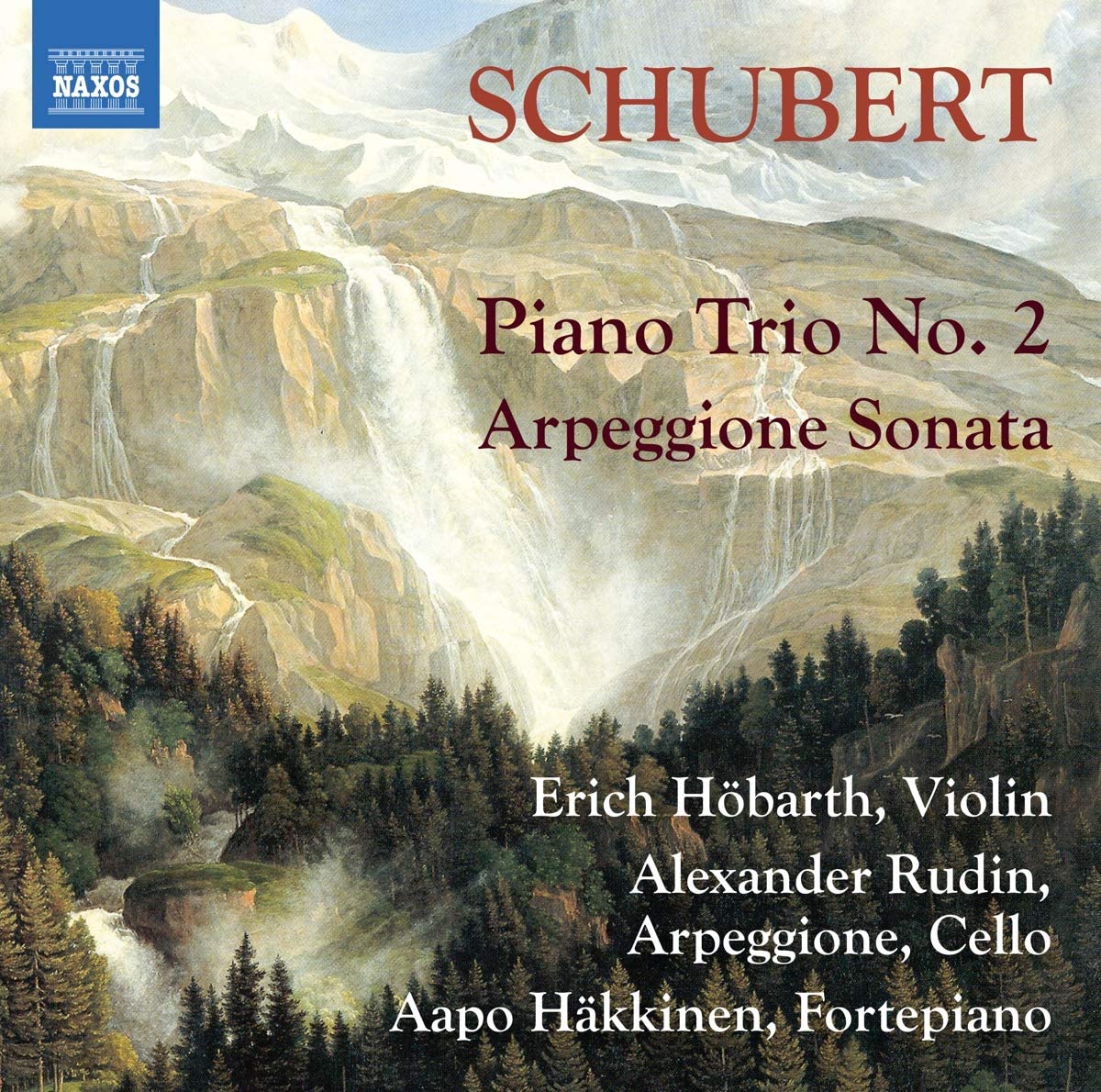
Schubert: Piano Trio No. 2, Arpeggione Sonata

Erich Höbarth violin, Alexander Rudin arpeggione/cello and Aapo Häkkinen Graf fortepiano
79:55
Naxos 8.573884

Click HERE to buy this on amazon.co.uk
[These sponsored links help the site remain alive and FREE!]

Arguably the main talking point here is Schubert’s Arpeggione Sonata in A minor, D 821 played on the instrument for which it was written in 1824. The arpeggione, a kind of bowed guitar with frets and six strings, had been invented only around a year earlier by one of the principal Viennese luthiers, Johann Georg Stauffer. It would enjoy a brief existence, its only noted performer being Vincenz Schuster, a guitarist who was a regular performer at the domestic concerts given by Schubert and his friends. Today the work is usually played on the cello, or, less frequently the viola, but given the greater compass of the arpeggione, it requires transposition and has been adapted for all manner of instruments, not to mention turned into a concerto. Schubert scholars tend to be rather snooty about it, but it is an affable, engaging and substantial piece in three movements, a playful Allegro moderato with a development section that builds a fair degree of tension, a song-like Adagio with some typically felicitous modulations and a good-humoured final Allegretto that sets out as an animated dialogue between the two instruments.

The performance is excellent. The arpeggione sounds (at least here) a little like a cross between a cello and a viol, but the upper register has a distinctive wiry sonority. It blends well with the fortepiano, a Viennese instrument built by Conrad Graf in 1827, the year of the E flat Piano Trio, and just a year before Schubert’s death. It would have been good to have been given more detail on it, for it is an instrument of exceptional tonal beauty, with a silvery top register capable of the most delicate scalic passagework and arpeggiations, but also a strong, firmly rounded bass, as the Finnish harpsichordist and fortepianist Aapo Häkkinen demonstrates throughout both works.

The Piano Trio No 2 in E flat, D 929, is of course one of the great products of Schubert’s last year, a massive four-movement work rich in all that is valued in the composer. The strong opening announcement of the Allegro sets out the stall with striking effect. This, Schubert seems to be saying, is going to be something impressive and of expansive breadth. Yet he is quickly into more lyrical territory with the cello’s statement and the movement will ebb and flow between moments of dramatic tension and flowing lyricism, all splendidly captured here by Erich Höbarth, Alexander Rudin and Häkkinen. Listen, for example, to the beguiling lyrical warmth of the secondary idea. A similarly treasurable moment comes at the same point in the succeeding Andante con moto, and again shortly afterwards with the keyboard’s arpeggiations, a passage marked con Pedale, appassionato, where Häkkinen conjures pure magic from the Graf. But throughout these are performances of the highest calibre, performances that given the bargain Naxos price tag should be snapped up without delay.

Brian Robins

Categories
Recording

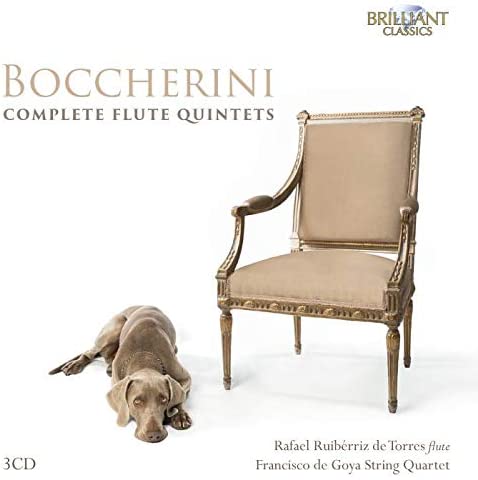
Boccherini: Complete Flute Quintets

Rafael Ruibérriz de Torres, Francisco de Goya String Quartet
158:29 (3 CDs)
Brilliant Classics 96074

Click HERE to buy this on amazon.co.uk
[These sponsored links help the site remain alive and FREE!]

Luigi Boccherini composed three sets of six flute quintets – namely his opera 17, 19 and 55 – the two earliest sets in 1773 and 1774, just after his appointment as chamber musician to Prince Luis Antonio de Bourbón in Spain. The two early sets, the product of a thirty-year-old composer, have a delightful freshness and individuality to them, with the flute playing the ensemble role of a primus inter pares rather than dominating the texture with virtuosity. The nevertheless demanding flute writing suggests the presence in the royal circle of a player of considerable technical and musical ability, but sadly he or she has not as yet been identified. Boccherini’s reputation (in my opinion undeserved) as a composer of slight and often superficial music is belied but this constantly imaginative and beautifully crafted music, which is played with enormous flair on period instruments by flautist Rafael Ruibérriz de Torres with the  Francisco de Goya String Quartet. There is a wonderful sense of ensemble, as well as a witty and fruitful interaction among the players, bringing out the full charm and elegance of Boccherini’s music. Twenty-five years later, inspired by the flautist Gaspar Barli Boccherini returned to the flute quartet, composing his opus 55 set in 1797. What a lot has changed since the earlier sets! Boccherini has made the subtle but significant stylistic move from galant to classical, while he has fully embraced his adopted Spanish heritage, including no fewer than three fandangos in the set, as well as adopting a notably folk-related idiom elsewhere. He is also less coy about letting individual instruments, most notably the flute and his own cello, step out of the more homogenous textures into the spotlight. The result is music that sounds much more profound and rhetorically powerful, and the performers rise magnificently to the challenge with highly eloquent performances. Recorded in two dramatically contrasting venues (namely a church and a recording studio), the Brilliant engineers do a very fine job in creating the same lively and sympathetic acoustic for all three CDs, and the tone of the period strings and Signor de Torres’ Wenner copy of an 18th-century Grenser flute is captured extremely vividly. This is a delightful set of recordings, adding valuably to our impressions of Boccherini as a composer of imagination and substance.

D. James Ross

Categories
Recording

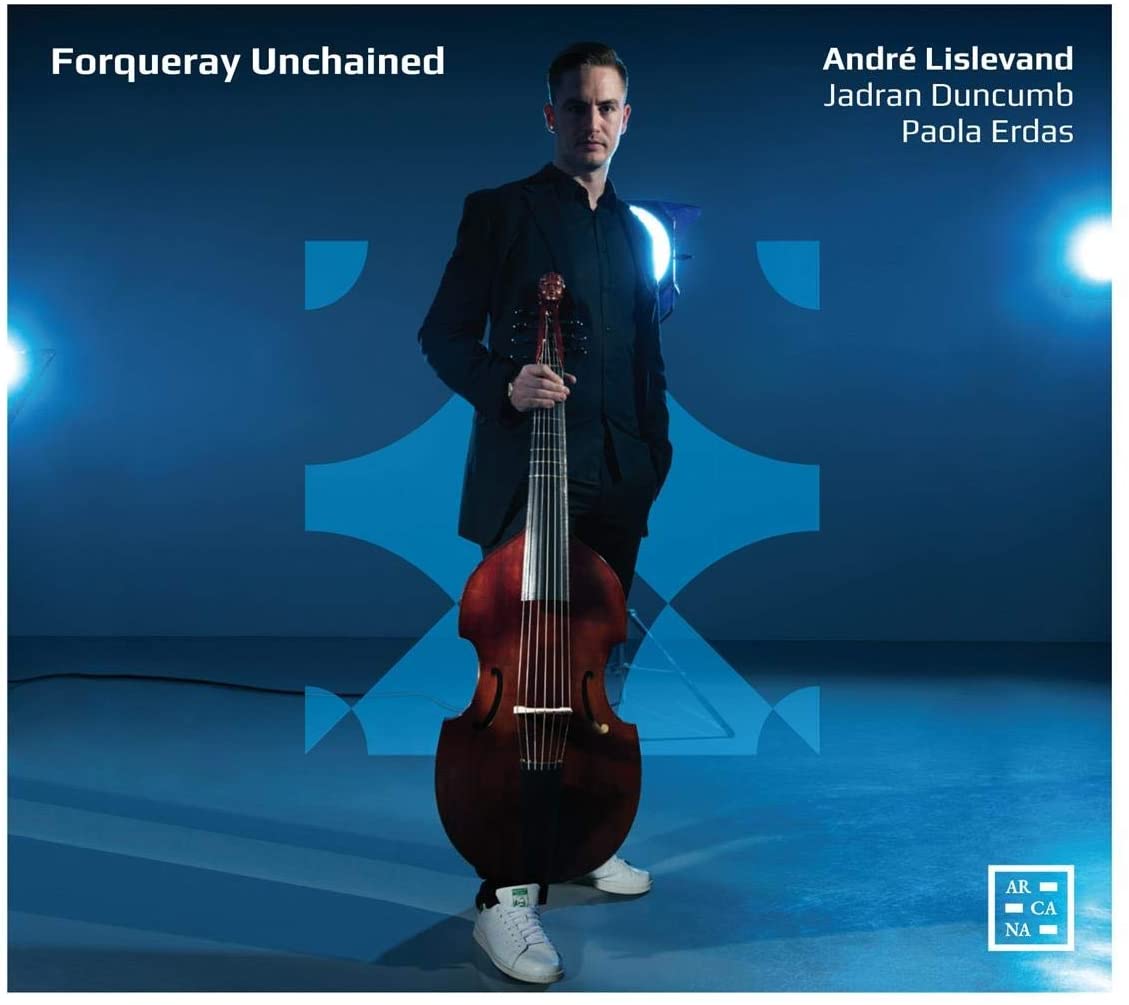
Forqueray Unchained

André Lislevand, Jadran Duncumb, Paola Erdas, feat. Rolf Lislevand
61:49
Arcana A486

Click HERE to buy this on amazon.co.uk
[These sponsored links help the site remain alive and FREE!]

I’ve been hoping for some Forqueray (who was born in 1671) in this anniversary year and here we have three artist-compiled suites in which his music is predominant, but complemented by selections from the work of Marin Marais, Robert de Visée, and Louis Couperin. The gamba is mostly accompanied by theorbo, though occasionally (and unnecessarily) also by harpsichord. I did, however, enjoy the keyboard’s rich solo – Couperin’s Passacaille.

Forqueray’s demands on his interpreters are considerable, but André Lislevand is absolutely on top of his game and not afraid to explore the extremes of his instrument’s aesthetic world though without ever losing touch with le bon goût. From time to time he is perhaps a little too gentle compared with the more incisive theorbo, though it might be, of course, that the latter needed to curb his enthusiasm in places. But theirs is an audibly happy collaboration and the actual programme is excellently conceived.

The booklet (in English, French, and Italian) contains the usual biographies and three short essays which, as seems to be the current fashion, give us the music’s context but say little specific about its content, though this would surely be welcomed by anyone new to the repertoire.

David Hansell

Categories
Recording

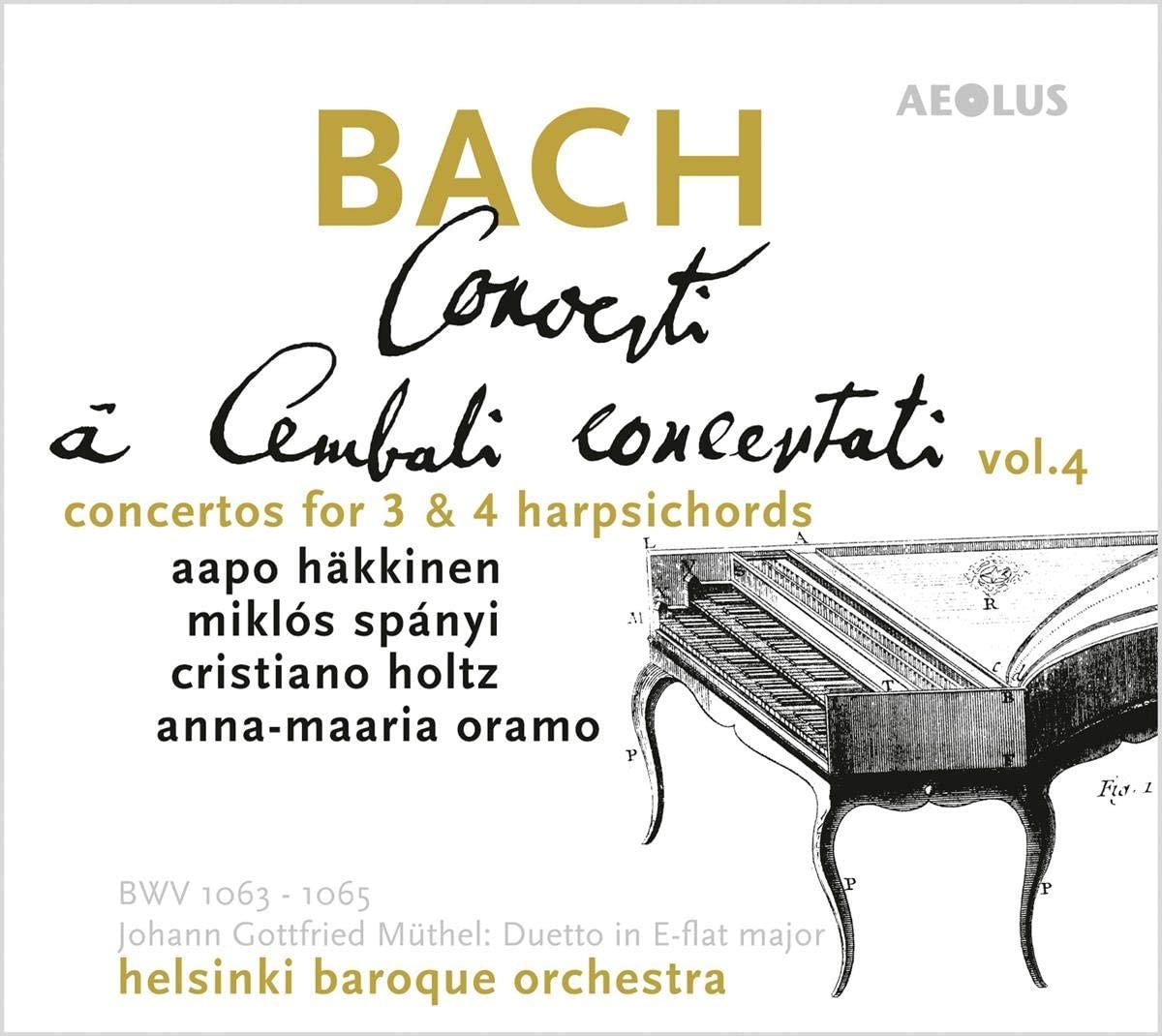
Bach: Concerto à Cembali concertati vol. 4

Concertos for 3 & 4 harpsichords
Aapo Häkkinen, Miklós Spányi, Cristiano Holtz, Anna-Maaria Oramo, Helsinki Baroque Orchestra
77:45
Aeolus AE-10107
+Müthel: Duetto in E-flat major

Click HERE to buy this on amazon.co.uk
[These sponsored links help the site remain alive and FREE!]

This recording brings the set of four CDs of Helsinki Baroque Orchestra’s recording of Bach’s Concerti à Cembali concertati, with Aapo Häkkinen as the leading harpsichordist, to a conclusion. The first volume was released in 2012.

The playing is light and bright, and with one-to-a-part strings, the harpsichords – especially in BWV 1065 – are in no danger of being smothered. As in the previous recordings, the Helsinki Baroque Orchestra plays on an interesting array of instruments with violins by Stainer and Klotz, a viola by Leclerc c. 1770 and a ‘cello from Rome c. 1700. The odd one out is a Bohemian double bass dated 1840, and it sounds like it: much too boomy in some places. Clearly, they do not always play with a 16’ – there is a delightfully transparent Youtube video of their performance in Japan of Brandenburg V which not only eschews a 16’ violone but has only two other upper strings alongside the concertante violin! So why use a double bass when a slighter-toned violone would have matched the other strings far better?

The ‘filler’ in this volume – it has included pieces for single harpsichord in the earlier volumes like the Italian concerto – is a quite different piece: Johann Gottfried Müthel (1728-1788)’s Duetto in E-flat major of 1771 is in three movements played here on two closely-recorded clavichords from the very end of the 18th century, reminding us of the continuing popularity of the clavichord as a boudoir instrument, which is just what is right for this piece.

I have quite a few recordings of the complete set of harpsichord concerti: Ton Koopman with the Amsterdam Baroque Orchestra from the early 1990s, Trevor Pinnock with The English Concert, Lars Ulrich Mortensen with Concerto Copenhagen, and there is Pieter-Jan Belder with the Amphion Consort for Brilliant Classics and Davitt Morony with colleagues on historic instruments – all of which have strong claims as a complete set.

Only the more recent like Concerto Copenhagen, the Amphion Consort and the emerging (but not yet complete) series with Francesco Corti and Il Pomo d’Oro use (rightly to my mind) single strings, so this recording may be a good choice.

David Stancliffe

Categories
Recording

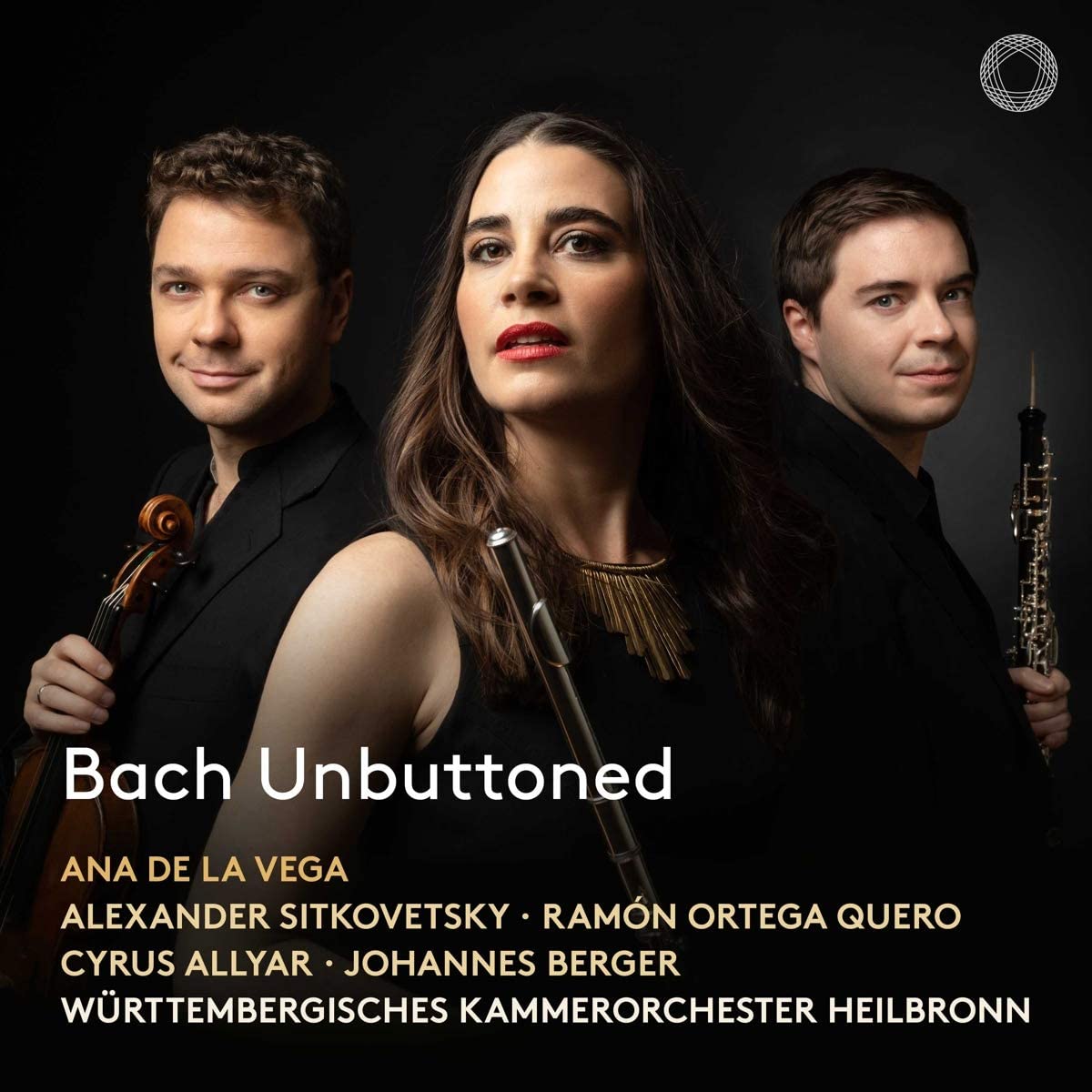
Bach Unbuttoned

Ana De La Vega flute, Ramón Ortega Quero oboe, Alexander Sitkovetsky violin, Cyrus Allyar trumpet, Johannes Berger harpsichord, Württembergisches Kammerorchester Heilbronn
62:26
Pentatone PTC 5186 893

Click HERE to buy this on amazon.co.uk
[These sponsored links help the site remain alive and FREE!]

This is a CD of Brandenburgs 5, 4 and 2 with the double concerto in D minor played enthusiastically by Ana de la Vega and Ramón Ortega on modern flute and oboe. ‘Regards to instrumentation,’ writes de la Vega in the liner notes, ’in those days it was usual to play a musical line on the instruments available, depending who was on your castle staff and up to the job. Hence we have taken similar licence, playing Brandenburg no. 4 with flute and oboe (instead of two flutes) and the famous double concerto with two different melodic instruments, that happened to be ‘at hand’. (No mention of the fact that in 4 it was two recorders, rather than traversi anyway.)

As an exercise in enjoying playing Bach, this is a polished and wizzy spree. The players are classy, and once you have got used to the high pitch, it sounds well. BUT – and there needs to be a warning ‘but’ – there are regrettable consequences. First, the balance between the instruments goes up the creek – the accompanying orchestra is many players per part, so it becomes the dominant sound with the bass particularly thumpy – and the harpsichord, even in the first movement of Brandenburg 5 is so reticent – why? Second, the ‘solo’ instruments need to have their volume ‘enhanced’ to compete and they lack the natural fluency of the period instruments and their unobtrusive blendability, which is cruelly exposed in Brandenburg 2.

Perhaps surprisingly, I found the slow movement of the D minor double concerto, with its almost trio sonata quality, the most plausible – it reminded me of playing the same work with just that same scoring in the 1950s before we had period instruments. Most Bach can be played on whatever is to hand with a degree of enjoyment. Viva la musica!

David Stancliffe


Categories
Recording

Lamento

Damien Guillon countertenor, Café Zimmermann
69:06
Alpha Classics Alpha 626
Music by J. C. & J. M. Bach, Bernhard, Biber, Froberger & Schmelzer

Click HERE to buy this on amazon.co.uk
[These sponsored links help the site remain alive and FREE!]

Few chamber ensembles play the music of Baroque Germany with more authority than Café Zimmermann, and in their latest release they have unearthed some superb music associated with death and mortality – little can they have realised as they recorded the programme in May 2019 how relevant it would have become by the time of its release. The most remarkable aspect of the project is the discovery of so much unfamiliar music of superlative quality, in some cases by composers who are also virtually unknown. Principal amongst these are the two ‘regional’ Bachs, Johann Michael (1648-1694) organist at Gehren, and Johann Christoph (1642-1703), organist at Eisenach. The former is represented by an eloquent strophic aria and the latter by a powerfully expressive lament, both sung expressively by Damien Guillon, who also graces the setting of Psalm 42 by Schütz pupil Christoph Bernhard, as well as a quite mesmerising setting of O dulcis Jesu, attributed to Heinrich Biber. While, as Peter Wollny’s programme note points out, the writing for the obbligato violin in this striking piece is thoroughly Biberesque in style, the vocal writing bears no resemblance to any of Biber’s surviving oeuvre that I know of, and indeed I would be cautious of the attribution of this anonymous piece. And if we are tempted to think cynically of the relationship between Baroque patrons and composers, Schmelzer’s deeply heartfelt “Lamento sopra la morte Ferdinandi III” provides a useful antidote. This is a CD packed with unanticipated melancholy delights, and Café Zimmermann, with their ideal blend of authority and genuine lively curiosity, are the perfect ensemble in whose company to explore it. Perhaps the bravest decision of many is to conclude the disc with Biber’s extraordinary unaccompanied Passacaglia from the Rosenkranzsonaten for solo violin – it is a testimony to the superb technique and musicality of the group’s first violinist, Pablo Valetti, that we are riveted to the last!

D. James Ross

Categories
Recording

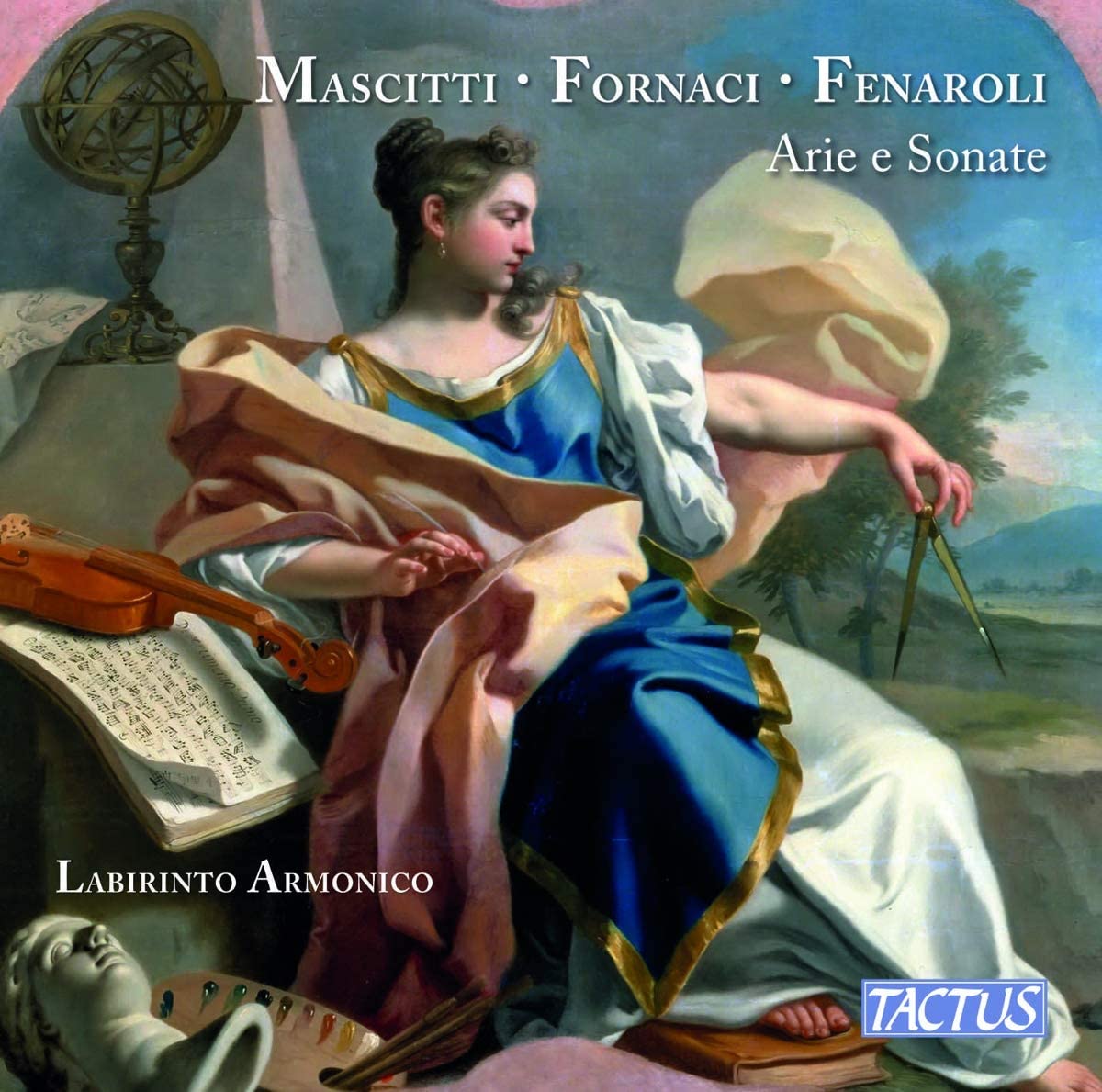
Mascitti·Fornaci·Fenaroli: Arie e Sonate

Labirinto Armonico
56:06
Tactus TC 660004

Click HERE to buy this on amazon.co.uk
[These sponsored links help the site remain alive and FREE!]

My response to this imaginatively programmed CD is largely dictated by my reaction to the voice of the group’s mezzo-soprano, Elisabetta Pallucchi. We spend about a quarter of the disc in her hands, as she sings the six dramatic arias by Giacomo Fornaci, and sadly I found her constant broad vibrato very much at odds with the music and indeed with the tonal purity of the instrumentalists. This is a pity, particularly as it is clear that she could sing without vibrato if she wanted, but allows it to flourish on any sustained note she sings. Quite why it didn’t strike anybody as odd, that the instruments were using one approach and she another, is puzzling. Fornaci’s Amorosi Respiri Musicali of 1617 sound interesting, but I was unable to enjoy them to the full. The unifying factor in this enterprising programme is geographical – all three composers are natives of Abruzzo (not the ‘Abruzzi’ of the programme note), the region of Italy east of Rome with an Adriatic coast. Born in 1598, Fornaci is the oldest composer represented. Next comes Michele Mascitti (1664-1760), represented by probably the best of the music, the last three of an opus 4 set of 12 Sonate for two violins and continuo, tastefully rendered by the ensemble. Last but not least is Fidele Finaroli (1730-1818), whose six organ sonatas are imaginatively presented by Maurizio Maffezzoli on the Sebastiano Vici organ of 1790 in the Chiesa di S. Lorenzo Martire in Mergo, an instrument illustrated and fully described in the programme booklet. Maffezzoli finds some intriguing registrations to bring this music vividly to life – significantly one stop that he uses features a wide vibrato as if to pre-empt my criticism of the group’s vocalist! Sadly, what suits 19th-century organ music, doesn’t suit early 17th-century vocal music.

D. James Ross

Categories
Recording

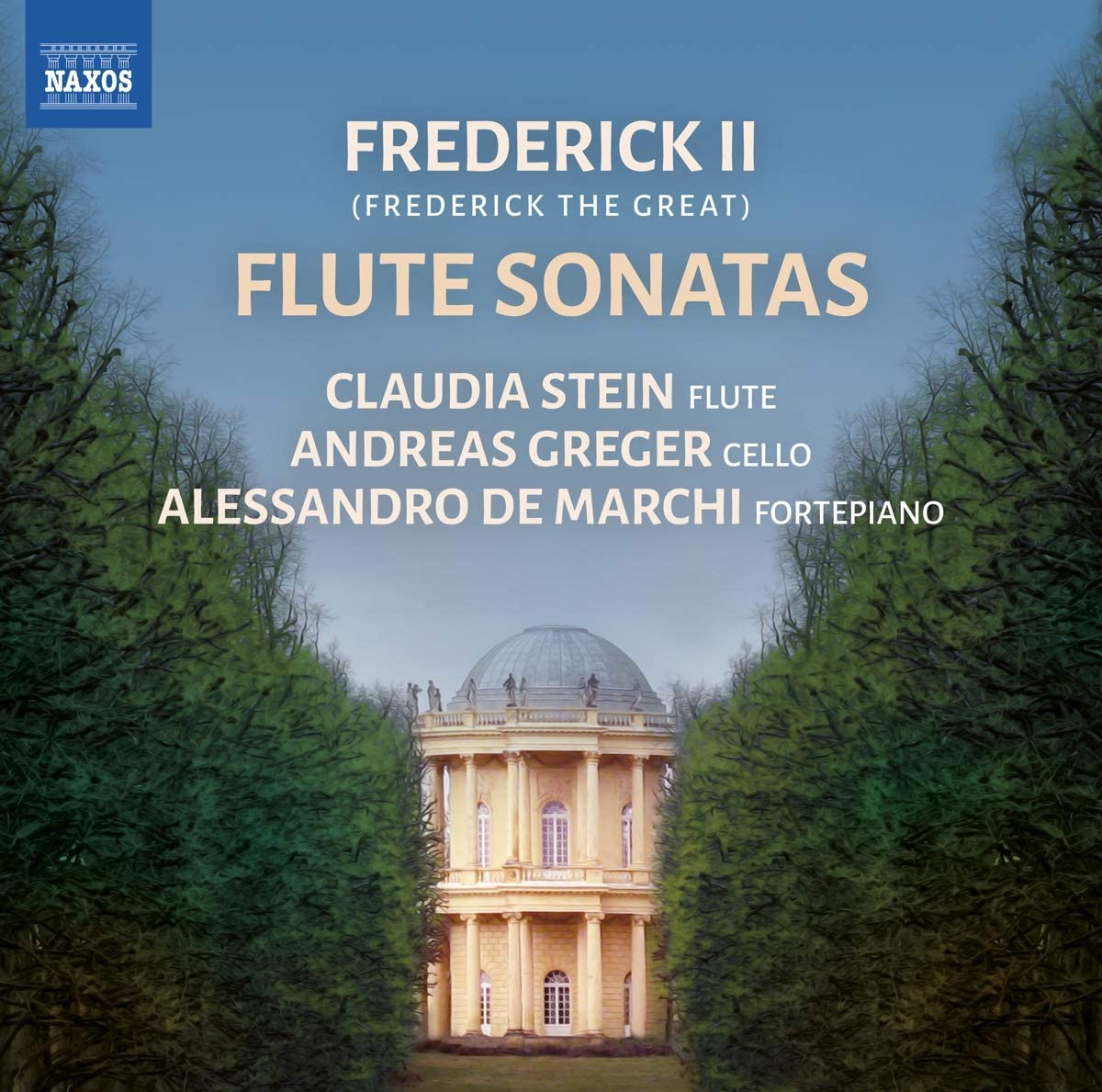
Frederick II: Flute Sonatas

Claudia Stein flute, Andreas Greger cello, Alessandro De Marchi fortepiano
77:37
Naxos 8.574250

Click HERE to buy this on amazon.co.uk
[Buying things we review keeps the site alive – and FREE!]

Adolph Menzel’s stunning painting of Frederick the Great presenting a candle-lit flute concert with his chamber orchestra attests to the fact that the Prussian king was no mere dilettante, a fact reinforced by his cultivation of a number of the finest musicians in Europe at his court, as well as his own surviving music for flute. The performers here present six of Frederick’s flute sonatas, as well as a set of variations for flute and continuo by Alessandro De Marchi on one of them, the C major sonata, a cello piece by De Marchi and piano music by Friedrich Wilhelm Marpurg. The royal sonatas prove to be both imaginative, and perhaps unsurprisingly make superb use of the flute. These recordings are lent a rather distinctive colour by the continuo use of fortepiano and Baroque cello, but puzzlingly, and a little disappointingly, Claudia Stein plays a modern flute. She has a good grasp of the idiom of this music, but her tone is rather metallic, a feature exaggerated by the rather ‘close’ recording of her instrument. It does seem odd to me to combine a modern solo instrument with such a delightfully period continuo ensemble – the variety of tonal textures the fortepiano contributed is a revelation. On the other hand, four of the works here are receiving their world premiere recordings and the rest are hardly well known, so the musicians are to be congratulated in their presentation of this underrated repertoire.

D. James Ross