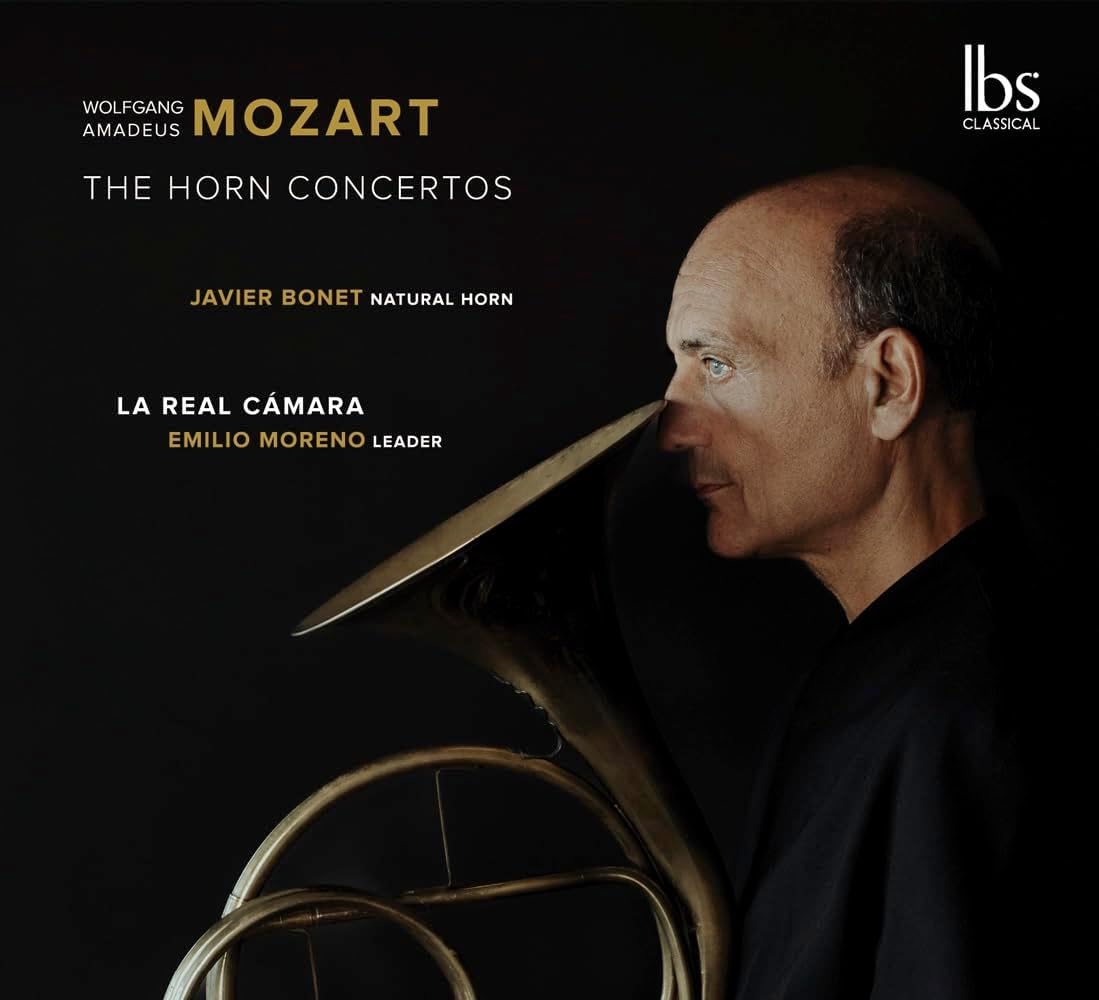
Javier Bonet natural horn, La Real Cámara, directed by Emilio Moreno
73:22
Lbs Classics
We tend to think of Mozart’s horn concertos as a tidy and entertaining group of four works composed for a long-standing family friend, Joseph Leutgeb. They are in fact nothing of the kind, having been the subject of musicological detective work almost since the composer’s own time. Take, for example, the Concerto in D, K 412 & K 386b, known as No. 1, once thought to have been composed in 1782, but later shown by paper dating to have been left unfinished in 1791, the year of Mozart’s death. One fragment, the central Rondo, and a movement not included on the present CD, was completed the following year by Mozart’s pupil, Franz Xavier Süssmayr. What is included is a repeat performance of the final Rondo with the humorous running commentary Mozart added in Italian to the manuscript, much of it insulting comments directed at his friend Leutgeb, who one imagines laughing so much that he has difficulty playing his instrument – ‘Take a breath’… ‘Go, on’… ‘This is a little better’ … and so forth are among the more refined examples. Here the comments are read by the Italian actor Carlo Gianneschi; it was a happy idea to print them translated, Mozart’s scatology and all.
Another fascinating piece of ‘mozartiana’ is the fragment of a Concerto in E, K494a. Started probably at the end of 1785 or early 1786, the fully-scored and expansive exposition is on a scale that suggests this will be the most ambitious and mature of the horn concertos. But a few bars after the soloist’s entry, the orchestra just stops, to be joined in silence by the horn a few bars further on. At least one attempt has been made to continue the fragment (Roger Montgomery on Signum), but here it is played as Mozart left it, creating a mystery around the would-be work that is both poignant and quizzical. Abounding with sufficient thematic riches for two concertos, the mystery is compounded by the fact that apparently Leutgeb knew nothing about it when Mozart’s widow Constanze showed it to him. One further work that needs explanation is the two-movement Concerto in E flat, K370b and K371, composed around the time Mozart moved to Vienna in 1781 and therefore the earliest of his horn concertos. The score was left with incomplete orchestration, a slow movement lacking altogether. Its subsequent history included being cut up as a Mozart souvenir and the rediscovery of some 60 missing bars as recently as 1991. The present performance is played in a reconstruction by Robert Levin. The nature of the solo writing, which includes octave leaps and is certainly different from the Leutgeb works, has led at least one commentator to the conclusion that it is the one horn concerto not composed for Mozart’s friend. But that perhaps also applies to K494a?
One of the most prized assets of a horn player’s technique was an ability to play legato with a smooth, continuous tone. Javier Bonet quotes the Mercure de France on the subject of Joseph Leutgeb, the publication noting that he ‘sings the adagios as perfectly as the smoothest, most interesting and most precise voice would’. It’s an encomium I’m more than happy to bestow on Bonet too, since although he displays a fine technique and the necessary agility where Mozart asks for it, something not always guaranteed – ‘There you go again, torturing me …’, it is the purity of line and vocal quality of the lyrical writing that remain longest in the mind. One need listen no further than the lyrical opening of K370b to be impressed not only by the cantabile line but the glowing warmth and affection of Bonet’s playing. Only in some of the cadenzas would I part company with him, since his playing at times carries them beyond stylistic bounds and length. The orchestra playing under Emilio Moreno, a doyen of the Spanish early music scene, is stylish and fully supportive
This is a thoroughly enjoyable CD, obviously made and played not just with a high level of musicality but also with affection. ‘O damn you, you’re talented!’, to quote Mozart again.
Brian Robins