Categories
Uncategorized

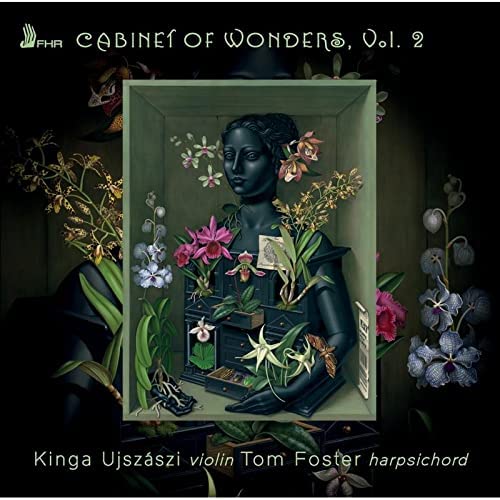
Cabinet of Wonders, Vol. 2

Works for the violin and basso continuo from the 18th-century Schrank II Collection, Dresden
Kinga Ujszászi violin, Tom Foster harpsichord
57:15
First Hand Records FHR121

Click HERE to buy this recording from amazon.co.uk
[These sponsored links keep this site FREE]

This CD of 18th-century music for violin and continuo associated with Dresden offers premiere recordings of works by Martino Bitti, Henricus Albicastro and Carlo Fiorelli, as well as two anonymous works, possibly by Nicolò Laurenti and Antonio Montanari. They are from a collection probably compiled by the violin virtuoso Johann Georg Pisendel, an almost exact contemporary of J S Bach. Pisendel was the leading violinist of the Dresden Hofkapelle, becoming its official concertmaster in 1730. An eclectic and assiduous collector of music, Pisendel subsequently left his library of music to the Court, where it was preserved in Schrank II, the cabinet of the title, which found its way in due course into the Saxon State and University Library in Dresden. It is indeed a cabinet of wonders, both in the range of flavours of the music it contains and the varying demands the music places on the players. These performances by Ujszászi and Foster are delightfully expressive, while the decision to have the harpsichord play the continuo part alone rather than supported by a cello lightens the texture and creates a compellingly informal and spontaneous atmosphere. It is extraordinary to think that none of this music has been recorded before, and it is a mark of the sheer volume of fine music lying tucked away in archives that nobody has hitherto touched this resource. I have enjoyed both volumes of this series, and look forward to this rich collection providing us with further volumes of unanticipated treasures.

D. James Ross
Categories
Uncategorized

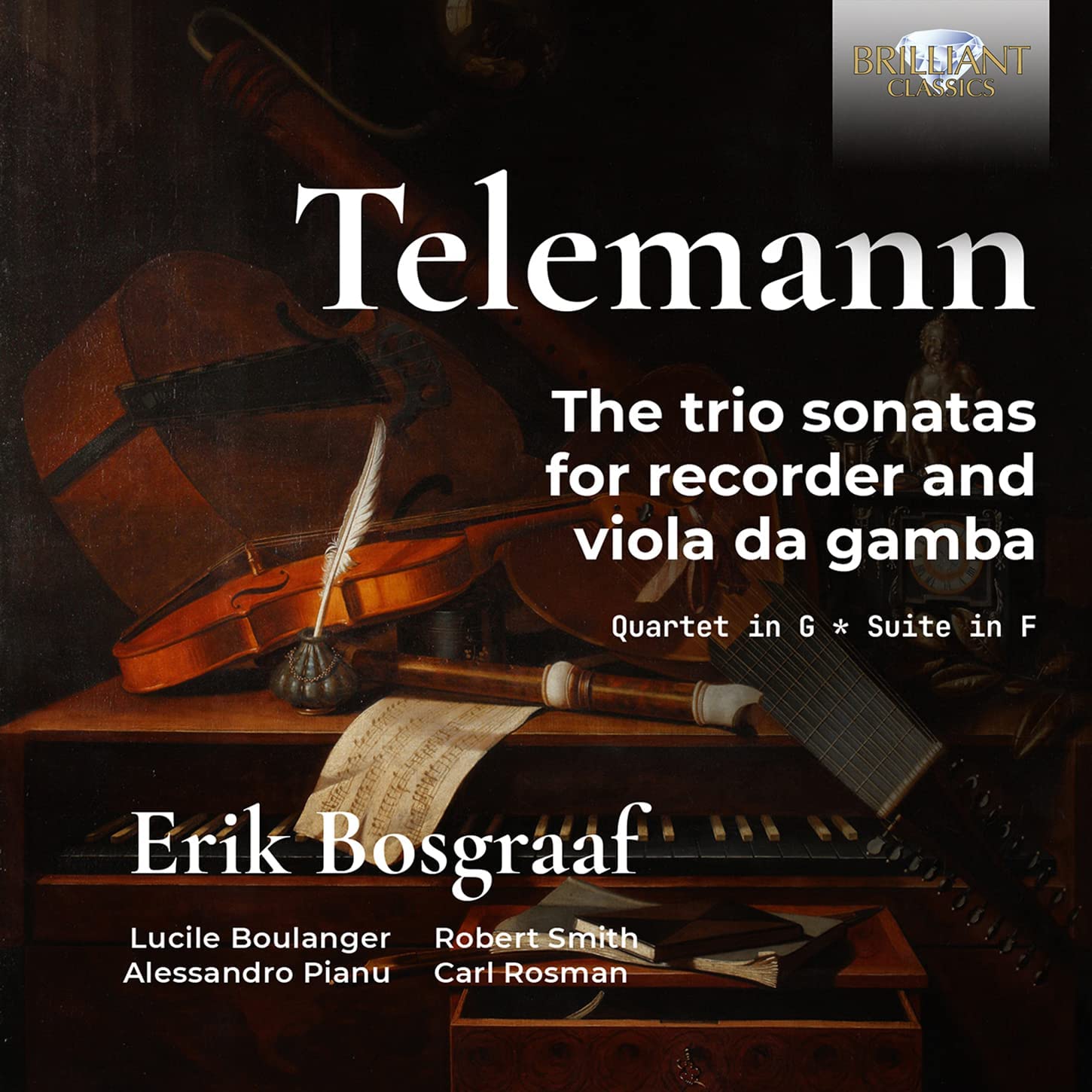
Telemann: The trio sonatas for recorder and viola da gamba

Erik Bosgraaf recorder, voice flute & alto chalumeau, Carl Rosman, tenor chalumeau, Lucile Boulanger & Robert Smith gambas, Alessandro Pianu harpsichord/organ
56:55
Brilliant Classics 96393

Click HERE to buy this recording on amazon.co.uk
Using these sponsored links helps keep this wesbite FREE TO ACCESS

Any CD bringing recorder works by Telemann to our attention will have to surpass merely going through the motions! There are swathes and piles already in our collections, in various compilations going back quite a while. Indeed, these very sonatas featured on an excellent Brilliant Classics five-CD box set (94831) by ensemble Opera Prima under Cristiano Contadin, “Complete Concertos and Sonatas with gamba” (Highly recommended!). Fortunately, here we are in safe hands, or rather fingers, as the gifted Dutch recorder player, Erik Bosgraaf, displays an enviable mellifluence and proficiency! The German adjectives “flink” and “geschliffen” (nimble and refined) came to mind as we enjoyed some familiar encounters, yet these were given just the right measure of spice and élan, with some superb transitions of mood and tempo. Track 13’s Largo to 14’s superb Allegro in TWV42:g9, and again from TWV42:d7’s Adagio into its slick Allegro. The technical assurance here is obvious, as the rich, accommodating acoustic of the Kruiskerk in Bergum which lends its own magic. Never over-stressed or ostentatious, the playing is truly admirable and in those moments of rustic Polishness just the right amount of gusto is applied!

The two nicely chosen extras make this a well-rounded recording; the quartet TWV43:G10, usually two bass viols and transverse flute, here tackled on the “voice flute” (tenor recorder in D) which adds a slight tonal twist without transposing requirement. As is typical in many of Telemann’s instrumental pieces, the “replying” and “counter-replying” themes bounce along merrily in lively, elegant dialogue!

The final item is a delight to hear, a double-chalumeaux work, done in such a warm, playful and spirited way, Bosgraaf takes the alto chalumeau and Carl Rosman the tenor. The delightful Gigue rounds off a most entertaining CD that feels ideally suited for all settings, wrapped in a lush church acoustic for welcome tonal warmth.

David Bellinger

Categories
Recording Uncategorized

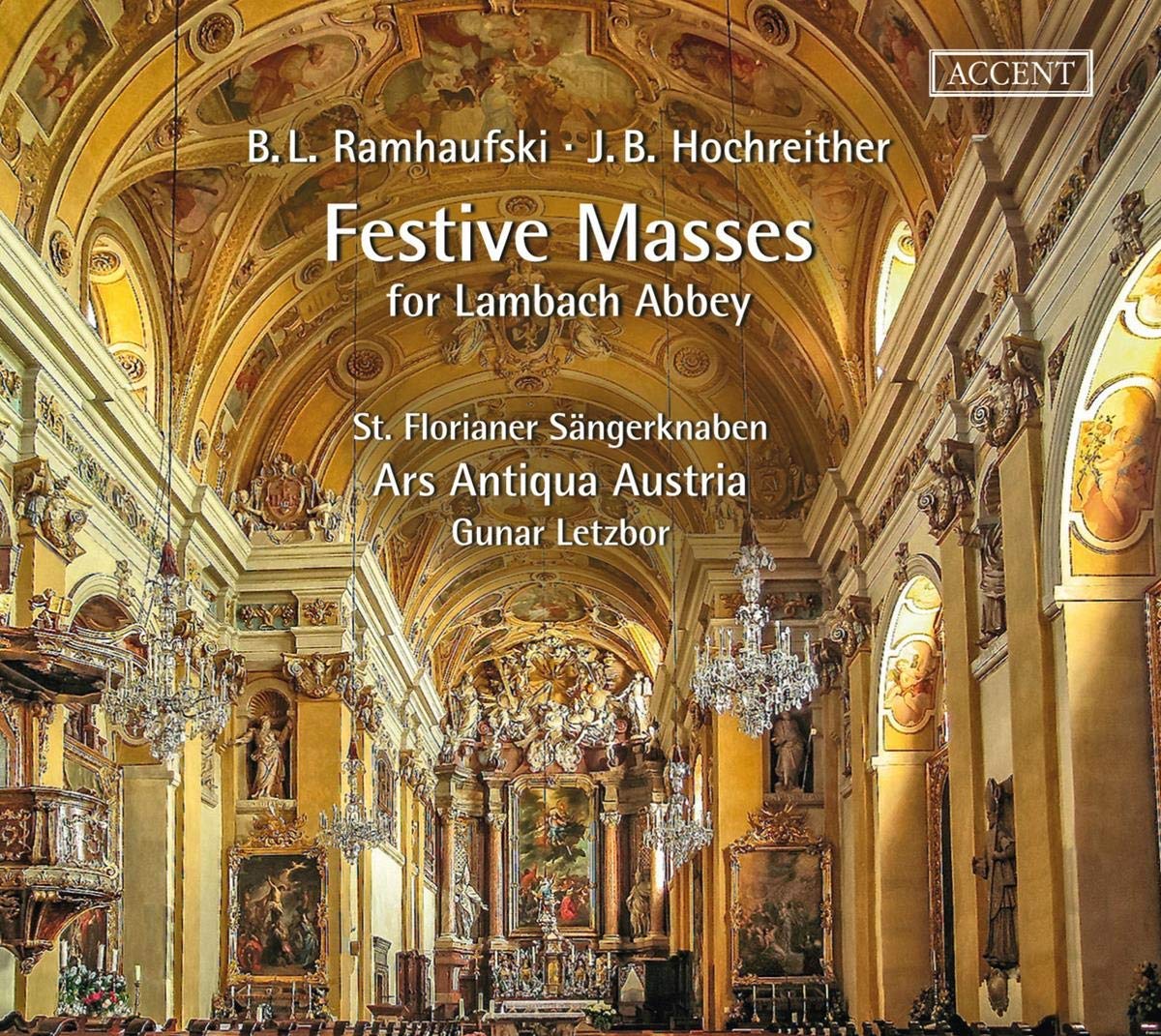
Festive masses from Lambach Abbey

St. Florian Sängerknaben, Ars Antiqua Austria, Gunar Letzbor
66:31
Accent ACC 24358

There are obscure composers and then there are the likes of Benjamin Ludwig Ramhaufski and Joseph Balhasar Hochreither! The latter was born halfway through the lifetime of the former and, mostly on account of the prominent trumpet parts, there is not much to distinguish their music; indeed, on a blind listening, I defy even a seasoned lover of 17th-century music not to assume it’s either Schmelzer or Biber… Such is the quality of the polyphony and the lyrical ease of the melodies. Combining boy’s voices with those of six men works very well and the instrumentalists clearly enjoy the chamber music feel. Gunar Letzbor’s quest for “true sound” typically gives a dry edginess to his recordings, but here the rather warmer acoustic allows the sound to blossom a little without detracting from the detail. I have enjoyed having this CD in the car for the past few weeks – it is bright and uplifting, and I highly recommend it.

Brian Clark

Categories
Uncategorized

The Alehouse Sessions

Barokksolistene, Bjarte Eike
50:42
Rubicon RCD1017

Before I review this CD I have to declare an interest – some of you will have read my ecstatic EMR review from the St Magnus Festival in June of a series of appearances by the Barokksolistene (still available on the EMR website) in which I tried to capture the mixture of amazement and pleasure that I experienced at their live shows. Although it is impossible, I shall have to try to set my experience as an audience member to one side as I review this CD of one of the actual programmes I attended back in June. So how does this recording hold up as a heard experience without all the intriguing stage business, the charismatic presence of Bjarte Eike and the witty and profound theatrical dimension? Is it, as sometimes happens, a case of ‘you had to be there’? Well no. The superb technical prowess of these remarkable musicians, their uncanny sense of ensemble, their unparalleled familiarity with the material all shine through I think in this CD. Some of the eccentricities of presentation which at the live performance we rather took on trust, sound a little more outrageous on CD – Thomas Guthrie’s idiosyncratic vocal style perhaps needs his beguiling physical presence to be entirely convincing, while I was much more aware of the heavy level of arrangement of the source material which had clearly gone on. In some of the music, this involves updating the harmonies in an unsettlingly modern cabaret style, while the edges of the instrumental authenticity are a little blurred by the use of a mixture of Baroque and essentially modern instruments. Some of the musicians unashamedly bring their jazz roots with them onstage, but for me the type of music they are performing lends itself brilliantly to that sort of spontaneous improvisatory approach. At its best, this CD is wonderfully energetic and idiomatic, and even at its most eccentric it is never remotely unmusical or dishonest to its source material. Perhaps most impressive is the way in which the CD, like the show, captures the ambience of a bunch of young men ‘on the lash’ using musical performance to show off to one another, to challenge one another and ultimately to impress us with their innate musicality and technical assurance. Maybe it is after all impossible for me to divorce listening to this CD from the experience of the live Barokksolistene, and maybe the CD will mainly sell as an after-concert souvenir, but actually I would recommend that you buy the CD and then seriously try to catch the group live. You won’t regret either!

D. James Ross

Categories
Uncategorized

Antegnati: 12 Ricercari

Federico Del Sordo organ and harpsichord
58:08
Brilliant Classics 95628

I must say that the prospect of 12 Ricercari (all that is mentioned on the front of the booklet) by even one as distinguished as Constanzo Antegnati was rather daunting but I need not have worried! The counterpoint flows suavely, enlivened by some athletic ornamentation, and the historic organ is a constant delight. Furthermore, contrasting music by other composers is interspersed among the ricercari and played on stringed keyboard instruments: modern copies of an early 17th-century harpsichord and fretted clavichord, this last a rare treat. Here and there, the keen-eared will detect a few inconsistencies of articulation but there is far more to enjoy than to carp at. The booklet is informative and interesting about the music, its context and the organ (though in English only) and detailed organ registrations are available online, though it wouldn’t have been difficult to include them. Recommended especially for early keyboard buffs.
David Hansell
Categories
Uncategorized

Zelenka: Missa Sancti Josephi

Julia Lezhneva, Daniel Taylor, Tilman Lichdi, Jonathan Sells SATB, Kammerchor Stuttgart, Barockorchester Stuttgart, Frieder Bernius
57:51
Carus 83.279

THESE GROUPS have had a strong relationship with Zelenka’s music for many years – in fact, the first choral music I ever heard by him was their version of his Missa Dei Patris. This CD is evidence of the affinity they clearly have. As well as the mass (which, being for a saint, lacks a setting of the Credo, according to Dresden usage), the disc includes settings of De profundis and In exitu Israel, psalms that form part of Vespers for Sundays. There are many fine moments to enjoy in the music, such as the opening of the Gloria of the mass, and the bass trio that opens the De profundis setting, but throughout the singing and playing is simply superlative, and all beautifully captured by the recording engineers. It may seem an odd thing to highlight but I was particularly impressed that the packaging did not concentrate on the soloists – in a world in which that is increasingly becoming the norm, it is great to see Carus stick to their house style and let the music (and these first-class performances of it) speak for themselves.

Brian Clark

Categories
Uncategorized

The Piper and the Fairy Queen

Camerata Kilkenny, David Power
68:29
RTE lyric CD 156

[dropcap]I[/dropcap]n its own words this CD is ‘exploring the common heritage of traditional Irish tunes and Baroque dances’, a project for which the string ensemble is joined by uillean piper, David Power. It is widely known that Baroque composers frequently drew on the ‘traditional’ music they heard around them for their instrumental music. Telemann, in particular, makes very distinctive and daring allusions to the folk traditions of eastern Europe. The Camerata Kilkenny do play some Telemann, but (unfortunately, perhaps) they go with the subtitle of their CD and choose his rather conventional Suite La Musette and the witty Gulliver Suite for two violins, neither of which frankly have much of a common heritage with traditional music. The other major Baroque suite seems similarly ill-chosen as it is music from Purcell’s Fairy Queen – fine for a title but adding little to the declared theme. The playing of the ensemble in this Baroque repertoire is competent enough, but they don’t seem to me to transfer any of the flair of traditional playing to the Baroque repertoire. The participation of David Power on uillean pipes includes several pipe solos relating to the CD’s title and several more interesting collaborations between pipes and strings such as the account of Handel’s famous pifa from Messiah and Leclair’s Musette and Menuets from Scylla and Glaucus. In these, the tuning isn’t always entirely comfortable. I think if this CD had focussed on its declared aim of finding links between the Baroque and traditional heritages it would have been more engaging than I found the CD which was eventually produced.

D. James Ross

[iframe style=”width:120px;height:240px;” marginwidth=”0″ marginheight=”0″ scrolling=”no” frameborder=”0″ src=”//ws-eu.amazon-adsystem.com/widgets/q?ServiceVersion=20070822&OneJS=1&Operation=GetAdHtml&MarketPlace=GB&source=ss&ref=as_ss_li_til&ad_type=product_link&tracking_id=infocentral-21&language=en_GB&marketplace=amazon&region=GB&placement=B07CPBVVK4&asins=B07CPBVVK4&linkId=86f826457ff118f08391ff237f9ec8ff&show_border=true&link_opens_in_new_window=true”]

[iframe style=”width:120px;height:240px;” marginwidth=”0″ marginheight=”0″ scrolling=”no” frameborder=”0″ src=”//ws-eu.amazon-adsystem.com/widgets/q?ServiceVersion=20070822&OneJS=1&Operation=GetAdHtml&MarketPlace=DE&source=ss&ref=as_ss_li_til&ad_type=product_link&tracking_id=earlymusicrev-21&language=de_DE&marketplace=amazon&region=DE&placement=B07CPBVVK4&asins=B07CPBVVK4&linkId=cc95d2be82d739ad1669601c98aa0ff9&show_border=true&link_opens_in_new_window=true”]

[iframe style=”width:120px;height:240px;” marginwidth=”0″ marginheight=”0″ scrolling=”no” frameborder=”0″ src=”//ws-na.amazon-adsystem.com/widgets/q?ServiceVersion=20070822&OneJS=1&Operation=GetAdHtml&MarketPlace=US&source=ss&ref=as_ss_li_til&ad_type=product_link&tracking_id=earlymusicrev-20&language=en_US&marketplace=amazon&region=US&placement=B07CPBVVK4&asins=B07CPBVVK4&linkId=eae3ef3e5068be312af4bd7ee1d08da8&show_border=true&link_opens_in_new_window=true”]

Banner, 234x60, ohne Claim, bestellen

This site can only survive if users click through the links and buy the products reviewed.
We receive no advertising income or any other sort of financial support.

As an Amazon Associate I earn from qualifying purchases.

Amazon and the Amazon logo are trademarks of Amazon.com, Inc. or its affiliates.

Categories
Uncategorized

Gamba Concertos

The Viola da Gamba in the Spotlight
Thomas Fritzsch gamba, Michael Schönheit pianoforte, Merseburger Hofmusik
66:42
Coviello Classics COV91710
Concertos and sonatas by Abel, J. C. Bach, Johann Carl Graf zu Hardeck, Milling & Raetzel

[dropcap]T[/dropcap]his is one of those booklets (Ger/Eng) that has to be read so that the full story of these works’ survival and restoration – a matter of luck, determination and musicological skill sensitively deployed – can be enjoyed and appreciated. I can be driven to distraction by mid-18th-century repeated note bass lines but here I rather enjoyed the gentle clucking of the 1805 Broadwood piano used on the continuo line, to say nothing of the melodic charms of the gamba above. It adds a particular frisson to know that the solo instrument belonged to the aristocrat in whose library some of these pieces are preserved. It also helps that it is extremely well played. The recording does a good job too, keeping the soloist in the foreground while still allowing us to hear the supporting (single) strings when they have something to say. I approached this with a mixture of curiosity and trepidation. I finished it smiling broadly.

David Hansell

[iframe style=”width:120px;height:240px;” marginwidth=”0″ marginheight=”0″ scrolling=”no” frameborder=”0″ src=”//ws-eu.amazon-adsystem.com/widgets/q?ServiceVersion=20070822&OneJS=1&Operation=GetAdHtml&MarketPlace=GB&source=ss&ref=as_ss_li_til&ad_type=product_link&tracking_id=infocentral-21&marketplace=amazon&region=GB&placement=B06ZZQW9CV&asins=B06ZZQW9CV&linkId=a0a0f578d46ef7145511607609001fca&show_border=true&link_opens_in_new_window=true”]

[iframe style=”width:120px;height:240px;” marginwidth=”0″ marginheight=”0″ scrolling=”no” frameborder=”0″ src=”//ws-eu.amazon-adsystem.com/widgets/q?ServiceVersion=20070822&OneJS=1&Operation=GetAdHtml&MarketPlace=DE&source=ss&ref=as_ss_li_til&ad_type=product_link&tracking_id=earlymusicrev-21&marketplace=amazon&region=DE&placement=B06ZZQW9CV&asins=B06ZZQW9CV&linkId=bed571ecc941b215c2dedc5ed13565e5&show_border=true&link_opens_in_new_window=true”]

[iframe style=”width:120px;height:240px;” marginwidth=”0″ marginheight=”0″ scrolling=”no” frameborder=”0″ src=”//ws-na.amazon-adsystem.com/widgets/q?ServiceVersion=20070822&OneJS=1&Operation=GetAdHtml&MarketPlace=US&source=ss&ref=as_ss_li_til&ad_type=product_link&tracking_id=earlymusicrev-20&marketplace=amazon&region=US&placement=B06ZZQW9CV&asins=B06ZZQW9CV&linkId=b6e2a7492d9697a7a5953ccb554dfb9d&show_border=true&link_opens_in_new_window=true”]

Banner, 234x60, ohne Claim, bestellen

This site can only survive if users click through the links and buy the products reviewed.
We receive no advertising income or any other sort of financial support.

As an Amazon Associate I earn from qualifying purchases.

Amazon and the Amazon logo are trademarks of Amazon.com, Inc. or its affiliates.

Categories
Uncategorized

New PDF downloads

Some people don’t like reading reviews online, so – from time to time – digests of all the reviews are uploaded as PDFs. They are not magazine standard but serve the purpose. Unlike the old printed version, they are grouped by period, so book, music and CD reviews are all in the same PDF for the period(s) you are interested in.

Enjoy.

Feedback welcomed!

pre 15th century

15th century

16th century

17th century

Baroque

Classical

Romantic

Various

Categories
Uncategorized

C. P. E. Bach: The Solo Keyboard Music 31

‘für Kenner und Liebhaber’ Sonatas from Collections 1 & 2
Miklós Spányi clavichord
73:23
BIS-2131
Wq 55/1-3, 5, 56/2,4,6 [=H 244, 130, 245, 243, 246, 269, 270]

[dropcap]T[/dropcap]he Hungarian performer Miklós Spányi continues his complete edition of C.P.E. Bach’s solo keyboard music with four of the sonatas from the first set ‘für Kenner und Lieber’ (the remaining two appear on another disc in the series played on tangent piano) and three from the second set. Published in 1778 and 1779 these are mature sonatas which, despite what the sleeve notes refer to as their ‘tonal restlessness’, are tightly constructed and very satisfying to listen to. Spányi plays on a Hubert copy made by Thomas Friedemann Steiner, a persuasive instrument for these sonatas. He is alive to all the rhetorical implications of the music as well as showcasing its technical virtuosity. The recording quality is excellent.

Noel O’Regan

[iframe style=”width:120px;height:240px;” marginwidth=”0″ marginheight=”0″ scrolling=”no” frameborder=”0″ src=”//ws-eu.amazon-adsystem.com/widgets/q?ServiceVersion=20070822&OneJS=1&Operation=GetAdHtml&MarketPlace=GB&source=ss&ref=as_ss_li_til&ad_type=product_link&tracking_id=infocentral-21&marketplace=amazon&region=GB&placement=B01ETDAY9K&asins=B01ETDAY9K&linkId=5a6c619a35f8dd673d393a856a915e22&show_border=true&link_opens_in_new_window=true”]

[iframe src=”http://www.jpc-partner.de/link.php?partner=ngr&artnum=3553753&bg=ffffff&tc=000000&lc=e5671d&s=120&t=1&i=1&b=1″ width=”120″ height=”214″ scrolling=”no” frameborder=”0″]

[iframe style=”width:120px;height:240px;” marginwidth=”0″ marginheight=”0″ scrolling=”no” frameborder=”0″ src=”//ws-na.amazon-adsystem.com/widgets/q?ServiceVersion=20070822&OneJS=1&Operation=GetAdHtml&MarketPlace=US&source=ss&ref=as_ss_li_til&ad_type=product_link&tracking_id=earlymusicrev-20&marketplace=amazon&region=US&placement=B01ETDAY9K&asins=B01ETDAY9K&linkId=77734f32997bcbfe89f1a4e792afc4d7&show_border=true&link_opens_in_new_window=true”]