Categories
Sheet music

Maurice Greene: Two orchestral Te Deum settings

Edited by H. Diack Johnstone & Ryan Patten
Musica Britannica MB111
ISBN: 9780852499771 ISMN: 9790220229312
xxxiii + 132pp, £115.00
Stainer & Bell

Both of the settings in this latest volume of Musica Britannica were written to celebrate the return of George II from his ancestral home in Hanover. The earlier dates from 1745 and is a “numbers” setting; each of the verses is a self-contained movement. In contrast, the 1750 Te Deum is a continuous patchwork of contrasting sections. Both are written for four-part chorus and orchestra (strings with pairs of oboes and trumpets, and one flute in the first, two flutes in the second). The soprano line divides occasionally in both Verse and and Chorus sections. Musically – and most likely by coincidence – for me, the most interesting music in both settings is the “Vouchsafe, O Lord”; in 1745, Greene opted for an alto soloist with flute and cello obbligatos, while the much shorter later version opens with oboe and violin before the alto enters. This is music that definitely needs to be performed and recorded, if only to demonstrate the qualities of Greene’s output; for too long, he (and, I might add, Boyce and Stanley, to name but two much more than “worthy” English composers) has languished in Handel’s shadow.

Indeed, the preface here explains that that was true in their own day; even though he was the official composer to the Chapel Royal, Greene was often overlooked at major celebrations, with music by Handel performed instead. The preface also includes an expression that made me scratch my head: “Most unusually for its time, the scoring of the Te Deum, like Bach’s B minor mass, involves two flutes in addition to two oboes (and bassoon)”. Someone needs to familiarise themself with music at the Dresden court…

Unusually for MB, the critical commentary is short; both works survive as single sources, so there is no need to cross-reference differences between manuscripts. It is, of course, no less meticulous than previous volumes, and this 110th title will stand proudly with the others in this prestigious series.

Brian Clark
Categories
Sheet music

Restoration Theatre Airs

Edited by Peter Holman & Andrew Woolley
Musica Britannica MB110
ISBN: 9780852499757 ISMN: 9790220229183
lix + 156pp, £135.00
Stainer & Bell

This important volume includes music by 14 composers. The first set of airs includes music for “The Tempest” by Matthew Locke and Robert Smith, but the remaining 12 suites are single-composer examples. The others are William Turner, Louis Grabu, Gottfried Finger, Francis Forcer, William Croft, John Eccles, Jeremiah Clarke, James Paisible, William Corbett, John Barrett, possibly Pierre Gillier, and the ever-popular Anonymous. In other words, it’s a veritable who’s who? of Purcellian England.

The music itself is mostly in four parts. Exceptions are Turner’s music for “Pastor Fido, or The Faithful Shepherd” in three parts, and Grabu’s for “Valentinian” in five. Finger added a woodwind solo to the sixth movement of his music for “The Mourning Bride”. The editors have composed a viola part for Forcer’s music in “The Innocent Mistress”. The suites consist of an overture and a sequence of binary dances or airs, the vast majority in what you might call “standard keys”; the four movements in the appendices to the Finger suite are in F minor (only the bass line of the fourth survives), which is the home key of Clarke’s “All for the Better…”

A description of the sources fills more than ten pages. The critical notes, which together with the extensive introduction, are a tribute to the editors, occupy the next 13 pages. I was unable to find an explanation of why they opted to add a viola part to the Forcer suite, but not the Turner. The added trumpet part in Barrett’s “The Albion Queens” is idiomatic and utterly convincing. Another fine volume in this series of international importance.

Brian Clark

Categories
Sheet music

George Jeffreys: Latin Sacred Music – 1

Edited by Jonathan P. Wainright
Musica Britannica MB109
ISBN: 9780852499740 ISMN: 9790220228575
xxxviii + 233pp, £135.00
Stainer & Bell

The full subtitle of this volume is “Liturgical music and motets for one, two and four voices and bass continuo”. The index subdivides the music as follows: Latin liturgial music (two mass movements – the first of them actually for five voices! – and settings of the Venite, Te Deum, Magnificat, Nunc dimittis, and Jubilate Deo), [2] motets for bass voice, [13] motets for two voices (eight of them printed in two versions), and 11 motets for four voices.

The very fine music occupies 198 pages of this typically beautiful Stainer & Bell volume. As an example of Jeffreys’ writing, let us consider a short section from the four-voice Venite exultemus Domino. “Hodie si vocem ejus” begins with solo alto in F major (the “home key” is D major!), answered by the solo bass (“Nolite obdurare corda vestra”) which modulates to A major within five bars; the full ensemble leads (via B major and a circle of fifths back to the home key) to a perfect cadence (“secundum diem tentationis in deserto”) in C major. Quite the harmonic journey!

After 22 pages of detailed critical notes come the full texts with translations. It seems Jeffreys learned to compose “like an Italian” by copying out music that his employers in Northamptonshire, the Hatton family, bought from a London musicseller. This volume, along with the earlier MB CV of English Sacred Music, and (presumably) the forthcoming volume 2 of Latin Sacred Music, will pave the way for more performances of his output, and encourage scholars to investigate Wainright’s assertion that the important role Jeffreys played in bringing the stile nuovo to England has been overlooked.

Brian Clark

Categories
Sheet music

Croft: Three odes with orchestra

Edited by Alan Howard
Musica Britannica MB108
ISBN: 9780852499696 ISMN: 9790220228100
xlviii + 127pp, £115.00
Stainer & Bell

This excellent volume contains the two pieces Croft wrote to celebrate the Peace of Utrecht in 1713 – an earn his Oxford doctorate – and an ode (the editor Alan Howarth argues) to mark the Peace of Ryswick in 1697. if, as likely, that is the case, the composer would still have been a teenager, so the infelicities identified in the informative introduction might be forgiven. The main problem with the source (a later copy by one of Croft’s students from the 1720s) is the labelling of the instrumental parts – in the opening movement, there is a trumpet line (or two trumpet lines?) with unplayable notes, and the editor interprets the next four lines as violins where it strikes me as more likely that the first pair are oboes and the next pair violins. In the following movements, an alto is accompanied by recorders, the soprano and bass by strings, the bass by violins, and the full ensemble renders the short concluding chorus. The Utrecht pieces, whose performances in Oxford were noticed in the press, are far more substantial and it is clear that in the intervening years, Croft has matured as a composer. His debt to the Purcellian court ode is self-evident. Where we nowadays tend to think of him as being obscured by Handel, there is no sense in which this music is overshadowed by the German’s music for the Utrecht celebrations – indeed, some of his best choral writing might suggest that the influence worked in the opposite direction! I hope the availability of these fine pieces will inspire musicians to take up his cause – there really is a wealth of beautiful music here!

Brian Clark 

Categories
Sheet music

Early Tudor Organ Music

Early English Church Music 65 (volume 1) & 66 (volume 2)
Edited by John Caldwell
Vol. 1: xxxvi + pp 1-206 £100
ISMN 979 0 2202 2852 0, ISBN 978 0 85249 971 9
Vol. 2: pp 207-403 £85
ISMN 979 0 2202 2853 7, ISBN 978 0 85249 972 6
Stainer & Bell Ltd

These two magnificent landscape volumes will be essential for anyone interested in this repertoire. The wealth of information presented in the introduction (xii-xxxvi in volume 1) is incredibly valuable. The main source of the music itself is British Library Additional MS 29996, with 12 secondary sources also discussed and their significance assessed. The volumes are organised by liturgical function, beginning with 14 settings of the Miserere and ending with 21 anonymous hymn settings (the last incomplete). Caldwell supplements this with music from secondary sources and three appendices (intabulations, plainchant melodies, and hymns and faburdens).

Each of the sections has a title page with critical notes on each of the pieces. The music itself is set out beautifully. Organists familiar with the style will have no trouble with the Mensurstrich-style subdivision into regular bars, and I suppose the brain adapts to final notes before the end of a piece (indicated by “pause” marks) are sustained until the end, even though they have the same note value as the “other” finals. The more I looked at the edition, the more it became apparent that it is a thoroughly annotated, modernised facsimile of the originals (except that “original barlines are not shown”). I do not fully understand the need to leave all the shorter notes unbeamed, not to add a bracketed flat for the B below middle C on the treble staff where there already is one in the bass clef (as in modern usage). I am also puzzled by some of the placements of the 3:2 indication of coloration – surely it should either be in the middle of the grouping, or at the beginning, but consistently so. I am sure, though, that anyone using these invaluable volumes will not worry about such things – they will just get on and play the music! And hurrah to that!

Brian Clark

Categories
Sheet music

Requiems by Giovanni Croce and Giovanni Rovetta

The Requiem Mass at St Mark’s, Venice, in the Seventeenth Century
Edited by Jonathan R. J. Drennan
Recent Researches in the Music of the Baroque Era, 238
xvii, six plates + 50pp $140
ISBN 978-1-9872-0865-8

This is the first of three volumes surveying Requiem settings at the basilica of San Marco from the 17th to the 19th centuries. After a detailed introduction, Drennan presents the two settings in the traditional A-R format, meaning that my usual gripes about wasted space and dumbing down of time signatures apply. Both works are written for ATTB choir and were intended to be sung from the bigonzo, a large raised “tub” (the edition includes two excellent photographs of the space); only Croce’s setting splits into two groups – and even then only for the Dies irae. Several pages could have been saved if, instead of printing eight staves every time one choir answered the other (on p. 21 meaning Choir 1 has ONE BAR at the end of the page), they were simply both presented on four staves and clearly labelled. This almost certainly have meant that the Sanctus and Agnus Dei would have appeared on an opening, rather than over two pages. Rovetta adds continuo to his setting but – again – space could have been saved (by printing the chant as a single line, for example!) and those two last movements would fit a spread. The music itself is written in the stile antico; polyphony is limited but both composers know how to use rhythm to keep their music interesting while fulfilling the necessity to declaim the text clearly. Both settings are extremely brief; Drennan suggests that has more to do with restrictions set by church authorities than the composers.

Brian Clark

Categories
Sheet music

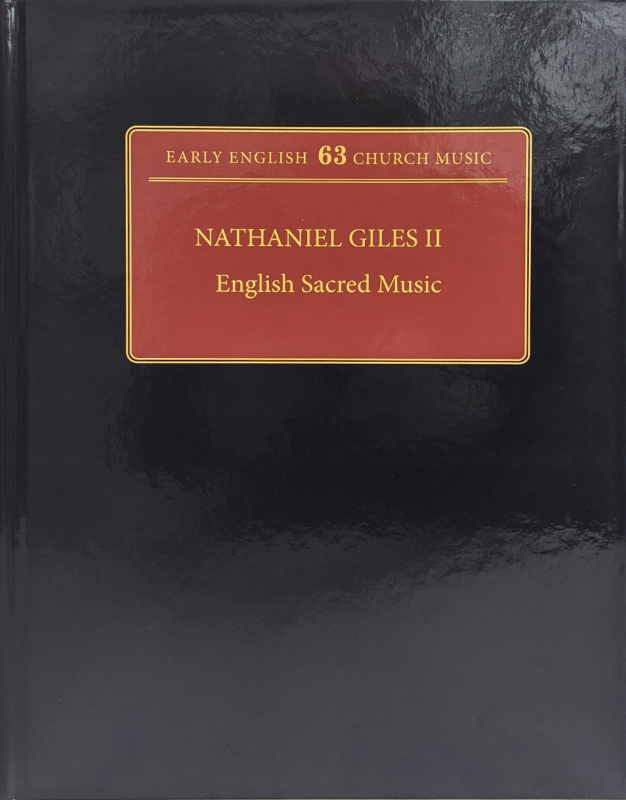
Nathaniel Giles: English Sacred Music

Early English Church Music [volume] 63
ISBN 978 0 85249 965 8 | ISMN 979 0 2202 2643 4 (Hardback)
xxx, 130pp. £70
Stainer & Bell

This second volume dedicated to the few surviving works of Nathaniel Giles (1558?–1634) contains service music. While presenting an edition of the First Service is straightforward, the Second Service can only be reconstructed from the surviving sources to within a certain degree of completeness and the editor Joseph Sargent has had to put his creative hat on for passages where the solo parts are not available, and the Short Service is very fragmentary indeed but both Sargent and the series editor, David Skinner, recommend their contrapuntal possibilities to would-be reconstructionists. After a detailed biography of the composer, Sargent surveys the sources and lays out his editorial approach. Then come detailed descriptions of the sources and a meticulous editorial commentary on the three services. Then to the music itself, laid out on pages larger than A4 size that can accommodate the up to ten voices (two five-part choirs – cantoris and decani, according to Anglican tradition) and the organ part(s). I had to do some brain juggling when systems were compressed and a voice from the lower group appeared in the middle of the combined groups, but generally the approach works. The added parts are printed in smaller notation. The paper is slightly shiny – I did not find that a problem but I have heard others complain about using such paper for music because it can sometimes catch light awkwardly and become difficult to read. I hope more than anything else that this marvellous tome (at another bargain price of only £70!) will encourage performances of the music – it very much deserves to be heard!

Brian Clark

Categories
Sheet music

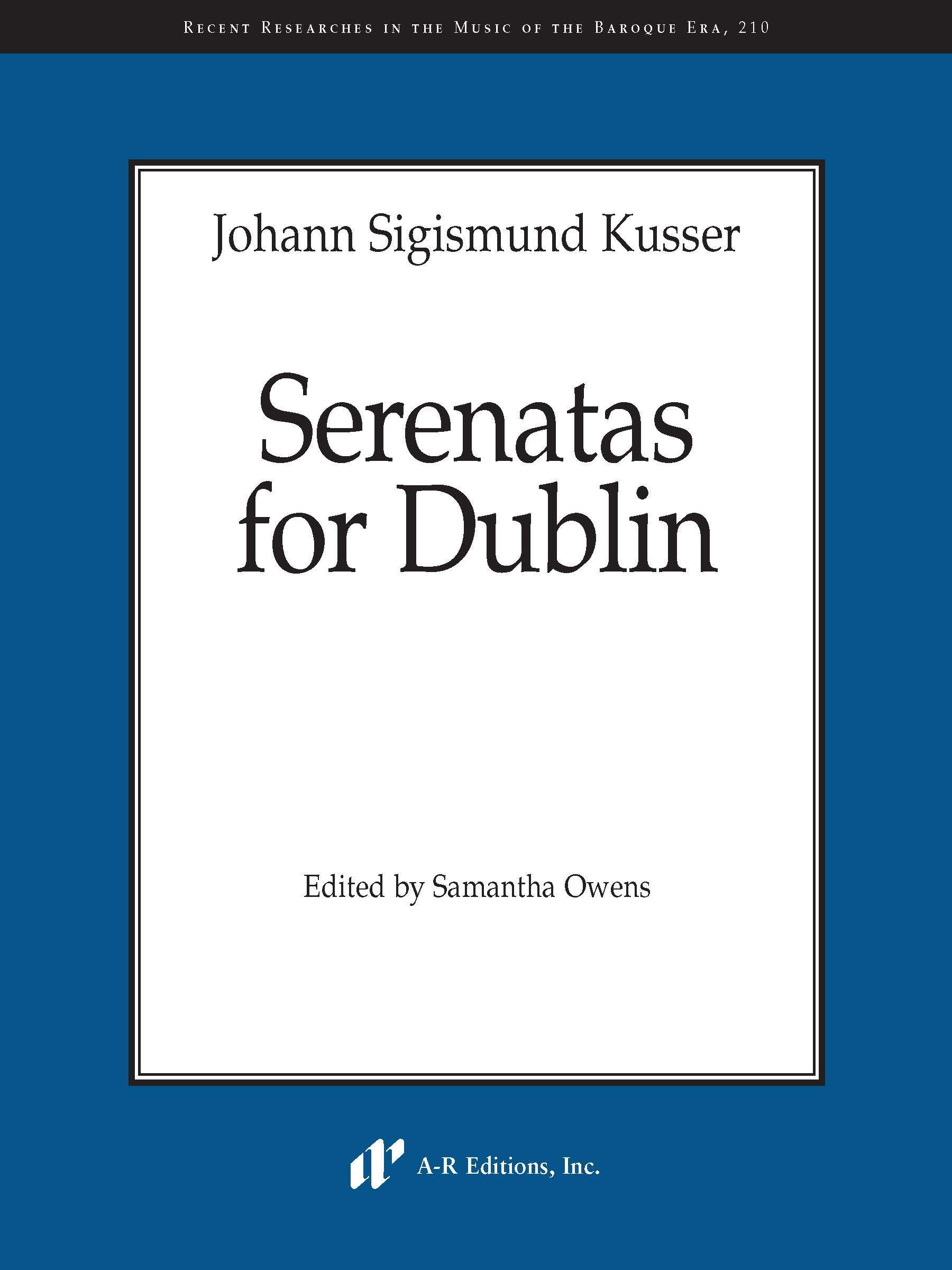
Kusser: Serenatas for Dublin

Recent Researches in the Music of the Baroque Era, 210
Edited by Samantha Owens
xxi, four plates, 262pp.
ISBN 978-1-9872-0450-6

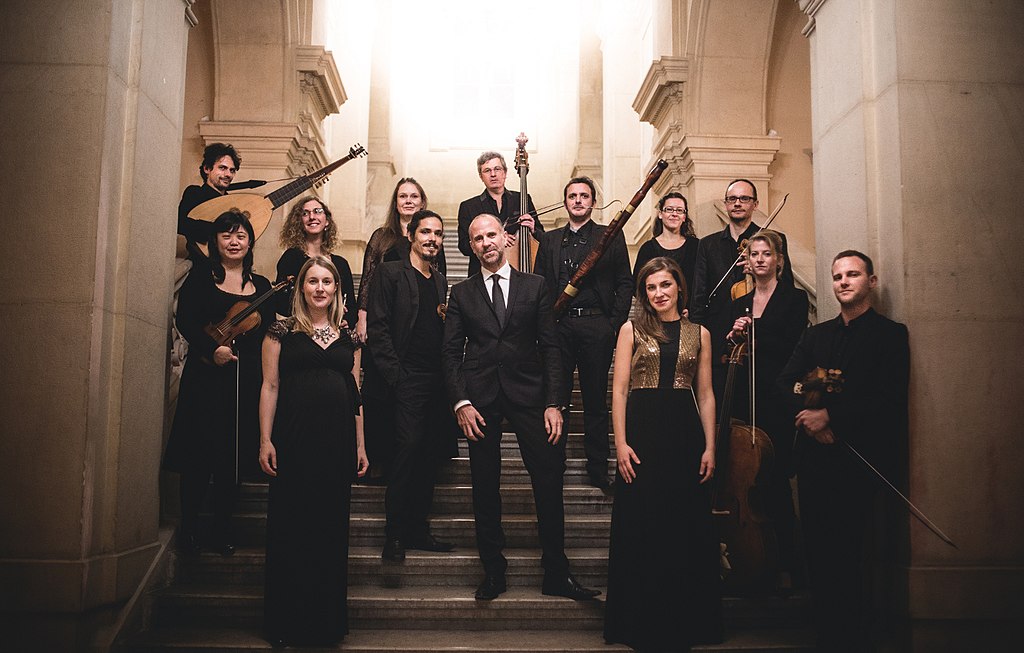
This is Samantha Owens’ latest contribution to the (long overdue!) rediscovery of Kusser’s music. It contains the three surviving serenatas (of 21!) that the composer wrote during his time in Ireland: “The Universal Applause of Mount Parnassus” (1711 for Queen Anne’s birthday), “An Idylle on the Peace” (1713 on the Utrecht settlement), and the rather oddly named “No! He’s not dead” (ca. 1707-14, again for Queen Anne). After a French overture, each is a sequence of recitatives, arias and choruses, many with colourful scorings displaying the versatility of the musical establishment in Dublin. The state pomp of the serenata on the Peace inspires the use of three trumpets, while the 1711 work calls for no fewer than nine solo sopranos. Many of the arias are built on dance forms, and Kusser reveals himself to be quite the tunesmith. He was also a self-borrower, here recycling arias from operas he had written in Germany. Two of the serenatas have recorded in full on Hungaroton, and portions of the other by the Irish Baroque Orchestra under Peter Whelan, both groups drawing out the charm of these neglected pieces. Hopefully the publication of this magnificent volume will inspire others to take up the challenge.

Brian Clark

Categories
Concert-Live performance Recording Sheet music

Paradise regained

If you are lucky enough to be in or near Lyon on 21 March, you shouldn’t miss the first performance in modern times of an oratorio by Luigi Mancia, who was maestro di cappella in Mantua at the end of the 17th century. If you like to find out more about its re-discovery in an anonymous manuscript in Lyon’s municipal library and hear extracts (including an amazing aria accompanied by three concertante cellos!) follow this link (in French!) The performance is expected to last one and three-quarter hours, not including the interval. Tickets are available here.

Categories
Sheet music

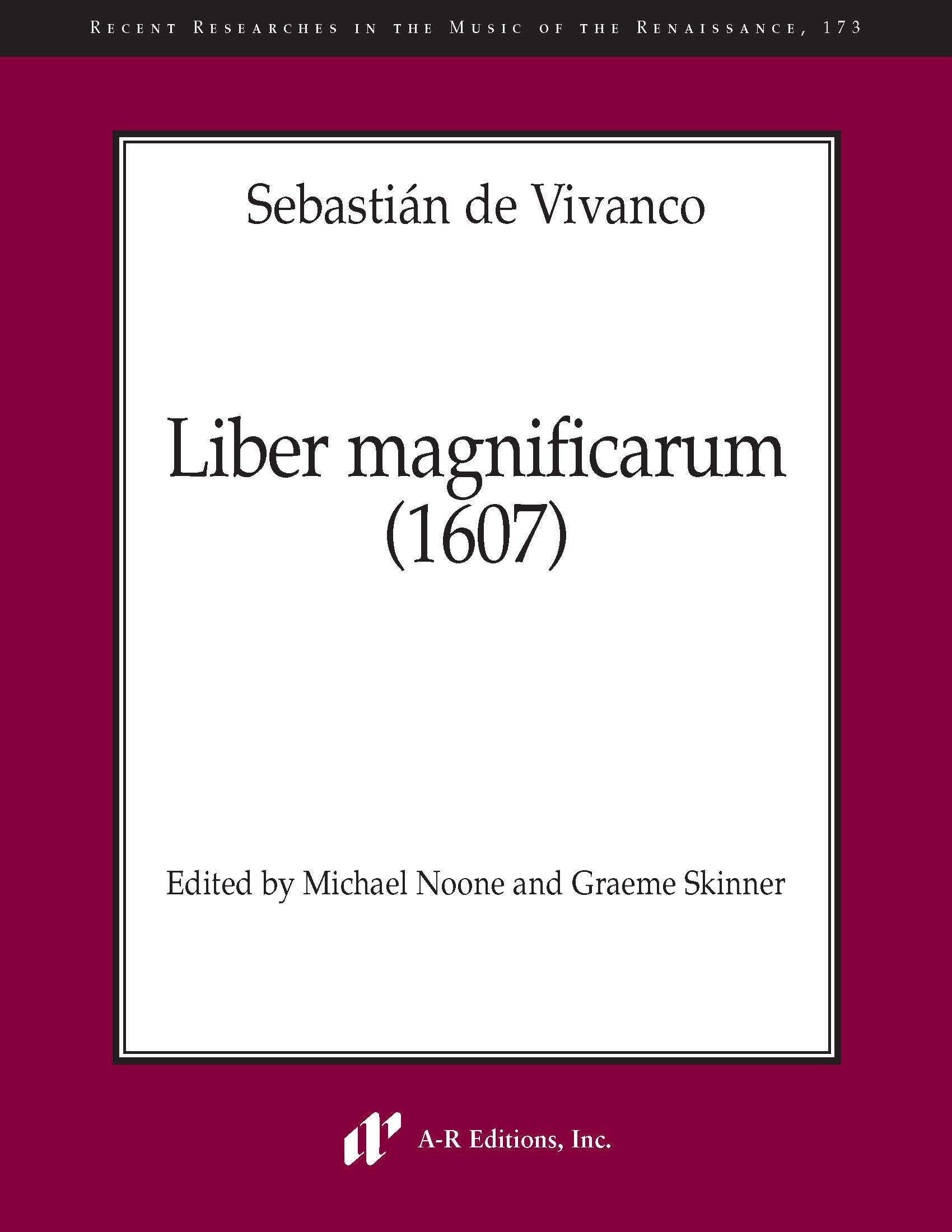
Vivanco: Liber magnificarum (1607)

Recent Researches in the Music of the Renaissance, 173
Edited by Michael Noone and Graeme Skinner
xxiii + 277pp.
ISBN 978-1-9872-0531-2. $360

Click HERE to buy this from the publisher’s website.
[PLEASE NOTE: This link is NOT sponsored]

Anyone who has studied Renaissance polyphony knows that composers of the period devised the most cunning contrapuntal devices to allow a musical phrase to be used and re-used simultaneously backwards and forwards, upside down, and in different note values, mostly without the listener even realising. If Sebastián de Vivanco has been somewhat overshadowed by his Avilan contemporary, Victoria, it most certainly was not on account of his polyphonic prowess. The present volume contains no fewer than 18 settings of the Magnificat (two in each of the eight tones, one setting the odd verses, the other the evens, plus two extras for the most popular 1st and 8th tones). Most are for four voices, but there are two for five, three for six, and one for eight. There are also two settings of the versicle to the Magnificat, “Benedicamus Domino” (one each for four and five voices, the former printed in no fewer than four different possible realisations of the canons). An appendix printed the three perpetual canons without texts and a three-voice canon on “Christum regem pro nobis” which form the frame to the portrait of the composer that appeared on the title page of the original Salamancan print.

If you plan to perform this music, you should be aware that even pieces indicated as being for four or five voices are not always exactly that; particularly the “Gloria Patri” sections throw in canons whose resolutions produce extra voices (up to eight) – in the case of No. 8 (a setting of the odd verses), this also involves the inclusion of other texts: the Vespers hymn, “Ave maris stella”, the antiphon at Lauds, “Ave Maria, gratia plena”, and “O gloriosa Domina”, a hymn also from the service of Lauds. Such polytextuality did not bother composers of the period, and this integration of them all into an already complex polyphonic texture is a real tour de force. The extraordinary cost of this volume is going to dissuade most choirs from exploring the repertoire, which is more than a great shame; since A-R Editions offer off-prints of each of the three masses in a previous volume, perhaps eventually they can be persuaded to make some of these works more practically available too?

Brian Clark