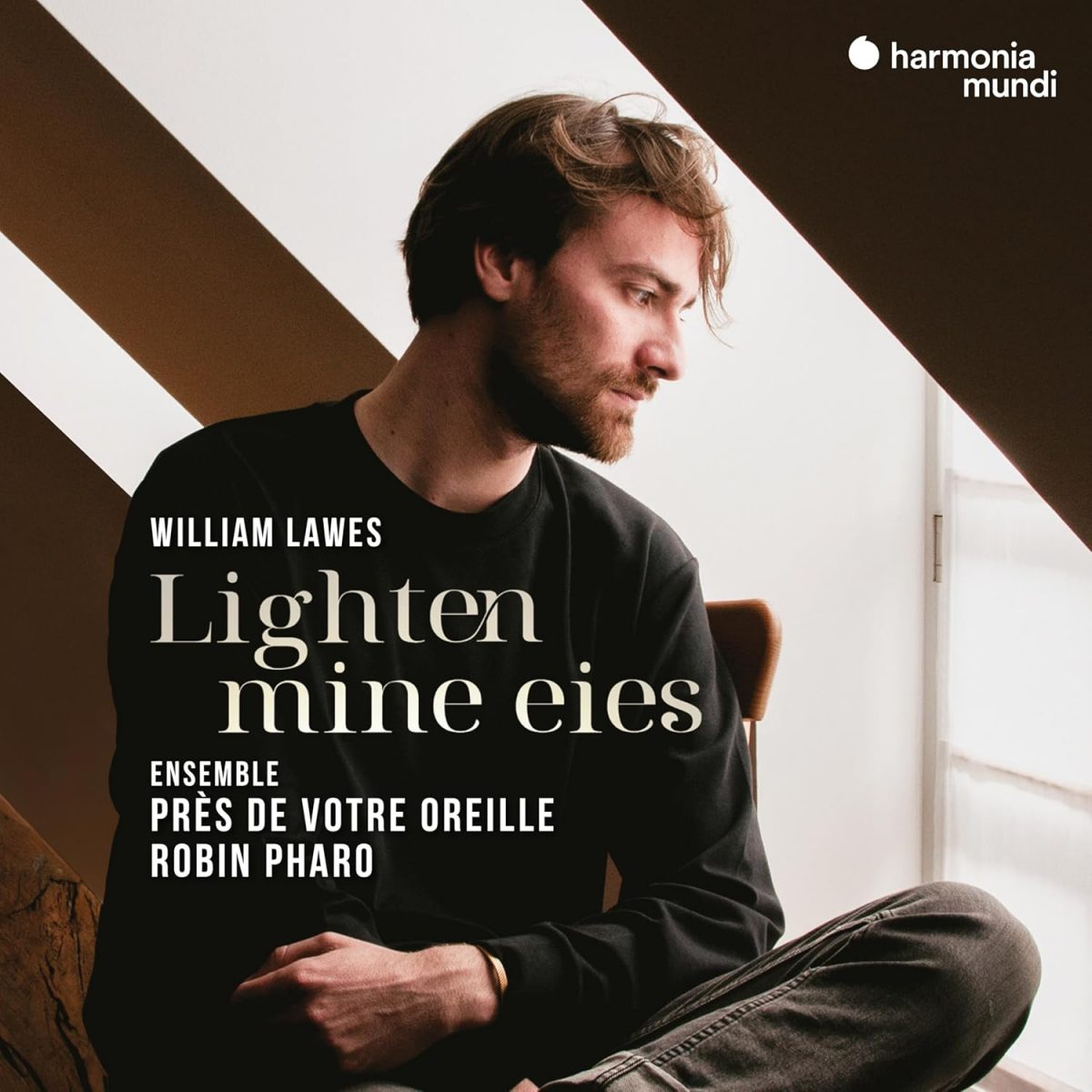
Ensemble Près de votre oreille, directed by Robin Pharo viola da gamba
62:19
harmonia mundi HMM 905391
There was a time when the idea of a French ensemble recording sacred and secular vocal music by William Lawes justaposed with instrumental ensemble pieces by the composer might have seemed unlikely, even bizarre. Yet such now is the predominance of French early music performers who have mastered not only the Baroque music of their own country but that of, for example, England, Germany or Spain. The ensemble founded by the gamba player Robin Pharo, which translates as ‘Ensemble Close to Your Ear’, lives up to its name by performing music of chamber-like intimacy that includes Byrd’s Mass for Four Voices, the major work they performed when I first encountered them at the festival based at Chateau d’Hardelot in the Pas de Calais. On that occasion, they performed the Mass with one voice per part, recognition of the many private – indeed secretive – celebrations of Mass that took place in the dangerous world of Elizabethan England.
The vocal line-up, different to the one I heard at Hardelot, includes soprano Maïlys de Villoutreys, Anaïs Bertrand (mezzo) and the splendid American bass Alex Rosen, currently one of the go-to singers in France. The programme is principally based around a selection drawn from 30 three-part Psalms published posthumously by Lawes’s brother Henry in 1648, which, along with a similar number of Henry’s own psalms, were published three years after William’s death, serving as a Cavalier at the Siege of Chester. Also included are several other songs including ‘Music, the Master of thy Art is Dead’, the elegy composed on the death of Lawes’s colleague and friend John Tomkins, organist of the Chapel Royal, and – by some way the longest item – the strophic song ‘O my Clarissa’, here given, as would have been intended, with each verse treated to adroit ornamentation, the whole sung by Maïlys de Villoutreys, who throughout brings her pure, bright-toned and characterful soprano to bear on the music in way that is never anonymously ‘white’. Much is made, too, of the psalm paraphrases, miniature masterpieces of a mostly penitential character that include starkly original harmonies within their condensed framework. ‘Ne irascaris, Dominus’, the only Latin text (taken from Isaiah 64), for example, is an extraordinary setting that closes with the deeply affecting line, ‘Jerusalem desolata est’. But all these settings belie their brevity by means of the density of musical thought.
Interspersed throughout are instrumental pieces, in the main selected from the collection known today as the Harp Consorts, among Lawes’s most intriguing and little-known instrumental pieces. There are thirty pieces arranged into dance suites and uniquely scored “For the Harpe, Base Violl, Violin and Thoerbo”. While maintaining the principle opf the dance suites, Lawes is here concerned with exploiting variation techniques, each work consisting of paired variations on dance movements by Lawes himself and others, They include three large-scale pavans for bass viol, including one (No. 10 in G minor) in which Lawes elaborates on a bass theme by Coprario that has recently been shown to include a quotation by another composer who also influenced Lawes, Alfonso Ferrabosco. Much scholarly debate has been devoted to the type of harp Lawes intended for this startlingly original music, the density of the writing suggesting either a double or triple. Here it is played on a opy of an Italian harp built by Simon Capp, an instrument perhaps like the “Arpa Doppia” Monteverdi specified in the score of L’Orfeo.
The Byrd Mass concert left some distinct reservations as to performance practice, but here there are none. Robin Pharo and his fine musicians have entered fully into the world of the enigmatic William Lawes to provide a vivid portrait of the composer.
Brian Robins