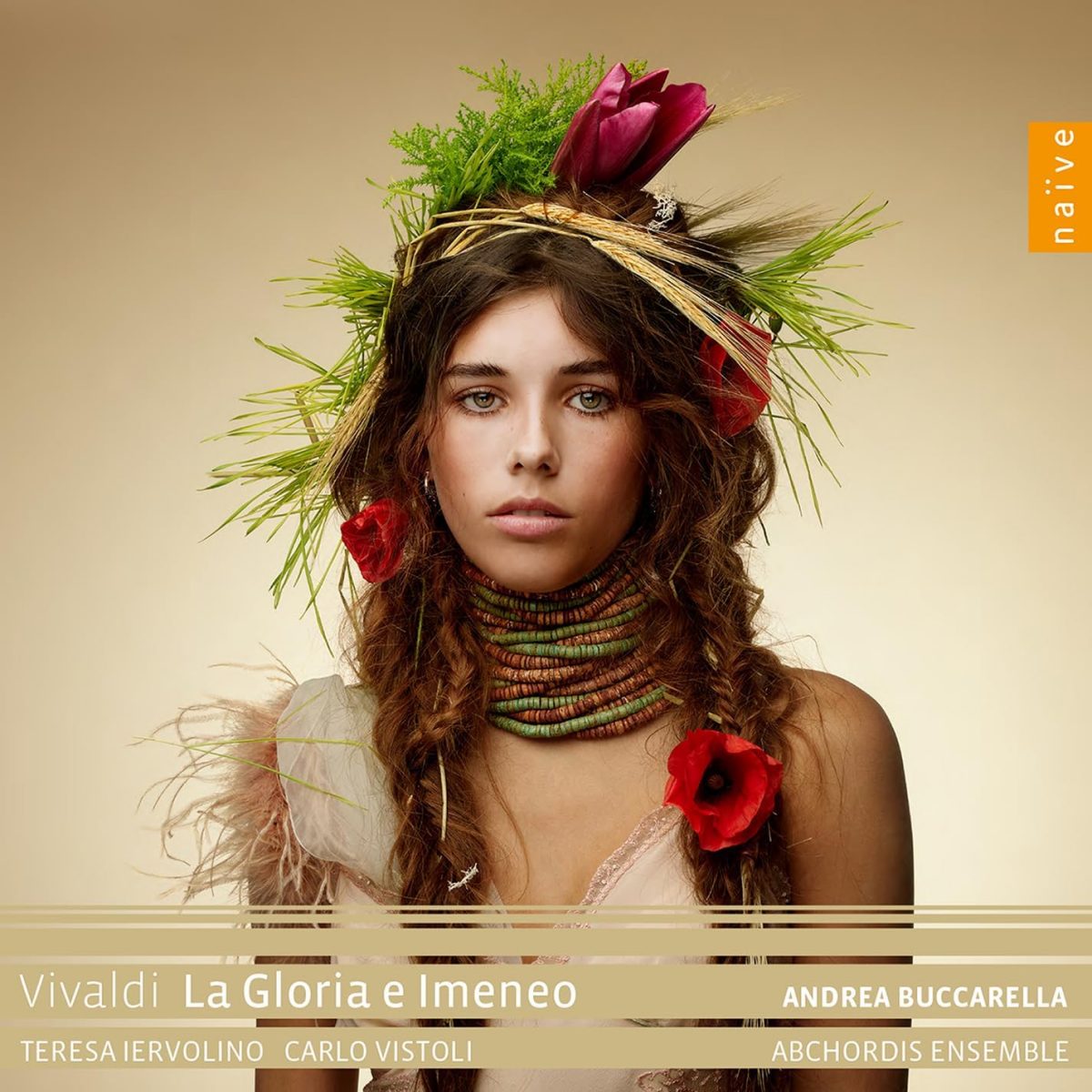
Teresa Iervolino mS, Carlo Vistoli cT, Abchordis Ensemble, directed by Andrea Buccarella
54:41
Naïve OP8877
La Gloria e Imeneo belongs to a category of occasional works termed serenatas that were widely employed in the 17th and 18th centuries to celebrate events such as royal or noble weddings, birthdays, name-days and so forth. The marriage of Louis XV to the Polish princess Maria Leszczy in September 1725 inspired widespread celebrations not only in France, but also among French communities elsewhere, such as Venice. Here they were organised by the recently-installed French ambassador Count Jacques-Vincent Languet, the performance of the work commissioned from Vivaldi taking place in a loggia at the end of the garden at his residence, known as the Palais de France.
Vivaldi composed eight serenatas for this kind of tribute, three of which are known to survive today. Typically, they were semi-dramatic works for two or three usually allegorical characters (La Gloria has just two, Gloria (Glory) and Hymen (Imeneo), the god of marriage) who, between them, attempt to eclipse each other in a stream of panegyrics expressed in alternating recitatives and arias. Most were constructed in two parts, with an interval during which guests would be served refreshment, but La Gloria has no such break. The text – that for the present work is anonymous – was characteristically cobbled together by a court poet or similar. Given that by definition serenatas were ephemeral, it was not unusual to find composers drawing on previous works or re-using material in subsequent compositions. La Gloria has examples of both, including Vivaldi’s recent operas Giustino and Il Tigrane (both Rome, 1724) and La Silvia (Milan, 1724), while two numbers would find their way into the more elaborate serenata La Senna festeggiante, composed the following year, probably for the name day of Louis XV.
Regular visitors to this site will be accustomed to my general praise for Naïve’s magisterial Vivaldi edition, of which the issue at hand is vol. 73. With a project this size recorded by a widely varied contingent of artists obviously not all the recordings will be of the highest order, although the overall quality – once a few early problems had been iron-out – has been astonishingly high. Regrettably, this new issue is unlikely to be included among the most memorable of the series. The principal problem is the inflexible, unbending direction of the string ensemble that, in this case, forms the membership of the Abchordis Ensemble. As would be expected in a work of this kind, the majority of the arias are quick; here given Buccarella’s propensity for extremely brisk tempos they frequently take on a relentlessness that is tiresome, a feeling exacerbated by the endless plucking of lute chords and arpeggiations. Indeed, the lute’s contribution to the continuo in this kind of work is in any event contentious.
For the singers works such as this pose particular problems, since to convey texts that are paeans whose endless flattery of its subjects is of little or no interest to a modern listener takes particular skills that neither singer here possessed or is at least allowed to demonstrate. Originally probably intended for castratos, Gloria is here sung by Teresa Iervolino, a mezzo, albeit one with a bronzed timbre that in the lower register has tonal colours more associated with a contralto, while Imeneo is sung by Carlo Vistoli, one of Italy’s best-known counter-tenors. While both sing well enough, contending efficiently with extensive passaggi that frequently require bravura treatment, they are never allowed by the director to be truly expressive or communicative to any significant degree. Embellishment is at a minimum, while any hope of hearing something as exotic as a trill is soon abandoned. Just how uninteresting the performance is can be demonstrated by turning to Robert King and his splendid Vivaldi series (Hyperion), where La Gloria e Imeneo is coupled with La Senna festeggiante on an excellent two-CD set. There, while we are obviously still stuck with the stilted text, at least an effort is made to bring colour and expressive life to some fine music.
Brian Robins