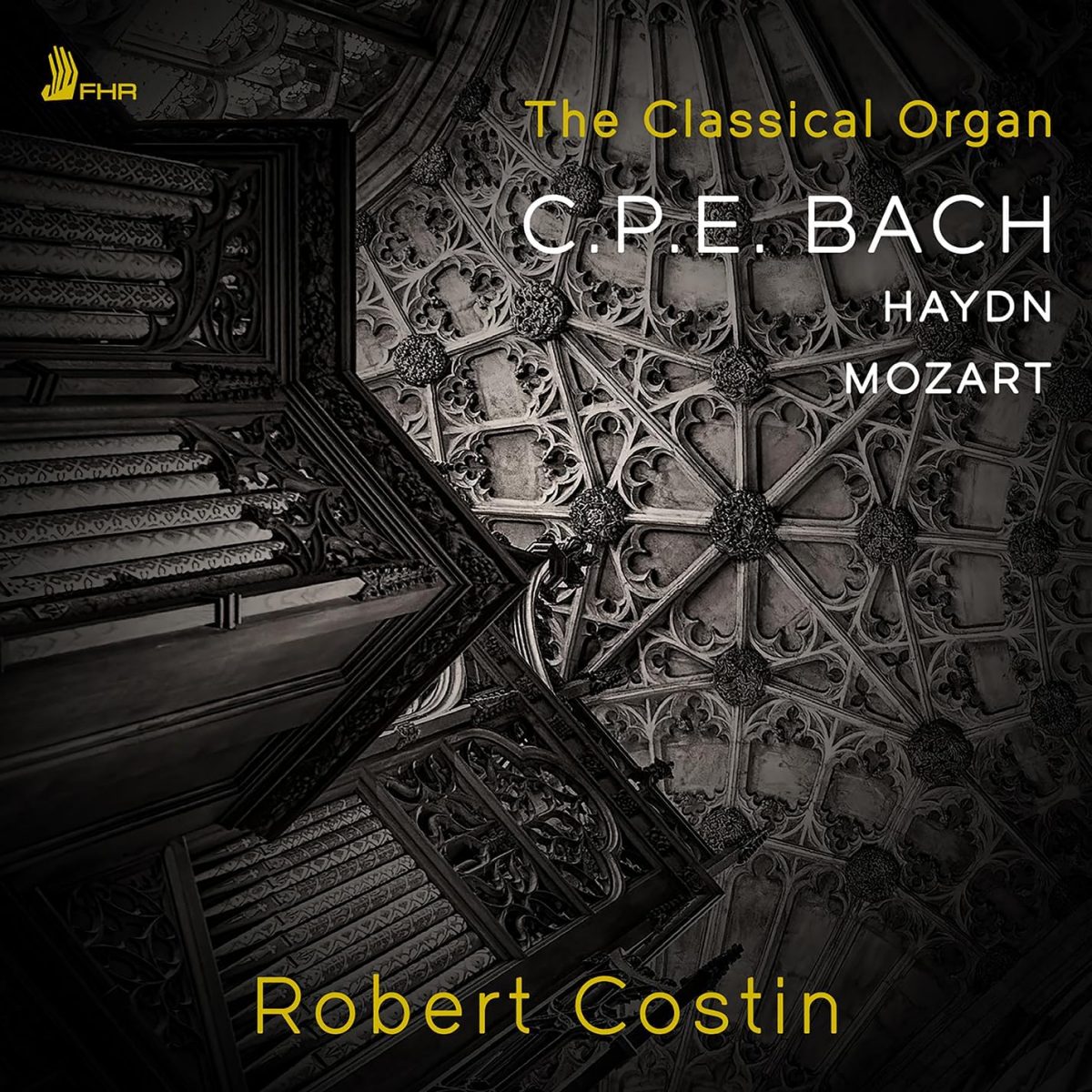
Robert Costin
79:47
firsthandrecords FHR 173
These accounts of five of CPE Bach’s Wq 70 Sonatas with a selection of fillers for mechanical clock by Haydn and Mozart are played by Robert Costin on the organ of Sherborne Abbey. Originally built in 1856, this Gray & Davison instrument has undergone extensive adaptation over the years, including having its mechanism adapted to electro-pneumatic action and back again to purely mechanical action! Built over fifty years after the deaths of the featured composers, it doesn’t seem like an obvious choice for this repertoire, and it seems unlikely that the classical period composers would have had anything like the choice or types of stops available to Robert Costin. In this respect we are very much in the player’s hands regarding the appropriateness of the timbres he has chosen, and I have to say I am not always entirely persuaded of the authenticity of the sounds chosen here – exacerbated by the generous acoustic, this recording sometimes sounds to me like a Victorian interpretation of classical period music, often sounding a little bit overblown, like later ‘improvements’ on the scores of Handel and Bach. The CD notes suggest an association with Princess Anna Amalia of Prussia, sister of CPE Bach’s patron, Frederick the Great, and a musician and composer in her own right, who had an organ installed in her living room in the same year as Bach published his Sonatas. While Bach’s music would also have been intended to meet the growing demands of the concert hall, I think that this inventive music would sound much more effective with the focussed timbres of a smaller instrument. This mismatch of material and instrument comes even more into focus in the slighter repertoire for mechanical clocks, which concludes the CD. While I would personally have preferred the sounds of a less portentous instrument for these Bach Sonatas, Robert Costin plays with refinement and elegance, and we are given a very full account of the details of the chosen instrument. Incidentally, the first of the Bach Sonatas is omitted as it does not appear in the composer’s catalogue – this seems an odd decision as this missing sonata would clearly have completed the set of six Sonatas and filled the CD without resorting to the unrelated and more trivial music for mechanical clock.
D. James Ross