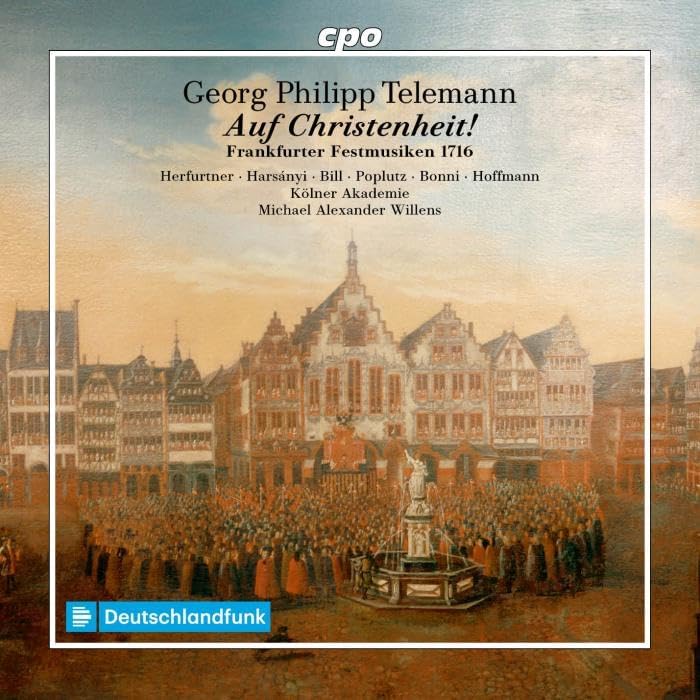
Frankfurter Festmusiken 1716
Soloists, Kölner Akademie, Michael Alexander Willens
142:35 (2 CDs)
cpo 555584-2
Sometime around the beginning of 1712, Telemann wrote an application to the Frankfurt free city authority to apply for the post of director of music, stating in the process that he wished to ‘quit court life [he had been employed by the Eisenach court since 1708] and take up a quieter one’. He was appointed to the post in March. In Frankfurt, Telemann’s brief was not dissimilar to that of Bach in Leipzig, including composing church music and occasional works for civic occasions. Of these, almost certainly the most lavish were those celebrating the birth of the Hereditary Prince Leopold to the Habsburg Emperor Charles VI and the Empress Elizabeth on 13 April 1716, an event of great political significance since Leopold became the much-longed-for heir apparent to the Holy Roman Empire, hopes dashed only months later when the baby died in November. (A daughter, Maria Theresa, would become the first Empress to rule).
Plans for Frankfurt to celebrate were set on foot for May 17, Telemann being commissioned for a sacred work to words by Georg Pritius, the preacher of the sermon. The resultant work, ‘Auf Christenheit begeh ein Freudenfest’ (TWV 12: 1a/b), was planned on a suitably lavish scale, with full scoring including three trumpets and timpani. It is cast in two parts, the first to be given before the sermon, the second after. In that sense it follows the plan of many of Bach’s cantatas, but in others it varies considerably, not least the extensive use of accompanied recitative (accompagnati), often used to colourful effect including obbligato parts, particularly for oboe, for which Telemann had the participation of the Berlin virtuoso Peter Glösch in addition to a strong line-up of vocal soloists, some brought in from the court at Darmstadt. The arias are mostly of the strophic or through-composed type and are without exception full of incidental delights and colourful scoring. The entire work is indeed a joy, here enhanced by splendid singing from the soloists, all of whom deserve mention: Hanna Herfurtner and Elena Harsányi (sopranos), Elvira Bill (alto), Georg Poplutz (tenor), and Thomas Bonni (basss), the last named particularly characterful. The chorus consists of the same voices. This entrancing work is directed with idiomatic élan by the experienced Michael Alexander Willens,* it being worth adding that those concertante oboe parts are throughout superbly played by Katharina Andres.
As if this treat in wasn’t enough, festivities continued with a banquet for those entitled to attend and more plebeian celebrations – including military shows with cannons, etc. –for those that weren’t. In the evening, those still on their feet attended an open-air performance of a large-scale serenata by the city’s director of music, who it seems may have suggested it himself (what price a ‘quieter’ life!). In keeping with such festive works, the characters of Deutschland grünt und blüht im Friede (TWV 12:1c) are mainly allegorical, there being no dramatic content. The scoring is even more sumptuous than that of the church work, its forces being supplemented by a pair of horns and three (!) bassoons, while the choral writing is in eight parts, a point rather amusingly brought into the text by the chorus. In contrast to the church music, the arias are mainly in the expected da capo form, with plain recitative rather than accompagnato. Following an extended five-movement concerto, Germania and Irene reflect on the joys of the peace that has descended on German territories, articulating the relief felt by the respite from war, respite attained in the wake of the peace treaties agreed at the end of the War of the Spanish Succession. The mood set, articulated in an aria like Germania’s ‘Mein reich lebt in vergnügter Ruh’ (My realms live in happy peace), veers between the exuberant and more reflective, characterised by an alternation of cantabile writing – here beautifully sustained, if at the expense of diction, by Herfurtner, who also deals expertly with more florid episodes. Later, Mars – a role sung by Bonni with humour and gusto – appears on the scene but promises he’ll leave Germany in peace. The City of Frankfurt endorses the sentiments of Germania and Irene, which are further enhanced by the appearance of Mercury, bringing the news of the birth of the child that will ensure peace. The work ends with military splendour and the firing of cannons, reproduced on the recording. If perhaps not quite on the same level as the church music, the serenata is again an irresistible example of Telemann’s wonderfully fecund compositional skills. As with ‘Auf Christenheit’, the performance is near-exemplary and utterly compelling.
We’re told that the performance that May night was so successful that it was repeated not just once, but twice, which is extraordinary given that the work runs 90 minutes. Even more surprising is that Telemann revived the serenata when music director in Hamburg in 1733, a fate almost unheard of for an occasional work such as this, but fully deserved in this case. There are not many occasional works that have outlasted the occasion.
Brian Robins
One reply on “Telemann: Auf Christenheit!”
Addendum.
Forgot to mention, the mighty and cogent setting of the “Brockes-Passion” (1716) by Telemann was given 2nd & 3rd April, at the Barfuesserkirche in Frankfurt, and deployed the “imported” musical forces of the Darmstadt court, as with this birthday ode… reputedly nearly 100 Musicians?