Categories
Recording

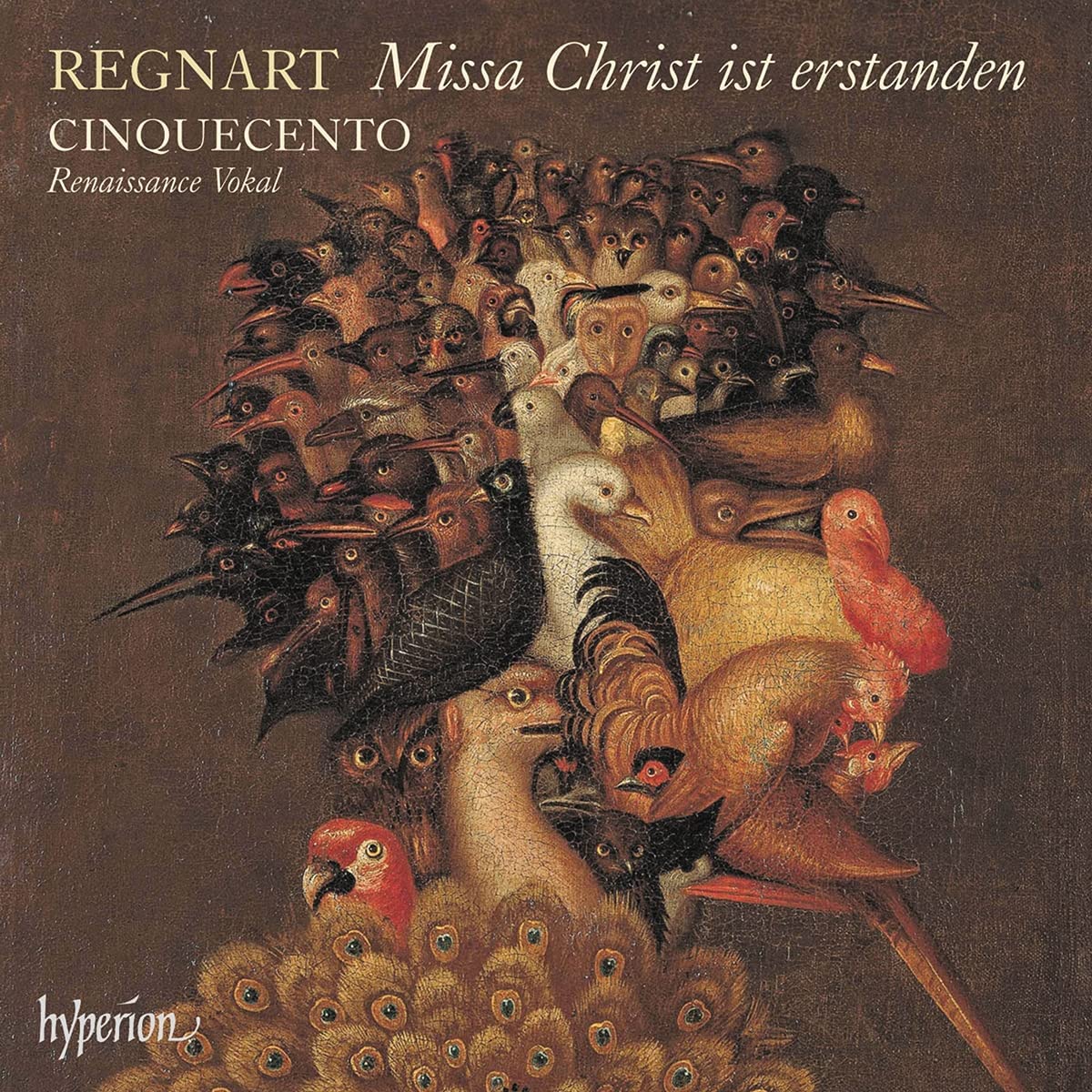
Regnart: Missa Christ Ist Erstanden

Cinquecento Renaissance Vokal
64:45
hyperion CDA68369

Click HERE to buy this recording on amazon.co.uk
[These sponsored links support the artists and the record company, and help the site remain alive and FREE!]

Having been poleaxed by the way Cinquecento’s excellent singing complemented the excellence of Isaac’s music on their previous release but having been less impressed by their previous disc of Regnart (2007), I approached this recording with circumspection. None required. Like the former, it is another superb recording of revelatory music. Regnart’s praises were being sung over four hundred years ago by none other than Lassus. Like the rest of us, the greatest creative artists can reveal lousy taste, or speak up for an untalented friend, or favour someone inferior to make themselves seem even better, but Lassus, about ten years Regnart’s senior, was bang on the money when he came to recommending him for advancement.

The two masses that take up most of this programme are best heard after the little hymn tunes on which they are based. In both cases, Regnart’s varied treatment of the tunes within his masses makes for two outstanding compositions; listening to them is spiritually rewarding and an aesthetic pleasure. This is well exemplified in the Gloria of Missa Christ ist erstanden. There is some fine sequential writing approaching the movement’s first close at “Patris”, followed by a well-judged slowing of tempo to a sumptuous cadence on “miserere nostri”, and an extended Amen brings the movement to a close with another gorgeous cadence. There are fine moments in other movements, with an excellent passage for three of the five voices in the Credo at “et iterum …”, and another striking cadence in the Sanctus at “tua”. Missa Freu dich is no less distinguished. The Credo is notable for some animated syncopation in the “Crucifixus” section, with further rhythmic vitality approaching the end of the movement. The Sanctus ends with a climactically high note on the last word “tua” for the countertenor. Perhaps most to be relished is the Agnus, with exciting dissonance at “peccata mundi” and a lovely cadence on “nostri”, repeated, to round off the entire disc, on “pacem”.

The three fillers are well chosen. Maria fein, du klarer Schein is a beautiful sacred song in five parts, while the other two works are later contrafacta of what were originally “light Italian love songs” according to the excellent notes by Erika Supria Honisch. She informs us that Ruhmbt alle Werck was originally “Vorrei saper da voi”. For those who are interested, the original of Wann ich nur dich hab was “Tutto lo giorno”, 1574.

This is a disc of glorious polyphony, especially memorable for its undulating phrases, sung superbly by Cinquecento, with not only a feeling of bracing air between the individual parts, but also, where appropriate, concentrated warmth during deeper sonorities.

Richard Turbet

Categories
Recording

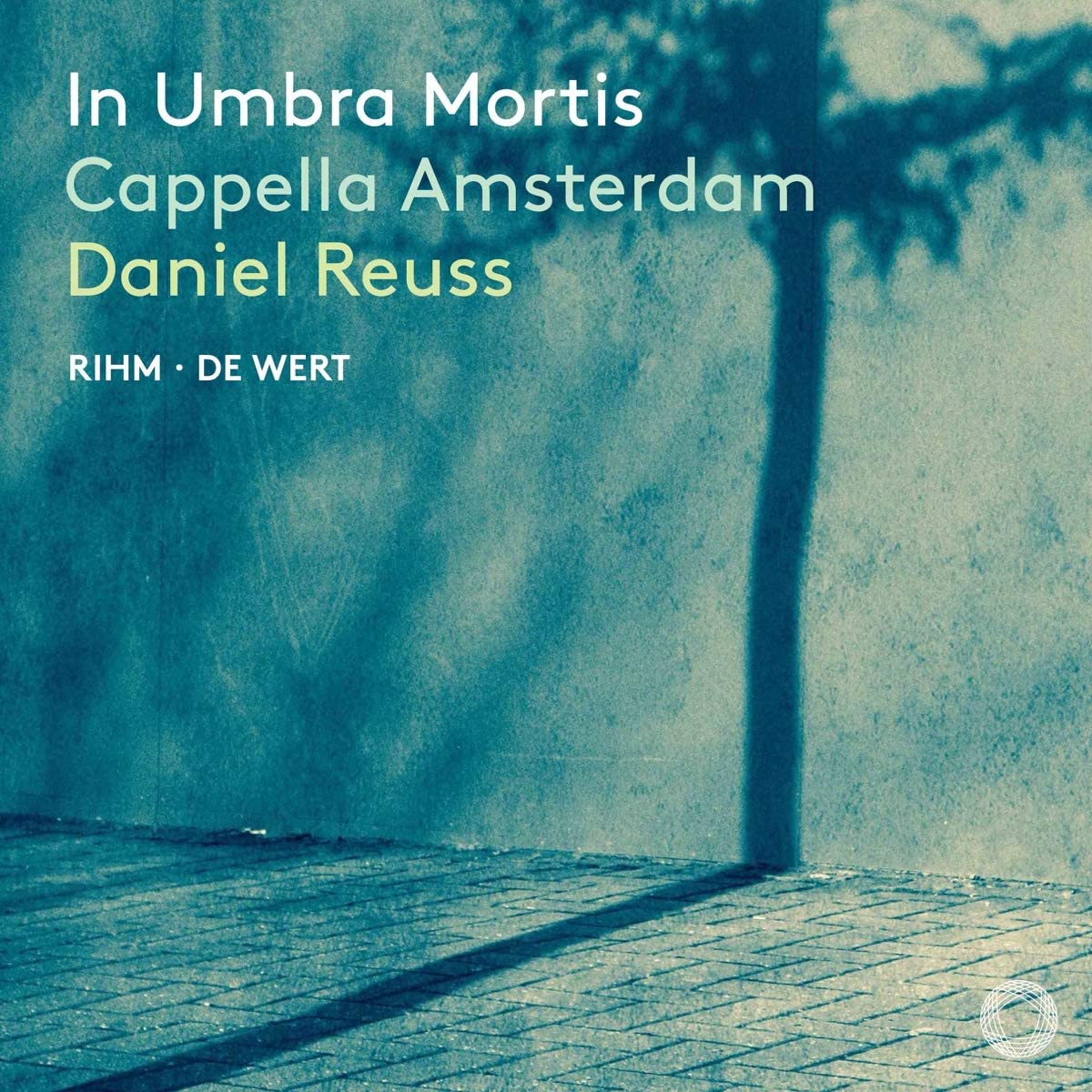
In Umbra Mortis

Cappella Amsterdam, Daniel Reuss
Rihm – De Wert
57:32
Pentatone PTC 5186 948

Click HERE to buy this on amazon.co.uk
[These sponsored links help the site remain alive and FREE!]

This programme alternates music by the contemporary German composer Wolfgang Rihm (b.1952) with that of the Renaissance master Giaches de Wert (1535-96). As the programme note observes, the music is ‘intertwined’, as we pass rapidly from early to contemporary music, inviting direct comparison. The choice of composers is inspired – Rihm’s idiom is firmly rooted in the Renaissance, while Wert’s seems to exhibit a prescience of modern harmonies. Rihm’s music is his Sieben Passions-Texte (2001-6), a considerable masterpiece, powerfully sung here by an ensemble of 24 voices. With a choir of this size, one of the main issues is blend, and this is achieved with an astonishing consistency here. The added power of the relatively large number of voices is palpable, and it is interesting that while the overlap in personnel with the smaller ensemble who sing the de Wert is considerable, the latter is not simply an offshoot of the former. The five- and six-part motets by de Wert, also penitential in mood, demonstrate his daring use of chromaticism and consummate mastery of structure. Such juxtapositions of repertoire are not always successful, but this one has been so carefully considered and superbly executed that both repertoires benefit from the encounter. I have one tiny reservation – there is a degree of background ‘clomping’, which may annoy some listeners. I found it distracting to start with, but soon forgot it in my enjoyment of this remarkable music.

D. James Ross

Categories
Recording

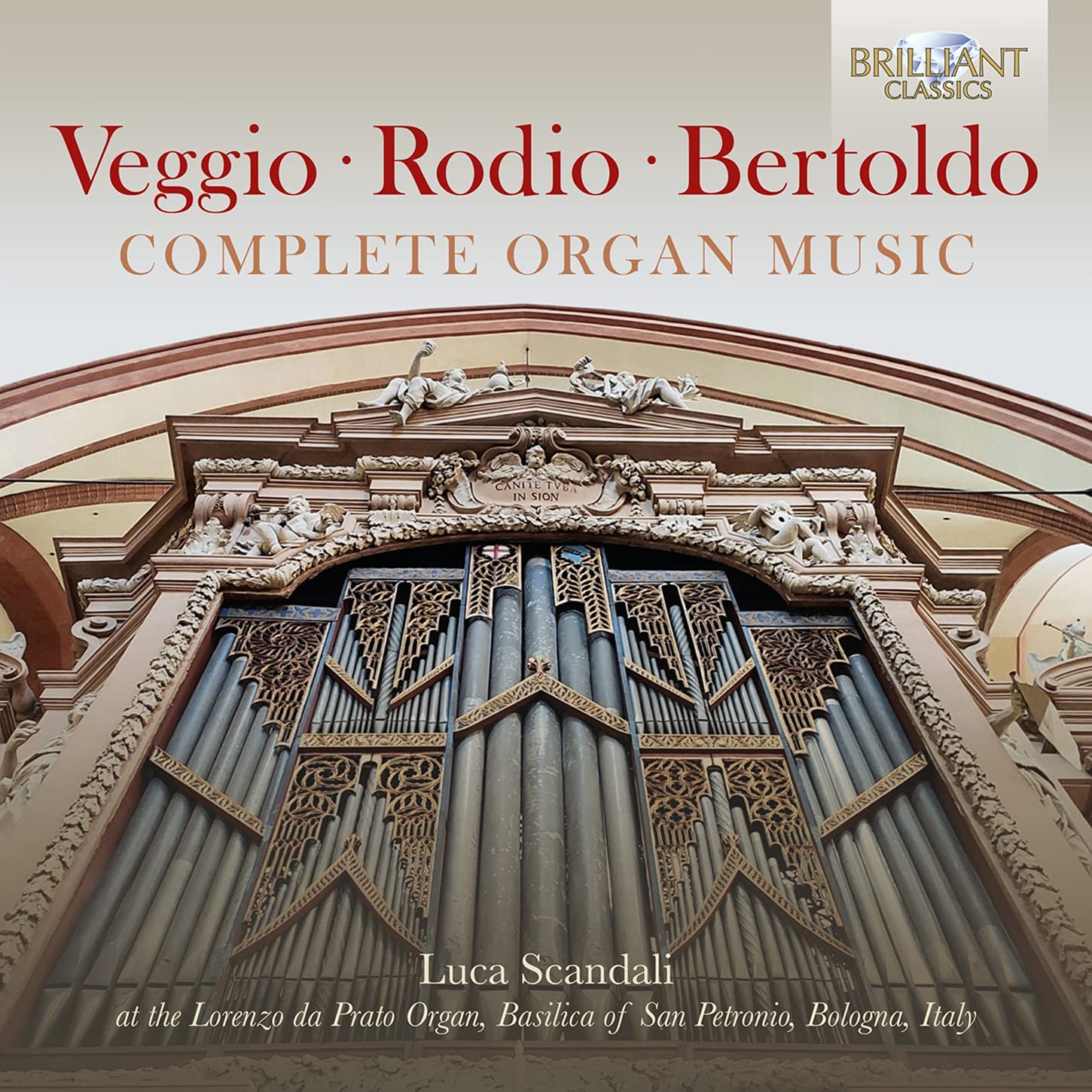
Veggio · Rodio · Bertoldo: Complete Organ Music

Luca Scandali Lorenzo da Prato organ, San Petronio, Bologna
98:42 (2 CDs in a single jewel case)
Brilliant Classics 95804

Click HERE to buy this on amazon.co.uk
[These sponsored links help the site remain alive and FREE!]

The recent untimely death of Liuwe Tamminga has deprived us of a fine organist who spent many years officiating at the Lorenzo da Prato organ in the Basilica of San Petronio in Bologna, the instrument at the centre of these two CDs of music by three little-known Italian composers from the middle of the sixteenth century. One of the oldest surviving organs, it was built in 1471-75 and added to in 1531. Luca Scandali studied with Tamminga and with the latter’s predecessor and mentor, Luigi Ferdinando Tagliavini, so he knows the instrument well and makes very good use of its full range of stops. It can make a very big sound and the Basilica’s acoustic is also big – the reverberation continues long after final chords are released – but the recording engineers have coped very well here. Scandali shows a keen affinity with his repertory, maintaining a good sense of flow while showing considerable flexibility in individual lines and sections.

Not much is known of Claudio Veggio, the earliest of the three featured composers; all his surviving keyboard music can be found in a single manuscript housed in Castell’Arquato (situated between Piacenza and Parma). Scandali plays six ricercars (one of which he has also completed), as well as an attractive canzona intabulation. The ricercars are impressive pieces, two of them quite extended in length. They tend towards imitation by homphonic blocks, rather than by single voices, and come across rather more like intabulations than ricercars.

Rocco Rodio came from Bari but worked in Naples, where he was a contemporary of composers such as Diego Ortiz, Bartolomeo Roy and Jean de Macque in what was a cultural melting pot, leading to a flourishing school of keyboard composition. His only volume of keyboard music, published in 1575, is the first known to have been printed in open score. It contains five extended ricercars, interspersed here with three fantasias on well-known plainchant themes, plus one on La Spagna. The ricercars are imaginative pieces which go in some unexpected directions. For the fantasias, Scandali is joined by sackbut player Mauro Morini who plays the long note cantus firmi. I am in two minds about this: while it does help to bring out the chant for modern audiences not familiar with it, it gives an undue emphasis to the cantus firmus, which was not necessarily intended to be heard, with the sackbut at times overpowering the other voices in the texture.

Sperindio Bertoldo came from Modena but spent most of his life as organist at the Duomo in Padua. He has left just three ricercars, more conventionally imitative than those of the other two composers here. They are interspersed with two toccatas and five French chanson intabulations. The toccatas are a particularly good showcase for full organ, while the canzonas are rich with sprightly figuration and are used to exploit its range of stops. This recording represents an attractive compilation of music by three relatively unknown figures, serving to showcase what was already a flourishing Italian organ music scene between c. 1540 and c. 1575, before Claudio Merulo and the Gabrielis came into their stride. Scandali’s enthusiasm for the repertory shines through and I enjoyed listening to it very much.

Noel O’Regan

Categories
Recording

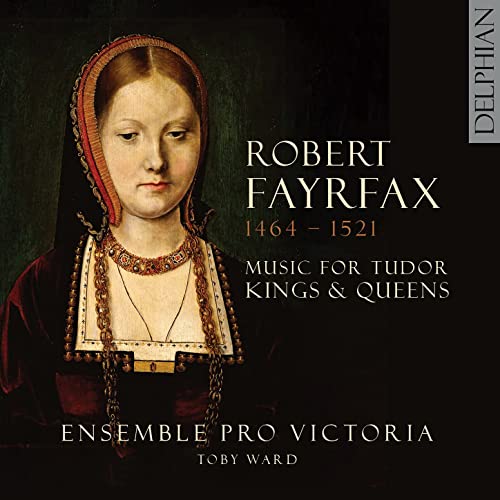
Fayrfax: Music for Tudor Kings & Queens

Ensemble Pro Victoria
67:07
Delphian DCD34265

Only digital available for now – you can pre-order it HERE.
[These sponsored links help the site remain alive and FREE!]

Oh hooray! Somebody is commemorating the quincentenary of the death of Robert Fayrfax, one of England’s, and the world’s, great composers. Nobody begrudges the attention lavished upon Josquin Despres, the quincentenary of whose passing also falls this year, but Fayrfax is likewise a musical colossus, and these two men are more than equipped to be named together in the same sentence. Although nearly all the pieces on this disc have been recorded before, the selection of material makes for a fascinating programme, and it benefits from being performed by one of Britain’s finest young vocal ensembles, who in turn are supported by musical scholarship of the highest order, led by Magnus Williamson.

The said programme consists of all seven secular songs by Fayrfax which survive intact, one for two voices, the rest for three; three relatively well-known Latin works – Magnificat Regale, Salve regina and Maria plena virtute; and two more Latin works which have required heavy reconstruction – Ave lumen gratiae and the Credo from the Missa Sponsus amat sponsam. This last-mentioned work is the only premiere recording on the disc. (A different edition of the first half of Ave lumen appears on ASV CD GAU 160 sung by The Cardinall’s Musick. Strangely, although a reconstruction of the second half of the motet is sung on the present disc, only the text of the first half is provided in the booklet.) The mass survives in a seriously fragmentary state, spread around several sources, one of which is a lutebook. With major surgery, all the movements have been rendered in a performable, if necessarily provisional, condition edited by Roger Bray, and are available as such from Stainer and Bell. Seemingly the Credo is “the least incomplete movement” (email from Magnus Williamson to the reviewer) and so this was chosen to give some indication of what this intriguing and significant mass might have sounded like in contemporary performances both formal and domestic. Magnus explains in the booklet how he has built upon the initial work of Roger Bray to provide the form of the movement sung and played here. His perceptive and convincing theory about the origin and subsequent history of the mass is also set forth.

The programme is well constructed. This is the first commercial disc to include all of Fayrfax’s surviving songs, which are interspersed among the longer Latin works throughout the recording, which is topped and tailed by two of his finest and best-known liturgical pieces. The Mary antiphon Maria plena virtute concludes the record, one of the most impressive works in the entire Tudor repertory and one that sounds advanced for its time; it is not surprising that in one source it is attributed to Taverner. Probably it is one of Fayrfax’s latest works, composed after he had entered royal service in 1504. Beginning the disc is the Magnificat Regale, among his most recorded works and one of the three works by Fayrfax that survive from the Eton Choirbook. Originally there were six of his works in this magnificent manuscript, but three have been lost altogether; the Magnificat has also been lost from the Choirbook but survives intact elsewhere, Ave lumen gratiae has required the comprehensive reconstructive attention mentioned above, and only Salve regina survives intact in the Choirbook itself. The fact that all three surviving works are included on this disc is another instance of a group of linked works being included on this same record for the first time. The programme is completed by the Credo from the Missa Sponsus amat sponsam which was also mentioned above.

The members of Ensemble Pro Victoria (EPV) patently have their own clear overall concept of Fayrfax’s music. Their sound is radically different from that of The Cardinall’s Musick (TCM) who have recorded – sublimely – nearly all these pieces. EPV sound grainier, with individual voices exhibiting more vibrato except in some extended full passages during the longer Latin liturgical pieces. That said, the Credo sounds almost as though it is barked in certain places. The classic song Sumwhat musyng provides a concise illustration of their different stylistic approach from that of TCM, EPV’S fraught delivery conveying an emotional depth on a par with TCM’s introverted contemplation. One could say that where their repertories coincide, TCM’s interpretations tend to be otherworldly, while those of EPV are of this world. The standard of singing in both cases is very high, and individual preference among listeners might come down to a greater liking either for the ethereal or for the earthly (or even at times earthy). But Fayrfax’s works are great and marvellous enough to withstand varied interpretations, so owners of some or all of TCM’s five Fayrfax discs (Gaudeamus CD GAU 142, 145, 160, 184, 185) could well find EPV’s different approach to Fayrfax rewarding, besides the presence of one and a half Latin works not recorded by TCM. The measured intensity of The Cardinall’s Musick might just suit this music slightly better, but the Ensemble Pro Victoria plough their own furrow with a passionate engagement that does no great disservice whatsoever to Fayrfax’s transcendent music.

Richard Turbet

Categories
Recording

Andrea Gabrieli: Motets & Organ Works

Weser-Renaissance, Manfred Cordes
69:07
cpo 555 291-2

Click HERE to buy this recording on amazon.
[Doing so is your only way to help keep the site alive!]

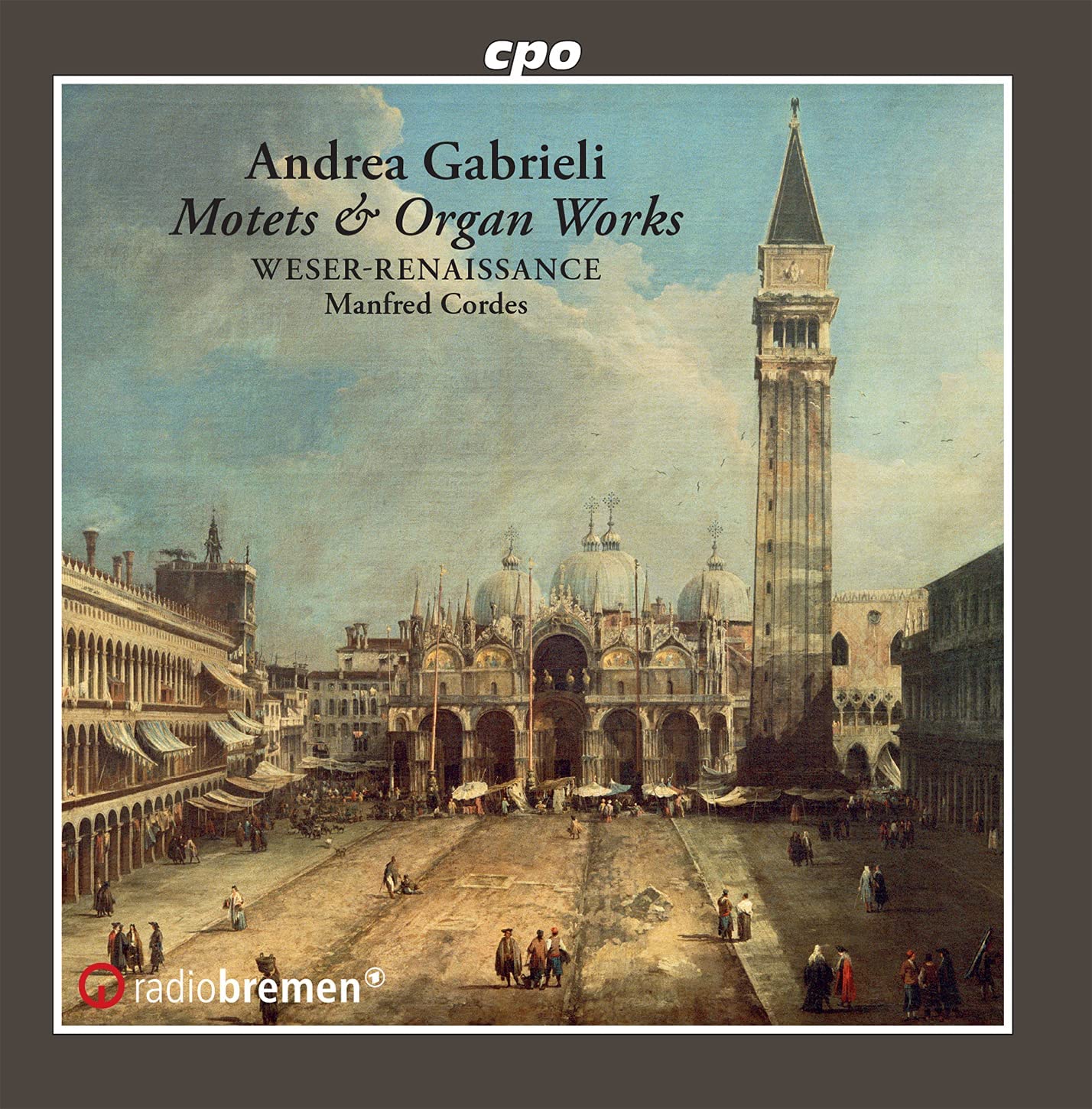
Like Bach’s sons, Mendelssohn’s sister and Schumann’s wife (among many others), Andrea Gabrieli is one of those unfortunates whose relative has somehow eclipsed their own valuable output. I remember in my first year at university how much I enjoyed playing through volumes of Andrea Gabrieli’s keyboard music as I “taught myself the piano” (anyone who has heard me play know that it’s very much still work in progress…) At the Early Music Society, we played canzonas by Giovanni Gabrieli and it was only much later in life (at the Gloucester courses run by Alan Lumsden and Philip Thorby) that I really came to appreciate just how good a composer Andrea Gabrieli was.

This new recording on cpo confirms everything I ever thought. Veronika Greuel’s incisivce and extensive booklet note contextualises the music, which the one-to-a-part ensemble, mixing voices with a variety of the instruments one would expect (violin, cornetto, three trombones, dulcian, chitarrone and organ), then perform in a suitably “big” acoustic with lots of air around the notes. There are four organ works by the composer, and a fifth an entabulation by the performer (Edoardo Bellotti on a modified reconstruction of a late 17th-century instrument), neatly played and revealing the breadth of the composer’s mastery of styles. All in all, I cannot imagine a better way to advocate for Andrea’s rightful place in the Early Music Hall of Fame.

Brian Clark

Categories
Recording

Threads of Gold II: Music from the Golden Age

The Choir of York Minster, directed by Robert Sharpe, Benjamin Morris organ
74:22
Regent REGCD544

Click HERE to buy this on amazon.co.uk
[These sponsored links help the site remain alive and FREE!]

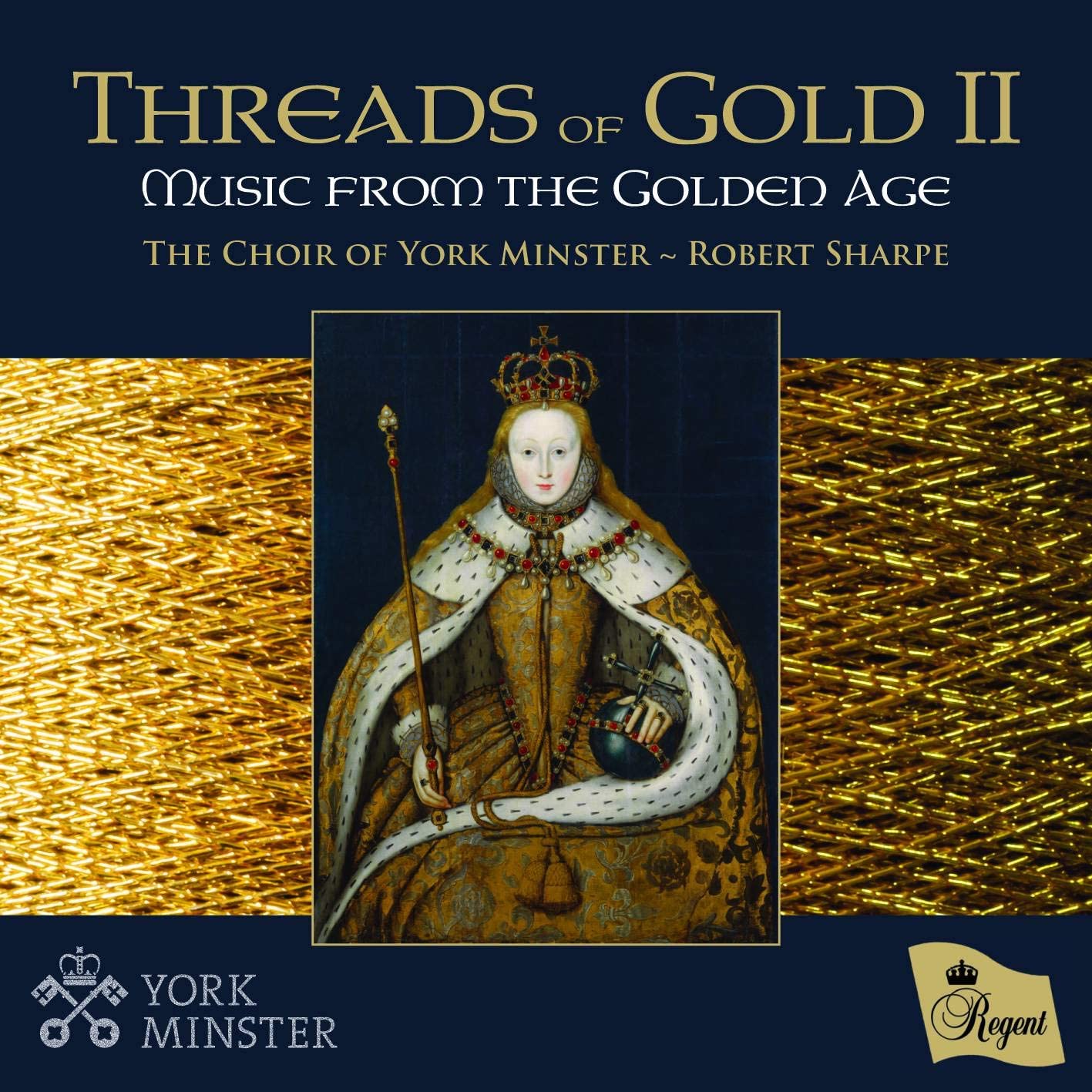
I gave the first disc in this series, recorded during 2016, a favourable review in EMR dated 27 May 2017, tipping my hat in conclusion to the excellent notes provided by John Lees. This time I am commencing with a short paean to John for another fine commentary on the background to, and contents of, a second superb disc. He is entirely accurate and up to date regarding current musical research on the period, yet is circumspect when contemporary documentation is in short supply, as in the case of Tomkins having been Byrd’s pupil. Meanwhile this is all expressed in a style that is reassuringly scholarly and a pleasure to read, something to which those of us who write about music can all aspire.

As it was in the case of the first disc, the high quality of the booklet notes and the music itself and the performance of the music all complement one another. If Tallis and particularly Byrd did best numerically on that outstanding initial disc, with one or two items emerging from “left field”, then it is the young guns Tomkins and particularly Gibbons who do well on this second offering. Yet while it is Gibbons who scores highest with six items, it is Tomkins who emerges with the only actual premiere on the disc: his beautiful verse anthem Praise the Lord O my soul is new to CD, having previously appeared only on a fine LP, never reissued, by Newport Cathedral Choir in 1983 (Alpha APS 343). That said, works such as his powerful full anthem in eight parts O God the proud are risen and a couple of Gibbons’s verse anthems Behold I bring you glad tidings and We praise thee O Father are quite elusive. One of the less familiar Tudor evening services, William Mundy’s In medio chori, was included on the first disc, and another such is selected here, the Latin setting by Tallis. Disc I began and ended with two of Byrd’s greatest Latin works, and the Latin pattern is followed here, with Robert Parsons’ sublime Ave Maria opening the proceedings, and another of Byrd’s masterpieces Peccantem me quotidie bringing them to a conclusion.

The quality of the singing is every bit on a par with that on the preceding disc. Only listen to the exquisite layering in the final chord of Byrd’s Sing joyfully – quite the best unaccompanied ending to this anthem on disc (there is currently a stirring version by Musica Secreta accompanied fittingly by The English Cornett and Sackbut Ensemble on Chandos CHAN 0789) – in which it is so easy for inner parts to be swamped as everyone exhales on the conclusion of Byrd’s short sharp test of vocal endurance; and to the impact of the trebles’ thrilling entry at “O spare me a little” in Gibbons’s Behold thou hast made my days. Meanwhile the full choir can sing with the intimacy that Byrd would have anticipated in performances of Justorum animae whether domestic (it was published in book 1 of Gradualia 1605 and the volume was approved by Richard Bancroft, then Bishop of London) or clandestine (during illegal Roman Catholic masses). Robert Sharp unerringly chooses tempi appropriate to the individual pieces and to the acoustic of the recording venue, while Benjamin Morris’s accompaniments are sensitive and tasteful. Compared with the previous disc, the Choir itself, recorded during 2019, sounds different, as one would expect three years onwards, and the acoustic seems less reverberant – it is stated simply that disc I was “recorded in York Minster” (perhaps the chancel?) whereas disc II is said to have been recorded in the Lady Chapel. The Choir, who can not only blend mellifluously but also project individual parts where necessary, is a credit not only to York Minster but to the Church of England, while the verse passages are sung responsively by soloists, each with characterful voices not drilled to a uniform sound, who are in turn a credit to the Choir. Everything about this disc is distinguished, and it cannot be praised too highly.

Richard Turbet

Categories
Recording

Onder de Hemel van Vlaanderen

Gabriel Wolfer organ, Cassandre Stornetta voice
72:00
Label G 016

Click HERE to buy this on amazon.co.uk – this link is to a digital download only…
[These sponsored links help the site remain alive and FREE!]

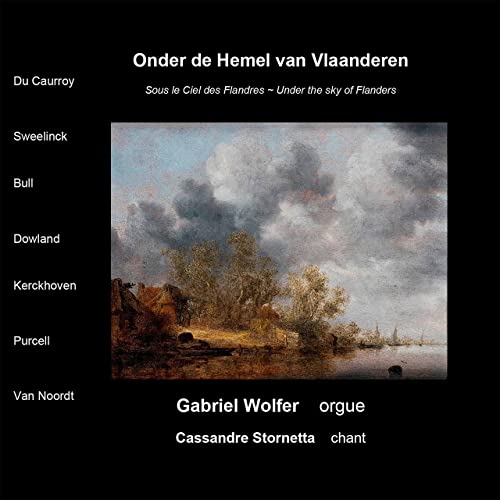
This 2021 recital by Gabriel Wolfer is played on an organ built in 2019 by Bertrand Cattiaux for the église Sainte-Jacques, Beurnevésin, in the Swiss Jura. The organ is built in the style of Flemish organs of the 17th century, but with the addition of a pedal organ. The twelve manual registers are available as jeux baladeurs on either of the two manuals, enabling a wide range of registrations, and are scaled and voiced after organs by the Bremser family, dating from the mid-seventeenth century Flanders. The speech is direct and singing, and is well-recorded in this small church. The temperament has 8 pure thirds, and the pitch is A=415Hz. The music, beginning with composers from the Low Countries, Du Caurroy and Sweelink, continues with Dowland and Bull, both known to have had connections there, before returning to more strictly Netherland composers. This is music for manuals only and is well-suited to this instrument, as are the English composers who would not have known the North German style of organ.

For me, the only discordant note is the singer, who has too developed a voice to match the directness and simplicity of the organ. She only sings three numbers – Une jeune filette at the start, the chanson on which the Du Caurroy variations are based and Cornelis de Leeuw’s carol Een kindeken is ons geboren that precedes the Bull version at the end, together with the Purcell Evening Hymn. So it is the organ and its able player who take centre stage.

The programme centres on sets of variations and fantasias, so a variety of sounds embroiders these threads giving us ample opportunity to appreciate the organ’s vocal qualities. In part this is due to its winding, and in part to the action which is clearly all of a piece. The sound is fluid, and I should have liked to hear it with a group of singers, like Vox Luminis, who would match its living, breathing tones so well. I find that I am intrigued, and do not tire of it; the organ builders – who have worked on conserving some distinguished 17th-century organs in France – deserve their reputation. I commend this CD not only for the interesting Flemish programme but also for the chance to hear this interesting and beautifully finished organ.

David Stancliffe

Categories
Recording

Isaac: Missa Wohlauff gut Gsell von hinnen

Cinquecento Renaissance Vokal
hyperion CDA68337
78:03

Click HERE to buy this on amazon.co.uk
[These sponsored links help the site remain alive and FREE!]

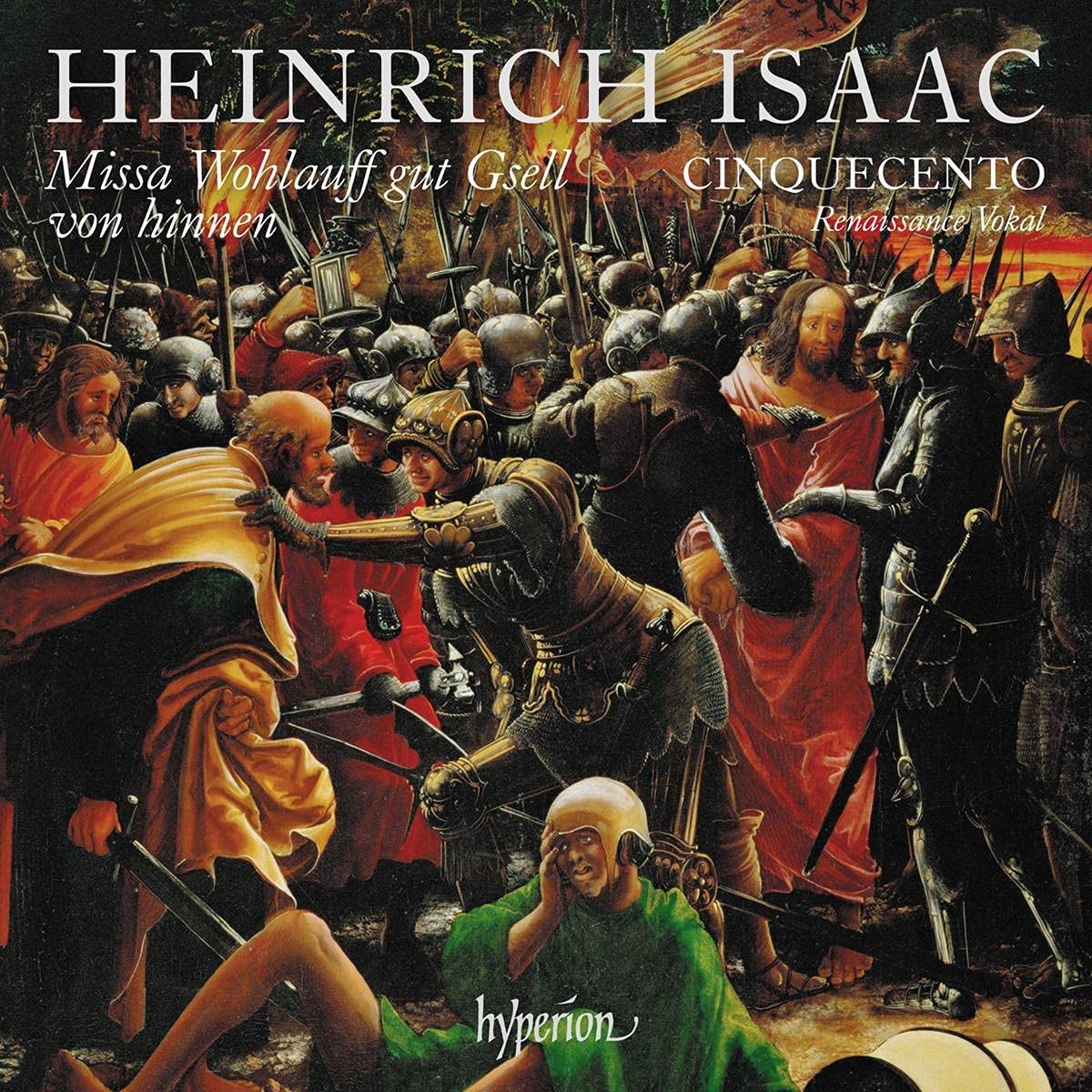
In any history of music, or any listing of the greatest composers of a particular time, certain names can be expected always to turn up. Alongside Josquin, there is usually a nod, or a gesture more animated, in the direction of Isaac. The likes of Josquin have flourishing academic industries committed to perpetuating their fame, but just as some rediscovered composers have to be added to this pantheon, so The Usual Suspects need to have their music scrutinised periodically to confirm that it really is as good as it is cracked up to be, in the light of continuing musical rediscoveries, and is not just reeled out as being rated among the best uncritically because it always has been. This is the value of a recording such as the one currently under review. Now that we are increasingly aware of just how many outstanding composers there were around the time of Josquin and in his wake, does an established star such as Isaac still deserve his elevated status?

The evidence of this disc is a stentorian affirmative. It is an extraordinarily good recording, as much for the quality of the music as for its performance. It is Cinquecento’s best recording since Palestrina’s second book of Lamentations (Hyperion CDA68284) and one cannot praise it more highly than that. They have made recordings of music by truly excellent, undeservedly neglected composers, besides some established fixtures, but sometimes a composer elbows his way out from among those who are even that good, and confirms that here is someone who is simply world class. That is what happens on this disc. Every track is outstanding, and Isaac is manifestly on a par with the greatest – you name them, he is their equal, from Machaut to Byrd via Josquin and, as we have seen, Palestrina. And he is aided by Cinquecento in blistering form. They can be monochromatic and pedestrian, but here they hit their straps, their interpretations fully complementing the quality of Isaac’s music. Besides the Mass, the programme includes six motets (one possibly by Obrecht rather than Isaac) and Josquin’s setting of the song on which Isaac bases his Mass.

First, to the Mass. As David J. Burn explains in his excellent notes, it is based upon a song that survives with both German and French texts. This is why Josquin’s setting in four parts with the French text Comment peult avoir joye? – itself a minor masterpiece – is included. Isaac’s Mass is in six parts, but a high proportion of its many sections are for reduced voices. He takes every aspect of the song and seems to present it in every way possible to a composer of his time. His judgment in varying the numbers voices, and reintroducing all six, is faultless, and Cinquecento duly respond faultlessly. Their voices resonate sonorously yet whether singing down to three parts or up to the full six, whether low in their register or high, whether loud or soft, every line is clearly audible, and its relationship to its fellows is perfectly balanced, while retaining the momentum essential to sustaining the rhetorical and narrative flow. Such is the quality of Isaac’s music and of Cinquecento’s execution that, for this listener, their excellence seems to grow with repeated hearings. So many passages clamour for notice; one in particular for this reviewer is the third and final Agnus in which Isaac’s effortless canonic contortions bring about breath-taking suspensions, while he allows the outline of his chosen tune to conduct the Mass to a sublime and satisfying conclusion.

In their different ways the motets, all in four or five parts, are just as fine. They range from the majestic O decus ecclesia in five parts, running to over twelve minutes – just before midway through the second part there is a divinely contrived descending sequence, subsequently repeated in outline ascending as well as descending again, the nature of which will be familiar to listeners acquainted with masses by composers as late as Rogier and Monteverdi – to the comparably minute Parce Domine at less than two minutes. Sonorities, melodies, harmonies, textures, narrative flow and rhythmic vitality are all products of the creative mind of a genius. These are served by Cinquecento with their best singing on disc, not only for the standard of their actual singing, but also for their interpretations, never bland, never exaggerated, always sensitive to Isaac’s settings of his texts. As the notes explain, the final work Judaea et Jerusalem might be by Obrecht. This seems quite possible to this listener, but even if it is by Obrecht, it sits well in this company, being the work of a composer whose stature is comparable to that of Isaac.

Admirers of Cinquecento will find themselves rewarded as never before by this recording. Admirers of Isaac who do not know this music, especially the mass, will find their admiration confirmed and perhaps even expanded. Explorers unacquainted with Isaac will discover a new musical territory replete with riches.

Richard Turbet
Categories
Sheet music

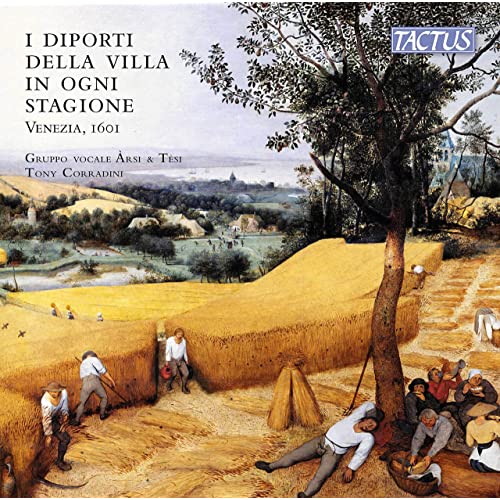
Vivanco: Liber magnificarum (1607)

Recent Researches in the Music of the Renaissance, 173
Edited by Michael Noone and Graeme Skinner
xxiii + 277pp.
ISBN 978-1-9872-0531-2. $360

Click HERE to buy this from the publisher’s website.
[PLEASE NOTE: This link is NOT sponsored]

Anyone who has studied Renaissance polyphony knows that composers of the period devised the most cunning contrapuntal devices to allow a musical phrase to be used and re-used simultaneously backwards and forwards, upside down, and in different note values, mostly without the listener even realising. If Sebastián de Vivanco has been somewhat overshadowed by his Avilan contemporary, Victoria, it most certainly was not on account of his polyphonic prowess. The present volume contains no fewer than 18 settings of the Magnificat (two in each of the eight tones, one setting the odd verses, the other the evens, plus two extras for the most popular 1st and 8th tones). Most are for four voices, but there are two for five, three for six, and one for eight. There are also two settings of the versicle to the Magnificat, “Benedicamus Domino” (one each for four and five voices, the former printed in no fewer than four different possible realisations of the canons). An appendix printed the three perpetual canons without texts and a three-voice canon on “Christum regem pro nobis” which form the frame to the portrait of the composer that appeared on the title page of the original Salamancan print.

If you plan to perform this music, you should be aware that even pieces indicated as being for four or five voices are not always exactly that; particularly the “Gloria Patri” sections throw in canons whose resolutions produce extra voices (up to eight) – in the case of No. 8 (a setting of the odd verses), this also involves the inclusion of other texts: the Vespers hymn, “Ave maris stella”, the antiphon at Lauds, “Ave Maria, gratia plena”, and “O gloriosa Domina”, a hymn also from the service of Lauds. Such polytextuality did not bother composers of the period, and this integration of them all into an already complex polyphonic texture is a real tour de force. The extraordinary cost of this volume is going to dissuade most choirs from exploring the repertoire, which is more than a great shame; since A-R Editions offer off-prints of each of the three masses in a previous volume, perhaps eventually they can be persuaded to make some of these works more practically available too?

Brian Clark

Categories
Recording

Sacred Treasures of Spain

Sacred Motets from the Golden Age of Spanish Polyphony
The London Oratory Schola Cantorum, Charles Cole
69:49
hyperion CDA68359

Click HERE to buy this on amazon.co.uk
[These sponsored links help the site remain alive and FREE!]

This CD provides a lovely cross-section of choral music from Renaissance Spain, combining some very familiar works by Victoria and Guerrero with some perhaps less widely known repertoire by Vivanco, Ribera, Robledo and Esquivel. The male voices of the Schola Cantorum, ably directed by Charles Cole, sing with a high degree of focus and expression, giving powerful readings of this superb repertoire. A major factor in the recording is the very large and resonant acoustic of the recording venue, St Albans Church, Holborn, which more or less dictates sedate tempi and encourages a degree of unhurried ‘lingering’. I have to say that I was in no way averse to this, feeling that it brings out the full magnificence of these motets, but the absence of any ‘rapid’ passages does give the CD something of a two-dimensional quality, and even a slightly dated feel. I seem to remember that the London Oratory has an equally rich acoustic, and it is clear that the singers feel very at home with this degree of resonance. Certainly, Charles Cole never allows the music to wallow, and the performances are never less than dynamic and expressive. The choir has a wonderfully stable sound, with admirable intonation throughout as well as impeccable balance and blend.

D. James Ross